Loss… just that. A little exploration of losing.

Since my father’s death exactly a year ago I have experienced an extraordinary storm of additional albeit unrelated losses in almost every area of my life. His death became like a bullet ricocheting around the architecture of my world felling furnishings and humans alike. I now look around me and see a distinctly changed landscape, a series of voids in the shapes of people, things, plans; a mini war zone of collapsed structures through which I find myself wandering dazed and dusty, functioning but exhausted.

What is Loss? The Oxford Dictionary definition says it is “the fact or process of losing something or someone”. As far as definitions go that really doesn’t say much. It makes loss sound so harmless, kind of accidental, the result of a moment of absent-mindedness or brief neglect. It imparts nothing of the potentially huge and devastating impact loss can have, nor of the vast range of subjective responses to it. It doesn’t suggest loss’s innate and prominent role in Life and Death, in war and crime, in love and faith – all existential foundation stones of our human world.

Read More »

I applaud these Prison Reforms, but the crucial element to bringing about real change is still missing

I am no fan of David Cameron and the Tories, but I’d like to give credit where it is due. And his Prison Reform speech on Monday, though flawed in places, does deserve applause. After decades of Michael Howard’s delusional “Prisons work!” approach, we finally have a prime minister who is talking some sense.

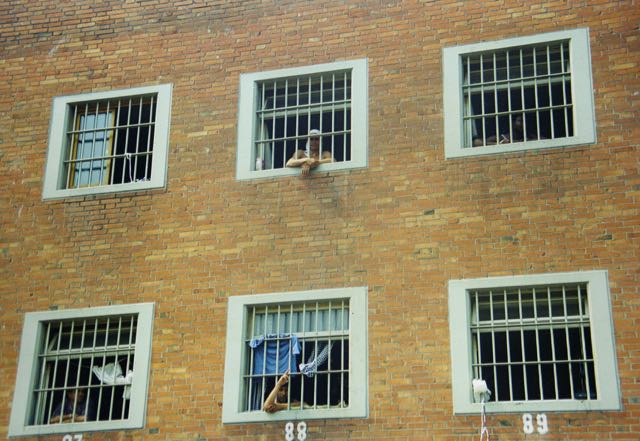
008 prison.jpg

I started working in prisons back in 1987 and the same backward ‘hang’em, flog’em’ method of dealing with offenders has largely prevailed until now. The terror of appearing “soft” on crime has led to our system being the “scandalous failure” that it is now proclaimed to be, even by the very government that has contributed to prisons being “at their worst level for 10 years”. Successive governments have preferred to continue pumping more than £13 billion a year into an over-crowded, under-staffed, under-funded, violent and ineffective system, which even fails its primary goal of helping prisoners “to lead law-abiding and useful lives in custody and after release” in more than half of all cases it handles.

Read More »

What purpose does Holocaust Memorial Day serve for those generations who can’t “remember”?

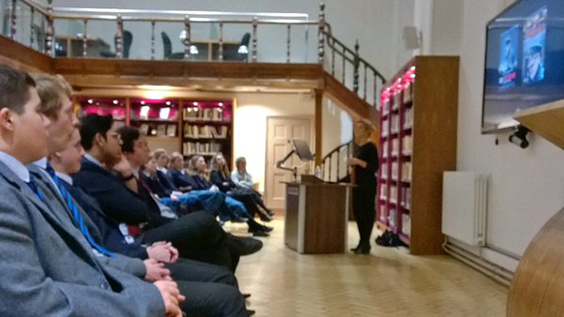
On Monday I was invited to give my talk about Germany’s memorial culture of apology and atonement (read more) at Brighton College as part of their Holocaust Studies Week. One student asked a question being debated by current historians: “When can we let WW2 recede into the past like other episodes of history do?”

6c682644-29fd-46de-9a95-e49714cdda9e.jpg

Today, 27th January, is International Holocaust Memorial Day, the date that marks the day Auschwitz-Birkenau was liberated by Soviet troops in 1945. It is the day on which we are asked to remember the 11 million victims killed in the Holocaust – 6 million Jews and 5 million Soviet POWs, homosexuals, Sinti and Roma, mentally or physically disabled, Roman Catholics, political dissidents, ethnic Poles, Slavs and Ukrainians. All had become victims of the Nazi hatred that deemed them to be “Untermenschen”, literally ‘beneath’ or ‘below’ human; sub-humans. They were killed because they were seen to be a threat to the ideal world image that Hitler and his followers were striving to manifest.

Read More »

I haven’t worked with many terrorists during my prison years but there was one who for years I, and my class of eight male prisoners, called ‘Habibi’ – the word for ‘my darling’ as we later found out.

Behind every terrorist act is a human being with a grievance. Some will probably call me a ‘terrorist sympathiser’ for saying that, but one of the most important lessons I learnt from working and talking with countless criminals is that people themselves are not innately evil. Their deeds might be, but they themselves are not. That’s why many of the over-simplified, dualistic discourses in the recent ‘To bomb or not to bomb in Syria?’ debate really got under my skin. Action vs. Non-Action, Good vs. Evil, Right vs. Wrong…

team_terror.jpg

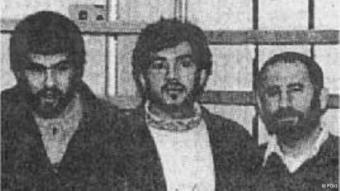
I have no first-hand experience of today’s terrorists (thank goodness) but in the nineties I did work closely with a Lebanese man awaiting trial for his major role in one of Germany’s biggest terrorist attacks in which five Kurdish politicians were blown up in a restaurant in Berlin in 1992. As a terrorist he was considered a potential danger and security hazard and kept in enforced isolation. So for him my art class became his only excursion from his cell. Why the authorities found it fitting to place him in my care when I myself was locked in the room with no beeper, no key, no guard, still puzzles me! He asked the group to call him Habibi, so obligingly we did. It was only many years later that I discovered that was the word for “my darling”.

Read More »

I don’t wear a red poppy, not deliberately to make a point, nor out of disrespect – it just isn’t the symbol that captures enough of what, how and to what end I want remember.

3000

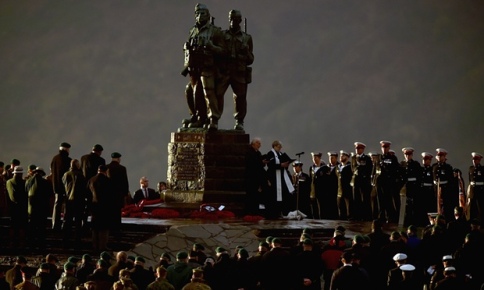
It is Remembrance season and once again I find myself feeling slightly uncomfortable, a bit pedantic, no doubt irritating and at worst offensively unpatriotic. And yet Remembrance is one of my favourite themes and both my grandfathers fought in the World Wars. So why can’t I jump whole-heartedly into the seas of poppies and poppy wearers, dignitaries and wreaths, that stream through our streets to lap up against memorials and into churches each November? Of course I want to ‘remember’ and acknowledge all the soldiers who died or were wounded serving their country, but discordant questions waft like dried leaves or ghosts through the architecture of British Remembrance rituals. So once again I ask myself and all of us collectively: what exactly are we remembering, and to what end? Remembrance is by nature vital, solemn, beautiful, meaningful… in many ways we do it so well. But beneath the tradition, ceremony and ritual conveyed through a distinctly military visual language, the message has also, in today’s world, become slightly flawed, inadequate and at times hypocritical.

Read More »

Daring to look your family’s past in the face

Last week a Chinese schoolboy approached me after my talk The other side: The Second World War through the eyes of an ordinary German family. Slightly trembling and in broken English he asked me if I had been frightened looking into my family’s past. In my talk I describe the journey I started 10 years ago, of peering deep into the darkest episode of modern history to discover what role my family, above all my German grandfather, a decorated Wehrmacht General, had played, or may have played. I knew the boy was asking this question for a personal reason, the shadows of his own family demons were almost visible, passing like clouds over his terrified face.

My grasp of Chinese history is woefully thin. I wracked my brains for atrocities or events that this boy’s family member(s) could have been involved in. Tiananmen Square in 1989 sprang to mind along with the general sense of horrors perpetrated by Chairman Mao’s regime. But actually it didn’t matter whether I knew the precise what, when, where and who of his story. What mattered was the impact it was having on his life.

Read More »

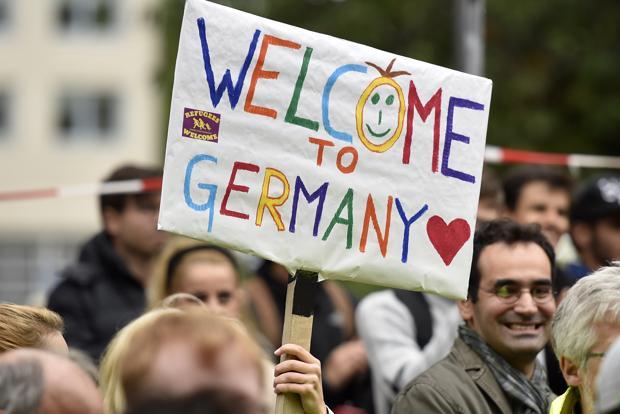
Germany’s welcoming response to the refugee crisis doesn’t surprise me. The more Germans are allowed to acknowledge their own WW2 traumas, the more their personal and collective memories of the horrors of the 1944-50 flights and expulsions come to light.

germanysyria-kkmD--621x414@LiveMint

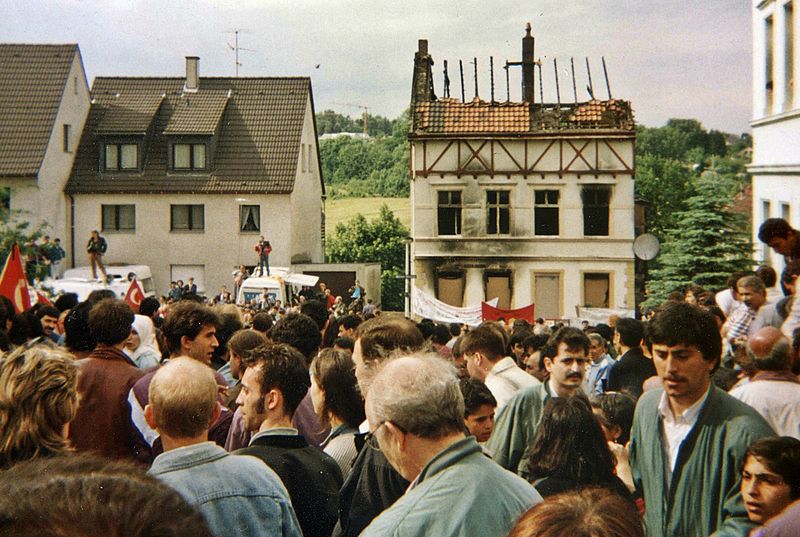
Germany’s ‘open house’ policy and newly attributed “moral leadership” within the mounting refugee crisis was indeed initially surprising. It certainly wasn’t always so. I’m remembering the 17-year-old boy I met in the nineties when I was working as an artist in Cologne Prison. His name was Christian and he had been placed in the special segregated unit there because his crime was so contentious on a national scale. He was one of four young Neo-Nazis responsible for burning down the house of a large Turkish family in Solingen in May 1993, killing three girls and two women and injuring fourteen other family members. It was the most severe instance of anti-foreigner violence in modern Germany and in 1995, Christian was found guilty of murder, attempted murder and arson and sentenced to 10 years.

800px-1993_Solingen_Brandanschlag_2Read More »

Left right, left right, left right…

IMG_5425

I am on a very long walk – 600km so far – and as my legs go through the motions of left right, left right, left right I find myself thinking about my German grandfather going through the same physical motions as he marched into Russia with his Wehrmacht troops in 1941. I am walking West across the north of Spain on a pilgrimage to the spiritual destination of Santiago de Compostela. He was marching East across Russia to capture the strategically important destination of Moscow.

Read More »

“German court sentences 94-year-old ‘Bookkeeper of Auschwitz’ to four years in prison.” Is this Justice? Or is this the German Judicial System’s attempt to atone for its appalling failure since WW2 to bring more of the real culprits to justice?

_84281791_84281790

This is an obvious choice of topic for my July blog for it touches on all my main themes: WW2 Germany, prison, punishment, forgiveness, redemption.

What we have here is a 94-year-old former SS officer whose job at the age of 21 was to sort the luggage of the new arrivals to Auschwitz and register the prisoners’ goods and valuables. Oskar Gröning was not a guard but a bookkeeper who counted the money the Nazis stole from the Jews. During the trial that started in May in the German city of Lüneburg he admitted: “It is without question that I am morally complicit in the murder of millions of Jews through my activities at Auschwitz. Before the victims, I also admit to this moral guilt here, with regret and humility. But as to the question whether I am criminally culpable, that’s for you to decide.” Today he was sentenced to 4 years in prison after the German Courts found him guilty of being accessory to murder of 300,000 people.

Read More »

The Queen’s visit to Germany – “politically motivated” or her gesture of “complete reconciliation”?

queen-belsen-wreat_3355422k

As I started writing this month’s blog this morning, the Queen was visiting Bergen-Belsen Concentration Camp for the first time, apparently at her request.

Much has been criticised or mocked about her State visit in the press: the timing – the eve of a summit where David Cameron is expected to begin new negotiations in relation to Britain’s EU membership; her apparently politically-biased speech in which she referred to a division in Europe being “dangerous” and that guarding against it “remains a common endeavour”; the Queen’s unenthusiastic reception of the German president’s gift of a portrait of her as a child on a blue horse with her father; even the reason for her going was apparently to put Angela Merkel, who is often referred to as Queen of Europe, back in her place…!

Read More »