11.11. ‘Lest we forget…’ But I did. This year I forgot.

For many a year, as regular readers of my blog can attest to, I have acknowledged and written about Armistice Day, Remembrance Sunday and the need to remember. But this year, 11.11. passed me by unnoticed. I was definitely silent at 11am, but not because I was remembering. I was in the depths of Cornwall deeply immersed in the increasingly final (final final x 10) Final Edits of my book.

I feel bad for forgetting, because I do think it’s important that we remember and commemorate. Just listen to the repeat of Radio 4’s 2014 programme Commemoration to hear some of the main reasons we do. But I also find it curious that I did forget. For this dance between remembering and forgetting is a healthy one. I should know. I have been dancing it a long time.

On Thursday 11th November, the only glimpse I caught of a world beyond the war narratives constantly unfolding in words on my laptop screen, was the sound of the shaky-voice of South Africa’s last white president, FW de Klerk. He had died in Cape Town aged 85, and his office had issued a prerecorded posthumous video apology for the pain caused by his country’s discriminatory system of white rule. On reflection, this collision in time between his apology and our Armistice Day, revealed what, to me, might actually be the essence of why we still need to remember.

“I, without qualification,” said the man who, together with Nelson Mandela, had overseen the end of apartheid, “apologise for the pain and hurt and the indignity and the damage that apartheid has done to black, brown and Indians in SA.” 

I cannot comment on his speech or his former role in the painful history of his country – you can read a bit about them on some of the links below. But, whatever sceptics and critics say about his motives or timing or whether what he said went far enough, I did feel the power of apology in his words. Genuine apology is that all too often underrated act that can set into motion so much of what we try to achieve through remembrance: restitution, forgiveness, reconciliation and healing. For many victims of wrongdoing or harm, such acknowledgement of their pain and a heartfelt apology for it is all they really want.

Of course, on Remembrance Sunday of all days, we first and foremost want to honour and show gratitude to the fallen and to hold their loved ones in our thoughts and hearts. But, if you don’t know any soldiers who have fought, let alone died in contemporary wars, or if you have never met a veteran of the World Wars, as is increasingly the case, it is hard to actually ‘remember’ in more than a slightly abstract way. For many school children, the Second World War exists in a last century time warp, as I found out at one of my recent talks when one of them asked me whose side I had been on! (Really? Have you not listened to a word I have just said? Or do I just look like I am 95-years-old?)

That is why I am wondering if Remembrance could shift some its emphasis on the past, to include more about the present and the future. The act of apology innately requires an understanding of the lessons history can teach us. Embedded within an apology is more than just a hope for ‘Never Again’. A genuine apology is ‘Never Again’ in action. So today, Britain’s Remembrance Sunday, I am not only going to remember the sacrifices and losses of war. I am going to imagine a time when the hands of heartfelt apology are extended between nations both in acknowledgement of past mistakes and in renewed agreement to act in ways that assure such mistakes never happen again.

Links to further reading:

FW de Klerk issues posthumous apology for pain of apartheid

Apology accepted? SA weighs in on FW de Klerk’s final message

FW de Klerk: South Africa’s last white president dies and leaves apology for apartheid

For Some South Africans, de Klerk Missed Chances for True Reconciliation

BBC Radio 4 Something understood: Commemoration

Is trying nonagenarians for Nazi War Crimes the best way to achieve justice?

If it wasn’t so serious, the idea of a 96-year-old going on the run to escape trial would be quite comical. But behind the image of an old lady hopping into a cab at her retirement home and fleeing for the subway station in the early hours is a quagmire of deeply complex and emotive issues.

Irmgard Furchner stands accused of having contributed to the murder of 11,412 people between 1943 and 1945 when she was an 18-year-old typist and former secretary to the SS commander of the Stutthof concentration camp in Poland. She is the latest of several nonagenarian Nazi war criminals to be brought to trial, some of them in youth courts because they weren’t adults at the time of their alleged crimes.

Irmgard Furchner being brought into court

The reason this particular case captured my attention is partly because it coincided with the seventy-fifth anniversary of the final day of the Nuremberg Trials that saw twelve senior members of the Nazi establishment sentenced to death by hanging. And partly because the hearing Furchner was due to attend was in Itzehoe, the same north German town that I have been going to all my life. I have been looking Nazism and the Second World War in the face for several decades now, but my countless happy memories visiting relatives there had completely insulated it from the chill of Germany’s wider history. 

Now it is in the spotlight as the face of retribution. So, is it a total no-brainer that even seventy-five years later, such people, nonagenarian or not, must pay for their part in some of the worst mass killings in history? Or is this more a rush by prosecutors to seize the final opportunity to redress the failures of the previous decades? Will sentencing these last Nazis to time in prison achieve justice for the victims? Or are these trials there to serve the broader objective of Never Forget? Is a ninety-year old even the same person as their eighteen-year-old self?

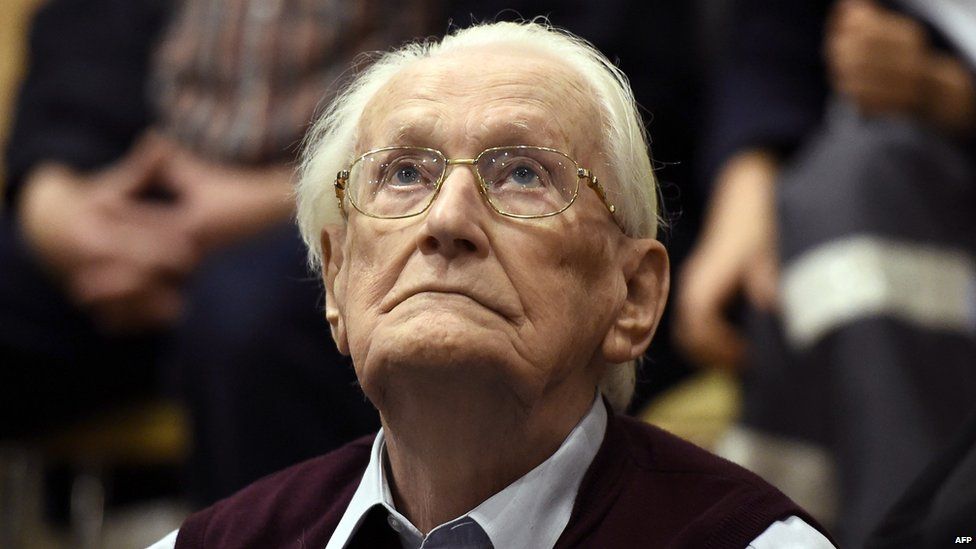
The last guilty verdict issued was to former SS guard Bruno Dey, who was handed a two-year suspended sentence in July 2020 at the age of 93. The 2019 trial against 95-year-old Johann Rehbogen for his service as a guard also in Stutthof Concentration Camp, had to be terminated as his organs were failing. The only successful conviction was of 96-year-old Oskar Gröning, the so-called ‘bookkeeper of Auschwitz,’ who was sentenced to four years in 2015 but died in hospital after his several appeals failed. I wrote about him at the time in my blog. In his case he had not tried to evade justice. Driven by a desire to counter Holocaust deniers and prevent something like Auschwitz from ever happening again, he had been openly talking about his time as an accountant in the death camp. His testimonies, however, were used against him in court with the unintended outcome that other low-level perpetrators and bystanders went silent. 

Oskar Gröning at his trial in 2015

For some people, the greatest justice to all victims of Nazi persecution that these trials can provide is to keep the crimes fresh in peoples’ minds and prevent them from being forgotten, denied or trivialised. They force Germans, including younger generations, to listen to the testimonies of survivors and to rake over the whole disturbing and uncomfortable past once again. 

It is so important that we never forget; that we all learn the lessons that Germany’s descent into barbarity and atrocity teaches us, not least about the vulnerability of democracy today. But survivors often declare that legal retribution is not the main outcome they are after. That they are more interested in shining light on unresolved or overlooked crimes and contributing to Holocaust remembrance and education. 

So, are we now at a time when imprisonment is a less effective response than a more direct dealing with the aftermath of the offence? Is there now another way that serves justice to the many victims of the Third Reich and their descendants AND sends a powerful message to would-be perpetrators of mass crimes that they will never get away with murder AND contributes to remembrance and education AND offers possibilities for healing and reconciliation? 

The past cannot be changed, but the present can. Might communication between those harmed by and those implicated in Nazi crimes, within the safe frameworks of Restorative Justice or mediation initiatives, offer the possibility to fulfil all the outcomes desired by the survivors? Could the excrutiating discomfort of acknowledgment of past wrongdoing be the punishment? Would talking together create an opportunity to resolve some of the harm and nurture the shoots of healing, forgiveness and reconciliation that can sprout from really listening and really being heard? 

Further reading:

Trial of 100-year-old man in Germany: why Nazi war crimes take so long to prosecute – The Conversation

Former Nazi death camp secretary, 96, remanded in custody after going on the run – Times of Israel

Nuremberg: The Trial of the Nazi War Criminals – Radio 4

Germans are right to pursue 100-year-old former Nazi war criminals – Irish Times

Did you know…? A little quiz to see who is really guilty when it comes to ‘prisons’

Talking with friends – an admittedly unreliable study on which to base objective conclusions – I am wondering if you too are experiencing a dull grey weight to your days. If your thoughts are slightly befuddled, your energy levels subdued, your feelings a kind of bland beige. Whether it’s mild depression, Long Covid, Seasonal Affective Disorder (SAD) or the impact of eighteen months of restrictions, worries and losses caused by a perfect storm of Covid, Brexit and long-term neglect, the usual palette of life seems, for many, to have mixed itself into a nondescript yuk of a colour. 

September inevitably brings change. As the nights steal increasing light from our mornings and evenings, we pack away those hopeful but unworn summer clothes, watch leaves crinkle and kickstart jobs, studies or projects. From soaring energy prices and fuel shortages to cabinet re-shuffles, we are rocked by uncertainty. Even in Germany it’s all change as Mutti, the very face of stabilitytries her best to retire.  

Meanwhile, our sclerotic prison system resists change as it plods through the ebbs and flows of the outside world. In the ten years since 2011, the Right Honourables Clarke, Grayling, Gove, Truss, Lidington, Gauke and Buckland have tried, but largely failed, to stop the relentless rhythms of ineffectiveness. Will Dominic Raab, our new Secretary of State for Justice, who didn’t exactly shine in his role overseeing the evacuation of Afghanistan, be able to re-direct its course? Just looking at some of the more recent headlines, I don’t think so.

Albert Einstein said: “We cannot solve our problems with the same thinking we used when we created them.” At my Wednesday morning dance group, I experienced firsthand why. Change does not always come about through control and enforcement. It comes about through compassionate attention, movement, connection, acceptance and love.

Everybody wants to be seen for who they truly are. Because in our essence, we are all beautiful. By only seeing and judging the outer product of a person’s upbringing, education, tragedies and choices, we miss their inner selves with all their original hopes and dreams and unique offerings to the world.   

I recently attended a webinar of Ian Hislop, Editor of Private Eyein conversation with Frances Crook, Chief Executive of the Howard League for Penal Reform. She is stepping down after 30 years as one of Britain’s leading and most respected voices on prison reform. That’s pretty much the same length of time I have been involved in teaching prisoners or campaigning for better prisons, albeit with considerably less impact. The conversation was actually more entertaining than depressing, though the facts never cease to confirm Britain’s role as an excessively punitive nation. Did you know, for example, that we give out more life sentences per year – around 13,000 – than all European countries (Turkey excluded) combined? 

Just for fun – or to add another dollop of grey to any minor depression – let’s do a little quiz based on their conversation and my on-going research.

  1. How many people are currently in our prisons?
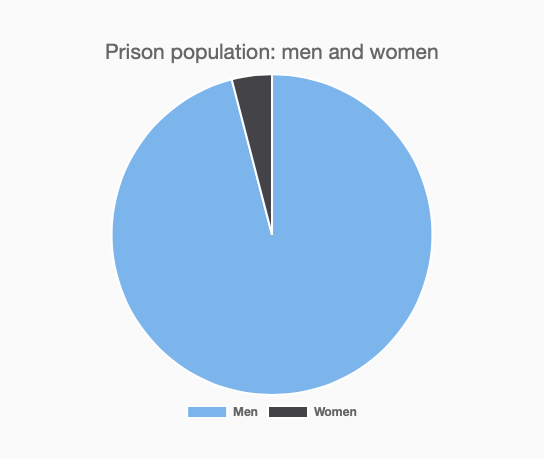
  2. What percentage of those are women?
  3. How much does re-offending cost the government and taxpayer?
  4. What happened recently in HMP Bronzefield?
  5. What almost always works?

If we start with that last question – the answer according to Frances Crook is: education. Education nearly always works. It can be beneficial to everybody. Life-changingly so. We all know that, not least because those who can afford it are prepared to invest £40,000 a year to get the best for their child. You no doubt want your children and grandchildren to have a good education too. It’s natural. So why is no more than a tiny fraction of that same sum (which is what it also costs to keep an adult in prison for a year) invested in as much education as possible for those who have so little?

One of this week’s headlines pointed out this neglect. 

This ‘Prisoners not taken to lessons…’ thing is precisely why I stopped running the Learning to Learn through the Arts scheme that I set up in my capacity as Arts Coordinator to Koestler Arts from 2002-2006. Having raised the funds, sourced appropriate artists, bought materials, liaised with prisons and organised all the many other practicalities involved in running a 4-6 week art project, all the prison had to do was deliver the men to the allotted room at the appropriate time. But more than often they didn’t. Or couldn’t. Staff shortages was one reason. Old-fashioned punitive attitudes, a risk-averse governor, bad organisation were others.

You might know the answers to the rest of the questions.

  1. 80,000. We lock up more people than anywhere in Western Europe.
  2. Roughly 3000 or up to 5% are women. 
  3. Re-offending costs £18 billion. In contrast, to run an educational course costs a few hundred pounds per person.
  4. At HMP Bronzefield, the private prison run by contractor Sodexo, an 18-year-old gave birth alone in her cell . When her calls for help were ignored, she passed out in pain. The baby died. She bit through the umbilical cord, climbed into bed and cradled it for 12 hours.

Looking at Answer Nr. 4, Chief Inspectors, charities, pressure groups can all point out the failures behind such a traumatic incident. They have been there for so long.

Yet ministers repeatedly ignore facts, common sense, morality, humanity and even kindness. 

When our prime minister quips behind closed doors at a Conservative party fundraiser that the UK could become ‘the Saudi Arabia of penal policy’ under his current ‘hardline’ home secretary, Priti Patel, you know for sure that there is little sensitivity towards the grim levels of stress, pain and discomfort experienced by those living or working in some of our prisons. Little understanding of how growing up surrounded by violence and fear has an impact on a person’s nervous system and brain functioning. Little understanding of the strain on a mother of three who has to choose between putting food on the table or heating the room for an hour. 

I believe the plethora of such unempathetic attitudes and policies towards those who are less advantaged, less educated, less fortunate are massively contributing to the current ‘yuk’ colour of life. Understanding is one of the paths to a compassionate and restorative Criminal Justice System. A lack of understanding mixed with emotional immaturity is one of the surest paths to an unjust and failing prison system. And the latter is costing us all dear, on many levels. 

They/We are squandering the precious opportunities incarceration could offer to nurture and rebuild rather than waste and destroy human potential. 

So who is really the guilty party and the danger to society here? 

If you feel moved to, please support the excellent work of Howard League for Penal Reform and/or Prison Reform Trust

Further reading – not all articles represent my opinions

Warning on ‘parlous state’ of jail education

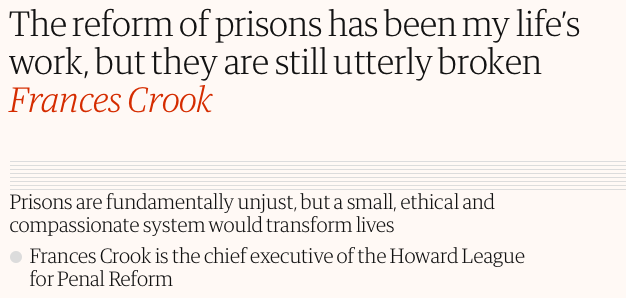
The reform of prisons has been my life’s work, but they are still utterly broken‘ by Frances Crook

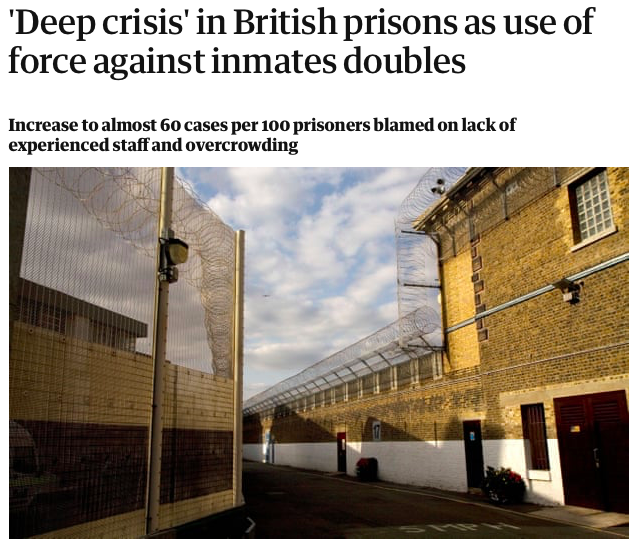
‘Deep crisis’ in British prisons as use of force against inmates doubles

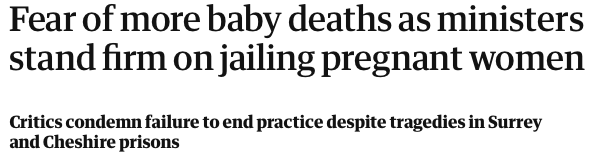
Fear of more baby deaths as ministers stand firm on jailing pregnant women

Newborn baby dies in prison cell after teenage mother left alone without medical helpB

Two very different military withdrawals…

In the light – or should I say pitch darkness – of the horrors and tragedies that have been unfolding in Afghanistan as the USA, UK and other countries withdraw, my recent visit to the National Army Museum in London felt strangely apposite. One of its current exhibitions – Foe to Friend: The British Army in Germany since 1945 – covers the final withdrawal of British troops from Germany in 2020. It traces Britain’s 75-year military presence there, first as occupiers and administrators of a destroyed country, then as reluctant but necessary Allies confronted with escalating Cold War tensions, and on to its current relationship as friends. 

I can’t stop thinking about what is happening in Afghanistan. It feels beyond catastrophic, beyond imagination, but of course, I am in no position to comment. Except maybe to point out the contrast of our withdrawal from Germany, which passed effortlessly and without incident. Presumably that is the mark of an original mission reaching its intended positive conclusion and outcome, though I have to say I was surprised when I first learned that we even still had a presence there! A second exhibition in the foyer of the museum makes one realise, however, just how alive that period still is in many people’s lives. 

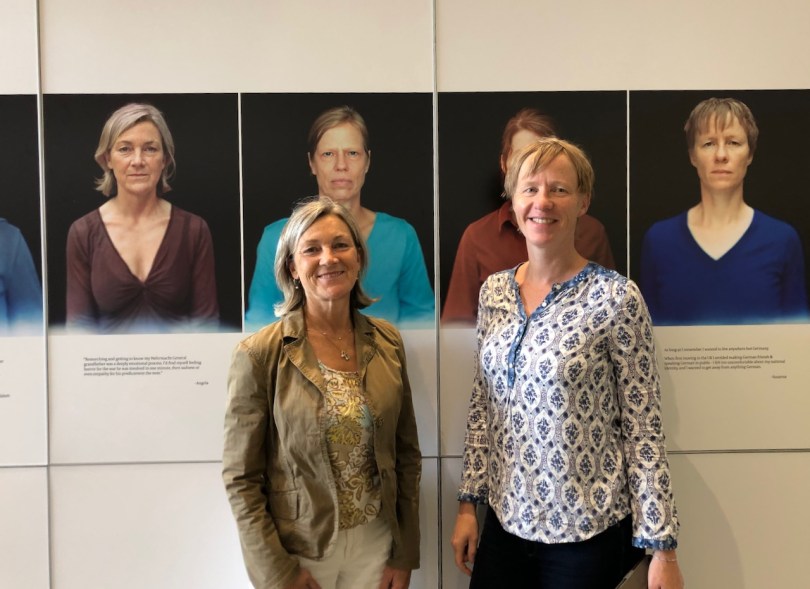
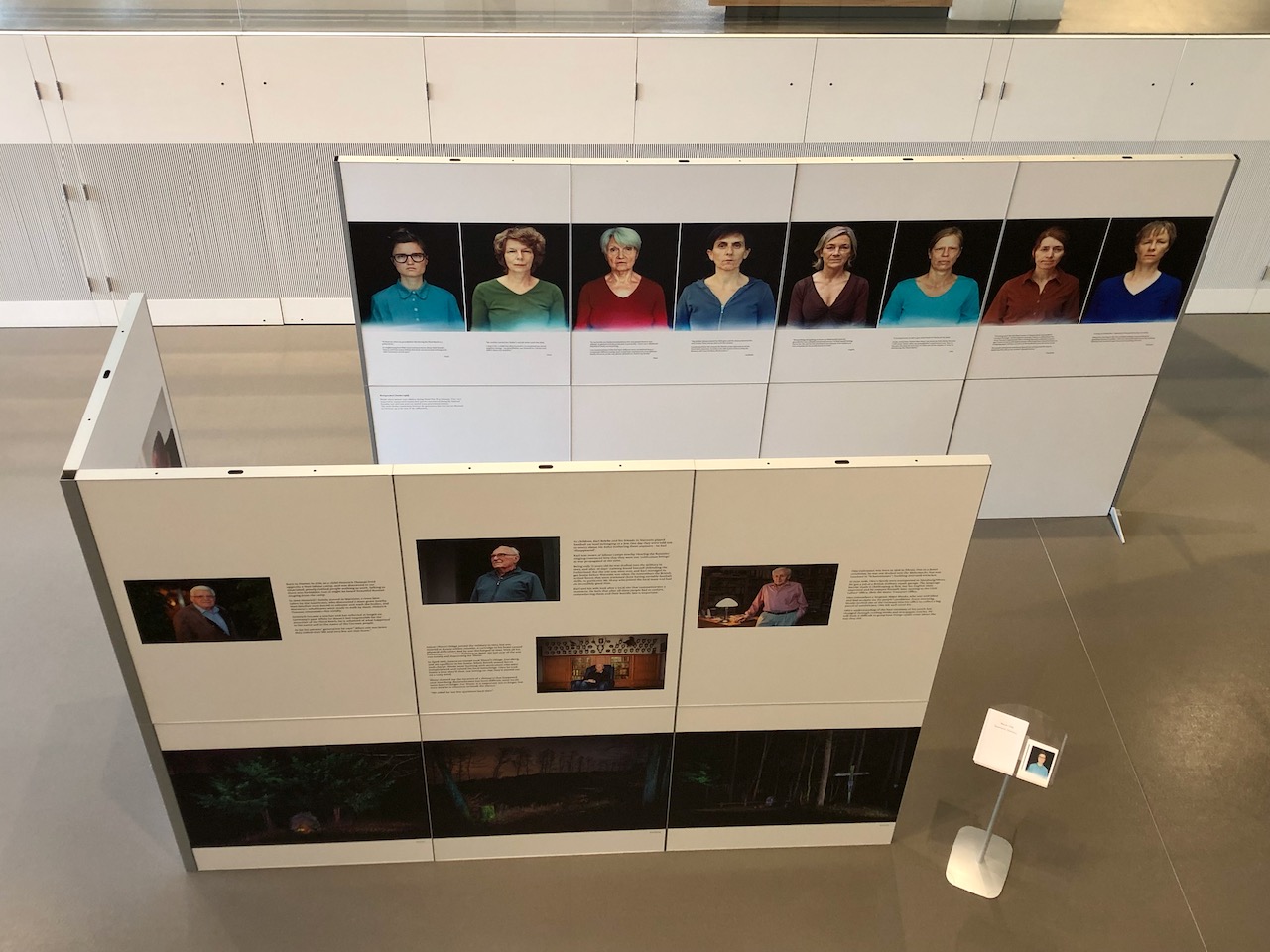
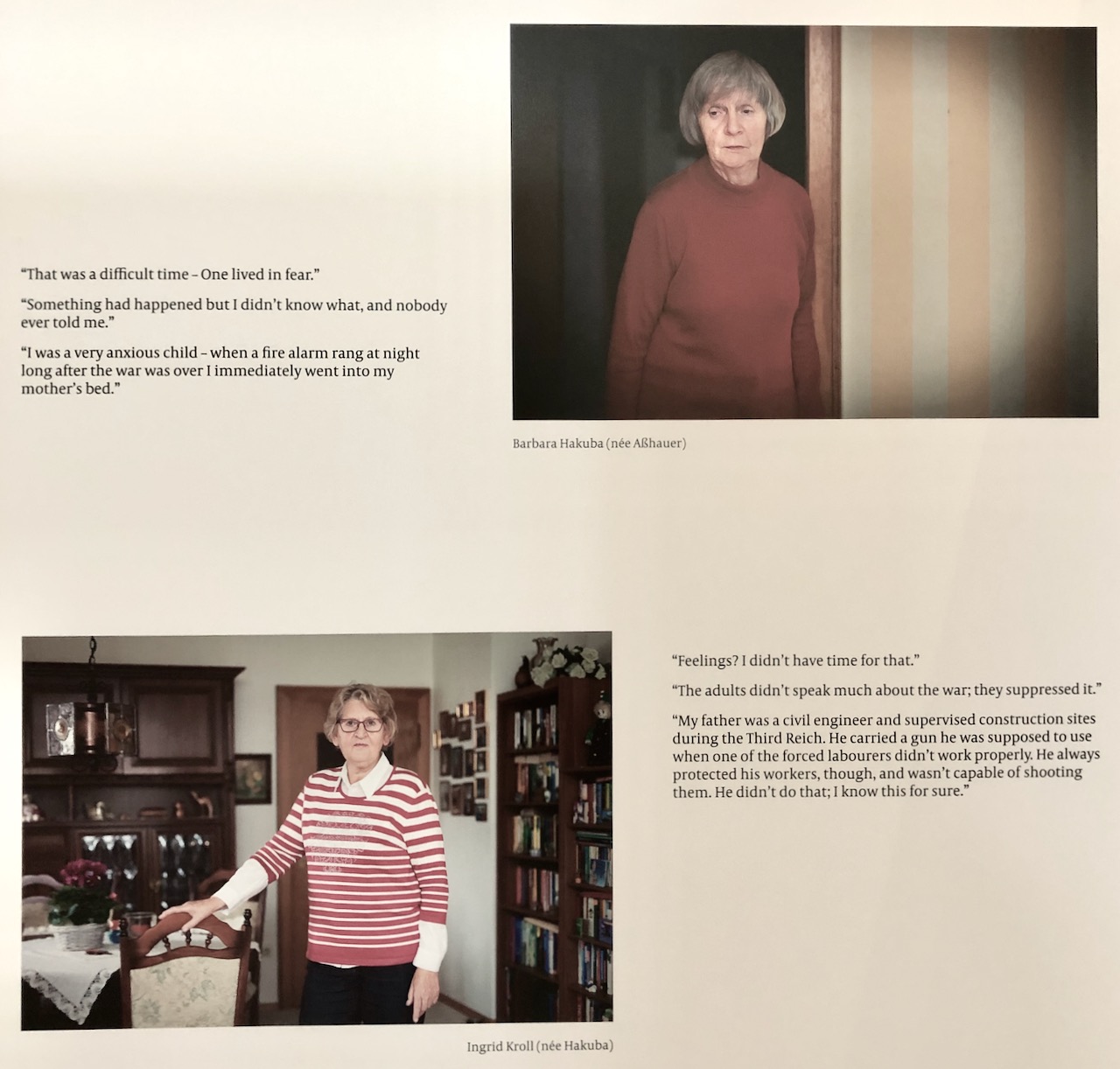
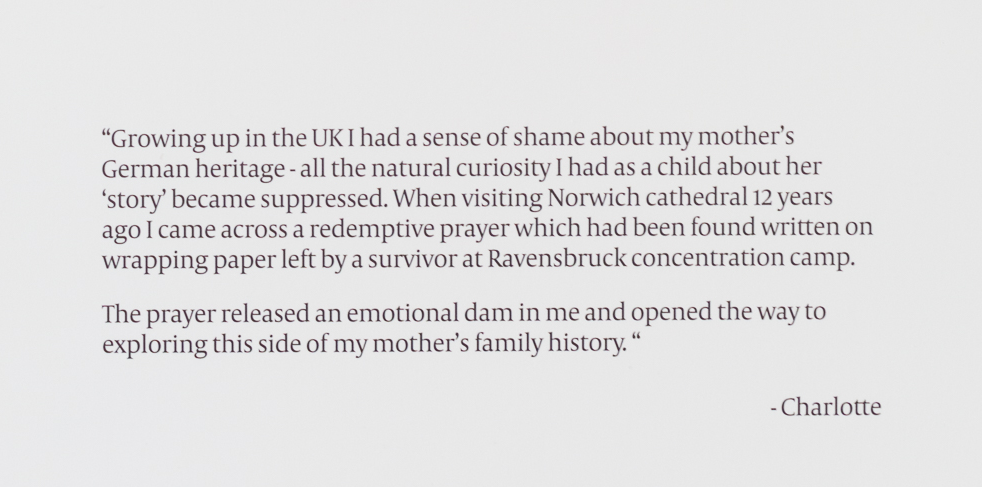
Long Shadows of War has been created by the German photographer, Susanne Hakuba. Susanne lives in England and has been a friend ever since she invited me to participate in her brave and on-going examination of how the Third Reich still casts shadows on Germany, its people and her own life. Any person who is familiar with my blogs or talks will be all too aware of how much Germany has already done to deal with its Nazi heritage at a national and political level. But this exhibition shows how the personal level can be another story, quite literally. 

Susanne’s haunting photographs, quotes and poems draw on the testaments of others to reveal the differing attitudes between three generations: those who witnessed the times, those who lived in their parent’s and grandparent’s trauma- or guilt-filled silences immediately after the war, and those who carried the heavy contents of that silence with its ensuing emotional absence without realising it.

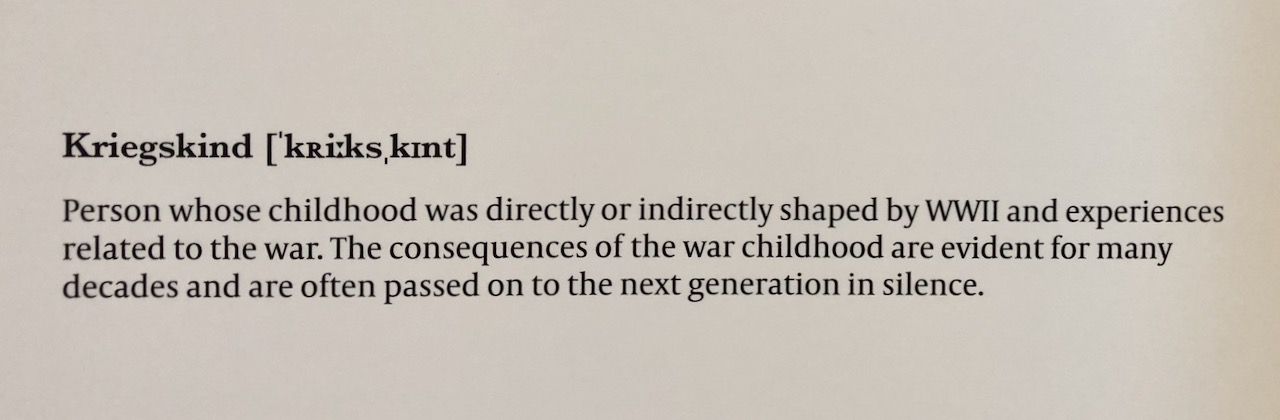
Susanne Hakuba: Two Kriegskinder / War children: “…Feelings? I didn’t have time for that.”

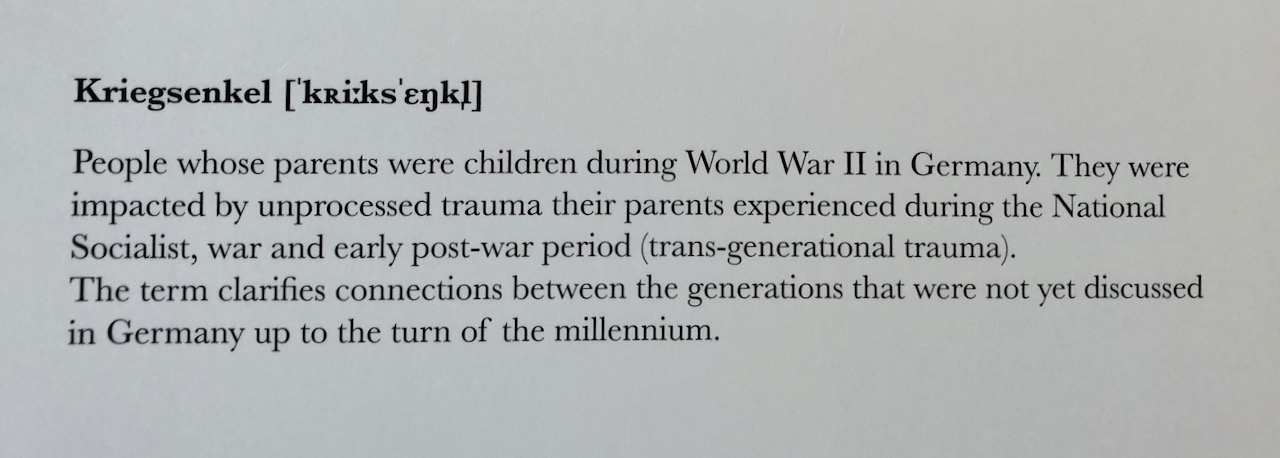
The third generation – born in the sixties and seventies – have been gradually and carefully breaking through the silence to discover what lies behind familiar narratives that don’t quite add up. It’s no longer about uncovering the facts, many of which will never be known or knowable; it is more about the emotions attached to them. For it is these that coloured and flavoured most German childhoods, often leading to inexplicable symptoms, confusions about identity and self-destructive behaviours as they advanced towards adulthood.

This phenomenon is called inter- or transgenerational trauma. It describes the transmission of unresolved issues from one generation to the next; a form of emotional inheritance seeking resolution. I talk about it in my TEDx talk and it is widely acknowledged in Germany. For all sorts of reasons, however, we don’t know much about this in Britain. But seeing the interest visitors to the exhibition display, Susanne is hopeful – as am I – that her/our work can be a catalyst for people – of any nationality or history – to look at the gaps in their own family stories in order to discover what is lurking there unrecognised, unspoken but potent. 

What is happening in Afghanistan will leave many people traumatised and many others guilty. The impact of both so often gets buried in silent withdrawal as people try to cope. But suppressed traumas and wrongdoings can lead to misery, dysfunction and, all too often, to devastating actions and crimes. I sincerely hope that growing coverage of this subject through exhibitions, talks, books and the media will raise our collective awareness of how important it is to acknowledge and treat trauma before it is allowed to fester and pollute the lives of generations to come. As Afghanistan will no doubt teach us, it is in everybody’s interests to do so.


Some further reading:

British army hands back last headquarters in Germany

Parents’ emotional trauma may change their children’s biology. Studies in mice show how

Can We Really Inherit Trauma?

Fearful Memories Passed Down to Mouse Descendants

What Is Generational Trauma? Here’s How Experts Explain It 

Are ‘chain gangs in high-vis jackets’ really the best way to beat crime?

I was going to divert from the usual themes of my blog and write about something light and summery. But then the government published its Beating Crime Plan and, though I can’t face going through all of it, I feel compelled to point out a couple of things. Because its showy, populist, tough-on-crime bluster and glaring ignorance of the real issues is a smack in the face for anyone who dared hope for a different, progressive or even a building-back-better or levelling-up approach.

You can read the full paper here if you really haven’t got better beach or staycation reading. Or just get an idea from the different views on its content in some of the links below. For now, I am just going to take two examples that come straight out of Boris Johnson’s mouth to illustrate my point. Which is basically that little of this is going to work… because it never has. 

The first quote is from the foreword:

“None of us can fulfil our potential if we live in fear, none of us can rise up if we’re held down by those who would do us harm. If we as a society, as a country, are to truly flourish then we have to start by beating crime – and I’m proud that this Government has the plan to do just that.”

So, the first sentence, while true, is also an own goal. Living in fear is precisely what so many children and young people are forced to do in their early lives. It’s what drives them to join a gang for supposed safety-in-numbers; to reach for the perceived protection of a knife; to become an aggressor rather than a victim. 

The second sentence, also off. ‘Beating crime’ is the not the way for a society and country to truly flourish. Crime, like drugs, is a largely a symptom, not the cause of failure. To thrive as a nation, we need to give the most disadvantaged more of a chance to fulfil their potential; to educate and support them to become the person that deep down they know they could be, but can’t find a way to be. As for the government’s plan Johnson is so proud of…

The second example is what Johnson said to reporters: 

“If you are guilty of antisocial behaviour and you are sentenced to unpaid work, as many people are, I don’t see any reason why you shouldn’t be out there in one of those fluorescent-jacketed chain gangs visibly paying your debt to society.” 

I am kind of assuming that all my readers can see reasons why this might not just be wrong, but also deeply offensive? Is it progressive, or even remotely appropriate to bring back what amounts to little less than medieval public shaming? Basic psychology, the Treaty of Versailles, no doubt your own experience of shame all demonstrate how humiliation, even if ‘justified’ usually leads to counter-productive outcomes. As for ‘chain gangs’… really?

And what ‘debt to society’ is he talking about? The debt of having been failed by the education system, of having lived in poverty due to the absence of a living wage, of having been a victim of systemic disadvantage / racism / drug addict parents / trauma / lack of opportunity? Not all criminals fall into those categories, but a great many do.

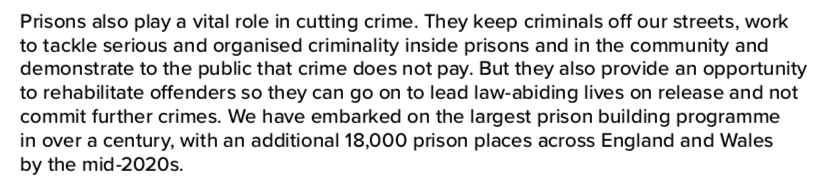
The plan continues with ideas that blatantly ignore recommendations, previous experience, the expertise of those on the ground… and even logic. More stop-and-search powers, even though these are known to disproportionately target black people. More prisons, even though their £37,000 per person per year merely results in the £18.1 billion bill for high re-offending rates, usually within 12 months of release. You just have to read the below paragraph and compare with the statistics to see how deluded and detached from reality the reasoning behind these plans are!

If prisons worked you wouldn’t have to embark on the largest prison building programme… you could spend all those millions of pounds on mental health therapies and drug addiction treatment and prevention; on building soft social skills; on support for dyslexia, jobs, housing… Anyway, I could go on, but it is too frustrating and fruitless to. Maybe next month I will find something lighter and more summery to write about… as long as the government don’t publish any more of their plans.

Related links – not all representative of my opinions

‘Weird and gimmicky’: police chiefs condemn Boris Johnson’s crime plan

Boris Johnson says stop and search is ‘kind and loving’. He’s gaslighting Black people

Boris Johnson Under Fire From Business Chief Over Hi-Viz ‘Chain Gangs’ Plan

Hi-vis chain gangs? This is what happens when a newspaper columnist becomes prime minister

Johnson proposes hi-vis chain gangs as part of crime plan

Crime always pays for the Tories – that’s why they turn to it again and again

Boris Johnson promises ‘fluorescent-jacketed chain gangs’ so criminals can visibly pay debt

Boris Johnson defends police pay freeze

Boris Johnson’s new police plans slammed by former Met officer

BBC World at One (start at 28:18 mins)

PRITI PATEL: The public want to see justice done

I dare you not to look away…

What is the difference between ‘I had no idea’ and ‘I didn’t know’?

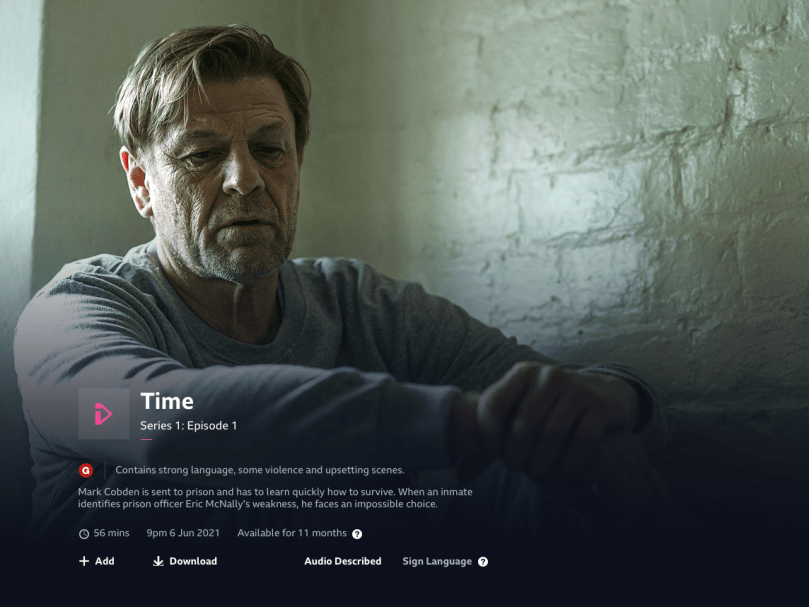
I ask this question in the wake of what must be one of the best television series in the past year: BBC One’s deeply uncomfortable and disquieting three-parter, Time.

It is described as: ‘Jimmy McGovern’s hard-hitting, brutally honest portrayal of a failed public service which gets everything right about prison life – minus the tedium.’ If you haven’t seen it – and sorry to my readers abroad if you can’t get BBC – I would like to invite you to watch it, even to dip into it for ten minutes. I’ll tell you why.

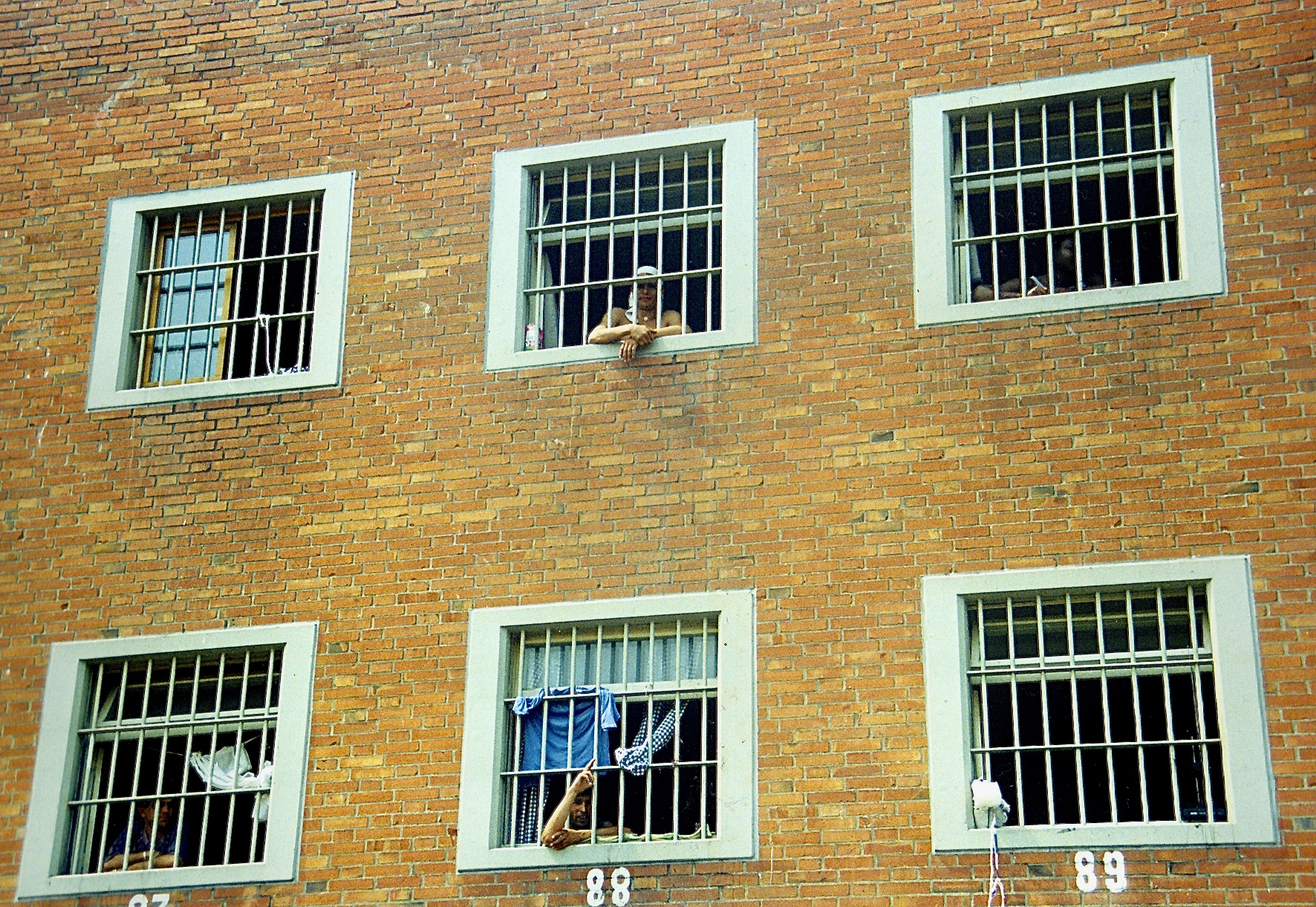
Having worked in many prisons in England, I feel everybody needs to know what is going on in them. In our name. There was nothing in the series that I didn’t recognise from my years inside. As I am up against a tight writing deadline for my book (and this blog actually!), I am going to allow the three episodes to speak for me and bear witness to the sheer illogic, and all too often, inhumanity of our current system.

This doesn’t apply to all prisoners, but if we recognise that many addictive, violent and destructive behaviours derive from childhood trauma; if we fully comprehend the impact of untreated traumatic incidents, then the cruelty of locking up people, who were first and foremost victims, in what are often little more than hell holes, becomes very clear. 

My admittedly provocative opening question stems from a genuine desire to understand the answer.

For decades, the adult-generation of Germans living through the Second World War have not been believed when they say, ‘we didn’t know’ (about the concentration camps). And people around the world often blame them for having looked the other way. I don’t want to get into that debate here. There is a consensus among historians that some would have known, some would have heard about them and not believed it, and others would not have known. Most of the camps were miles away in the east and there was little access to free press. There was also a deadly dictatorship controlling thoughts and actions. Yet not knowing, or knowing and not doing anything, allowed the deadly system to persist for as long as it did.

I have been talking to a wide range of audiences about my experiences of working as an artist in prisons for nearly three decades. The most common thing I hear afterwards is a shocked “I had no idea.” It’s totally valid, I make no judgment. There are loads of things I have no idea about. But why don’t more people know about this? There are prisons in nearly every major town. The shocking statistics of failure, the appalling conditions and the tragic stories of many of the people locked up in them are reported on all the time, in every form of media. How can we not know about them?

There is obviously a wide spectrum from having no idea, to knowing but looking away, to knowing and acting. I would just like to use this month’s blog to encourage you to become more informed, specifically about the system in which we warehouse prisoners. Not just for their sakes, but for all of us who live in the communities into which they are returned… usually worse.

When enough people ‘have an idea’, things can and will change.

Watching this series is a start. It’s tough watching, but the reality is much, much tougher.

I dare you not to look away.

Reviews:

Time review – Sean Bean and Stephen Graham astound in enraging prison drama

Time review – like a punch in the face, but in a good way

Time review: This gripping, gruelling portrait of life in prison is essential viewing

Let’s at least talk about it…

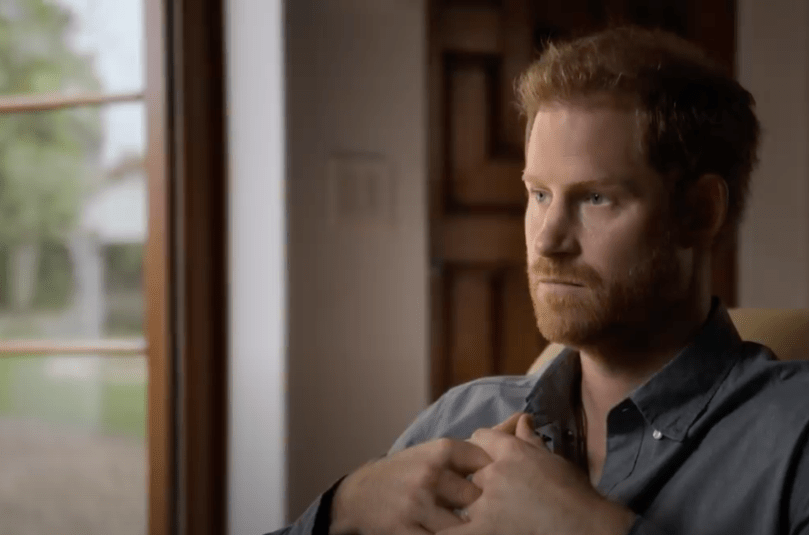
I know many people are finding plenty of reasons to slate Prince Harry at the moment: for his open criticism of his upbringing; for hypocrisy in privacy vs. publicity matters; for his ‘therapy speak’. 

I also know there is fierce resistance to what he is saying. After all, it flies in the faces of stiff-upper-lip Britishness and the Royal Family’s ‘play-the-game’ rules.

How about we put all judgment aside for a moment, and simply listen to – and hear – what he is trying to do. Because doesn’t it then become clear that he is trying to talk about some of the most important things that can affect us all? Things that haven’t been talked about nearly enough.

Unresolved trauma. 

Silence. 

And mental health.

No-one can accuse him of not knowing each of them intimately.

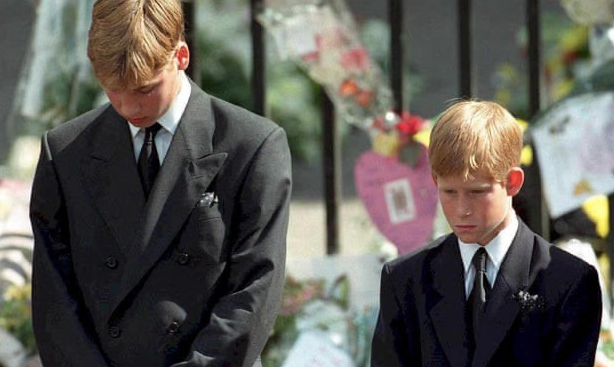
Prince William and Harry at their mother’s funeral in 1997

According to the leading charity, MIND, mental health issues went up by 20% between 1993 and 2014. Imagine the rate at which they are rising now, especially among the young. You just have to witness, as I recently have, a desperate twenty-something year old trying to access mental health provision in this country in order to see how woefully inadequate it is. And how much needs to be done.

From MIND

There is nothing new or wrong in recognising the potentially huge role parents and primary carers play in forming or, in some cases unfortunately, de-forming a child’s mental health. It’s not an attack; or blame. It’s just fact. So personally, I welcome Harry’s efforts to get us all talking about these things. And I can only recognise logic, truth and sense when he says:

“There is no blame. I don’t think we should be pointing the finger or blaming anybody, but certainly when it comes to parenting, if I’ve experienced some form of pain or suffering because of the pain or suffering that perhaps my father or my parents had suffered, I’m going to make sure I break that cycle so that I don’t pass it on, basically.

Or:

“It’s a lot of genetic pain and suffering that gets passed on anyway so we as parents should be doing the most we can to try and say: ‘You know what, that happened to me, I’m going to make sure that doesn’t happen to you.’”

People have been asking what ‘genetic pain’ is. I know the scientific fact-checkers at TED would have a lot to say about his use of the word ‘genetic’ in that context – they did about my single mention of it in my TEDx talk, which wasn’t even about genetic inheritance! He possibly means ‘generational’ pain, but, as I mentioned in last month’s blog, science often lags behind lived experience and the insights of other disciplines, so maybe his – and my – experiences will one day be proved to be genetically true as well.

I actually think that if more parents or grandparents learnt to ‘therapy speak’ about the hurt or trauma in their childhoods and lives, many destructive cycles would be broken. Of course it isn’t comfortable at the time. And yes, it can be extremely upsetting, especially if criticism of family members is voiced on a global platform. But feeling a need to talk openly and publicly is often a direct result of having been silenced. And the impact of silence on traumatic experiences is potentially devastating. It pushes raw, unprocessed emotions deeper into the psyche where, unexpressed, they fester like bandaged wounds deprived of the air that will heal them. And then the problems start. 

After over two decades of silence… of being silenced… Harry is now giving his wounds some ‘air-time’. And I hope the world will allow him to stumble and cock up royally (…sorry!) from time to time while he does his best to break new ground – just like his mother tried to do – and raise awareness of the insidious killer in our midst.

And what can we do to help the situation?

Maybe the first step is to start talking. And listening. Talking about things that have mattered… with your children and your grandchildren. With your parents and grandparents. With your wife, husband, friends. Because while silence may help you cope with something, it may not help those who come after.

So, talk about it… before it becomes too late. 

LINKS (as usual, a variety of viewpoints – some definitely not my opinion)

I talk about the impact of silence and lack of understanding surrounding intergenerational trauma in my TEDx talk – Facing the past to liberate the present

“The Me You Can’t See”.

Prince Harry appears to criticise way he was raised by his father – The Guardian

Prince Harry’s ‘Genetic Pain’ Comments Are Not Actually A Dig At Prince Charles – GRAZIA

Prince Harry’s ‘genetic pain’ is an insult to his grandmother. The Duke’s preoccupations with mental health and his parents reveal him to be as self-obsessed as any privileged millennial – The Telegraph

Prince Harry: I want to break cycle of pain for my children – BBC NEWS

Prince Harry says trauma of Diana’s death led him to use alcohol and drugs – The Guardian

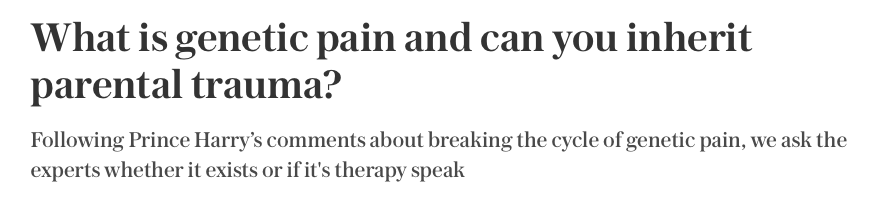
What is genetic pain and can you inherit parental trauma? – The Telegraph

Meghan, Diana, drugs and therapy: what Harry said in Apple TV series – The Guardian

When it comes to human experiences, is ‘following the science’ always the right way to act?

For just over a year now, the world has been focused on ‘following the science’. And no doubt rightly so in many instances. Science is brilliant, in too many ways to list here. But… when it comes to human experience, its tools are often blunt, clunky or inadequate.

Sometimes, science lags behind human instinct or common sense. Sometimes, its microscopic focus loses sight of the macroscopic whole. Objective rationale overrides simple solutions seen by subjective understanding. Symptoms may be treated in isolation rather than as part of a highly intelligent organism. Other times, a phenomenon is too mind-boggling to be explained by logical process; love, death, black holes… That’s where art or religion, with their different toolset, have a go with varying degrees of success.

My recent TEDx talk – you can watch it here if you haven’t seen it yet – presents my experience of the transgenerational transmission of trauma or guilt. It’s an example of subjective experience gradually making its way to objective explanation. It is not a new idea. Way back, in Exodus Chapter 20, the bible talked of “…visiting the iniquity of the fathers upon the sons to the third and fourth generation.” In Shakespeare’s Merchant of Venice, Launcelot says, “Yes, truly; for, look you, the sins of the father are to be laid upon the children.” And over the past fifty years or so, symptoms of inherited trauma/guilt have been documented in descendents of a wide range of people exposed to traumatic events. However… because science doesn’t have the ability to prove it happens – not yet at least – some dismiss examples of such transmissions as being impossible, coincidental, imagined, nonsense.

But does that mean that it doesn’t happen? Is science right… or simply behind?

Take Post Traumatic Stress Disorder (PTSD), for example. Traumatic incidents have always been part of the human experience. And no doubt people all over the world have displayed symptoms of PTSD long before it was given a name. Yet the term ‘trauma’ only started to be explored at the end of the nineteenth century when Freud and his fellow pioneers of neurology and psychology considered it a diagnosis worthy of specialised treatment. When thousands of men returned from First World War fronts with psychological symptoms and medical conditions that had never been seen before, let alone explained, the British came up with the diagnosis of “shell shock.” Those who suffered from it were entitled to treatment – often hypnosis – and a disability pension. The sheer numbers, however, led the British General Staff to forbid the use of the term. Instead, “NYDN” (Not Yet Diagnosed, Nervous) was to be used and the afflicted were deemed undisciplined and lacking moral fibre. It wouldn’t be until 1941 with the publication of The traumatic neuroses of war by Abram Kardiner that it was recognised that any man could be affected by the atrocities of war and that traumatic symptoms were a normal response to an unbearable situation.

During the Second World War, psychiatrists continued to use hypnosis as treatment for trauma and veterans were offered improved practical and economic support. Psychological scars, however, were left unrecognised and untreated. From 1947, traumatic neuroses all but disappeared from official psychiatric language. 

The interest in trauma reignited in the seventies with the return of Vietnam war veterans who had such incapacitating symptoms that they were incapable of coping and functioning in civilian life. Many behaved violently towards their partners or became homeless and unemployable. But their symptoms continued to be labelled separately: alcoholism, substance misuse, depression, mood disorder or schizophrenia and treated accordingly, frequently without success. It was only when clinicians and mental health professionals working with Holocaust survivors, battered women, abused children and victims of accidents or rape collated their reports and discovered overwhelming similarities in their traumatised clients, that the range of behavioural, emotional and cognitive symptoms were combined into one psychological trauma diagnosis: Post Traumatic Stress Disorder. In 1980, after several rejections, this term would finally be included in the bible of psychology, the Diagnostic and Statistical Manual of Mental Disorders (third edition; DSM-III). 

For us today, it probably feels obvious that exposing men and women to abuse, war or anything that evokes extreme fear and helplessness would leave traumatic markers. And to a large degree science can now explain the mechanisms behind the process. That sense of ‘obviousness’ is how I have come to feel about the possibility of unresolved trauma or wrongdoing being passed onto the next generations, even though we don’t know how it happens. As I suggest in my TEDx talk, “our roots don’t just run backwards to our ancestors, but forwards to our children and those who come after. And if those roots are damaged or severed, what we hand on will also be impaired.

Many people have written to say my talk has resonated with their own experience of their forebears. But none of us can prove anything. And science will need time to develop the tools that can. Which probably means that the legacies of past familial, societal or historical traumas will not be taken into consideration when helping those afflicted by the often debilitating symptoms of depression, addiction, mental health… 

I think we need to be careful that this new emphasis on ‘following the science’ doesn’t pervade all areas of life. Even if we don’t yet understand the many complex ways in which transmission can occur, let’s give credence to the insights of people who have an innate or formally trained capacity to feel into a situation and ‘know‘ what’s right in the same way maternal instinct so often does. We have two sides to our brains for good reason. Currently the sceptical-until-proven logic of the left side largely prevails. But the non-verbal, intuitive right side has an equally valuable place, especially when it comes to imparting knowledge about our shared humanity. That’s an area where science often trails far behind.

I’d be interested to hear whether or not you think the experiences and insights I reveal in my TEDx talkFacing the past to liberate the future – need science to prove they are ‘real’?  

Related links:

The legacy of trauma: An emerging line of research is exploring how historical and cultural traumas affect survivors’ children for generations to come

Understanding and healing collective trauma – Thomas Hübl

Dr Gabor Maté: Transgenerational trauma, stressed environment and child’s diagnosis

Who’d have thought 18 minutes standing on a red dot could unleash such terror?

The news that I had been selected to speak at TEDxStroud came on what can only be called a day from hell. It was August 2020. The brick gable end of my mother’s old garage had just collapsed in a storm leaving live electricity cables strewn across the driveway. She was unadvisedly trying to tidy them away while sinking into a diabetic low when we received the news that my brother-in-law’s father had died of Covid. In the flurry of activity and phone calls that followed, the email plopped into my inbox: CONGRATULATIONS! You are one of nine people selected from 84 applicants to deliver a TEDx talk on the theme of Emergence…  

I had totally forgotten I had even applied and my heart simultaneously raced and sank as I realised this was another gauntlet I had to take up. TED is the mecca of public speaking platforms. The iconic red spot on the floor has hosted some of the world’s very best speakers and lured over 3,600 people with a good idea to share. There are strict criteria: No more than 18 minutes per talk. No selling or promotion of a product or business. No profit or pay to speakers or organisers… just a good idea that is worth spreading. 

Tickets and further information can be found here

Over the following months, Covid threw curveballs at the original visions for a live event with an audience of 400, sending each one flying like skittles in an alley. Lockdown even forced a postponement from November’20 to March’21. The organising team were undeterred in their commitment. With each new restriction, they adapted, delivering changes of plan with supportive sensitivity and unwaning optimism. Meanwhile, we speakers met in Zoom rooms hosted by other talented volunteers where we would listen and feed back to each other while witnessing amorphous blobs of chosen subjects being honed to their essence. Not ‘just a minute‘ without ‘hesitation, deviation or repetition’ as on BBC Radio 4, but 18 minutes! 

Sounds easy? It’s not. The techniques to memorise our talks ranged from falling asleep to a recording of your own voice droning its way into your memory, (nothing has ever sent me to sleep faster, all insomniacs click here if you’d like a copy!) to delivering it in a silly Texan accent. We had to practice talking to the barrel of a camera lens while smiling at some imaginary audience member sitting beyond it. We even had to choose proper clothes to wear as opposed to our baggy lockdown jumpers and leggings. 

Practicing…

Kind friends tried to assuage the terror that gained momentum over the final two months until it clenched my chest in a vice and froze my brain. “But you speak so well… it’s no different from the talks you already give… you can do this with your eyes shut.” But a TEDx talk isn’t the same at all. It will be uploaded to YouTube and made available to a global audience… potentially forever. You have no slides or prompts to jog the memory. And what’s more, my ‘great’ Tedx idea isn’t an easy one to talk about, let alone sell as a ‘gift’! Because I am basically asking people to get really uncomfortable; to follow me on a journey that descends into the dark underbelly of human experience, where prisoners, Nazis, unspeakable atrocities or war experiences fester like wounds marinated in silence, pain and shame. 

I sometimes feel I should apologise for bringing such things into the light of awareness. But I won’t, because the rewards are too great to ignore. And because it has become clear, not just to me but to neuroscientists, geneticists and psychologists, that we have to go there if we want to break the cycle by which toxic, unresolved past traumas and wrongdoings persistently disrupt the present. Now more than ever, it is important to recognise the link between the past and so many of today’s symptoms of violence, division, discrimination, inequality, addictions, injustices, racism… 

It is not easy to face unacknowledged past harm, not least because it will have been buried for a reason, often a good reason such as protection or avoidance of pain. But I promise you, it is ultimately easier than schlepping it around with us, patching it up and handing it on to the next generation to deal with. 

Recording my TEDx talk on Thursday 11th March

So, may I invite you to join us this SUNDAY 21st MARCH 2021 from 2pm, not just to hear my TEDx talk Facing the past to liberate the present, but the talks of seven other amazing speakers, each of whom has been on an equally intense journey to deliver a wonderful idea as a gift to you and our world. Tickets and further information can be found here.

PLEASE SIGN UP TO MY NEWSLETTER to be kept informed about all my forthcoming events or click on FOLLOW MY BLOG at the top of the page to receive them straight into you inbox.

Remembering Dresden – along side its people – helps in the healing of the past

From 13th-15th February, Dresdeners will be gathering to mark the anniversary of the destruction of their city in 1945. This year, rather than creating their usual human chain to snake through the city in peaceful reflection, it will, like most things in this pandemic, be a largely online affair. A Dresden Trust trustee always attends the event as a gesture of deeply-felt solidarity and reconciliation. This year was to be my year to represent the Trust, but instead we have sent a video of messages to our friends and contacts there. Immediate emails of thanks reveal how deeply moved they have been by this extension of virtual British hands and hearts to them. It was a tiny act on our part, but its value was clearly of significance. 

The last couple of years have seen the 75th anniversaries of many Second World War events: the D-Day landings, VE Day, VJ Day, the liberation of Auschwitz… Each was naturally ‘celebrated’ in technicolour with dignitaries from around the world, for these were some of our nation’s finest hours. Tucked in the shadows of those victories, was the 75th anniversary of the UK and USA bombing of Dresden. As far as I am aware, no British politician attended. Neither Boris Johnson nor Jeremy Corbyn even commented on it. It is still a thorn in the side of Britain’s conscience. 

I am fully aware of the contention surrounding the bombing of Dresden. Was the city a legitimate target? Did the Germans deserve it? Was it a war crime? Were Bomber Harris and his Command heroes or part of a campaign that went too far… way too far? In the articles at the bottom of this post you can read up on some of these attitudes, as well as get a picture of the horrors witnessed by a British serviceman held prisoner there. 

Bomber Command Memorial, Green Park, London (2012)

Seventy-six years on, I feel we are totally missing the point if we get tangled up in binary discussions of whether it was right or wrong. Within the context of Hitler and a World War, you can see how it could be considered ‘right’. On that basis, by reading some of my German grandfather’s letters, you can also see how it could have been considered ‘right’ to invade Russia. And by listening to the stories of prisoners, you can also come to understand how they too consider their crimes to have been the ‘right’ thing to have done. Wrongdoing – on an individual or national level – is usually based on thoughts that justify it as being the ‘right’ thing to do. Often this is a reaction designed to redress the wrongdoing of another… and so it goes on. The validity of the reasoning, however, doesn’t automatically make it the right thing to do morally

We are living through extraordinary times of potential change for good. I say ‘potential’ because if we in Britain do not broaden our perspectives on our past in tune with history’s ever-shifting shape, we run the risk of becoming fossilised within it. Nothing can change if we cling to the old. The current statue debate, as provocatively and passionately pursued by Robert Jenrick, our secretary of state for housing, communities and institutions, is an example of the deeply flawed thinking at the core of some of our attitudes to the past. For him, statues represent history itself. Yet they don’t. They represent the values of the time. Both history and values evolve, and debating and adapting to this evolution are important parts of any country’s healthy relationship to its past. What’s more, focusing on statues is a classic example of merely treating the symptom rather than the cause of a problem.

While I don’t believe the removal (or not) of statues is either the real issue or the solution, the government’s evident terror of a ‘revisionist purge’ by ‘town hall militants,’ ‘woke worthies’ and ‘baying mobs’ is revealing. (And insulting to the justifiable requests for a reconsideration of the appropriateness of certain statues in today’s cities). It is the terror, not just of the dismantlement of our statues and heritage, but of our almost purely benign self-image. So great is that fear, that Mr Jenrick is giving himself the personal power to intervene in democratic decisions made by local communities, councils and institutions about the fate of their statues if their decisions don’t adhere to the government’s position. Is that democracy?

Our national self-image and reputation have already been considerably wobbled, if not toppled, in recent years. So I say, bring it on! Why don’t we just go for it? Why don’t we literally ‘come out’ officially and admit: We have… at times… been utter shits. Does that automatically diminish all that we hold dear and celebrate about ourselves? No, not at all. We can be all those good things AS WELL AS being, at times… shits. We can have done and achieved amazing things AS WELL AS having made mistakes, or been on the wrong side of good, or been actively, deliberately bad. We can honour our pilots and soldiers AS WELL AS deeply question the morality of some of our decisions. No country will think less of us… indeed I am sure they will embrace and welcome our vulnerability after so much bullish bluster.

Dresden, February 1945

Until we can shift our position even just a little, Dresden will remain a contentious and unresolved issue. A dark smudge on the national conscience. Whether it was right or wrong, a war crime, an atrocity or a strategic attack, the fact remains that an estimated 25,000 people – primarily women, children, elderly, refugees and POWs – were killed in indescribably ghastly ways, by any standards of warfare. We deliberately designed it to be just so. Could this government, the successors of the instigators of such calculated destruction and loss of life, not also extend a small gesture of thought to the descendants of our victims?

In Mr Jenrick’s argument, “To tear [statues] down is, as the prime minister has said, ‘to lie about our history’.” If we really rely on our statues to tell the truth about our history, then we need to get carving and casting fast. For so far, only truths considered flattering or benign are being told. Nothing of the dark shadows cast by those men on pedestals is included in our statue-version of history. Doesn’t that then make it a lie…?

Past harm left unresolved is a burden that disrupts the present of each generation as it seeks resolution. It adversely shapes attitudes and policies. Let’s be the generation that works through the full truth of our past, creates peace with it and thereby liberates future generations from it.

In my forthcoming TEDx talk on 21st March 2021, I will be explaining How facing the past freed me. You can read more about it here and buy tickets to the event here

Related articles:

The Spectator: Did Britain commit a war crime in Dresden? A conversation Sinclair McKay and A.N. Wilson on the 75th anniversary of the bombing raid

Good Morning Britain 75th anniversary: Dresden bombing survivor Victor Gregg 100 on

Herald Scotland: Dresden 75th anniversary: why Britain must come to terms with its own dark wartime past 

BBC: Dresden: The World War Two bombing 75 years on

The Telegraph: We will save Britain’s statues from the woke militants who want to censor our past (Robert Jenrick)

The Guardian: It’s not ‘censorship’ to question the statues in our public spaces

Please sign up to my NEWSLETTER to be kept up to date on my forthcoming BOOK on the subject here. To receive my monthly blog by email, press FOLLOW at the top of this page. Or contact me for any enquiries about my TALKS.