Is trying nonagenarians for Nazi War Crimes the best way to achieve justice?

If it wasn’t so serious, the idea of a 96-year-old going on the run to escape trial would be quite comical. But behind the image of an old lady hopping into a cab at her retirement home and fleeing for the subway station in the early hours is a quagmire of deeply complex and emotive issues.

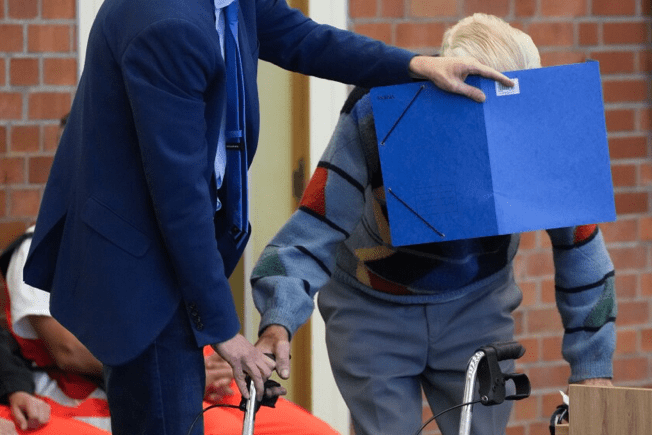
Irmgard Furchner stands accused of having contributed to the murder of 11,412 people between 1943 and 1945 when she was an 18-year-old typist and former secretary to the SS commander of the Stutthof concentration camp in Poland. She is the latest of several nonagenarian Nazi war criminals to be brought to trial, some of them in youth courts because they weren’t adults at the time of their alleged crimes.

Irmgard Furchner being brought into court

The reason this particular case captured my attention is partly because it coincided with the seventy-fifth anniversary of the final day of the Nuremberg Trials that saw twelve senior members of the Nazi establishment sentenced to death by hanging. And partly because the hearing Furchner was due to attend was in Itzehoe, the same north German town that I have been going to all my life. I have been looking Nazism and the Second World War in the face for several decades now, but my countless happy memories visiting relatives there had completely insulated it from the chill of Germany’s wider history. 

Now it is in the spotlight as the face of retribution. So, is it a total no-brainer that even seventy-five years later, such people, nonagenarian or not, must pay for their part in some of the worst mass killings in history? Or is this more a rush by prosecutors to seize the final opportunity to redress the failures of the previous decades? Will sentencing these last Nazis to time in prison achieve justice for the victims? Or are these trials there to serve the broader objective of Never Forget? Is a ninety-year old even the same person as their eighteen-year-old self?
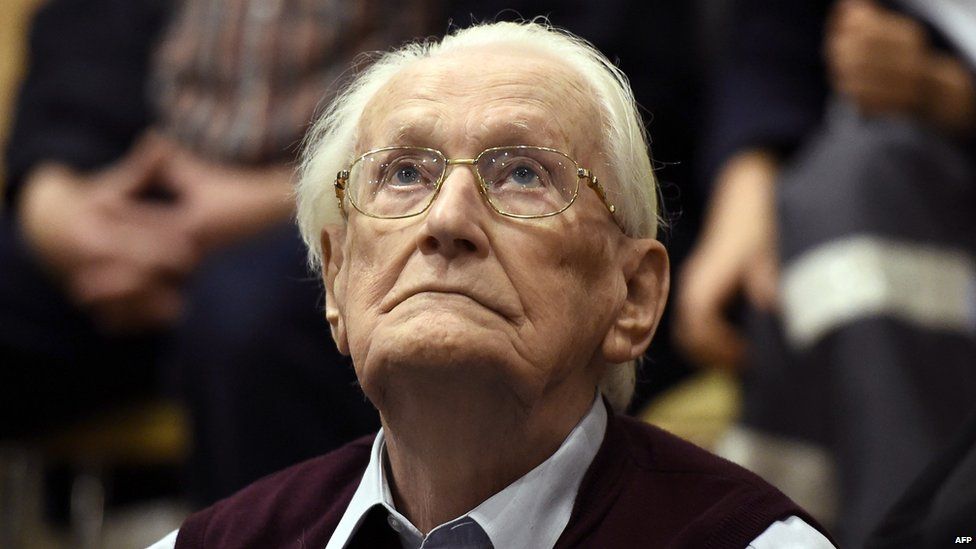
The last guilty verdict issued was to former SS guard Bruno Dey, who was handed a two-year suspended sentence in July 2020 at the age of 93. The 2019 trial against 95-year-old Johann Rehbogen for his service as a guard also in Stutthof Concentration Camp, had to be terminated as his organs were failing. The only successful conviction was of 96-year-old Oskar Gröning, the so-called ‘bookkeeper of Auschwitz,’ who was sentenced to four years in 2015 but died in hospital after his several appeals failed. I wrote about him at the time in my blog. In his case he had not tried to evade justice. Driven by a desire to counter Holocaust deniers and prevent something like Auschwitz from ever happening again, he had been openly talking about his time as an accountant in the death camp. His testimonies, however, were used against him in court with the unintended outcome that other low-level perpetrators and bystanders went silent. 

Oskar Gröning at his trial in 2015

For some people, the greatest justice to all victims of Nazi persecution that these trials can provide is to keep the crimes fresh in peoples’ minds and prevent them from being forgotten, denied or trivialised. They force Germans, including younger generations, to listen to the testimonies of survivors and to rake over the whole disturbing and uncomfortable past once again. 

It is so important that we never forget; that we all learn the lessons that Germany’s descent into barbarity and atrocity teaches us, not least about the vulnerability of democracy today. But survivors often declare that legal retribution is not the main outcome they are after. That they are more interested in shining light on unresolved or overlooked crimes and contributing to Holocaust remembrance and education. 

So, are we now at a time when imprisonment is a less effective response than a more direct dealing with the aftermath of the offence? Is there now another way that serves justice to the many victims of the Third Reich and their descendants AND sends a powerful message to would-be perpetrators of mass crimes that they will never get away with murder AND contributes to remembrance and education AND offers possibilities for healing and reconciliation? 

The past cannot be changed, but the present can. Might communication between those harmed by and those implicated in Nazi crimes, within the safe frameworks of Restorative Justice or mediation initiatives, offer the possibility to fulfil all the outcomes desired by the survivors? Could the excrutiating discomfort of acknowledgment of past wrongdoing be the punishment? Would talking together create an opportunity to resolve some of the harm and nurture the shoots of healing, forgiveness and reconciliation that can sprout from really listening and really being heard? 

Further reading:

Trial of 100-year-old man in Germany: why Nazi war crimes take so long to prosecute – The Conversation

Former Nazi death camp secretary, 96, remanded in custody after going on the run – Times of Israel

Nuremberg: The Trial of the Nazi War Criminals – Radio 4

Germans are right to pursue 100-year-old former Nazi war criminals – Irish Times

Two very different military withdrawals…

In the light – or should I say pitch darkness – of the horrors and tragedies that have been unfolding in Afghanistan as the USA, UK and other countries withdraw, my recent visit to the National Army Museum in London felt strangely apposite. One of its current exhibitions – Foe to Friend: The British Army in Germany since 1945 – covers the final withdrawal of British troops from Germany in 2020. It traces Britain’s 75-year military presence there, first as occupiers and administrators of a destroyed country, then as reluctant but necessary Allies confronted with escalating Cold War tensions, and on to its current relationship as friends. 

I can’t stop thinking about what is happening in Afghanistan. It feels beyond catastrophic, beyond imagination, but of course, I am in no position to comment. Except maybe to point out the contrast of our withdrawal from Germany, which passed effortlessly and without incident. Presumably that is the mark of an original mission reaching its intended positive conclusion and outcome, though I have to say I was surprised when I first learned that we even still had a presence there! A second exhibition in the foyer of the museum makes one realise, however, just how alive that period still is in many people’s lives. 

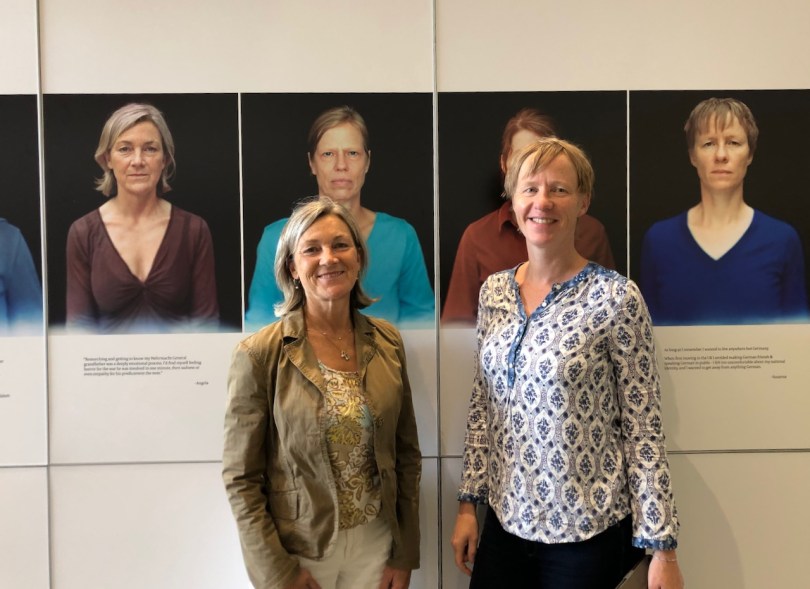
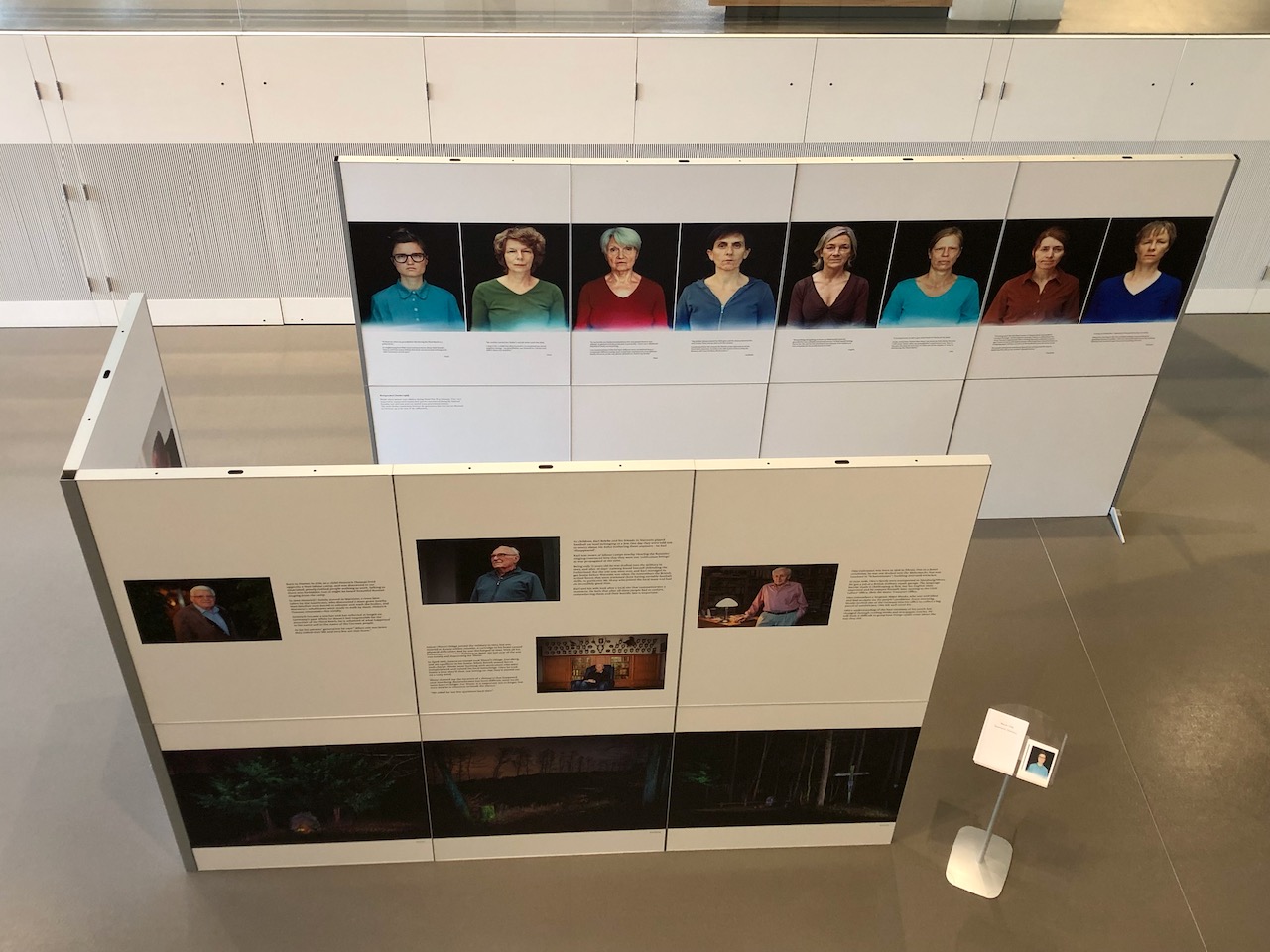
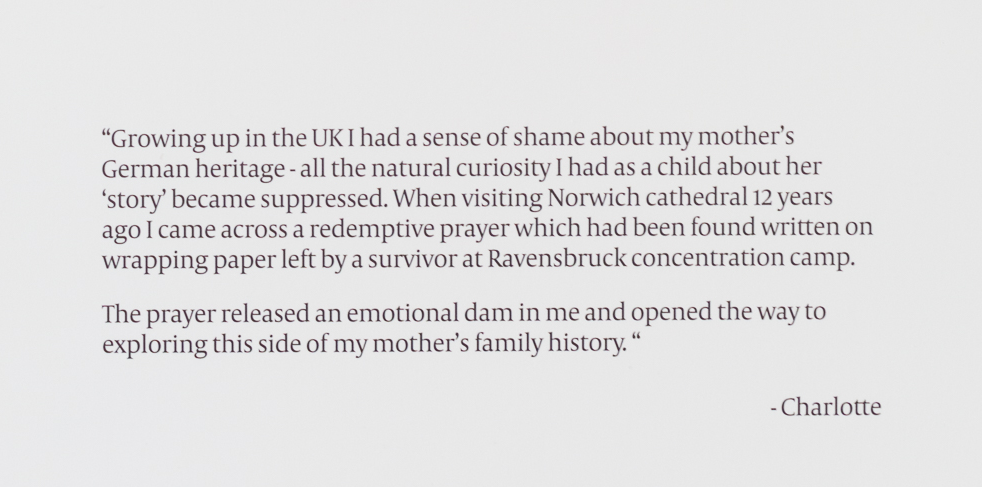
Long Shadows of War has been created by the German photographer, Susanne Hakuba. Susanne lives in England and has been a friend ever since she invited me to participate in her brave and on-going examination of how the Third Reich still casts shadows on Germany, its people and her own life. Any person who is familiar with my blogs or talks will be all too aware of how much Germany has already done to deal with its Nazi heritage at a national and political level. But this exhibition shows how the personal level can be another story, quite literally. 

Susanne’s haunting photographs, quotes and poems draw on the testaments of others to reveal the differing attitudes between three generations: those who witnessed the times, those who lived in their parent’s and grandparent’s trauma- or guilt-filled silences immediately after the war, and those who carried the heavy contents of that silence with its ensuing emotional absence without realising it.

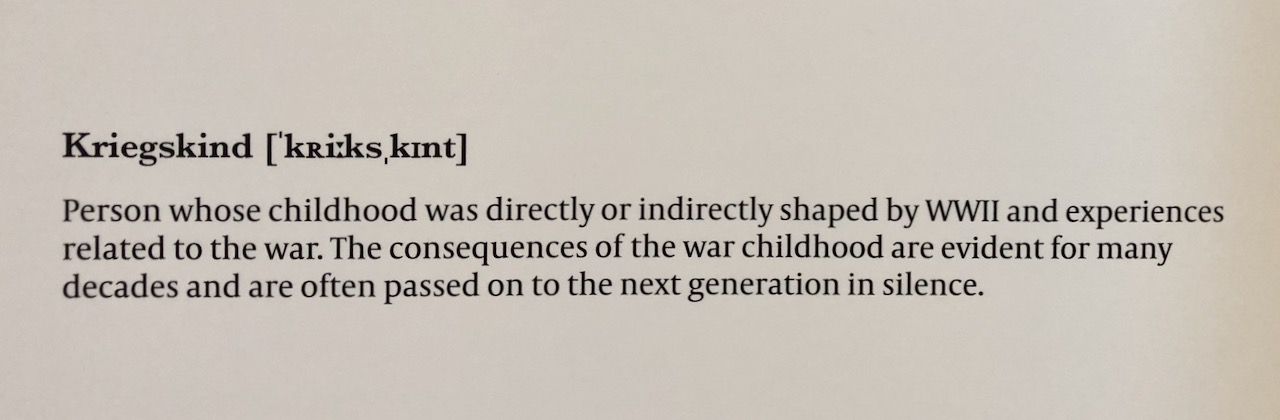
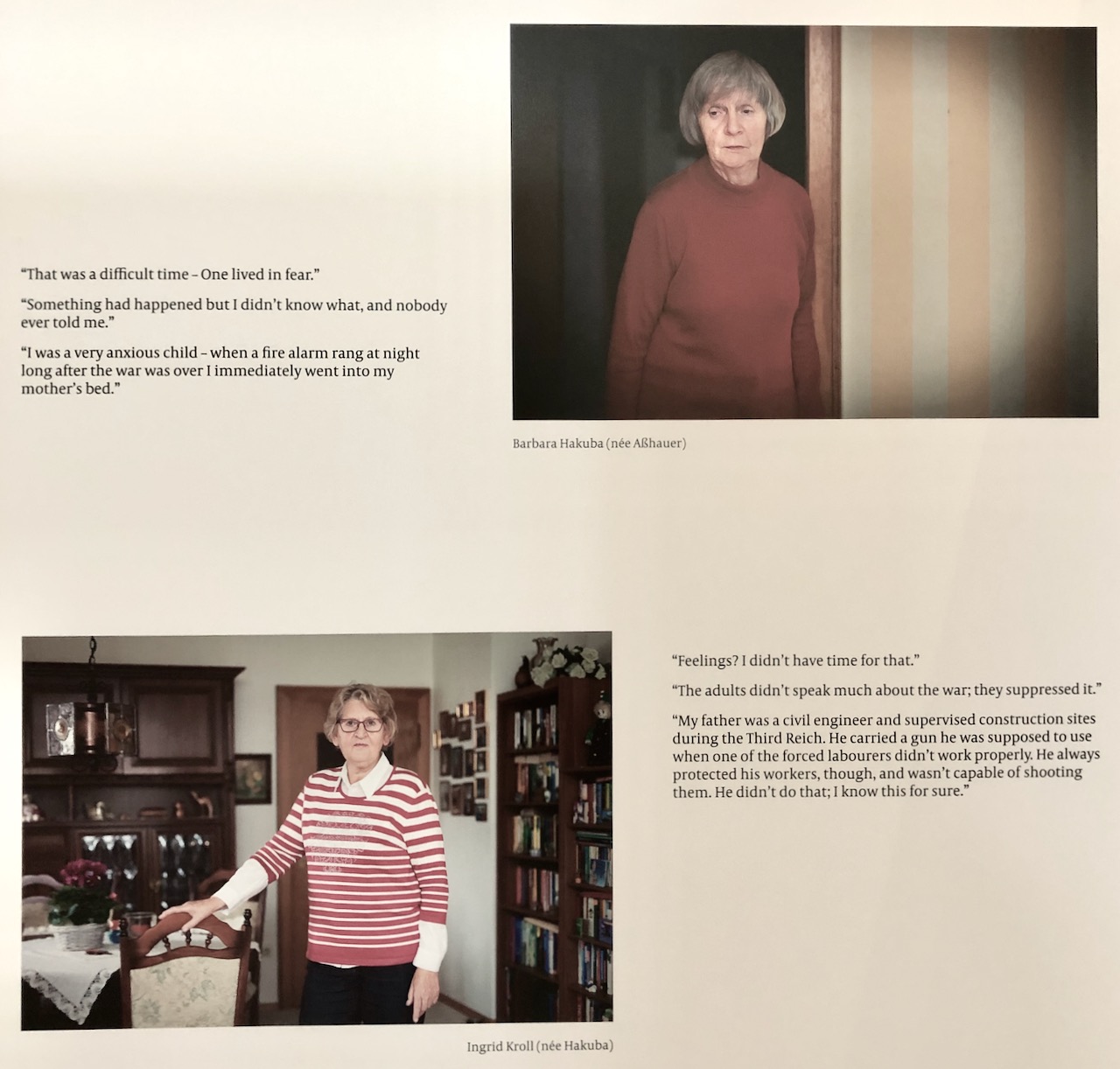
Susanne Hakuba: Two Kriegskinder / War children: “…Feelings? I didn’t have time for that.”

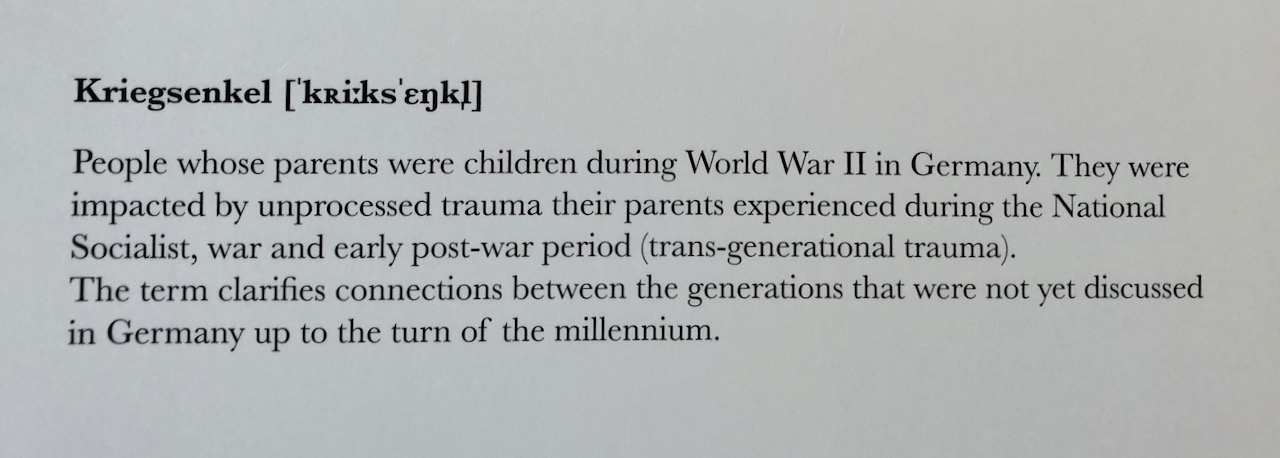
The third generation – born in the sixties and seventies – have been gradually and carefully breaking through the silence to discover what lies behind familiar narratives that don’t quite add up. It’s no longer about uncovering the facts, many of which will never be known or knowable; it is more about the emotions attached to them. For it is these that coloured and flavoured most German childhoods, often leading to inexplicable symptoms, confusions about identity and self-destructive behaviours as they advanced towards adulthood.

This phenomenon is called inter- or transgenerational trauma. It describes the transmission of unresolved issues from one generation to the next; a form of emotional inheritance seeking resolution. I talk about it in my TEDx talk and it is widely acknowledged in Germany. For all sorts of reasons, however, we don’t know much about this in Britain. But seeing the interest visitors to the exhibition display, Susanne is hopeful – as am I – that her/our work can be a catalyst for people – of any nationality or history – to look at the gaps in their own family stories in order to discover what is lurking there unrecognised, unspoken but potent. 

What is happening in Afghanistan will leave many people traumatised and many others guilty. The impact of both so often gets buried in silent withdrawal as people try to cope. But suppressed traumas and wrongdoings can lead to misery, dysfunction and, all too often, to devastating actions and crimes. I sincerely hope that growing coverage of this subject through exhibitions, talks, books and the media will raise our collective awareness of how important it is to acknowledge and treat trauma before it is allowed to fester and pollute the lives of generations to come. As Afghanistan will no doubt teach us, it is in everybody’s interests to do so.


Some further reading:

British army hands back last headquarters in Germany

Parents’ emotional trauma may change their children’s biology. Studies in mice show how

Can We Really Inherit Trauma?

Fearful Memories Passed Down to Mouse Descendants

What Is Generational Trauma? Here’s How Experts Explain It 

Are ‘chain gangs in high-vis jackets’ really the best way to beat crime?

I was going to divert from the usual themes of my blog and write about something light and summery. But then the government published its Beating Crime Plan and, though I can’t face going through all of it, I feel compelled to point out a couple of things. Because its showy, populist, tough-on-crime bluster and glaring ignorance of the real issues is a smack in the face for anyone who dared hope for a different, progressive or even a building-back-better or levelling-up approach.

You can read the full paper here if you really haven’t got better beach or staycation reading. Or just get an idea from the different views on its content in some of the links below. For now, I am just going to take two examples that come straight out of Boris Johnson’s mouth to illustrate my point. Which is basically that little of this is going to work… because it never has. 

The first quote is from the foreword:

“None of us can fulfil our potential if we live in fear, none of us can rise up if we’re held down by those who would do us harm. If we as a society, as a country, are to truly flourish then we have to start by beating crime – and I’m proud that this Government has the plan to do just that.”

So, the first sentence, while true, is also an own goal. Living in fear is precisely what so many children and young people are forced to do in their early lives. It’s what drives them to join a gang for supposed safety-in-numbers; to reach for the perceived protection of a knife; to become an aggressor rather than a victim. 

The second sentence, also off. ‘Beating crime’ is the not the way for a society and country to truly flourish. Crime, like drugs, is a largely a symptom, not the cause of failure. To thrive as a nation, we need to give the most disadvantaged more of a chance to fulfil their potential; to educate and support them to become the person that deep down they know they could be, but can’t find a way to be. As for the government’s plan Johnson is so proud of…

The second example is what Johnson said to reporters: 

“If you are guilty of antisocial behaviour and you are sentenced to unpaid work, as many people are, I don’t see any reason why you shouldn’t be out there in one of those fluorescent-jacketed chain gangs visibly paying your debt to society.” 

I am kind of assuming that all my readers can see reasons why this might not just be wrong, but also deeply offensive? Is it progressive, or even remotely appropriate to bring back what amounts to little less than medieval public shaming? Basic psychology, the Treaty of Versailles, no doubt your own experience of shame all demonstrate how humiliation, even if ‘justified’ usually leads to counter-productive outcomes. As for ‘chain gangs’… really?

And what ‘debt to society’ is he talking about? The debt of having been failed by the education system, of having lived in poverty due to the absence of a living wage, of having been a victim of systemic disadvantage / racism / drug addict parents / trauma / lack of opportunity? Not all criminals fall into those categories, but a great many do.

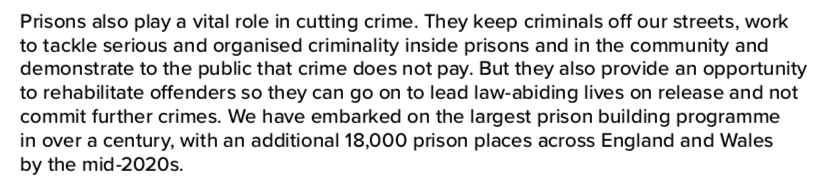
The plan continues with ideas that blatantly ignore recommendations, previous experience, the expertise of those on the ground… and even logic. More stop-and-search powers, even though these are known to disproportionately target black people. More prisons, even though their £37,000 per person per year merely results in the £18.1 billion bill for high re-offending rates, usually within 12 months of release. You just have to read the below paragraph and compare with the statistics to see how deluded and detached from reality the reasoning behind these plans are!

If prisons worked you wouldn’t have to embark on the largest prison building programme… you could spend all those millions of pounds on mental health therapies and drug addiction treatment and prevention; on building soft social skills; on support for dyslexia, jobs, housing… Anyway, I could go on, but it is too frustrating and fruitless to. Maybe next month I will find something lighter and more summery to write about… as long as the government don’t publish any more of their plans.

Related links – not all representative of my opinions

‘Weird and gimmicky’: police chiefs condemn Boris Johnson’s crime plan

Boris Johnson says stop and search is ‘kind and loving’. He’s gaslighting Black people

Boris Johnson Under Fire From Business Chief Over Hi-Viz ‘Chain Gangs’ Plan

Hi-vis chain gangs? This is what happens when a newspaper columnist becomes prime minister

Johnson proposes hi-vis chain gangs as part of crime plan

Crime always pays for the Tories – that’s why they turn to it again and again

Boris Johnson promises ‘fluorescent-jacketed chain gangs’ so criminals can visibly pay debt

Boris Johnson defends police pay freeze

Boris Johnson’s new police plans slammed by former Met officer

BBC World at One (start at 28:18 mins)

PRITI PATEL: The public want to see justice done

I dare you not to look away…

What is the difference between ‘I had no idea’ and ‘I didn’t know’?

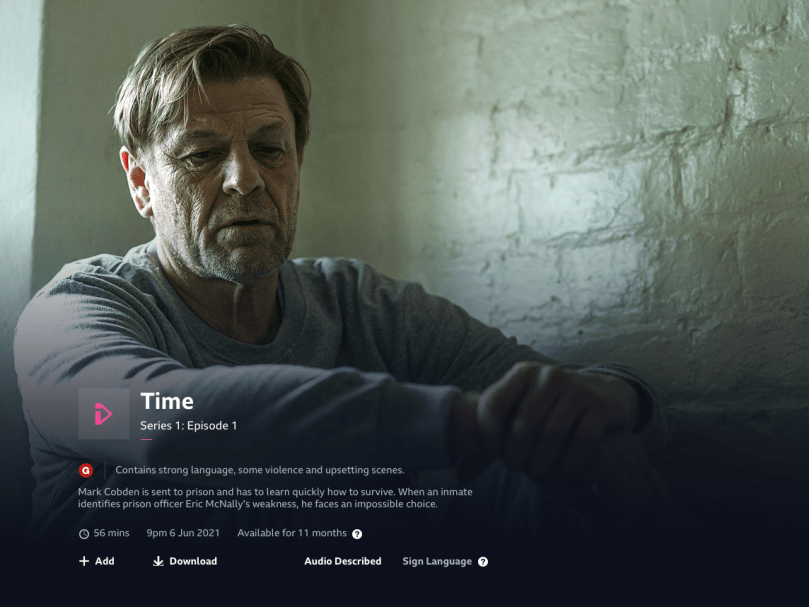
I ask this question in the wake of what must be one of the best television series in the past year: BBC One’s deeply uncomfortable and disquieting three-parter, Time.

It is described as: ‘Jimmy McGovern’s hard-hitting, brutally honest portrayal of a failed public service which gets everything right about prison life – minus the tedium.’ If you haven’t seen it – and sorry to my readers abroad if you can’t get BBC – I would like to invite you to watch it, even to dip into it for ten minutes. I’ll tell you why.

Having worked in many prisons in England, I feel everybody needs to know what is going on in them. In our name. There was nothing in the series that I didn’t recognise from my years inside. As I am up against a tight writing deadline for my book (and this blog actually!), I am going to allow the three episodes to speak for me and bear witness to the sheer illogic, and all too often, inhumanity of our current system.

This doesn’t apply to all prisoners, but if we recognise that many addictive, violent and destructive behaviours derive from childhood trauma; if we fully comprehend the impact of untreated traumatic incidents, then the cruelty of locking up people, who were first and foremost victims, in what are often little more than hell holes, becomes very clear. 

My admittedly provocative opening question stems from a genuine desire to understand the answer.

For decades, the adult-generation of Germans living through the Second World War have not been believed when they say, ‘we didn’t know’ (about the concentration camps). And people around the world often blame them for having looked the other way. I don’t want to get into that debate here. There is a consensus among historians that some would have known, some would have heard about them and not believed it, and others would not have known. Most of the camps were miles away in the east and there was little access to free press. There was also a deadly dictatorship controlling thoughts and actions. Yet not knowing, or knowing and not doing anything, allowed the deadly system to persist for as long as it did.

I have been talking to a wide range of audiences about my experiences of working as an artist in prisons for nearly three decades. The most common thing I hear afterwards is a shocked “I had no idea.” It’s totally valid, I make no judgment. There are loads of things I have no idea about. But why don’t more people know about this? There are prisons in nearly every major town. The shocking statistics of failure, the appalling conditions and the tragic stories of many of the people locked up in them are reported on all the time, in every form of media. How can we not know about them?

There is obviously a wide spectrum from having no idea, to knowing but looking away, to knowing and acting. I would just like to use this month’s blog to encourage you to become more informed, specifically about the system in which we warehouse prisoners. Not just for their sakes, but for all of us who live in the communities into which they are returned… usually worse.

When enough people ‘have an idea’, things can and will change.

Watching this series is a start. It’s tough watching, but the reality is much, much tougher.

I dare you not to look away.

Reviews:

Time review – Sean Bean and Stephen Graham astound in enraging prison drama

Time review – like a punch in the face, but in a good way

Time review: This gripping, gruelling portrait of life in prison is essential viewing

Let’s at least talk about it…

I know many people are finding plenty of reasons to slate Prince Harry at the moment: for his open criticism of his upbringing; for hypocrisy in privacy vs. publicity matters; for his ‘therapy speak’. 

I also know there is fierce resistance to what he is saying. After all, it flies in the faces of stiff-upper-lip Britishness and the Royal Family’s ‘play-the-game’ rules.

How about we put all judgment aside for a moment, and simply listen to – and hear – what he is trying to do. Because doesn’t it then become clear that he is trying to talk about some of the most important things that can affect us all? Things that haven’t been talked about nearly enough.

Unresolved trauma. 

Silence. 

And mental health.

No-one can accuse him of not knowing each of them intimately.

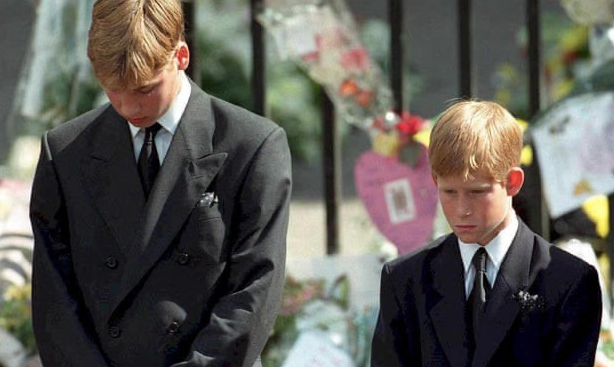
Prince William and Harry at their mother’s funeral in 1997

According to the leading charity, MIND, mental health issues went up by 20% between 1993 and 2014. Imagine the rate at which they are rising now, especially among the young. You just have to witness, as I recently have, a desperate twenty-something year old trying to access mental health provision in this country in order to see how woefully inadequate it is. And how much needs to be done.

From MIND

There is nothing new or wrong in recognising the potentially huge role parents and primary carers play in forming or, in some cases unfortunately, de-forming a child’s mental health. It’s not an attack; or blame. It’s just fact. So personally, I welcome Harry’s efforts to get us all talking about these things. And I can only recognise logic, truth and sense when he says:

“There is no blame. I don’t think we should be pointing the finger or blaming anybody, but certainly when it comes to parenting, if I’ve experienced some form of pain or suffering because of the pain or suffering that perhaps my father or my parents had suffered, I’m going to make sure I break that cycle so that I don’t pass it on, basically.

Or:

“It’s a lot of genetic pain and suffering that gets passed on anyway so we as parents should be doing the most we can to try and say: ‘You know what, that happened to me, I’m going to make sure that doesn’t happen to you.’”

People have been asking what ‘genetic pain’ is. I know the scientific fact-checkers at TED would have a lot to say about his use of the word ‘genetic’ in that context – they did about my single mention of it in my TEDx talk, which wasn’t even about genetic inheritance! He possibly means ‘generational’ pain, but, as I mentioned in last month’s blog, science often lags behind lived experience and the insights of other disciplines, so maybe his – and my – experiences will one day be proved to be genetically true as well.

I actually think that if more parents or grandparents learnt to ‘therapy speak’ about the hurt or trauma in their childhoods and lives, many destructive cycles would be broken. Of course it isn’t comfortable at the time. And yes, it can be extremely upsetting, especially if criticism of family members is voiced on a global platform. But feeling a need to talk openly and publicly is often a direct result of having been silenced. And the impact of silence on traumatic experiences is potentially devastating. It pushes raw, unprocessed emotions deeper into the psyche where, unexpressed, they fester like bandaged wounds deprived of the air that will heal them. And then the problems start. 

After over two decades of silence… of being silenced… Harry is now giving his wounds some ‘air-time’. And I hope the world will allow him to stumble and cock up royally (…sorry!) from time to time while he does his best to break new ground – just like his mother tried to do – and raise awareness of the insidious killer in our midst.

And what can we do to help the situation?

Maybe the first step is to start talking. And listening. Talking about things that have mattered… with your children and your grandchildren. With your parents and grandparents. With your wife, husband, friends. Because while silence may help you cope with something, it may not help those who come after.

So, talk about it… before it becomes too late. 

LINKS (as usual, a variety of viewpoints – some definitely not my opinion)

I talk about the impact of silence and lack of understanding surrounding intergenerational trauma in my TEDx talk – Facing the past to liberate the present

“The Me You Can’t See”.

Prince Harry appears to criticise way he was raised by his father – The Guardian

Prince Harry’s ‘Genetic Pain’ Comments Are Not Actually A Dig At Prince Charles – GRAZIA

Prince Harry’s ‘genetic pain’ is an insult to his grandmother. The Duke’s preoccupations with mental health and his parents reveal him to be as self-obsessed as any privileged millennial – The Telegraph

Prince Harry: I want to break cycle of pain for my children – BBC NEWS

Prince Harry says trauma of Diana’s death led him to use alcohol and drugs – The Guardian

What is genetic pain and can you inherit parental trauma? – The Telegraph

Meghan, Diana, drugs and therapy: what Harry said in Apple TV series – The Guardian

When it comes to human experiences, is ‘following the science’ always the right way to act?

For just over a year now, the world has been focused on ‘following the science’. And no doubt rightly so in many instances. Science is brilliant, in too many ways to list here. But… when it comes to human experience, its tools are often blunt, clunky or inadequate.

Sometimes, science lags behind human instinct or common sense. Sometimes, its microscopic focus loses sight of the macroscopic whole. Objective rationale overrides simple solutions seen by subjective understanding. Symptoms may be treated in isolation rather than as part of a highly intelligent organism. Other times, a phenomenon is too mind-boggling to be explained by logical process; love, death, black holes… That’s where art or religion, with their different toolset, have a go with varying degrees of success.

My recent TEDx talk – you can watch it here if you haven’t seen it yet – presents my experience of the transgenerational transmission of trauma or guilt. It’s an example of subjective experience gradually making its way to objective explanation. It is not a new idea. Way back, in Exodus Chapter 20, the bible talked of “…visiting the iniquity of the fathers upon the sons to the third and fourth generation.” In Shakespeare’s Merchant of Venice, Launcelot says, “Yes, truly; for, look you, the sins of the father are to be laid upon the children.” And over the past fifty years or so, symptoms of inherited trauma/guilt have been documented in descendents of a wide range of people exposed to traumatic events. However… because science doesn’t have the ability to prove it happens – not yet at least – some dismiss examples of such transmissions as being impossible, coincidental, imagined, nonsense.

But does that mean that it doesn’t happen? Is science right… or simply behind?

Take Post Traumatic Stress Disorder (PTSD), for example. Traumatic incidents have always been part of the human experience. And no doubt people all over the world have displayed symptoms of PTSD long before it was given a name. Yet the term ‘trauma’ only started to be explored at the end of the nineteenth century when Freud and his fellow pioneers of neurology and psychology considered it a diagnosis worthy of specialised treatment. When thousands of men returned from First World War fronts with psychological symptoms and medical conditions that had never been seen before, let alone explained, the British came up with the diagnosis of “shell shock.” Those who suffered from it were entitled to treatment – often hypnosis – and a disability pension. The sheer numbers, however, led the British General Staff to forbid the use of the term. Instead, “NYDN” (Not Yet Diagnosed, Nervous) was to be used and the afflicted were deemed undisciplined and lacking moral fibre. It wouldn’t be until 1941 with the publication of The traumatic neuroses of war by Abram Kardiner that it was recognised that any man could be affected by the atrocities of war and that traumatic symptoms were a normal response to an unbearable situation.

During the Second World War, psychiatrists continued to use hypnosis as treatment for trauma and veterans were offered improved practical and economic support. Psychological scars, however, were left unrecognised and untreated. From 1947, traumatic neuroses all but disappeared from official psychiatric language. 

The interest in trauma reignited in the seventies with the return of Vietnam war veterans who had such incapacitating symptoms that they were incapable of coping and functioning in civilian life. Many behaved violently towards their partners or became homeless and unemployable. But their symptoms continued to be labelled separately: alcoholism, substance misuse, depression, mood disorder or schizophrenia and treated accordingly, frequently without success. It was only when clinicians and mental health professionals working with Holocaust survivors, battered women, abused children and victims of accidents or rape collated their reports and discovered overwhelming similarities in their traumatised clients, that the range of behavioural, emotional and cognitive symptoms were combined into one psychological trauma diagnosis: Post Traumatic Stress Disorder. In 1980, after several rejections, this term would finally be included in the bible of psychology, the Diagnostic and Statistical Manual of Mental Disorders (third edition; DSM-III). 

For us today, it probably feels obvious that exposing men and women to abuse, war or anything that evokes extreme fear and helplessness would leave traumatic markers. And to a large degree science can now explain the mechanisms behind the process. That sense of ‘obviousness’ is how I have come to feel about the possibility of unresolved trauma or wrongdoing being passed onto the next generations, even though we don’t know how it happens. As I suggest in my TEDx talk, “our roots don’t just run backwards to our ancestors, but forwards to our children and those who come after. And if those roots are damaged or severed, what we hand on will also be impaired.

Many people have written to say my talk has resonated with their own experience of their forebears. But none of us can prove anything. And science will need time to develop the tools that can. Which probably means that the legacies of past familial, societal or historical traumas will not be taken into consideration when helping those afflicted by the often debilitating symptoms of depression, addiction, mental health… 

I think we need to be careful that this new emphasis on ‘following the science’ doesn’t pervade all areas of life. Even if we don’t yet understand the many complex ways in which transmission can occur, let’s give credence to the insights of people who have an innate or formally trained capacity to feel into a situation and ‘know‘ what’s right in the same way maternal instinct so often does. We have two sides to our brains for good reason. Currently the sceptical-until-proven logic of the left side largely prevails. But the non-verbal, intuitive right side has an equally valuable place, especially when it comes to imparting knowledge about our shared humanity. That’s an area where science often trails far behind.

I’d be interested to hear whether or not you think the experiences and insights I reveal in my TEDx talkFacing the past to liberate the future – need science to prove they are ‘real’?  

Related links:

The legacy of trauma: An emerging line of research is exploring how historical and cultural traumas affect survivors’ children for generations to come

Understanding and healing collective trauma – Thomas Hübl

Dr Gabor Maté: Transgenerational trauma, stressed environment and child’s diagnosis

Being inspired to be a ‘light in the darkness’ feels a powerful way to honour Holocaust Memorial Day

When it comes to Remembrance, I cannot think of a more important day to take time to reflect than today – Holocaust Memorial Day, the anniversary of the liberation of Auschwitz by the Soviet army in 1945. Eighty or so years lie between us and the horrors that started in Germany and then spread beyond. Most of the survivors of those times are no longer able to bear witness to them. And yet, for many descendents, that past will still be alive shaping their present. It is primarily for them, and all that they carry in their hearts, that I pay such attention to this day.

As readers of my blogs will know, any day of remembrance raises questions in me: what to remember, how to remember it and to what end? I’m always particularly interested in the editing process of our personal, collective and national memories. Which selection of people, events and actions we choose to remember and honour. And which get left out.

Edits of history come about for all sorts of reasons, not least because some memories are too painful… or shameful to re-visit. But what happens to things that happened, but aren’t included in the stories we tell about ourselves? What happens to those awkward truths or people that disrupt more favoured version of events? Obviously politics plays a big role in shaping a country’s historical narrative to support left, right or centre agendas. But I still ask, what happens to the inconvenient truths that get suppressed, denied or banished to the footnotes?

Plans for a Holocaust memorial next to Parliament

I found this recent article by Richard Evans in the New Statesman fascinating: How should we remember the Holocaust? It describes some of the multiple points of view in the on-going debate about the appropriate form, location, size, message and so much more of the proposed Holocaust Memorial and learning centre in the heart of Westminster. It’s complicated. This is exactly the kind of debate Germany has been engaged in almost incessantly since the eighties and that lies behind their extensive culture of ‘counter memorials.’ At one point it was even suggested that perpetual debate on the form of a memorial was possibly the best way to keep the memories alive.

I have many thoughts (obviously!) on what is said in the article, but I will spare you of them here (except one!) in favour of inviting you, on this day, to think about where you stand in relation to Holocaust remembrance. My ‘one’ opinion echoes that of Raphael Wallfisch, a leading international concert cellist whose mother was forced by the SS to play in the infamous women’s orchestra at Auschwitz. He insists that the proposed ‘British Values Learning Centre’ “must reflect clearly and truthfully, the complete and unvarnished truth of Britain’s role before, during and after the Jewish Holocaust…” This request for a fuller picture is echoed by many others in the Jewish community and beyond.

We are witnessing all around the world not only a rise in anti-Semitism, but also eruptions of rage as suppressed, uncomfortable truths surface. Covid-19 is giving us an opportunity to re-think how, what and why we remember. The Britain of today needs to rise to this challenge, now more than ever before. Of course, remembering and hearing the stories of the victims is paramount. But if we primarily focus on what Germany did and how the British triumphed over evil, we are missing a vital lesson. Britain also needs to look at, and learn from, what we as a nation didn’t do… but could have done.

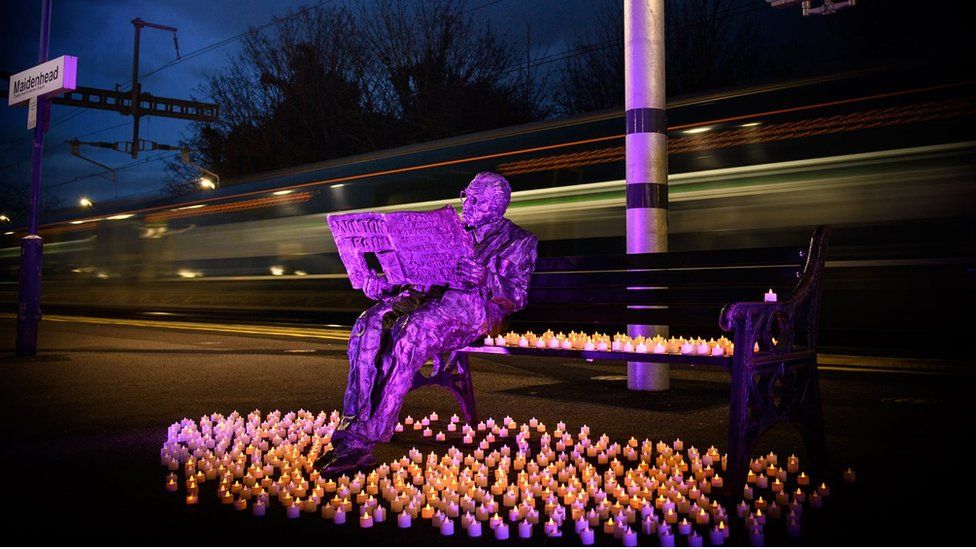
 Statue of Sir Nicholas Winton, the “British Schindler” at Maidenhead railway station

This man, Sir Nicholas Winton, could never be accused of not having done enough. Against all odds, he smuggled 669 boys and girls, destined for concentration camps, out of Czechoslovakia in 1939. Celebrating his unbelievable bravery and life-saving initiative with candles feels a truly fitting way to mark this day. We can all join in for households across the country are being invited to light a candle at 8pm this evening, as an encouragement to us all to “be the light in the darkness.”

A few more things here:

This 4-minute film is a deeply moving testament: Story of Nicholas Winton, BBC That’s life – Short version

Holocaust Memorial Day: Sir Nicholas Winton’s statue lit up: Article about the above lit-up statue

Article in The Conversation: Plans for UK Holocaust Memorial looked promising, but now debate has stalled

BBC 2: Confronting Holocaust Denial with David Baddiel

Should we be seeing the storming of the U.S. Capitol as Trump’s Kristallnacht?

On Sunday 10thJanuary 2021, Arnold Schwarzenegger, the Terminator action hero turned former governor of California, posted a short video on Twitter that went viral. Staring straight into the camera against a backdrop of stars and stripes, the man once known for his body-built body flexed his moral muscles by comparing the mob that stormed the U.S. Capitol with the Nazis.

“Wednesday was the Night of Broken Glass right here in the United States,” he said, referring to the horrors of Kristallnacht, the night of 9th/10th November 1938 when Nazis in Germany and Austria smashed the windows of Jewish homes, schools and stores and set fire to the synagogues. “The broken glass was in the windows of the United States Capitol,” he continued. “But the mob did not just shatter the windows of the Capitol. They shattered the ideas we took for granted. They did not just break down the doors of the building that housed American democracy. They trampled the very principles on which our country was founded.”

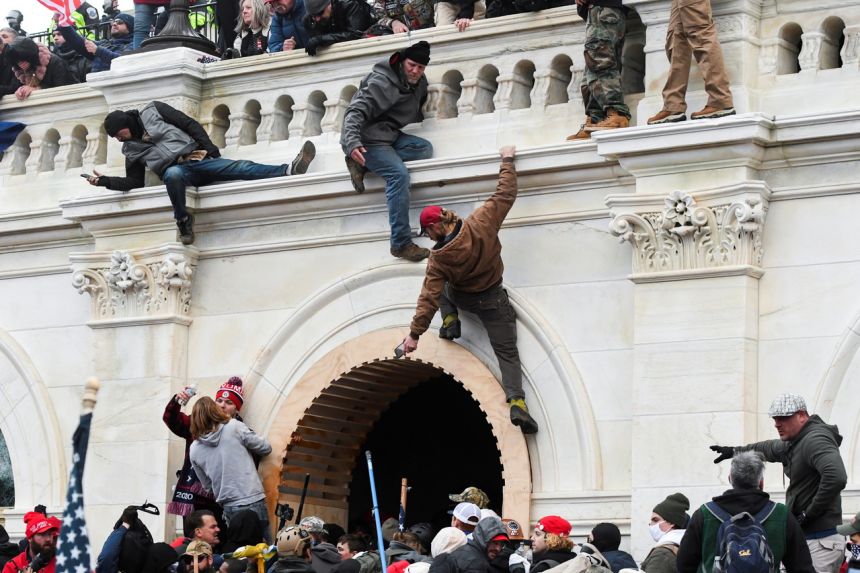
Witnessing, in real time, Trump-incited protestors scale white walls and balconies and swarm into the home of the U.S. Congress was truly shocking. Individually most looked pretty ‘normal’ with their caps, hoodies, beards – or horns – in place of masks. But as a mass emboldened by a collective mission, they felt sinister. A mob stitched together by the blatant, you’d think unbelievable, lies of their leader. Trump’s temper tantrum had turned a corner and stamped on the accelerator to become a genuine threat to life. 

But, though I admire Schwarzenegger for speaking out unequivocally, can you really equate what happened on 6th January with Kristallnacht? Are Trump’s ‘mobsters’ a valid equivalent to the rioting members of the SA (Sturmabteilung) and Hitler Youth? Is Trump an accurate counterpart to Goebbels? And finally, has democracy been shattered in the way Nazis shattered Jewish lives and livelihoods that night? I don’t think so, but I ask genuinely because making such serious comparisons to such a vast audience, albeit diluted by a schmalzy soundtrack and other comforting dollops of Hollywood, carries responsibilities and consequences. If it was America’s Kristallnacht, what should we and the rest of the world be doing about it?

Accurate or exaggerated, Schwarzenegger is certainly more qualified than most to draw such parallels. Born in Austria in 1947, he grew up with and among people who had lived through the Third Reich and Second World War: active cogs in the Nazi killing machine; passive bystanders, looking away but “going along… step-by-step… down the road;” or any of the other shades of innocence or culpability in between. 

What is indisputable in both scenarios – and recent ones here – is the role lies play in leading to things spinning out of control. But it’s intolerance that ultimately fuels these lies. Of course, there’s a healthy form of intolerance, which makes us speak out in the face of ‘wrongness’. But on either side of that, lie two unhealthy extremes: intolerance of anything or anyone that is different to us, ‘other’; and over-tolerance of that which may be familiar, desirable or comfortable to us, but that harms others.

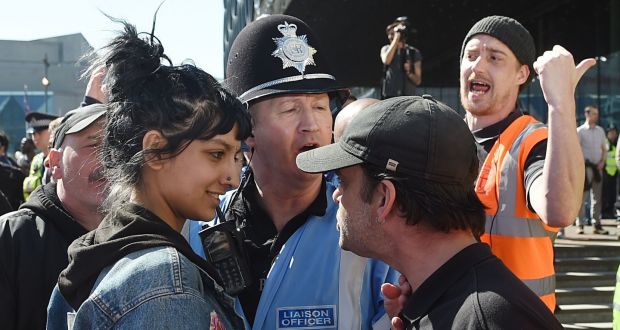
viral image of woman standing up to a far-right protestor

For me, a comparison to Nazi times is more helpful when applied to us… the ordinary people who, back in the 30s and 40s, inadvertently enabled their leaders to carry out murderous plans by doing nothing. Resisting was hard, for it could cost you, or your family, their lives. My mother’s best friend’s family vanished that way. Today, however, we can express a healthy intolerance of what we consider wrong, by resisting the temptation to see the mob as a collective ‘other’ made up of misguided cretins, uneducated loons, neo-fascists, Satan worshippers, conspiracy theorists… Some of them may well be any or all of those things, but they will also all be individuals – fathers, sons, mothers, neighbours – united in believing they are right and on the side of truth and goodness.

Maybe, to prevent re-enactments of Nazi times, we could (or should?) invest the time we spend judging, cursing and dismissing those we see as ‘other’, ‘bad’ or ‘wrong’ more wisely; by trying to listen to and understand them instead. That, after all, was what was neglected in the first instance. And people who feel unheard also feel they have to shout the loudest. And by having to shout, they become distorted versions of themselves. That is what we witnessed on Wednesday. It may sound fluffy or impossible and I am not in any way condoning or defending what happened in Washington. I am just trying to avoid becoming inadvertently complicit in deepening the division between ‘us’ and ‘them’. For we all know where that can lead. 

You can see some pictures here. Or read a bit more about what happened here.

Thoughts for a very different Christmas

With the recent news that Christmas has all but been cancelled, I find myself feeling the ache of millions of people’s disappointment. For so many, this is a joyfully anticipated time of year. I’m thinking of the stacks of thoughtfully chosen gifts, wrapped and ready… now abandoned. Of fridges and store cupboards swollen with traditional delicacies, all approaching sell-by dates. Of patient children and adults adapting their excited plans to visit grandparents and relatives to instead spend another day at home. 

This whole Covid-19 year has been one of dashed hopes and cancellations, but also of unexpected gains and joys. This winter’s repeated semi-lockdowns and the deadlocks of Brexit negotiations have tested us all further, even wobbling the initial sun- and spring-filled optimism of those who believed we would collectively shift values and become better human beings. For others, the tragedy of life-changing losses and trauma were there from the beginning. And for so many others still, life is existentially terrifying. 

I feel for everybody. For months I have talked, while pointing to the bottom half of my torso, of conscious or unconscious base layers of anxiety, sadness, fear and uncertainty forming the foundations of our days. Even if we are far from any front lines, they rumble on in the background like the constant hum of fridges of which we only become aware once they stop. It makes me wonder how this year will affect people long-term… in what ways it will take its toll. It will be healthy to listen and talk honestly to each other about how we feel.

From Everything is light by Jack Wimperis

But back to Christmas – not my favourite time of year I have to admit. Because as joyful as it is for some, as miserable it is for others! Christmas has an uncanny way of enhancing and exacerbating all the glitches in one’s life, all the things that are ‘wrong’ or missing. Whether it’s the separation from or loss of a loved one; whether it’s sickness, loneliness, homelessness, poverty… the list is long… all are strangely amplified by the oft-stressful and largely commercial insistence on excess and jollity. 

Which is why I really hope that this year, many people will find it easier to access that quiet place of inner peace and happiness that is not reliant on outer conditions; that place where ‘all is well,’ as the saying that has kept me sane since March goes; that place where we simply love and feel loved. So, at great risk of sounding like a Christmas Day sermon, I’d like to suggest that this year presents us with an opportunity. One where rather than focusing on the tinsel and turkey that we may or may not now have, we focus on the essence of that all-too familiar scene that started this whole loved or hated festival off in the first place: that of a stable, a star, a newborn baby and lots of straw. Surely, whether you are religious or not, it deserves at least a nod? 

Ok, so this blog is sounding like a sermon. But just maybe the stable could represent gratitude that we have shelter and warmth (if we indeed do).

Maybe the star could inspire the sense that something much, much bigger than us exists.

Maybe the newborn baby could fill us with love, tenderness and kindness to the planet, each other and ourselves.

And maybe the straw could remind us that we are simply lucky to have whatever and whoever we do have. Oh no, I feel an ‘Amen’ coming… 

Happy Christmas to you all!

New haircut… super short to last for months

The time to remember that ‘to the world he was a soldier, to us he was the world’

‘Tis the season to remember… and yet, this year, for the first time, I forgot. Remembrance Sunday was almost over before I suddenly remembered to remember. 

Locked down at home, I was definitely silent. But maybe the official 2-minute silence at 11am passed me by because in my talks and blogs I am frequently remembering. In fact, ‘looking back’ has become part of my identity, my expertise even. So much so that I have been selected, as one of nine speakers, to do a Tedx Talk on the subject: Facing the past in order to create a fairer future.’ It’s an exciting opportunity though unfortunately lockdown has forced the proposed date of 29th November to be postponed until the spring. It will happen though… like so many other things in this disorientating Covid world in which we are currently immersed. 

In the meantime, if you haven’t attended my talk on How Germany Remembers and would like to, there’s a chance to hear it online on Friday 13th November at 11.30am. It is being hosted by the National Army Museum in London where I spoke last year. You can read more about it here and you can register for free here.

But back to remembering… or forgetting in my case. Maybe there are some of us who feel a little tired of remembering. Or maybe it’s the national narrative we tell ourselves each year, that is tiring. This is one of the points made in Radio 4’s ‘Our Sacred Story’ in which Alex Ryrie, Professor of the History of Christianity at Durham University, suggests that the Second World War is both our modern sacred narrative as well as the shaper of our collective sense of what constitutes good and evil. 

This summer we celebrated the 75thanniversaries of VE and VJ Day. In fact, we’ve done loads of national remembering over the past years. So aside from Remembrance fatigue, I’m wondering if Covid’s restrictive squeeze on lungs, lives and events alike, is also impacting what and how we remember. Lockdown has been turning mindsets inwards, shifting focus and values onto all that is immediately around us – family, gardens, quiet streets or empty skies. Maybe this new way of being is merging effortlessly with the existing sub-stream of thought that strives for essence rather than glitzy, sparkling veneer. 

Looking at the BBC coverage of Remembrance Sunday, it is clear that even our mainstream institutions of commemoration are being forcibly stripped of excess. I salute the efforts of all involved in trying to evoke the all-too familiar rituals, yet nothing could distract from the extraordinary visuals of sparsity. Watching the morning ceremonies at the Cenotaph, one could be forgiven for not knowing where one was. The eerily still Whitehall dotted with a few socially-distanced, poppy- and wreath-bearing dignitaries resembled a set construction of a movie whose budget couldn’t stretch to more actors. And in Westminster Abbey, the Queen, bless her, hatted and masked up in black, couldn’t help but look a little like Darth Vader as she gently touched the white myrtle wreath that was then laid by a masked serviceman upon the Grave of the Unknown Warrior. 

I couldn’t sit through the empty-seated Royal Albert Hall festivities that in the past have both grated and made me cry against my will. Instead, I sought the essence of remembrance in other areas. I soon found it in the podcast, We have ways of making you think. In their Episode 203 on Remembrance, historian James Holland and comedian Al Murray were in conversation with Glyn Prysor, former historian of the Commonwealth War Graves Commission. Between them they brought to life the history of the ubiquitous white headstones that fill acres and acres of land both here and on the continent. 

Set up in 1917 while World War One was still raging, the process of burying in the region of a million war dead, half of whose remains were missing, demanded a very new way of thinking. In a departure from the Victorian hierarchy of worthiness that extended into death and resulted in the common man just being ‘bunged’ into a mass grave, the Commission made a move towards inclusion. It wanted to evoke the sense that everyone had contributed to the war and everyone was equal in death. The outcome was a uniform design for all headstones that would make no distinction between wealthy and poor. This was of course deeply controversial. Individuality would only be marked through the listing of name, rank, unit, regimental badge and date of death. An appropriate religious symbol could also be added, or not. And a space at the bottom was dedicated to personal messages from family members, some of whom would never be able to travel to the continent to visit the graves of their loved ones. 

Covid has been highlighting the need for a similar leveling process across our hierarchies of wealth, fairness and opportunity. As in war, it is the personal losses and tragedies that will far surpass and long outlive the victories or shenanigans of the politics. In that vein, I found the essence of remembrance in an inscription spotted on a war grave in Bayeux:

Into the mosaic of victory, our most precious piece was laid.