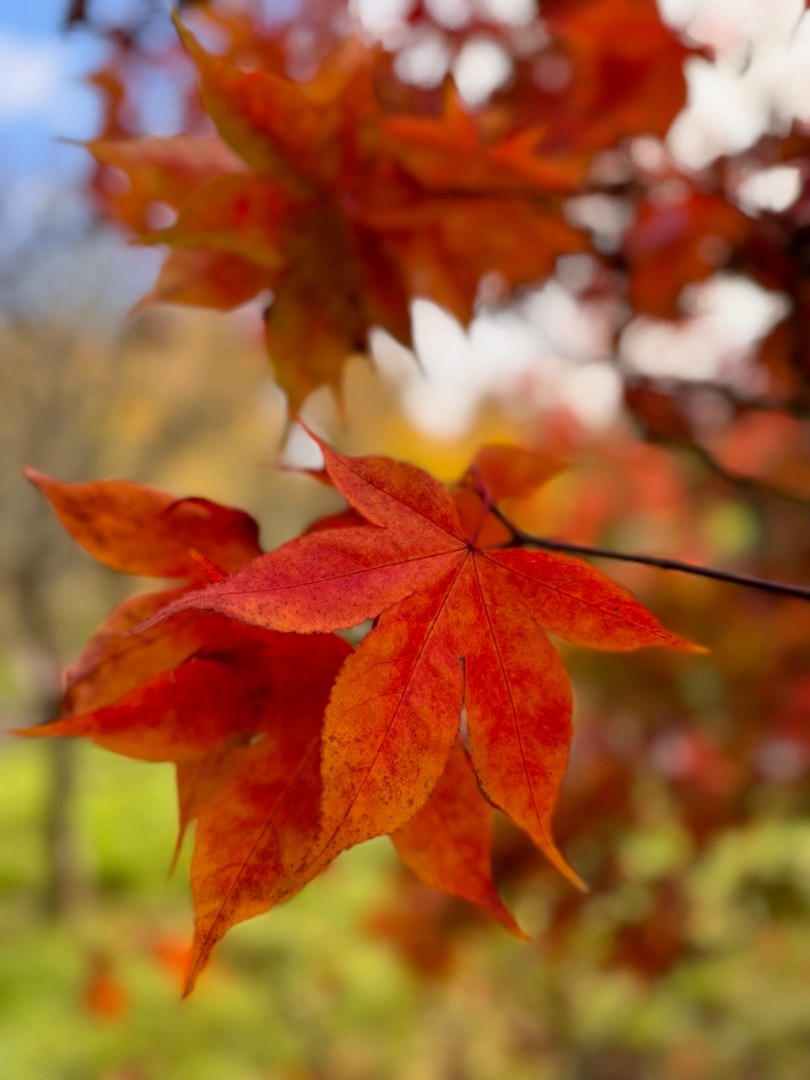
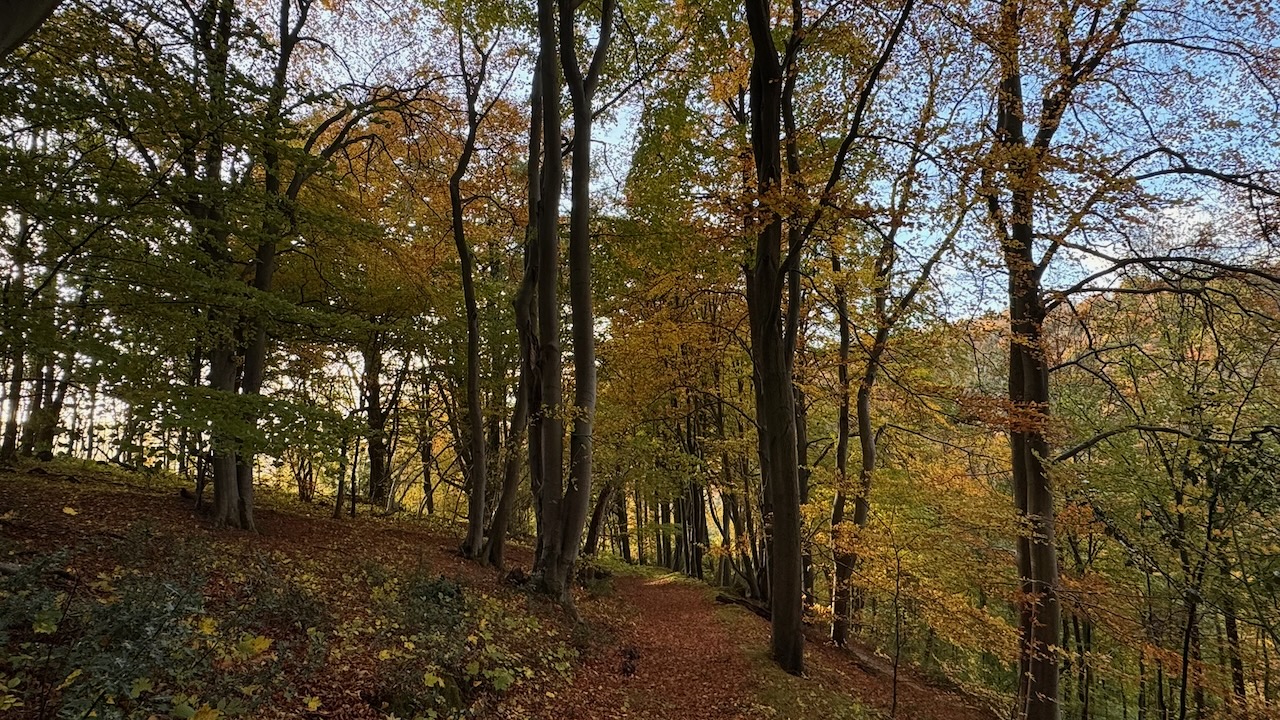
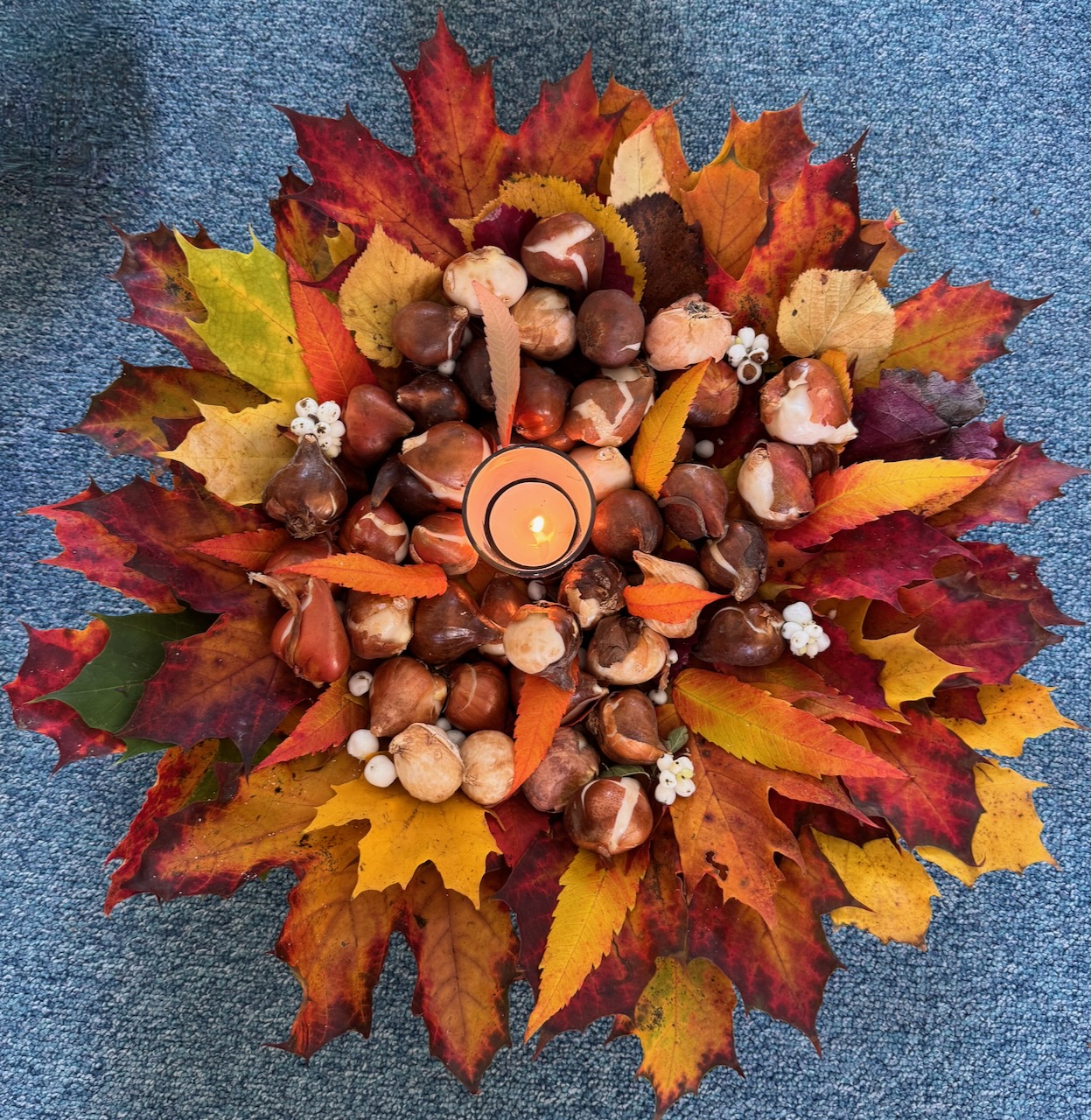
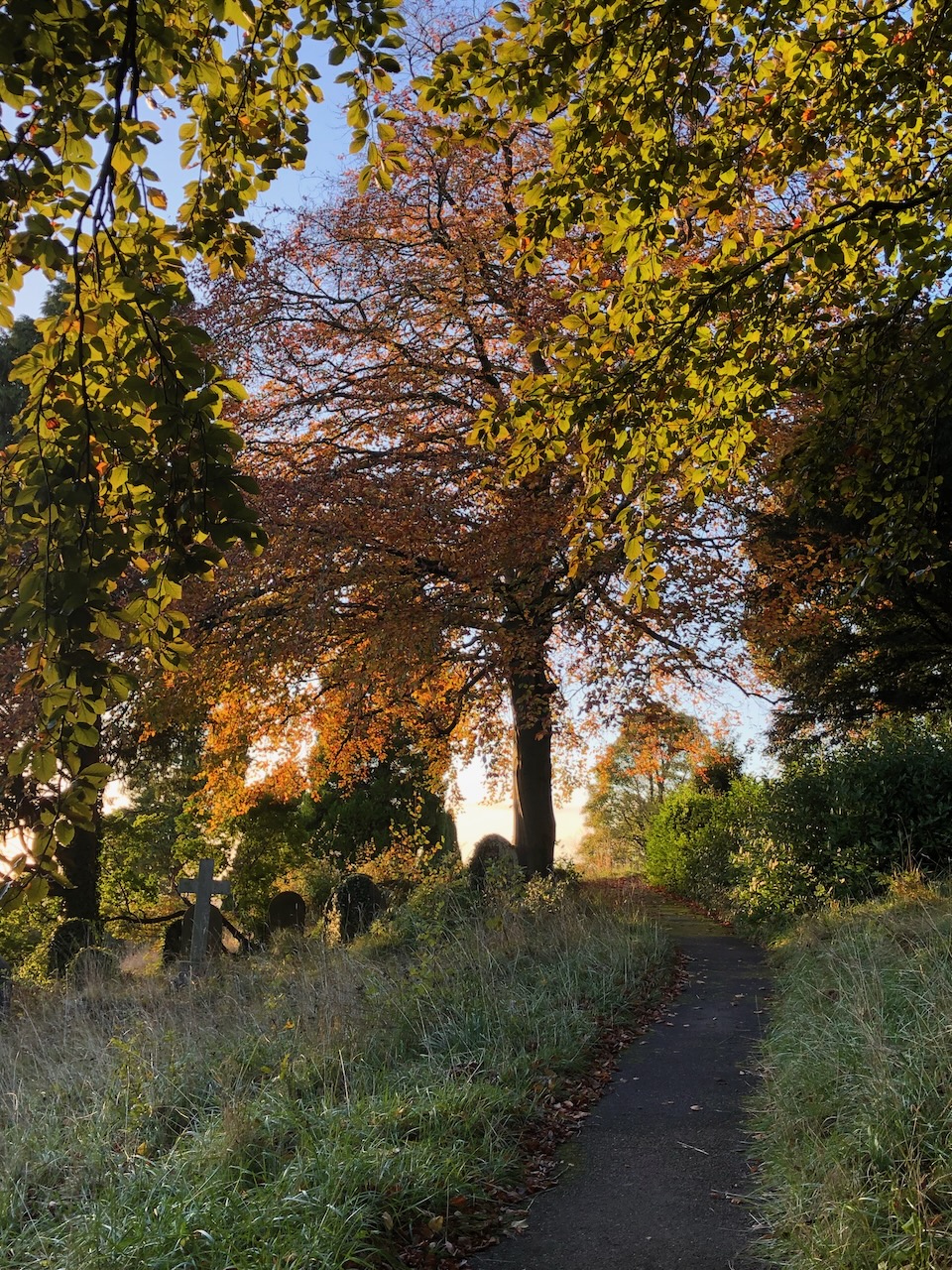
I normally plant bulbs on Remembrance Sunday. But this year I’ve been ill. Instead I went for a gentle walk in nearby woods, silent but for the breeze combing its way through the upper branches.
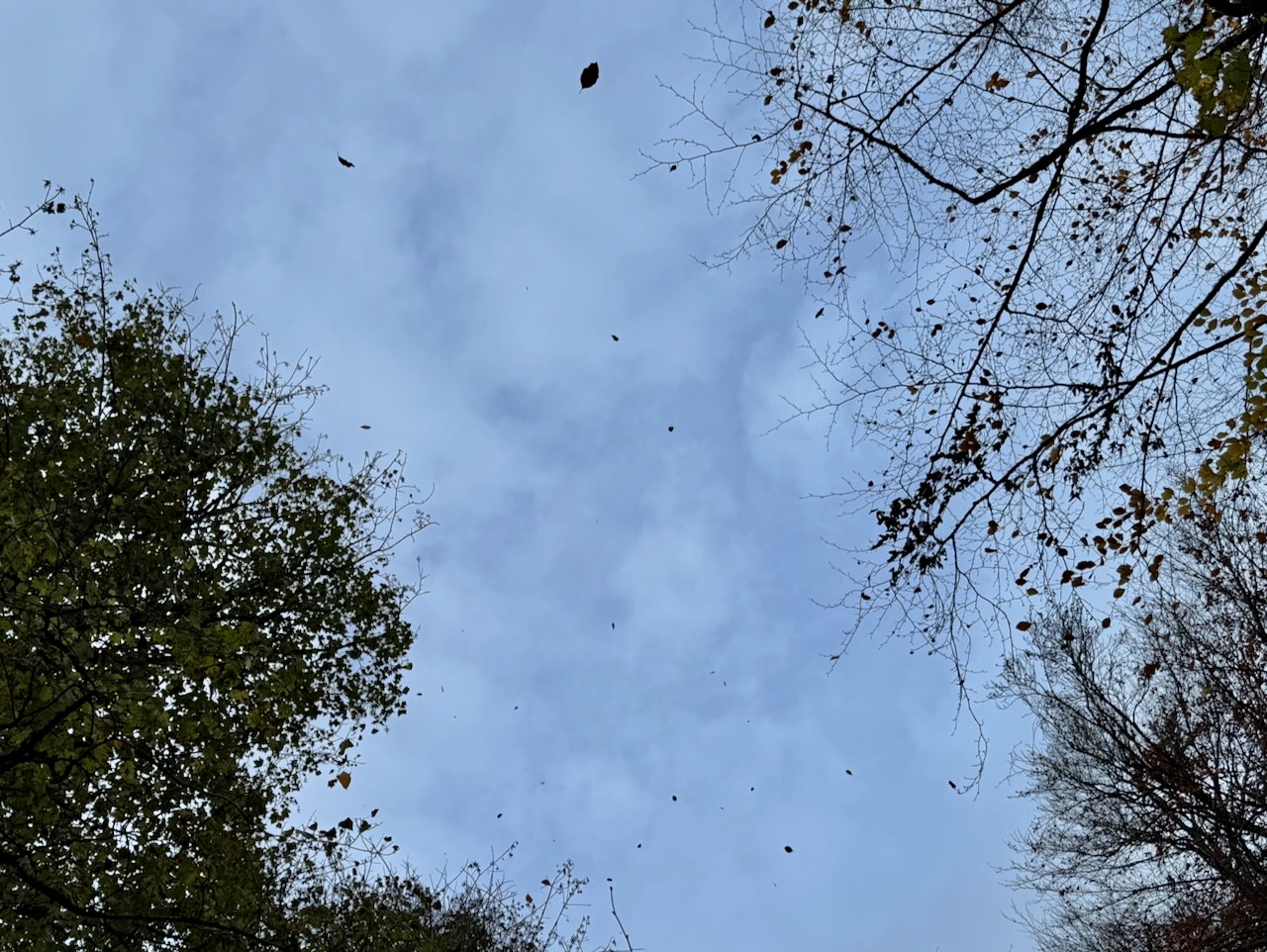
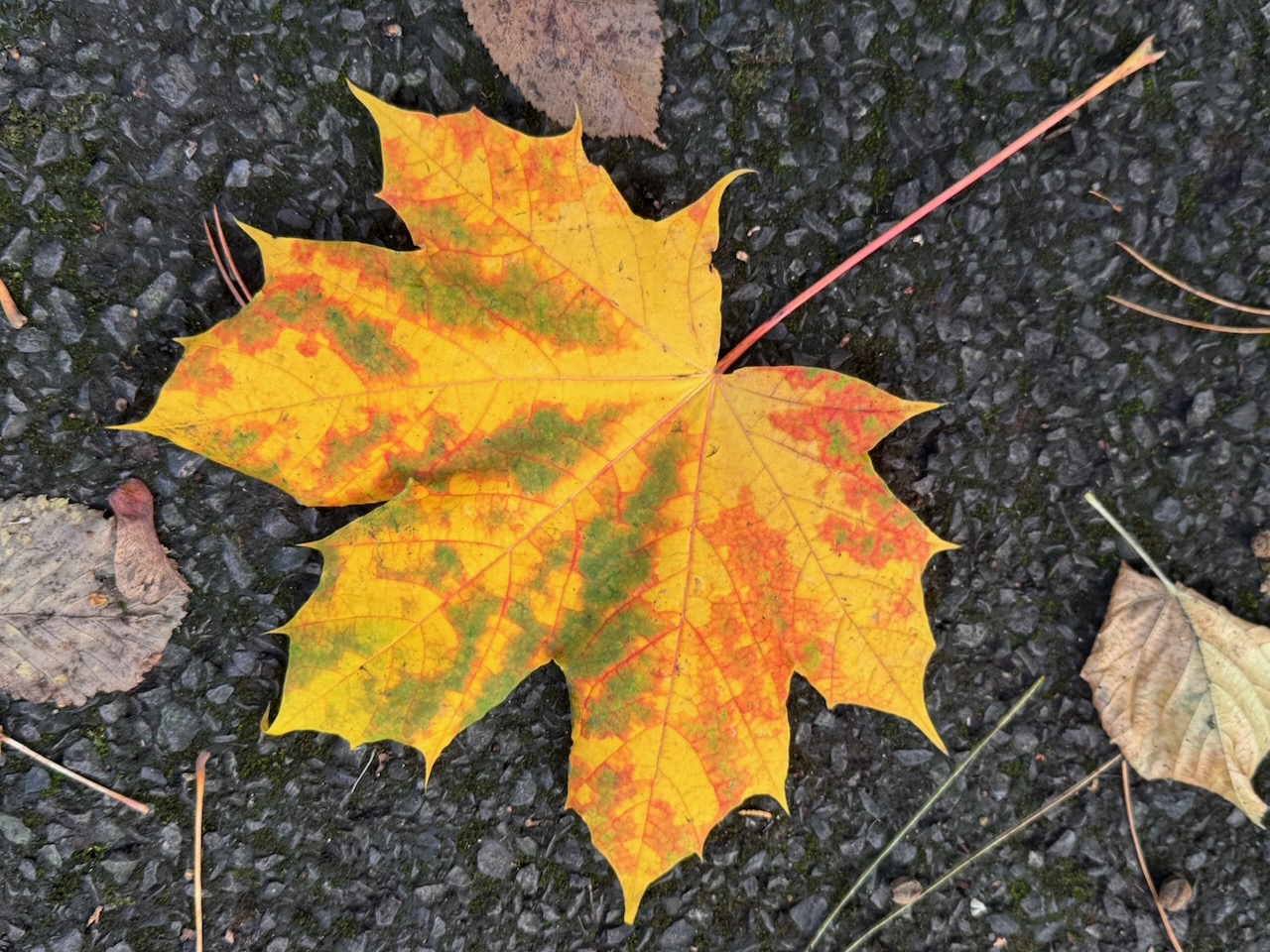
Down below, all was still. Except for individual leaves falling like snow. Each one taking its moment to break from the twig to which it had been rooted since the spring and dance in a series of pirouettes, twirls and summersaults before landing quietly among the already fallen. Unseen except by a chance walker.
Do they pick their moment, or are they plucked from life?
A certain readiness is a prerequisite for each leaf to fall. In summer, winds can howl through the branches and yet the leaves remain bound to the tree, weathering the storm, held in place by life forces that ebb and flow in synchrony with the seasons.
Death is natural for these fallen.
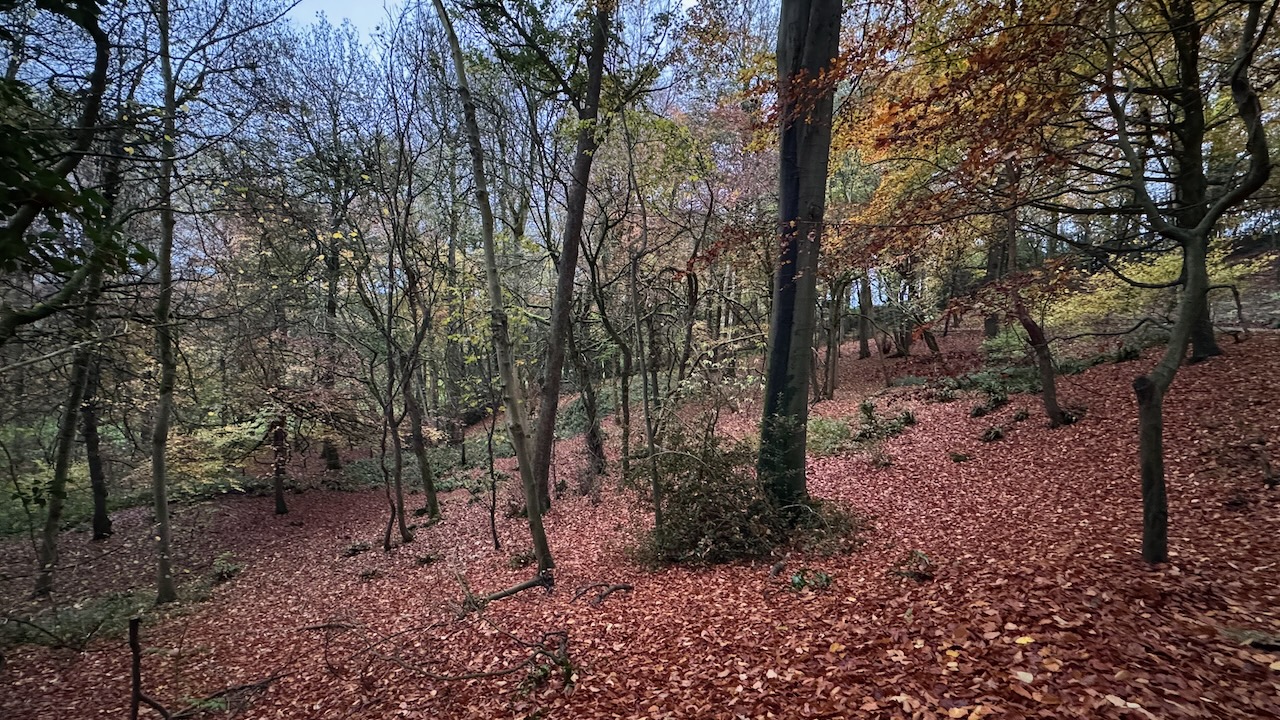
As I shuffle through the carpet of rust and gold, the rustle so reminiscent of childhood memories – kicking through the golden floors of beech forests in little rubber wellies – I can only ponder the dead. The war dead all around the world. The families they left behind. The scars of loss, grief, trauma and silence that remain in their wake, often hidden for generations, shaping the souls of those who come after.
We call them the fallen. It softens the reality of how they died. But while we remember them with warm hearts and deep gratitude, let us – with all the advantages of hindsight – not forget the utter horror, violence and futility of war.
As countries around the world build their armies and arsenal, let us refrain from falling into the trap of thinking war can ever be a solution to political, religious, geographical or economic problems.
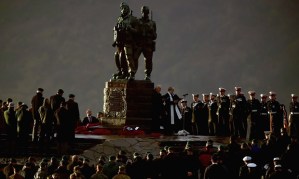
‘Tis the season to remember. In our progression through the grey gloom of this autumn [just 18 minutes of sunshine since 28th October apparently!] and the celebrations of Halloween, All Souls, Samhain, Guy Fawkes and November 11th, the dead take centre stage. Leaves and forest floors redden while poppies bloom on jacket lapels, village monuments and shop counters. This Sunday in London, as on all Remembrance Sundays, red wreaths will be laid by royalties, senior politicians and Commonwealth High Commissioners before some of the last surviving WW2 veterans march or are wheeled past the Cenotaph.
We have been collectively remembering Armistice Day since 1919, the first anniversary of peace at the end of World War One. Remembrance has since been extended to both World Wars and all those who have given their lives in service to defend our freedoms. It is a hugely important day for the British, the Commonwealth and many other countries around the world, albeit not in Germany. There, since the Middle Ages, 11am on 11.11 has marked the start of the carnival season and, on a more serious note, Armistice Day is not considered to have welcomed the beginning of peace but years of intense unrest and far worse horrors to come.
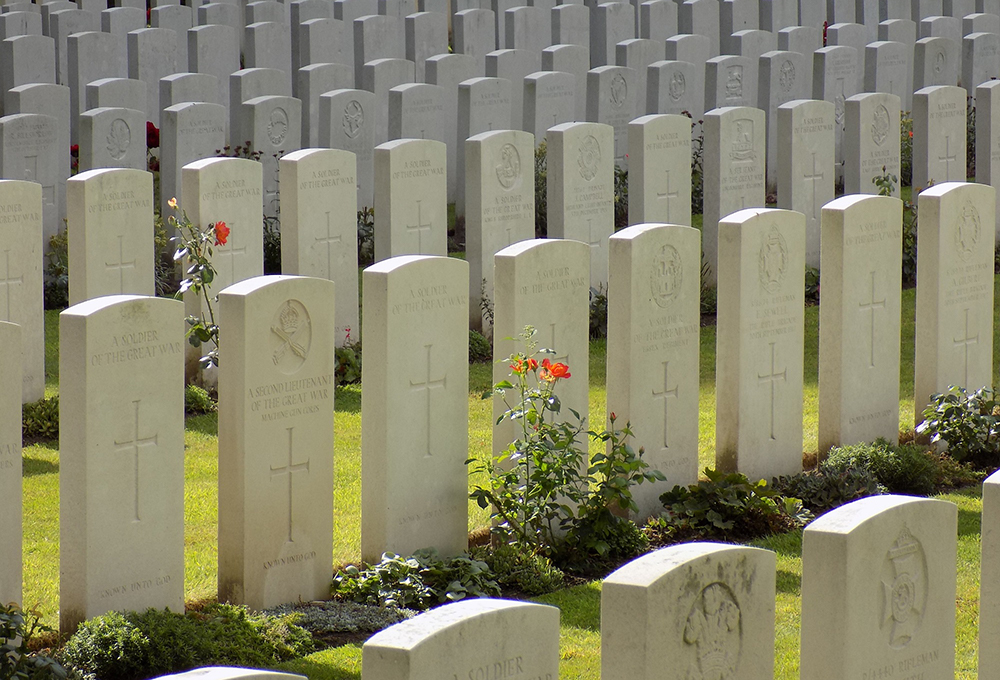
British and Commonwealth dead
I often dedicate my November blog to our traditional, deeply moving and impeccably executed rituals of remembrance, but not always without a little questioning too. Through the 15 years of research for In My Grandfather’s Shadow, I came to appreciate a far broader narrative of WW2 remembrance than that which Britain generally embraces and teaches. Granted there has been welcome progress over the decades with the inclusion of women as well as the huge contributions and sacrifices made by Gurkha, Indian, Sikh, African and Caribbean servicemen, among others. But there is still widespread ignorance of the bigger context.
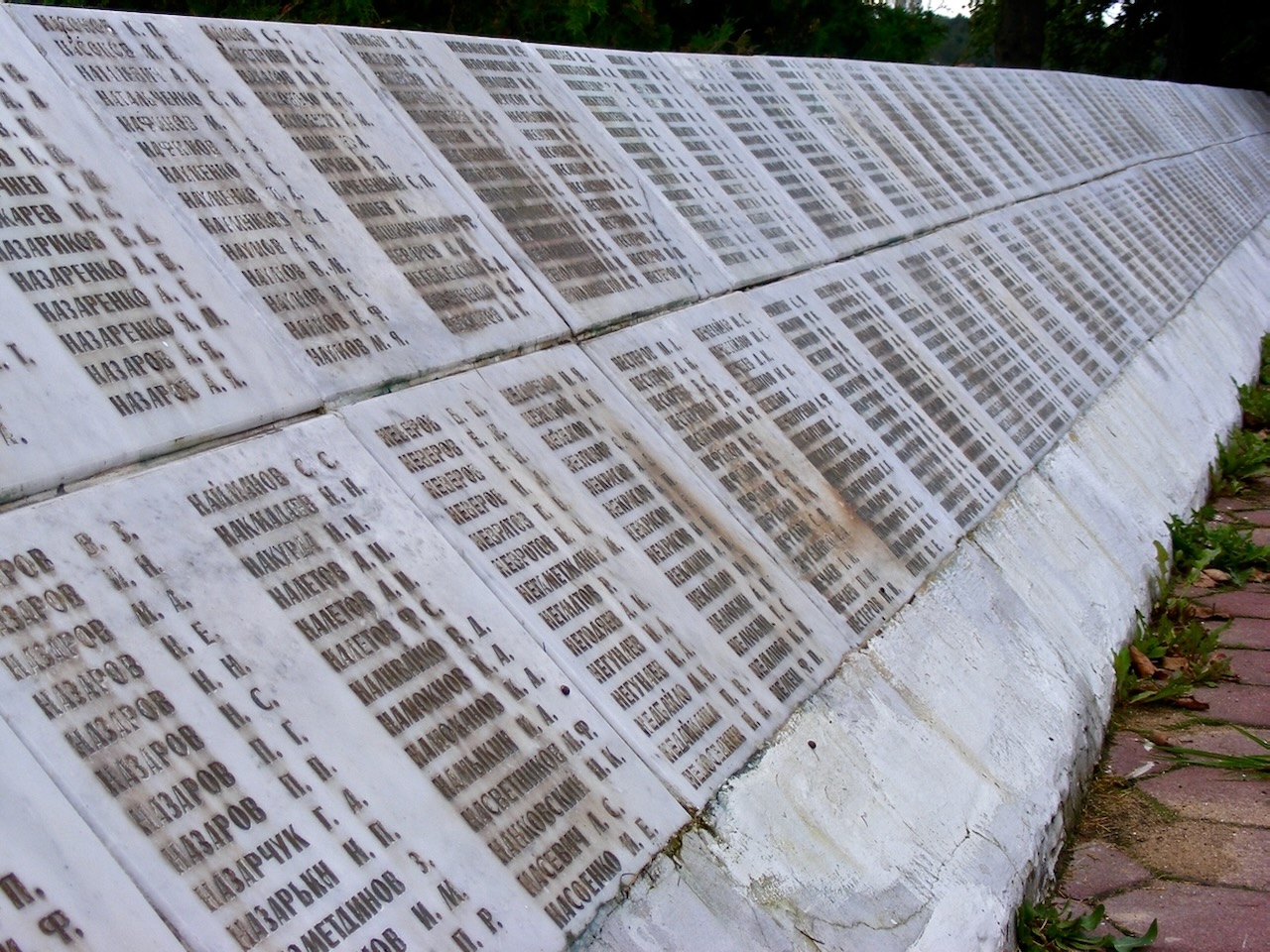
Russian dead
When I give my talks, I often use statistics. They provide a solid, black and white foundation of fact to my more psychological / philosophical ponderings. So often these figures shock. For example, when I ask people to guess the total losses, including civilians, of say Russia, Germany and Britain in the Second World War they are usually so far out that they themselves are horrified. I challenge you to make a guess… I’ll put the answers at the end of the blog. One man literally went white when he realised how wrong he had been in his thinking or, by his own admission, his lack of thinking. Another woman recently wrote to tell me how my book had opened her eyes in so many ways. “First off,” she said, “the big realisation of how little I have understood of the two world wars, my ignorance of those times and the aftermath.” This despite attending remembrance services all her life.
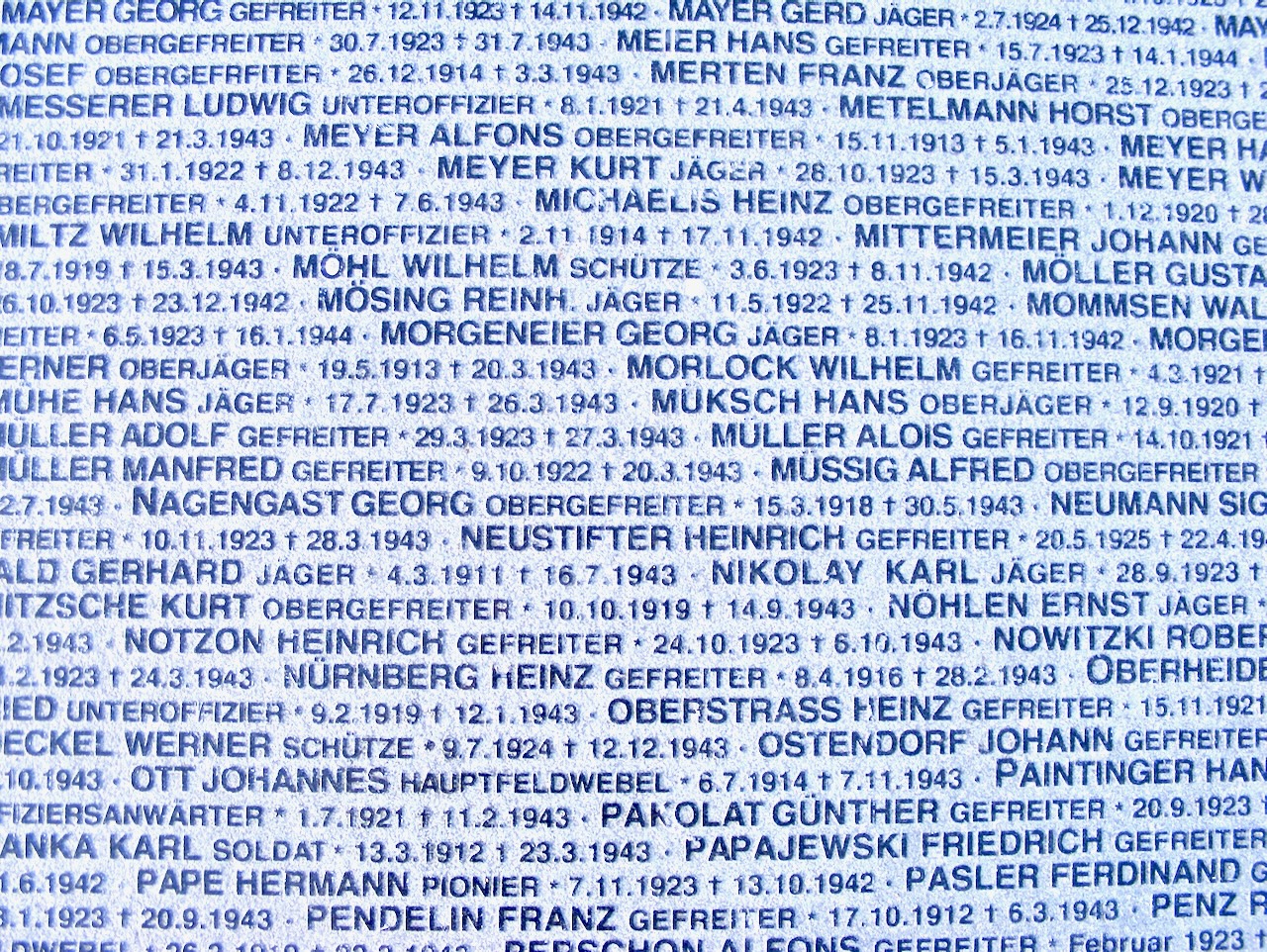
German dead
The quantity of deaths doesn’t mean each death was any less keenly felt. But I think she voices what is probably true of most of us. I certainly was ignorant of the broader landscape of loss and destruction, and no doubt still would be if I hadn’t had German roots that needed excavating and hadn’t made trips through Germany and Russia that exposed me to other ways of looking. The World Wars are the episode in history with which the British are often accused of being unnaturally obsessed. And yet, as a nation, we often present it as a deceptively straightforward story of good triumphing over evil. The victors write history after all.
Every nation has its ‘chosen traumas’ and ‘chosen victories’ which serve as cornerstones to its identity and prevent true healing from the past as they continue to play out in the present. We frequently have binary views of how we should feel based on – to use the reader’s words again – “simplistic, reductionist understanding… goodies and baddies…” Rarely have we “considered what it must feel like to have a different identity…”
I really appreciate and admire this woman’s soul-searching honesty. The humility and gentle opening to hearing the other sides’ stories gives me huge hope.
Healing, reconciliation, peace, forgiveness… all goals we strive for within our culture of Remembrance… can best come about when we become familiar with and find some understanding for the other side’s experience. Maybe, with our greater distance from both the acute trauma and the impassioned jubilation of our forebears, that is what generations now and in the future can strive to do more of.
Answer to my statistics question: Out of the around 60 million people killed in WW2, 26 million were Russian, approx. one third of them military and two thirds civilians. Between 7-9 million Germans died, roughly 6 million were soldiers and 3 million civilians. In the United Kingdom, just under 451,000 were killed. That’s 383,800 military, including combatants from overseas territories (Crown Colonies and the Indian Empire), and 67,200 civilians.
The Remembrance Sunday of 2022 will be one of thankfully few since 1945 that sees another war in Europe raging. As we remember those who lost their lives in past wars, fellow Europeans will be losing theirs in the all too real conflict fighting itself out in Ukraine.
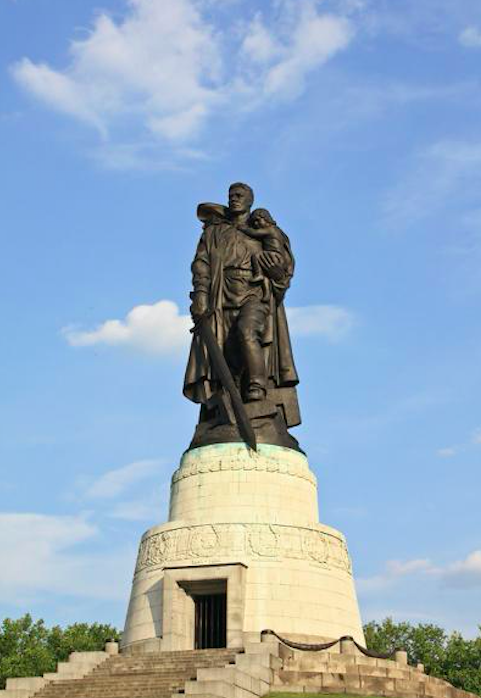
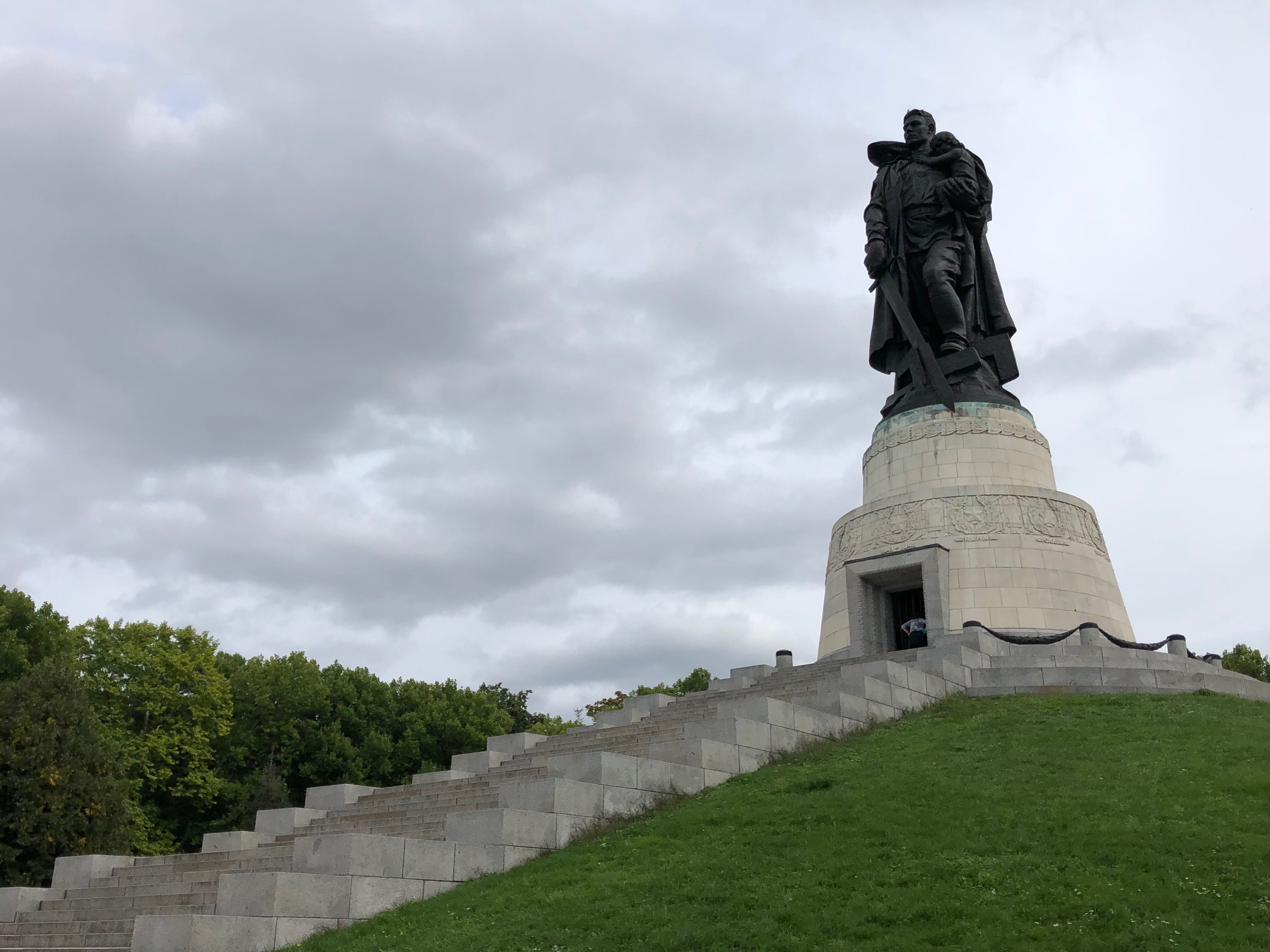
In my last blog I wrote about travelling the Berlin Wall Way, itself a form of 100+ mile-long memorial remembering both a repressive episode in history and those who lost their lives trying to escape it. Well, a little off that route in what was central East Berlin is Treptower Park, the largest Soviet military memorial outside the Soviet Union. Opened on 8th May 1949, it is a 10-hectare cemetery for 7000 of the more than 22,000 Soviet soldiers killed in the battle to take Berlin in the final months of the Second World War and contains the world-famous symbol of the role played by the Soviet Union in destroying National Socialism: the 13-meter towering statue of a Soviet soldier holding a lowered sword over a shattered swastika and cradling a rescued German child in his arm.
The Soviet Warrior Monument built by Yevgeny Vuchetich
To experience this place is to experience a sense of the enormity and profundity of the impact WW2 had on the Soviet / Russian people. For a start it is vast. And the extensive layout is designed to take you through a process of mourning and remembrance to honouring the victors as heroes and liberators.
‘Heroes and liberators.’
We too use those words in relation to our own soldiers. But how often have we – or do we – actively honour the decisive role the Soviet soldiers played in defeating Nazi Germany? And how often do we include the mind-boggling numbers of Russians murdered or killed in the process (25 million to give a rough/round figure) in our process of remembrance? We don’t really, is the only answer I can find. And yet they were our allies in a war that we, as a nation, have made central to our national identity. Could our slightly introspective leanings and lack of acknowledgment of the Soviet sacrifices and achievement (among many other factors, not least the horrors of the Stalin era) have contributed to the attitudes of subsequent regimes and politics towards the West? Just a question… but one that walking through Treptower Park certainly made me ask.
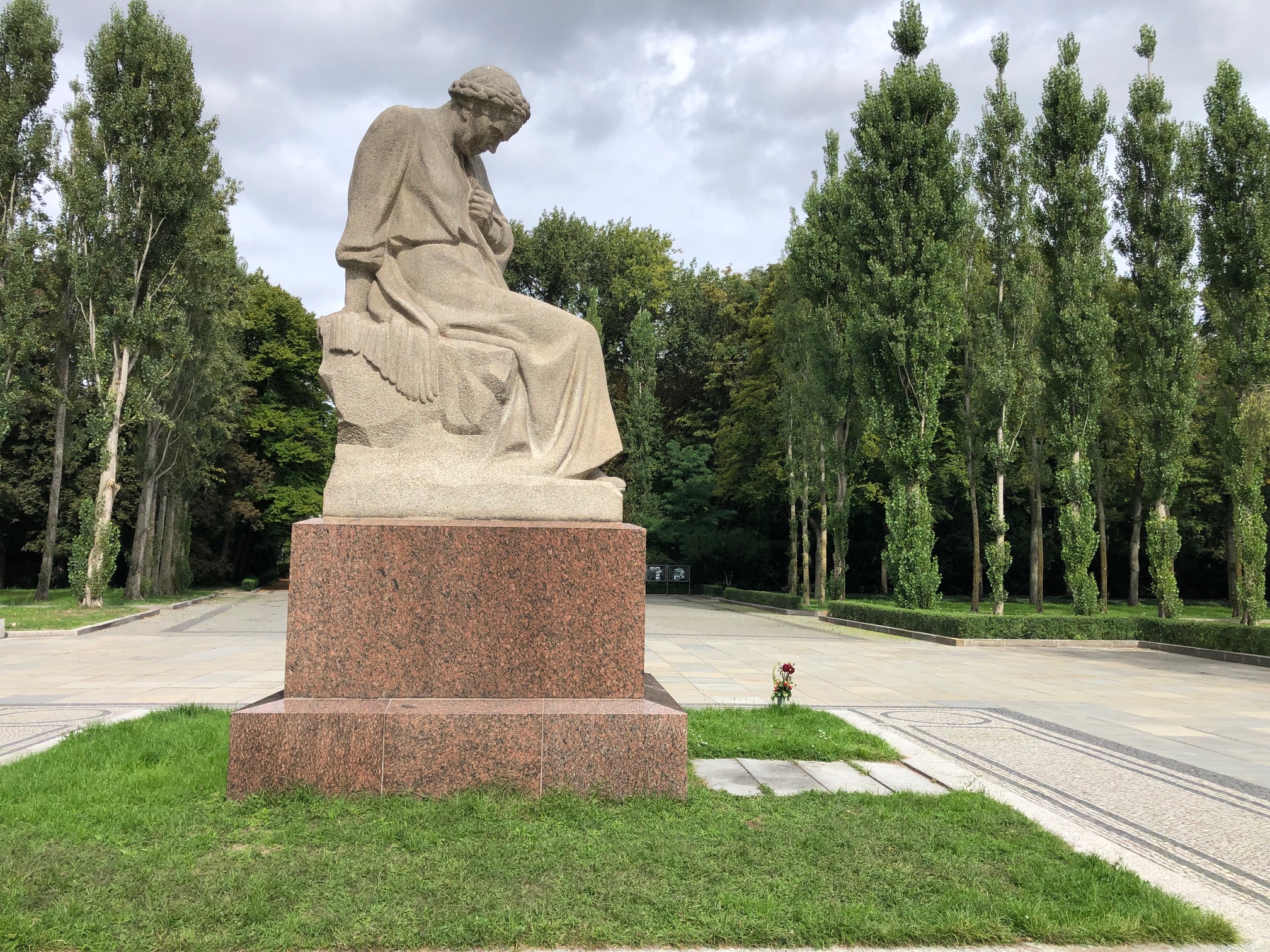
‘Mother Homeland’
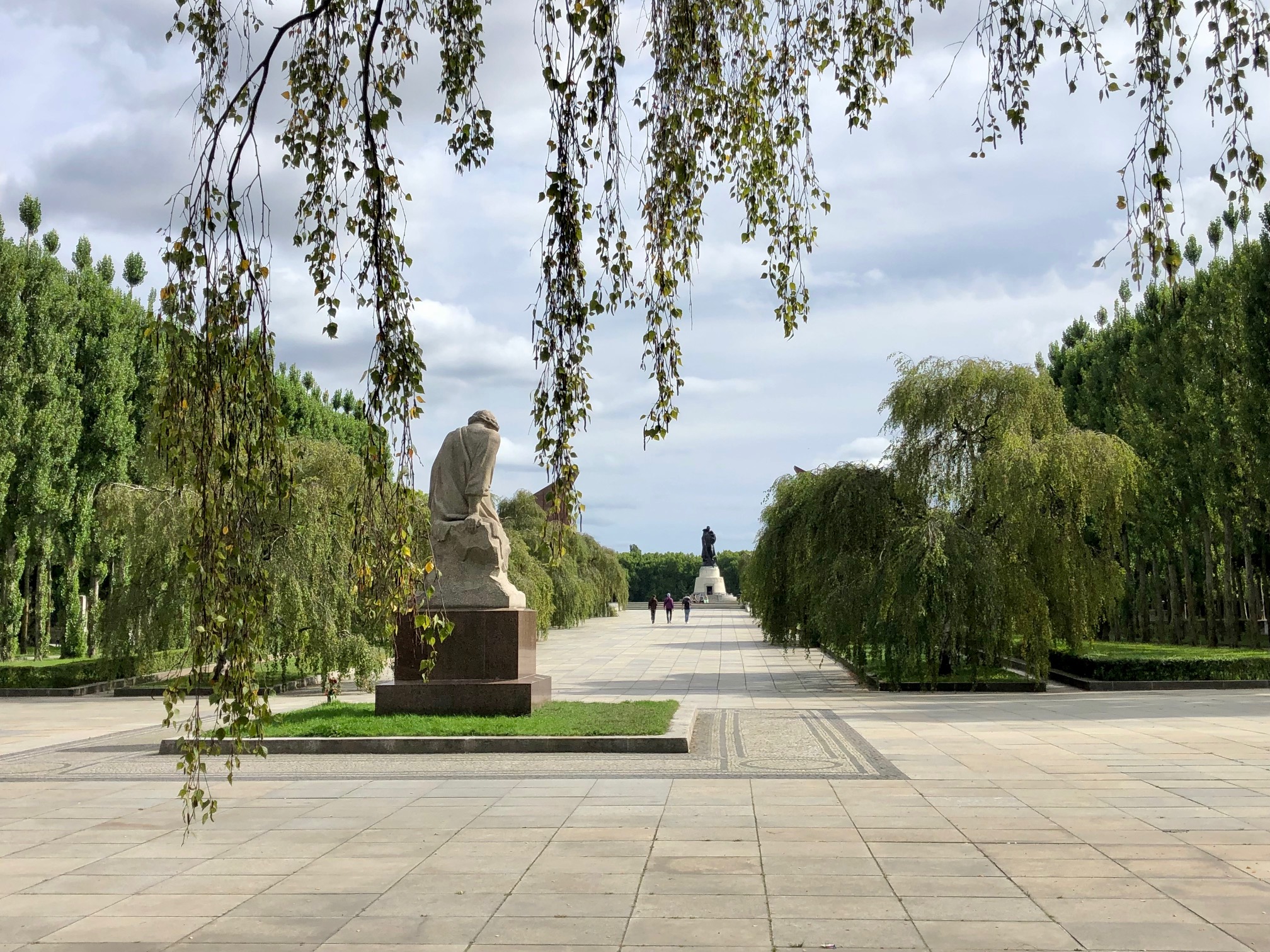
Entering through one of two avenues, the (tiny) visitor is led first to the statue of a grieving “Mother Homeland.”
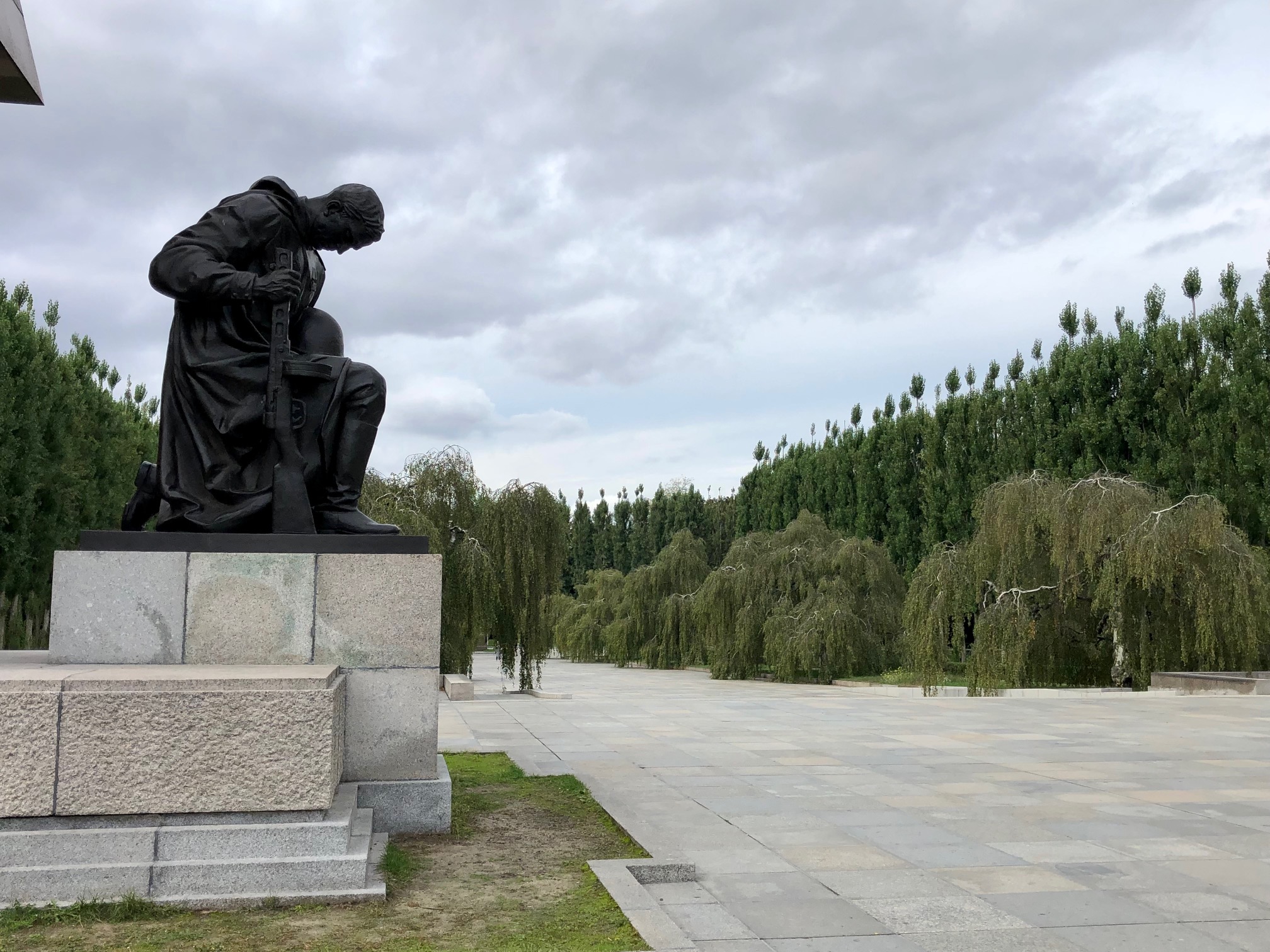
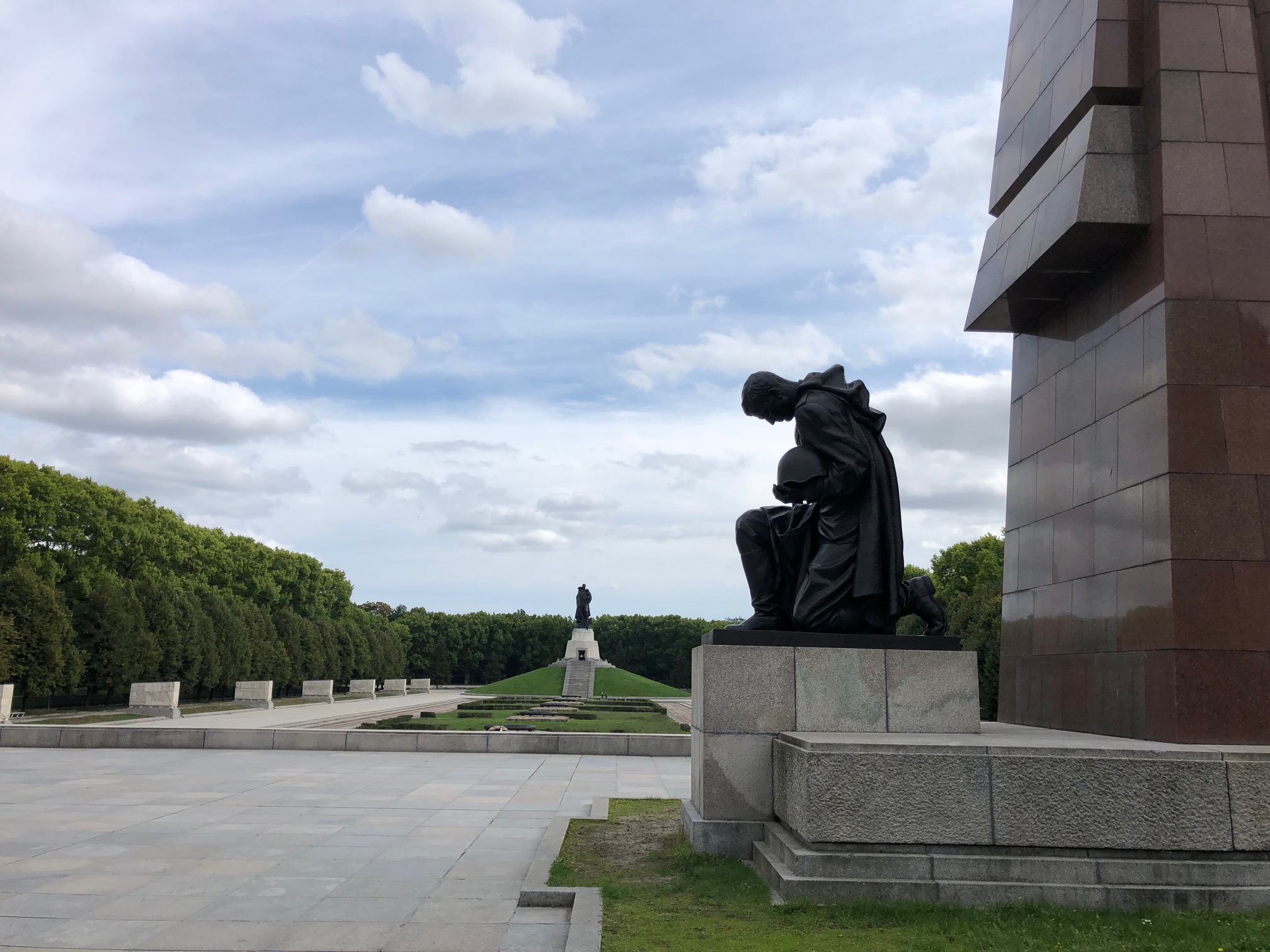
From there a promenade lined with weeping birches – incredibly moving witnessing trees seemingly crumpled in grief – you arrive at two sphynx-like kneeling soldiers that act as guardians to the cemetery section below.
Looking back to the avenue of weeping birches
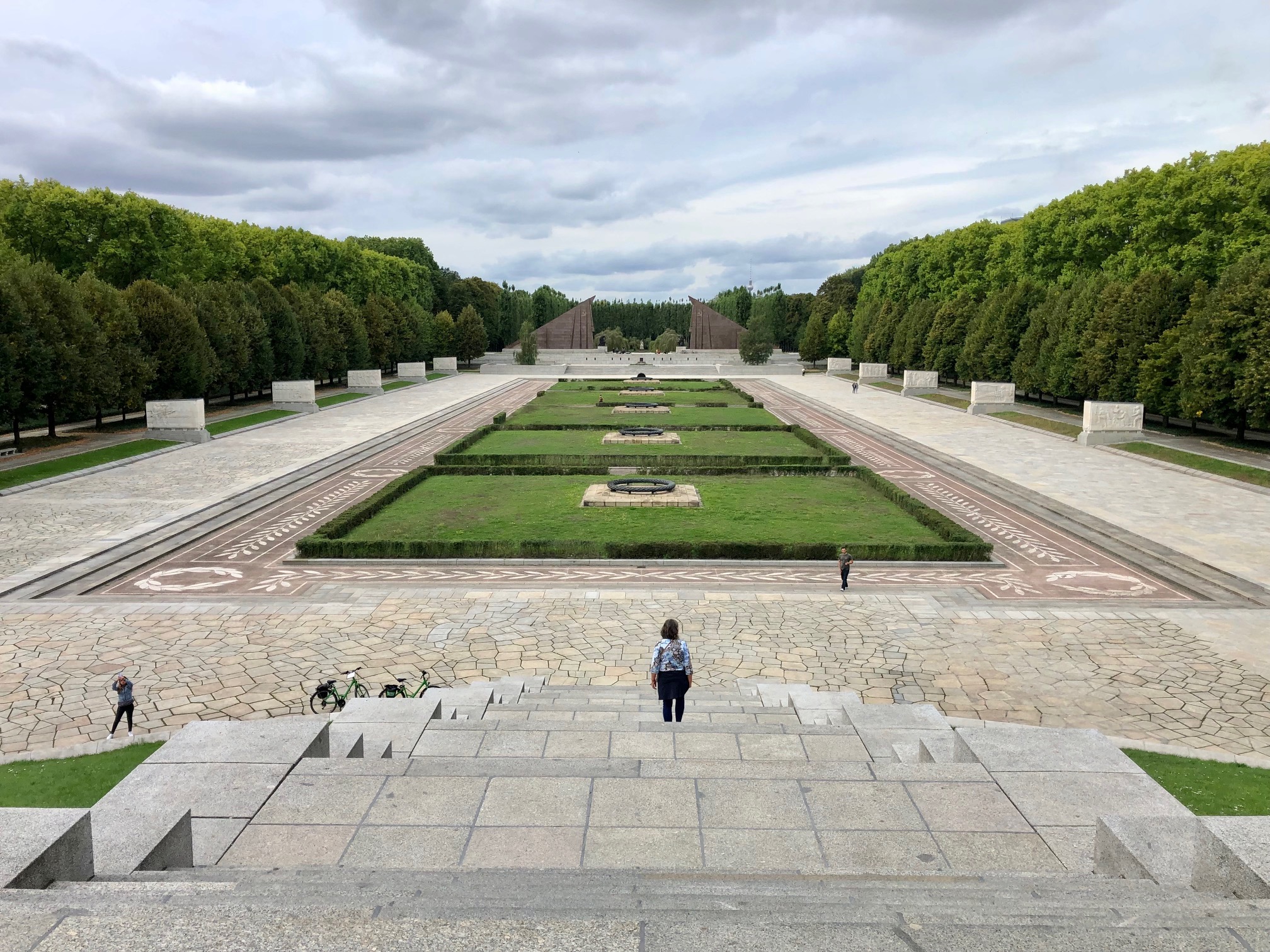
Looking ahead to the cemetery
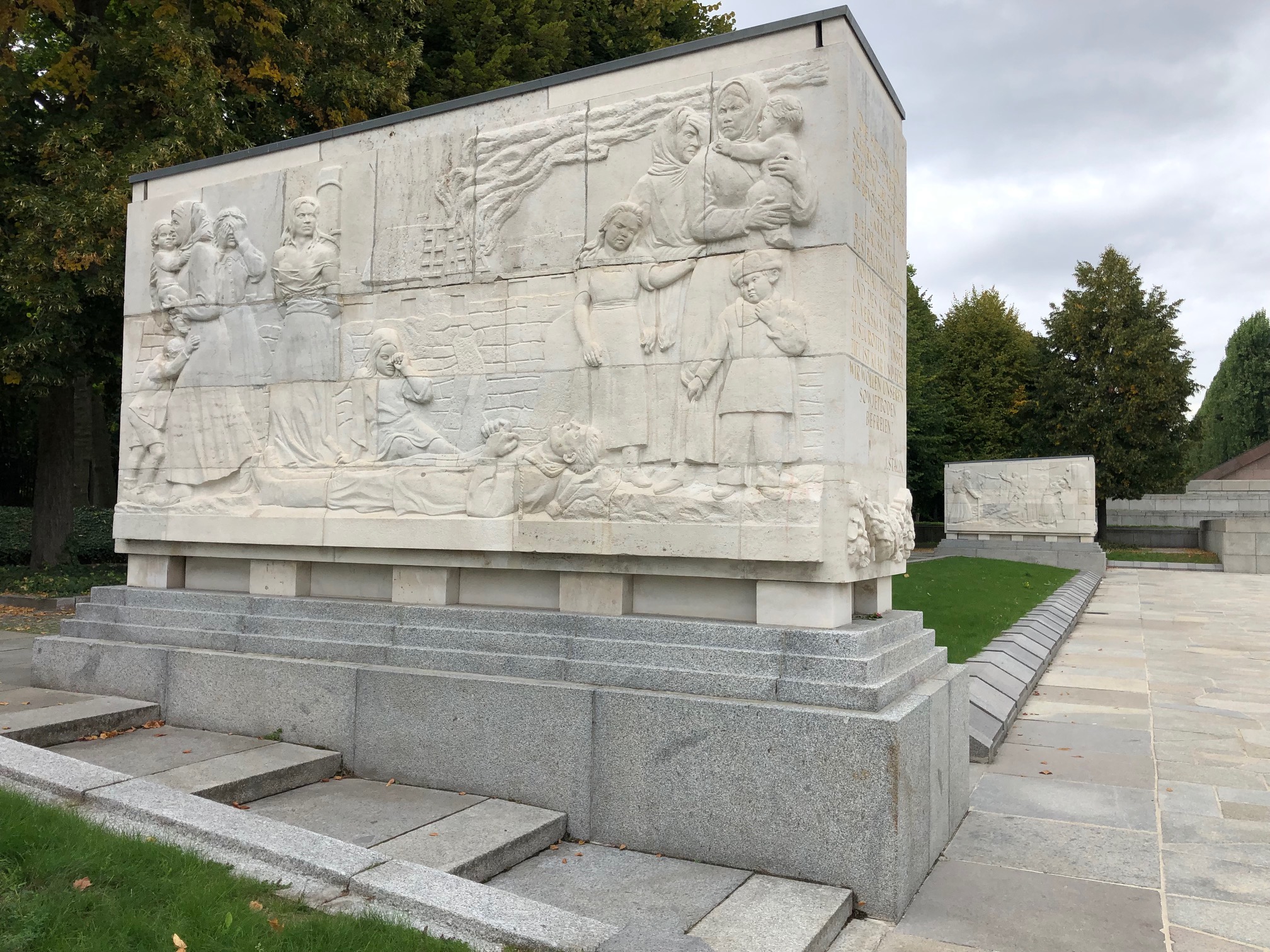
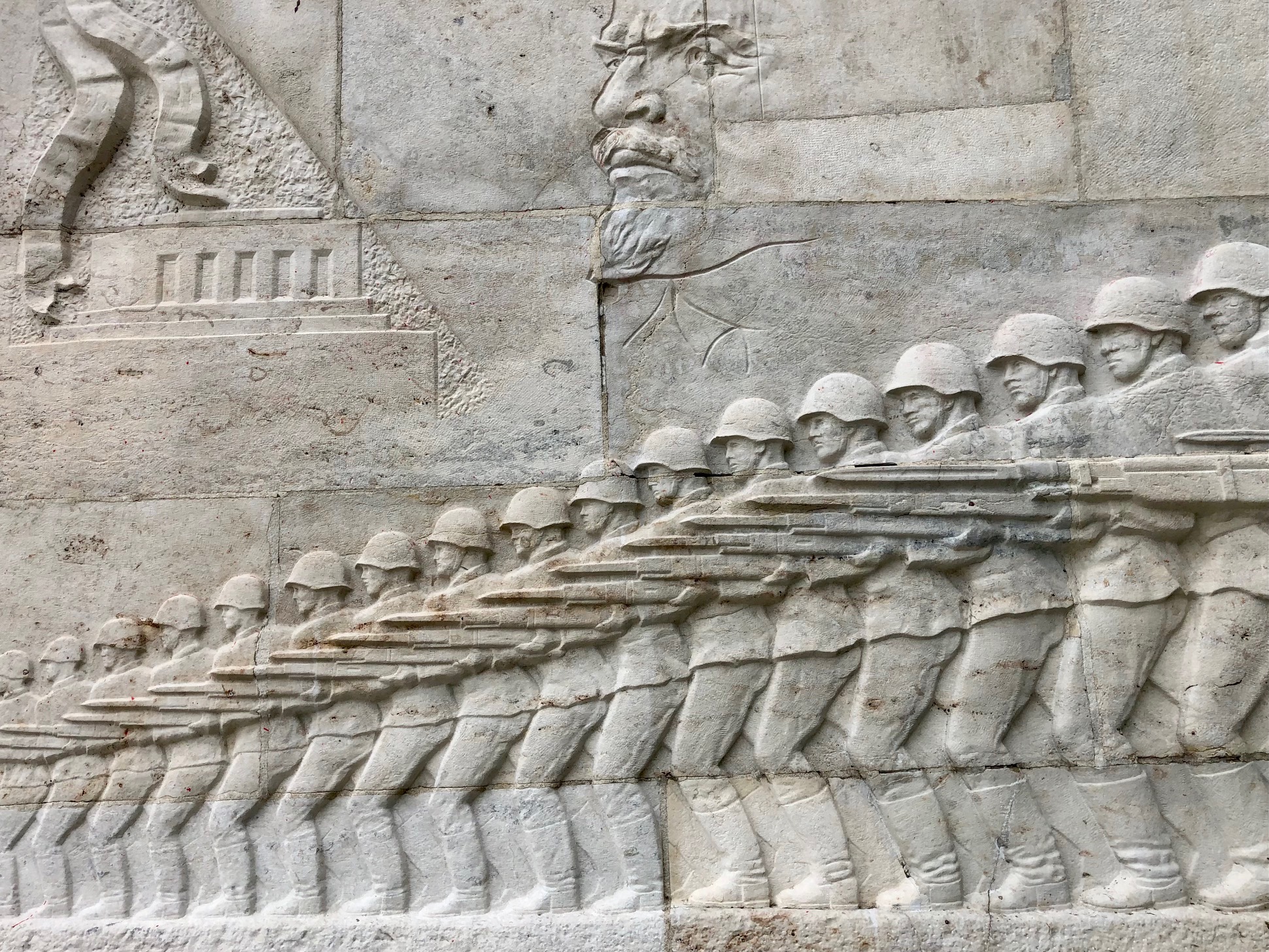
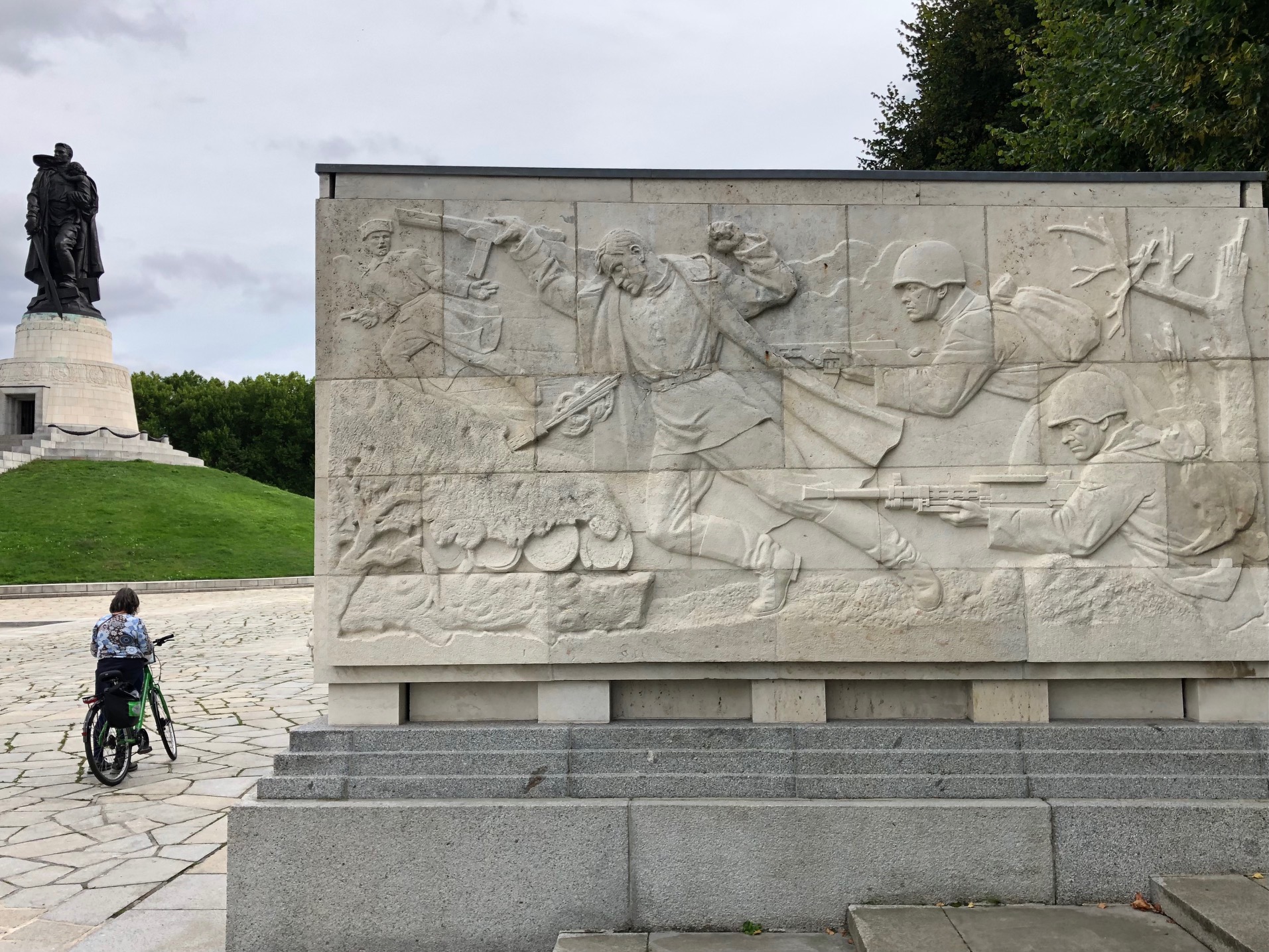
Beautifully executed stone reliefs illustrating scenes from the ‘Great Patriotic War’ decorate the sixteen marble sarcophagi flanking the graves, while gold-lettered quotes by J. Stalin, the commander in chief of the Soviet armed forces, underscore the importance of the Communist Party and the Red Army under his leadership. Though clearly outdated, these quotes survived Khrushchev’s denouncement of Stalinist rule in 1956 with the subsequent cull of Stalin-statues and effective banning of any mention of his name in public.
The sarcophagi tell the story of the Second World War in Russia…
…through extraordinary imagery and craftsmanship.
Dedicated to the ‘heroic dying’ of the Russian people
At the very far end, you climb a stepped hill to a mausoleum supporting the aforementioned bronze statue of a Soviet soldier holding a small German girl.
Turning around to descend, you get an overview of the whole dramatic panorama that reflects the historical narratives and artistic concepts dominant in the Soviet Union under Stalin and to a degree still exist today: monumentality, hero worship, a personality cult, and a claim to exclusivity.
Treptower Park has been and continues to be a frequent venue for commemorative events. Since 1990, with the signing of the German-Soviet treaty on neighbourly relations and the German-Russian agreement on the upkeep of war graves in 1992, the Federal Republic of Germany committed itself to the care, renovation and maintenance of all Soviet military graves and war memorials in Germany.
The evident meticulousness with which the whole site continues to be maintained (and patrolled by German police) is another of Germany’s visible expressions of understanding and reconciliation that have been extended to the Russian Federation and other countries brutally destroyed in the Third Reich’s expansionist and ideological wake. Does this reaching out in friendship make it easier to understand Angela Merkel’s unpopular (certainly in retrospect) policy relating to the Nord Stream pipeline? And the apparent weakness of Olaf Scholz’s initial reluctance to break Germany’s practice and permit the transfer of lethal weapons to areas of conflict… in this case, to Ukraine?
If the premise of my book is true and unresolved traumas of one generation can impact the lives and behaviour of subsequent generations, then the extreme collective traumas experienced by the Russian people over the past century are part of what we are seeing playing out in the attitudes, politics and actions of Russia today. Trauma responses such as emotional numbness, low self-esteem, acceptance of poverty might go some way to explain the apparent passivity and gullibility of large swathes of the population. Likewise, trauma responses such as shame might be producing the violence, megalomania and greed of those in power. Is this then, by extension of the idea, the natural destiny of all traumatised nations? After all we can see similar dysfunction and violence in Africa, South America and plenty of other nations once brutally colonised.
‘Psychohistory‘ – a new but exciting term to me that I appear to have already been practicing – seems to offer a way forward in thinking about these things. It combines history with psychology/psychoanalysis and social sciences/humanities to understand the emotional origin of the behavior of individuals, groups and nations, past and present. In other words, the ‘why’ of history.
I don’t have any answers, nor even the right questions yet, just an ever-growing sense of discomfort in simple, black and white narratives of good and bad, right and wrong. And an increasing belief that we are still very far from seeing, let alone comprehending the fuller picture. But we need to become more trauma-informed in all areas of life. For to neglect trauma is to leave people in a state of emotional numbness. And when you don’t feel, you become capable of overriding humanity and care for fellow living beings and life itself.
Further Reading / Viewing:
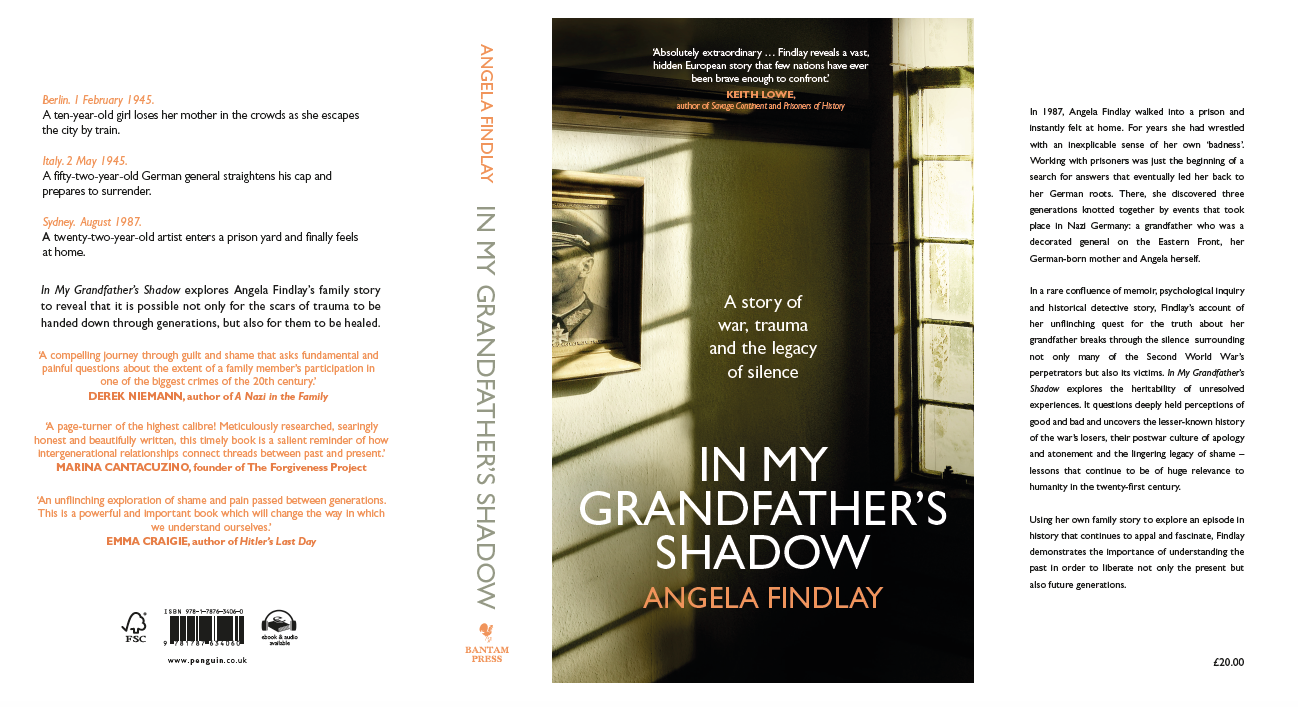
These questions are explored more deeply in my book: In My Grandfather’s Shadow. Published by Penguin Transworld and Bantam Press in July 2022 and available in most bookshops and the usual online outlets
The brilliant BBC documentary ‘Russia 1985-1999: Traumazone’ by Adam Curtis is made up of multiple film snippets taken in those years. As a fly on the wall experience and from the comfort of an armchair, it doesn’t get much ‘better’ in terms of an experience of Russia. To have lived through those years of extreme deprivation, corruption and hunger must have been little short of appalling.
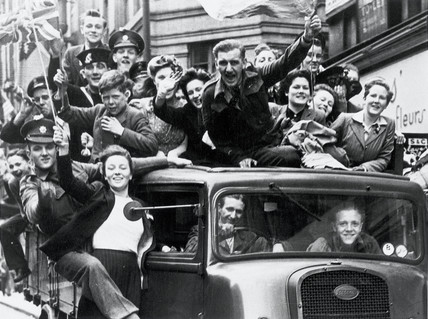
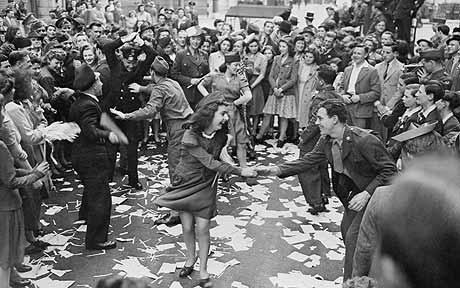
Friday 8thMay 2020 will be the 75thAnniversary of the end of the Second World War in Europe. It was the day when millions of people took to the streets and pubs to celebrate. For those who can remember that time in 1945, the emotions will be particularly poignant. Victory over the German enemy finally brought the promise of peace. That is indeed worthy of celebration. But what should we be doing three quarters of a century on?
VE Day, 1945
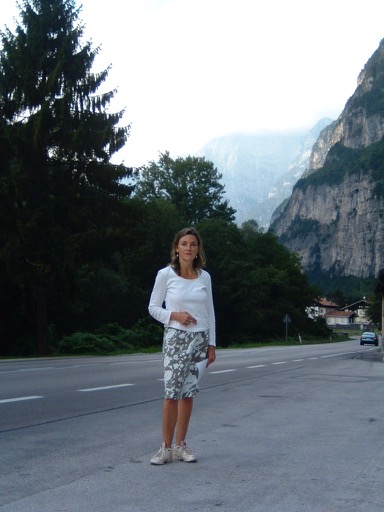
On Saturday 2nd May, I was due to be in Belluno on the edge of the Dolomites standing together with a group of total strangers from America and Italy. We had connected on Facebook and had hatched a plan to meet in the area where seventy-five years previously our fathers’, or grandfathers’, paths had crossed, first in war and then in peace. My sister, mother and my two octogenarian German aunts were coming too.
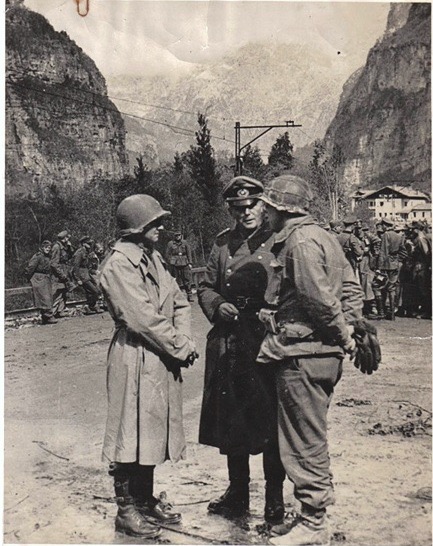
For me, it had all started fifteen years ago with the discovery of a photograph. I had googled my German grandfather’s name for the first time and the small black and white image that appeared on the screen instantly commanded my full attention. Until then, I had only known my grandfather as a framed photo on my mother’s writing desk. Just a face slightly obscured by the peak of a General’s hat with an iron cross hanging like a choker from a collared neck. He hadn’t moved in forty years. Now he was suddenly standing in front of me, wrapped in a belted, three-quarter length coat trimmed with a double row of perfectly aligned shiny buttons.
His face is instantly recognisable, his eyes still partially hidden as he talks to two men in baggier uniforms. He looks relaxed, upright. There’s even an air of authority in the way one of the seventy-a-day cigarettes I had often heard about rests between the fingers of his right hand. Reading the caption below the photo, I learn that it is 2nd May, 1945. The soldier on the left is an American Colonel, CO of the 337thInfantry, the other a translator. They are negotiating the handover of German troops and armaments. This is the day of Germany’s unconditional capitulation to the Allies. The moment my grandfather’s war ended and his time as a prisoner began. His experiences in the years that followed as a POW to the British would shape his family’s inner, and outer, worlds.
2nd May, 1945
After years spent disentangling the family roots from the blood-soaked mud of conflict and Germany’s post-war silence, my relatives and I would be travelling to meet the sons of the American 337th Division and the granddaughter of the Colonel in the photograph. They had warmly welcomed me into their group. This 75thanniversary, supported by the Councillor of Culture in Belluno, had little to do with victory or defeat, winners or losers, goodies or baddies. It was about reconciliation. About growing friendships and understanding in the soil of broken grief and lingering pride or devastation. It promised to be a very special occasion… we will try again next year.
Visiting the location in 2007
I can feel I am slightly bracing myself for what will happen on 8thMay. How will Britain mark this historic occasion? Energetic flag-waving aside, will it be much the same as our annual Remembrance Days in November and D-Days in June? Tony Hall, Director General of the BBC says their coverage “will bring households together to remember the past, pay tribute to the Second World War generation, and honour the heroes both then and now.” So yes, judging by that and the day’s schedule, it probably will.
Starting with a two-minute silence at 11am, a series of sing-alongs, prayers and encounters with veterans will follow, all interwoven with the familiar black and white footage. Then comes an evening of singers and actors performing well-loved songs, poetry and stories until 9pm when the Queen’s pre-recorded message will be broadcasted to close the day. Those who have got this far will probably feel slightly mushy (and possibly quite drunk). Filled with genuine gratitude to those who served, they will feel proud to be British, to be on the side of the victors and the heroic defenders of our freedoms… And that is all fine. Of course it is. But it’s not enough anymore.
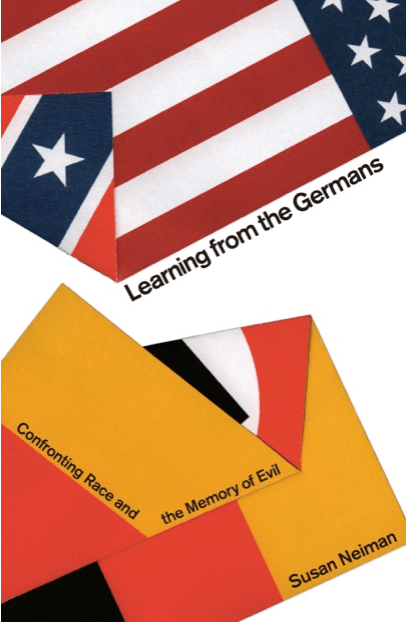
History used to be a matter of consolation or pride, now it is more a matter of warning and learning. As it shifts over time, black and white narratives of good and bad, victory and defeat, perpetrators, victims and heroes no longer hold. The story becomes more nuanced, the divisions more blurred, the lessons more universal. Simply remembering has become empty. Yet as Susan Neiman explains in her excellent book, Learning from the Germans, “We are not hardwired for nuance. Learning to live with ambivalence and to recognise nuance may be the hardest part of growing up.” No country can fully celebrate the triumphs of its history while ignoring the darker moments. So we cannot, nor should we be allowed to rest in our national self-image as the incontestable good guys. Seventy-five years ago, yes, but not today.
Neil Macgregor, former director of the British Museum and now of the Humboldt Forum in Berlin notes: “What is very remarkable about German history as a whole is that the Germans use their history to think about the future, where the British tend to use their history to comfort themselves.”
Maybe 75 years on is the right time for us to stop merely re-playing the gore, glory and gratitude of the Second World War and to start reaching beyond our own borders to include the histories and destinies of foreign populations, such as Russia, Poland, China – even Germany, who lost infinitely more and triumphed daily in tinier, but no less important ways. With a general consensus among historians about what happened and why, we can then shift our emphasis onto becoming fully aware that no country is immune from falling into the same abyss as Germany. Its descent happened gradually in full view. Like a frog being slowly brought to boil in a saucepan, most people didn’t notice.
Covid-19 has ushered in a rash of startlingly rapid changes to our laws and freedoms. We are forcibly and necessarily being shaken out of complacency and into the realisation that civilisation as we know it is both fragile and reversible. So more urgently than ever, our World War anniversaries need to be reminders of this and opportunities for learning and growth to inspire collective vigilance against darker forces and a genuine sense of unity across borders.
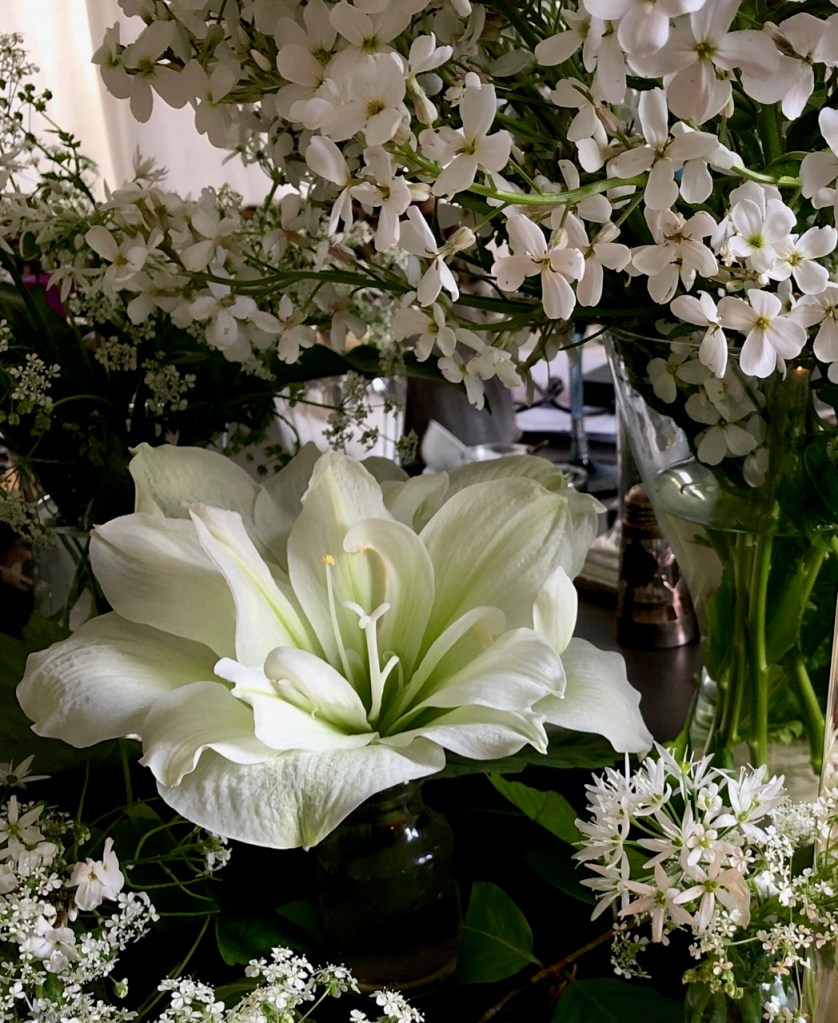
Let’s see what happens on Friday. If I wave anything, it won’t be a flag for Victory but a white flower for on-going Peace.
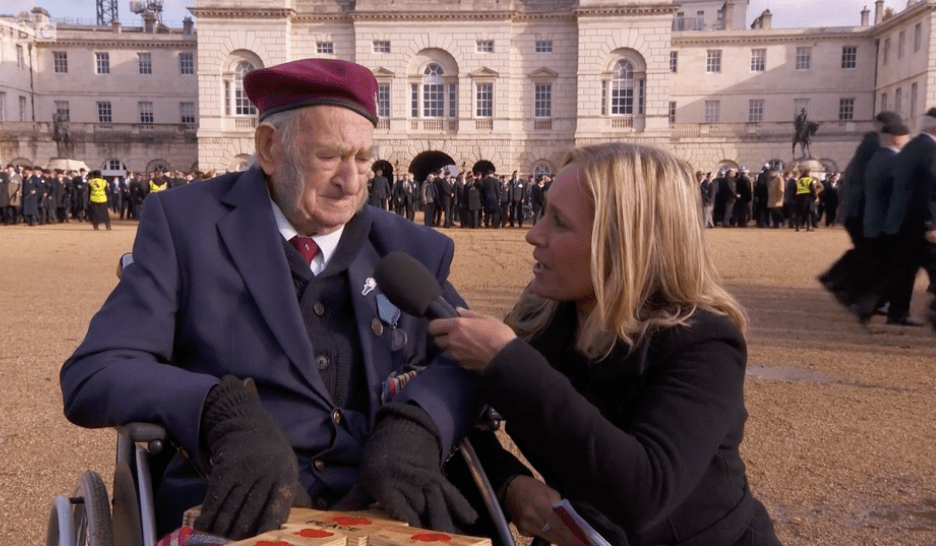
“It’s the memories,” 98-year old D-Day veteran, John Sleep, told the BBC interviewer, Sophie Raworth on Remembrance Sunday. Dressed in a blue suit decorated with medals and donning a burgundy beret and tie, his wheelchair was parked on Horse Guards Parade in front of the traditional ‘march past’ the Cenotaph. Asked how vividly he could remember it all, he said, “It was yesterday.” Silence followed as his face crumpled in its fight against tears. As for so many veterans, the title of “hero” bestowed on servicemen today feels misplaced. What he and his fellow soldiers did was not heroic, glorious or even brave necessarily. Those are qualities that belong to their friends who didn’t return. They are the real ‘heroes’ and their memories still roam and haunt the minds of the living.
Memories; PTSD; horror, honour and pride get shaken into potent cocktails of commemoration at this time of year. Last weekend was almost overwhelming in the scale of significant events to be remembered. Don’t get me wrong; I love remembering the past because each time I ‘re-member’ an event, I learn a little more about its relevance to the present and the future. Time became a linear construct through the human need for rationality and order. Yet in reality, or in my experience at least, time refuses to simply line up chronologically. The past and future co-habit each moment of what we call the present.
November 1989, the fall of the Berlin Wall
This year’s calendar of remembrance started on 9th November, when Europe and beyond celebrated the 30thAnniversary of the fall of the Berlin Wall and remembered all those who died on the physical and symbolic front line of the Cold War. A bit like with the 9/11 collapse of the Twin Towers, it seems that everybody can place exactly where they were when it happened. I can recall my Sussex landlady’s unbridled joy as she danced in front of her television clapping her hands as the ‘Ossis’ flooded through the wall into the welcoming, cork-popping arms of West Germans. I remember clapping and grinning with her, careful to disguise my shameful ignorance of just how momentous a moment this was. The Cold War may have been the political backdrop to life back then, but I was still in the dark over the potency of German history… half my family’s history.
Next up was the annual Festival of Remembrance at the Albert Hall, an event that every year both moves me to tears and irritates me in equal measure. I have written about it before but in spite of some deeply kitsch musical contributions – James Blunt, the former army officer with a remarkably high voice and Leona Lewis, former X-Factor winner, who massacred ‘Like a Bridge over Troubled Water’ – I found this year’s festivities generally more sensitive, less triumphal (thank goodness) and more inclusive. They focused on the 75th anniversaries of lesser known, yet no less brutal, battles of 1944, such as Monte Cassino and Rome, and the collaboration and friendship of the British, Commonwealth and Allied armies who fought them. They also marked the 100th anniversary of GCHQ and the vital, albeit largely uncelebrated role of the secret services such as the code-breaking work at Bletchley Park completed by a workforce 76.35% of which were women…
Ok, women’s forgotten / ignored / unrecognised place in war and history is a blog for another day. It’s the role of pride in all these activities of remembrance that I want to touch on here. Specifically the pride felt for and by family members. Pride can comfort in the face of death. Pride can give meaning to apparent pointlessness. Pride can assure the memory of a person is maintained for generations to come. Pride can overcome some of the horror of war. It can swell the heart and make thoughts soar. It can be a balm on the trauma of loss, which, if unprocessed, can be passed from generation to generation.
So how is it for the relatives of German soldiers, I wonder? Millions died and yet pride is a tool that cannot be employed to soften the sharp corners of grief or maintain the memory. It’s difficult, I know. But for the sake of generations to come, in order to avoid the transgenerational transmission of unresolved emotions and to understand and most importantly quash the re-emergence of Germany’s Far Right, we need to address the problematic nature of remembering the men and women who were limbs in Hitler’s military body of destruction, but also brothers, fathers, husbands, sons, friends… and grandfathers of ordinary German families.
John Sleep, our 98-year old veteran, is already putting my challenge into practice. Resting on the chequered blanket draped over his lap and gently held in place by misshapen hands in muddy, black woolen gloves, lies a simply-crafted wooden cross decorated with painted poppies and the word ‘Peace’. “It’s for the Monument of Tolerance,” he explained, “an organisation set up on the German border with all nationalities in it. The idea is to prevent wars,” he continues without the hesitation of his earlier answers. John also ‘does’ the German services. “I’ve got no problem with the Germans,” he declares. (Well that’s nice to hear.) “I think they did me a favour.” (Really??) “They got me a very good pension.” (Ah… ok – slightly disappointed face) But fair enough. He’d had “an argument” with a German tank and it had won.
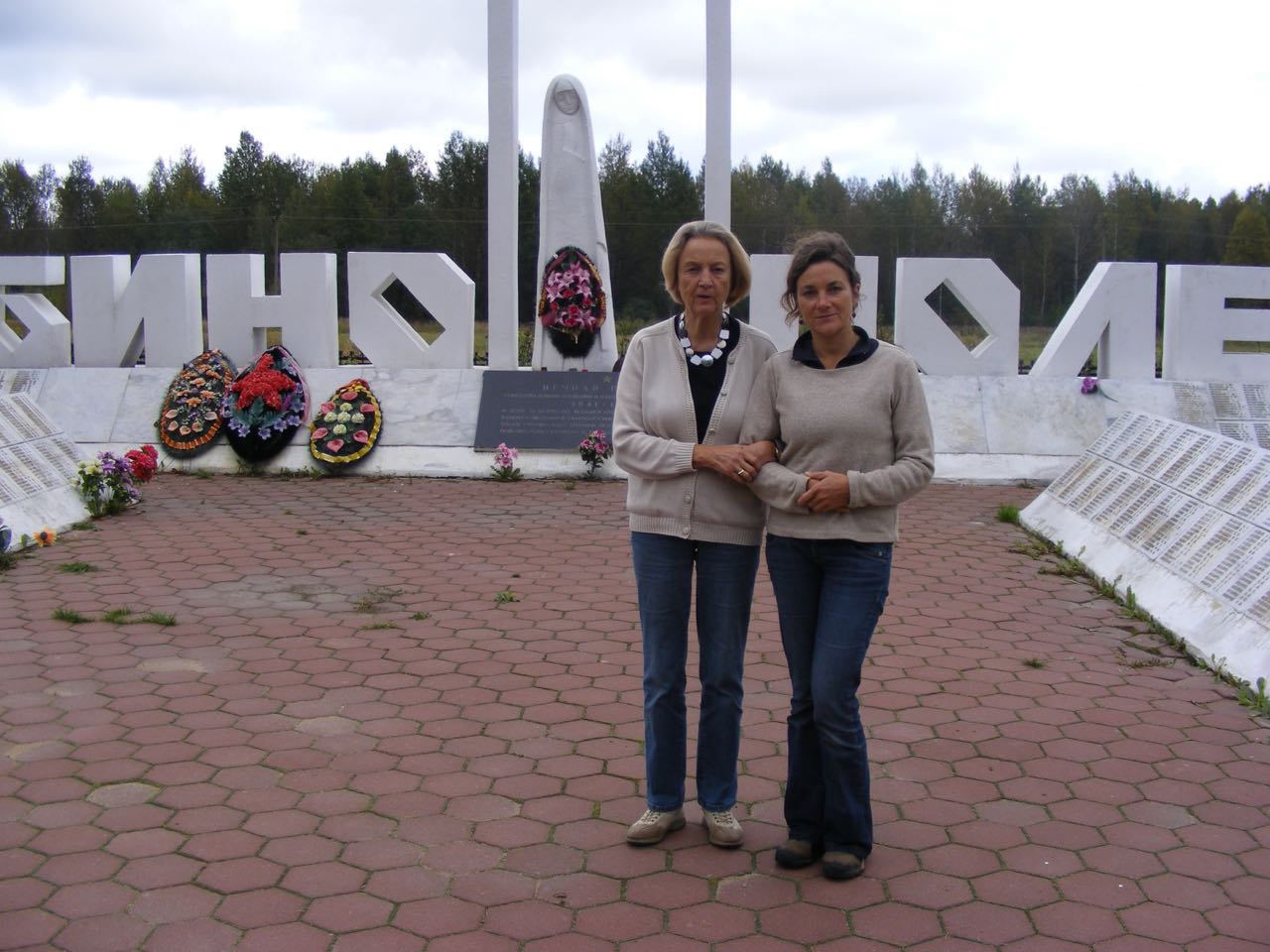
I like the ideas behind this Dutch Monument of Tolerance. Unveiled on 8 March 2001, it serves as a reminder of the more than 700 soldiers of 11 nationalities who lost their lives in the Leudal area between 1940 and 1945. I am pleased that at least here German families have an opportunity to bestow a tiny fraction of the recognition other nations can pour over their military family members. So, next Sunday 17th November, on the occasion of Germany’s humble Volkstrauertag – ‘people’s day of mourning’ – I would like to invite you to join me for a tiny minute in thought. A tiny moment in which we try and extend the lines of our famous and treasured poem of Remembrance to include some of Germany’s Wehrmacht soldiers and their families.
“At the going down of the sun and in the morning, we will remember them.”
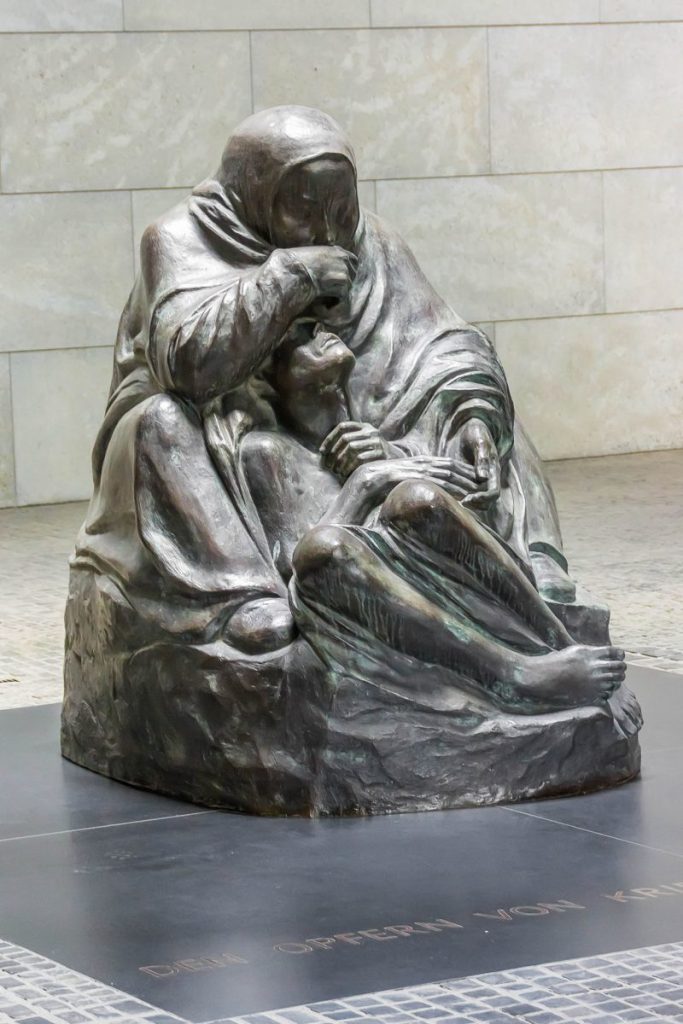
Käthe Kolwitz: Mother with her dead son, Neue Wache, Berlin
It is Remembrance season and once again I find myself feeling slightly uncomfortable, a bit pedantic, no doubt irritating and at worst offensively unpatriotic. And yet Remembrance is one of my favourite themes and both my grandfathers fought in the World Wars. So why can’t I jump whole-heartedly into the seas of poppies and poppy wearers, dignitaries and wreaths, that stream through our streets to lap up against memorials and into churches each November? Of course I want to ‘remember’ and acknowledge all the soldiers who died or were wounded serving their country, but discordant questions waft like dried leaves or ghosts through the architecture of British Remembrance rituals. So once again I ask myself and all of us collectively: what exactly are we remembering, and to what end? Remembrance is by nature vital, solemn, beautiful, meaningful… in many ways we do it so well. But beneath the tradition, ceremony and ritual conveyed through a distinctly military visual language, the message has also, in today’s world, become slightly flawed, inadequate and at times hypocritical.
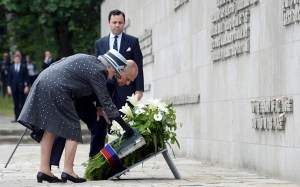
As I started writing this month’s blog this morning, the Queen was visiting Bergen-Belsen Concentration Camp for the first time, apparently at her request.
Much has been criticised or mocked about her State visit in the press: the timing – the eve of a summit where David Cameron is expected to begin new negotiations in relation to Britain’s EU membership; her apparently politically-biased speech in which she referred to a division in Europe being “dangerous” and that guarding against it “remains a common endeavour”; the Queen’s unenthusiastic reception of the German president’s gift of a portrait of her as a child on a blue horse with her father; even the reason for her going was apparently to put Angela Merkel, who is often referred to as Queen of Europe, back in her place…!
Within the context of my interest in WW2 Remembrance, May offers a welcome break from the misery and darkness. It is indeed a time to celebrate, for on May 8th 1945 Churchill was finally able to announce that the war was over in Europe. The jubilation was naturally boundless and Britain threw the biggest street party the country had ever seen. The Allies had triumphed over the Nazi enemy, Germany had unconditionally surrendered, and it would be the end of death and destruction.
Tell your story.
Let it nourish you, sustain you and claim you.
Tell your story.
Let it feed you, heal you and release you.
Tell your story.
Let it twist and re-mix your shadowed heart.
Tell your story,
Until your past stops tearing your present apart.
I heard the above words recently on Radio 4’s Spoken Word programme “Writing a new South Africa”. You can hear it here at 14.38 minutes: http://www.bbc.co.uk/programmes/b053bsfm
Spoken aloud, with all the power of someone who knows the potency of the words, it struck me that this is precisely what I have been doing in the past years.
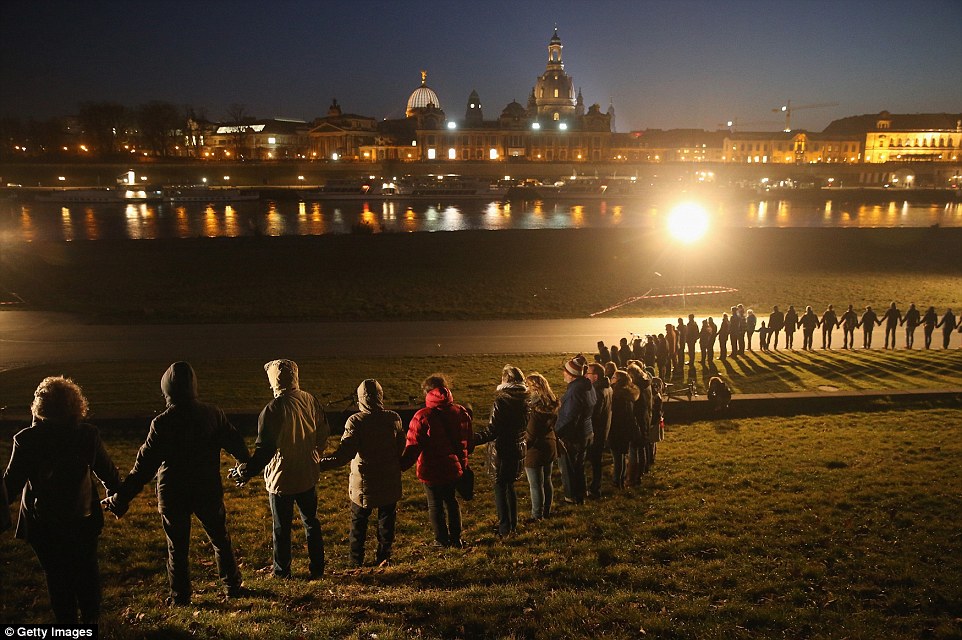
February 2015 saw the 70th anniversary of the bombing of Dresden, a contentious and highly debated element of the British and American war campaign. The deaths of 25,000 civilians and the destruction of the medieval city of Dresden known as the “Jewel of the Elbe” was without doubt one of the low points in the British military strategy.
On 13th February this year Germany held one of their rare commemorations for their own dead. It started with a service in the re-built Frauenkirche / Church of our Lady and continued later in the streets when up to 10,000 people formed a human chain along Dresden’s riverfront, holding hands to commemorate the dead and call for peace.
With my on-going interest in World War commemorations, this was of course a significant one, for two reasons really. On the one hand it remembers German victims of war and on the other it remembers an event that many people see as a British war crime.










 angela findlay blog