Remembering Russia’s past as a way to understanding its present

The Remembrance Sunday of 2022 will be one of thankfully few since 1945 that sees another war in Europe raging. As we remember those who lost their lives in past wars, fellow Europeans will be losing theirs in the all too real conflict fighting itself out in Ukraine.

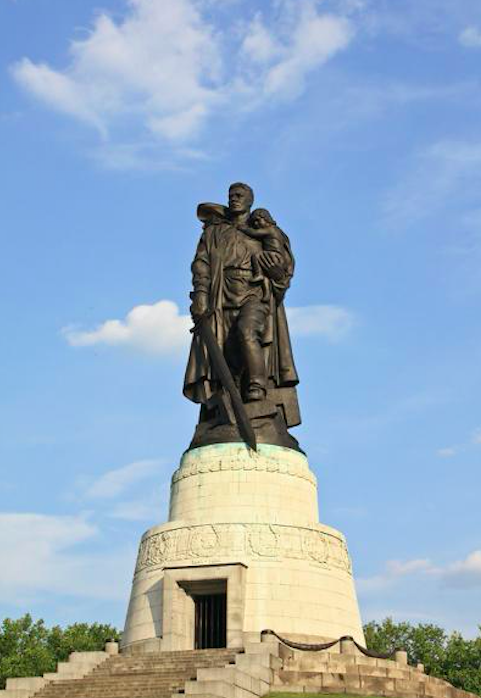
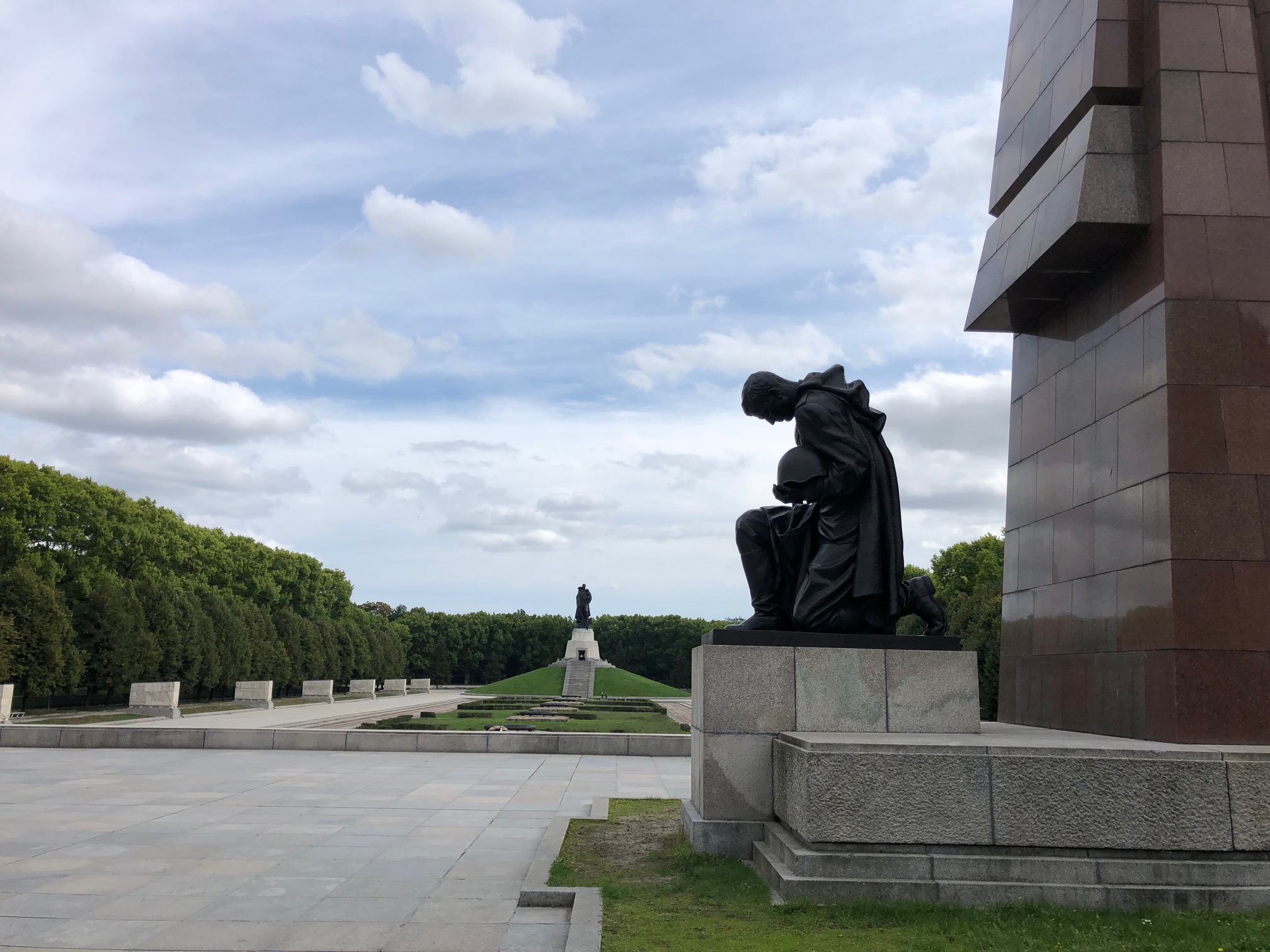
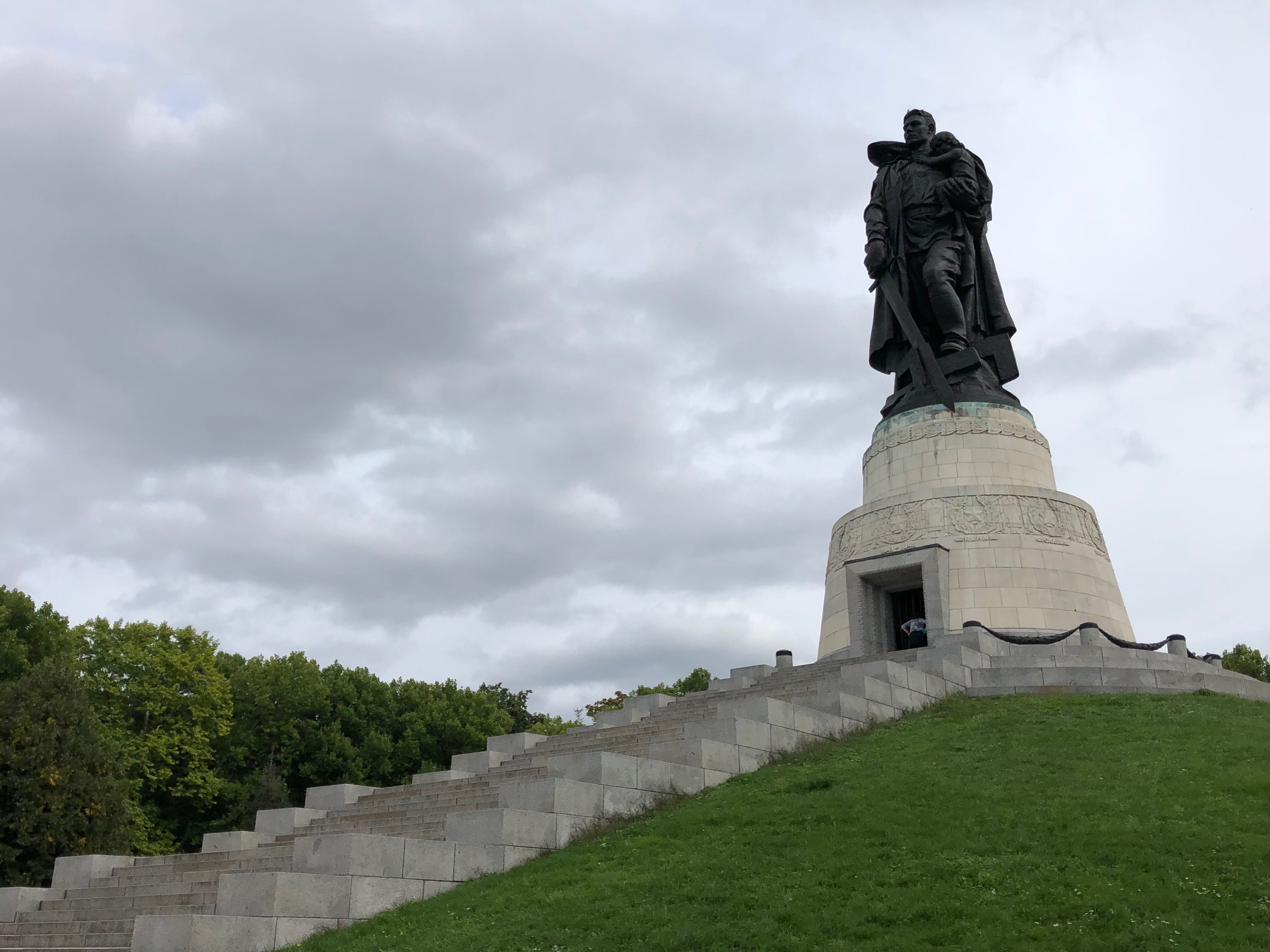
In my last blog I wrote about travelling the Berlin Wall Way, itself a form of 100+ mile-long memorial remembering both a repressive episode in history and those who lost their lives trying to escape it. Well, a little off that route in what was central East Berlin is Treptower Park, the largest Soviet military memorial outside the Soviet Union. Opened on 8th May 1949, it is a 10-hectare cemetery for 7000 of the more than 22,000 Soviet soldiers killed in the battle to take Berlin in the final months of the Second World War and contains the world-famous symbol of the role played by the Soviet Union in destroying National Socialism: the 13-meter towering statue of a Soviet soldier holding a lowered sword over a shattered swastika and cradling a rescued German child in his arm.

The Soviet Warrior Monument built by Yevgeny Vuchetich

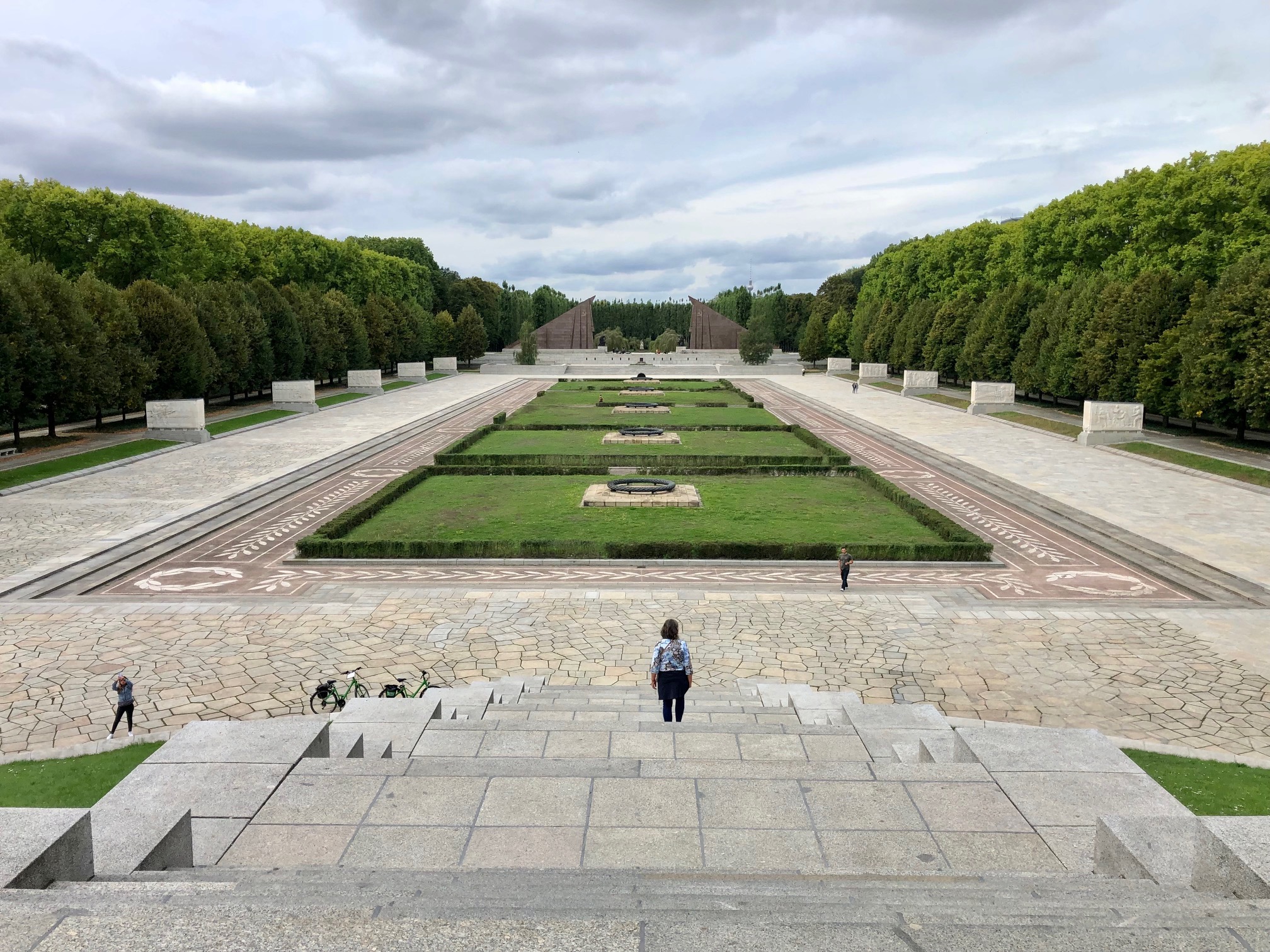
To experience this place is to experience a sense of the enormity and profundity of the impact WW2 had on the Soviet / Russian people. For a start it is vast. And the extensive layout is designed to take you through a process of mourning and remembrance to honouring the victors as heroes and liberators. 

‘Heroes and liberators.’

We too use those words in relation to our own soldiers. But how often have we – or do we – actively honour the decisive role the Soviet soldiers played in defeating Nazi Germany? And how often do we include the mind-boggling numbers of Russians murdered or killed in the process (25 million to give a rough/round figure) in our process of remembrance? We don’t really, is the only answer I can find. And yet they were our allies in a war that we, as a nation, have made central to our national identity. Could our slightly introspective leanings and lack of acknowledgment of the Soviet sacrifices and achievement (among many other factors, not least the horrors of the Stalin era) have contributed to the attitudes of subsequent regimes and politics towards the West? Just a question… but one that walking through Treptower Park certainly made me ask.

‘Mother Homeland’

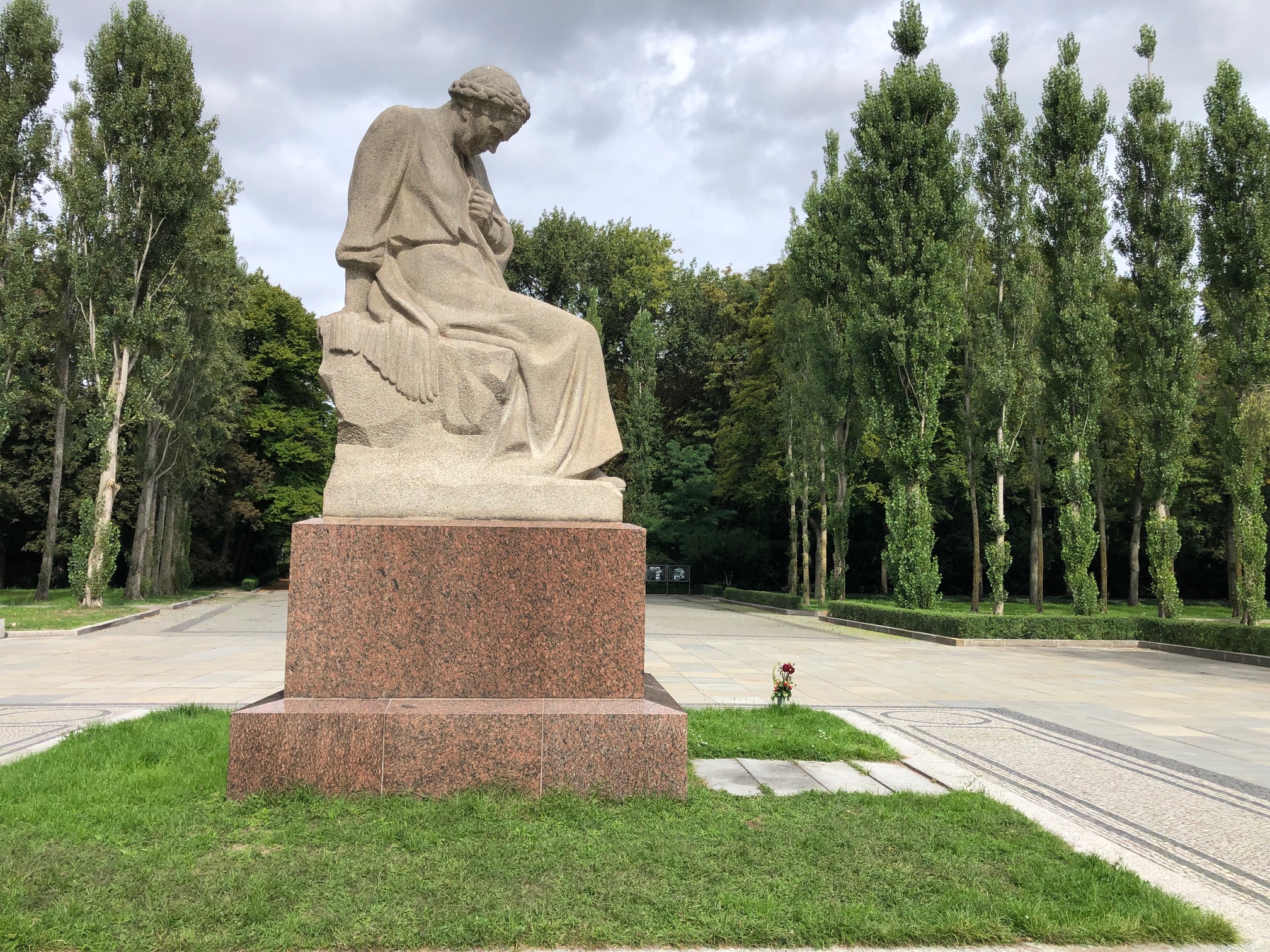
Entering through one of two avenues, the (tiny) visitor is led first to the statue of a grieving “Mother Homeland.” 

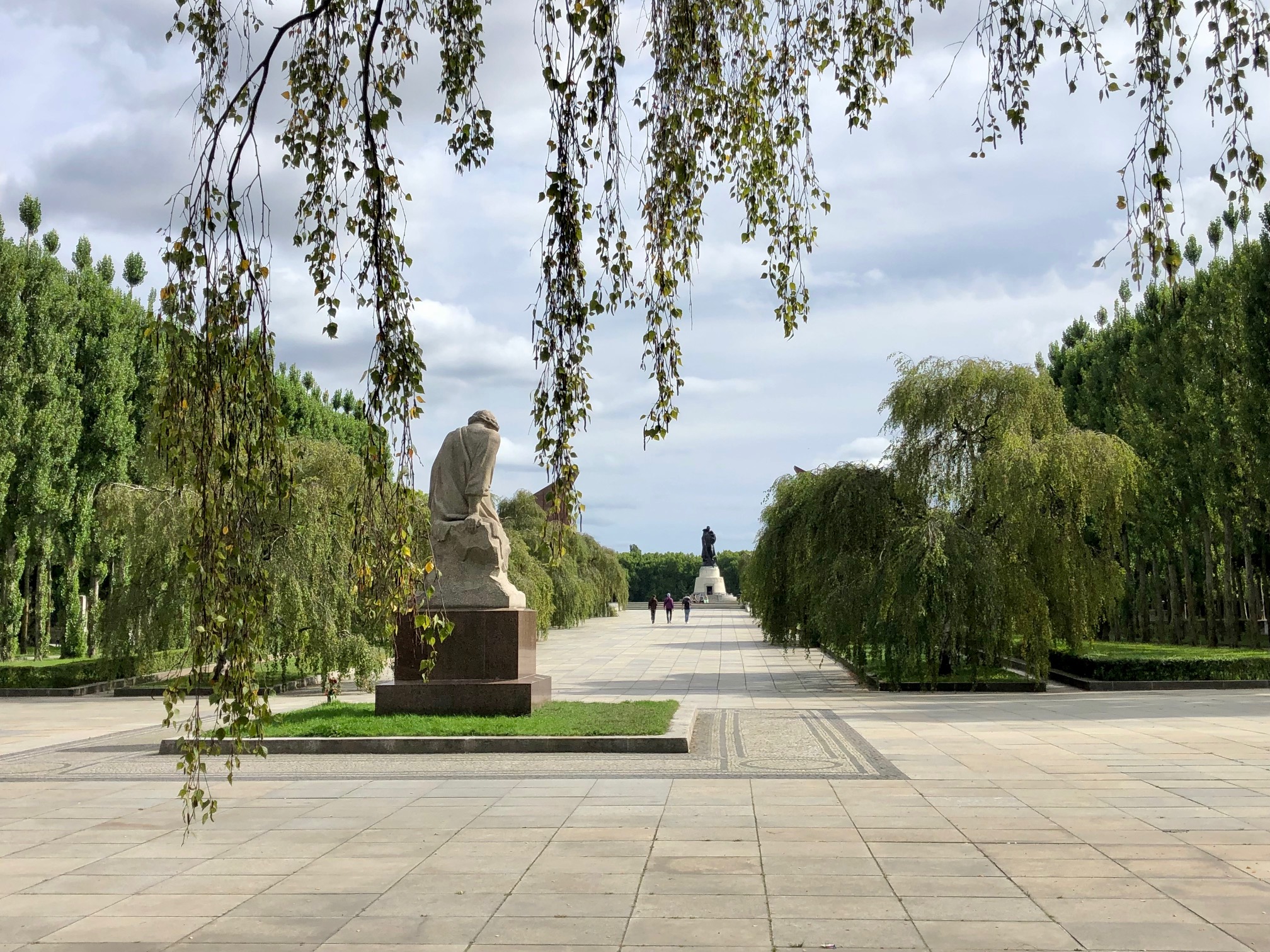
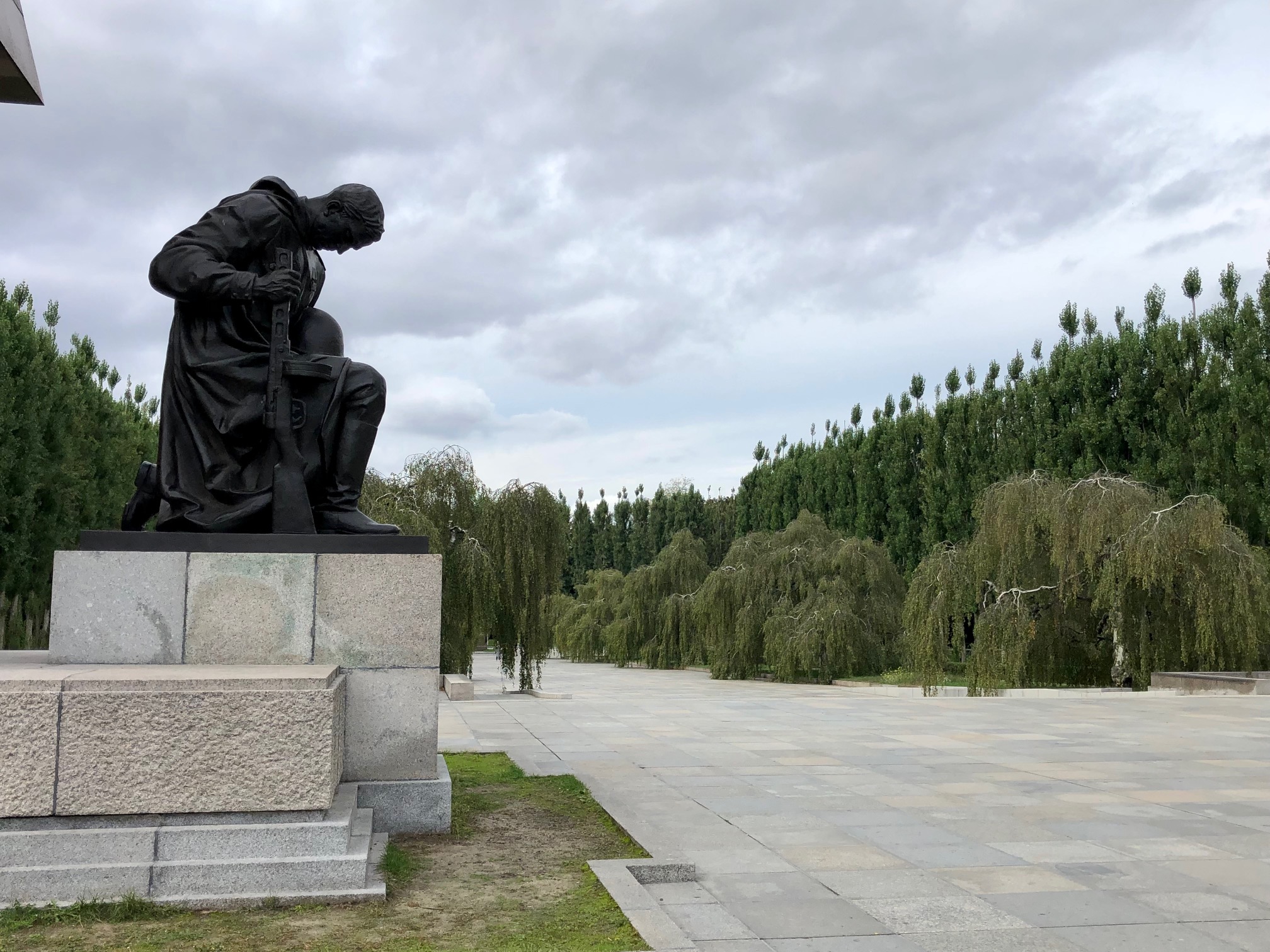
From there a promenade lined with weeping birches – incredibly moving witnessing trees seemingly crumpled in grief – you arrive at two sphynx-like kneeling soldiers that act as guardians to the cemetery section below. 
Looking back to the avenue of weeping birches
Looking ahead to the cemetery

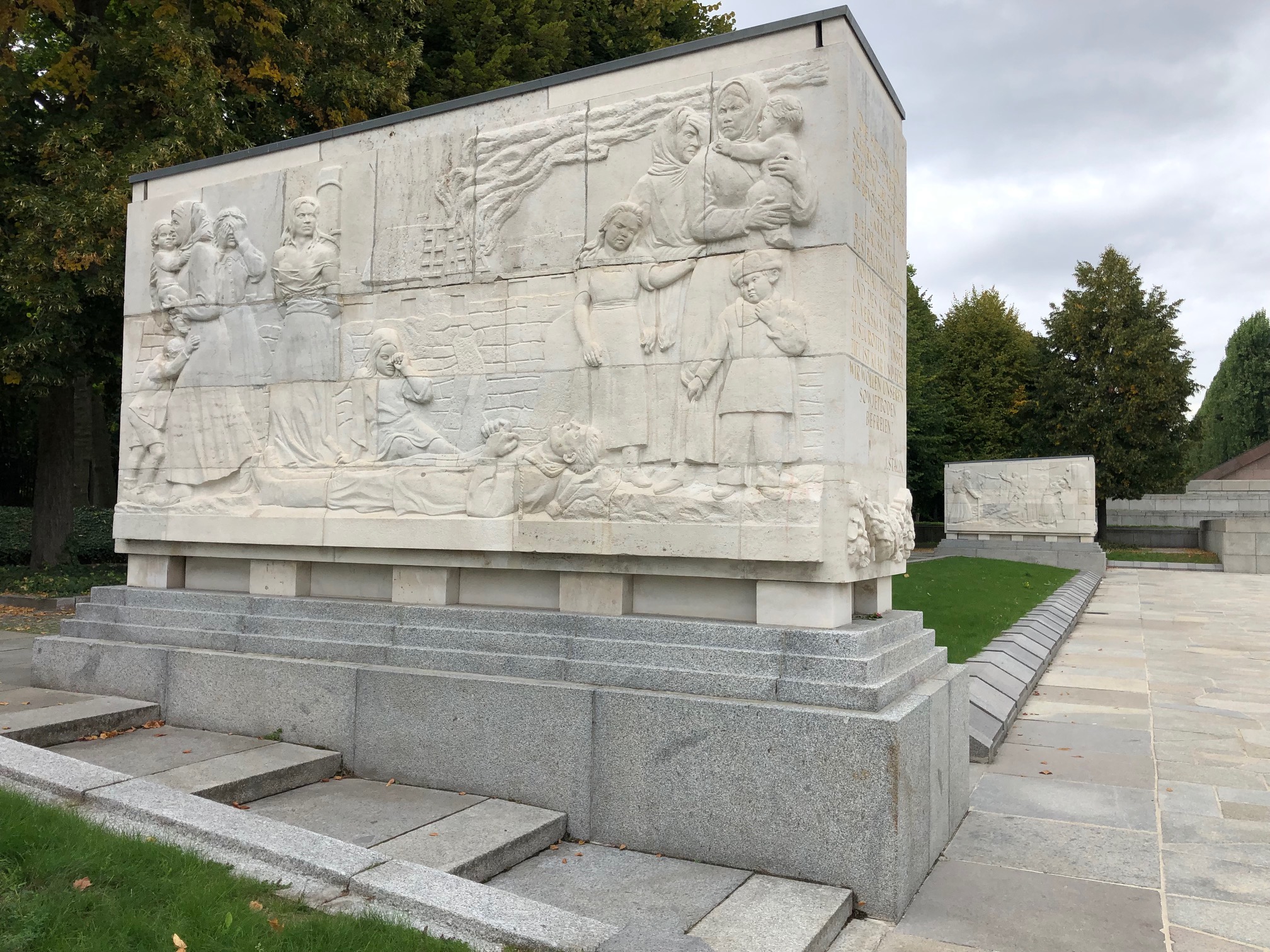
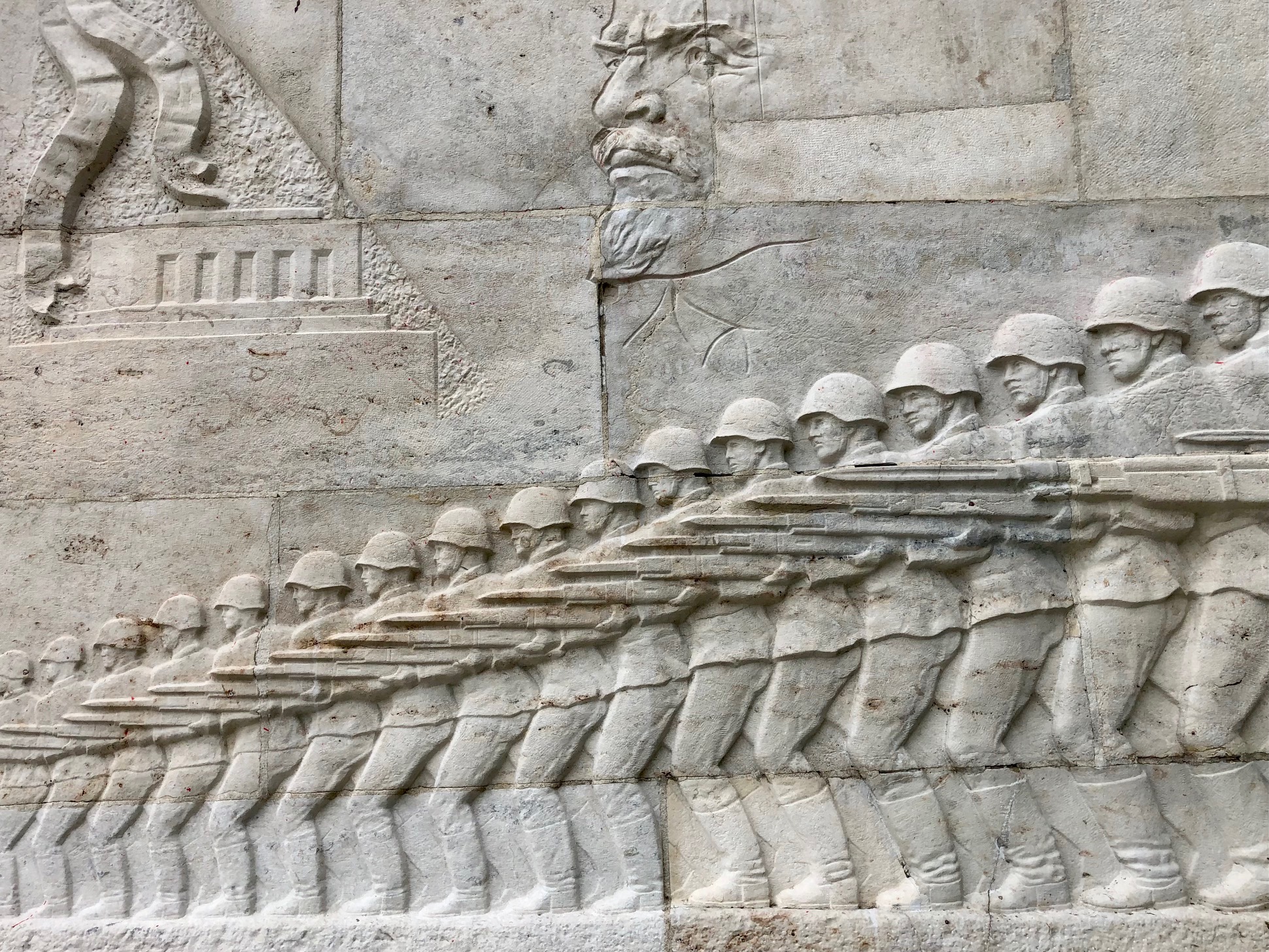
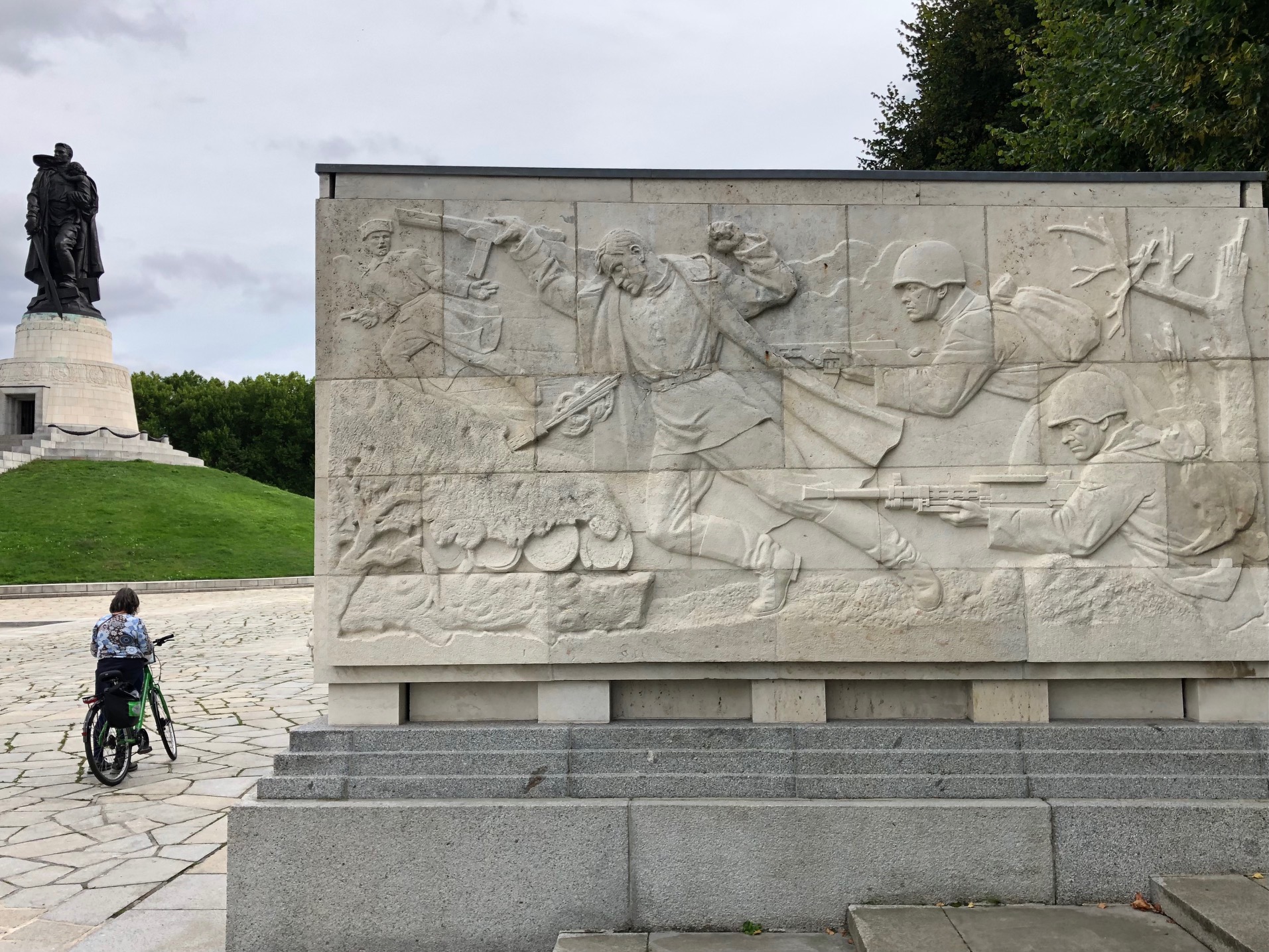
Beautifully executed stone reliefs illustrating scenes from the ‘Great Patriotic War’ decorate the sixteen marble sarcophagi flanking the graves, while gold-lettered quotes by J. Stalin, the commander in chief of the Soviet armed forces, underscore the importance of the Communist Party and the Red Army under his leadership. Though clearly outdated, these quotes survived Khrushchev’s denouncement of Stalinist rule in 1956 with the subsequent cull of Stalin-statues and effective banning of any mention of his name in public. 

The sarcophagi tell the story of the Second World War in Russia…
…through extraordinary imagery and craftsmanship.
Dedicated to the ‘heroic dying’ of the Russian people

At the very far end, you climb a stepped hill to a mausoleum supporting the aforementioned bronze statue of a Soviet soldier holding a small German girl.

Turning around to descend, you get an overview of the whole dramatic panorama that reflects the historical narratives and artistic concepts dominant in the Soviet Union under Stalin and to a degree still exist today: monumentality, hero worship, a personality cult, and a claim to exclusivity.

Treptower Park has been and continues to be a frequent venue for commemorative events. Since 1990, with the signing of the German-Soviet treaty on neighbourly relations and the German-Russian agreement on the upkeep of war graves in 1992, the Federal Republic of Germany committed itself to the care, renovation and maintenance of all Soviet military graves and war memorials in Germany. 

The evident meticulousness with which the whole site continues to be maintained (and patrolled by German police) is another of Germany’s visible expressions of understanding and reconciliation that have been extended to the Russian Federation and other countries brutally destroyed in the Third Reich’s expansionist and ideological wake. Does this reaching out in friendship make it easier to understand Angela Merkel’s unpopular (certainly in retrospect) policy relating to the Nord Stream pipeline? And the apparent weakness of Olaf Scholz’s initial reluctance to break Germany’s practice and permit the transfer of lethal weapons to areas of conflict… in this case, to Ukraine?

If the premise of my book is true and unresolved traumas of one generation can impact the lives and behaviour of subsequent generations, then the extreme collective traumas experienced by the Russian people over the past century are part of what we are seeing playing out in the attitudes, politics and actions of Russia today. Trauma responses such as emotional numbness, low self-esteem, acceptance of poverty might go some way to explain the apparent passivity and gullibility of large swathes of the population. Likewise, trauma responses such as shame might be producing the violence, megalomania and greed of those in power. Is this then, by extension of the idea, the natural destiny of all traumatised nations? After all we can see similar dysfunction and violence in Africa, South America and plenty of other nations once brutally colonised.

Psychohistory‘ – a new but exciting term to me that I appear to have already been practicing – seems to offer a way forward in thinking about these things. It combines history with psychology/psychoanalysis and social sciences/humanities to understand the emotional origin of the behavior of individuals, groups and nations, past and present. In other words, the ‘why’ of history.

I don’t have any answers, nor even the right questions yet, just an ever-growing sense of discomfort in simple, black and white narratives of good and bad, right and wrong. And an increasing belief that we are still very far from seeing, let alone comprehending the fuller picture. But we need to become more trauma-informed in all areas of life. For to neglect trauma is to leave people in a state of emotional numbness. And when you don’t feel, you become capable of overriding humanity and care for fellow living beings and life itself.

Further Reading / Viewing: 

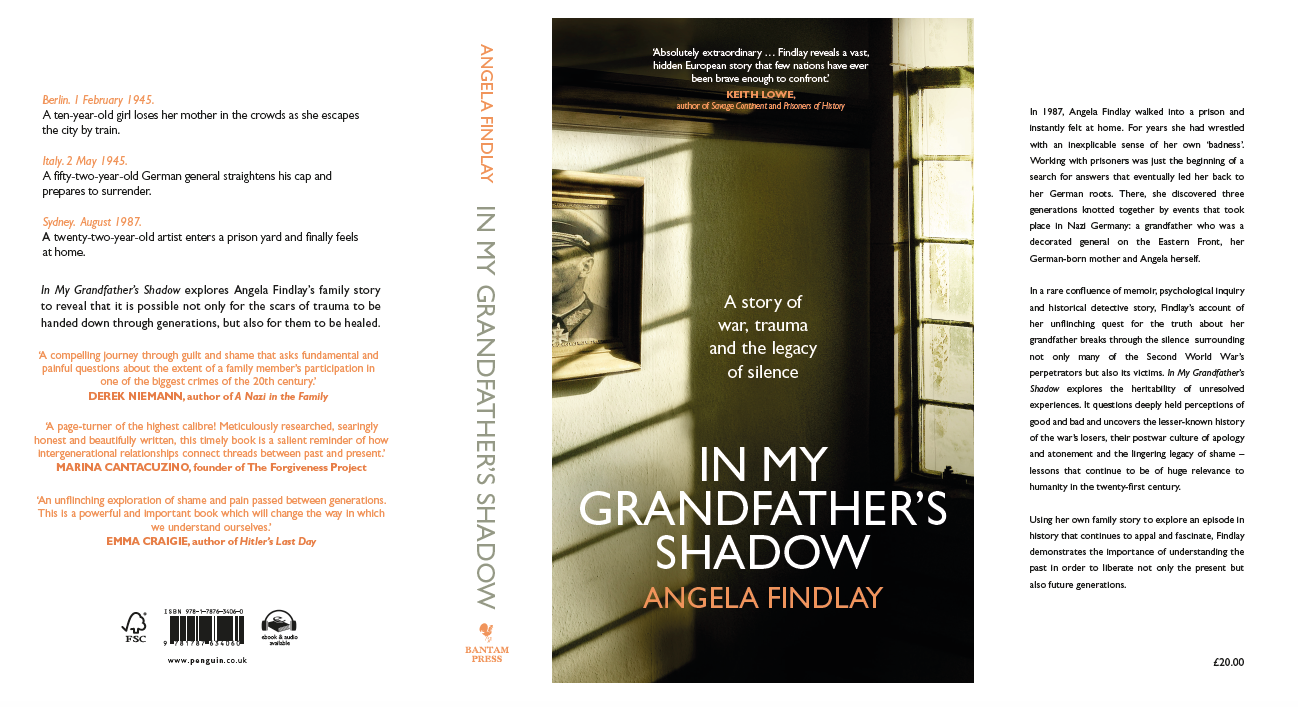
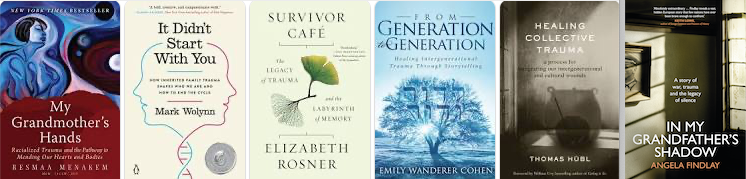
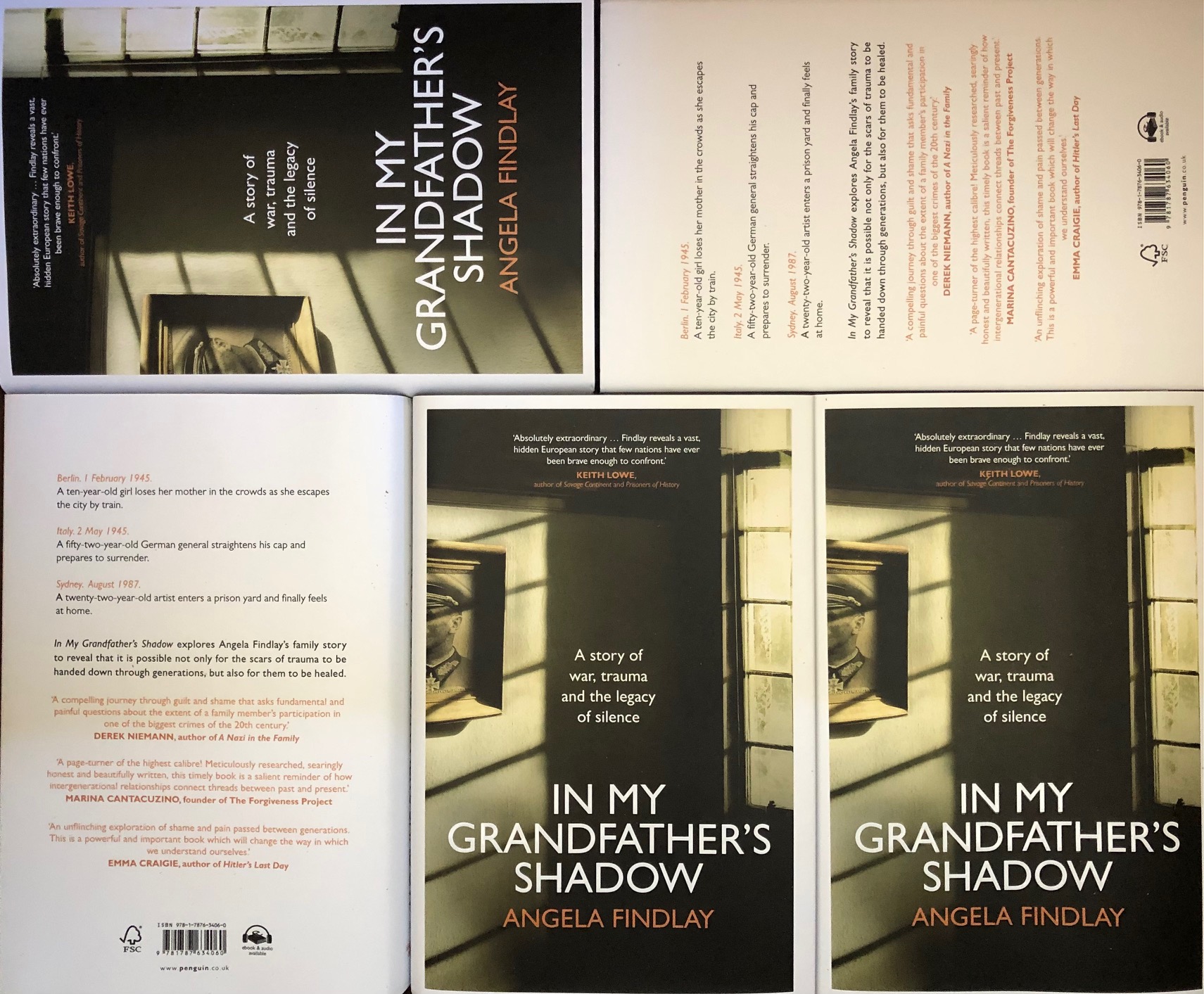
These questions are explored more deeply in my book: In My Grandfather’s Shadow. Published by Penguin Transworld and Bantam Press in July 2022 and available in most bookshops and the usual online outlets

The brilliant BBC documentary ‘Russia 1985-1999: Traumazone’ by Adam Curtis is made up of multiple film snippets taken in those years. As a fly on the wall experience and from the comfort of an armchair, it doesn’t get much ‘better’ in terms of an experience of Russia. To have lived through those years of extreme deprivation, corruption and hunger must have been little short of appalling.

Russia 1985-1999: TraumaZone review – ingenious, essential viewing from Adam Curtis

‘Generations of hurt’: Children and grandchildren of war survivors fear ripple effect of Russia’s war in Ukraine

Russia has yet to recover from the trauma of the Stalin era – The Guardian

Cycling the Berlin Wall Way… an education, a warning, an inspiration

In the faultless pageantry of Queen Elizabeth’s recent funeral, we witnessed one of the things that Britain does really well. Whether you are pro- or anti-monarchy, it was a spectacular display of planning, coordination, ritual, symbolism and attention to detail, as well as a gratitude- and love-filled farewell to the only ‘Her Majesty’ we have known. Impossible though it might sound, I missed most of it!

I was in Berlin experiencing what Germany does really well: remembrance and commemoration of a difficult and painful history. It was, however, not Germany’s intensive and on-going process of coming to terms with its Nazi past that I was focused on. This time, I was with my two siblings cycling the Berlin Wall Way, a continuous bicycle path that follows the former footprint of the 100-mile long Berlin Wall as closely as possible. Taking five days to complete, with added time to explore some of the many poignant locations in the centre, it was a total eye-opener, not least to the very concept of a divided city and country.

Map of West Berlin with the 160km Wall marked in red

The first initially confusing fact to digest is that, contrary to the widely held idea that the Berlin Wall was a north-to-south boundary separating West and East Berlin, in reality the wall went all the way round West Berlin thereby creating a democratic West German island within socialist East Germany. Even with a map, we found ourselves frequently asking: So, are we in the West or the East? the answer to which, I assure you, is rarely as straightforward or obvious as it sounds.

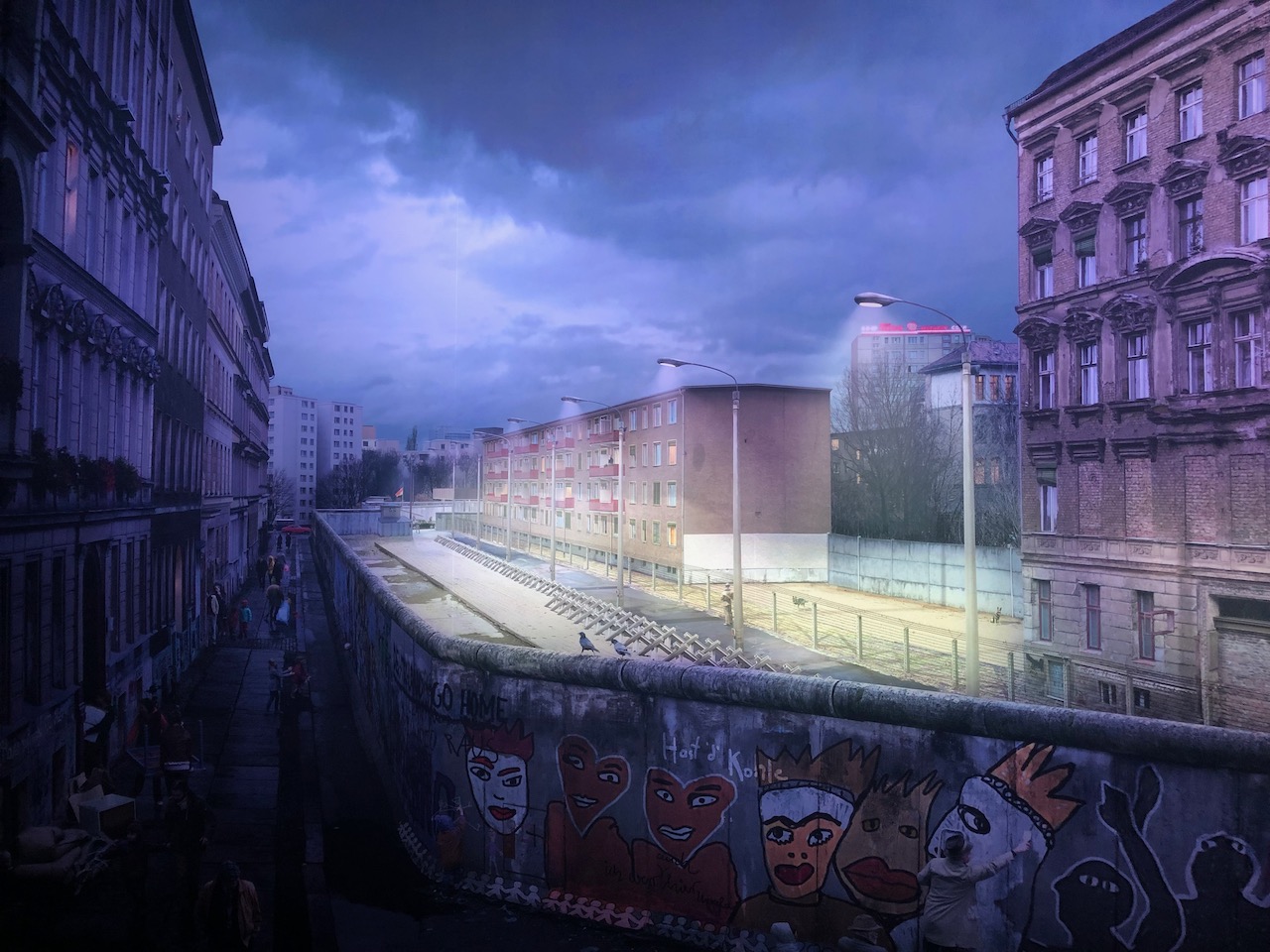
The second tangible shock felt while snaking along its course, was the utter illogic and arbitrariness of this ideological divide – through streets, houses, communities, lakes and woodlands. This randomness would have started as a line drawn on a map by the leaders of the victorious nations – USA’s President Harry S. Truman, Josef Stalin of the USSR, Britain’s prime ministers Winston Churchill and then Clement Attlee as well as other leading members of the three delegations present. That’s probably how most of the other contested border lines around the world have originated. To engage with the whole concept of division, not to mention the impact it had on families and friends separated for nearly three decades, is almost impossible. An enormous 360˚panorama entitled THE WALL by artist Jadegar Asisi gave us arguably our most immediate and visceral sense of being in West Berlin looking at and over the wall into the deadly world behind.

From the360˚ panorama THE WALL by Jadegar Asisi

The third challenge was understanding the complex evolution and structure of the wall that was built in three phases, starting overnight on 13th August 1961 as Berliners slept. What began as a barbed wire barrier and the closure of all but 13 of the 81 established crossing points between the Western and Soviet sectors, eventually developed into not one but two concrete walls separated by a corridor of no man’s land known as the ‘death strip’ with mines, raked sand to detect footprints, trip wire machine guns and armed East German guards in watch towers or patrolling on foot with dogs. By 1989, the Wall was lined with 302 watchtowers and more than 136 people had died trying to cross it.

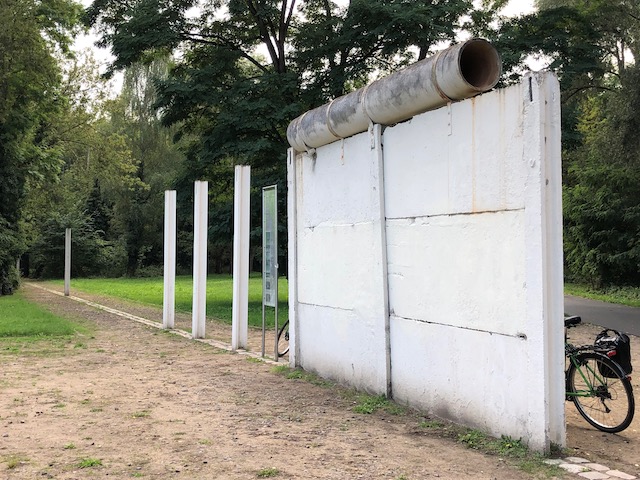
An example of a section of the wall. What we call the Berlin Wall is on the left

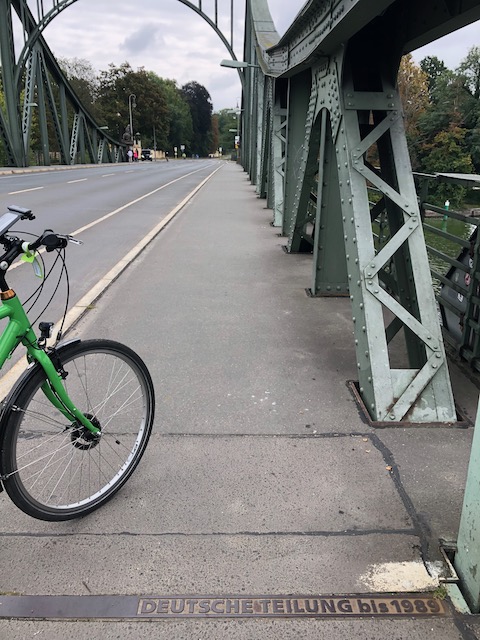
Our little trio started our circumnavigation of West Berlin on the famous Glienicker Bridge in Potsdam in the middle of which spies were on a number of occasions exchanged in the dead of night.

Glienicker Bridge

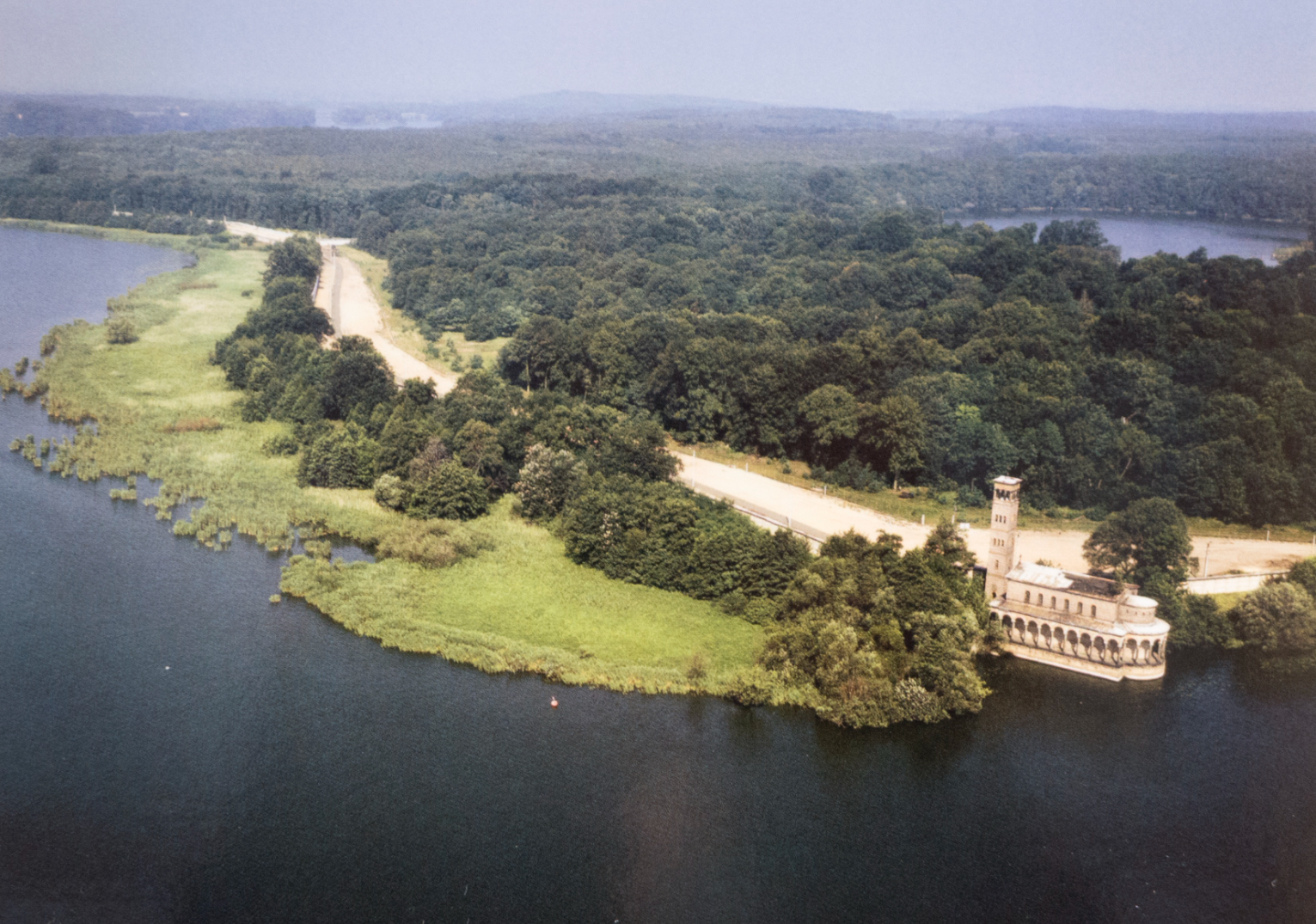
Following a reassuringly well-marked ‘Mauerweg’ route, we soon passed Schloss Cecilienhof, host to the 1945 Potsdam Conference where the division of Berlin and Germany into occupied zones was decided. From there we hugged the shoreline of beautiful lakes, passing the Sacrower Heilandskirche, the church stranded in the controlled border strip and cut off from its congregation.

Heilandskirche, Sacrow, 1961

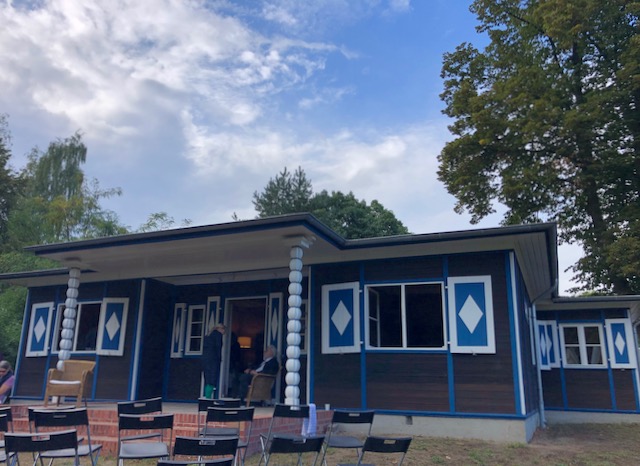
Heading north, we reached Alexander House, whose history became the subject of the acclaimed book by Thomas Harding, The House by the Lake, and is now a place of education and reconciliation.

Alexander House: The House by the Lake

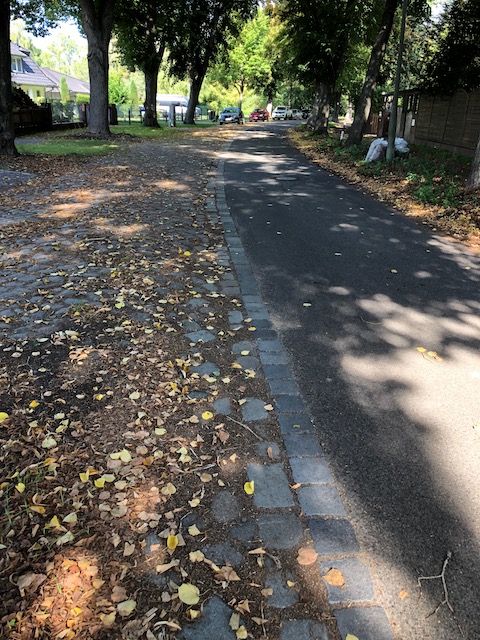
Staying in different hotels en route at intervals of roughly 30 miles enabled us to gain a sense of the scale of the wall and the extraordinary episode in history that only ended a little over 30 years ago. Sections of the concrete boundary, a double cobbled stripe embedded into the pavement or road surface, information boards with photographs and explanations all punctuated our journey.

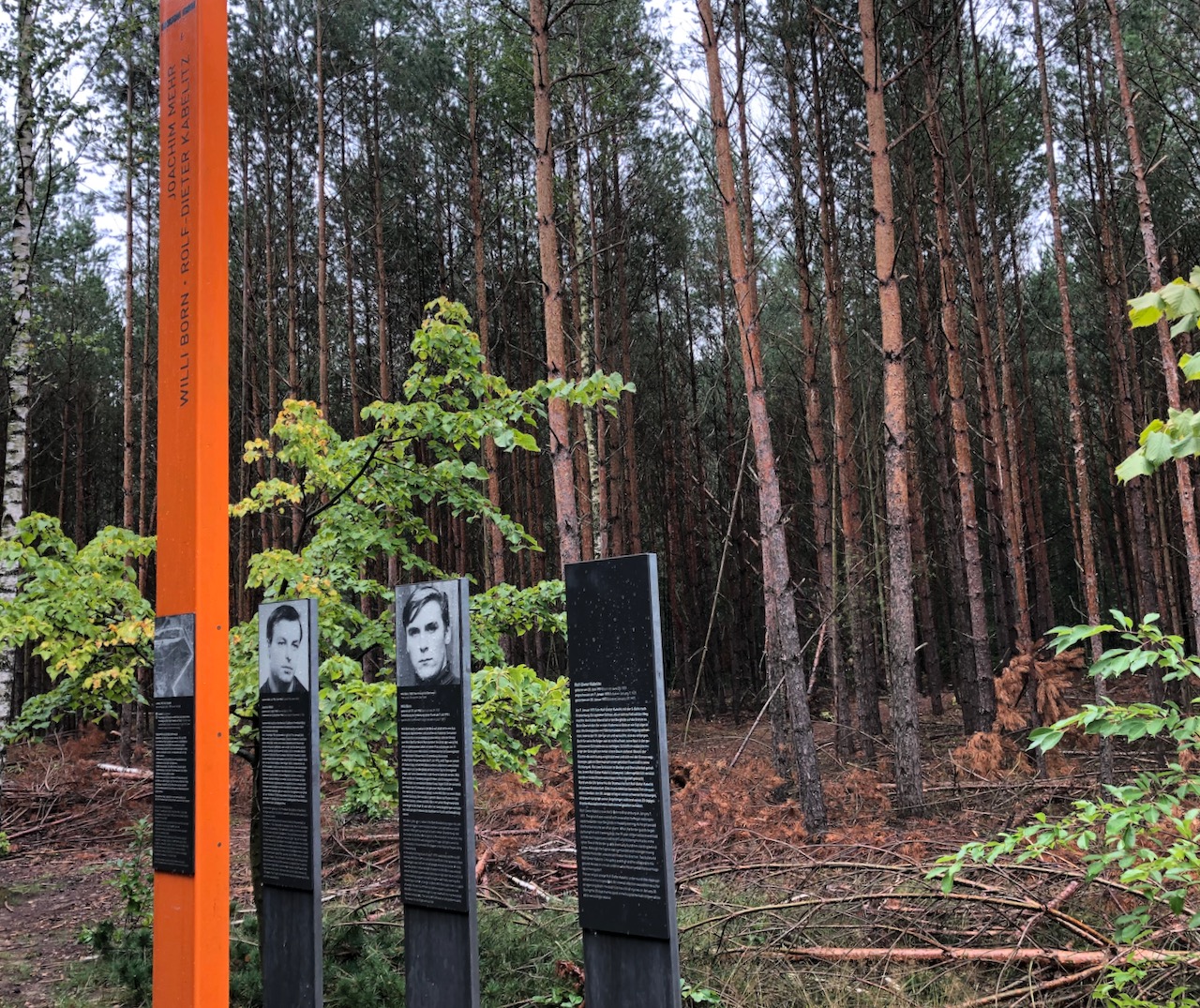
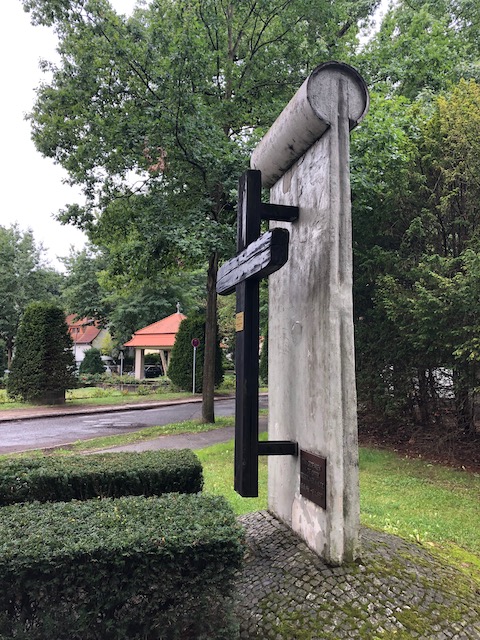
Most moving were the memorials telling heartbreaking stories of failed escapes, largely by young twenty-something-year-old men. With the same unflinching honesty for which all German WW2 or Holocaust-related museums and memorials have come to be known, these allowed us to feel the individual human cost of an ideology based on fear and a necessity to keep people in rather than keeping undesirables out, as the East’s ‘Anti-Fascist Wall’ name misleadingly proclaimed.

Continuing along canals and suburbs, we crossed the ‘Bösebrücke,’ the ‘Bad Bridge’ or Bornholm Bridge that made history on the evening of 9th November 1989 through the jubilant scenes of East Germans flooding across to be greeted by their Western “brothers and sisters” with sparkling wine, cheers and hugs while bemused Eastern border guards watched on helplessly. Unlike my former visits to Berlin while researching for my book, it was this joyous energy of liberation that primarily accompanied me on this trip and allowed me to experience the incredible resilience of Berlin’s inhabitants, past and present, and the revival of its worldwide status as a brilliantly creative, thriving city.

The Bornholm Bridge today and 1989 (pictured)

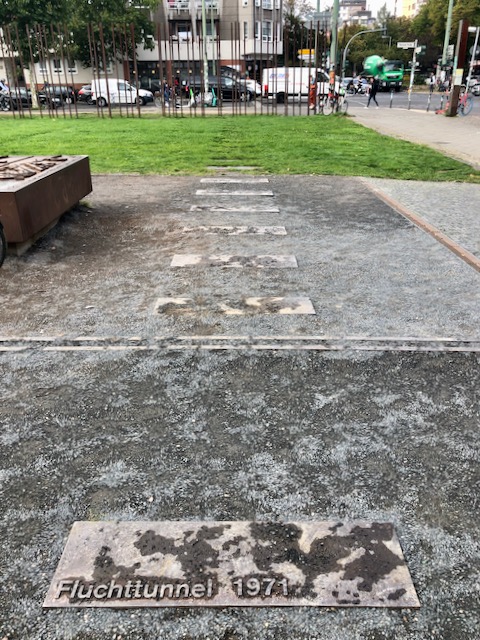
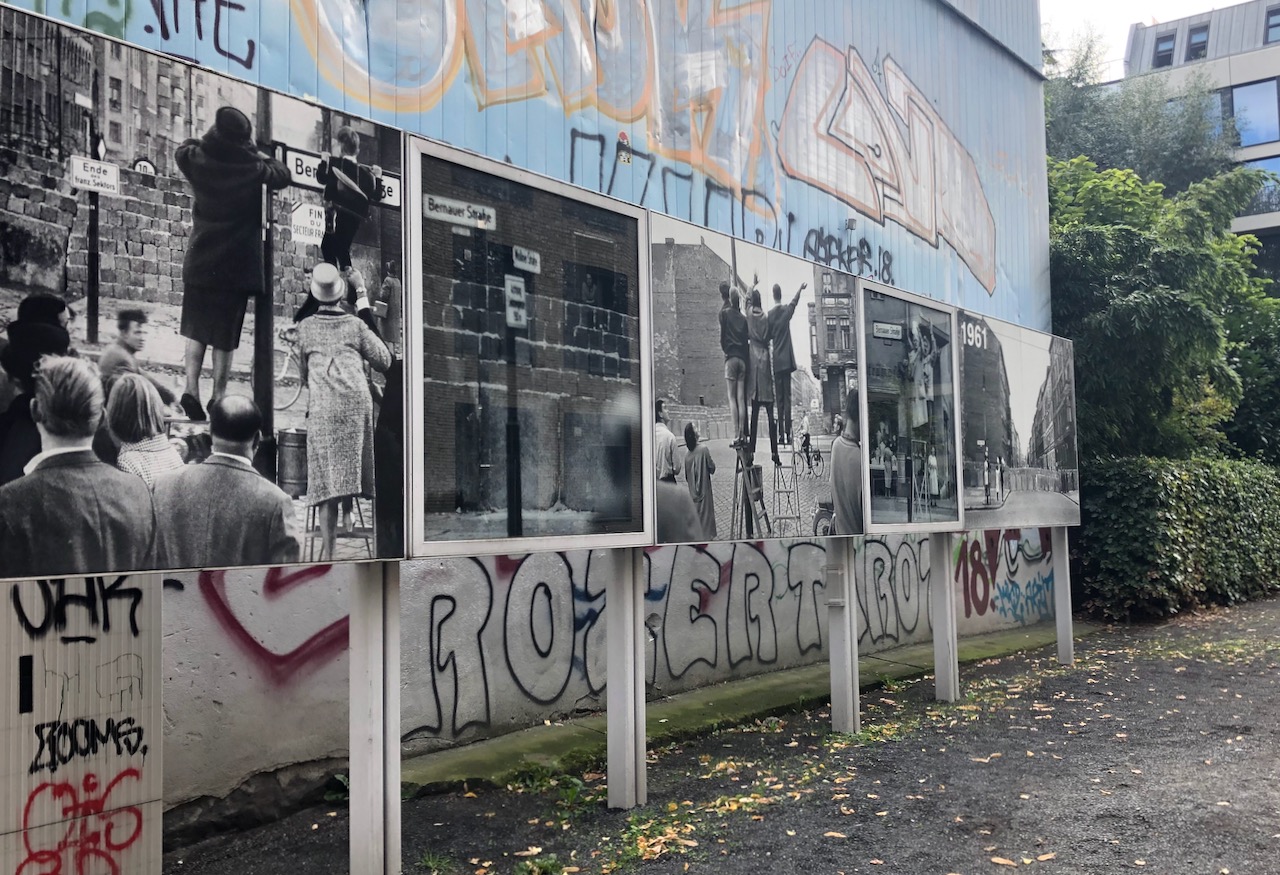
On we cycled, heading south through the beautifully curated but frequently harrowing Mauerpark (Wall Park) that leads into the Bernauer Strasse from which many of the well-known pictures of people jumping out of house windows into tautly held blankets in the West were taken. It was also the street under which various escape tunnels were dug similar to that shown in the 1962 documentary, The Tunnel and including the ‘Tunnel 29’ of the brilliant podcast and book with the same name.

An extended section of the wall and border strip have been preserved as a chilling testimony to its once terrifying presence.

Bernauer Strasse

The Wall then continues through Berlin Mitte past some of Berlin’s most famous landmarks: the Reichstag, the Brandenberg Gates, Under den Linden and the Tiergarten, past Potsdamer Platz and Check Point Charlie and along the boundary of what is now one of Berlin’s most chilling museums – the Topography of Terror – but what once was the location of many of the most sinister ministries of the Nazi regime. Then through graffiti-covered Kreuzberg, over the River Spree and to the longest surviving stretch of the inner wall painted in 1991 by painters from all over the world to form the colourful East Side Gallery.

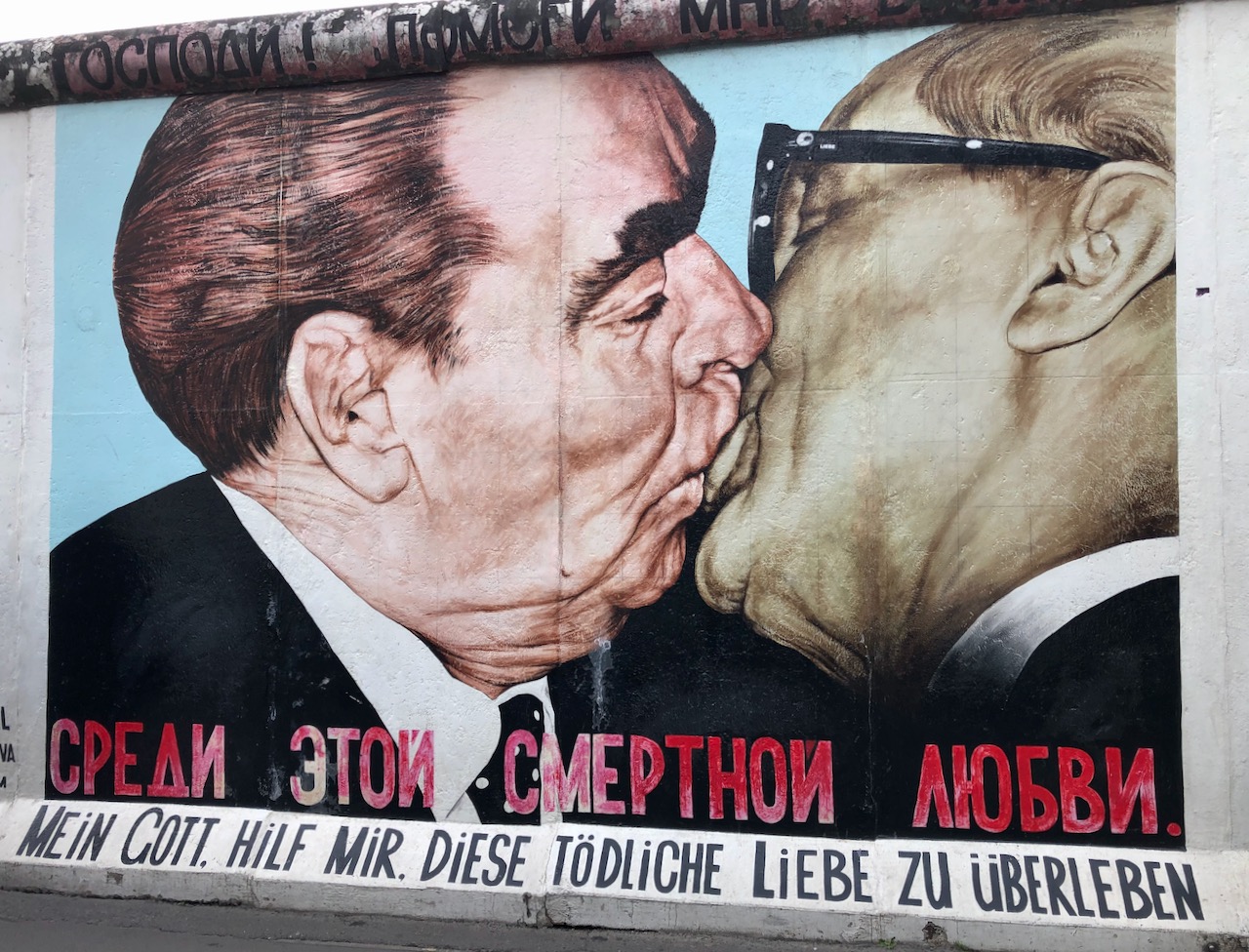
Eastside Gallery: ‘My God. Help me to survive this deadly love.” From a press photograph of Leonid Brezhnev and Erich Honecker painted by by Dmitri Vrubel.

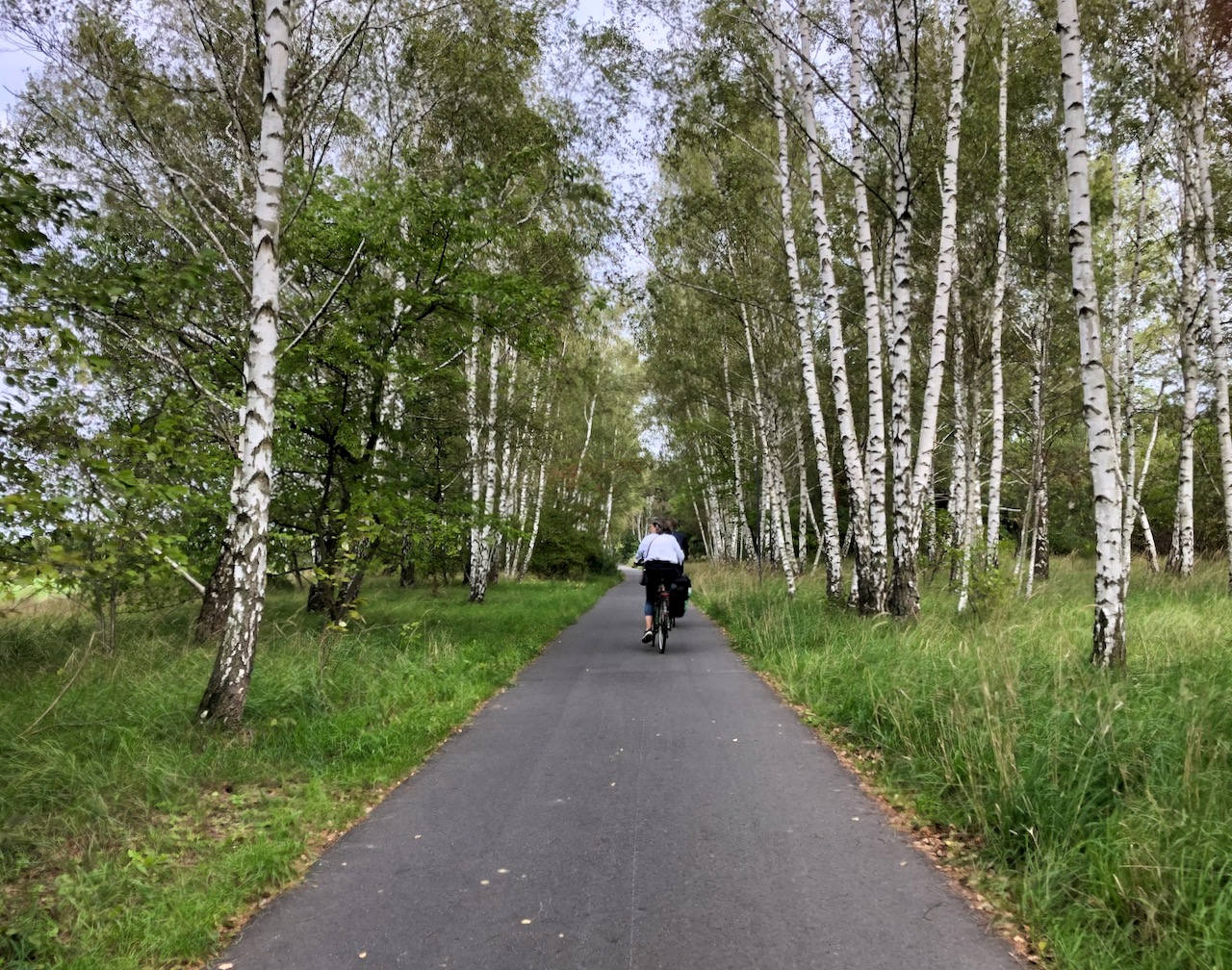
The final 40 miles or so along the southern strip of the wall’s course back to Potsdam was largely rural. A sense of peace replaces the former horror of all that the border came to represent. Long stretches of open fields, avenues of birch trees and an alley of 800 ornamental cherry trees donated by Japanese citizens and a TV station in 1995 “out of joy over the reunification of Germany.”

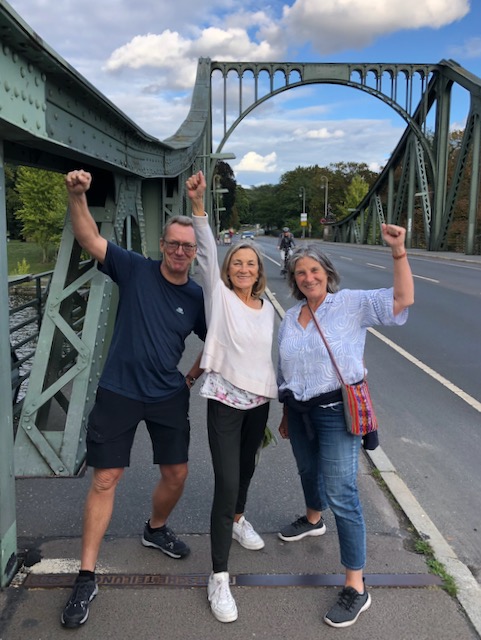
Finally, the three of us arrived back on the Glienicker Bridge from which we had begun our trip, each a little changed, each with a greater knowledge and understanding of German history and our German roots. Each with different emotional responses but a shared sense of the ultimate triumph of humanity and freedom over inhumane systems of repression.

Back on Glienicker Bridge

Upcoming Events relating to my book – In My Grandfather’s Shadow:

Friday 7th October, 7pm. Ebeneza Presents, Somerset: In My Grandfather’s Shadow. More information and tickets here

Sunday 9th October, 4pm. Cuckfield Book Festival: I will be in conversation with Julia Boyd, the best-selling author of Travellers in the Third Reich and A Village in the Third Reich.
More information and tickets here

Wednesday 12th October, 4pm. Mere Literary Festival: In Conversation with Jo Hall. More information and tickets here

Sunday 3rd November, 8.30pm. Stroud Book Festival: In Conversation with Alice Jolly, novelist, playwright and memoirist. More information and tickets here

Becoming aware of the invisible ties that bind us to the past…

It is now just three weeks until the publication of my book, In My Grandfather’s ShadowA week in the stunning, state-of-the-art Penguin Random House studio recording the whole thing for the audio book version has left me feeling more intimately connected to it than before. Like a parent, I have spent years nurturing it into its current shape. Now it is leaving the nest and heading into the big wide world… how exciting is that! 

Most of you will already have an idea of the themes it is likely to address from my blogs. And – spoiler alert – it does. But possibly the main thrust of the book – as stipulated by Penguin Transworld when they took me on – was to focus on the heritability of trauma. It involved ‘a bit’ (read: ‘total mind-fry’) of a re-write. Yet ultimately they were right. Because this idea, that we can inherit psychological wounds from our forebears, is gaining more and more traction.

The process or re-structuring a book…

One of the book’s working titles was ‘Invisible Lines’, which I liked. But ‘line’ is somehow wrong. Even the letters that make up those two words are too straight, too linear. For, while there is obviously a linear logic to the structure and the content, the essence explores hidden cycles and the bits of life that meander or tie themselves in knots. Or that appear unsubstantial, unreal even, when really they are holding the tiller to our lives.  

As I have said before, trauma, guilt and shame abide in the psyches of us all to a greater or lesser degree. They are part of what it is to be human. But frequently they remain unidentified, like bottom dwellers in the sea of our emotions that stir up the mud to cloud our vision and cause havoc with how we see, not only ourselves, but others and the wider world. 

In My Grandfather’s Shadow therefore takes readers on a deep dive into largely unknown or unspoken – until recently – corners of experience. Not just of those who lived through the Second World War, but those who came after. It looks at the impact of war and violence in general, a theme that has gained an unwelcome pertinence in the light – or should I say darkness – of Russia’s war in Ukraine with its horrific reports of rapes, brutal murders, forced transportations that echoe my grandfather’s letters from the eastern front in 1941-2. War is as old as the world. But where the brutality was once confined to the battlefield and soldiers, Ukraine is a salient reminder that modern warfare invariably extends into the homes and lives of civilians. For generations.

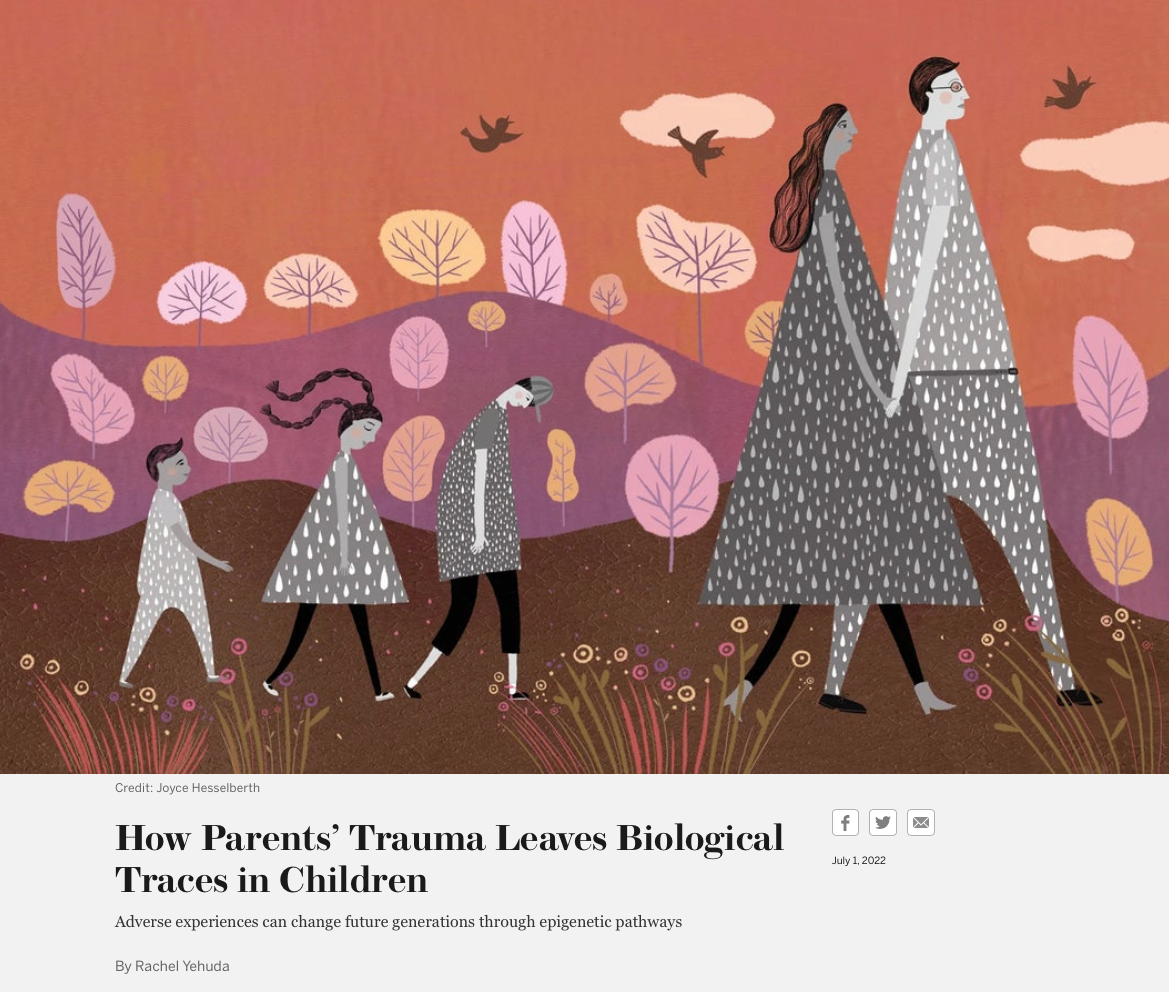
It is probably easy to imagine how the extreme traumas of the Holocaust could affect the offspring of survivors as well. Traumatic imprints have long been witnessed in second and third generations. What is less known because it could only be articulated when the non-Jewish German grandchildren of those who lived through the war came of age in their 40s, is that traumatic experiences of any nature, if left unattended or untreated, can seriously disrupt the lives of subsequent generations. The process is variably referred to as ‘transgenerational transmission’ or ‘emotional inheritance.’ Even science is embracing the possibility with its own language: ‘epigenetics.’ (See article

How Parents’ Trauma Leaves Biological Traces in Children – Scientific American

Whether biological, psychological, genetic or spiritual, the process of transmission is not new. What is new, is our growing awareness of it. And with that awareness comes responsibility. Responsibility to address the cause of the damage, to find ways to resolve or heal it, and then to prevent it. To neglect trauma, particularly in children, and to ignore how it’s effects can linger on for generations is to potentially condemn them to lives of violence, self-harm, substance misuse, depressions, low self-esteem, underachievement or a general sense of something being amiss, all of which are becoming increasingly endemic in our society. It is therefore in everybody’s interest to do this.

This is one of the reasons I took the risk of bearing my soul and writing my book. Because I really hope that parents, teachers, doctors, psychologists, politicians might open their minds to the possibility that behind someone’s problematic behaviour or attitudes, their unemployability, fears or lack of motivation there might lie an unresolved family trauma, wrongdoing or injustice that is seeking resolution through that person without them realising it. It took me five decades to unravel the ties that bound me to the experiences of my immediate forebears. Because nobody knew about it back then.

Well, we do now. Or at least you will do when you have read my book!

In the words of those who have read it:

“Can we as individuals untangle ourselves from a past that binds us to the suffering and deeds of our predecessors?”This profound question forms the basis of this remarkable memoir in which Findlay – granddaughter of Wehrmacht officer, General Karl von Graffen – wrestles the feelings of ‘badness within her’ that has plagued both her mental health and her sense of self for years. It’s a powerful investigation into the individual personal cost that results from wider history, and the ways in which inherited guilt and trauma can leave scars across the generations. A must read… Caroline Sanderson, Editor’s Choice in The Bookseller

This is a moving and powerful memoir that illuminates the extraordinary power of unprocessed trauma as it passes through generations, and how when it is faced it can be healed. Julia Samuel, author of Every Family Has a StoryGrief Works and This Too Shall Pass

An unflinching exploration of shame and pain passed between generations.  This is a powerful and important book which will change the way in which we understand ourselves. Emma Craigie, author

A page turner of the highest calibre! Meticulously researched, searingly honest and beautifully written, this timely book is a salient reminder of how intergenerational relationships connect threads between past and present... This book gives new meaning to the prescient words of psychoanalyst, Roger Woolger: ‘It is the responsibility of the living to heal the dead. Otherwise their unfinished business will continue to play out in our fears, phobias and illnesses.’ Marina Cantacuzino, author and founder of The Forgiveness Project

This is an absolutely extraordinary book. In peeling back the layers of her family history, Angela Findlay reveals a vast, hidden European story that few nations have ever been brave enough to confront. Keith Lowe, author of Savage ContinentThe Fear and the Freedom, and Prisoners of History

A compelling journey through guilt and shame that asks fundamental and painful questions about the extent of a family member’s participation in one of the biggest crimes of the 20th century. Derek Niemann, author of A Nazi in the family

From 14th July, you will be able to purchase In My Grandfather’s Shadow at a bookshop near you such as Waterstones or various online stores .

11.11. ‘Lest we forget…’ But I did. This year I forgot.

For many a year, as regular readers of my blog can attest to, I have acknowledged and written about Armistice Day, Remembrance Sunday and the need to remember. But this year, 11.11. passed me by unnoticed. I was definitely silent at 11am, but not because I was remembering. I was in the depths of Cornwall deeply immersed in the increasingly final (final final x 10) Final Edits of my book.

I feel bad for forgetting, because I do think it’s important that we remember and commemorate. Just listen to the repeat of Radio 4’s 2014 programme Commemoration to hear some of the main reasons we do. But I also find it curious that I did forget. For this dance between remembering and forgetting is a healthy one. I should know. I have been dancing it a long time.

On Thursday 11th November, the only glimpse I caught of a world beyond the war narratives constantly unfolding in words on my laptop screen, was the sound of the shaky-voice of South Africa’s last white president, FW de Klerk. He had died in Cape Town aged 85, and his office had issued a prerecorded posthumous video apology for the pain caused by his country’s discriminatory system of white rule. On reflection, this collision in time between his apology and our Armistice Day, revealed what, to me, might actually be the essence of why we still need to remember.

“I, without qualification,” said the man who, together with Nelson Mandela, had overseen the end of apartheid, “apologise for the pain and hurt and the indignity and the damage that apartheid has done to black, brown and Indians in SA.” 

I cannot comment on his speech or his former role in the painful history of his country – you can read a bit about them on some of the links below. But, whatever sceptics and critics say about his motives or timing or whether what he said went far enough, I did feel the power of apology in his words. Genuine apology is that all too often underrated act that can set into motion so much of what we try to achieve through remembrance: restitution, forgiveness, reconciliation and healing. For many victims of wrongdoing or harm, such acknowledgement of their pain and a heartfelt apology for it is all they really want.

Of course, on Remembrance Sunday of all days, we first and foremost want to honour and show gratitude to the fallen and to hold their loved ones in our thoughts and hearts. But, if you don’t know any soldiers who have fought, let alone died in contemporary wars, or if you have never met a veteran of the World Wars, as is increasingly the case, it is hard to actually ‘remember’ in more than a slightly abstract way. For many school children, the Second World War exists in a last century time warp, as I found out at one of my recent talks when one of them asked me whose side I had been on! (Really? Have you not listened to a word I have just said? Or do I just look like I am 95-years-old?)

That is why I am wondering if Remembrance could shift some its emphasis on the past, to include more about the present and the future. The act of apology innately requires an understanding of the lessons history can teach us. Embedded within an apology is more than just a hope for ‘Never Again’. A genuine apology is ‘Never Again’ in action. So today, Britain’s Remembrance Sunday, I am not only going to remember the sacrifices and losses of war. I am going to imagine a time when the hands of heartfelt apology are extended between nations both in acknowledgement of past mistakes and in renewed agreement to act in ways that assure such mistakes never happen again.

Links to further reading:

FW de Klerk issues posthumous apology for pain of apartheid

Apology accepted? SA weighs in on FW de Klerk’s final message

FW de Klerk: South Africa’s last white president dies and leaves apology for apartheid

For Some South Africans, de Klerk Missed Chances for True Reconciliation

BBC Radio 4 Something understood: Commemoration

Is trying nonagenarians for Nazi War Crimes the best way to achieve justice?

If it wasn’t so serious, the idea of a 96-year-old going on the run to escape trial would be quite comical. But behind the image of an old lady hopping into a cab at her retirement home and fleeing for the subway station in the early hours is a quagmire of deeply complex and emotive issues.

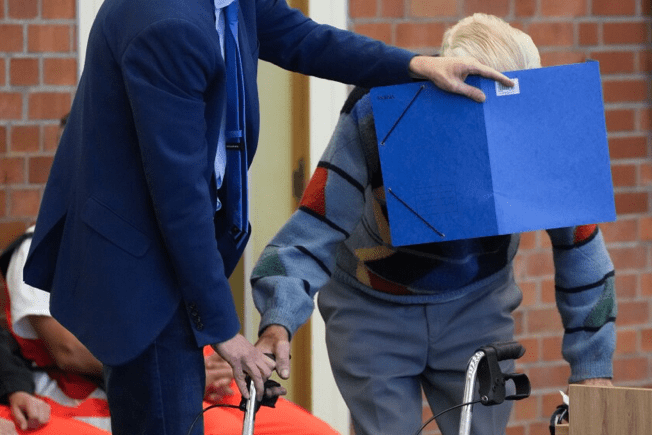
Irmgard Furchner stands accused of having contributed to the murder of 11,412 people between 1943 and 1945 when she was an 18-year-old typist and former secretary to the SS commander of the Stutthof concentration camp in Poland. She is the latest of several nonagenarian Nazi war criminals to be brought to trial, some of them in youth courts because they weren’t adults at the time of their alleged crimes.

Irmgard Furchner being brought into court

The reason this particular case captured my attention is partly because it coincided with the seventy-fifth anniversary of the final day of the Nuremberg Trials that saw twelve senior members of the Nazi establishment sentenced to death by hanging. And partly because the hearing Furchner was due to attend was in Itzehoe, the same north German town that I have been going to all my life. I have been looking Nazism and the Second World War in the face for several decades now, but my countless happy memories visiting relatives there had completely insulated it from the chill of Germany’s wider history. 

Now it is in the spotlight as the face of retribution. So, is it a total no-brainer that even seventy-five years later, such people, nonagenarian or not, must pay for their part in some of the worst mass killings in history? Or is this more a rush by prosecutors to seize the final opportunity to redress the failures of the previous decades? Will sentencing these last Nazis to time in prison achieve justice for the victims? Or are these trials there to serve the broader objective of Never Forget? Is a ninety-year old even the same person as their eighteen-year-old self?

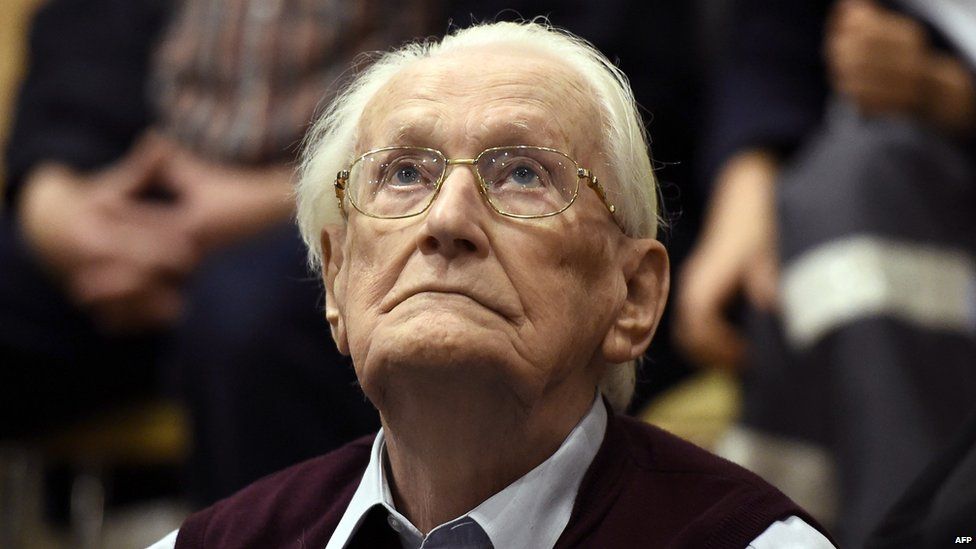
The last guilty verdict issued was to former SS guard Bruno Dey, who was handed a two-year suspended sentence in July 2020 at the age of 93. The 2019 trial against 95-year-old Johann Rehbogen for his service as a guard also in Stutthof Concentration Camp, had to be terminated as his organs were failing. The only successful conviction was of 96-year-old Oskar Gröning, the so-called ‘bookkeeper of Auschwitz,’ who was sentenced to four years in 2015 but died in hospital after his several appeals failed. I wrote about him at the time in my blog. In his case he had not tried to evade justice. Driven by a desire to counter Holocaust deniers and prevent something like Auschwitz from ever happening again, he had been openly talking about his time as an accountant in the death camp. His testimonies, however, were used against him in court with the unintended outcome that other low-level perpetrators and bystanders went silent. 

Oskar Gröning at his trial in 2015

For some people, the greatest justice to all victims of Nazi persecution that these trials can provide is to keep the crimes fresh in peoples’ minds and prevent them from being forgotten, denied or trivialised. They force Germans, including younger generations, to listen to the testimonies of survivors and to rake over the whole disturbing and uncomfortable past once again. 

It is so important that we never forget; that we all learn the lessons that Germany’s descent into barbarity and atrocity teaches us, not least about the vulnerability of democracy today. But survivors often declare that legal retribution is not the main outcome they are after. That they are more interested in shining light on unresolved or overlooked crimes and contributing to Holocaust remembrance and education. 

So, are we now at a time when imprisonment is a less effective response than a more direct dealing with the aftermath of the offence? Is there now another way that serves justice to the many victims of the Third Reich and their descendants AND sends a powerful message to would-be perpetrators of mass crimes that they will never get away with murder AND contributes to remembrance and education AND offers possibilities for healing and reconciliation? 

The past cannot be changed, but the present can. Might communication between those harmed by and those implicated in Nazi crimes, within the safe frameworks of Restorative Justice or mediation initiatives, offer the possibility to fulfil all the outcomes desired by the survivors? Could the excrutiating discomfort of acknowledgment of past wrongdoing be the punishment? Would talking together create an opportunity to resolve some of the harm and nurture the shoots of healing, forgiveness and reconciliation that can sprout from really listening and really being heard? 

Further reading:

Trial of 100-year-old man in Germany: why Nazi war crimes take so long to prosecute – The Conversation

Former Nazi death camp secretary, 96, remanded in custody after going on the run – Times of Israel

Nuremberg: The Trial of the Nazi War Criminals – Radio 4

Germans are right to pursue 100-year-old former Nazi war criminals – Irish Times

Who’d have thought 18 minutes standing on a red dot could unleash such terror?

The news that I had been selected to speak at TEDxStroud came on what can only be called a day from hell. It was August 2020. The brick gable end of my mother’s old garage had just collapsed in a storm leaving live electricity cables strewn across the driveway. She was unadvisedly trying to tidy them away while sinking into a diabetic low when we received the news that my brother-in-law’s father had died of Covid. In the flurry of activity and phone calls that followed, the email plopped into my inbox: CONGRATULATIONS! You are one of nine people selected from 84 applicants to deliver a TEDx talk on the theme of Emergence…  

I had totally forgotten I had even applied and my heart simultaneously raced and sank as I realised this was another gauntlet I had to take up. TED is the mecca of public speaking platforms. The iconic red spot on the floor has hosted some of the world’s very best speakers and lured over 3,600 people with a good idea to share. There are strict criteria: No more than 18 minutes per talk. No selling or promotion of a product or business. No profit or pay to speakers or organisers… just a good idea that is worth spreading. 

Tickets and further information can be found here

Over the following months, Covid threw curveballs at the original visions for a live event with an audience of 400, sending each one flying like skittles in an alley. Lockdown even forced a postponement from November’20 to March’21. The organising team were undeterred in their commitment. With each new restriction, they adapted, delivering changes of plan with supportive sensitivity and unwaning optimism. Meanwhile, we speakers met in Zoom rooms hosted by other talented volunteers where we would listen and feed back to each other while witnessing amorphous blobs of chosen subjects being honed to their essence. Not ‘just a minute‘ without ‘hesitation, deviation or repetition’ as on BBC Radio 4, but 18 minutes! 

Sounds easy? It’s not. The techniques to memorise our talks ranged from falling asleep to a recording of your own voice droning its way into your memory, (nothing has ever sent me to sleep faster, all insomniacs click here if you’d like a copy!) to delivering it in a silly Texan accent. We had to practice talking to the barrel of a camera lens while smiling at some imaginary audience member sitting beyond it. We even had to choose proper clothes to wear as opposed to our baggy lockdown jumpers and leggings. 

Practicing…

Kind friends tried to assuage the terror that gained momentum over the final two months until it clenched my chest in a vice and froze my brain. “But you speak so well… it’s no different from the talks you already give… you can do this with your eyes shut.” But a TEDx talk isn’t the same at all. It will be uploaded to YouTube and made available to a global audience… potentially forever. You have no slides or prompts to jog the memory. And what’s more, my ‘great’ Tedx idea isn’t an easy one to talk about, let alone sell as a ‘gift’! Because I am basically asking people to get really uncomfortable; to follow me on a journey that descends into the dark underbelly of human experience, where prisoners, Nazis, unspeakable atrocities or war experiences fester like wounds marinated in silence, pain and shame. 

I sometimes feel I should apologise for bringing such things into the light of awareness. But I won’t, because the rewards are too great to ignore. And because it has become clear, not just to me but to neuroscientists, geneticists and psychologists, that we have to go there if we want to break the cycle by which toxic, unresolved past traumas and wrongdoings persistently disrupt the present. Now more than ever, it is important to recognise the link between the past and so many of today’s symptoms of violence, division, discrimination, inequality, addictions, injustices, racism… 

It is not easy to face unacknowledged past harm, not least because it will have been buried for a reason, often a good reason such as protection or avoidance of pain. But I promise you, it is ultimately easier than schlepping it around with us, patching it up and handing it on to the next generation to deal with. 

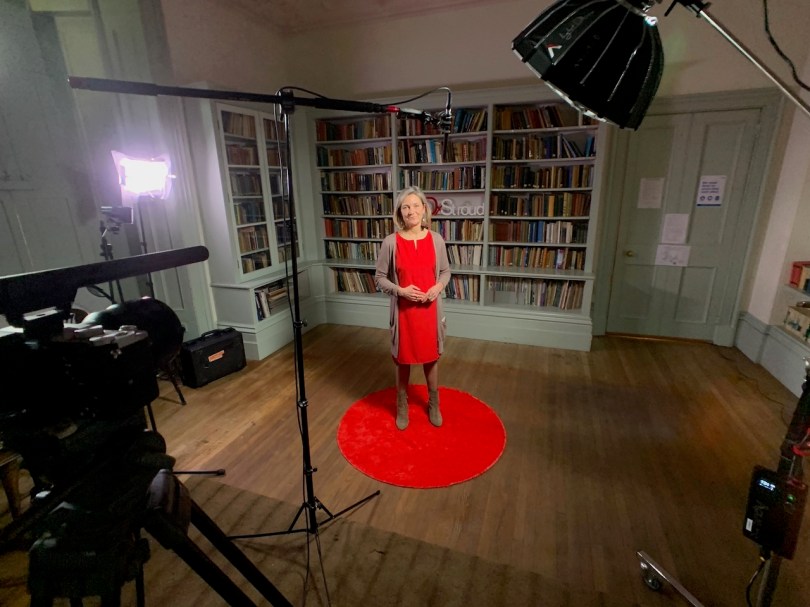
Recording my TEDx talk on Thursday 11th March

So, may I invite you to join us this SUNDAY 21st MARCH 2021 from 2pm, not just to hear my TEDx talk Facing the past to liberate the present, but the talks of seven other amazing speakers, each of whom has been on an equally intense journey to deliver a wonderful idea as a gift to you and our world. Tickets and further information can be found here.

PLEASE SIGN UP TO MY NEWSLETTER to be kept informed about all my forthcoming events or click on FOLLOW MY BLOG at the top of the page to receive them straight into you inbox.

Remembering Dresden – along side its people – helps in the healing of the past

From 13th-15th February, Dresdeners will be gathering to mark the anniversary of the destruction of their city in 1945. This year, rather than creating their usual human chain to snake through the city in peaceful reflection, it will, like most things in this pandemic, be a largely online affair. A Dresden Trust trustee always attends the event as a gesture of deeply-felt solidarity and reconciliation. This year was to be my year to represent the Trust, but instead we have sent a video of messages to our friends and contacts there. Immediate emails of thanks reveal how deeply moved they have been by this extension of virtual British hands and hearts to them. It was a tiny act on our part, but its value was clearly of significance. 

The last couple of years have seen the 75th anniversaries of many Second World War events: the D-Day landings, VE Day, VJ Day, the liberation of Auschwitz… Each was naturally ‘celebrated’ in technicolour with dignitaries from around the world, for these were some of our nation’s finest hours. Tucked in the shadows of those victories, was the 75th anniversary of the UK and USA bombing of Dresden. As far as I am aware, no British politician attended. Neither Boris Johnson nor Jeremy Corbyn even commented on it. It is still a thorn in the side of Britain’s conscience. 

I am fully aware of the contention surrounding the bombing of Dresden. Was the city a legitimate target? Did the Germans deserve it? Was it a war crime? Were Bomber Harris and his Command heroes or part of a campaign that went too far… way too far? In the articles at the bottom of this post you can read up on some of these attitudes, as well as get a picture of the horrors witnessed by a British serviceman held prisoner there. 

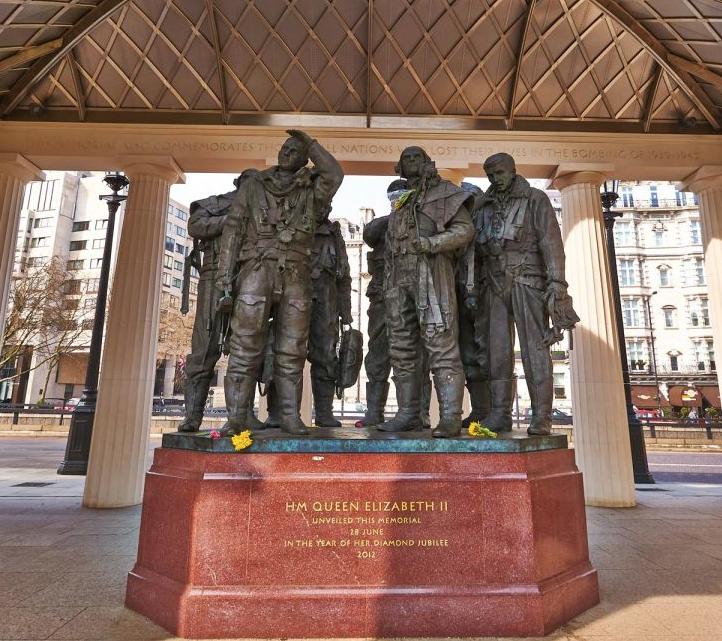
Bomber Command Memorial, Green Park, London (2012)

Seventy-six years on, I feel we are totally missing the point if we get tangled up in binary discussions of whether it was right or wrong. Within the context of Hitler and a World War, you can see how it could be considered ‘right’. On that basis, by reading some of my German grandfather’s letters, you can also see how it could have been considered ‘right’ to invade Russia. And by listening to the stories of prisoners, you can also come to understand how they too consider their crimes to have been the ‘right’ thing to have done. Wrongdoing – on an individual or national level – is usually based on thoughts that justify it as being the ‘right’ thing to do. Often this is a reaction designed to redress the wrongdoing of another… and so it goes on. The validity of the reasoning, however, doesn’t automatically make it the right thing to do morally

We are living through extraordinary times of potential change for good. I say ‘potential’ because if we in Britain do not broaden our perspectives on our past in tune with history’s ever-shifting shape, we run the risk of becoming fossilised within it. Nothing can change if we cling to the old. The current statue debate, as provocatively and passionately pursued by Robert Jenrick, our secretary of state for housing, communities and institutions, is an example of the deeply flawed thinking at the core of some of our attitudes to the past. For him, statues represent history itself. Yet they don’t. They represent the values of the time. Both history and values evolve, and debating and adapting to this evolution are important parts of any country’s healthy relationship to its past. What’s more, focusing on statues is a classic example of merely treating the symptom rather than the cause of a problem.

While I don’t believe the removal (or not) of statues is either the real issue or the solution, the government’s evident terror of a ‘revisionist purge’ by ‘town hall militants,’ ‘woke worthies’ and ‘baying mobs’ is revealing. (And insulting to the justifiable requests for a reconsideration of the appropriateness of certain statues in today’s cities). It is the terror, not just of the dismantlement of our statues and heritage, but of our almost purely benign self-image. So great is that fear, that Mr Jenrick is giving himself the personal power to intervene in democratic decisions made by local communities, councils and institutions about the fate of their statues if their decisions don’t adhere to the government’s position. Is that democracy?

Our national self-image and reputation have already been considerably wobbled, if not toppled, in recent years. So I say, bring it on! Why don’t we just go for it? Why don’t we literally ‘come out’ officially and admit: We have… at times… been utter shits. Does that automatically diminish all that we hold dear and celebrate about ourselves? No, not at all. We can be all those good things AS WELL AS being, at times… shits. We can have done and achieved amazing things AS WELL AS having made mistakes, or been on the wrong side of good, or been actively, deliberately bad. We can honour our pilots and soldiers AS WELL AS deeply question the morality of some of our decisions. No country will think less of us… indeed I am sure they will embrace and welcome our vulnerability after so much bullish bluster.

Dresden, February 1945

Until we can shift our position even just a little, Dresden will remain a contentious and unresolved issue. A dark smudge on the national conscience. Whether it was right or wrong, a war crime, an atrocity or a strategic attack, the fact remains that an estimated 25,000 people – primarily women, children, elderly, refugees and POWs – were killed in indescribably ghastly ways, by any standards of warfare. We deliberately designed it to be just so. Could this government, the successors of the instigators of such calculated destruction and loss of life, not also extend a small gesture of thought to the descendants of our victims?

In Mr Jenrick’s argument, “To tear [statues] down is, as the prime minister has said, ‘to lie about our history’.” If we really rely on our statues to tell the truth about our history, then we need to get carving and casting fast. For so far, only truths considered flattering or benign are being told. Nothing of the dark shadows cast by those men on pedestals is included in our statue-version of history. Doesn’t that then make it a lie…?

Past harm left unresolved is a burden that disrupts the present of each generation as it seeks resolution. It adversely shapes attitudes and policies. Let’s be the generation that works through the full truth of our past, creates peace with it and thereby liberates future generations from it.

In my forthcoming TEDx talk on 21st March 2021, I will be explaining How facing the past freed me. You can read more about it here and buy tickets to the event here

Related articles:

The Spectator: Did Britain commit a war crime in Dresden? A conversation Sinclair McKay and A.N. Wilson on the 75th anniversary of the bombing raid

Good Morning Britain 75th anniversary: Dresden bombing survivor Victor Gregg 100 on

Herald Scotland: Dresden 75th anniversary: why Britain must come to terms with its own dark wartime past 

BBC: Dresden: The World War Two bombing 75 years on

The Telegraph: We will save Britain’s statues from the woke militants who want to censor our past (Robert Jenrick)

The Guardian: It’s not ‘censorship’ to question the statues in our public spaces

Please sign up to my NEWSLETTER to be kept up to date on my forthcoming BOOK on the subject here. To receive my monthly blog by email, press FOLLOW at the top of this page. Or contact me for any enquiries about my TALKS.

Being inspired to be a ‘light in the darkness’ feels a powerful way to honour Holocaust Memorial Day

When it comes to Remembrance, I cannot think of a more important day to take time to reflect than today – Holocaust Memorial Day, the anniversary of the liberation of Auschwitz by the Soviet army in 1945. Eighty or so years lie between us and the horrors that started in Germany and then spread beyond. Most of the survivors of those times are no longer able to bear witness to them. And yet, for many descendents, that past will still be alive shaping their present. It is primarily for them, and all that they carry in their hearts, that I pay such attention to this day.

As readers of my blogs will know, any day of remembrance raises questions in me: what to remember, how to remember it and to what end? I’m always particularly interested in the editing process of our personal, collective and national memories. Which selection of people, events and actions we choose to remember and honour. And which get left out.

Edits of history come about for all sorts of reasons, not least because some memories are too painful… or shameful to re-visit. But what happens to things that happened, but aren’t included in the stories we tell about ourselves? What happens to those awkward truths or people that disrupt more favoured version of events? Obviously politics plays a big role in shaping a country’s historical narrative to support left, right or centre agendas. But I still ask, what happens to the inconvenient truths that get suppressed, denied or banished to the footnotes?

Plans for a Holocaust memorial next to Parliament

I found this recent article by Richard Evans in the New Statesman fascinating: How should we remember the Holocaust? It describes some of the multiple points of view in the on-going debate about the appropriate form, location, size, message and so much more of the proposed Holocaust Memorial and learning centre in the heart of Westminster. It’s complicated. This is exactly the kind of debate Germany has been engaged in almost incessantly since the eighties and that lies behind their extensive culture of ‘counter memorials.’ At one point it was even suggested that perpetual debate on the form of a memorial was possibly the best way to keep the memories alive.

I have many thoughts (obviously!) on what is said in the article, but I will spare you of them here (except one!) in favour of inviting you, on this day, to think about where you stand in relation to Holocaust remembrance. My ‘one’ opinion echoes that of Raphael Wallfisch, a leading international concert cellist whose mother was forced by the SS to play in the infamous women’s orchestra at Auschwitz. He insists that the proposed ‘British Values Learning Centre’ “must reflect clearly and truthfully, the complete and unvarnished truth of Britain’s role before, during and after the Jewish Holocaust…” This request for a fuller picture is echoed by many others in the Jewish community and beyond.

We are witnessing all around the world not only a rise in anti-Semitism, but also eruptions of rage as suppressed, uncomfortable truths surface. Covid-19 is giving us an opportunity to re-think how, what and why we remember. The Britain of today needs to rise to this challenge, now more than ever before. Of course, remembering and hearing the stories of the victims is paramount. But if we primarily focus on what Germany did and how the British triumphed over evil, we are missing a vital lesson. Britain also needs to look at, and learn from, what we as a nation didn’t do… but could have done.

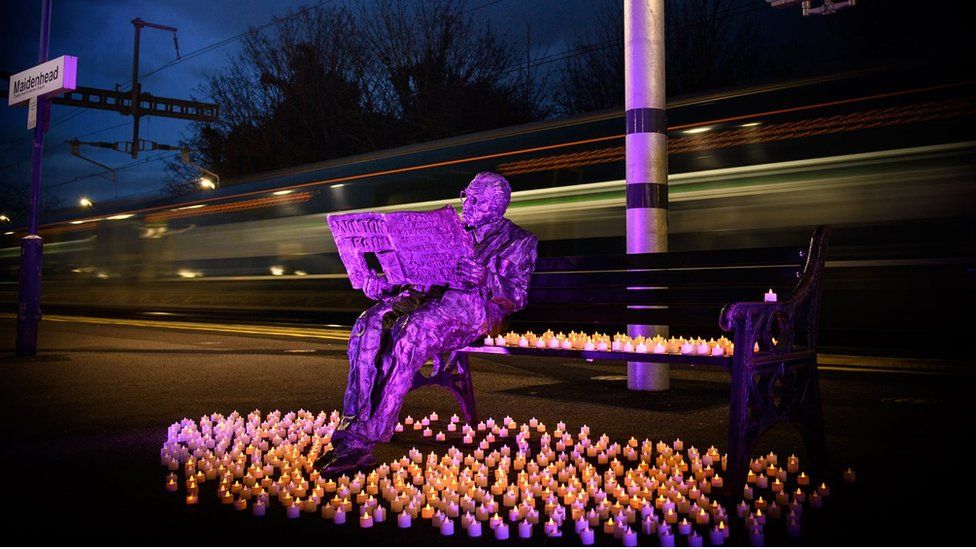
 Statue of Sir Nicholas Winton, the “British Schindler” at Maidenhead railway station

This man, Sir Nicholas Winton, could never be accused of not having done enough. Against all odds, he smuggled 669 boys and girls, destined for concentration camps, out of Czechoslovakia in 1939. Celebrating his unbelievable bravery and life-saving initiative with candles feels a truly fitting way to mark this day. We can all join in for households across the country are being invited to light a candle at 8pm this evening, as an encouragement to us all to “be the light in the darkness.”

A few more things here:

This 4-minute film is a deeply moving testament: Story of Nicholas Winton, BBC That’s life – Short version

Holocaust Memorial Day: Sir Nicholas Winton’s statue lit up: Article about the above lit-up statue

Article in The Conversation: Plans for UK Holocaust Memorial looked promising, but now debate has stalled

BBC 2: Confronting Holocaust Denial with David Baddiel

The time to remember that ‘to the world he was a soldier, to us he was the world’

‘Tis the season to remember… and yet, this year, for the first time, I forgot. Remembrance Sunday was almost over before I suddenly remembered to remember. 

Locked down at home, I was definitely silent. But maybe the official 2-minute silence at 11am passed me by because in my talks and blogs I am frequently remembering. In fact, ‘looking back’ has become part of my identity, my expertise even. So much so that I have been selected, as one of nine speakers, to do a Tedx Talk on the subject: Facing the past in order to create a fairer future.’ It’s an exciting opportunity though unfortunately lockdown has forced the proposed date of 29th November to be postponed until the spring. It will happen though… like so many other things in this disorientating Covid world in which we are currently immersed. 

In the meantime, if you haven’t attended my talk on How Germany Remembers and would like to, there’s a chance to hear it online on Friday 13th November at 11.30am. It is being hosted by the National Army Museum in London where I spoke last year. You can read more about it here and you can register for free here.

But back to remembering… or forgetting in my case. Maybe there are some of us who feel a little tired of remembering. Or maybe it’s the national narrative we tell ourselves each year, that is tiring. This is one of the points made in Radio 4’s ‘Our Sacred Story’ in which Alex Ryrie, Professor of the History of Christianity at Durham University, suggests that the Second World War is both our modern sacred narrative as well as the shaper of our collective sense of what constitutes good and evil. 

This summer we celebrated the 75thanniversaries of VE and VJ Day. In fact, we’ve done loads of national remembering over the past years. So aside from Remembrance fatigue, I’m wondering if Covid’s restrictive squeeze on lungs, lives and events alike, is also impacting what and how we remember. Lockdown has been turning mindsets inwards, shifting focus and values onto all that is immediately around us – family, gardens, quiet streets or empty skies. Maybe this new way of being is merging effortlessly with the existing sub-stream of thought that strives for essence rather than glitzy, sparkling veneer. 

Looking at the BBC coverage of Remembrance Sunday, it is clear that even our mainstream institutions of commemoration are being forcibly stripped of excess. I salute the efforts of all involved in trying to evoke the all-too familiar rituals, yet nothing could distract from the extraordinary visuals of sparsity. Watching the morning ceremonies at the Cenotaph, one could be forgiven for not knowing where one was. The eerily still Whitehall dotted with a few socially-distanced, poppy- and wreath-bearing dignitaries resembled a set construction of a movie whose budget couldn’t stretch to more actors. And in Westminster Abbey, the Queen, bless her, hatted and masked up in black, couldn’t help but look a little like Darth Vader as she gently touched the white myrtle wreath that was then laid by a masked serviceman upon the Grave of the Unknown Warrior. 

I couldn’t sit through the empty-seated Royal Albert Hall festivities that in the past have both grated and made me cry against my will. Instead, I sought the essence of remembrance in other areas. I soon found it in the podcast, We have ways of making you think. In their Episode 203 on Remembrance, historian James Holland and comedian Al Murray were in conversation with Glyn Prysor, former historian of the Commonwealth War Graves Commission. Between them they brought to life the history of the ubiquitous white headstones that fill acres and acres of land both here and on the continent. 

Set up in 1917 while World War One was still raging, the process of burying in the region of a million war dead, half of whose remains were missing, demanded a very new way of thinking. In a departure from the Victorian hierarchy of worthiness that extended into death and resulted in the common man just being ‘bunged’ into a mass grave, the Commission made a move towards inclusion. It wanted to evoke the sense that everyone had contributed to the war and everyone was equal in death. The outcome was a uniform design for all headstones that would make no distinction between wealthy and poor. This was of course deeply controversial. Individuality would only be marked through the listing of name, rank, unit, regimental badge and date of death. An appropriate religious symbol could also be added, or not. And a space at the bottom was dedicated to personal messages from family members, some of whom would never be able to travel to the continent to visit the graves of their loved ones. 

Covid has been highlighting the need for a similar leveling process across our hierarchies of wealth, fairness and opportunity. As in war, it is the personal losses and tragedies that will far surpass and long outlive the victories or shenanigans of the politics. In that vein, I found the essence of remembrance in an inscription spotted on a war grave in Bayeux:

Into the mosaic of victory, our most precious piece was laid.