Peace on earth, goodwill to men… and women

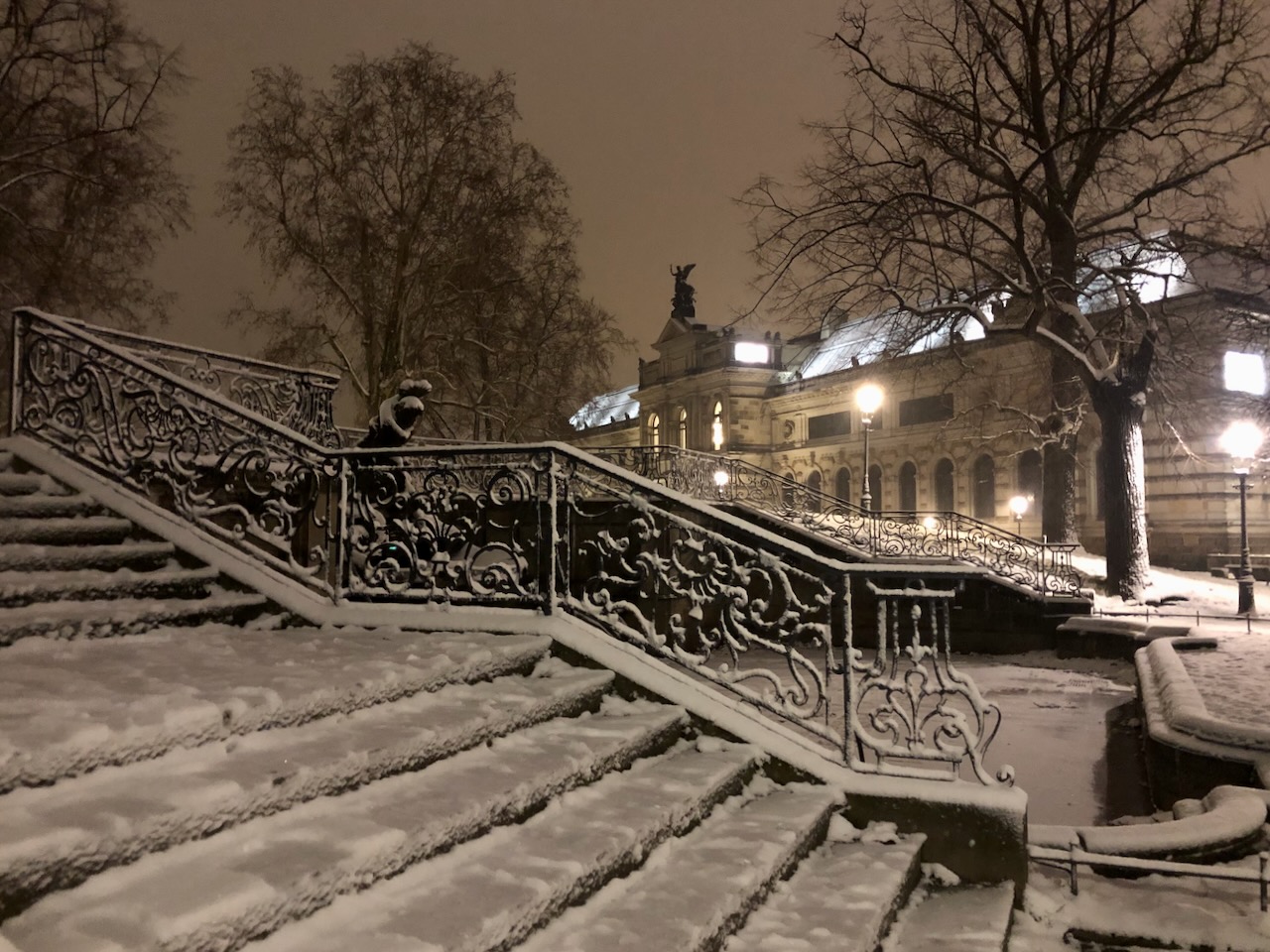
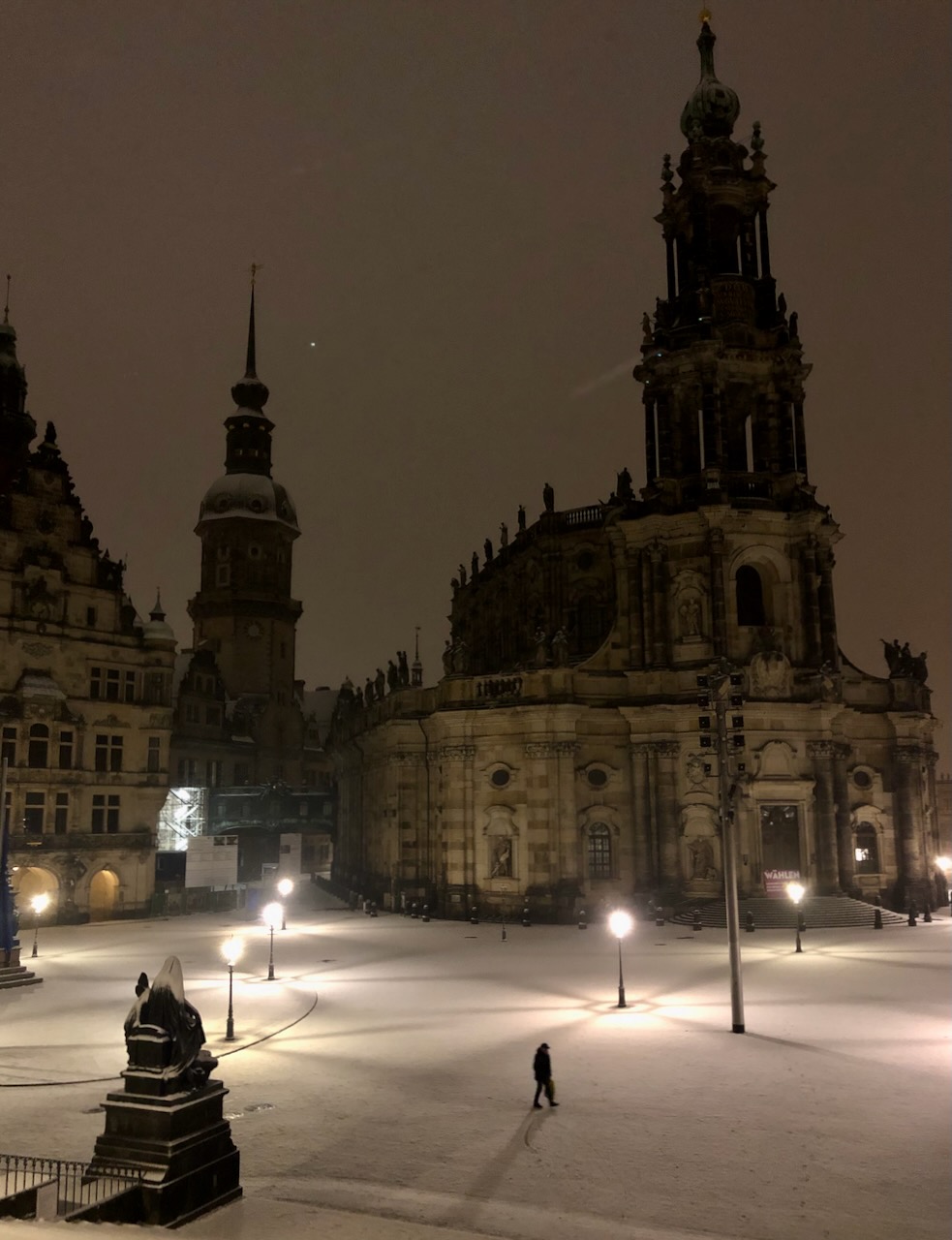
I am not a huge fan of Christmas, but I do love the peace of the days that follow the rush and stuffing of stockings, fridges and bellies. A stillness descends as exhausted people navigate the aftermath of families, toy-strewn floors and overflowing bins. Finally, those of us in the northern hemisphere can follow winter’s call to slow down, rest, and listen to the wisdom of our hearts and souls before the new year draws us back into action. 

Peace is not something we can take for granted anymore. Fighting – with words, ideologies or weapons – has increasingly become the norm. We have just been told by the UK defence minister, Al Carns, that “the shadow of war is knocking on Europe’s door.” And warned by NATO boss, Mark Rutte, that “we must be prepared for the scale of war our grandparents and great grandparents endured.” In this year marking the 80th anniversaries of the end of the Second World War, I’ve been asking myself: how do we maintain peace in a world in which so many of the vows and institutions created to prevent future wars are under threat? How do we ensure that ‘Never Again’ still holds? Various recent events have been shaping my thoughts.

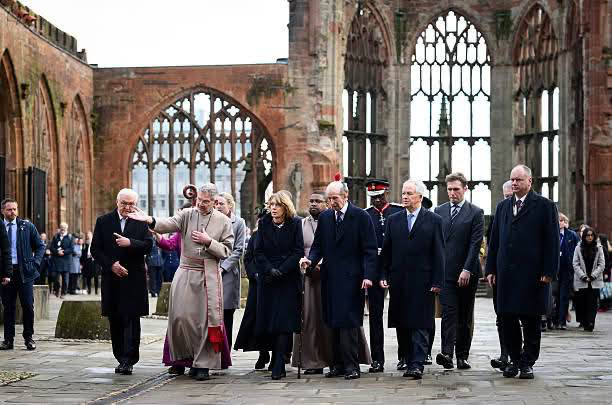
In early December, the German President Frank-Walter Steinmeier and his wife, Elke Büdenbender, embarked on a three-day state visit to the UK, the first in 27 years. In his speech at the state banquet hosted by King Charles III and Queen Camilla, Steinmeier highlighted the deep connections between Britain and Germany; how traditions from each country have been woven together so tightly that their origins are now obscured. Not least among these is the Christmas tree. The first one was displayed in Windsor in 1800 by the German Queen Charlotte, wife of King George III, and the custom soon spread to living rooms across the UK. The same is true for Battenberg Cake – a story I love and have often told in my work (see my December 2017 blog). 

L-R: President Steinmeier, Dean of Coventry, Elke Büdenbender, Duke of Kent…

On the final day of his visit, President Steinmeier travelled to Coventry Cathedral. He and his wife were greeted by His Royal Highness The Duke of Kent who, among his other roles, is Patron of The Dresden Trust. Coventry and Dresden have been twinned since 1959, linked both by the devastation of the bombing raids each country inflicted on the other, and by the many decades of peace and reconciliation work that have followed.

Al Murray and James Holland

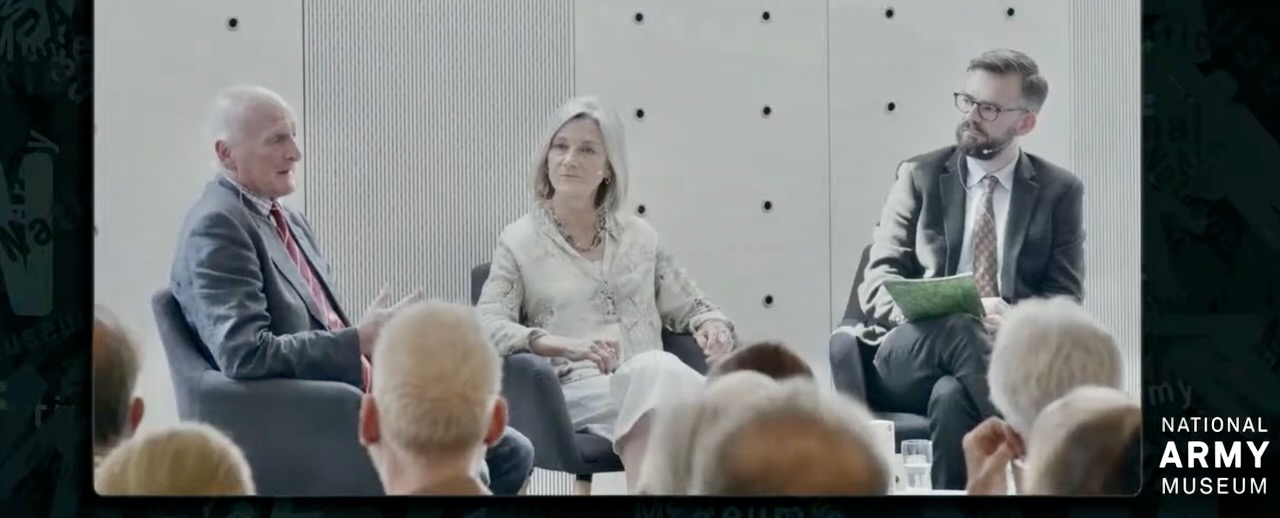
At around the same time, I had been sitting in one of Goalhanger’s recording studios. You may know them for some of their most popular podcasts in The Rest Is… series, including the chart-topping The Rest Is History and The Rest Is Politics. I was there with Henry Montgomery to talk with historian and broadcaster James Holland, and comedian and ‘Pub Landlord’ Al Murray, on their equally popular WW2-focused podcast, We Have Ways of Making You Talk Henry, also the grandchild of a high-ranking army officer – in his case the British field marshal best known as ‘Monty’ – and I had previously spoken together on VE Day at the National Army Museum. As I have mentioned in other blogs, we are exploring from our different perspectives how well Britain’s remembrance culture is really working. With ever fewer World War veterans and first-hand witnesses still alive to warn us of the horrors and futility of war, is it doing enough to keep “Never Again” a lived reality?

National Army Museum: Henry Montgomery, me and Daniel Cowling, May 2025

When I look at the visuals of Britain’s remembrance culture that make it into the media – for many people, perhaps the only occasions where they will actively ‘remember to remember’ the lessons of history – I fear we are not going far enough. We see mostly men in dark coats laying wreaths and solemnly reaffirming vows to uphold the peace and international friendship while elsewhere in the world other men stubbornly refuse to make it. We see the bright regalia of royalty and the glinting medals of veterans. It is the language of the military and the state: formal, symbolic and carefully choreographed. All fine and important. But peace is not confined to grand stages or organised occasions.

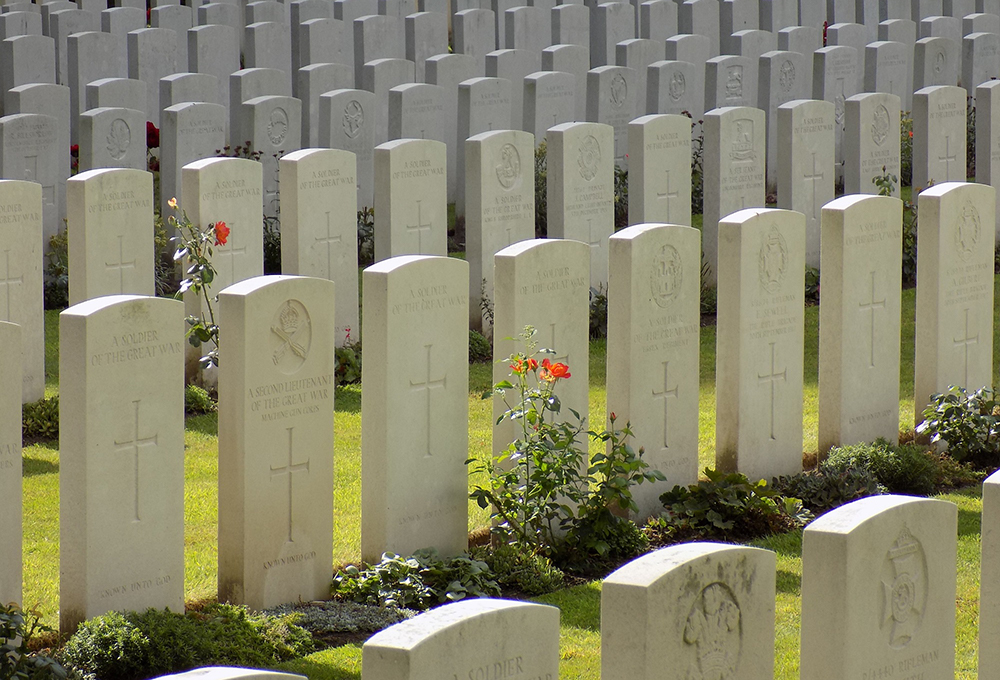
Listening to Radio 4’s brilliant Reith Lectures, this year titled Moral Revolution (what could be more pertinent in our times?) and delivered by the historian and author Rutger Bregman, I was struck by a description of a Quaker practice to bury the dead in unmarked graves. In stark contrast to the fields of Commonwealth War Graves and annual remembrance rituals, they believe you don’t honour people with costly headstones but with actions. Thomas Clarkson, the famous abolitionist who wrote extensively on the Quakers, said: If you wish to honour a good man, let all his actions live in your memory so that they may constantly awaken you to imitation, thus you will show that you really respect his memory.

In a similar vein, Germany’s counter memorial movement, which began in the 1980s, fundamentally changed the dynamics of memorialisation. Through its shifting, disappearing monuments and memorials to absence, the focus turned toward the millions murdered by the Nazis. Responsibility for remembrance and for ensuring such destruction never happens again was transferred from stone and bronze into the hands of ordinary people. 

And that is where it belongs. Peace is sustained not only by treaties, leaders and ceremonies, but by us – each and every one of us in our daily lives. 

So if, like Rutger Bregman with his call for a Moral Revolution, we were to start a Revolution of Peace, what might it look like? What would its optics be? What language would it speak and who would embody it? I suspect it would be a revolution that brings heart, warmth, listening, sharing and art into our everyday encounters. One with no emphasis on sides and differences, winners and losers, no interest in egos, power games or deception. Idealistic maybe, but arguably closer to what is naturally human for many of us than conflict and war. 

Perhaps over Christmas we can practice peacekeeping: at kitchen tables, in disagreements, in how we speak to one another and how willing we are to listen. In choosing curiosity and compassion over judgment. In noticing where hostility quietly creeps into our own lives and questioning the ingrained narratives that divide the world into a good and right ‘us’ and a bad and wrong ‘them’.  

When peace is on the line, remembrance must shift from an act of looking back to a commitment to shaping the future. Just as conflicts and wars escalate out of countless small decisions, so peace does too. May we – and the world’s leaders – choose peace in the year ahead.

But first, let the mayhem continue… Wishing you all a very happy festive season, a meaningful Winter Solstice, a restful and restorative break and, in 2026, peace on earth and goodwill to men… and women.

The We have Ways… podcast episode is due to be published on 30th December in all the usual podcast outlets.
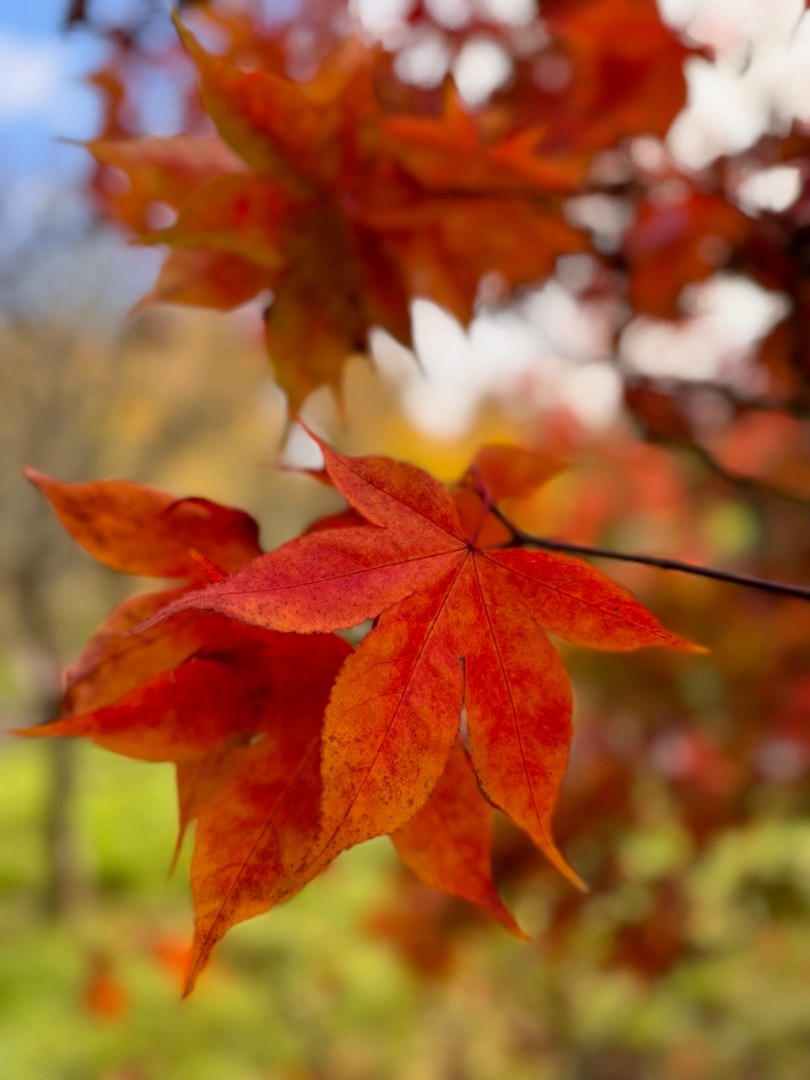
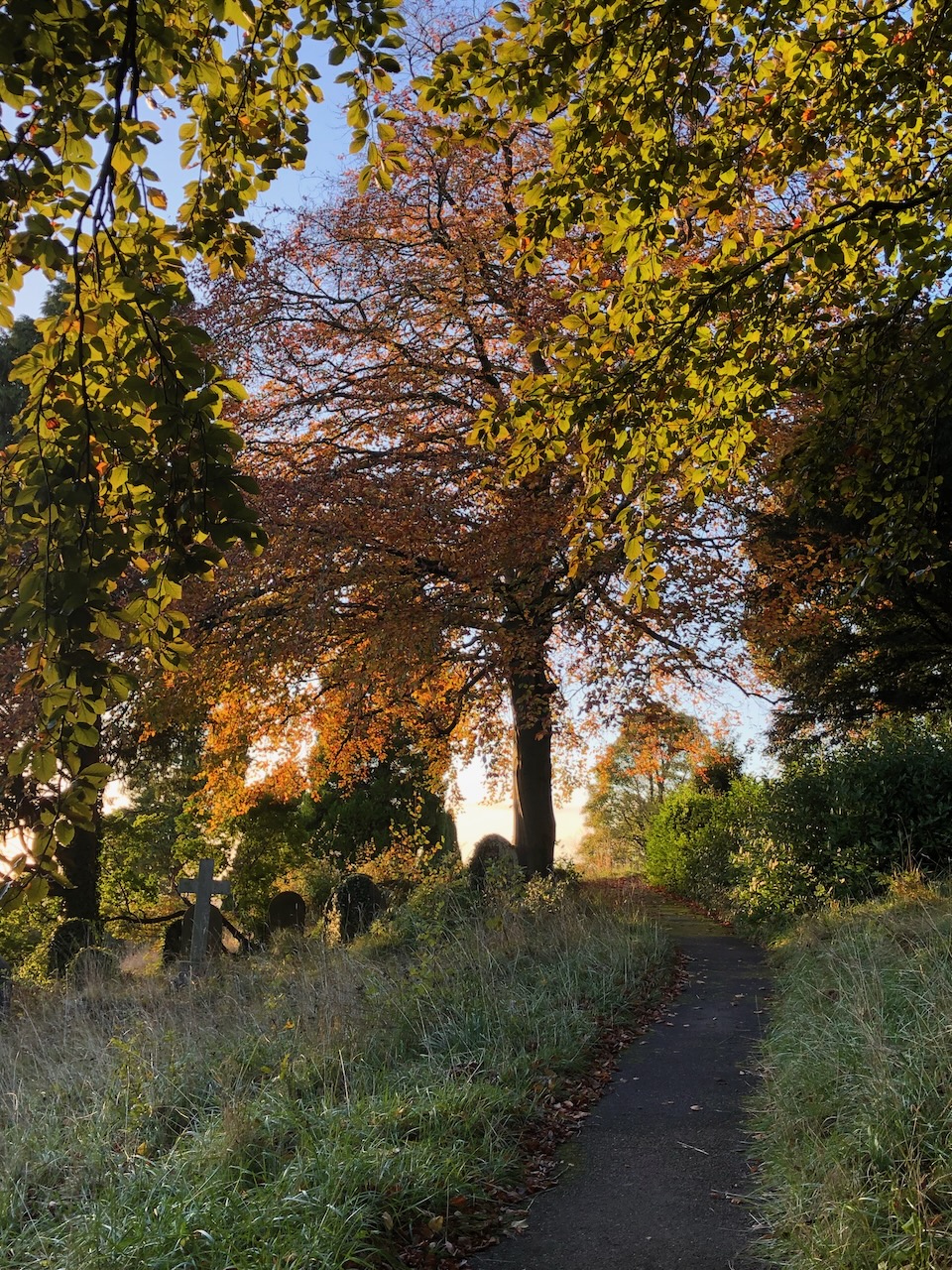
Remembering, while watching falling leaves…

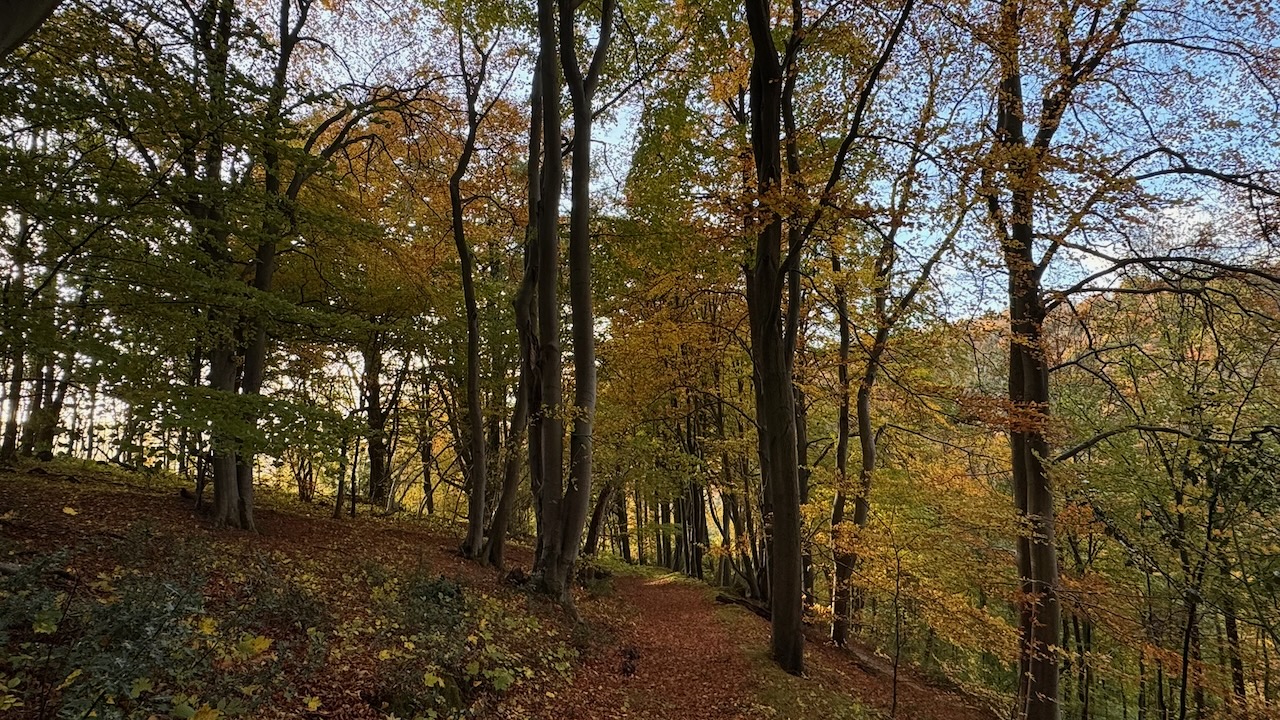
I normally plant bulbs on Remembrance Sunday. But this year I’ve been ill. Instead I went for a gentle walk in nearby woods, silent but for the breeze combing its way through the upper branches.

Down below, all was still. Except for individual leaves falling like snow. Each one taking its moment to break from the twig to which it had been rooted since the spring and dance in a series of pirouettes, twirls and summersaults before landing quietly among the already fallen. Unseen except by a chance walker. 

Do they pick their moment, or are they plucked from life?

A certain readiness is a prerequisite for each leaf to fall. In summer, winds can howl through the branches and yet the leaves remain bound to the tree, weathering the storm, held in place by life forces that ebb and flow in synchrony with the seasons.

Death is natural for these fallen.

As I shuffle through the carpet of rust and gold, the rustle so reminiscent of childhood memories – kicking through the golden floors of beech forests in little rubber wellies – I can only ponder the dead. The war dead all around the world. The families they left behind. The scars of loss, grief, trauma and silence that remain in their wake, often hidden for generations, shaping the souls of those who come after.

We call them the fallen. It softens the reality of how they died. But while we remember them with warm hearts and deep gratitude, let us – with all the advantages of hindsight – not forget the utter horror, violence and futility of war.

As countries around the world build their armies and arsenal, let us refrain from falling into the trap of thinking war can ever be a solution to political, religious, geographical or economic problems.

Let us remember that the cost is always too high.

Looking at our present and future to find the lessons of the past

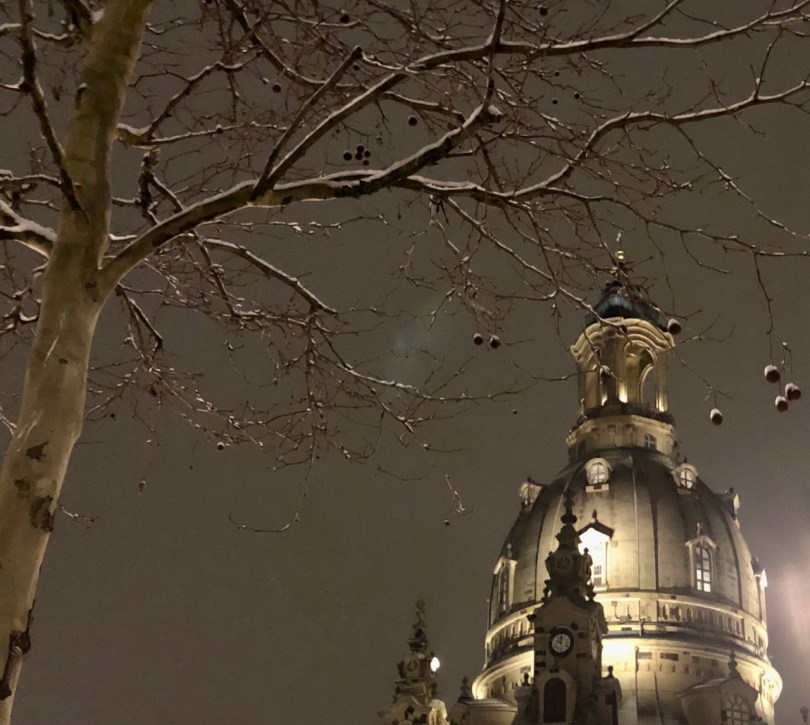
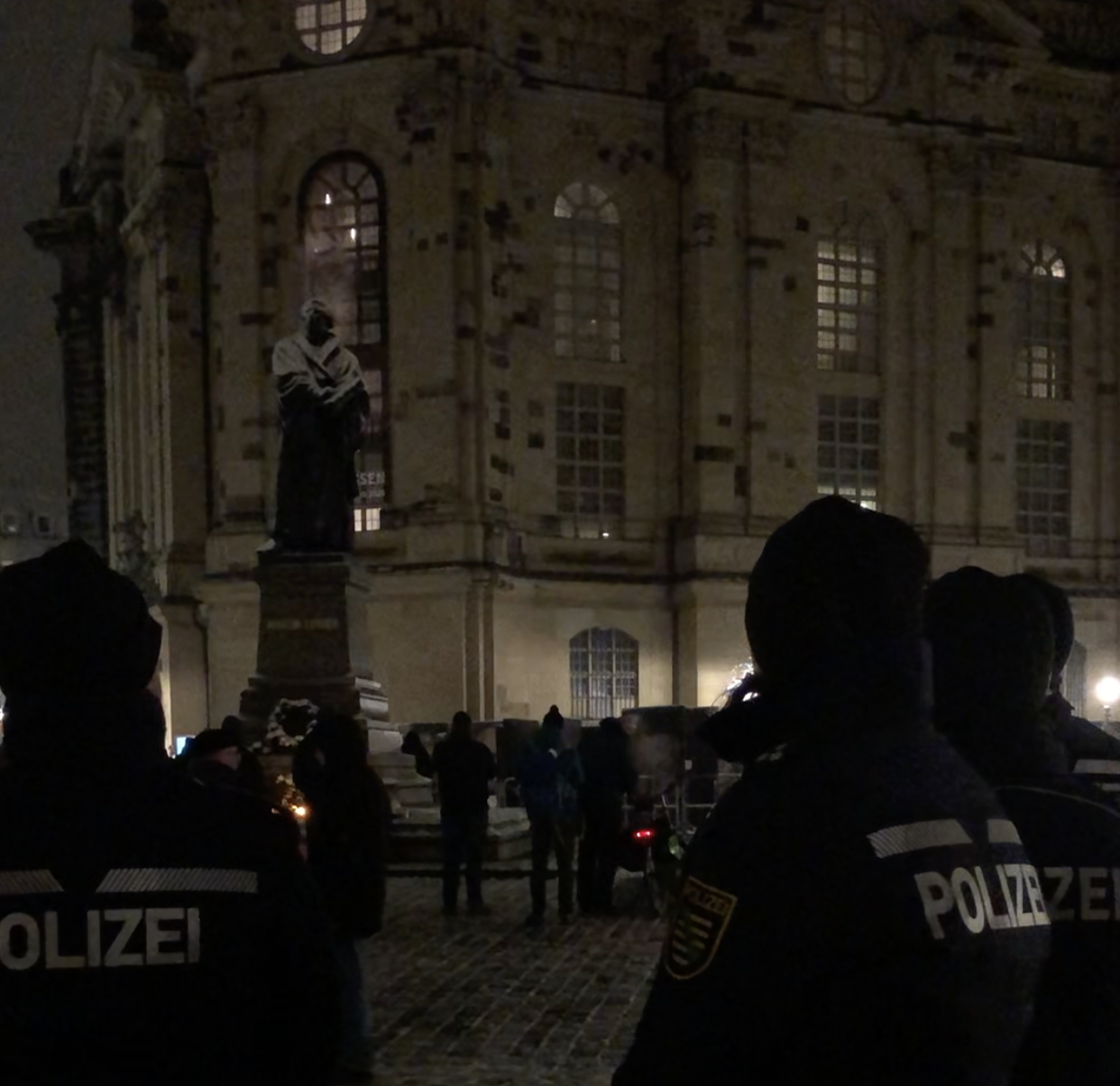
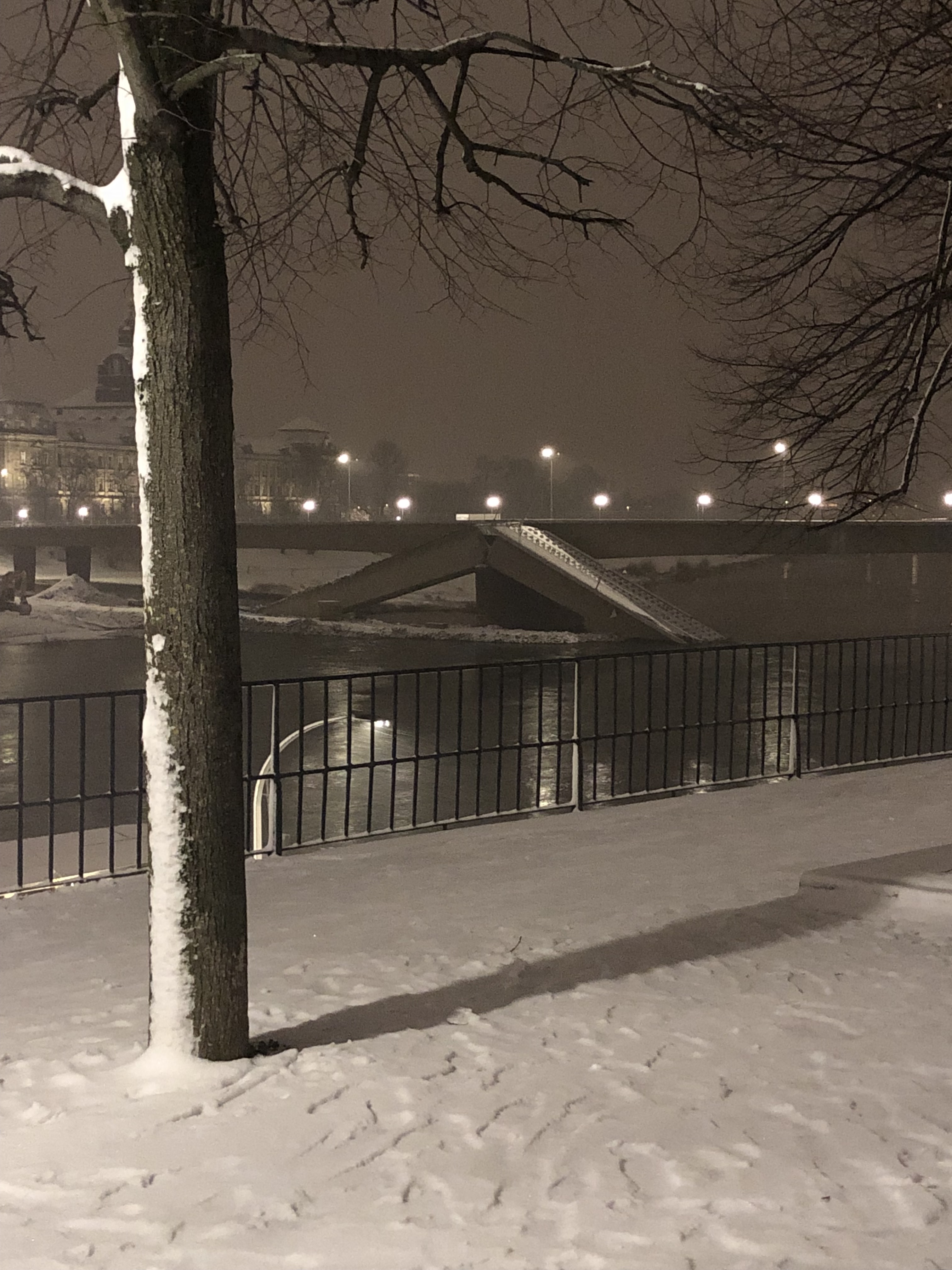
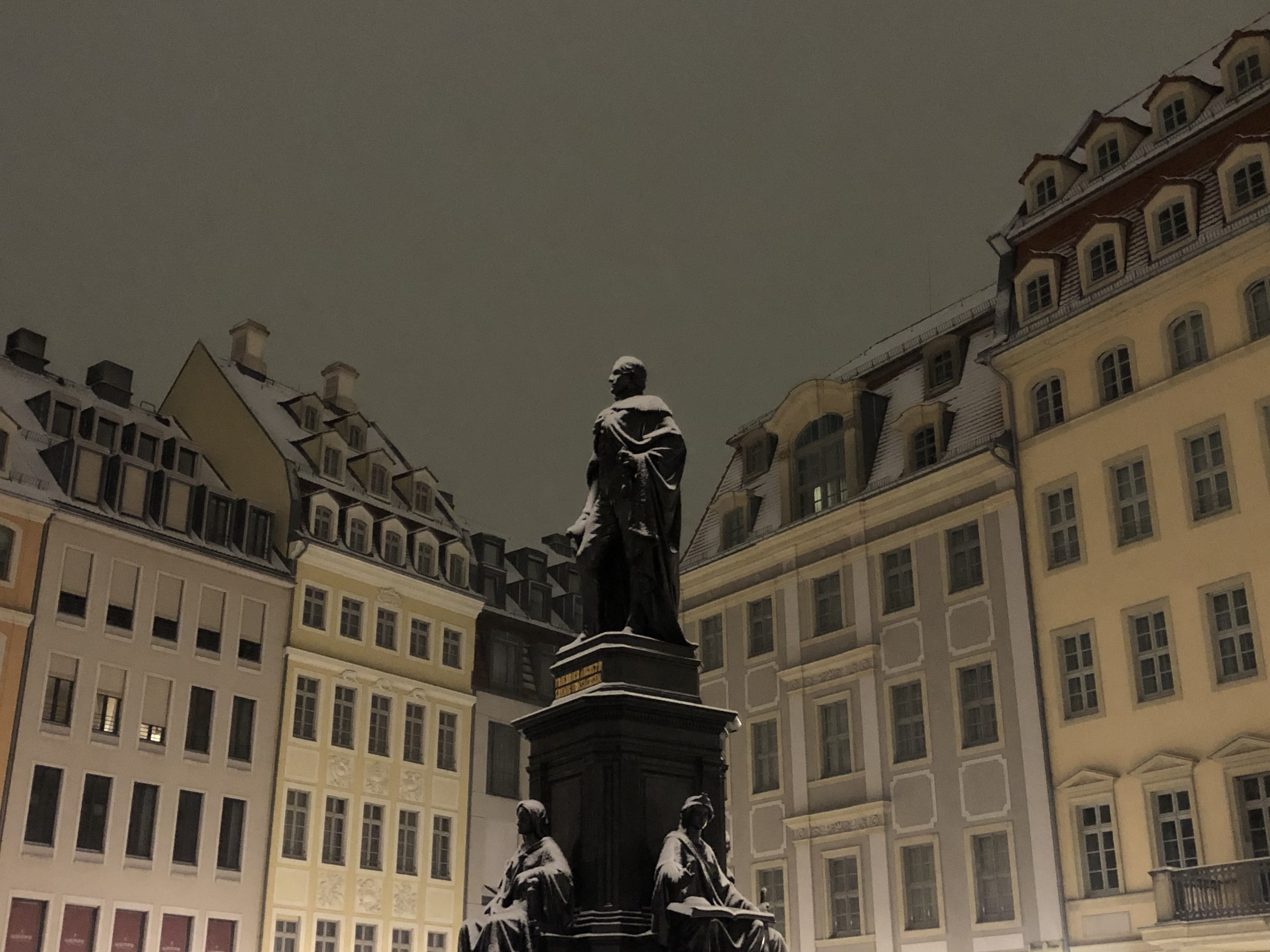
On February 13th at 9.45pm, the bells started; asymmetrical tones infusing the snow-sprinkled city. 

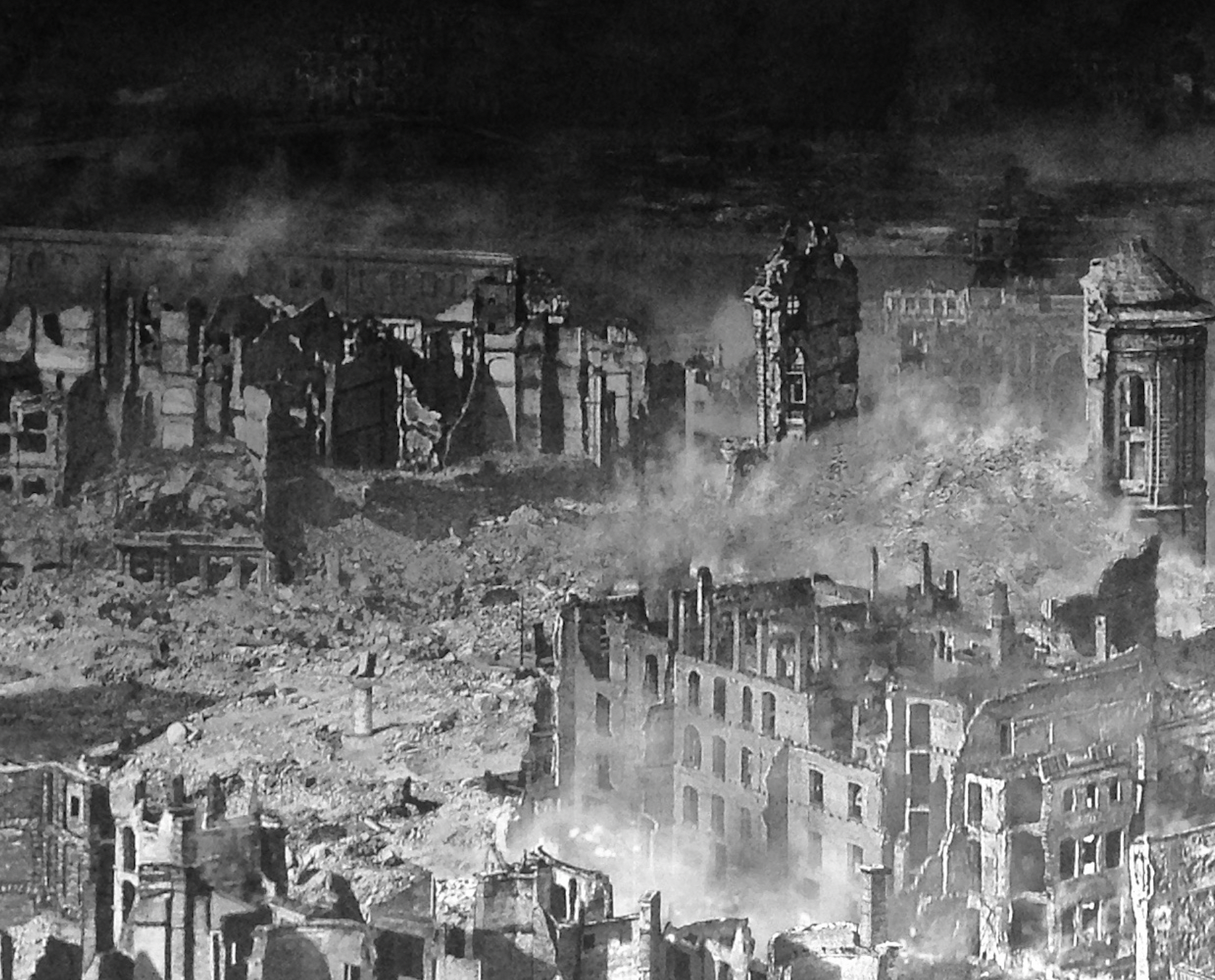
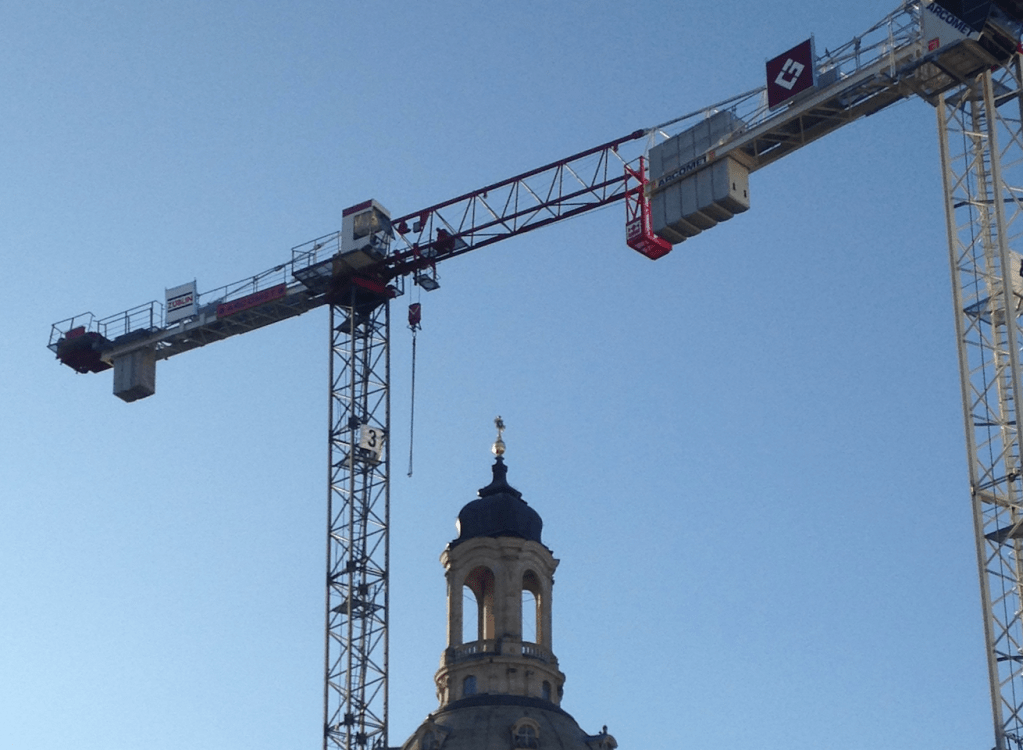
People wrapped in scarves and silence, stared at the dome of the Frauenkirche that 80 years before had been mangled by bombs into a pile of rubble that would scar the city for over fifty years.

Candles placed on the ground flickered benign flames as memories haunted the minds of those who had witnessed a firestorm that melted asphalt, roofs and neighbours alike.

A human chain of hand-holding citizens wove through the resurrected buildings, knitted together both in remembrance and defiance of the re-emerging forces of lessons not learned.

This year’s anniversary of the British and USA bombing of Dresden was determined not simply to look back and roll out familiar but increasingly empty tropes such as ‘Never Again’. Instead, ‘Future through Remembrance’ was the theme repeated through the activities I attended as a Trustee of the British Dresden Trust. Younger generations from Germany, Ukraine, Poland, UK occupied the foreground mingling the wisdom of elders with messages that gave genuine hope for our troubling times. 

Stay awake. Be aware and curious as a child about what is happening around you. Look at history from multiple angles. Step back to see it in perspective. Take responsibility. 

Benjamin Britten’s War Requiem followed by silence in place of applause gave the horror, tragedy and futility of any war the viscerality needed to galvanise us out of complacency into using Remembrance fiercely rather than sentimentally; to unite us as human beings, each with a heart and soul that thump with a longing for peace. 

It was the move from formality to informality, from grand gestures to tiny actions we are all capable of doing everyday, that left the most lasting impression. From pomp and ceremony to conversation; from people in suits or uniforms telling us the importance of remembrance of a time that is increasingly distant, both temporally and emotionally, to a lively exchange between young and old from different nations on the values of democracy and peace.

Peace that is all too easily taken for granted. 

Further Reading and Links

The Dresden Trust

History and politics collide as Dresden mourns its destruction in WWII by Katja Hoyer

DRESDEN: A Survivor’s Story by Victor Gregg

DRESDEN: The fire and the darkness by Sinclair McKay

AIR RAID by Alexander Kluge

The Duke of Kent marks the 80th anniversary of the bombing of Dresden

Commemoration: 80th Anniversary of the destruction of Dresden

l

Question to self: Is speaking out still the right thing to do?

If you haven’t yet seen Jesse Eisenberg’s latest film, ‘A Real Pain,’ I can only urge you to do so. Starring himself and Kieran Culkin [youngest son in Succession!], the pair play two estranged cousins who travel to Poland to fulfil the wish of their recently deceased, concentration camp survivor grandmother for them to visit her former home. It’s essentially a road movie and extremely funny. But the context of the Holocaust and the attempts of third-generation Americans to come to terms with it, makes it also profoundly moving, thought-provoking and important. 

Millions of people world-wide are still grappling with the aftermath of those appalling years of Nazi rule. More, rather than fewer, stories of survivors and first-hand witnesses are coming to light told by descendants who have finally found ways to articulate what their forebears couldn’t. My own, In My Grandfather’s Shadow, published in 2022, is testament to the painful process of peeling back the layers of incredulity in which the extremes of both cruelty and suffering are wrapped. For many, it is justifiable to judge or blame ordinary Germans for not speaking out or revolting against the wrongness of what was happening in clear sight. Despite acknowledging their justified fears, it would have been the right thing to do.

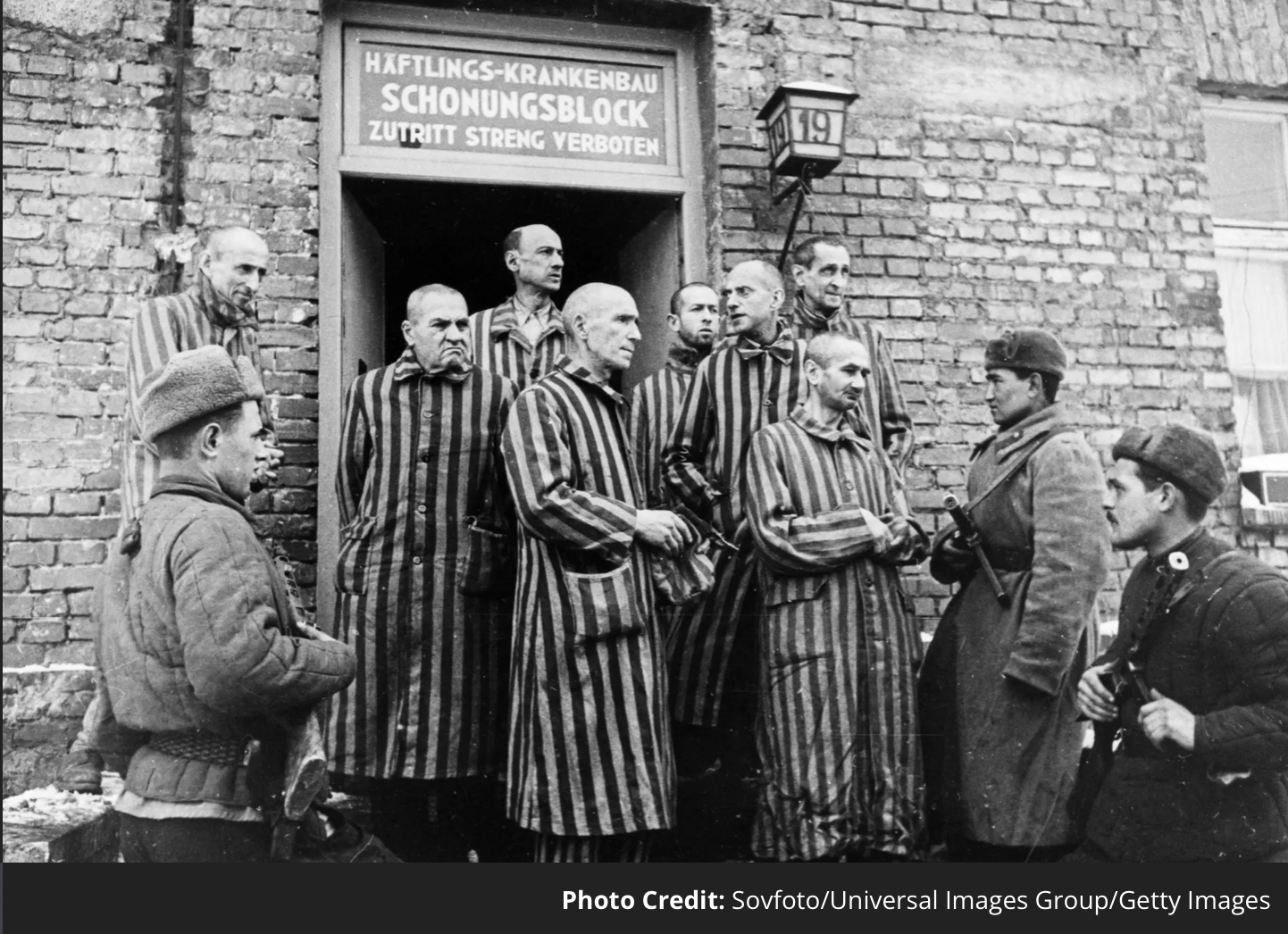
As we approach Holocaust Memorial Day marking the 80th anniversary of the liberation of Auschwitz by Soviet forces in 1945, we are asked to remember the horrific consequences of the crimes that, in part, were enabled because people did not speak out. We will once again repeat the heartfelt ‘Never Again’ that has been chanted like a mantra over the decades. But is it enough?

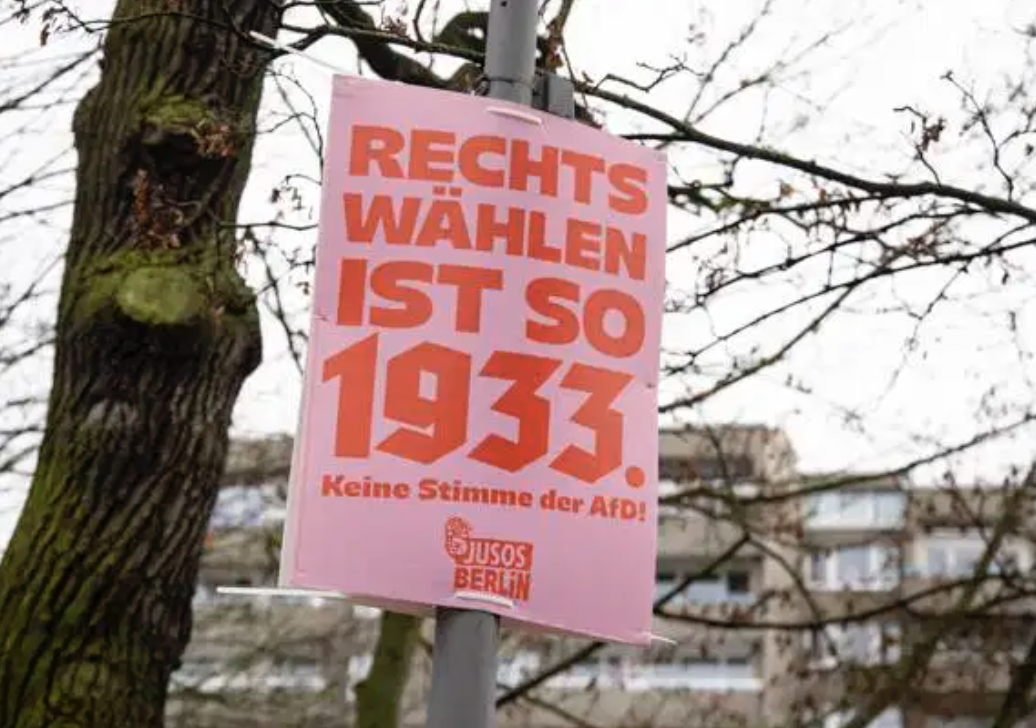
“Voting right-wing is so 1933”

Across the globe, the roots and shoots of far-right policies are taking hold with renewed vigour. In highly vigilant Germany, ‘Voting right-wing is so 1933’ is a campaign slogan for left-wingers. But calling out discrimination and anti-immigrant policies, becoming an ‘upstander’ rather than a bystander has become increasingly perilous, even a danger to life. I wonder how Bishop Mariann Budde’s recent controversial sermon at the inaugural prayer service at Washington National Cathedral will play out. Referencing immigrants and LGBTQ+ individuals among others, she calmly but directly asked President Trump “to have mercy on the people in our country who are scared now.” Will she be cancelled, trolled, fired, discreetly removed from her post? So far she is refusing to apologise for speaking her truth. Was it brave, wise, right? Or, as he and his supporters claim, ‘nasty, woke, inappropriate’ and she a “Radical left hard line Trump hater”? Bizarre as it sounds, by seeking a path of compassion, did she inadvertently shame and dent an ego as big as the world?

As someone with (non-Jewish) German roots, I feel like it is both in my DNA and a conscious personal responsibility to speak out in the face of a perceived injustice or wrongdoing. However, I am beginning to feel an even stronger impulse. In these times of widespread latent and reactive vitriol and rage, I have started to listen into the other side’s point of view rather than – or at least before(!) – slating it. To create a tiny pause, a space between the attack and counter-attack model so many discussions rapidly descend into. It’s like stepping back from an easel when you have been immersed in some detail in order to see the whole picture. For when we speak out against something with conviction but without seeing the back story behind the other’s conviction, we are basically assuming a moral and intellectual high-ground that imparts the message that ‘they’ are wrong (inferior) and ‘we’ are right? This never goes well! Trump’s return to the White House proves that.

Decades of trying to comprehend the behaviour of ordinary Germans eighty or ninety years ago have revealed to me that many of them won’t have been so different to many of us today, i.e. more concerned with their own lives – milking cows, running businesses, keeping children warm and fed – than politics. Looking away, keeping stumm becomes a basic survival tactic. But the outrage humans feel in the face of endless discrimination, inequality, injustice, harm can rapidly turn to despondency and disaffection when we realise we can do little more than sign a petition or share a rant on social media or among friends. Eventually we might become numb, at worst immune to the wrongdoing. I know that I personally read, watch and listen to the news far less than I used to because the drip-feed of madness, badness and sadness feels toxic and induces inertia. I have no idea if this is maturity, complacency, disheartenment, a nauseating lack of humour or an equally nauseating sense of self-righteousness, but I have lost some of my more outspoken tendencies and anger at the world and replaced them with something that is hopefully more productive but still relevant to these times.

My prison work showed me that the most valuable action I could offer prisoners was to listen and to hear them. Not just their stories, excuses and justifications, but what came before. The drivers of their behaviour. With their defences down, trust, compassion and understanding could grow. Attitudes and actions quietly changed without them being shown to be wrong.

I am not sure if this is the right way to go in general life. The story of the Zen / Chinese Farmer comes to mind with its ‘We’ll see…’

It’s certainly not a quick-fix solution. But maybe it’s a tiny antidote to the constant stoking of anger? A drop towards the creation of a kinder world in which wider discourse and a greater tolerance of difference are possible. And ‘Never Again’ regains its urgency and weight. 

A few links to that don’t necessarily reflect my views, but are accessible sources to pursue your own research.

A Real Pain Review

A Real Pain Trailer

Germany’s present is not Germany’s past by Katya Hoyer

Who is Mariann Edgar Budde, the bishop who angered Trump with inaugural sermon?

I am not going to apologise’: The Bishop who confronted Trump speaks out

Remember, Remember… we all lost

‘Tis the season to remember. In our progression through the grey gloom of this autumn [just 18 minutes of sunshine since 28th October apparently!] and the celebrations of Halloween, All Souls, Samhain, Guy Fawkes and November 11th, the dead take centre stage. Leaves and forest floors redden while poppies bloom on jacket lapels, village monuments and shop counters. This Sunday in London, as on all Remembrance Sundays, red wreaths will be laid by royalties, senior politicians and Commonwealth High Commissioners before some of the last surviving WW2 veterans march or are wheeled past the Cenotaph.

We have been collectively remembering Armistice Day since 1919, the first anniversary of peace at the end of World War One. Remembrance has since been extended to both World Wars and all those who have given their lives in service to defend our freedoms. It is a hugely important day for the British, the Commonwealth and many other countries around the world, albeit not in Germany. There, since the Middle Ages, 11am on 11.11 has marked the start of the carnival season and, on a more serious note, Armistice Day is not considered to have welcomed the beginning of peace but years of intense unrest and far worse horrors to come. 

British and Commonwealth dead

I often dedicate my November blog to our traditional, deeply moving and impeccably executed rituals of remembrance, but not always without a little questioning too. Through the 15 years of research for In My Grandfather’s Shadow, I came to appreciate a far broader narrative of WW2 remembrance than that which Britain generally embraces and teaches. Granted there has been welcome progress over the decades with the inclusion of women as well as the huge contributions and sacrifices made by Gurkha, Indian, Sikh, African and Caribbean servicemen, among others. But there is still widespread ignorance of the bigger context.

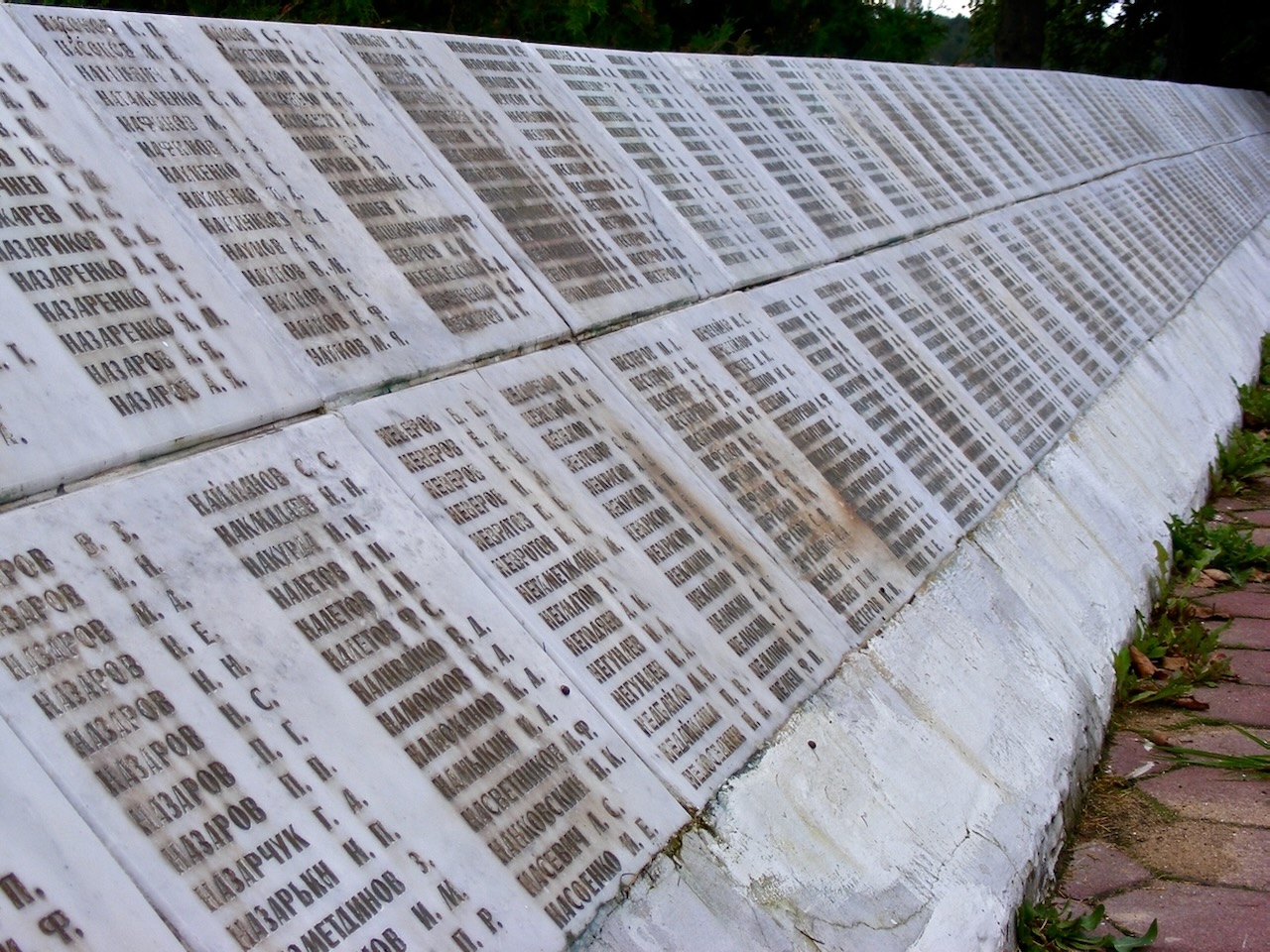
Russian dead

When I give my talks, I often use statistics. They provide a solid, black and white foundation of fact to my more psychological / philosophical ponderings. So often these figures shock. For example, when I ask people to guess the total losses, including civilians, of say Russia, Germany and Britain in the Second World War they are usually so far out that they themselves are horrified. I challenge you to make a guess… I’ll put the answers at the end of the blog. One man literally went white when he realised how wrong he had been in his thinking or, by his own admission, his lack of thinking. Another woman recently wrote to tell me how my book had opened her eyes in so many ways. “First off,” she said, “the big realisation of how little I have understood of the two world wars, my ignorance of those times and the aftermath.” This despite attending remembrance services all her life. 

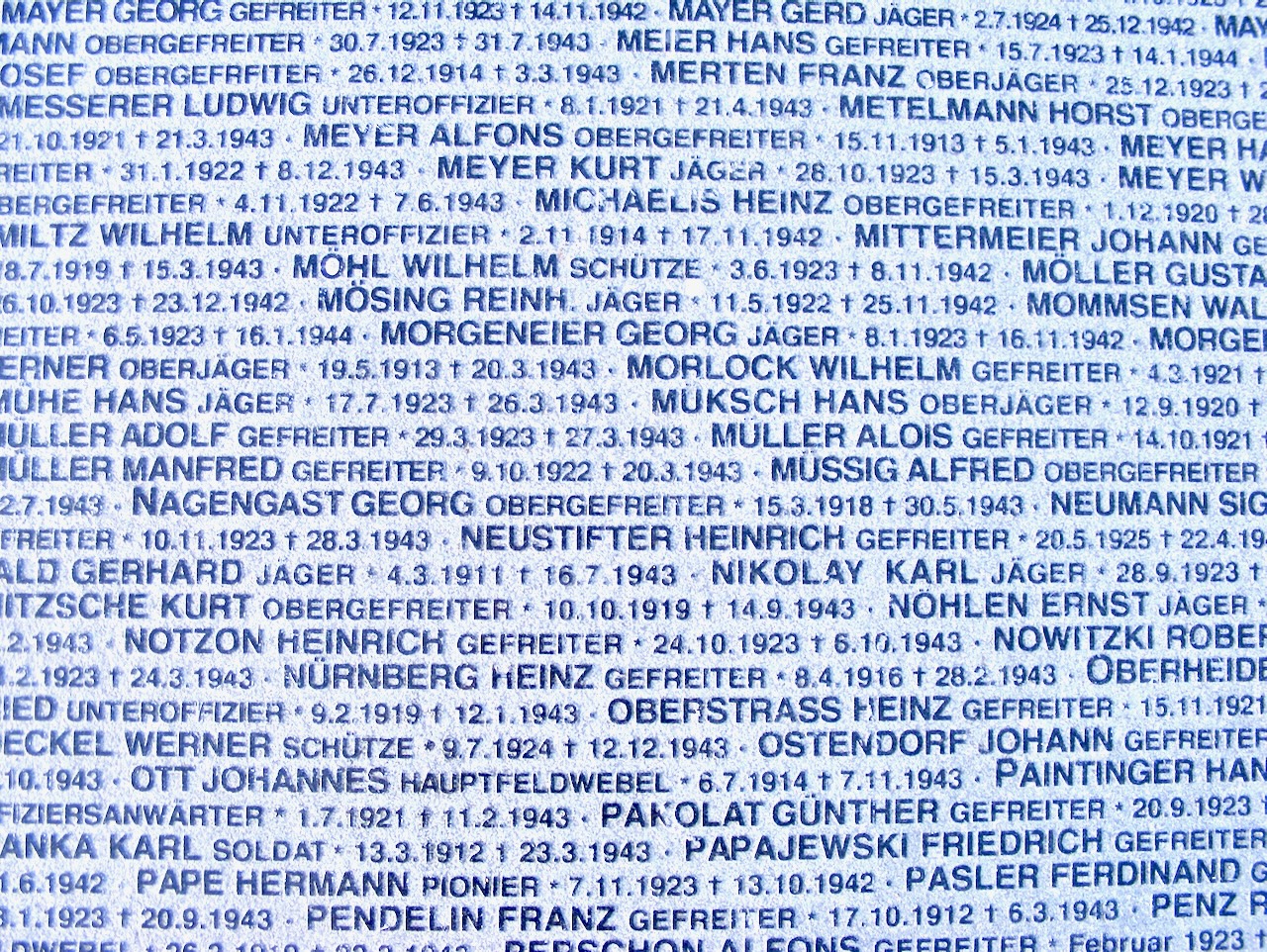
German dead

The quantity of deaths doesn’t mean each death was any less keenly felt. But I think she voices what is probably true of most of us. I certainly was ignorant of the broader landscape of loss and destruction, and no doubt still would be if I hadn’t had German roots that needed excavating and hadn’t made trips through Germany and Russia that exposed me to other ways of looking. The World Wars are the episode in history with which the British are often accused of being unnaturally obsessed. And yet, as a nation, we often present it as a deceptively straightforward story of good triumphing over evil. The victors write history after all. 

Every nation has its ‘chosen traumas’ and ‘chosen victories’ which serve as cornerstones to its identity and prevent true healing from the past as they continue to play out in the present. We frequently have binary views of how we should feel based on – to use the reader’s words again – “simplistic, reductionist understanding… goodies and baddies…” Rarely have we “considered what it must feel like to have a different identity…” 

I really appreciate and admire this woman’s soul-searching honesty. The humility and gentle opening to hearing the other sides’ stories gives me huge hope.   

Healing, reconciliation, peace, forgiveness… all goals we strive for within our culture of Remembrance… can best come about when we become familiar with and find some understanding for the other side’s experience. Maybe, with our greater distance from both the acute trauma and the impassioned jubilation of our forebears, that is what generations now and in the future can strive to do more of. 

Answer to my statistics question: Out of the around 60 million people killed in WW2, 26 million were Russian, approx. one third of them military and two thirds civilians. Between 7-9 million Germans died, roughly 6 million were soldiers and 3 million civilians. In the United Kingdom, just under 451,000 were killed. That’s 383,800 military, including combatants from overseas territories (Crown Colonies and the Indian Empire), and 67,200 civilians.

The ghosts of lost flowers

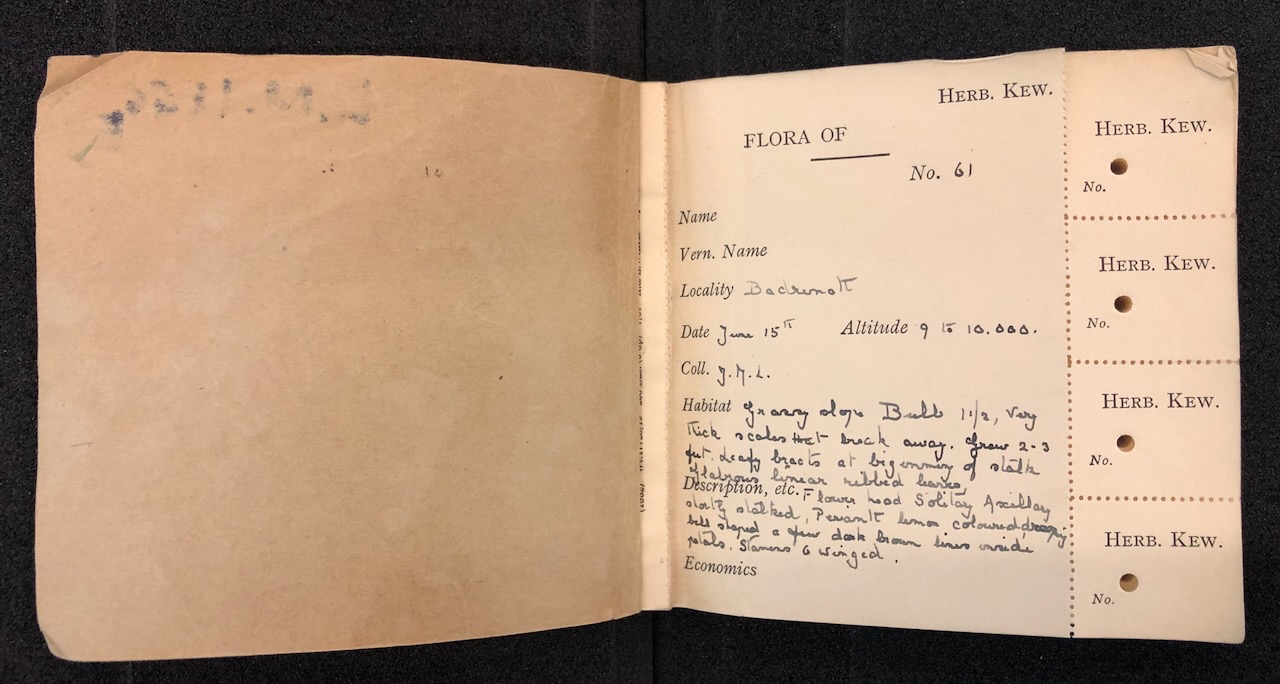
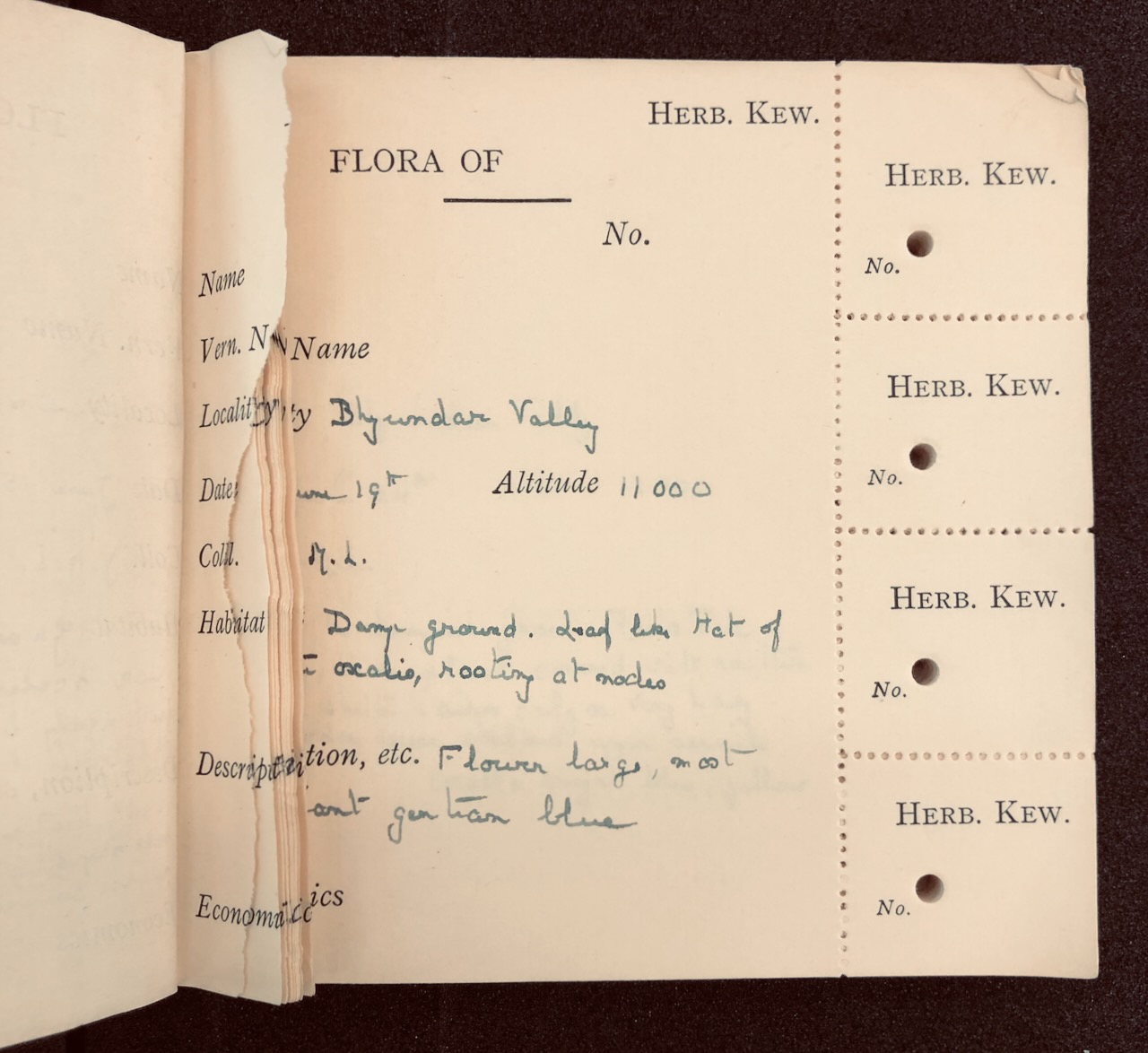
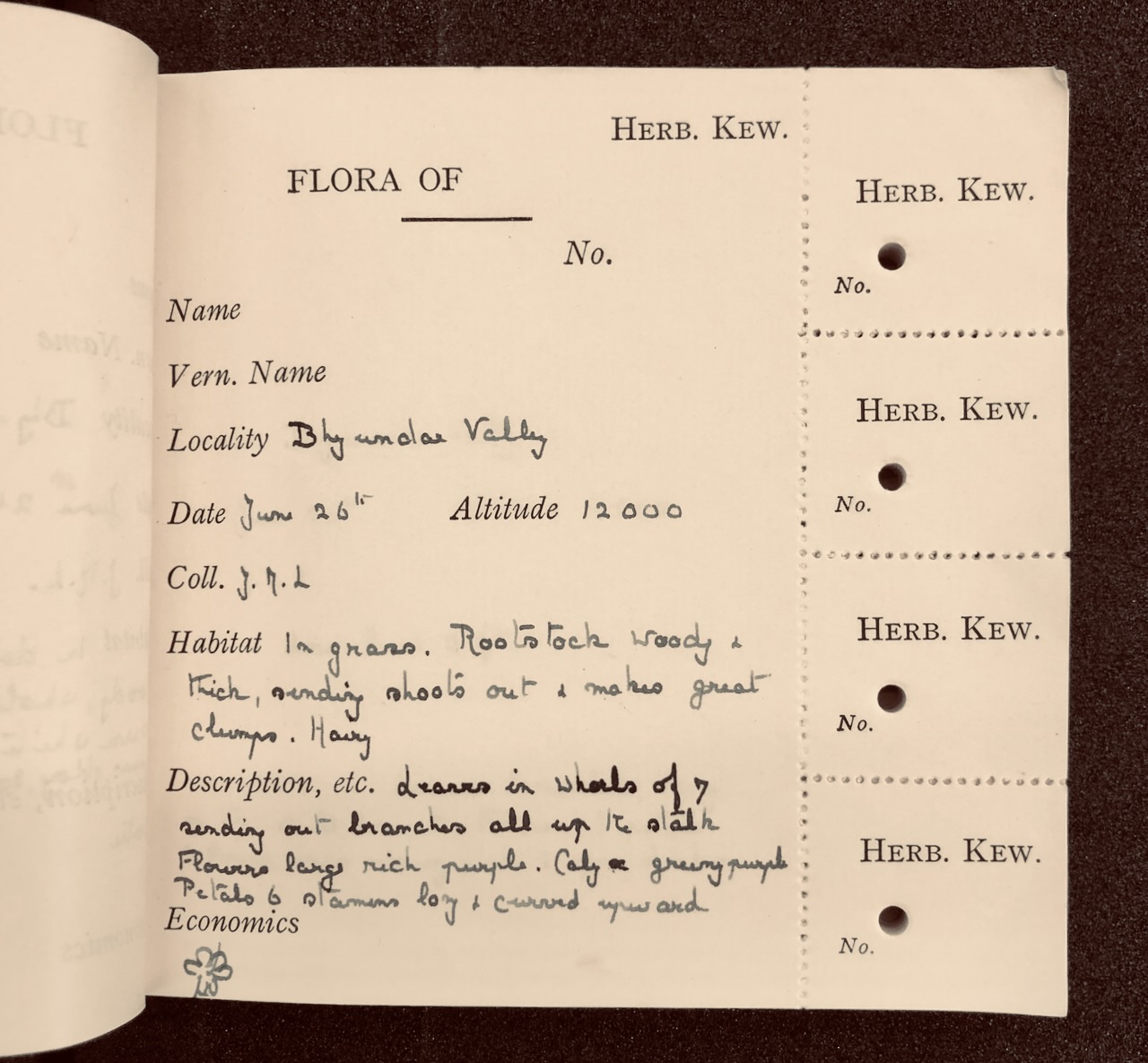
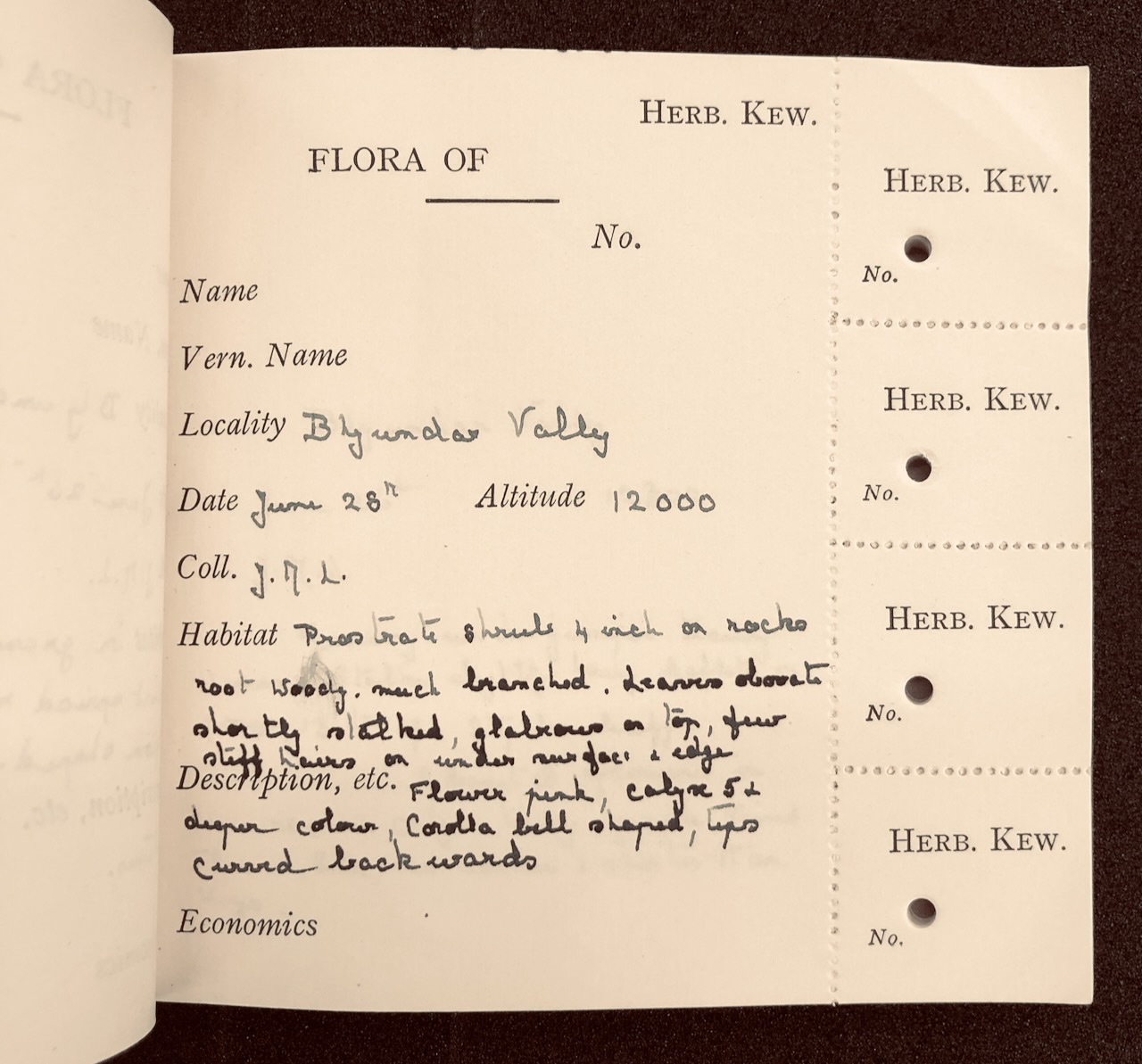
On 4th July, while the minds and eyes of many people in Britain and further afield were firmly focused on Election Day, mine were occupied with my Great Great Aunt who died on this day 85 years ago. In one of those unintentionally magical examples of serendipity, I had managed to secure an appointment at Kew Gardens, London to view some of the fruits of her trekking and gathering in the Himalayas in 1939 just prior to her sudden death.

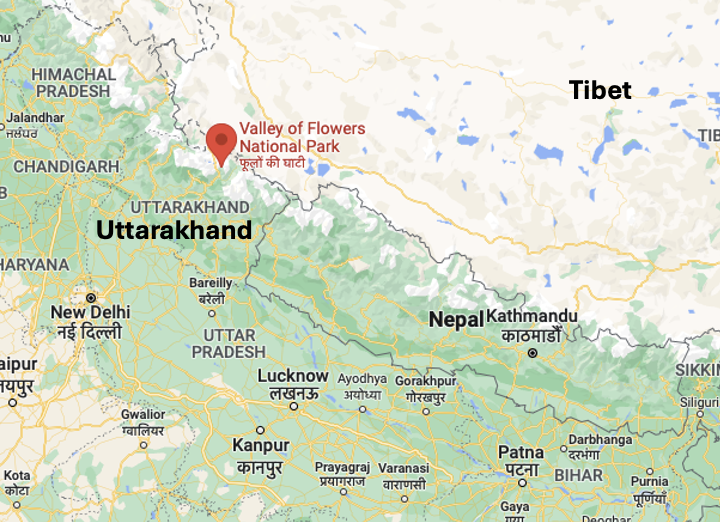
I introduced Joan Margaret Legge in a recent blog and talked a little on how, while the Second World War was rumbling towards its beginning, she had travelled to the Valley of Flowers, otherwise known as the Bhyundar Valley, in Northern India.

As a keen amateur botanist she had been inspired by the recent discovery of the valley in 1931 by a team of three lost British mountaineers returning from an ascent of Mount Kamet and seeking shelter from inclement weather. One of the climbers, Frank S. Smythe, had been so entranced by the valley that he returned in the monsoons of 1937 to explore and collect examples of its flora. His book, published in 1938, was the inspiration for my great great aunt to set sail in February 1939 and travel up through India to her base camp in the lower hills around Ranikhet. Waiting there for the snows higher up to melt, she spent two months acclimatising, doing practice hikes and organising porters and equipment for the big trek to her destination where she planned to spend the summer gathering seeds and samples for Kew.

Between 22nd May and 20th June she trekked north sleeping in precariously pitched tents with a hardy team of local men carrying provisions. Usually on her feet but sometimes on her bottom, she scrambled and climbed her solitary way through the mountains in a state of sweaty or rain-drenched awe of the ‘Glories’ as she called the soaring peaks that emerged and disappeared in the sky. She took cameras, presses supplied by Kew, wrote diaries and filled collectors’ notebooks with minuscule handwriting describing calyxes and tuberous roots while always scanning the terrain for flowers to press and send to the Herbarium in the hope of filling some of the gaps in Smythe’s earlier, spoiled-by-mould attempts to record what grew there. 

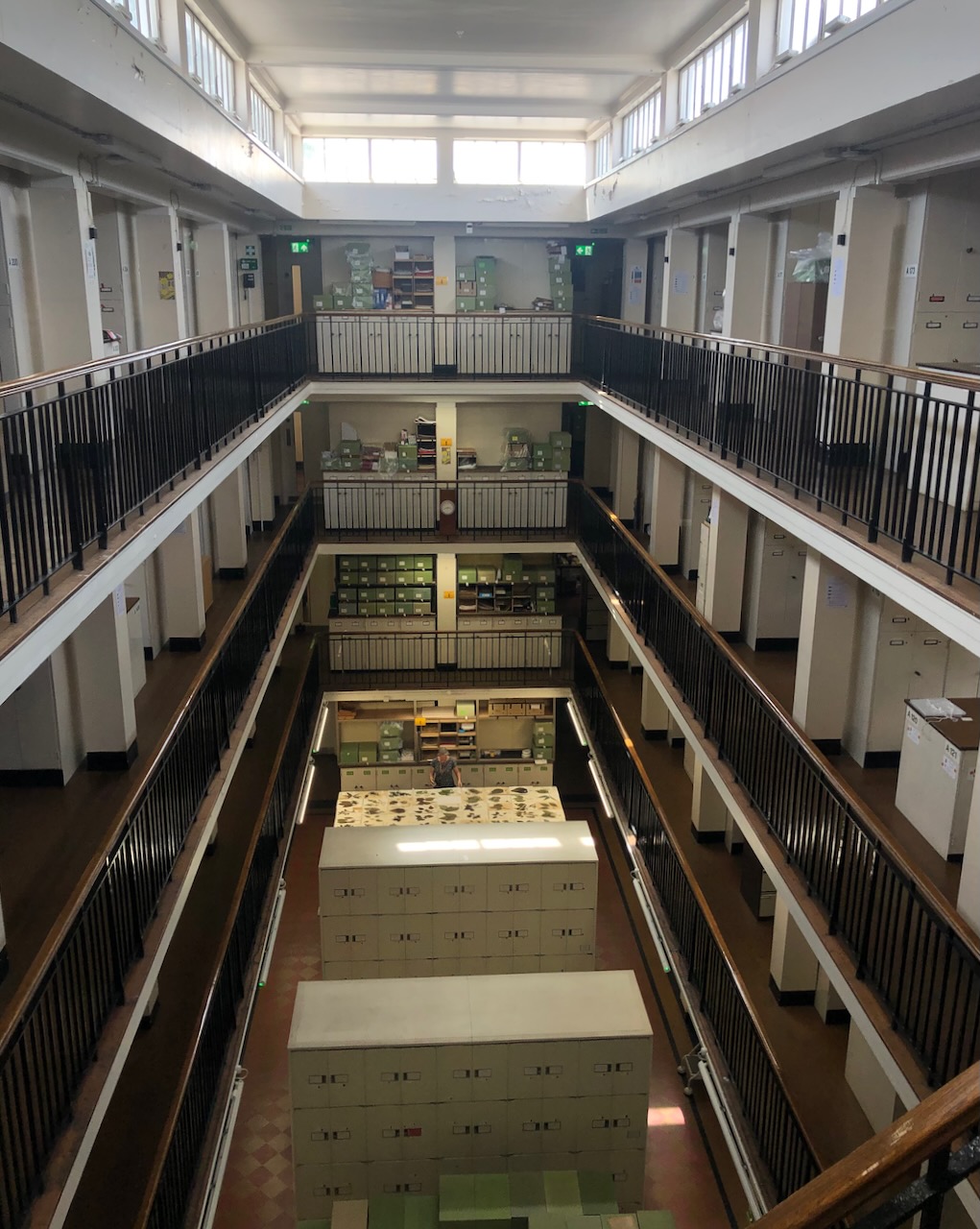
On my first visit to Kew in 2022 I had been told that none of her notebooks or specimens could be located, that they had probably not survived or had been of insufficient quality or significance. It was impossible to search for them… understandably so, the Herbarium houses an incredible seven million specimens!  

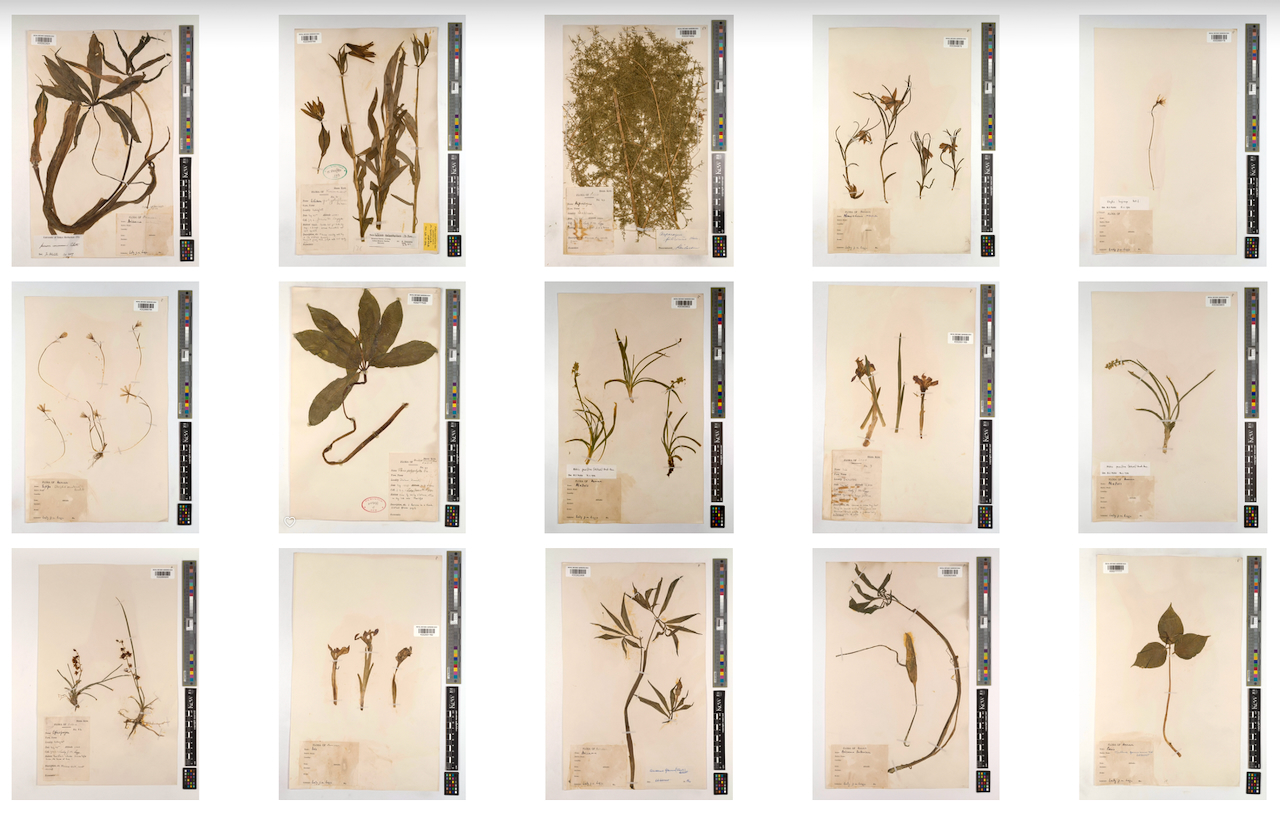
When I research I sometimes get this dogged instinct not to accept the first claim of something no longer existing or being lost in the annals of some past archival system and, not quite ready to give up, I renewed my quest to locate them. Following a string of helpful leads, several kind employees at the Herbarium, intrigued by my aunt’s story, joined me in my search. They soon discovered that a collector’s notebook and an as-yet unknown quantity of her specimens had indeed survived and the latter had been recently digitalised as part of a huge project to create a digital catalogue of the contents of Kew’s filing cabinets.

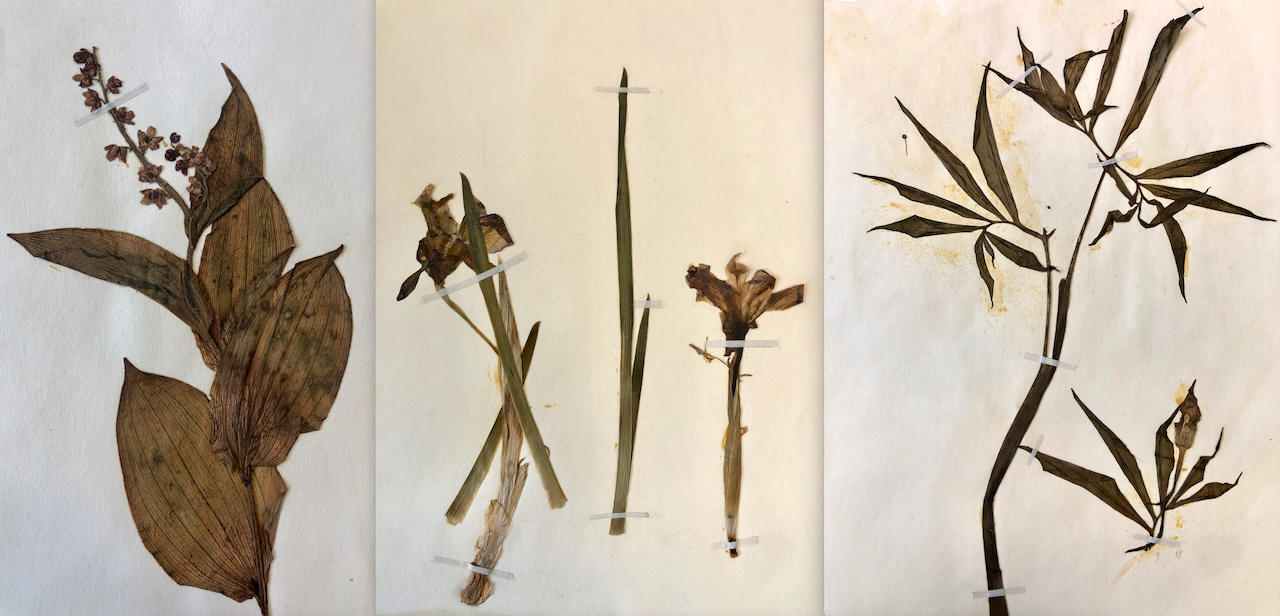
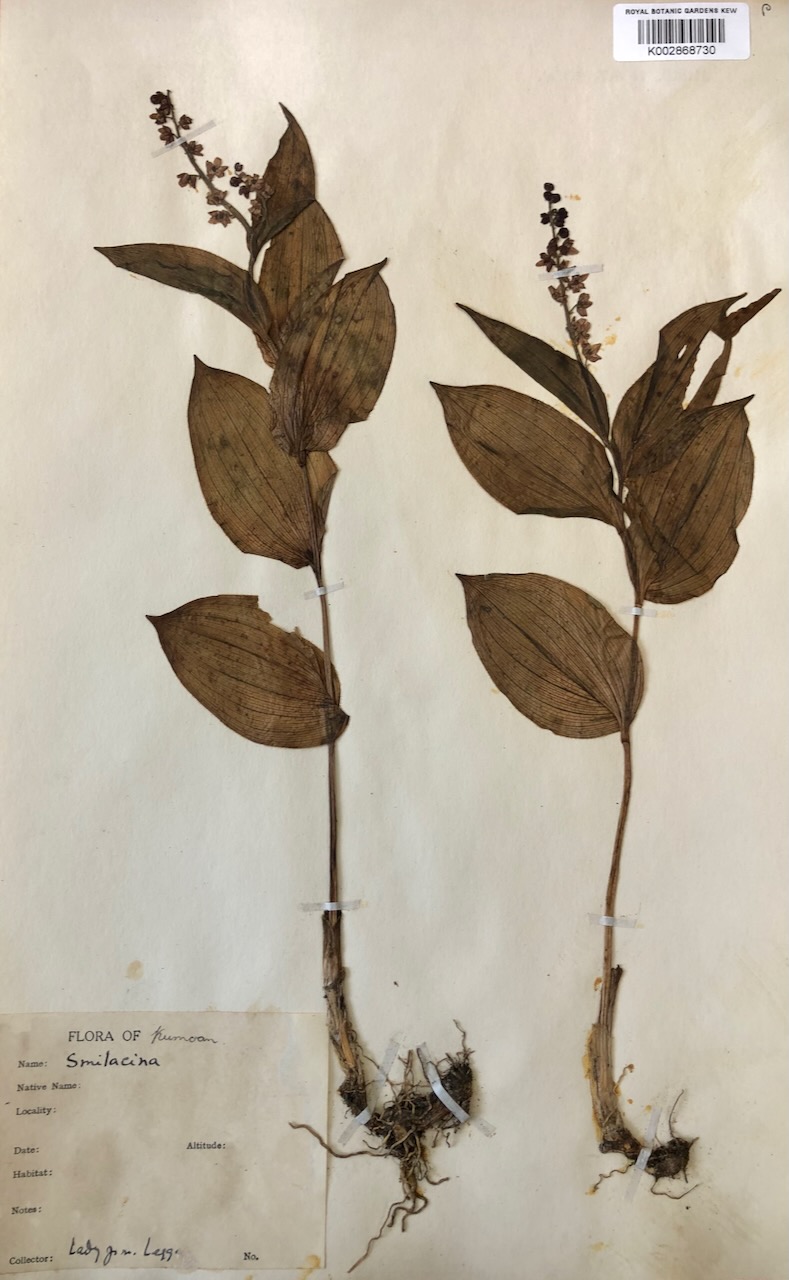
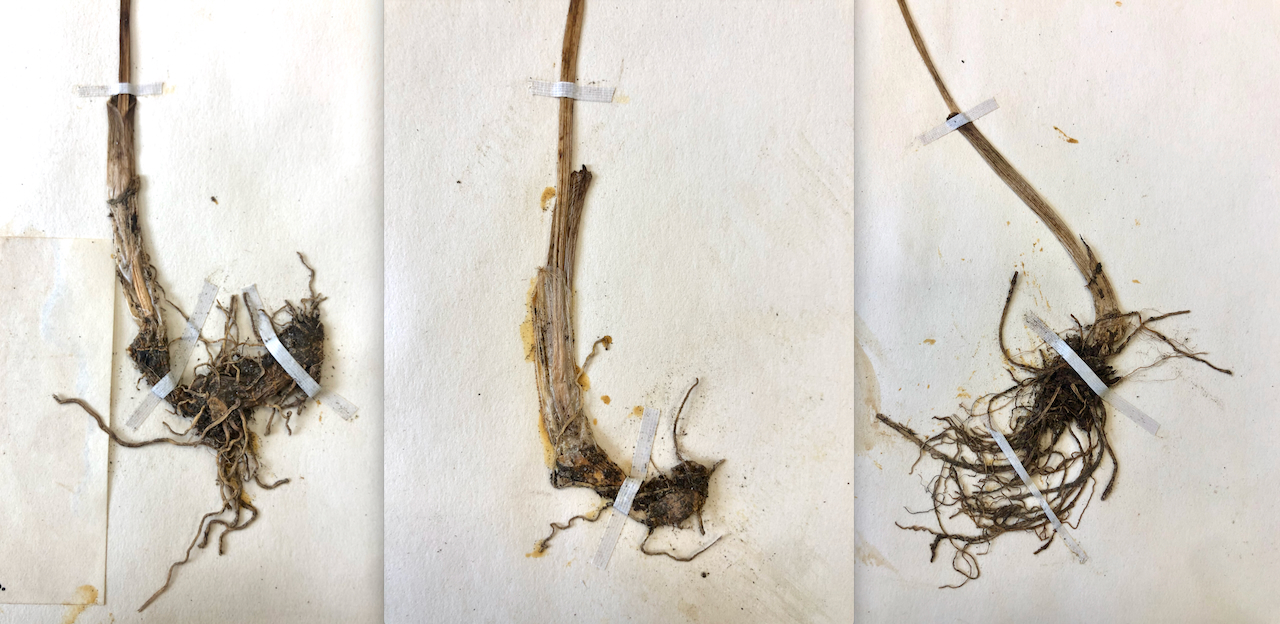
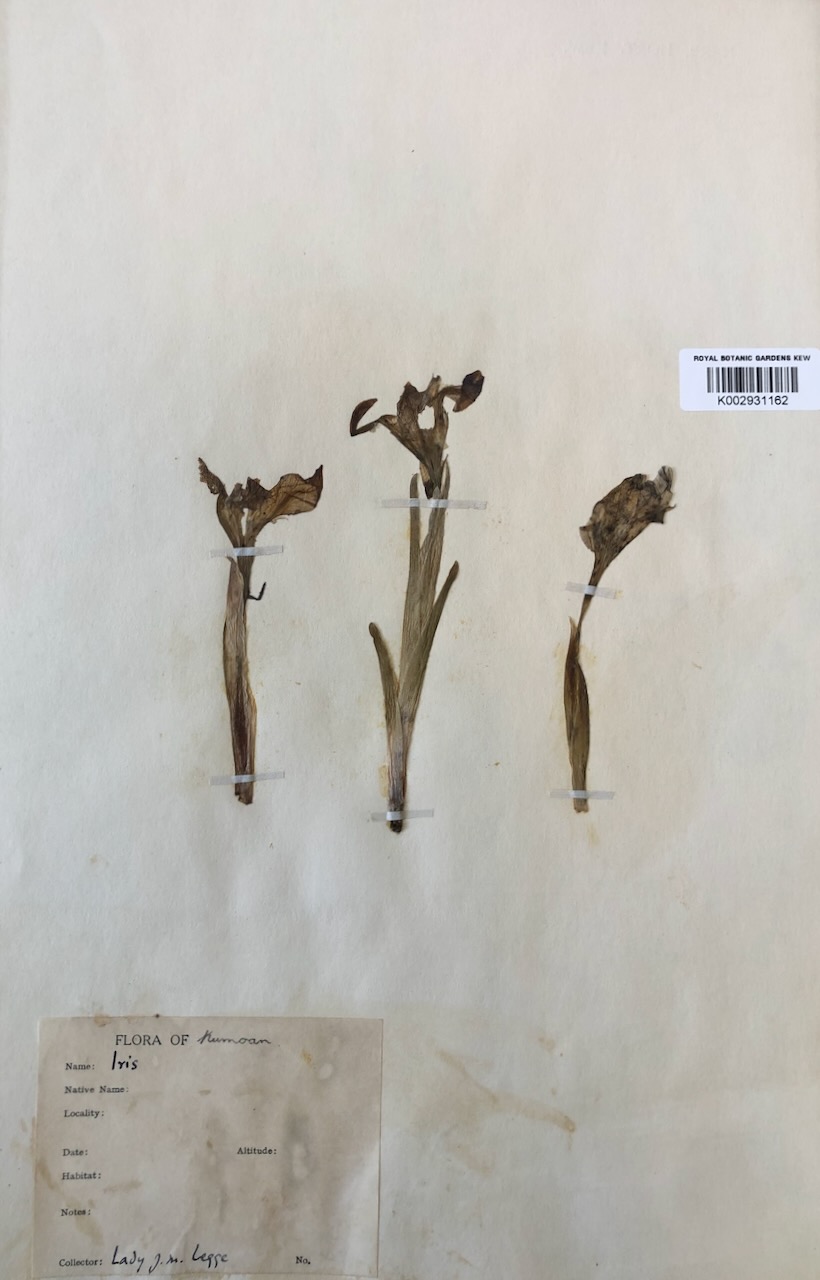
Digitalised specimens of Joan Margaret Legge ©Kew Gardens

And so, on the anniversary of Joan’s death, dodging ballot papers and predictive polls, I immersed myself in the sepia papers of a time and world that no longer exists.

Joan’s Collector’s Notebook, 1939  ©Kew Gardens

Exhumed from their graves and held in place by tiny straps, I was able to connect to Joan through the physical ghosts of the plants she had harvested. Traces of earth still clung to their roots, potent yellow pollen spilled from crumpled and flattened flowers, residual colours blushed petals and leaves as their ethereal beauty gently concertinaed the 85-year stretch of time between Joan’s picking and my viewing into a space in which I could almost touch her. 

Strange to think that these faded blooms had made it back to England while she hadn’t… It was a poignant preamble to an impending trip with my sister and two first cousins, all female descendants of Joan, designed to follow in her footsteps through the monsoon rains and soaring peaks of Uttarakhand, from Ranikhet to Joshimath and Badrinath and on to her isolated grave in the Valley of Flowers. As far as I know, we will be the first members of her family to visit Joan. It will be the realisation of a dying wish of my dear uncle who had long wanted to travel there himself but, unable to fulfil his dream, invited us to go there in his place.

Time marches on, history is made. We have a new prime minister and his government’s actions and inactions will make it into the newspapers and history books. Meanwhile, the silent and unseen reside as untold stories pressed between their pages awaiting discovery.

All images are © copyright of the Board of Trustees of the Royal Botanic Gardens, Kew and/or The Herbarium Catalogue, Royal Botanic Gardens, Kew. Published on the Internet http://www.kew.org/herbcat [accessed on 04/07/2024]


Berlin – a flâneur’s wanderings and ponderings

The past century has left heavy footprints all over the ever-changing face of Berlin. Without even scratching the surface, you can find the scars of murderous regimes, failed ideologies, war and destruction on all levels. But my regular visits to the city since 1990 have also witnessed the extraordinary resilience, creativity and defiant refusal to succumb to the particular ‘-ism’ trying to shape it. Throughout the city, past, present and future reside in a disturbing but reassuring harmony that promises not to forget, not to become complacent, not to allow such things to happen again while also offering plenty of opportunities for enjoyment.

Berlin’s contradictions are best experienced first hand. Feeling the city helps one to get closer to understanding it. It isn’t always comfortable, but it is infinitely interesting. Below is a little virtual / visual ‘tour’ of the two weeks I have just spent flâneuring through quarters of Berlin I hadn’t been to before, following my nose as I sniffed out history’s path into the present day. (You might like to read it on my Blog site, where the layout is more reliable.)

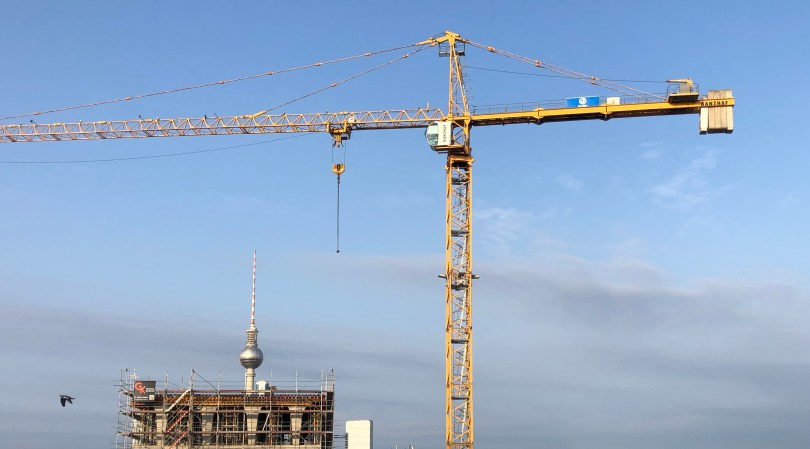
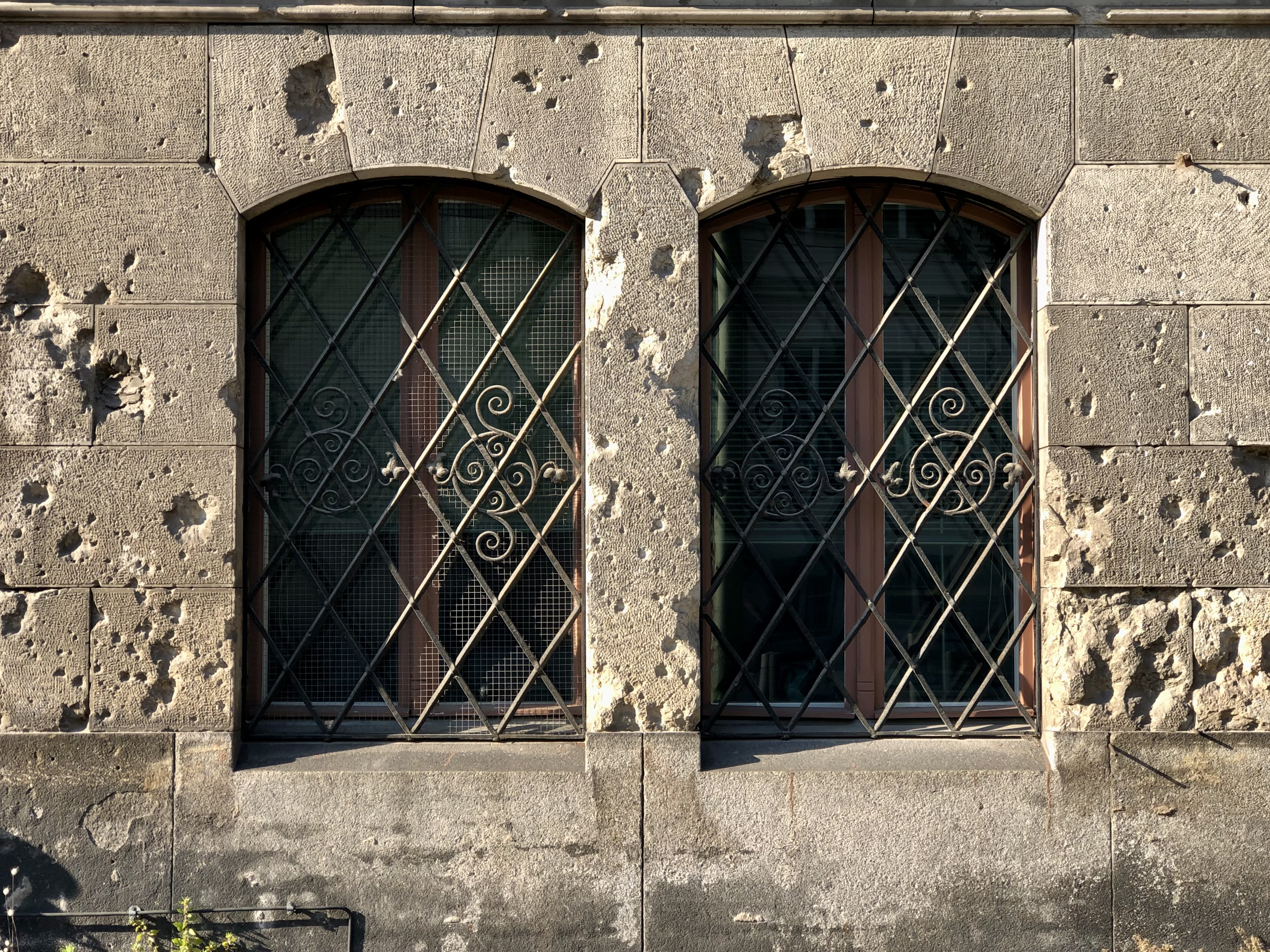
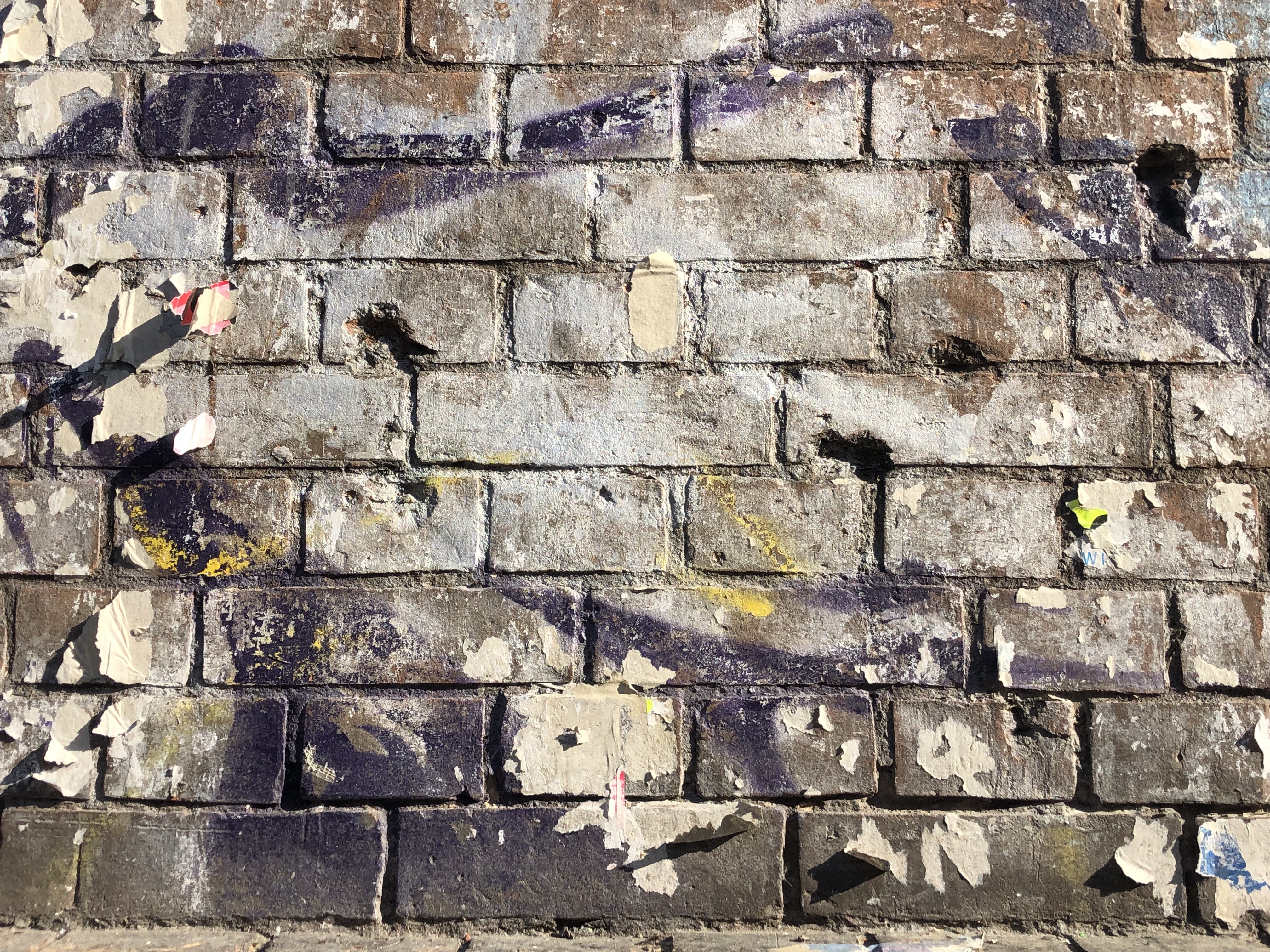
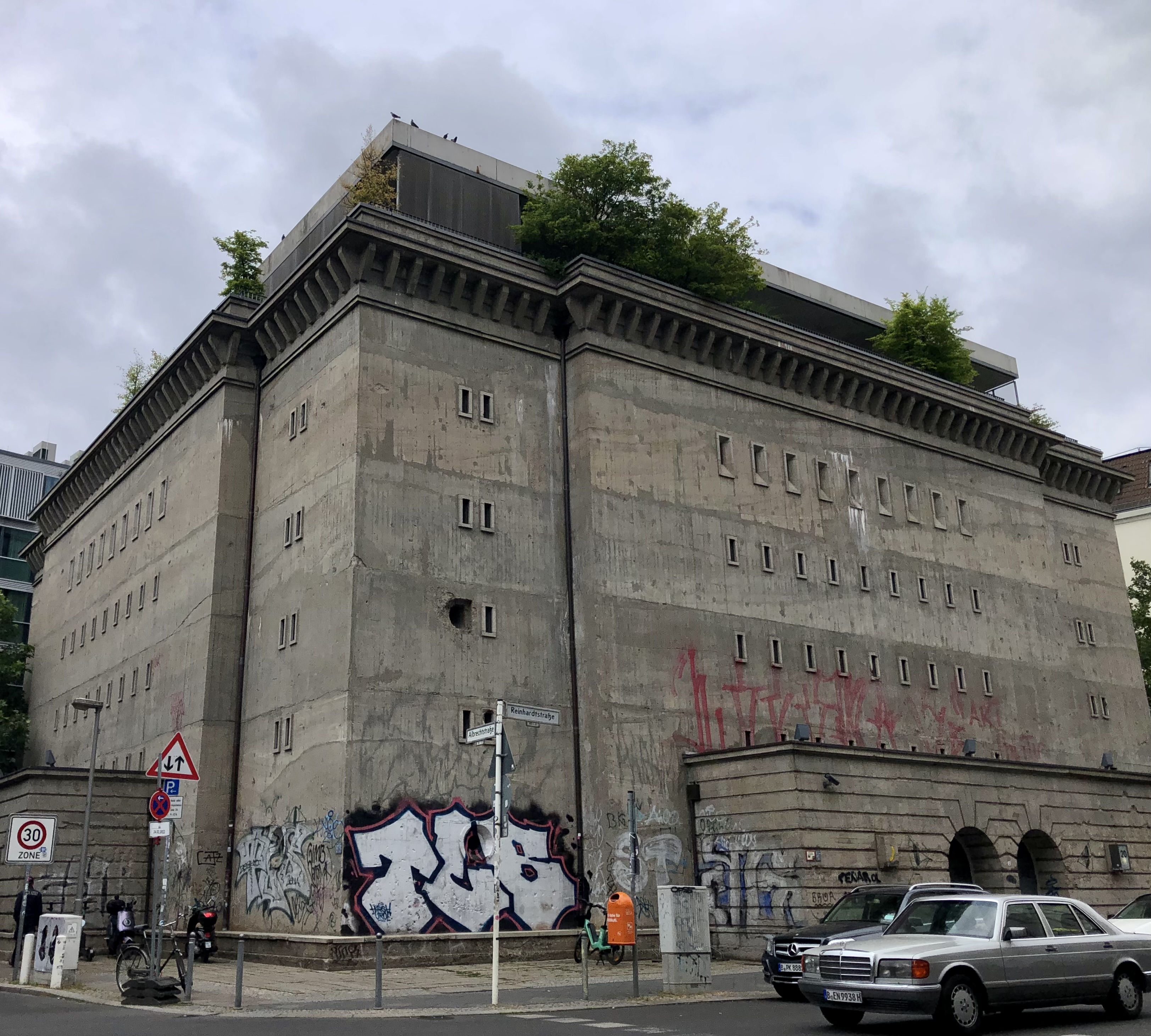
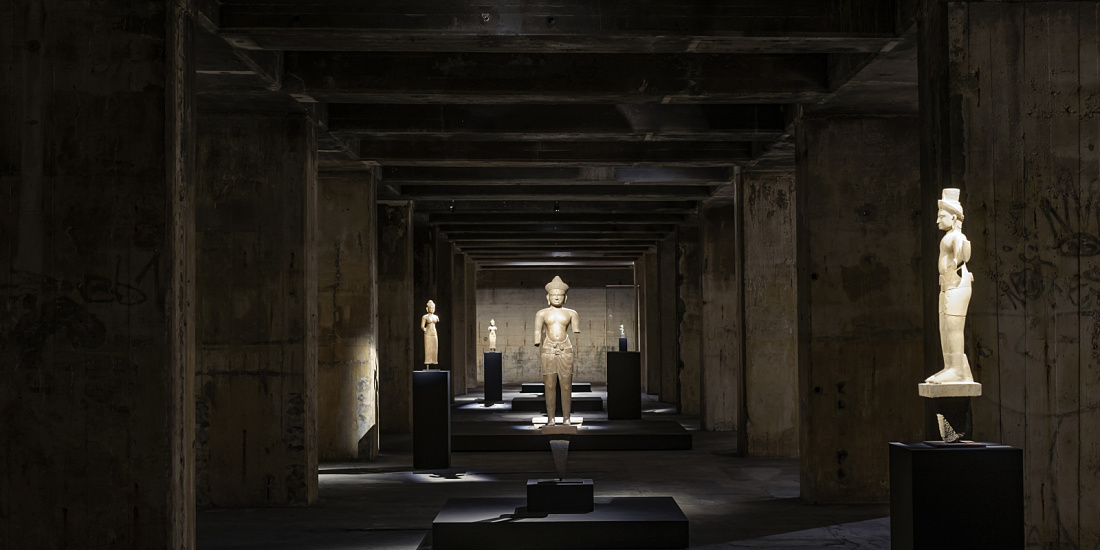
Striking in its lack of cosmetic disguise, evidence of the Second World War still lingers all too visibly: in the empty spaces left by bombed houses; the bullet holes from the final battle; and the enormous bunkers, now transformed into extraordinary galleries that house contemporary installations (Boros Sammlung) or offer an exquisite experience of Asian art in dark silence (Feuerle Sammlung).

After the war, the DDR evolved out of the Manifesto of the Communist Party of 1848 created by KARL MARX and FRIEDRICH ENGELS. Its goal was to ‘change the world’ and to this day, Karl Marx rates as one of the top three Germans, along with Konrad Adenauer (first chancellor of the Federal Republic of Germany 1949-1966) and Martin Luther (Protestant Reformation).

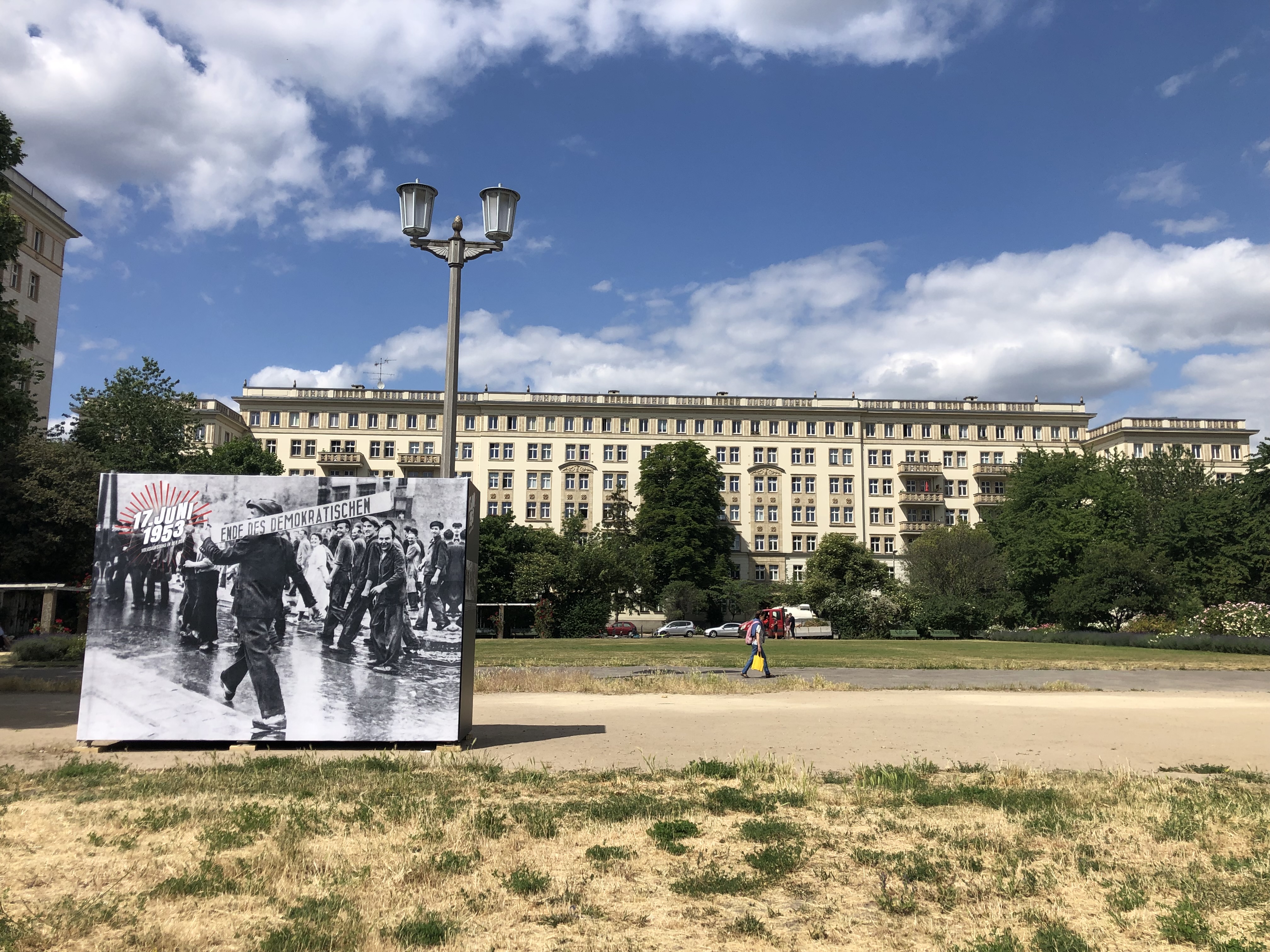
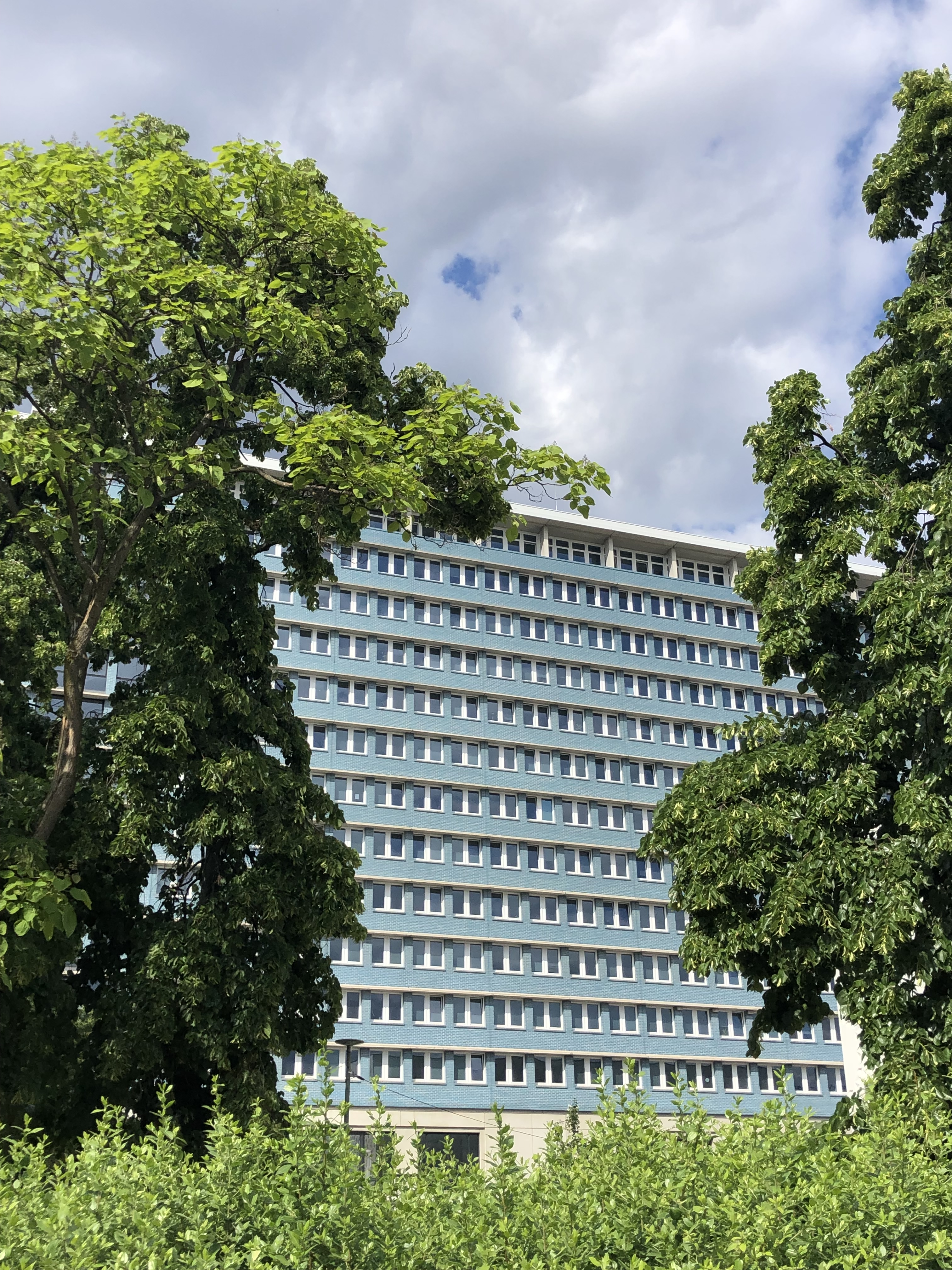
The KARL-MARX-ALLEE, formerly Stalinallee, is the 90-metre wide, 1.2-mile long DDR boulevard lined by grandiose Moscow-style architecture built between 1952 and 1960 and scented lime trees. Designed to sing the praises of socialism, the buildings offered luxurious flats for workers as well as restaurants, shops and a still iconic Kino International cinema. Many of the apartment blocks were covered in ceramic tiles, earning the Allee the nickname of ‘Stalin’s Bathroom’. Half of them had fallen off by 1989.

In the oldest part of the city, a typical ‘Plattenbau’, the panel system-building made up of pre-fab concrete panels, some with basin and loo already attached, rises above a little-known but beautifully crafted frieze telling the history of communism and the DDR.

This year was the 70th anniversary of the 17. JUNE 1953 WORKERS UPRISING in protest against the state’s imposition of more working hours for no extra pay. It was crushed with Soviet tanks and troops leaving 123 people dead.

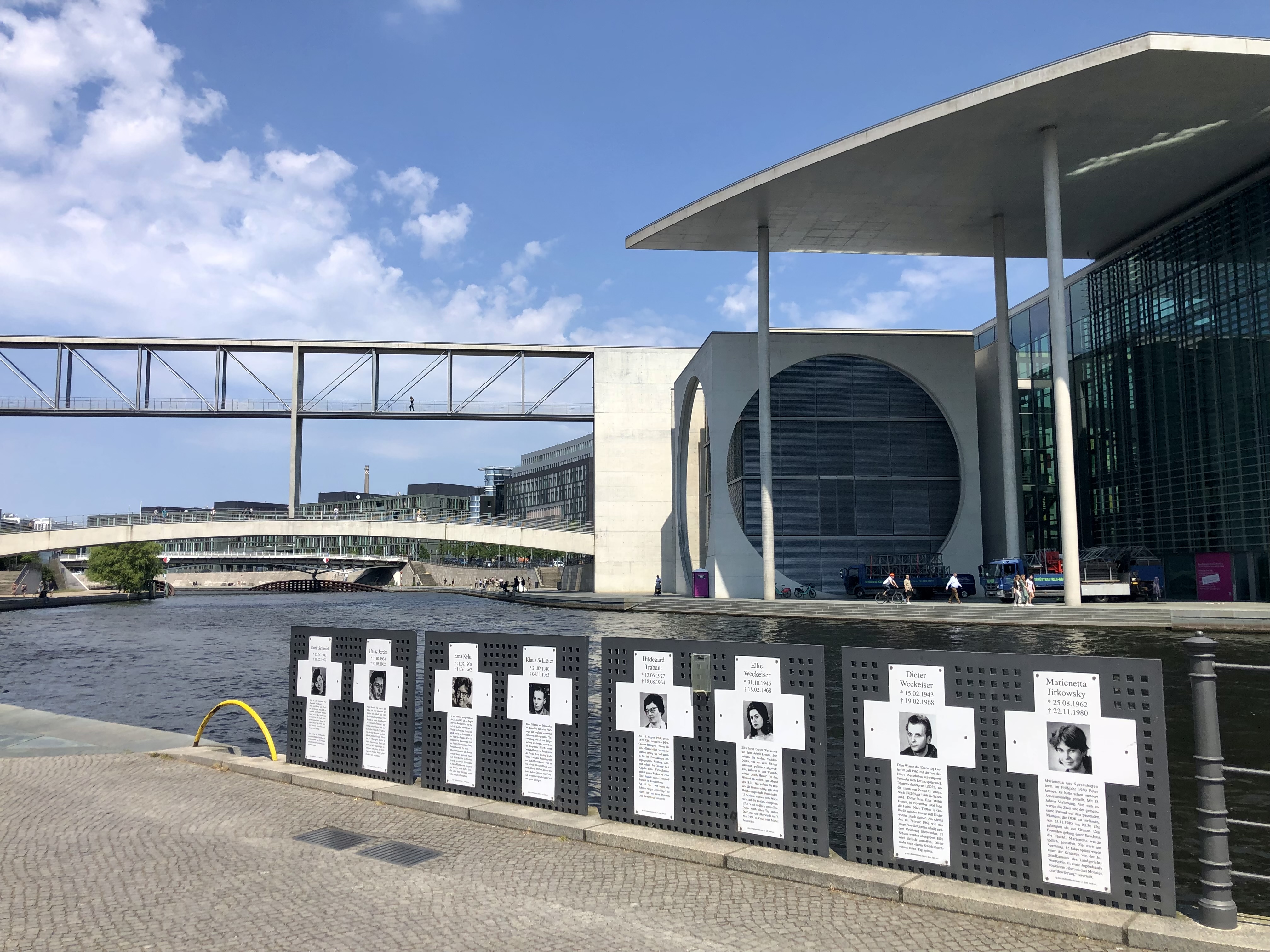
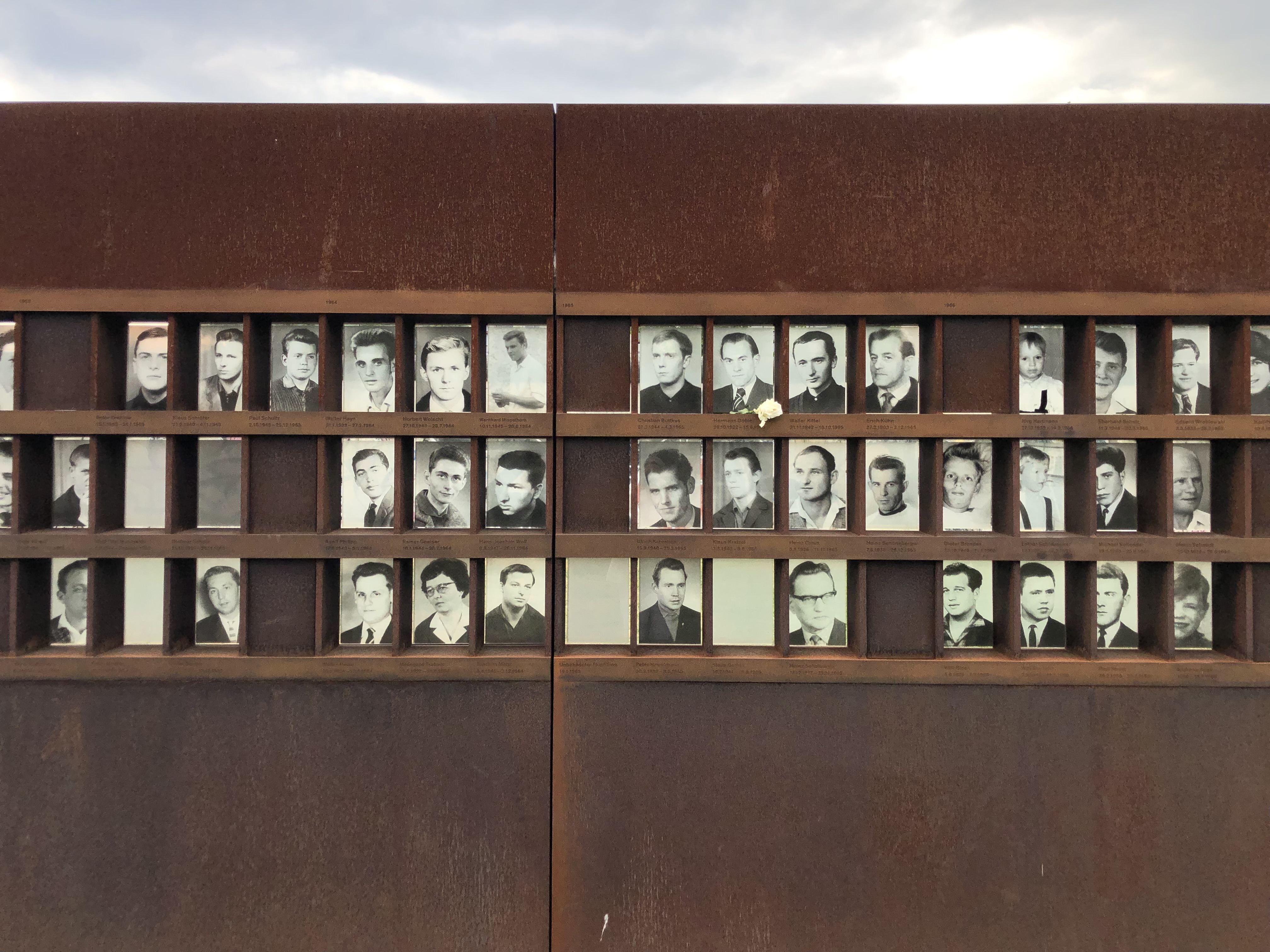
From 1961-1989, the BERLIN WALL effectively locked East Berliners into the regime’s paranoid ideology and ruthless regime. Monuments dotted on its snake-like course through the city tell the tragic stories of the more than 140 people who died trying to escape.

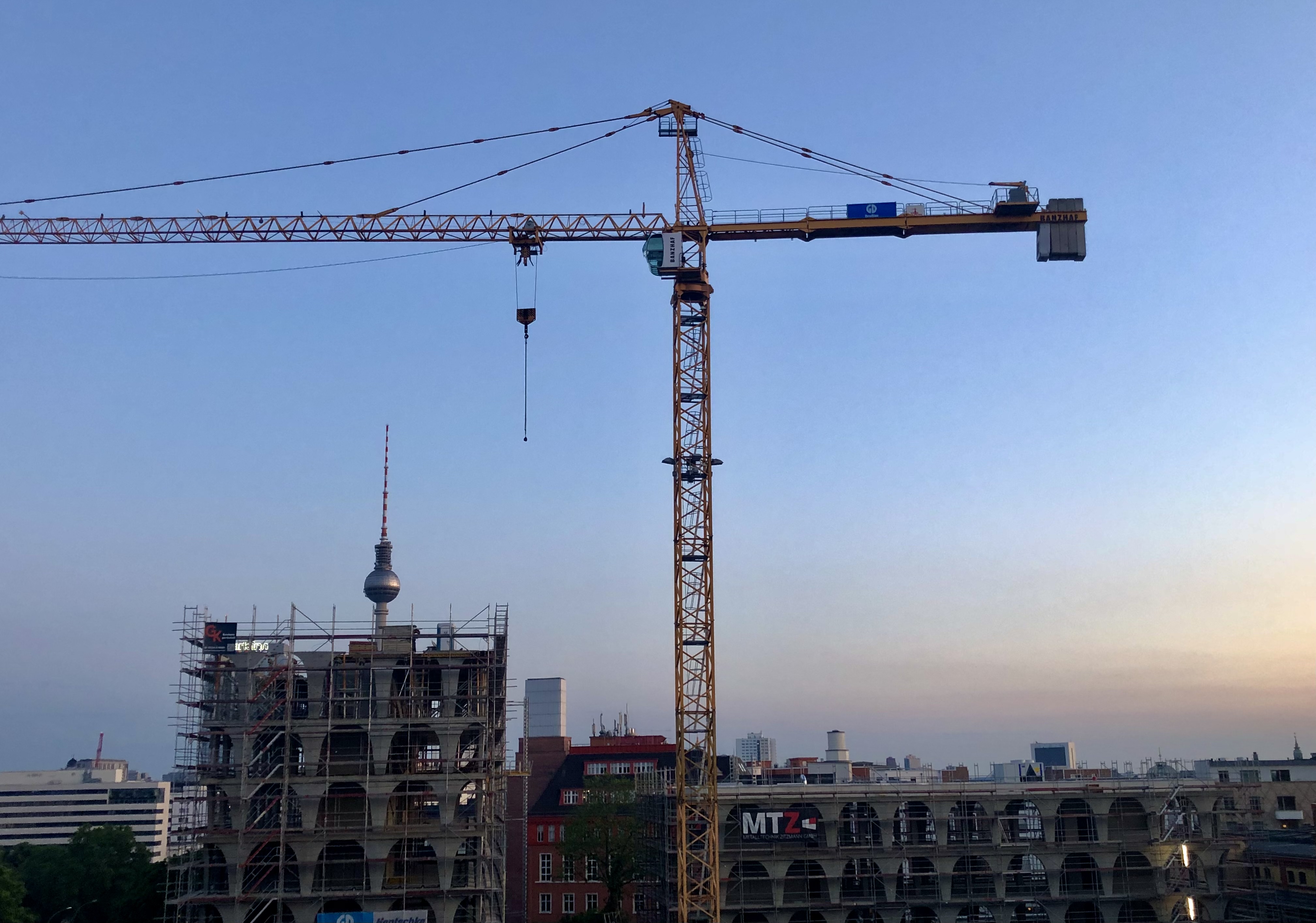
After the Fall of the Wall and the reunification of Germany in 1990, the next phase of (re-)building began and still continues everywhere. Some areas have been homogenised into the commercial cityscapes you can find the world over.

Around the Reichstag and central parliament area, ultra-modern architecture prevails. Outside Jakob Kaiser House, the all-important Grundgesetz or Basic Law is etched into glass – a fragile but resolute commitment by the Federal Constitution to guarantee fundamental rights in Germany .

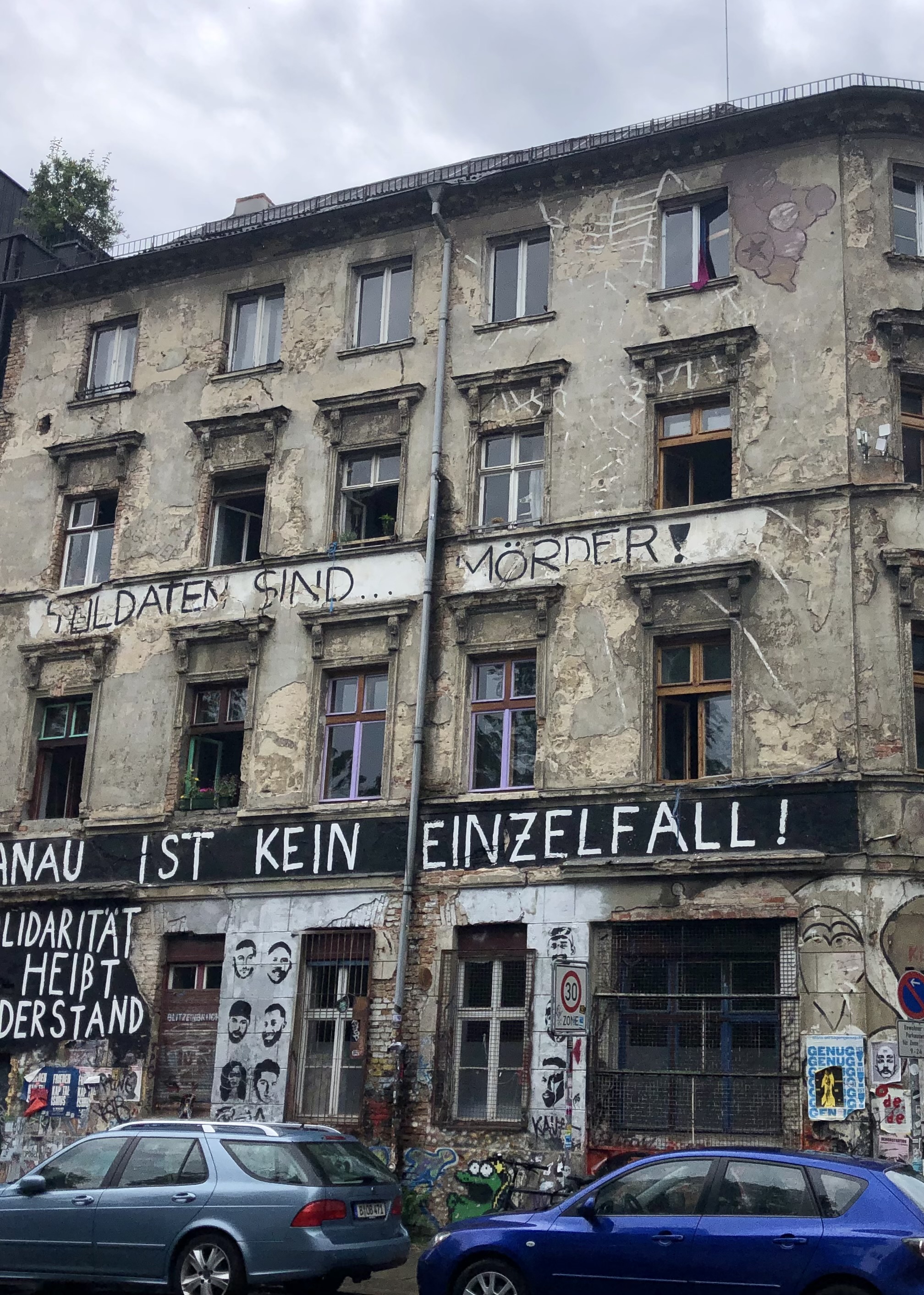
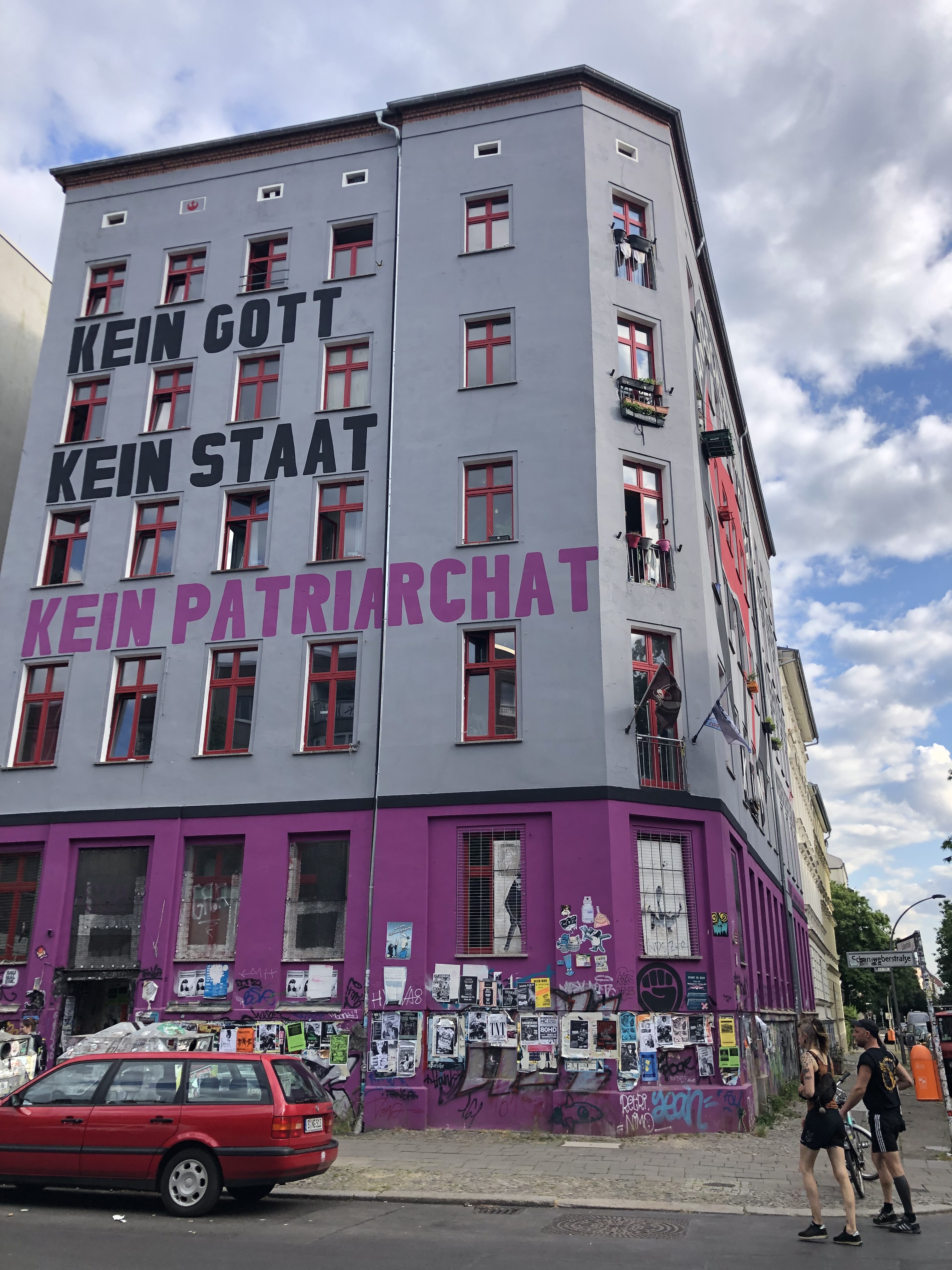
Elsewhere, whole quarters have dodged development and been claimed by layers of graffiti and young hipsters with tattoos scribbled like doodles over their bodies. Political slogans and statements adorn buildings squatted in since ‘Die Wende,’ the peaceful revolution of the autumn of 1989 that led to East and West Germany and Berlin becoming one again: ‘Soldiers are murderers’. ‘Keep calm and don’t give a fuck’. ‘No God, no state, no patriarch.’

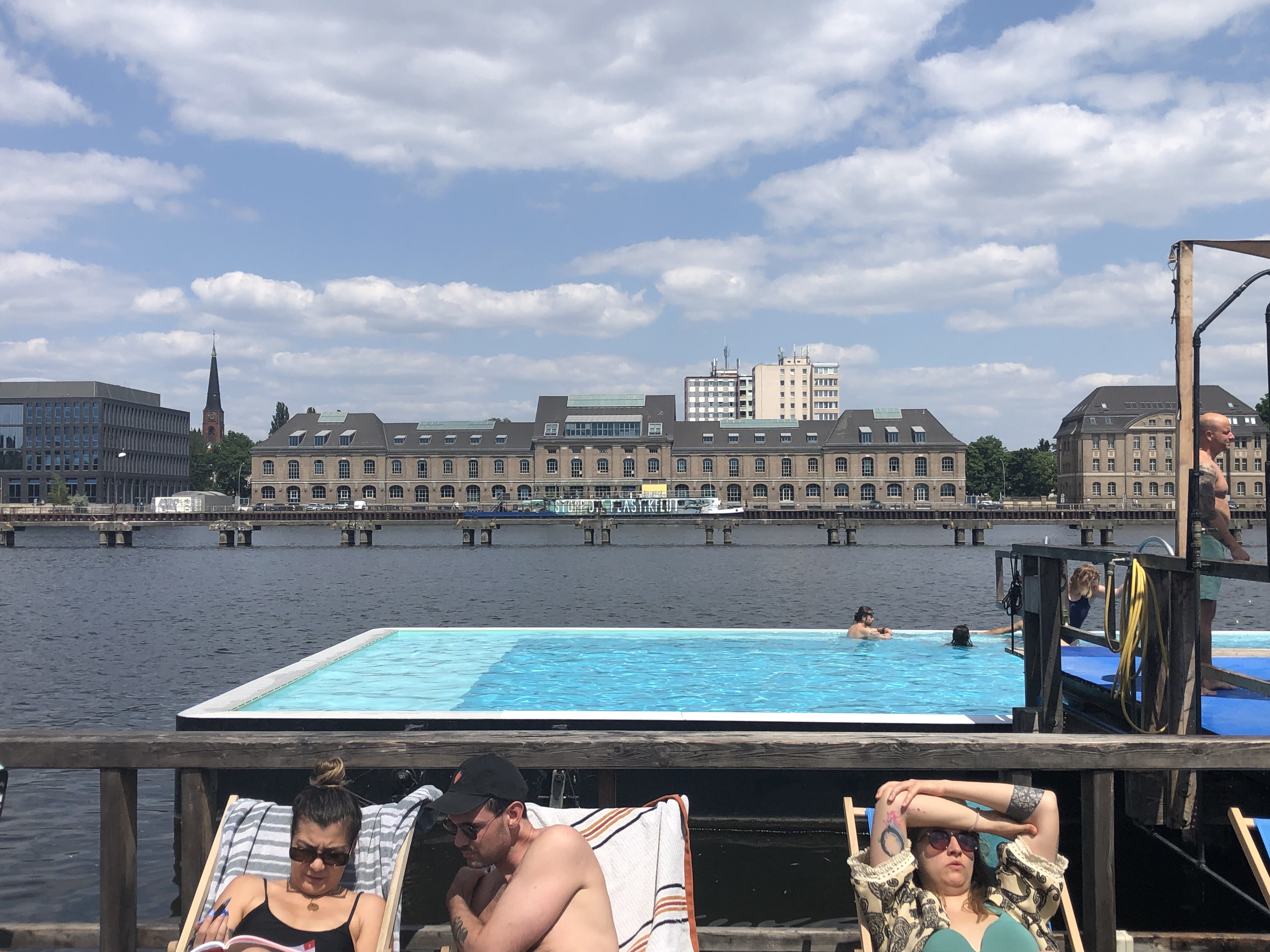
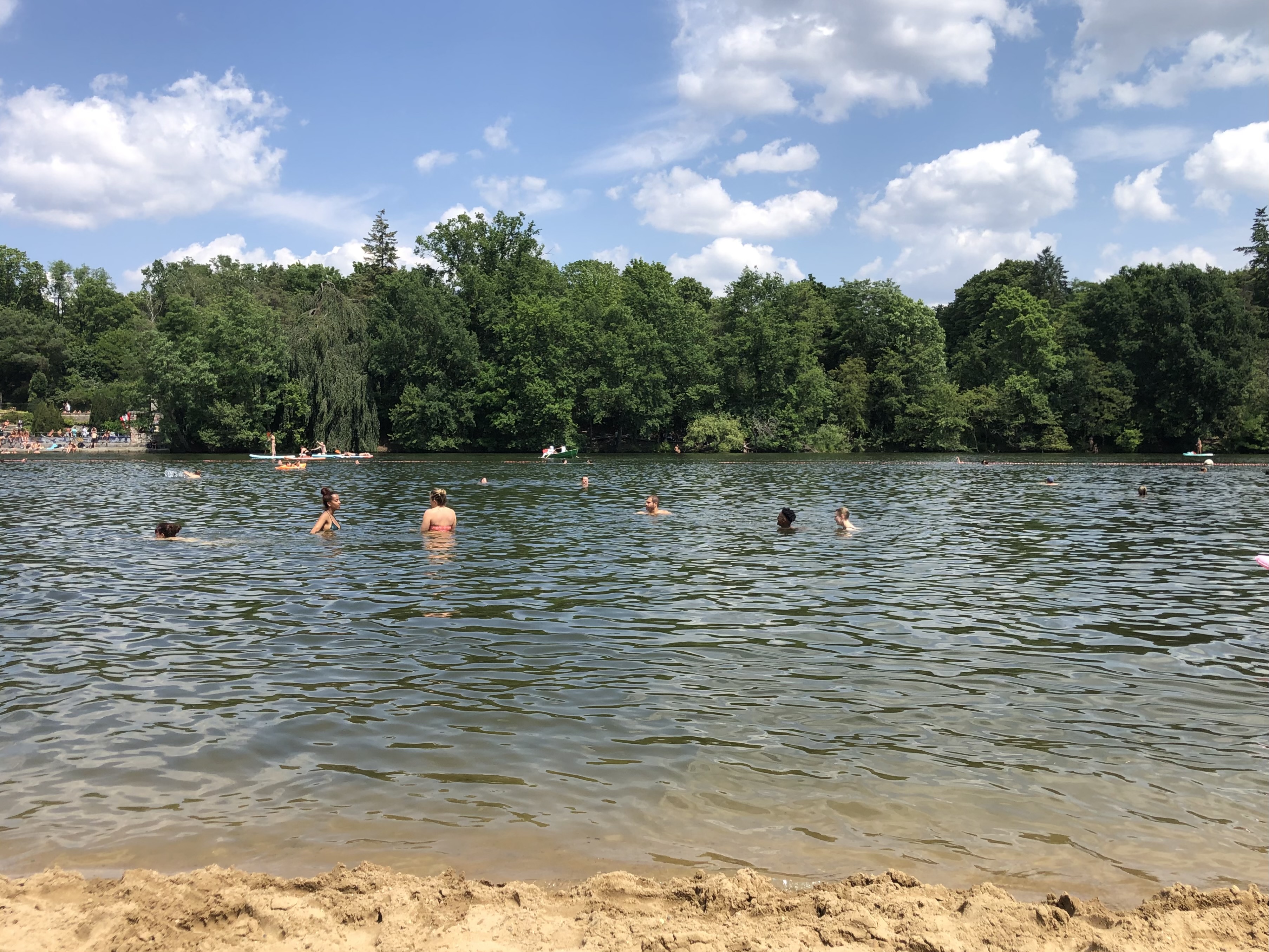
Then there’s swimming in the city centre or in one of the many lakes a cycle ride away; nude sunbathing in the parks and the chatter of endless cafés and bars that spill onto the streets.

Nestled between new and old, the constant reminders of what Germans – and the world – must never forget…

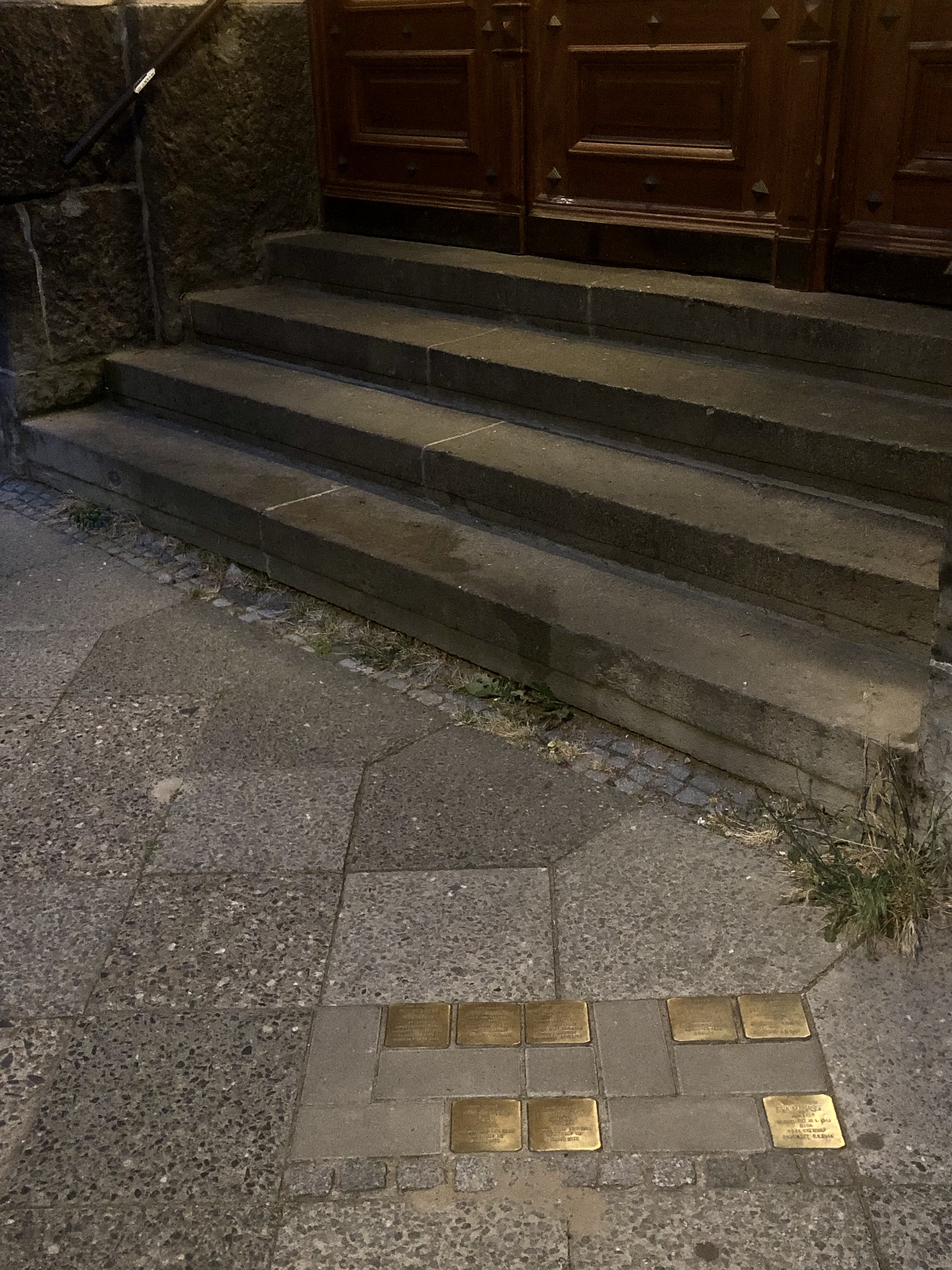
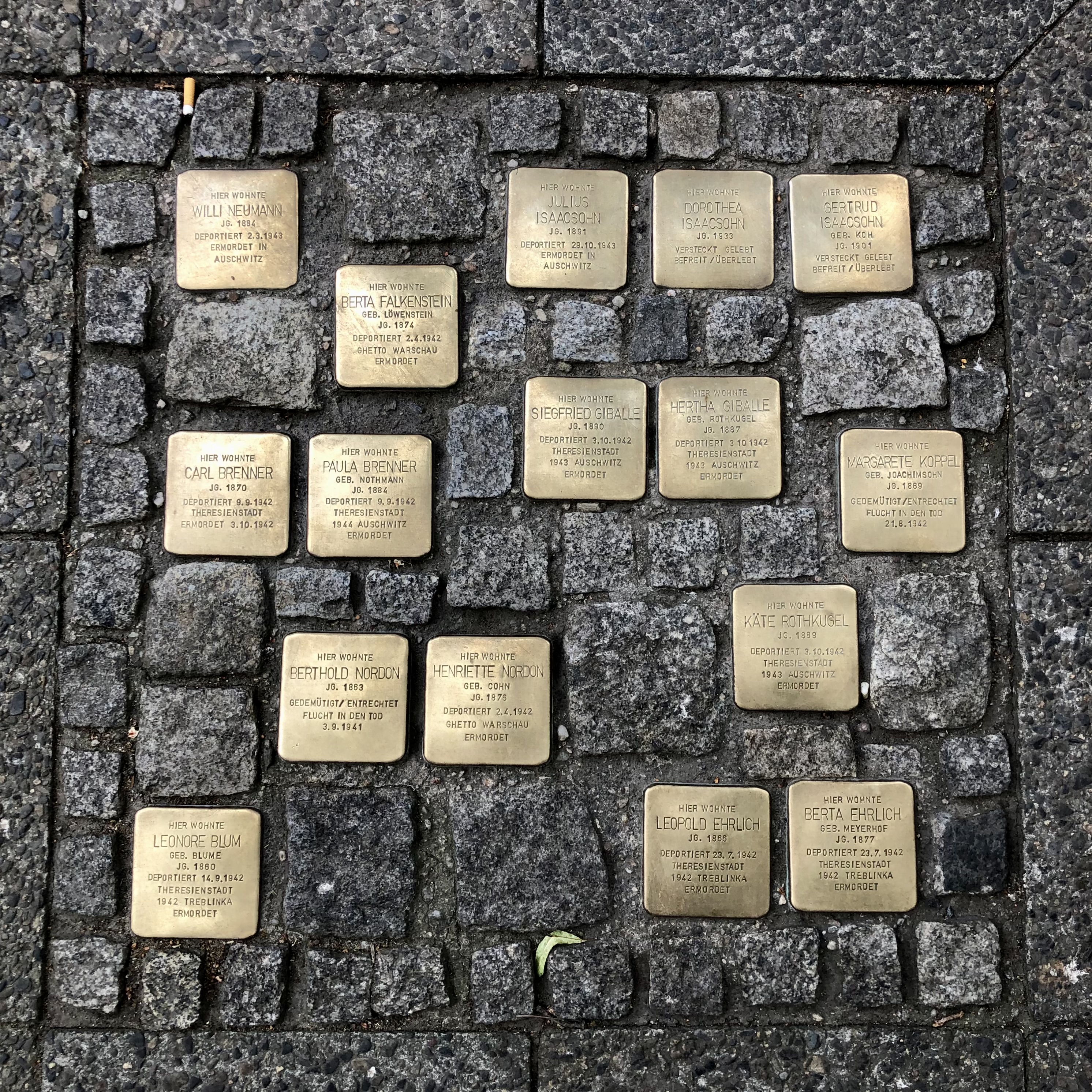
Stolpersteine – stumbling stones – glisten from the pavements naming and remembering those who once lived in these streets before they were deported and murdered by the Nazis.

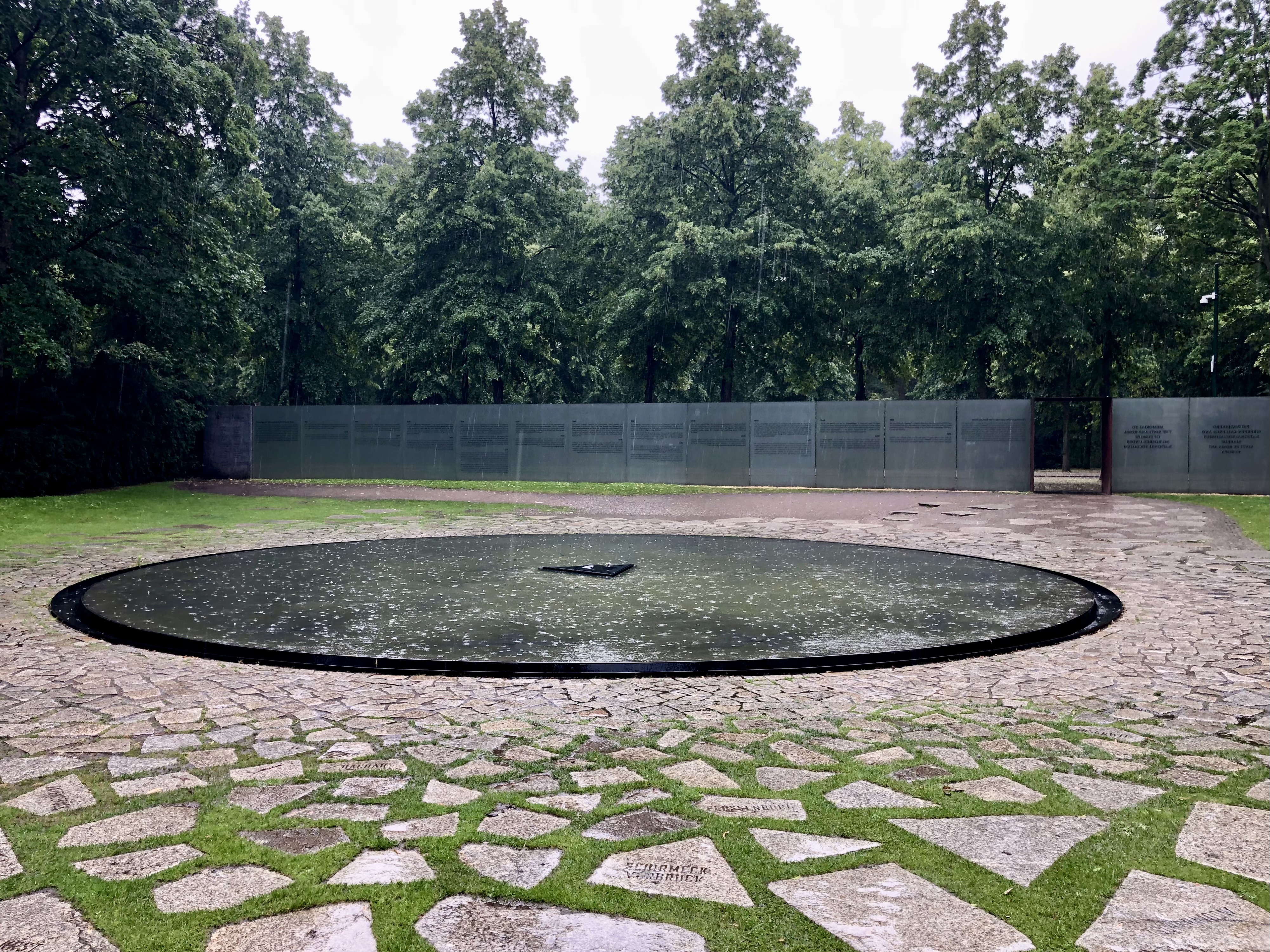
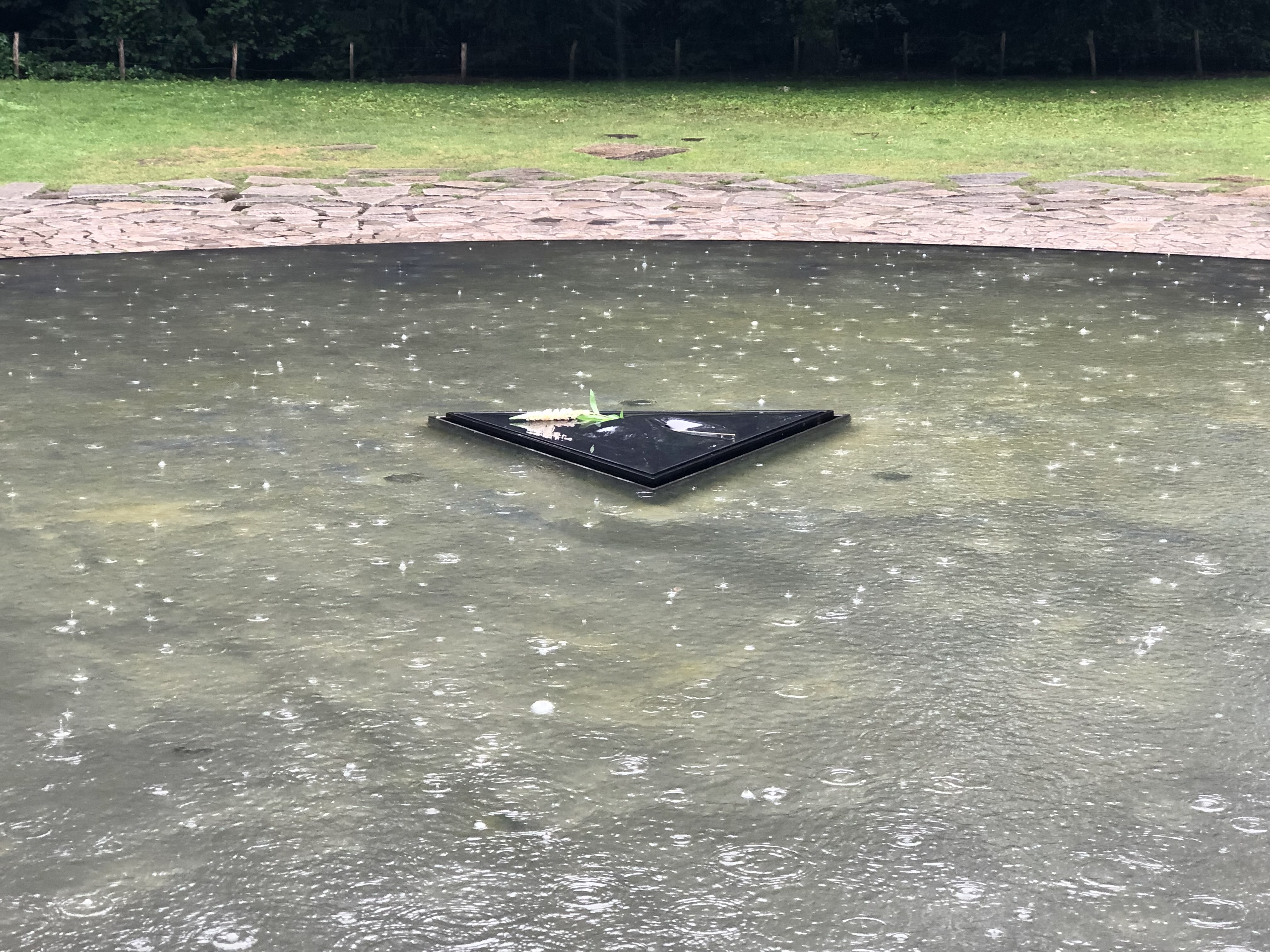
And in the very heart of Berlin, right between the Reichstag and the Brandenburg Gate, against a soundscape of raindrops and a quiet recording of single violin, I witnessed the daily laying of a fresh flower on the triangular island in the middle of the pond that is the Memorial to the Sinti and Roma Victims of National Socialism.

Berlin exudes a wealth of experience and suffering mined from the psychological, moral, philosophical and political depths into which it has plummeted time and again. But it feels to me and many others who love being there, that out of all the conflicting and restricting -isms of the past century, the power of the individual now has its rightful place. Be yourself, the city seems to say. You won’t be judged here.

Long may that last…

A meander from Dresden to Diplomacy…

As the days get noticeably longer and the year begins to gain momentum, I have been observing what builds up my energy and what makes it slump. It’s a good way to gain an indication of which direction to follow. What I notice again and again is that when interactions fall into binary dynamics of right and wrong, good and bad, or discussions strive for a dominant ‘winner’, my psyche becomes more combative or defensive and is quickly drained. There is rarely a satisfactory outcome. But when there is an openess for exploration, conversation, ‘compassionate enquiry or curiosity’ as the physician Gabor Maté would call it, my whole body relaxes. I come away feeling expanded, richer, slightly changed, more connected. More hopeful.

Where am I going with this? 

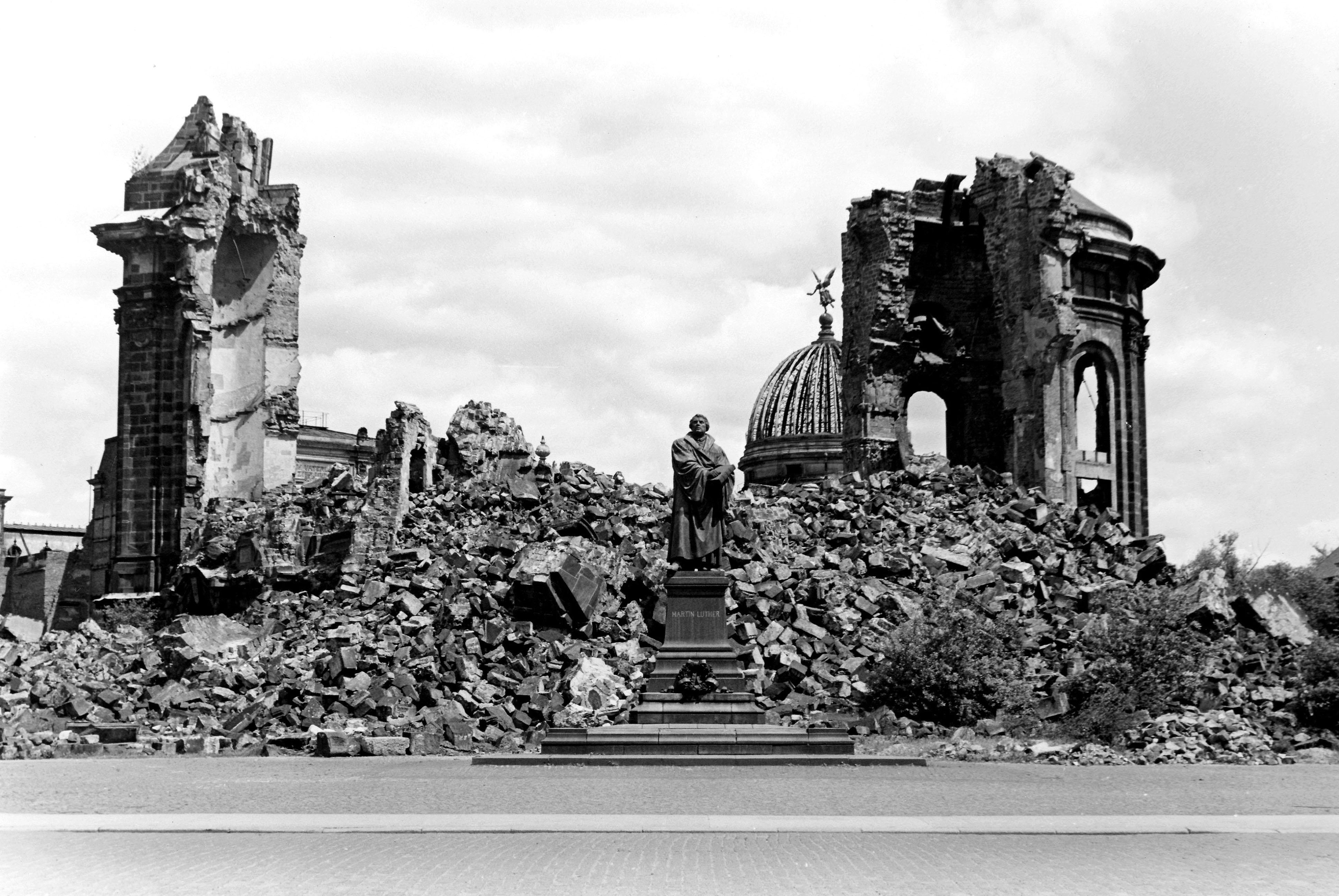
Ruin of the Frauenkirche in Dresden with the Monument to Martin Luther – Church of Our Lady.

Monday 13th February marks the 78th anniversary of the British and American bombing of Dresden. Every year, a human chain of people holding hands in an open gesture of unity wends its way through the city. This year, on Tuesday 14th, a lunchtime gathering will also take place in London with leading figures from the Anglo-German community to remember the second day of the 1945 bombing raid and celebrate the 30th Anniversary of the Dresden Trust. Founded shortly after the reunification of Germany by Dr Alan Russel in response to a ‘Call from Dresden’ to help rebuild the city, the charity is dedicated to healing the wounds of war and furthering harmonious relations between the people of Britain and Dresden.

Whether you see the bombing of Dresden as a British/US war crime, a justified military strategy or a deserved, morale-destroying mission specifically designed to create as much damage and carnage as possible, the outcome is the same: 25,000 civilians died unimaginably horrible deaths. Such extreme acts of destruction are only possible when all that people can see in their fellow human beings is difference, separation, ‘other,’ lesser, enemy… And where that occurs, peace becomes a far-off pipe dream.

In contrast, behind the reconciliatory, healing and bridge-building efforts of organisations such as the Dresden Trust, is a striving for the opposite: collaboration, communication, comprehension, compassion… and a whole load of other words starting with ‘co’ or ‘com’ that signify a certain oneness in our shared humanity. 

Two of the areas I have been most active in – rehabilitation and reconciliation – both have in common that they are repairing or making whole something that got broken. They come about post-event, after the damage has run its course, hence the ‘re-‘ prefix. So what if our collective focus shifted from the costly (on all levels) clean-up jobs those ‘re-‘ words embody, to preventative measures of ‘habilitating’ and ‘conciliation’? What if, instead of constantly having to make good again things that we have damaged – whether health, a lack of education, inequalities or injustices – we put all that time, energy and funding into seeking out and nurturing the common foundations and shared human needs we all have and that we can see so clearly in emergencies such as the devastating earthquakes in Turkey and Syria, where all the differentiating labels (national, political, ideological, gender etc.) we layer over our essential selves get stripped away? 

To do this we would need a fundamental shift from head to heart; in our education, politics, laws, economics, environmental policies, attitudes to foreigners. Thankfully, in many areas, that shift is already happening. 

During President Zelenskyy’s recent tour of Europe, I was gladdened to hear the calm voice of Christopher Chivvis, former Sr. US Intelligence Officer in Europe, in an interview with Evan Davis on BBC Radio 4’s PM programme. He quietly called for a more robust diplomatic track in relation to the Russia / Ukraine war rather than an escalation of increasingly powerful military methods of destruction with the ensuing losses of life. And then he outlined how this could look. I found him more psychologically astute and emotionally literate than many of the louder voices we hear, but see what you think You can listen to the interview here starting 46:31 mins in.

I imagine one of the foundation stones of diplomacy is a willingness to make a concerted effort to hear all sides of the story. An attempt to do just this came in the form of the brilliant 3-part BBC2 documentary series, ‘Putin vs the West’. Produced by Norma Percy, it presents the run-up to Putin’s invasion of Ukraine through the spoken words of an impressive range of key players as well as incredible footage of Putin and co at work. It was compelling watching that I can only recommend. But… for all the different angles it presented, it remained largely the point of view of the west. As Andrew Seale said in his article: “The problem with this type of documentary… is that there is no one credible to interrogate the west’s narrative.” And it was very clear, the west didn’t always get it right.

So we need to go even further. To include an even more diverse range of voices. To hear our critics too.

If Dresden can teach us anything, it is that it is too dangerous not to. War brutalises. War traumatises. For generations to come. Maybe as former US president, Barack Obama, said in defence of his retrospectively ‘best’ but much criticised decision not to take military action against Syria after it had crossed his ‘red line’ of using chemical weapons: “The ease with which military actions gain momentum, the greater difficulty in pulling back and insuring that diplomacy is given a chance.” 

Further reading

Talks between Russia and Ukraine would save lives argues Christopher Chivvis – The Economist

Putin vs the West review – like a gripping terrifying soap opera – The Guardian

The West is wrong to assume it has global support in the war against Putin – Open Democracy

On this year’s Holocaust Memorial Day, German tanks will be heading to Ukraine to fight Russia. Are we learning from or repeating the past?

With the approach of Holocaust Memorial Day, I find myself engaging with some of my customary questions around how to remember the past and learn from it. 

There is no question that 27th January is a day to collectively bear witness to those murdered under Nazi Germany’s heinous regime. To honour their memories and acknowledge the agonising voids they once filled. To hold in our minds and hearts those who survived and those born later scarred by the violence inflicted on their families. I personally can’t imagine a time when this is not the right thing to do.

Added to remembrance, is the necessity to grasp and implement the lessons of such dark episodes in history. The most obvious ones centre on the dangers and wrongness of discrimination; of othering fellow human beings for their perceived inferiorities or differences in religion, outlook, appearance, social standing, sexual orientation etc. This may feel relatively straightforward for decent people. It becomes less easy, however, when we are requested to act in the face of similar wrongdoings, rather than look away or rant on social media; to become ‘upstanders’ rather than bystanders. How do we do that in this world where injustices can be found everywhere?

One could deduce, that punishing the culprits is an important aspect of commemorating the Holocaust and avoiding future genocides, though the time for that may now have passed. Just over a month ago, the 97-year-old German care home resident, Irmgard Furchner, became possibly the last person to be convicted of Nazi war crimes. After a divisive trial in Itzehoe, she was given a 2-year suspended sentence for her role as the 18-year-old secretary to the Stutthof concentration camp commandant, Paul-Werner Hoppe. For many people, this is justice, no matter how late, and all the more deserved due to Furchner’s evident absence of remorse. For some, however, it is a vindictive attempt to assuage Germany’s collective guilt. For others, it is misplaced and sickening virtue-signalling, pointless scape-goating… the debate is lively.

Irmgard Furchner

A positive outcome of Germany’s learning from its dark past is its nigh on eighty years of pacifism. But this too appears to be being brought to an end, albeit with huge reluctance and resistance within the country. Putin’s illegal war and NATO’s unified military response in support of Ukraine have put understandable pressure on Germany to break its resolve not to get involved in military conflicts and supply Ukraine with its world class Leopard 2 tanks specifically designed to compete with the Russian T-90 tanks. Last night, after months of hesitation and debate, the Chancellor, Olaf Scholz, and the German government finally agreed to send a company of battle tanks and allowed other countries to send their German-made tanks too.

The whole issue is extremely complex, I know, but the psychological irony seems unavoidable. 

On the one hand, the widespread tendency to never let Germany forget the wrongs of its Nazi past is still alive and kicking. On the other, there is now equally widespread demand that it does just that. Or rather that it selectively remembers some bits of its past and forgets others, such as the traumatic memories of the last time German tanks rolled into Russia with the horrifically high death tolls and suffering of tens of millions that ensued. I wish I could ask my German grandfather what he thinks of the situation, having fought on the eastern front for so long… (See Chapters 14 & 15 in my book In My Grandfather’s Shadow)

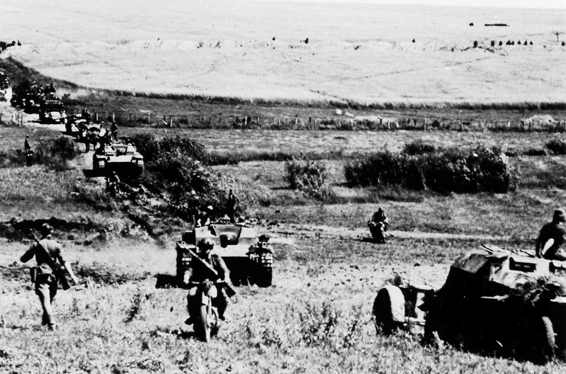
Operation Barbarossa, 1941

From many points of view, including a growing number within Germany itself, there are compelling arguments for the government to embrace a Zeitenwende’ (turning of the times) in its foreign policy and to override its long-standing commitment to peacekeeping, up its defence budget and contribute more military solidarity to its NATO allies in a shared effort to support Ukraine against Russia. I am not saying this is right or wrong, just recognising that it is a HUGE step for Germans and Germany, a potential game-changer for either good or bad, and one we should try to understand rather than simply criticise and judge. 

Within the over-simplified, clean-cut narrative of Putin = bad, Ukraine/NATO = good, (which is naturally true from the West’s perspective but not from Russia’s and its allies, hence the conflict), space should be allowed for Germany’s justified fears of an escalation. Its visceral memories of fighting Russia and closer proximity to the country, raise genuinely terrifying concerns that we need to take seriously. At the same time, the contradictions in the messages being delivered to Germany surely don’t go unnoticed: Remember and take the full blame for the atrocities you caused with the Holocaust and the Second World War… but actually, forget some of them now and immediately dispatch tanks against the former enemy with whom you have been trying to make some kind of peace or amends and play a decisive and deadly frontline role in what could easily become a Third World War.

Maybe it really is time for Germany to move beyond its WW2 identity. I hope that this Zeitenwende in German policy will also find a counter Zeitenwende in certain mindsets.

Further Reading:

Was this Germany’s last ever Nazi war crime trial?

Why Germany hesitates on sending battle tanks to Ukraine

Why Germany is struggling to stomach the idea of sending tanks to Ukraine

Germany to send Leopard tanks to Kyiv and allow others to do so

Forthcoming Events focusing on In My Grandfather’s Shadow and open to Public:

Thursday 2nd February, 6-8.30pm, Painswick, Glos: First Thursday In ConversationMore info

Thursday 23rd March, 6pm – Summer Town Library, Oxford: Talk and Q&AMore info soon

Wednesday 29th March, 2-3pm – Oxford Literary Festival: In Conversation with Miranda Gold… More info

In Praise of Empty Space…

November, in many cultures, is the month designated to remembering those who are no longer there. With a strange synchronicity, everything I did, watched, read or listened to pointed towards ‘absence,’ that non-presence devoid of form that artists call ‘negative space.’ “Empty space is the silence between musical notes, the pauses in poetry, the stillness of a dancer. Therein often lies the meaning or drama of a piece.” (In My Grandfather’s Shadow, Ch 11, p.144)  

I have just returned from a week in St Ives, the Cornish place that boasts the highest concentration of blue light in the UK and challenges many an artist to capture its effect in paint. A kind author friend each year offers her house of clean white rooms overlooking the beach and cliffs as a form of writing retreat for three of her fellow writer friends. All four of us want to make the most of precious time out, so the interiors fall silent during the days that in turn empty of all structure, just as our minds declutter of chores. 

I spent my time reading the diaries of my intrepid, spinster great great aunt, who travelled alone to the Himalayas in 1939 to gather flowers for Kew Gardens. I followed her slow, awe-filled progress as she step-by-stepped her precarious way through lofty peaks and flower- or snow-filled valleys, pausing with her when she rested to stare at the perfectly choreographed performance of clouds and weather dancing in front of my window. Thoughts wafted through my mind, some being noted, others just fading in and out like rainbows. For a whole week, I simply was.

My time there, along with books and films I have recently ingested, have been making me realise just how much I miss and yearn to regain some of what I remember loving doing as a child… nothing. Being born a day-dreamer, the spaces between activity and connection were always filled with a rich, albeit invisible world that had the capacity to entertain, or indeed bore. Boredom… how rarely we have time for that potentially creative vacuum within today’s ubiquitous overload of information, social media and communications that interrupt our rhythms with an octave of pings. I don’t think this is just a grumpy, old-age thing. (Well it may be a bit.) This nostalgia is captured well in ‘The End of Absence’ by the considerably younger and hipper author, Michael Harris. He reminds us of what we are in danger of losing as generations, who have never known life without the internet, gradually overtake those of us who have. 

The recently released and highly acclaimed film ‘Living’ based on the book by Akira Krosawa, screen written by Kazuo Ishiguro and starring Bill Nighy is set in 1950s London. Not a lot happens, and what does, happens incredibly slowly. The cinematography is stunning and emulates the subtle grace described in ‘In Praise of Shadows,’ a slim book by Junichiro Tanizaki that gently reveals traditional Japanese aesthetics and use of space. Unlike us in the west where the achievement of light is basically both goal and God, in Japan it was – and maybe still is in places – the creation of shadows that was the source of beauty and mystery. This quiet understatement is part of what I want to rediscover.

Another film I watched where even less happens but with still more potency and power, is The Banshees of Inisherin. Dark, sad, funny and impeccable in every way, including the acting of its two ‘In Bruges’ stars, Brendan Gleeson and Colin Farrell, it basically portrays the painful ending of an long-standing friendship caused by the simple declaration by one: ‘I don’t want to be friends with you anymore’. The extensive space the film allows each facial movement, scene, sentence… one can almost feel the multi-layered clutter of ones own world begging to be emptied into black bin bags, or deleted.

With this increasingly strong desire to create more space, I decided to have a big Studio Sale of my art. (All works available can be viewed here.) And to finally sort through my real and digital filing office and cabinets in order to establish more clarity and space for new shoots and fruits. 

So with the start of Advent this Sunday and the build-up to the crazy, all-consuming Christmas season, I would like to invite you to join me in seeking out and reclaiming some of those quiet spaces life used to offer in abundance, and still does if we just stop… feel… and dream our way into them.

Wishing you a very Happy and Meaningful Advent…

Related Links

To buy my book, In My Grandfather’s Shadow, as a Christmas present, please order from your local bookshop or online here

In My Grandfather’s Shadow’ is a brave, powerful, honest, thoughtful and meticulously researched book. I enjoyed it immensely. It has made me think very hard about intergenerational trauma transfer and explains so much about Germany, and perhaps, in the current context, Russia.General Sir Richard Shirreff, former Deputy Supreme Allied Commander Europe and author of ‘War with Russia’

To listen to the recent 5-part Interview with Chris Baxter on Radio West, please go to BBC iPlayer here

To look through and/or buy a piece of ART please go to my website: www.angelafindlay.com