I feel like I should write about the US/Israel war on Iran – just in case it’s the start of another world war. Conflict and its lasting impact are themes of my blogs, after all.
But I can’t quite bring myself to. Do you feel the same? That initial shock… then a deep sigh, a kind of eye-rolling weariness, an ‘Oh, for goodness’ sake…” followed by a quieter, heavier sadness: not again.
Perhaps being immersed in a vibrant community, in the arts, in nature and in inner processes – as many of you may be, in your own ways – offers a lens on world events that cuts through the noise of “facts” and “news” and brings the sheer idiocy of this war into sharp relief.
All wars are deadly serious, and my thoughts are frequently with those directly caught up in the pain, terror, danger, destruction and loss that war carries in its DNA. And yet, with so many alternatives to military action available, I struggle to see this one as anything other than a series of reckless actions by an orange, puffed-up caricature of a world leader alongside others in positions of power, playing with the lives, lands, and futures of millions, both near and far.
Many watching on seem baffled and possibly outraged by what has unfolded this month. But implications and consequences aside for a moment, the language of and justification for war itself feels curiously antiquated: transparently dishonest, illogical, unimaginative, emotionally illiterate, and astonishingly short-sighted.
Similarly, I find myself unable to listen to discussions in the House of Commons without a sense of embarrassment. The braying and booing, the scorning and jeering. You could hardly design a better architectural setting or system for pitching people against one another in a relentless ping-pong match of insults and counterarguments that defy meaningful action or resolution.
While I am at it, I would add the excessive striving for power, control, territory, wealth, or ideological domination to my list of grievances ready to be banished to Room 101. It all feels so… yesterday.
What would really give me hope, however, is seeing the many effective, often evidence-based practices and initiatives that foster peace, health, care, connection and creativity properly funded, implemented, and woven into systems that are currently buckling under the weight of outdated thinking, much of it developed in the name of ‘progress’.
As my wise constellations teacher said, what we may be witnessing is the “demise of competitive individualism”. Across the world, in both small and large ways, people are coming together in cooperatives, collaborations, conversations and communities, rather than conflicts. Many have recognised the dead end of elbowed egotism, excessive consumption, resource exploitation and disposable waste. Something else has been quietly brewing for decades. And though some of its early expressions may be flawed, it is happening.
Here in this feisty little town in Gloucestershire that has always punched above its weight, the ground is tangibly rumbling. Not with tanks, but with a peaceful, bottom-up revolution. Changes in thinking, acting and being in this wonderful world based on what is beneficial to all.
Bring it on.
For just as valerian roots can quietly topple stone walls, so too can the gradual growth of grassroots initiatives gently tumble those clinging to the brittle pinnacles of old systems that have lost connection to their source.
The month opens with the ancient Gaelic festival of Imbolc, the halfway point between the winter solstice and the spring equinox, marking the returning light and the first stirrings of spring. You could be forgiven for doubting it this year, with the interminable wet grey stretching across most of the winter.
Mid-month in many parts of Europe and beyond is carnival season. In the Rhineland in Germany, Weiberfastnacht launches the week of street parties, parades and general craziness. Bands of women brandishing scissors storm town halls, ceremonially lopping off men’s ties in a symbolic reversal of power. Traditionally a kiss might be offered in exchange. I suspect there would be little appetite to bestow even a small peck upon the cheek of any of the unsavoury men currently filling the headlines whose ties many would gladly queue overnight to sever.
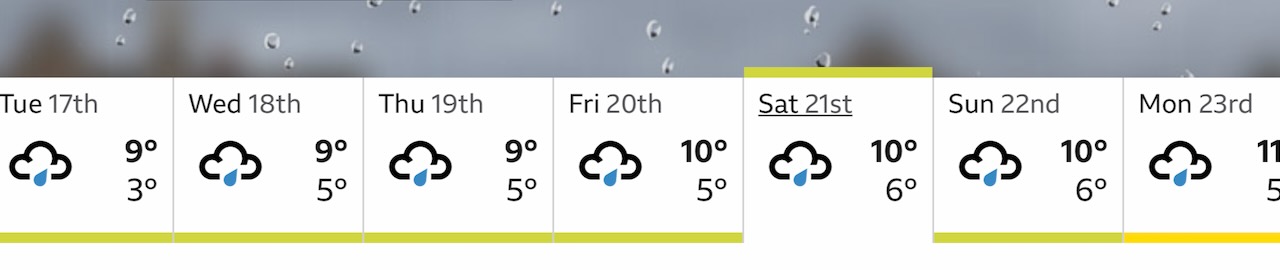
Skipping over Valentine’s Day with its plethora of red rose themed flower bunches, heart-shaped chocolates and pink bubbly, on 17 February, the Chinese Zodiac ushered in the Year of the Fire Horse – a harbinger of intensity and fast-paced change on both personal and global levels. It sounds promising. And that day I genuinely felt the stable door to my long, conscious wintering fly open. I bolted like a horse with a rocket up its arse. This equine imagery swiftly morphed, however, into something closer to a headless chicken unsure in which direction to run. A rush of energy is not necessarily the same as orientation.
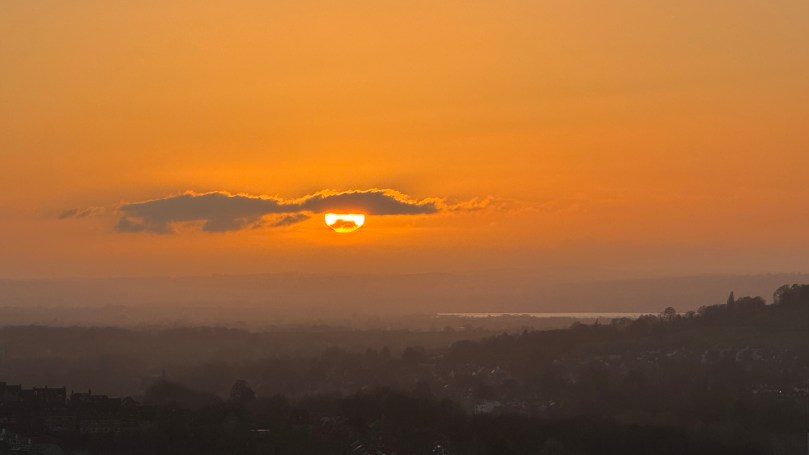
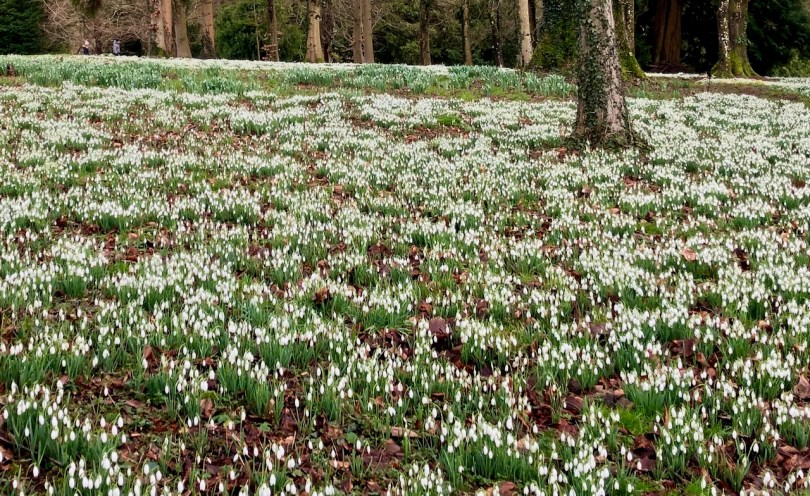
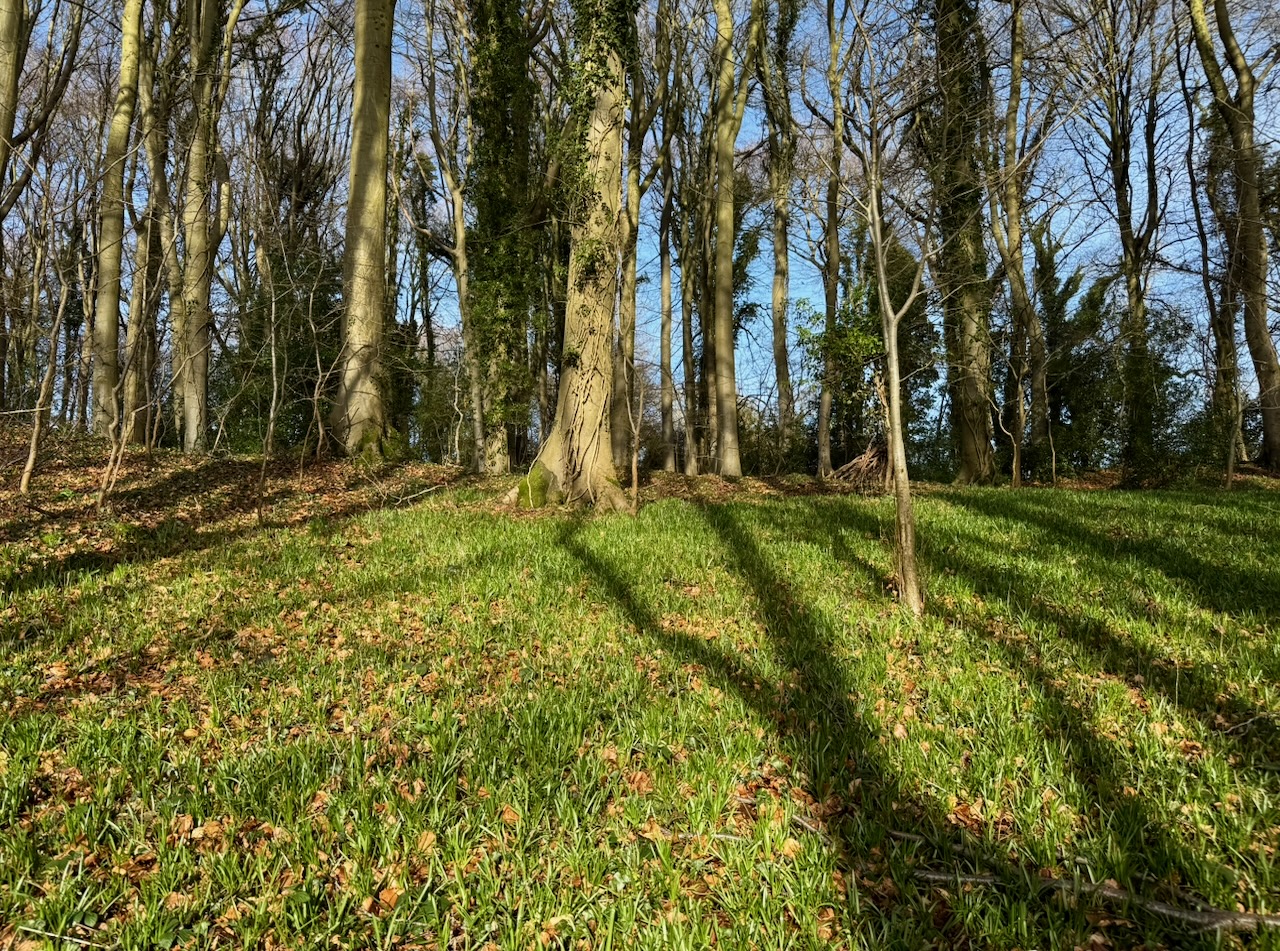
Then in the final week of the month, came rare sunshine. A morning walk in the woods. Warm breezes threaded with birdsong combed through bare branches quietly filling with sap. Forest floors rolled out green carpets in anticipation of white anemones, yellow celandine, and bluebells. For a moment, I felt the promise the daily news so persistently denies us.
In stark contrast, I think of the extraordinary advances in AI, building a new world of technological brilliance and mechanised humanity. Social media claims to tailor connection, yet so often blurs our individual and cultural edges into a controllable global homogeneity. We may be more networked than ever, but also more divided.
Each generation pushes against the boundaries of its time: church, family, class, gender. Restriction is perceived as the enemy to individuality. But as boundaries dissolve, are we becoming freer or simply blending? Might we be witnessing not just liberation but a longing? A reemergence of desire for what is elemental, real and rooted?
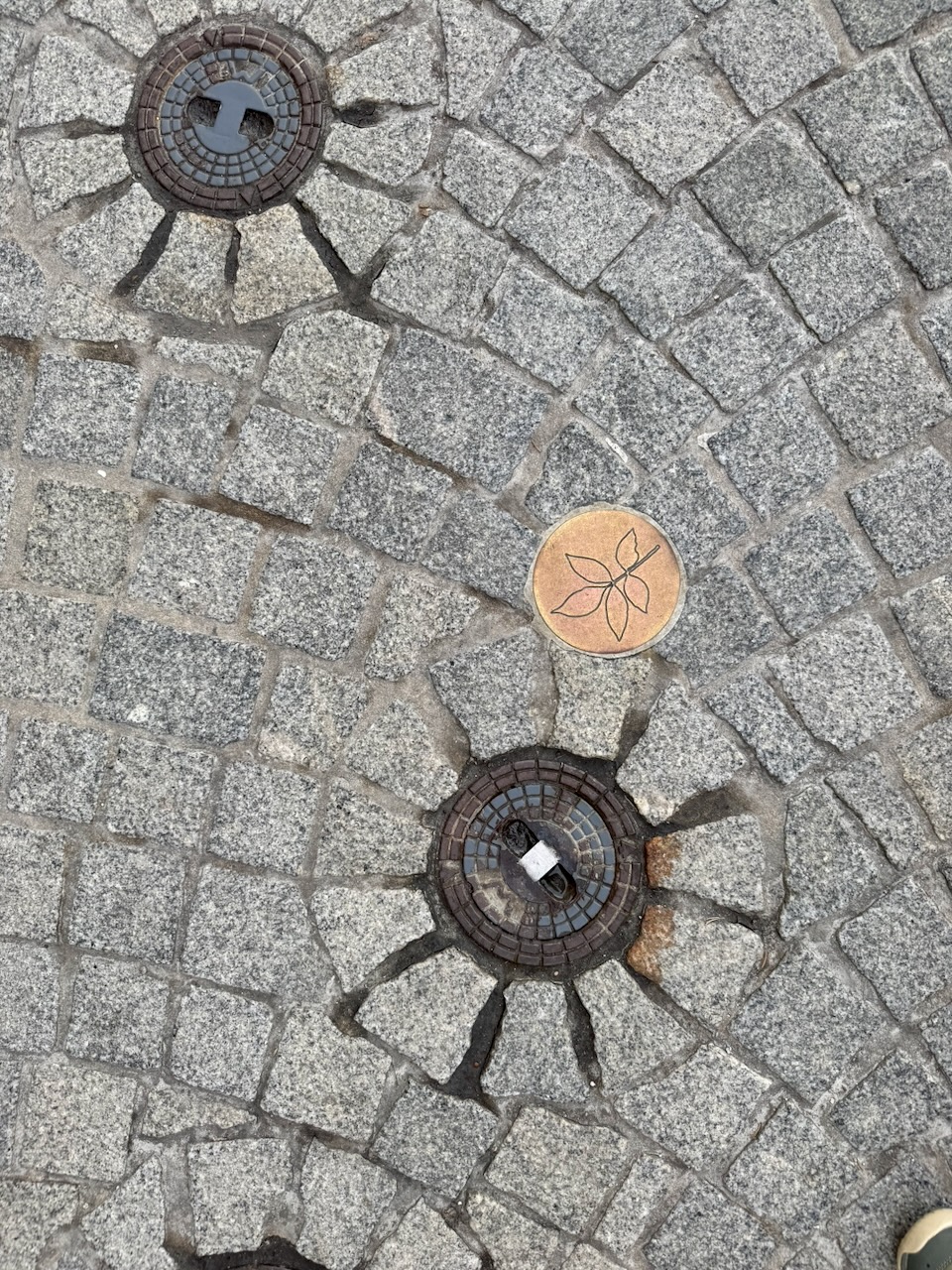
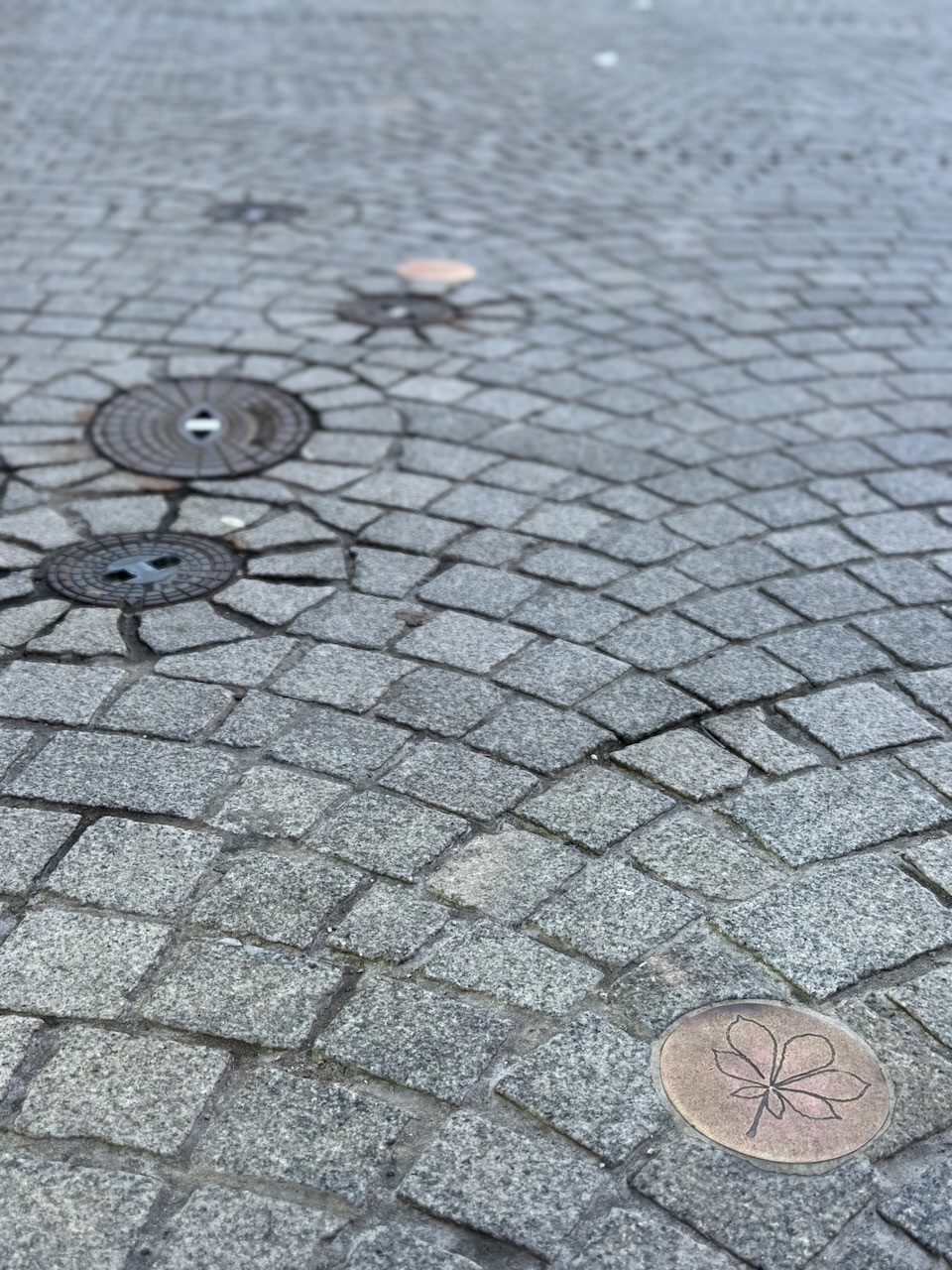
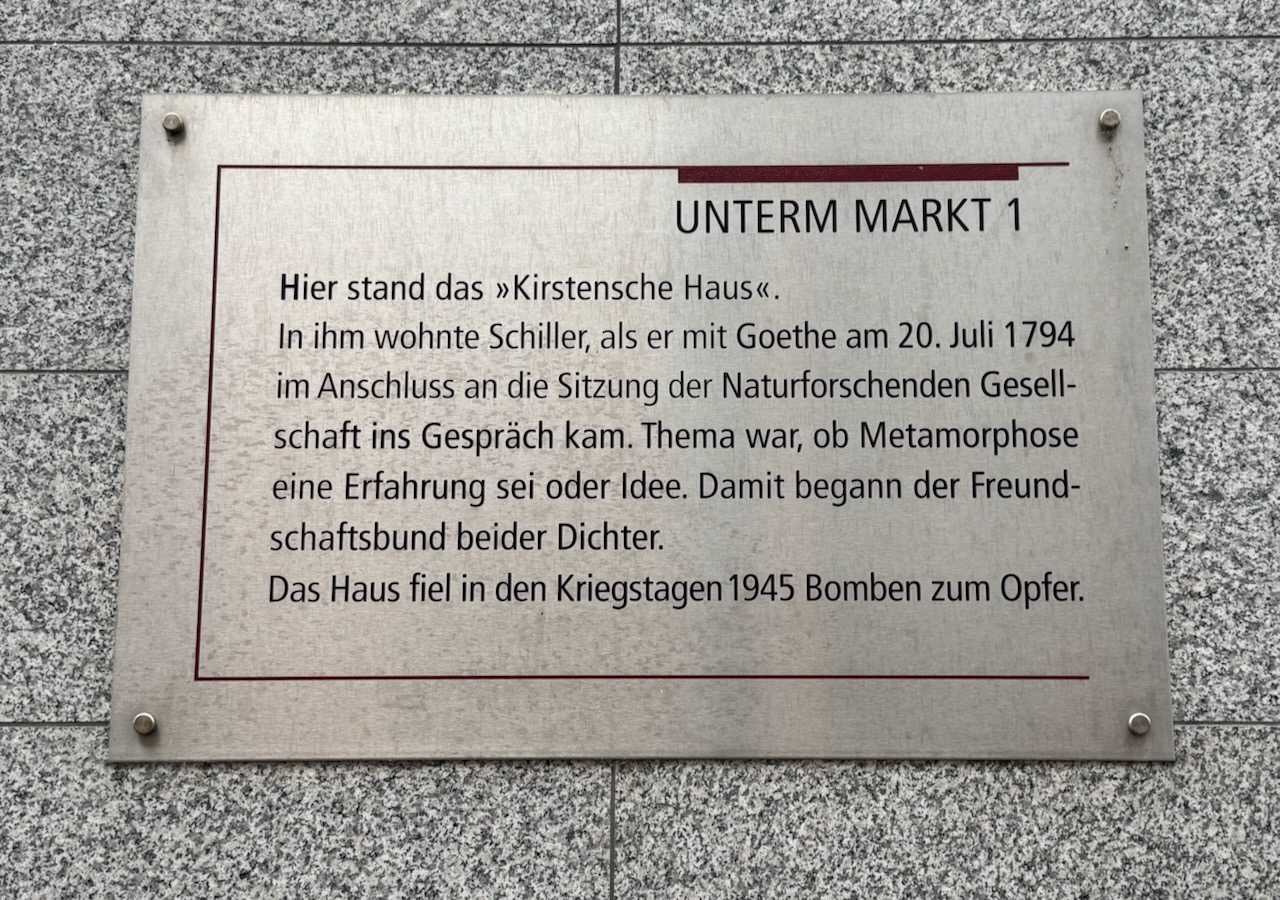
bronze leaves in cobbles marking the route Schiller and Goethe walked on 20. July 1794
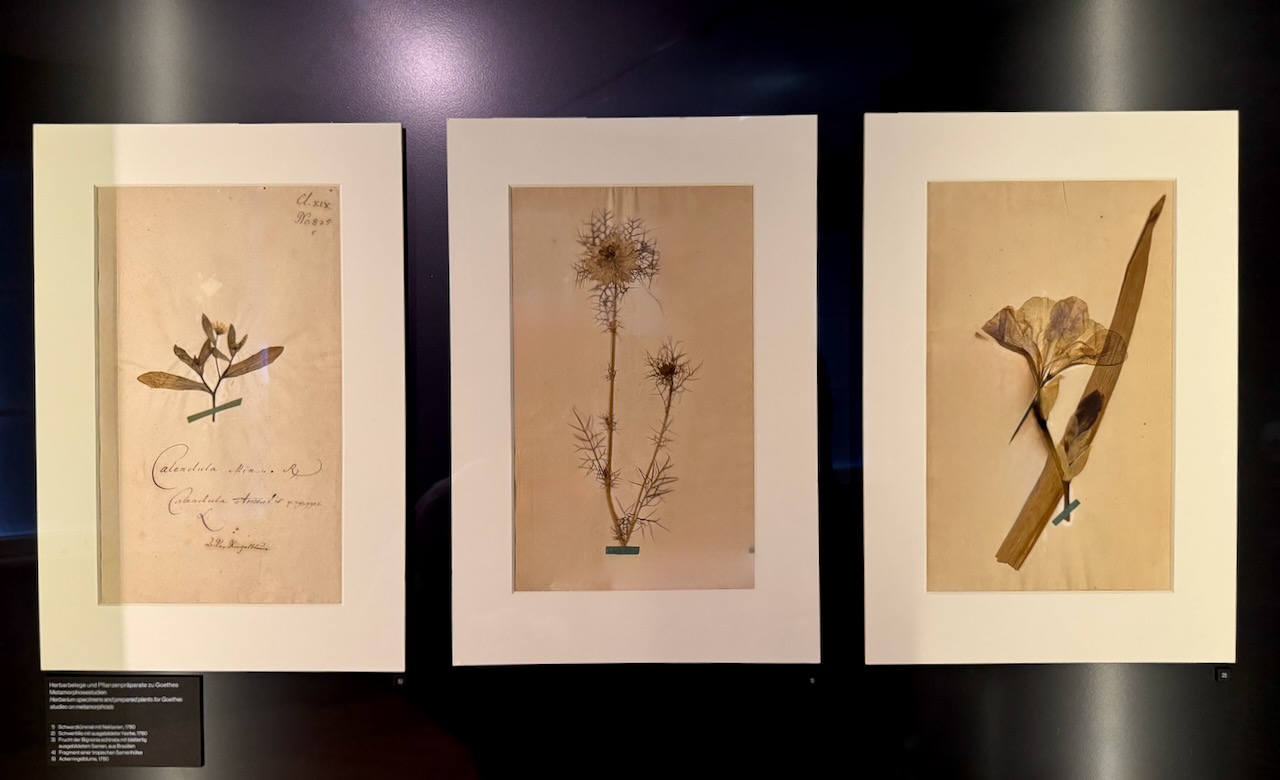
My thoughts return to Goethe’s Metamorphosis and Urpflanze – the archetypal plant – concepts he shared in 1794 with Schiller during a short walk between the Town Hall and Schiller’s house in Jena. This conversation would mark the beginning of their lifelong friendship. In short, (very) short, he proposed that behind the myriad forms of plant life lies an archetype: an invisible set of laws that shape their variations. A rose does not rebel against its rose-ness. A beech tree does not experiment with becoming a birch. Even animals – aside from Jonathan Livingston Seagull – remain faithful to the parameters of their species.
Some of Goethe’s flower specimens, Goethe Haus, Weimar
Humans, endowed with free choice, face a more complex task. We can wander far from ourselves and lose sight of any sense of an archetype.
How then do we like other living beings maintain a connection to our essence?
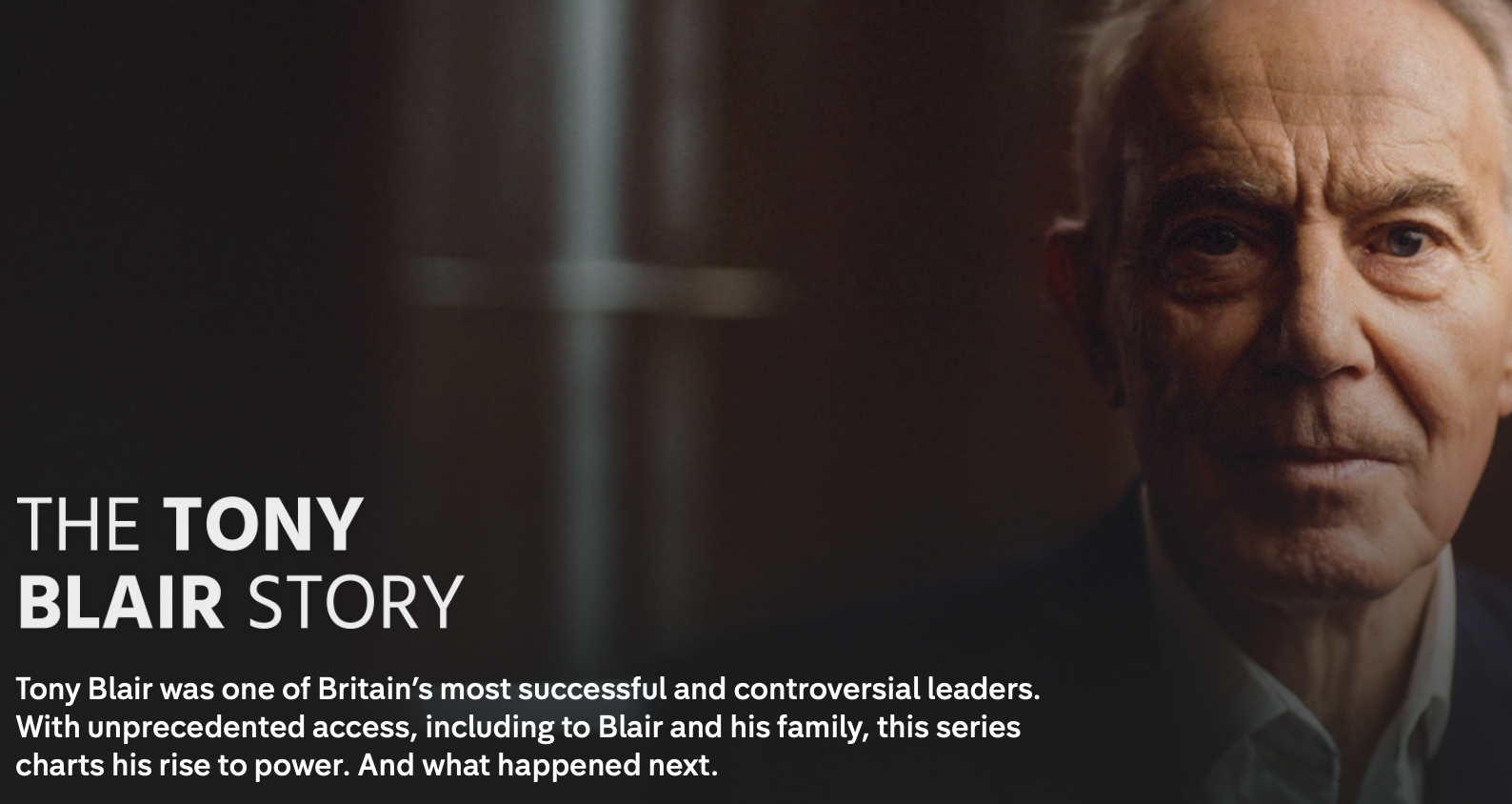
Watching The Tony Blair Story on Channel 4 recently, I was struck by his unmistakable sense of destiny. The conviction of a task, sometimes arriving as a premonition. That certainty propelled him toward significant achievements. But also led to the – in my view – catastrophic misjudgement of the Iraq War. Ego, power, entitlement? We are daily reminded all too clearly where those things lead.
Meanwhile, we are told that 12% of young people are NEETs – Not in Education, Employment or Training – drifting in a culture of instant stimulation but starved of meaning. How can they hear the quiet calling of vocation? How can they imagine let alone explore a destination with smartphones constantly robbing them of the fertile boredom and daydreaming out of which so many creative ideas once emerged?
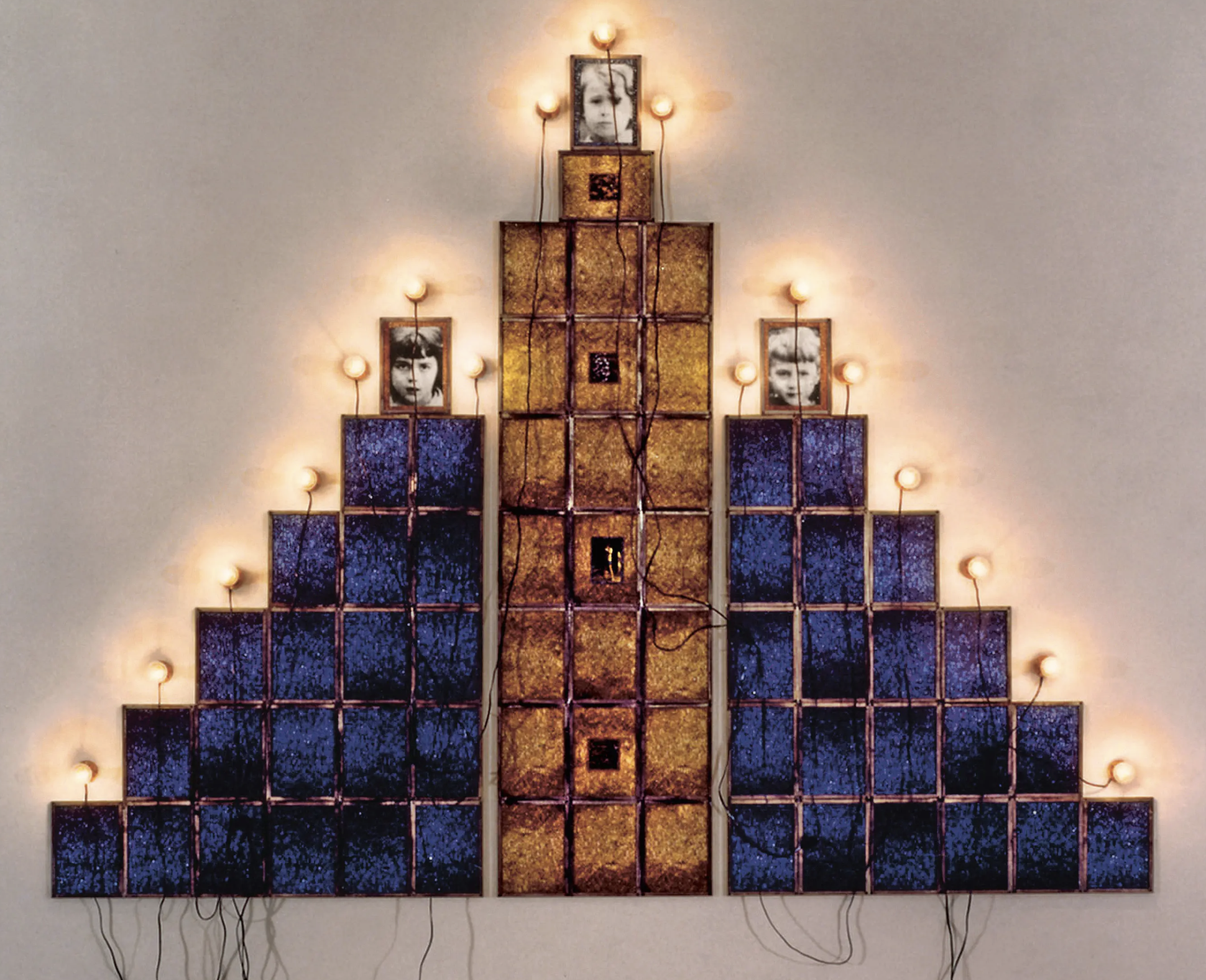
The French artist Christian Boltanski once said: The best way to make work is to do nothing… and nothing… until you get so bored that you do something.
He added: All we can do is wait and hope, hope that someday we’ll understand something, that someday we’ll understand who we are.
February, perhaps, is precisely this waiting. Dormancy, not death. Preparation. And then like racers off the starting block, commitment.
I am now referring to those oft-quoted lines frequently attributed to Goethe – though written by William Hutchinson Murray in The Scottish Himalayan Expedition (1951)
“Until one is committed, there is hesitancy, the chance to draw back… the moment one definitely commits oneself, then Providence moves too. All sorts of things occur to help one that would never otherwise have occurred… Boldness has genius, power, and magic in it. Begin it now.”
February holds both truths at once: the necessity of waiting, and the call to begin.
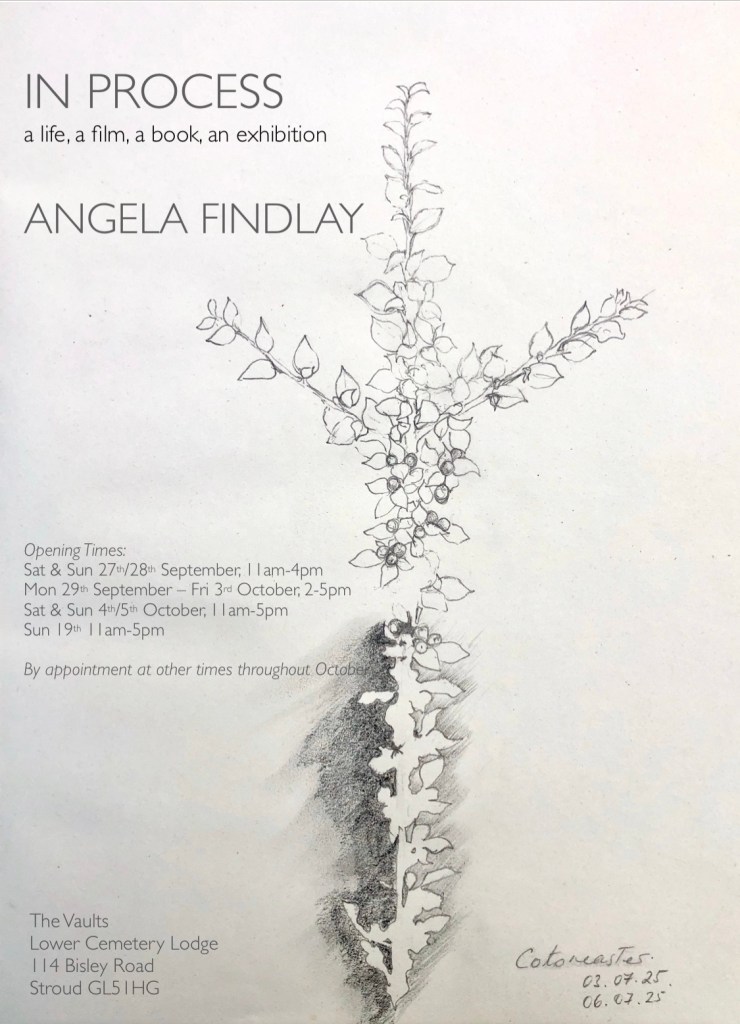
Reflections on: IN PROCESS… a life, a film, a book, an exhibition, The Vaults, Stroud. Sunday 19th October, 11am-5pm and by appointment until 1st November.
“We must, we must, we must increase the bust.
The bigger the better, the tighter the sweater, the boys depend on us.”
I remember chanting that with my boarding school roommates as a teenager, elbows flung back in a futile attempt – in my case at least – to inflate our adolescent chests. Bigger was definitely better, or so we believed.
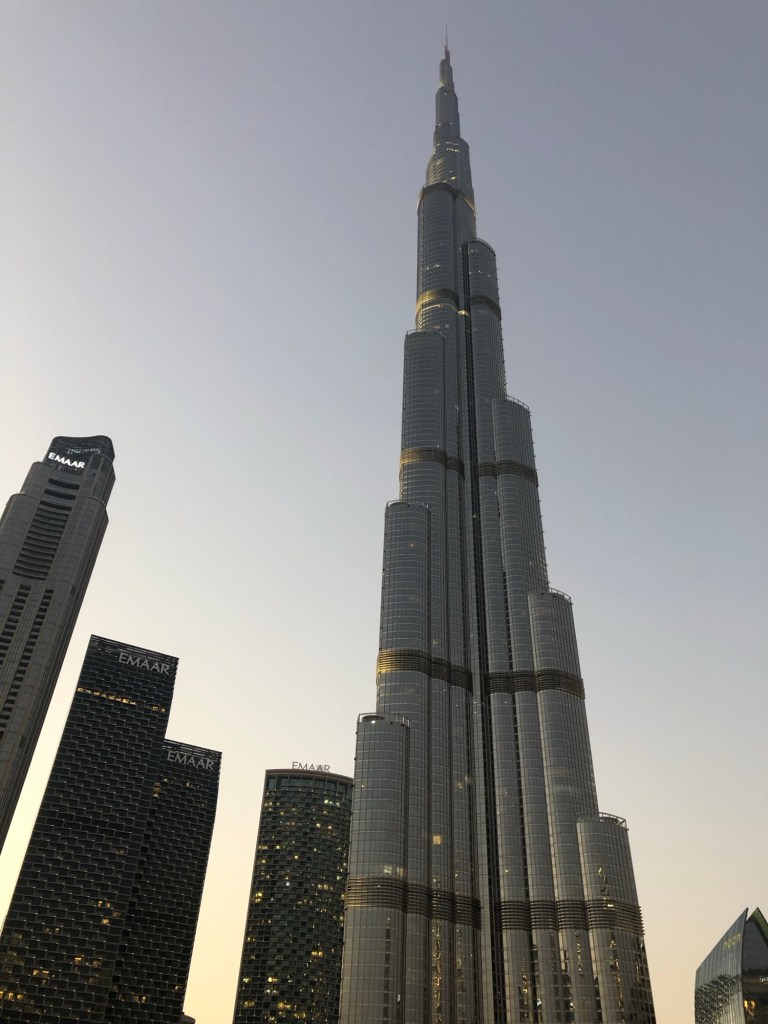
Burj Khalifa, Dubai
Skyscrapers, cars, salaries, houses… In so many areas of modern society, ‘big’ still equals ‘better.’ More followers, more likes, more headlines, more sales. The biggest countries led by the most powerful leaders and largest militaries make the most noise. And yet we know, quantity doesn’t equate to quality. Magnitude doesn’t always reflect meaning or value.
This idea – that bigger isn’t always better – is something I’ve seen reflected both in the trajectory of my great great aunt Joan’s life and in my own development as an artist. (If you are new to Joan’s story, please see my previous blogs for background.)
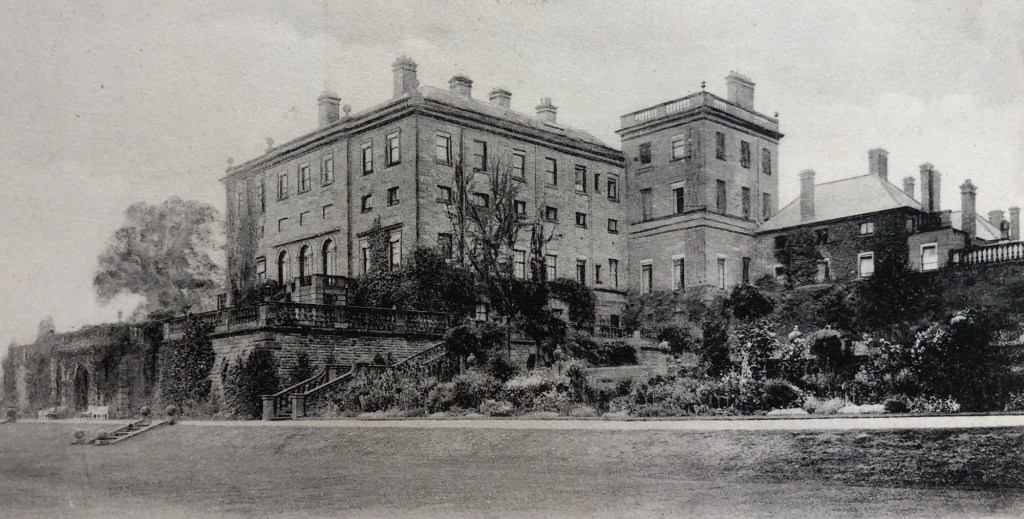
Patshull Hall, Staffordshire
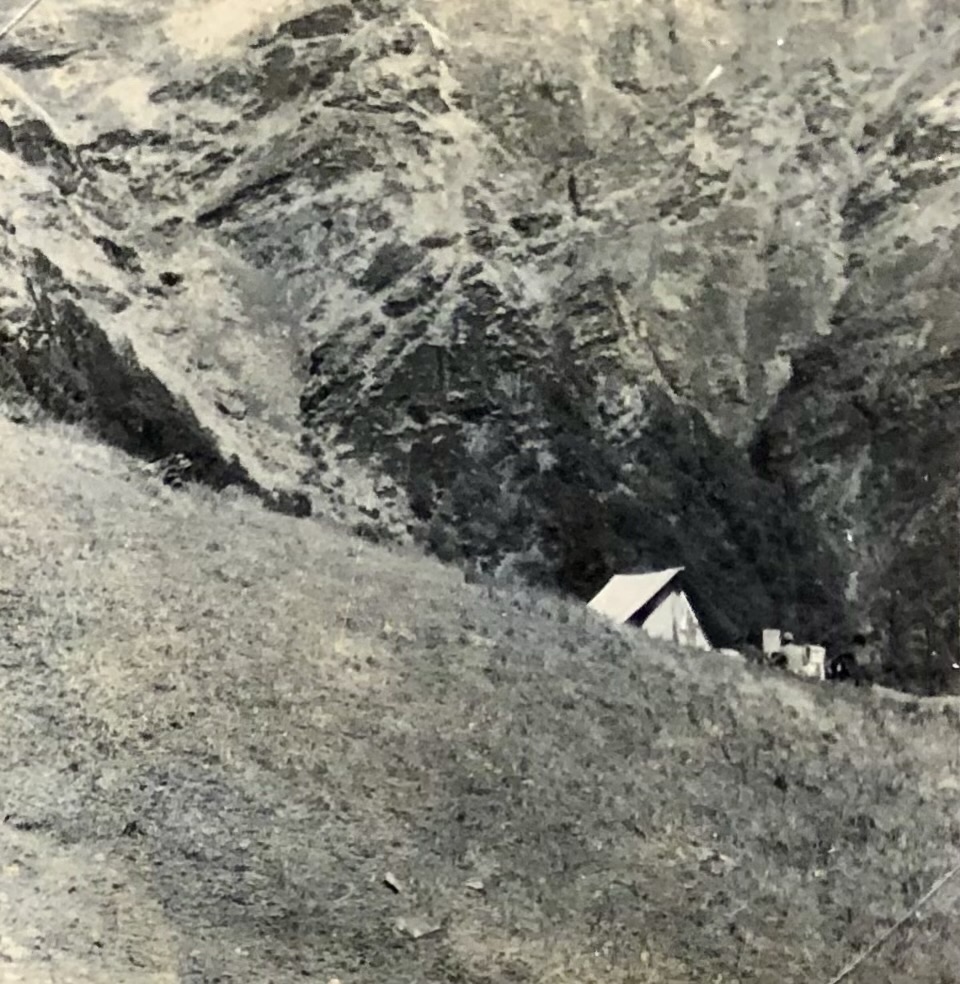
Joan’s tent
Joan grew up in a 147-room stately home in Staffordshire. Yet she spent her final weeks in a single, often soggy Meade tent pitched in a remote Himalayan Valley, surrounded not by grandeur but by shepherds, wildflowers and the sound of rain. She had traded scale for purpose. And her joy, it seems, had grown as her material load had lessened.
My own artistic journey has followed a similarly inverse curve.
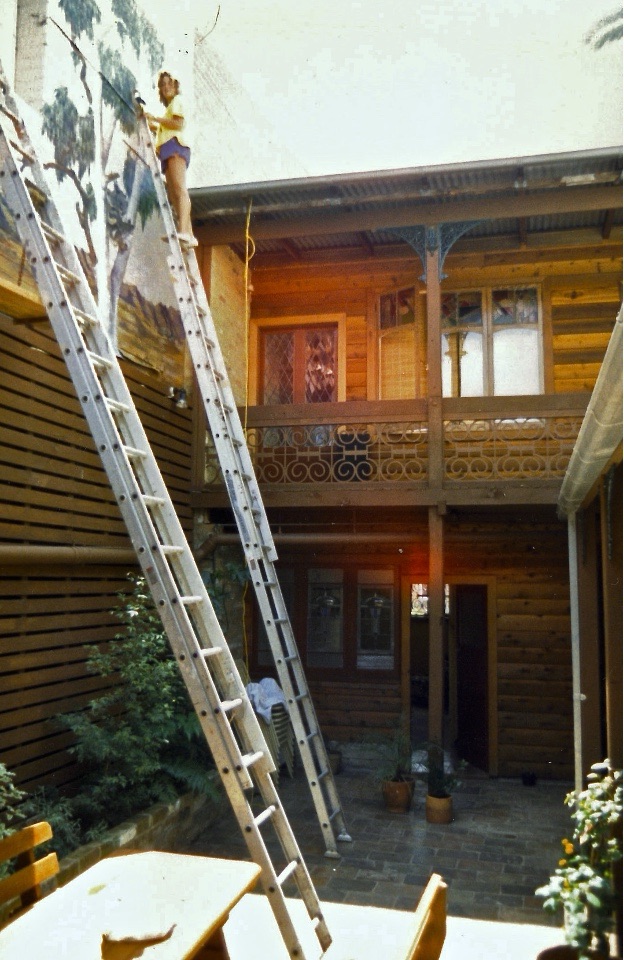
Painting a mural in Sydney, 1987
I began large, unable to contain any drawing or painting within the boundaries of paper or canvas. My work spilled onto walls, first private then public, then grew further to fill stage backdrops for theatres or touring bands. Various mishaps including a paint-splattered boss’s car and a disastrous commission to paint the backdrop for INXS KICK album tour in 1987, which promptly cracked and fell off in large chunks when rolled up, nudged me toward the more forgiving surface of prison walls. There, no amount of damage could make the environment worse than it already was.
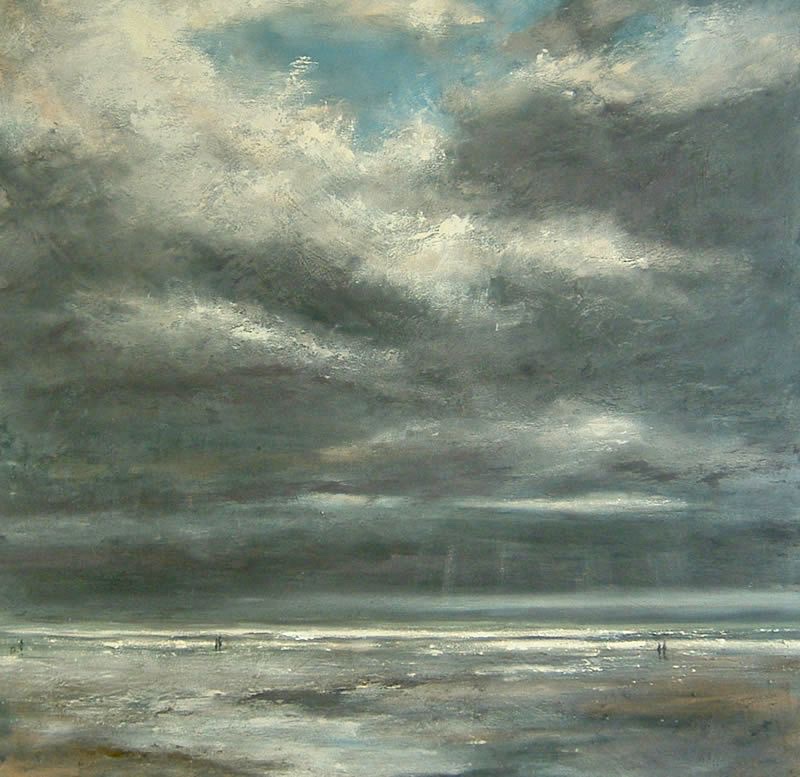
The light danced, 120x120cm
Years later, I turned my focus to canvases of my own, their size dictated by the available studio space and commercial considerations of galleries. And most recently, to works just 28x28cm – or smaller. I have replaced the vast audiences of art fairs with the quiet intimacy of just six or seven visitors at a time into the two vaults beneath my home in Stroud’s Cemetery.
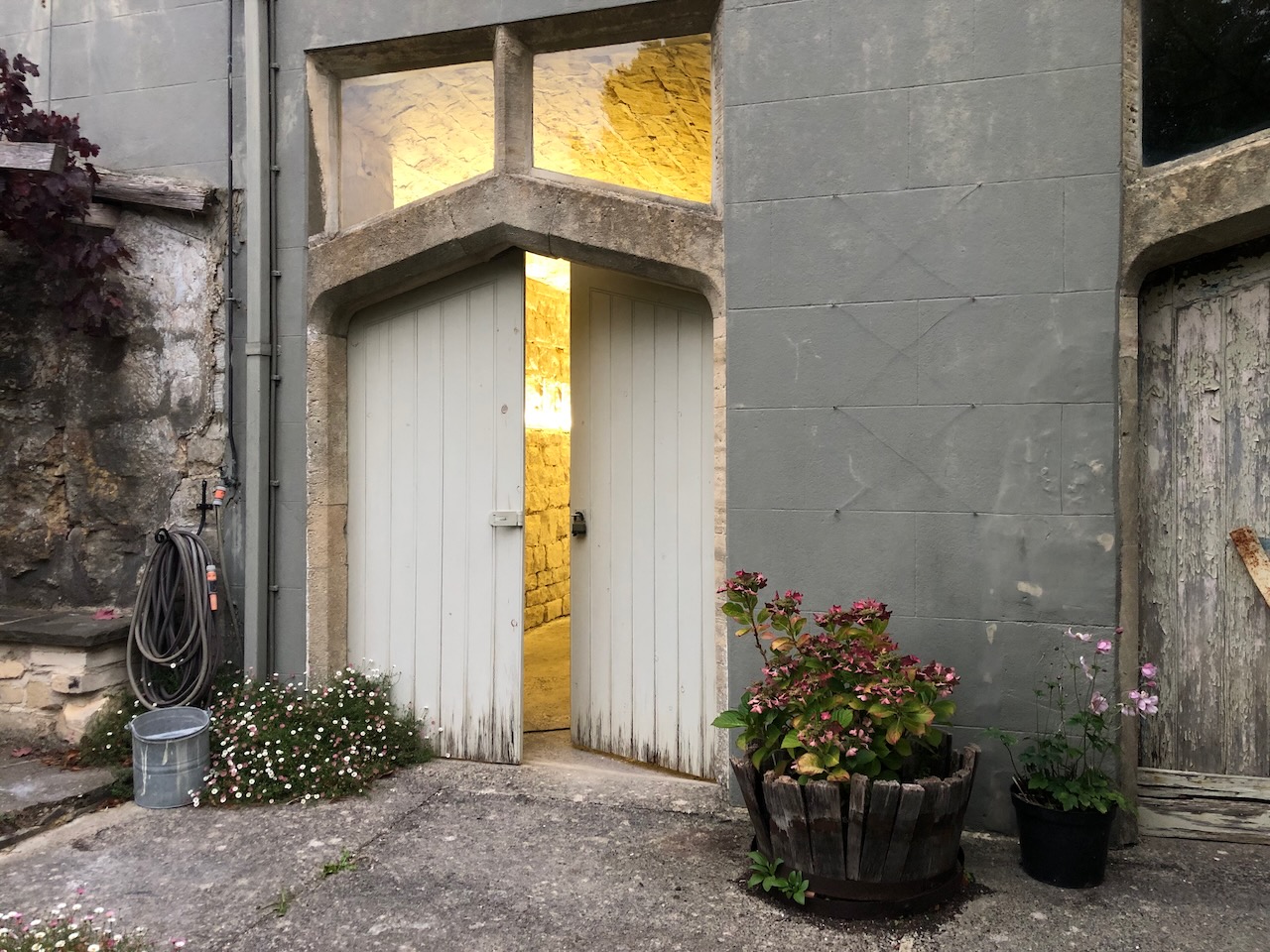
The Vaults
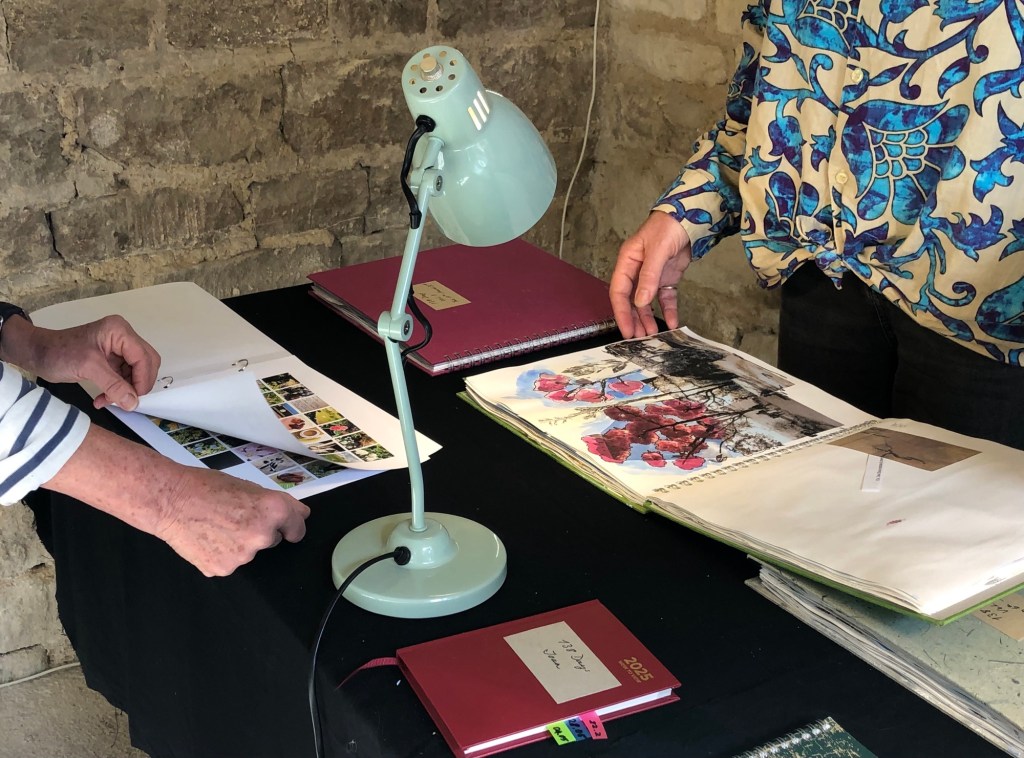
Those vaults now house In Process… a deeply personal exhibition about Joan, her life and the resonance her death still holds for me, our family and small communities she encountered in India.
In one vault, where gravediggers once hung their tools and I now hang mine, visitors watch a short film projected into the open lid of an old trunk telling the story of Joan Margaret Legge.
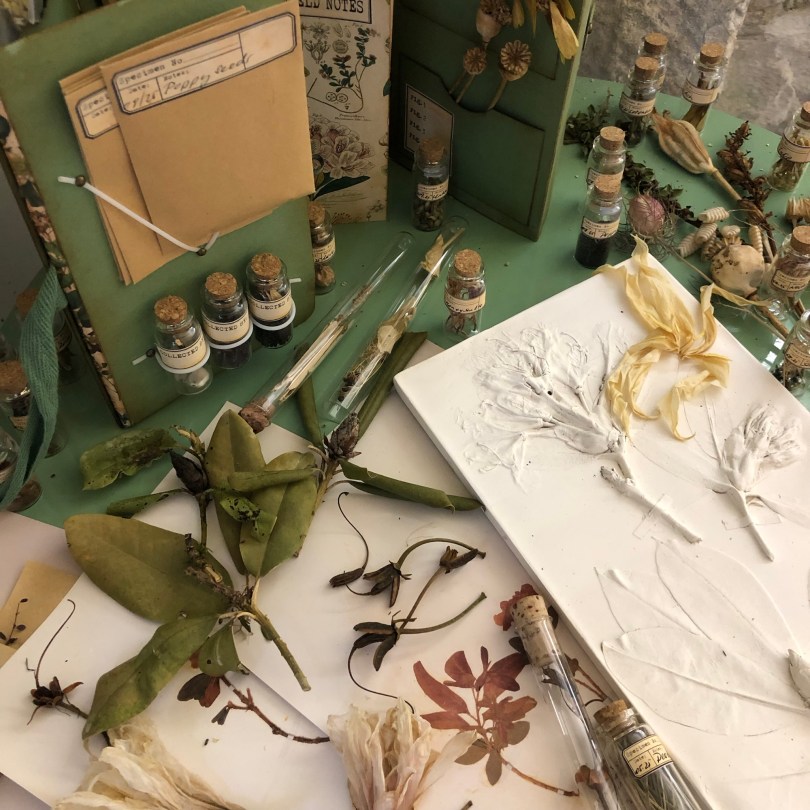
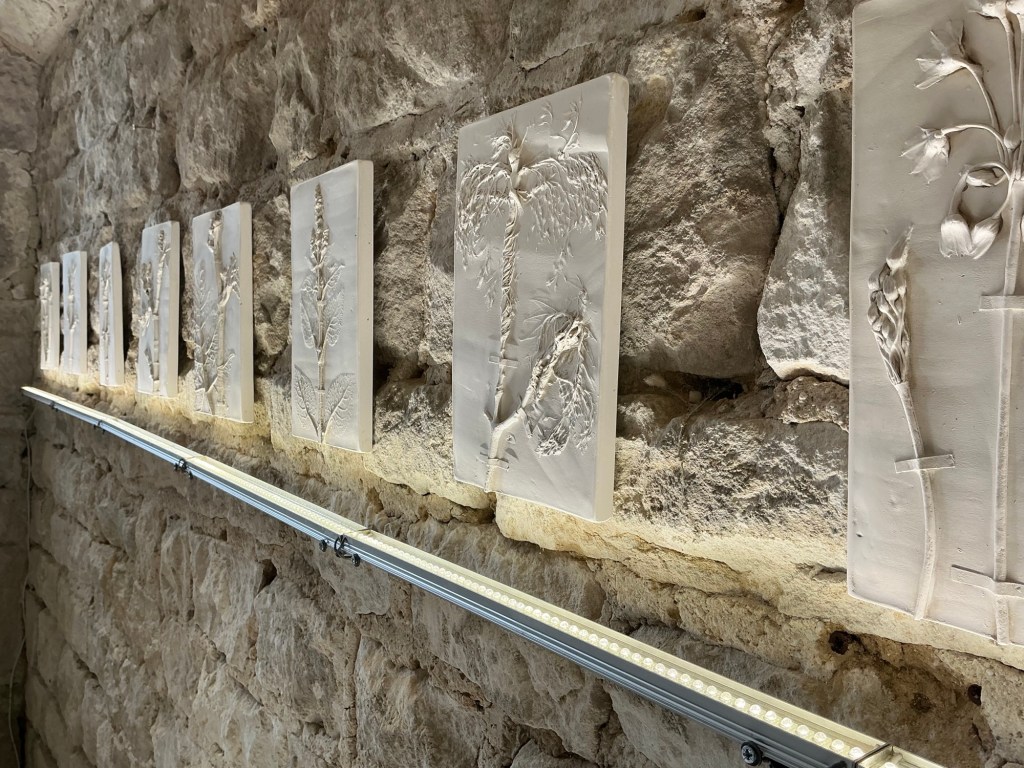
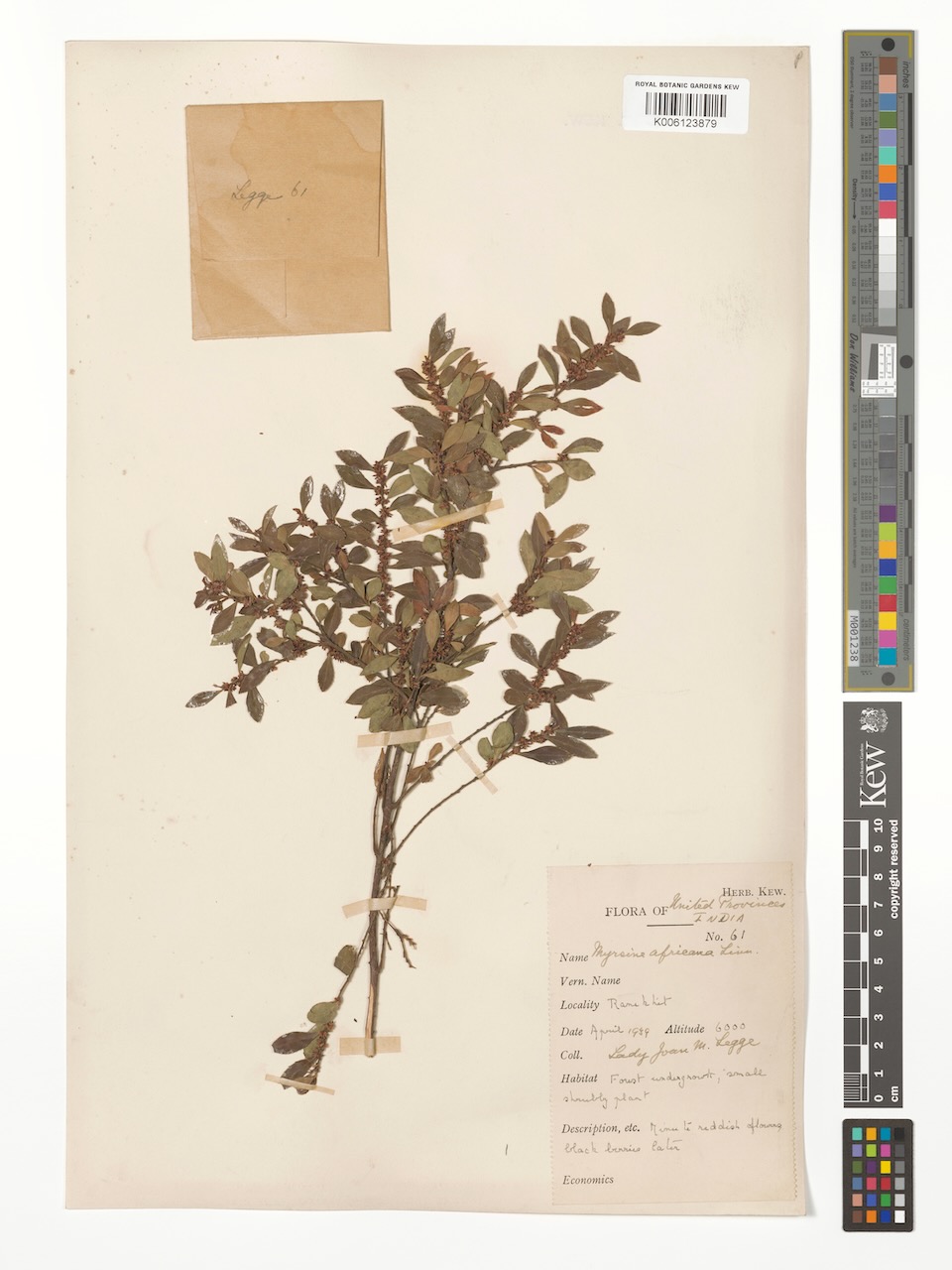
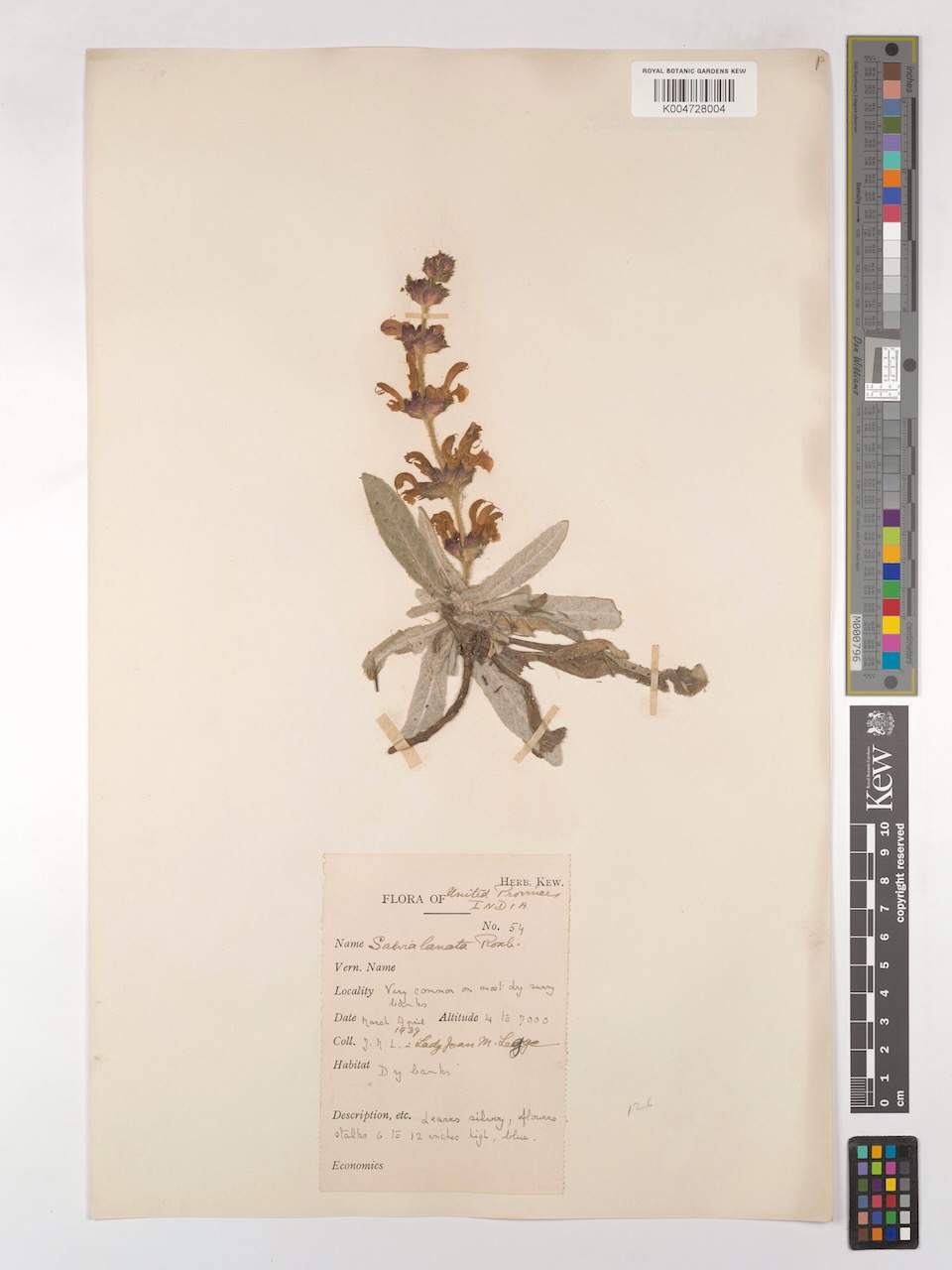
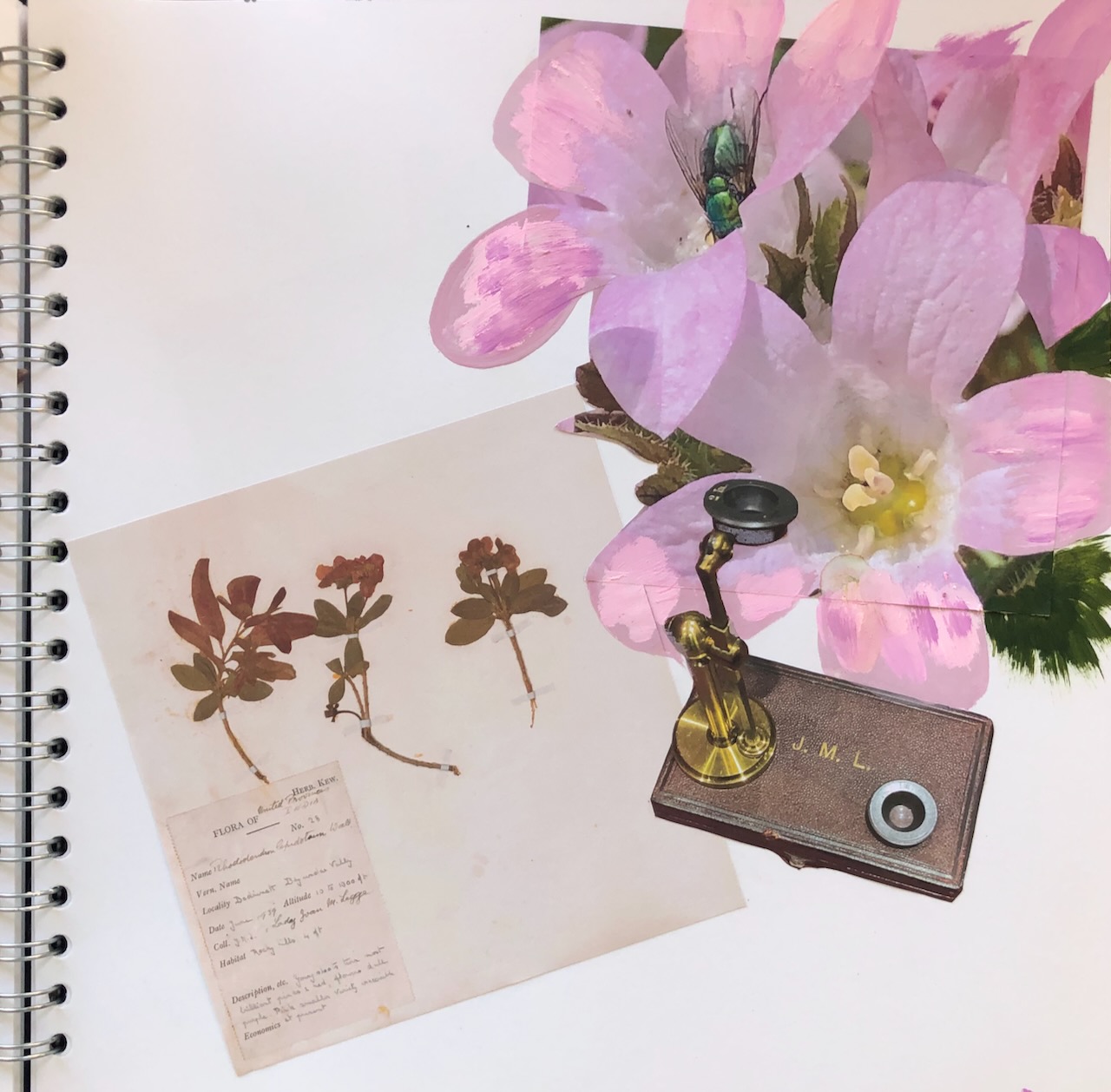
In the other, where those same workers drank tea, ghostly white plaster casts hang like three-dimensional botanical drawings reminiscent of the specimens Joan collected and sent to Kew Gardens.
‘138 days’
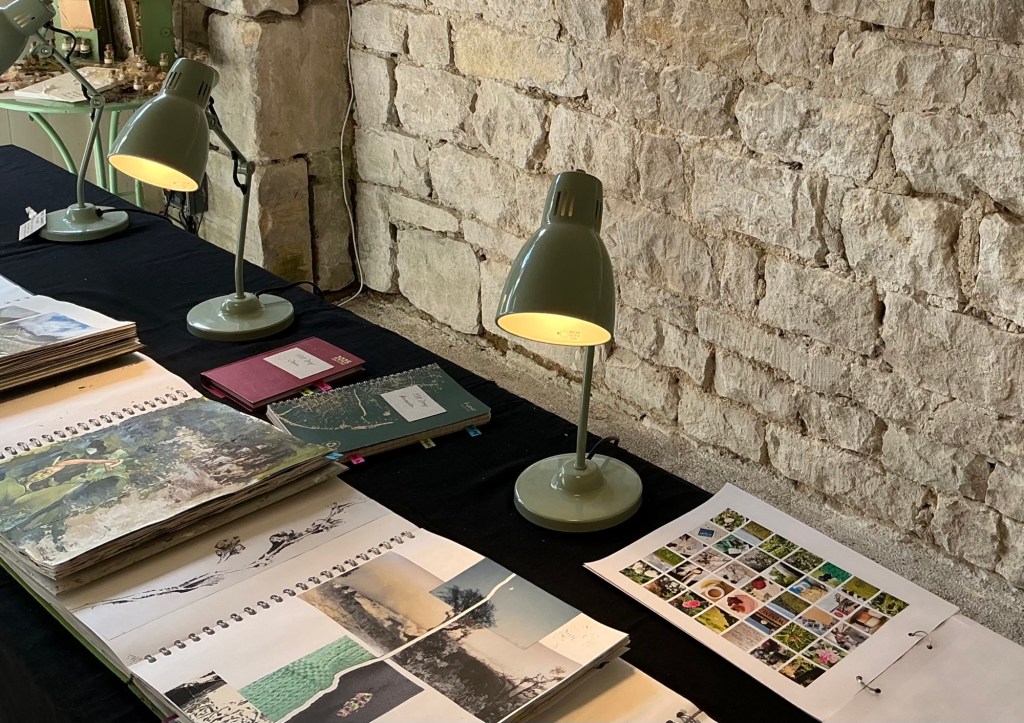
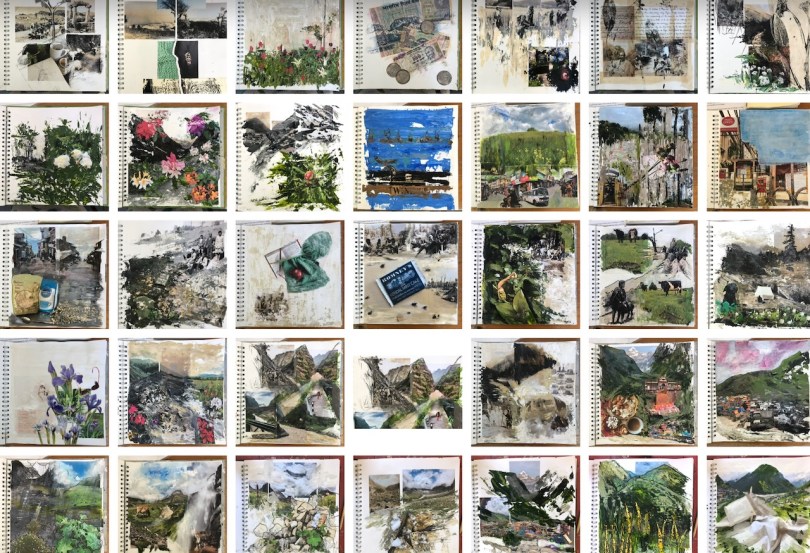
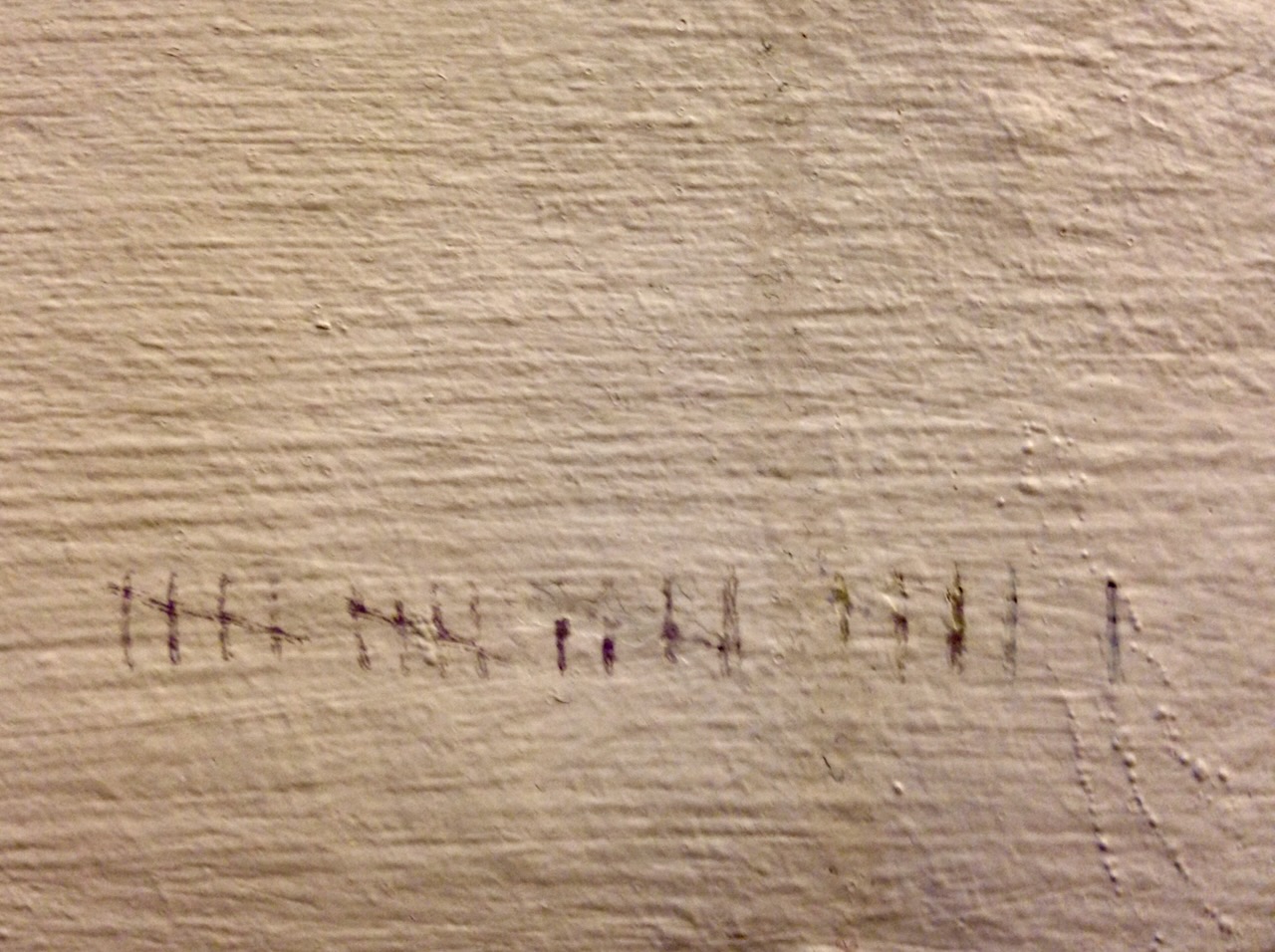
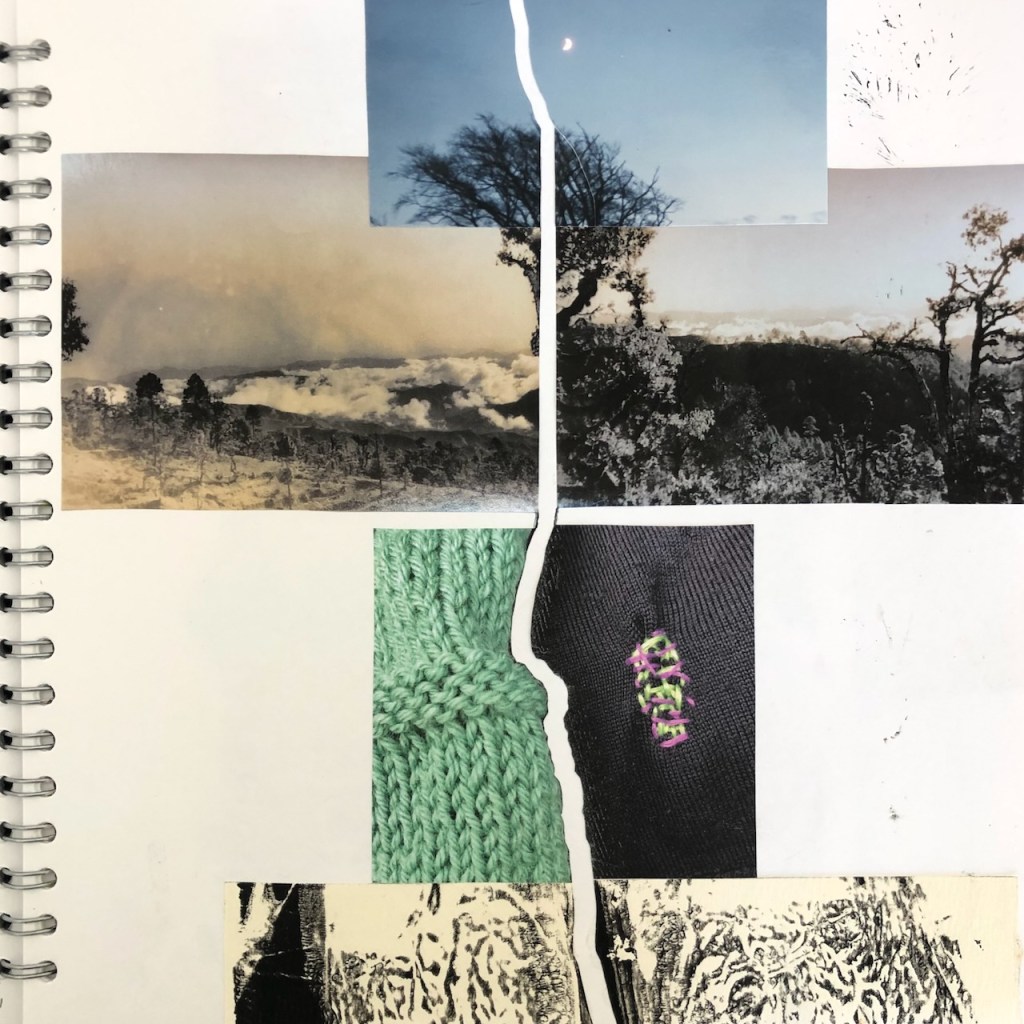
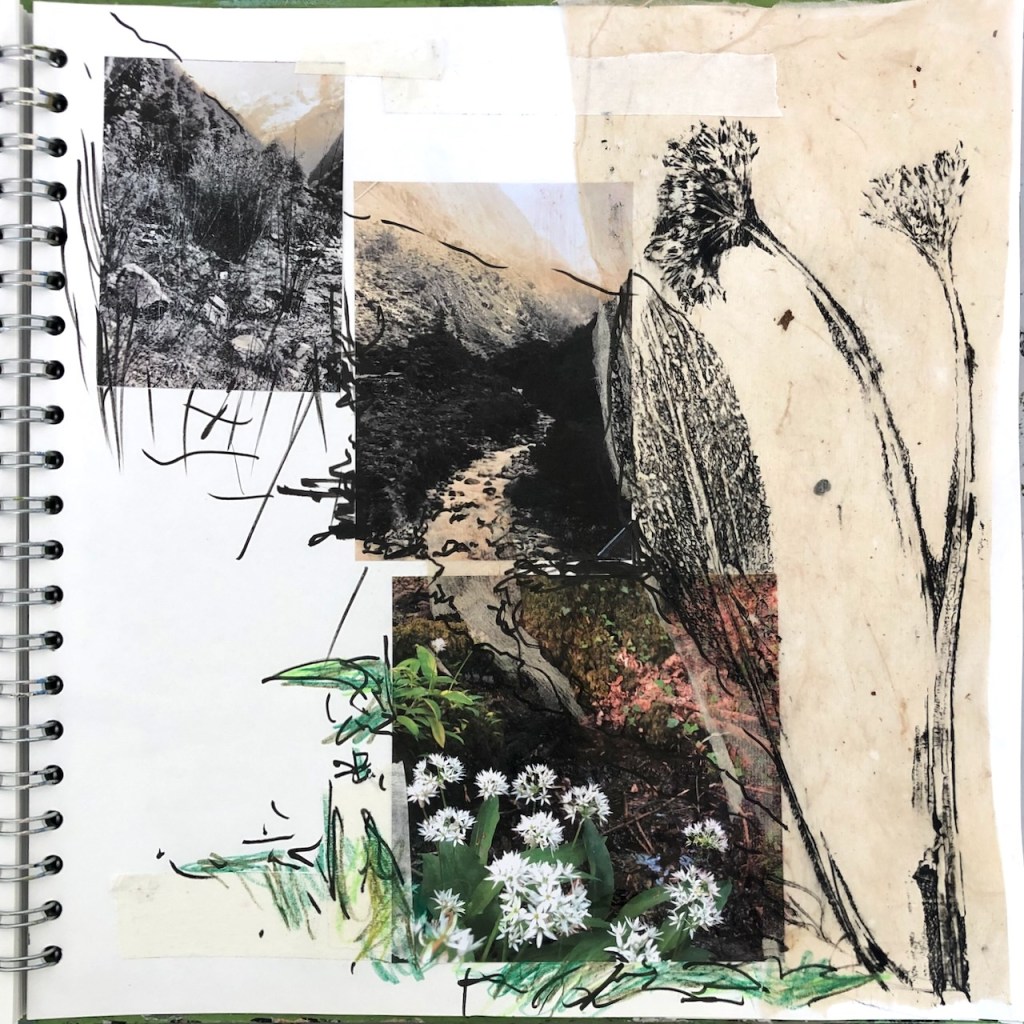
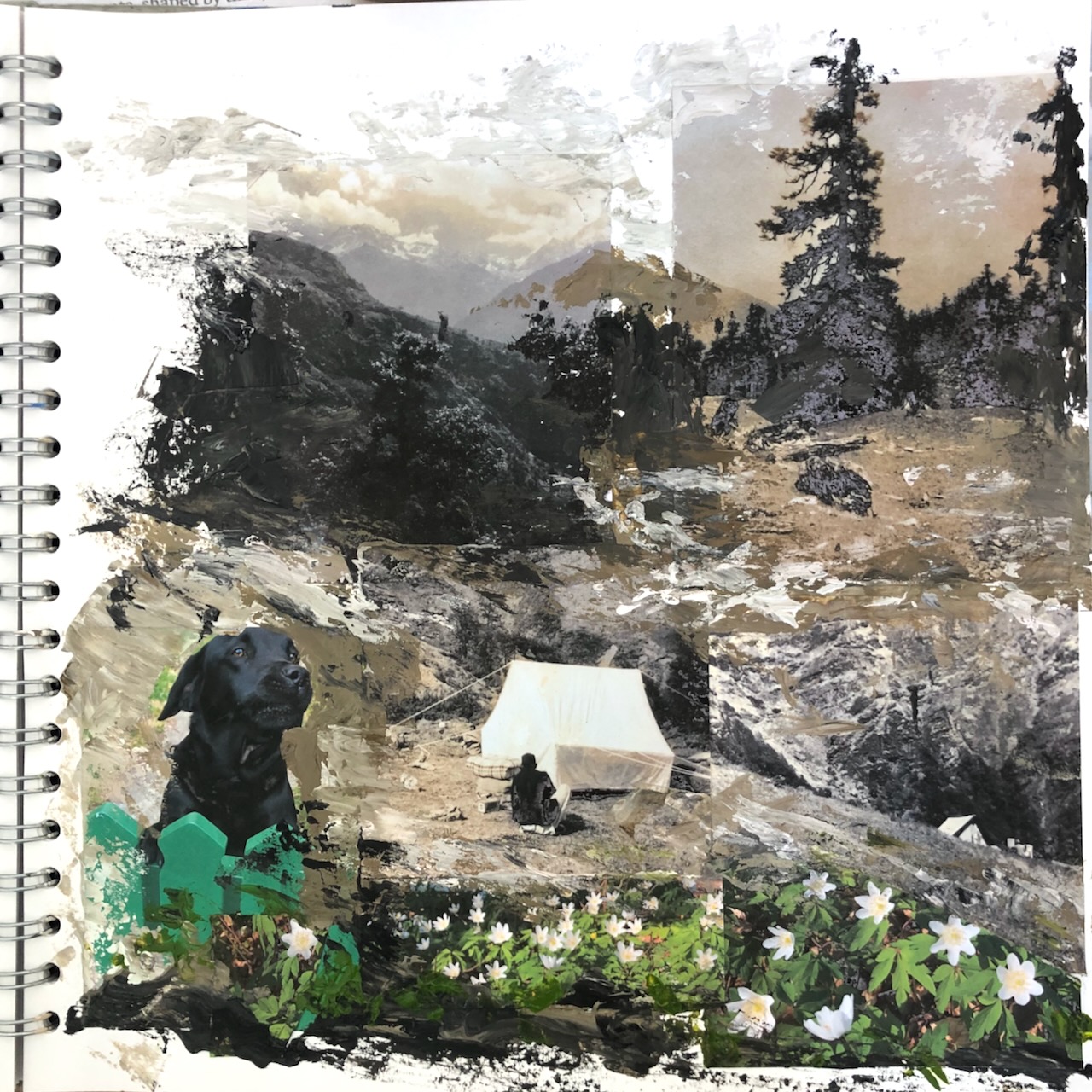
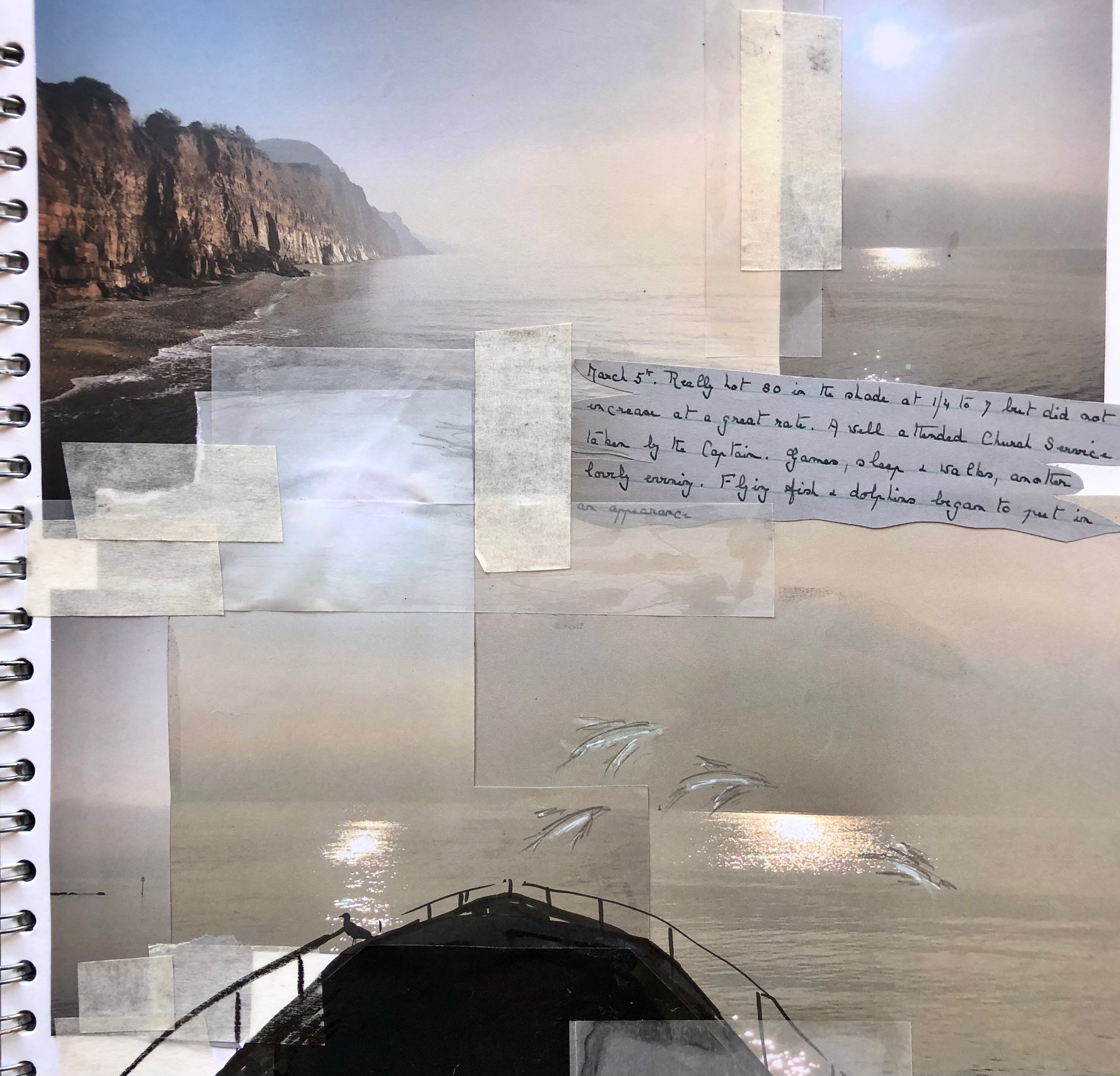
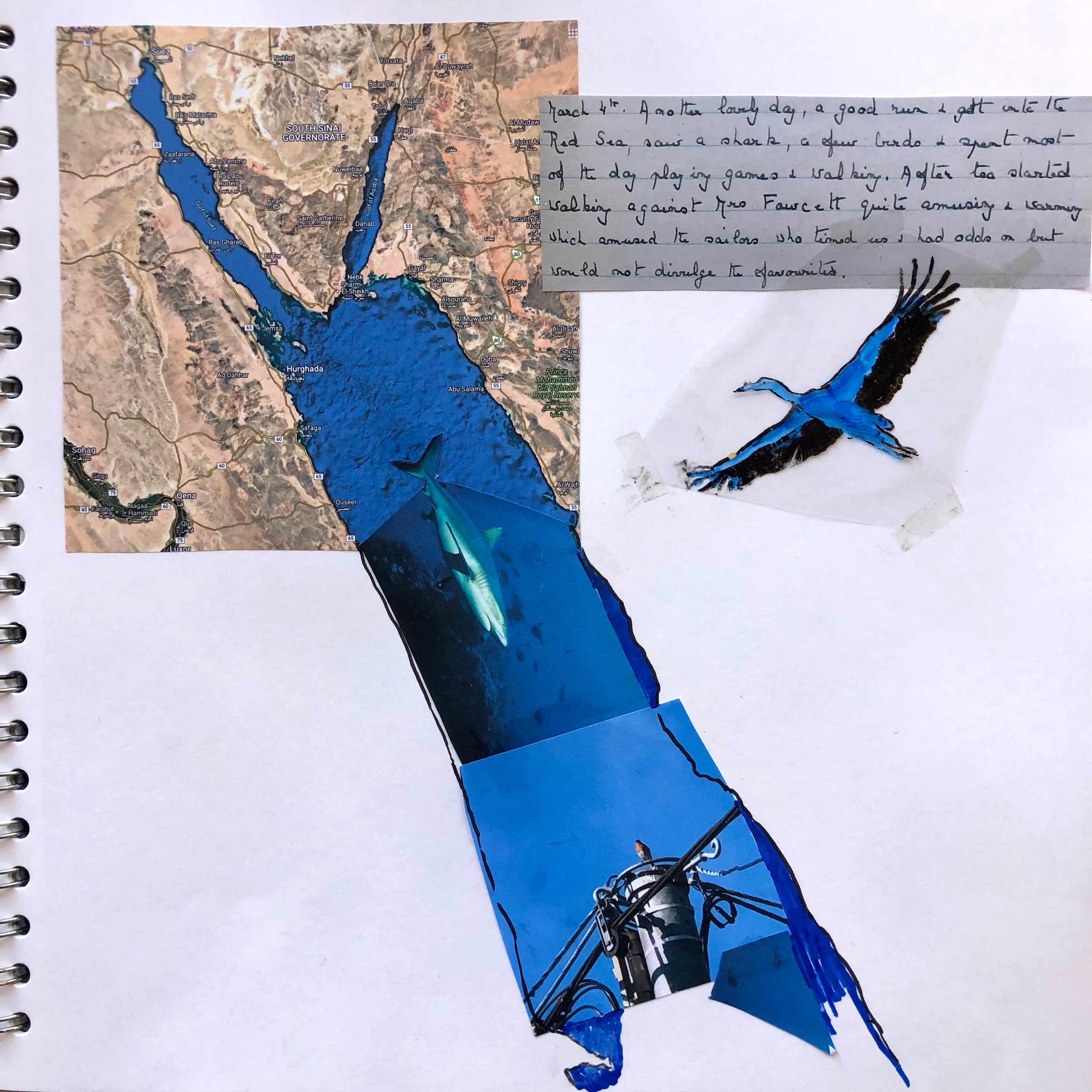
A series of square sketchbooks chart the 138 days I followed Joan’s 1939 diary entries. Starting on 17th February when I stepped into her shoes as she boarded a ship to India, I step out of them again on 4th July, the day she slipped off the edge of a Himalayan path to her death. One photograph, one sketchbook page, each day a quiet re-embodiment across time. Not a recreation of her journey, but a chance to listen more deeply to the changing tone of her voice in the final months of her life.
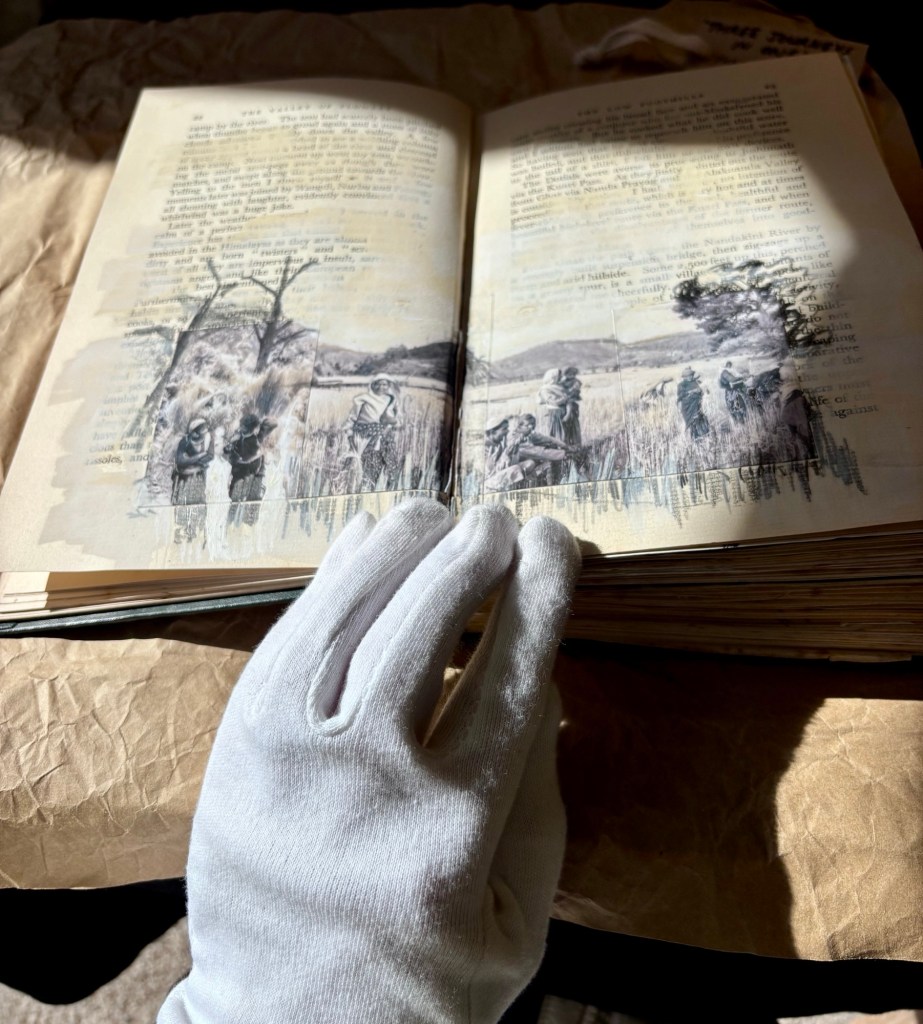
At the heart of the exhibition is its smallest piece: a re-working of a first edition of Frank Smythe’s Valley of Flowers, the very book that inspired Joan’s expedition. Through collage, drawings and pressed flowers, it now tells the stories of three visitors to the valley rather than just one: his, hers and mine. Wrapped in brown paper and tied with string like an archival package, the book invites visitors to wear white gloves to turn its delicate pages, not because it is precious in a monetary sense, but out of respect, Unlike most artworks, these ones are meant to be handled and engaged with.
‘Three journeys in one’
There is nothing for sale. No press campaign. No sponsorship. Just a quiet space, tucked away in a garden, found by invitation or chance. A strange but deliberate choice, and to me, a more authentic reflection of the humbleness of where Joan’s life ended than any traditional gallery could offer.
What Joan lost in material possessions, she gained in purpose and joy. Her life distilled into what nine porters could carry. She found a sense of completeness long before she had completed her journey.
That’s what I hope to convey in the improvised, immersive pieces shown in the warm belly of my limestone vaults. People forgive imperfection and lack of polish as they connect with Joan’s story through their hands, senses and bodies.
Just as artists learn to see not just form but negative space – the shapes between things – so Joan’s outwardly abundant life transformed into an inner world: slower, quieter, less visible, but not lesser in any way.
Maybe this is a natural outcome of ageing… the gentle decluttering of ambition and a reshuffling of values. Or maybe Joan’s story is a simple reminder that richness cannot always be seen and meaning doesn’t always require an audience.
The symmetry in our shrinking trajectories is just an observation.
But it feels strangely right.
IN PROCESS…
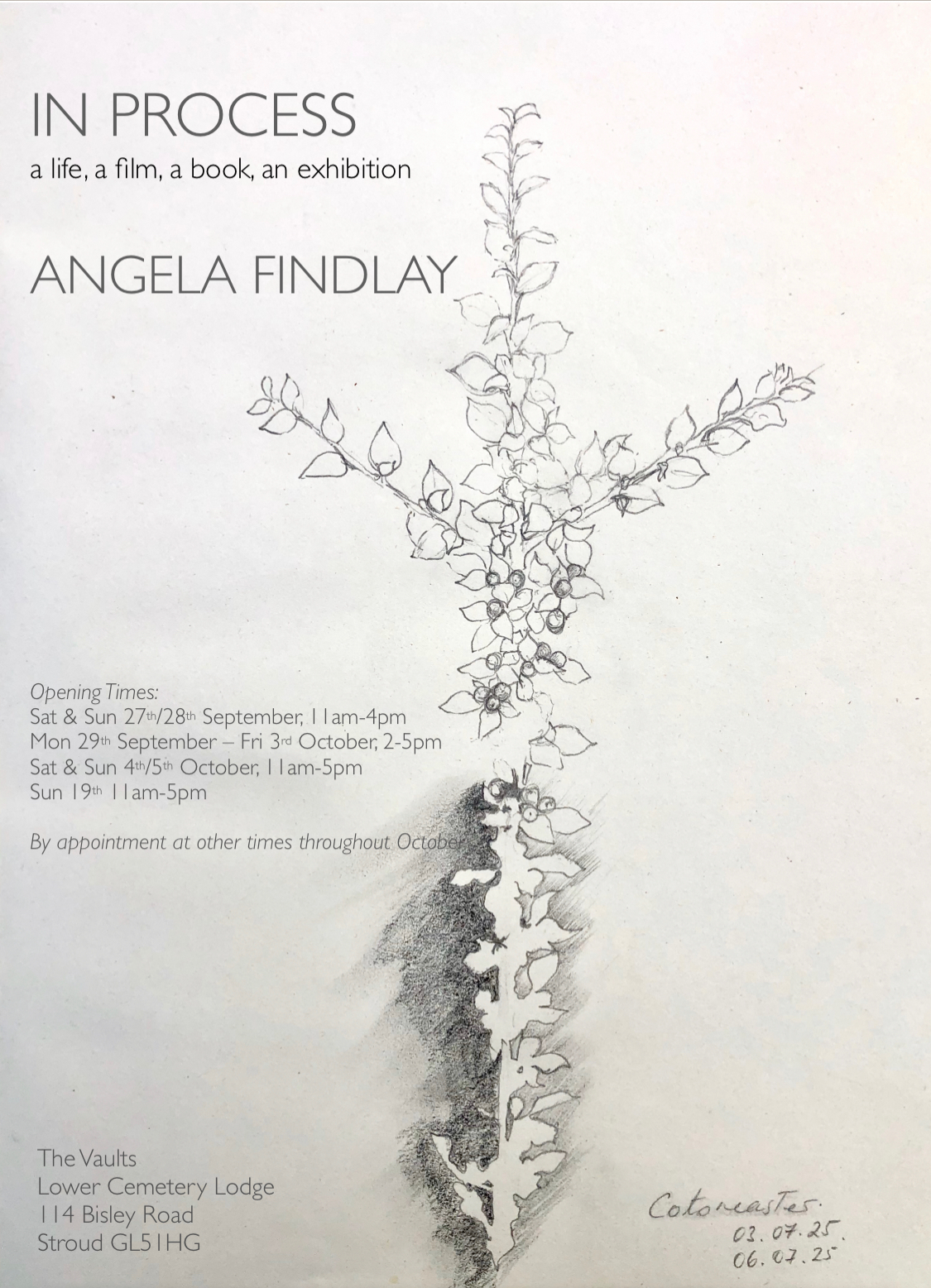
Sunday 19th October, 11am-5pm and by appointment until 1st November.
That’s how a friend recently described being an artist. He had been a student at Goldsmiths in the late eighties and early nineties, during the rise of the Young British Artists (YBAs) like Damien Hirst, Tracy Emin and Sarah Lucas, names that would go on to dominate the art world, thanks in part to the patronage of Charles Saatchi.
We ran into each other at the local paint shop—a regular stop for him in his current life as a decorator. Across a spread of tester pots and fillers, the conversation effortlessly turned to the day-to-day grind of being an artist. Over the summer I have been preparing for my forthcoming exhibition, In Process… (which opens today, 27th September!) and was feeling the impact of long, solitary studio days, wrestling with questions only I was posing and whose answers seemed only to matter to me. It can be a struggle: adhering to a discipline of showing up as captain to a ship with no passengers, steering a course to a nebulous destination, deep-diving into the depths of the soul, mind or body – wherever the well of creativity bubbles up – to haul tiny gems to the surface. Exhaustion and self-doubt often creep in.
‘What’s the point?’ is the main saboteur. The work seems irrelevant, the purpose elusive. There’s no financial gain, just costs. In the isolation of the studio, there’s no one to argue with those thoughts. Indeed it is easy to agree with them: Why bother?
And in times of widespread destruction – whether global or even personal – that sense of futility can grow.
This summer, for example, parts of my home were stripped back to their foundations. My life was overtaken by builders, noise, dusty cups of coffee and chaos. Creativity felt all but impossible. In the grand scheme of things, this was a minor inconvenience. Soon, things would return to normal. But what about those whose lives have been shattered by larger forces… wars, displacement, destruction and poverty on a massive scale? How does creativity find its place amidst the rubble of Gaza, Ukraine, or other war-torn regions? Or even amongst the devastating images that make their way into our minds?
History has shown that creativity can thrive in the moments when everything appears to be falling apart. Creative expression becomes a form of resilience, opposition, even survival. It can be a small act of regaining control in an otherwise uncontrollable situation; a conduit for grief, an out-breath for trauma, a balm for moral wounds. Marks on walls or scraps of paper cry out: I am still here.
In today’s news-filled world where conflicts and politics pitch people against each other while social media distracts and distorts, I feel the call to act. To do or say something that will make a difference. I contemplate taking to the streets and marching in protest. Or superglueing myself to a pavement. I wonder if ‘speaking out’ involves publishing endless blogs and posts on social media denouncing what (I feel) is wrong? Ineffectuality wears one down.
But to me, the direction of the human race is a force majeure, too big for even the Trump to halt. We find ourselves swept in its rampageous current, both unwilling cogs in the destruction of things we once valued, and parts of an optimistic surge to re-build better. I feel feeble and impotent. When I can’t even open the lid on a jar of gherkins, how can I shift anything of significance? But maybe this disorientating maelstrom is precisely the context in which creativity becomes most vital. Maybe the internal orientation creativity demands provides a space for the mind to process, to breathe, to make light of the weight and sense of the senseless, and to find fragments of meaning in what frequently seems like an overwhelming mess.
Destruction can’t defeat creativity; it calls it forth, demanding that we seek beauty, purpose and points of connection. That process can feel ‘brutal’. What’s the point? is never far away. But I try to remember: The point is not always to create something monumental. Nor is it to offer neat answers. Sometimes, the point is simply to make something that wasn’t there before, to keep moving forward and to hold onto the belief that every act of creation – however small and seemingly insignificant – is a counter movement, an act of defiance, a stand against that which threatens to destroy us.
In Process… at The Vaults in Stroud
I have heaved my most recent exhibition out of a time of dark chaos. But as I – and it – clawed our way to the surface, it grew its own wings. Help came from unexpected places. Beauty emerged. And now it is there, in the Vaults, among the grapes on my vine, fruits to share.
There was a point!
You are so welcome to visit.
IN PROCESS…
In Process… Opening Times:
Saturday & Sunday 27th/28th September, 11am-4pm
Monday 29th September – Friday 3rd October, 2-5pm
Saturday & Sunday 4th/5th October, 11am-5pm
Sunday 19th October 11am-5pm
And by appointment at other times throughout October (excluding 10th–17th and 22nd–26th October)
If you would like more context to the work in the exhibition prior to coming, please read my previous three blogs: Following Joan… Parts One, Two & Three.
On 17th February 1939, Joan Margaret Legge boarded the T.S.S. Hector at Birkenhead’s Vittoria Docks and set sail for India. Surrounded by a flurry of last-minute flowers, letters and good wishes as well as Leica cameras, rolls of Kodak film and 17 packages from Fortnum & Mason, she began a four-week sea voyage that would deposit her in Mumbai. From there she would travel north by train to the Himalayan hill town of Ranikhet. And so, aged 54, began her greatest adventure.
The year before, Joan had read mountaineer Frank Smythe’s newly published book The Valley of Flowers and was so captivated by his descriptions of the majestic Himalayas that she resolved to go there herself. With the intention of adding to the collection of flower specimens Smythe had collected, she offered her services as a keen albeit amateur botanist to Kew Gardens, who willingly accepted sending her flower presses and detailed instructions on how to collect and preserve flora from the field.
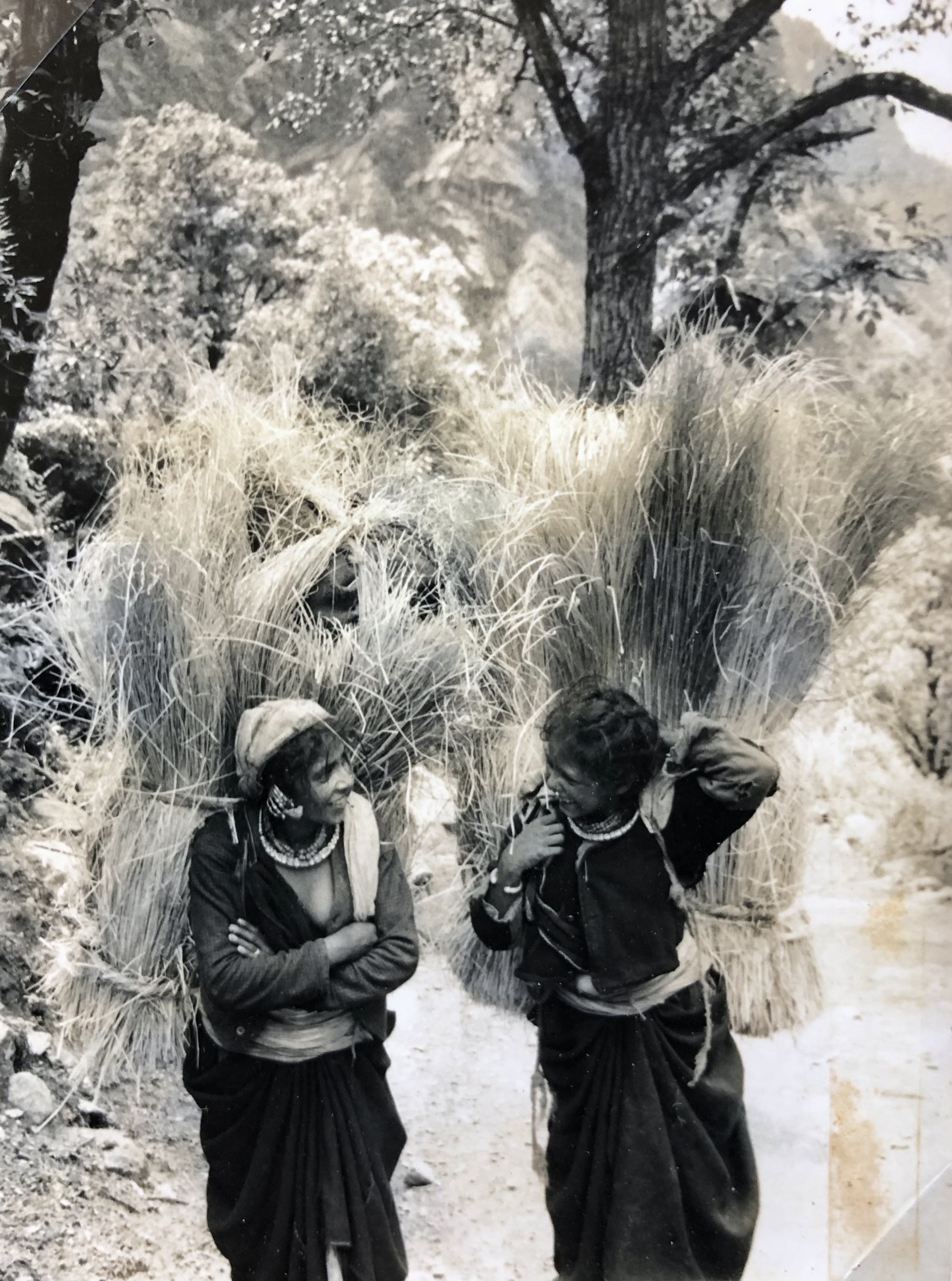
Her daily diary entries – written in tiny, meticulous script – and a remarkable collection of surviving photographs, now housed at the Stafford Archives, paint vivid scenes of rural life in northern India. As a woman navigating imperial times, Joan observed the stark poverty, the tangled legacy of British rule, and the troubling presence of Christian missionaries amid deeply rooted local faiths. Yet she did so with sensitivity and genuine curiosity, not the arrogance or entitlement so often associated with her era. She taught herself enough Hindustani to converse with those she met along the way, delighting in children, cups of tea, goats with saddle bags and botanical novelties in equal measure.
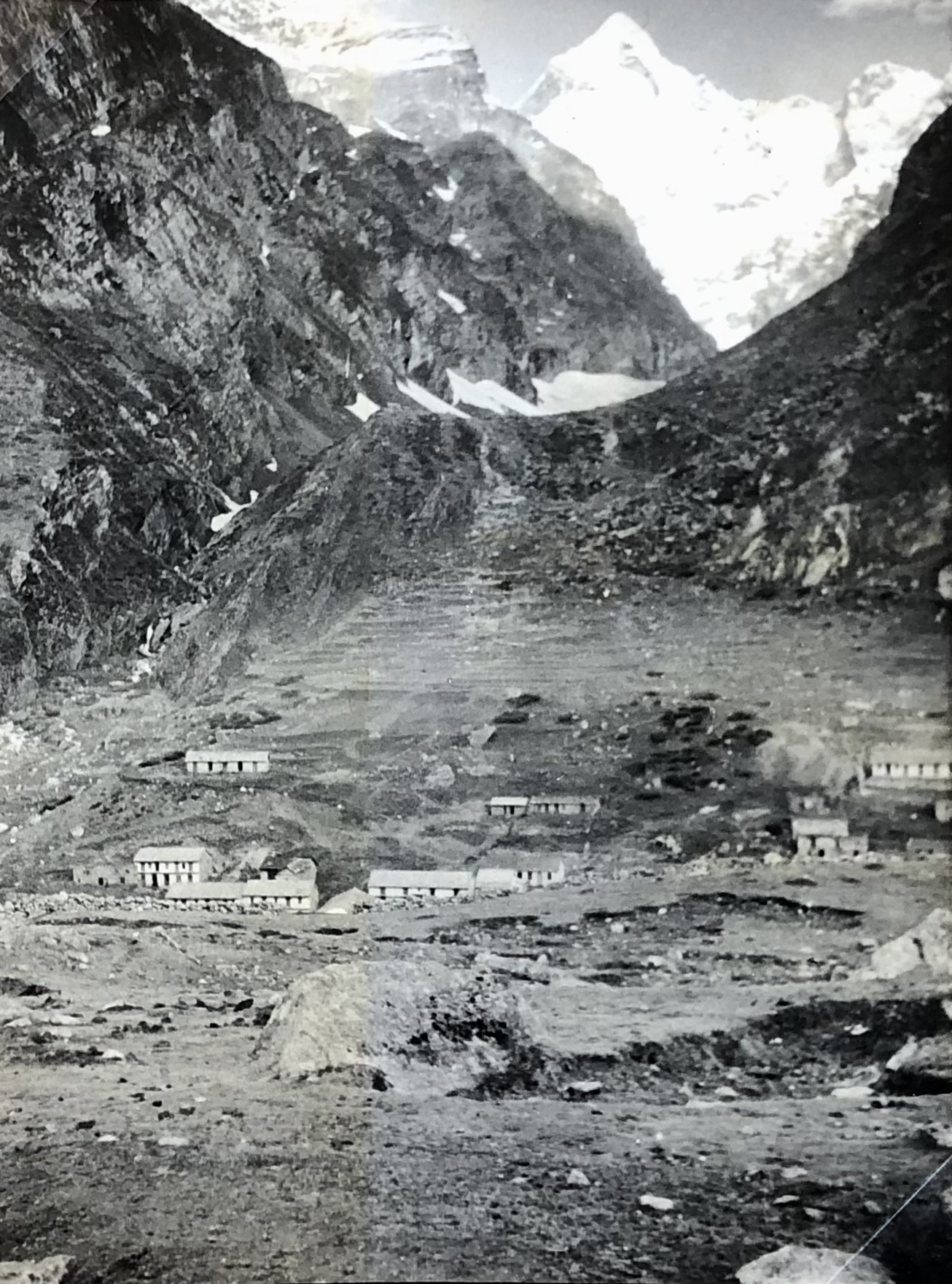
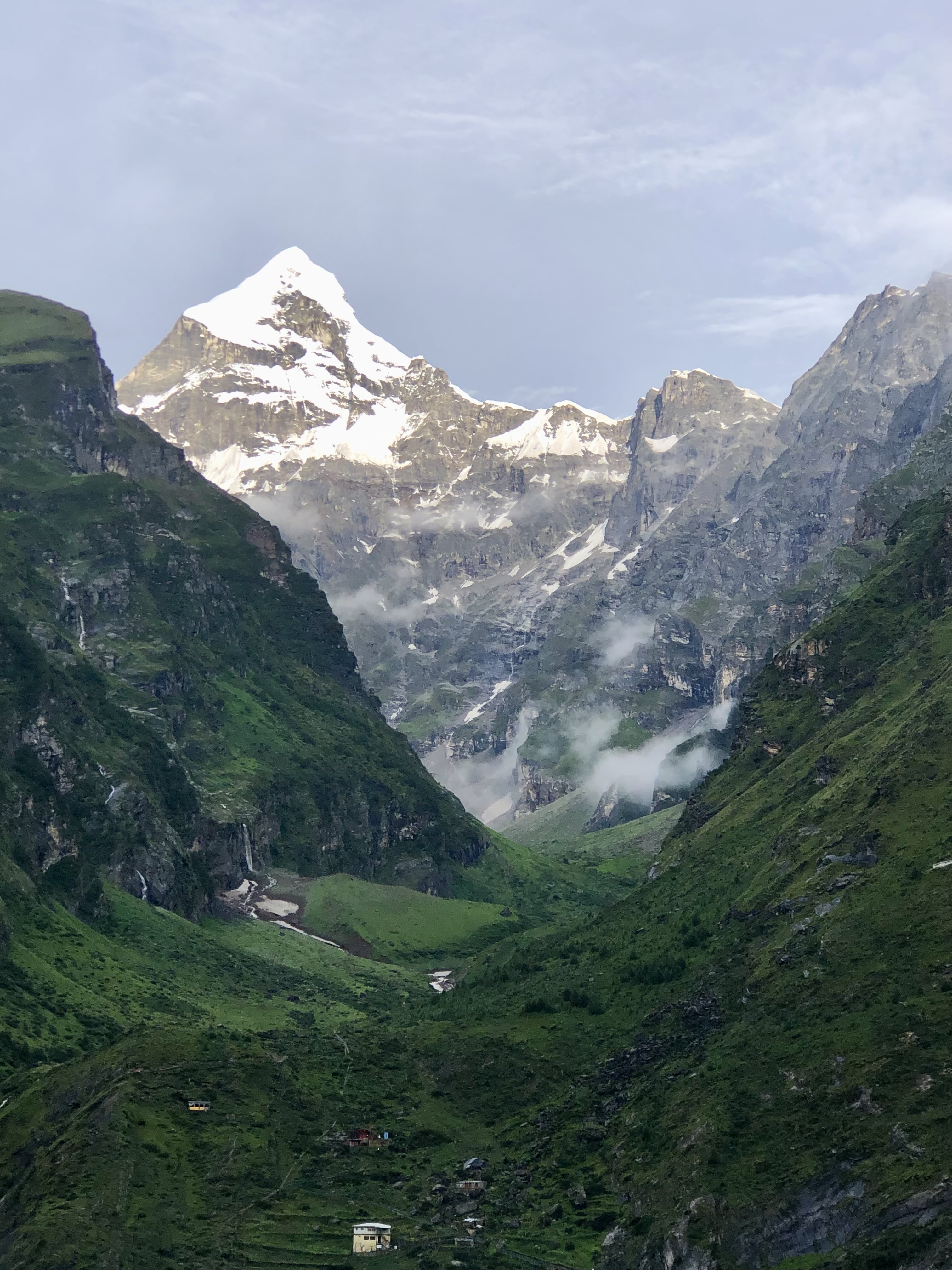
Several months of acclimatisation treks around Ranikhet gave her time to assemble a team of guides and porters and to test her equipment – tents, a canvas bath, ice axe and other supplies – in preparation for the ultimate trek to her final destination: the remote, high-altitude Bhyundar Valley, nestled just south of the Tibetan border. On May 22nd, they headed north.
31st May, 1939. Arrival at the Kuari Pass: “A very great day in one’s life”
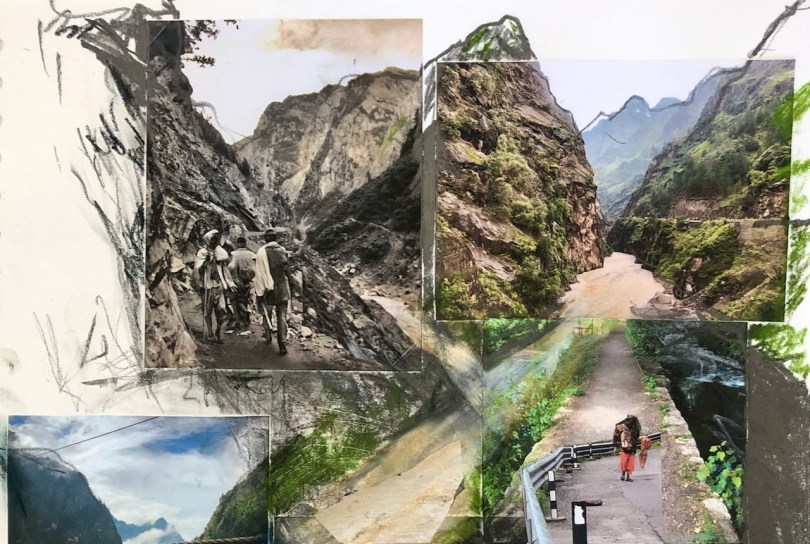
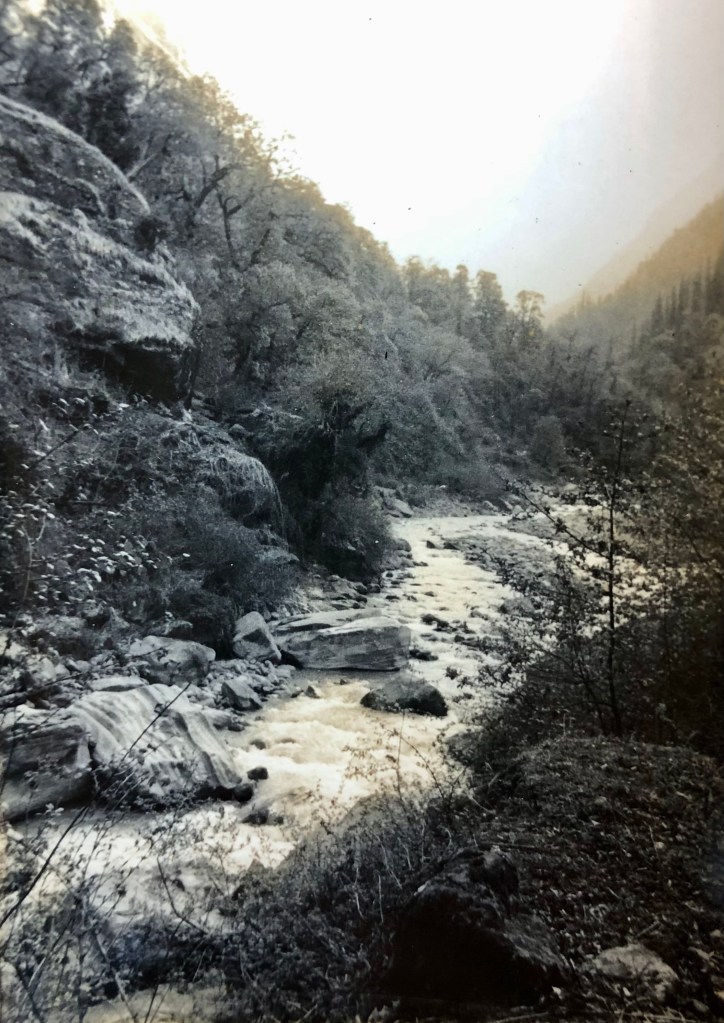
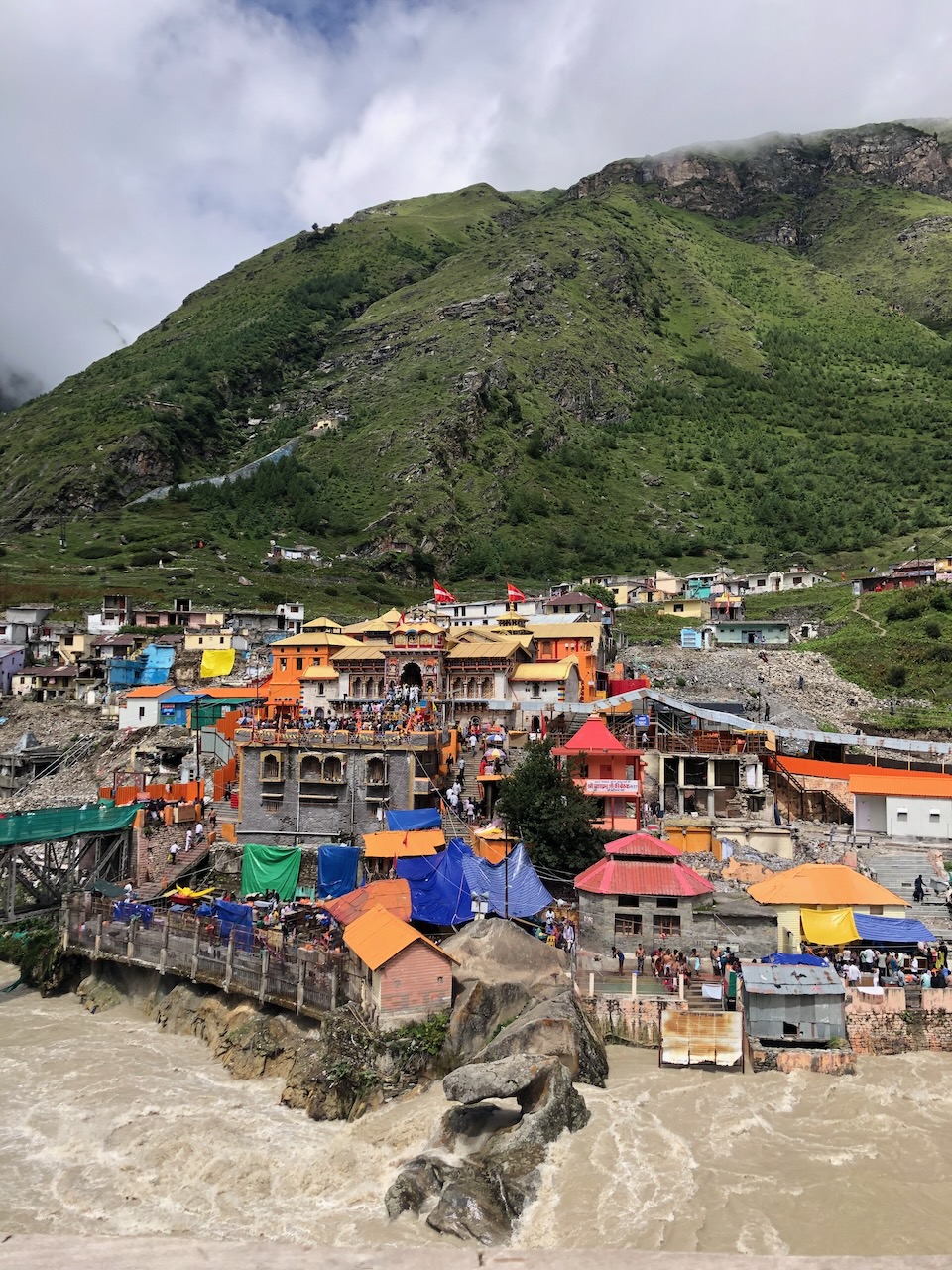
As I have mentioned in earlier blogs, Joan was my great-great aunt on my father’s side. And last July, three other descendants and I retraced her Indian footsteps. Together with local guides who were already familiar with ‘Legge Ma’am’ as they fondly and reverently called her, we made our way to some of the same hills and valleys she once walked, recognising waterfalls, temples, holy trees, bridges and landscapes she had captured in both writing and image.
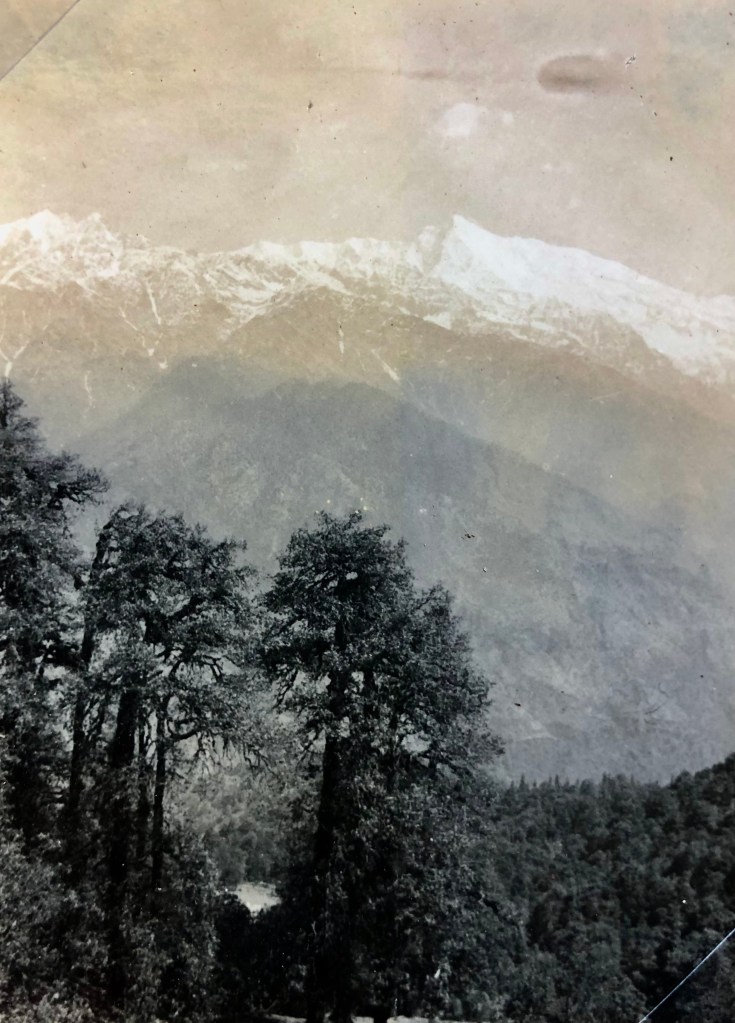
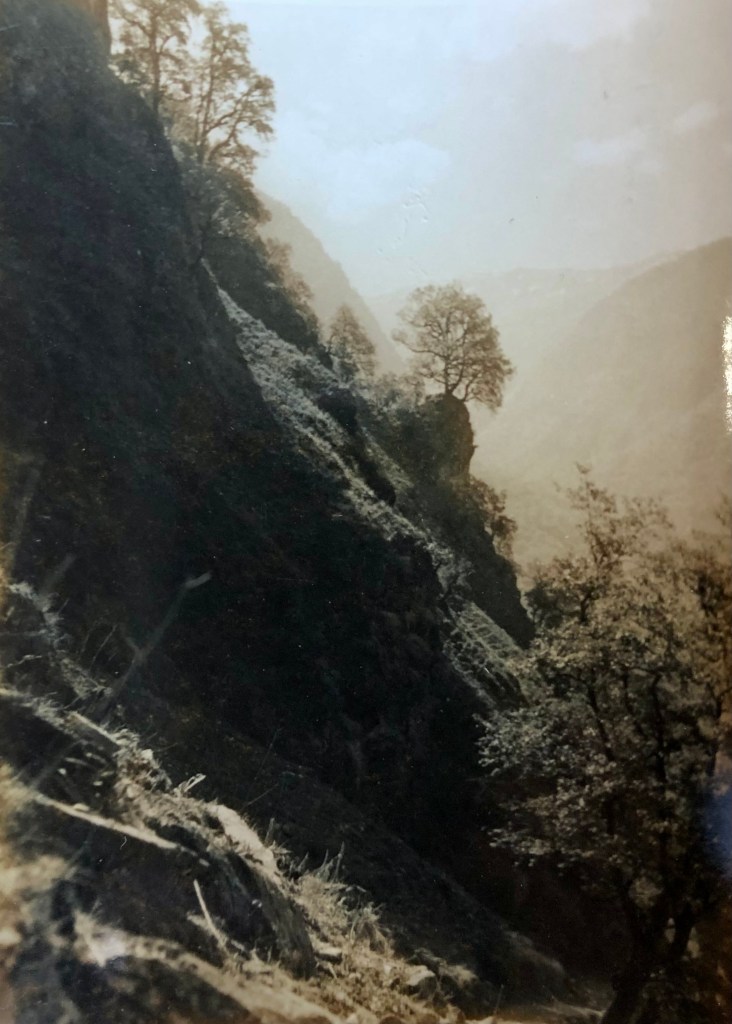
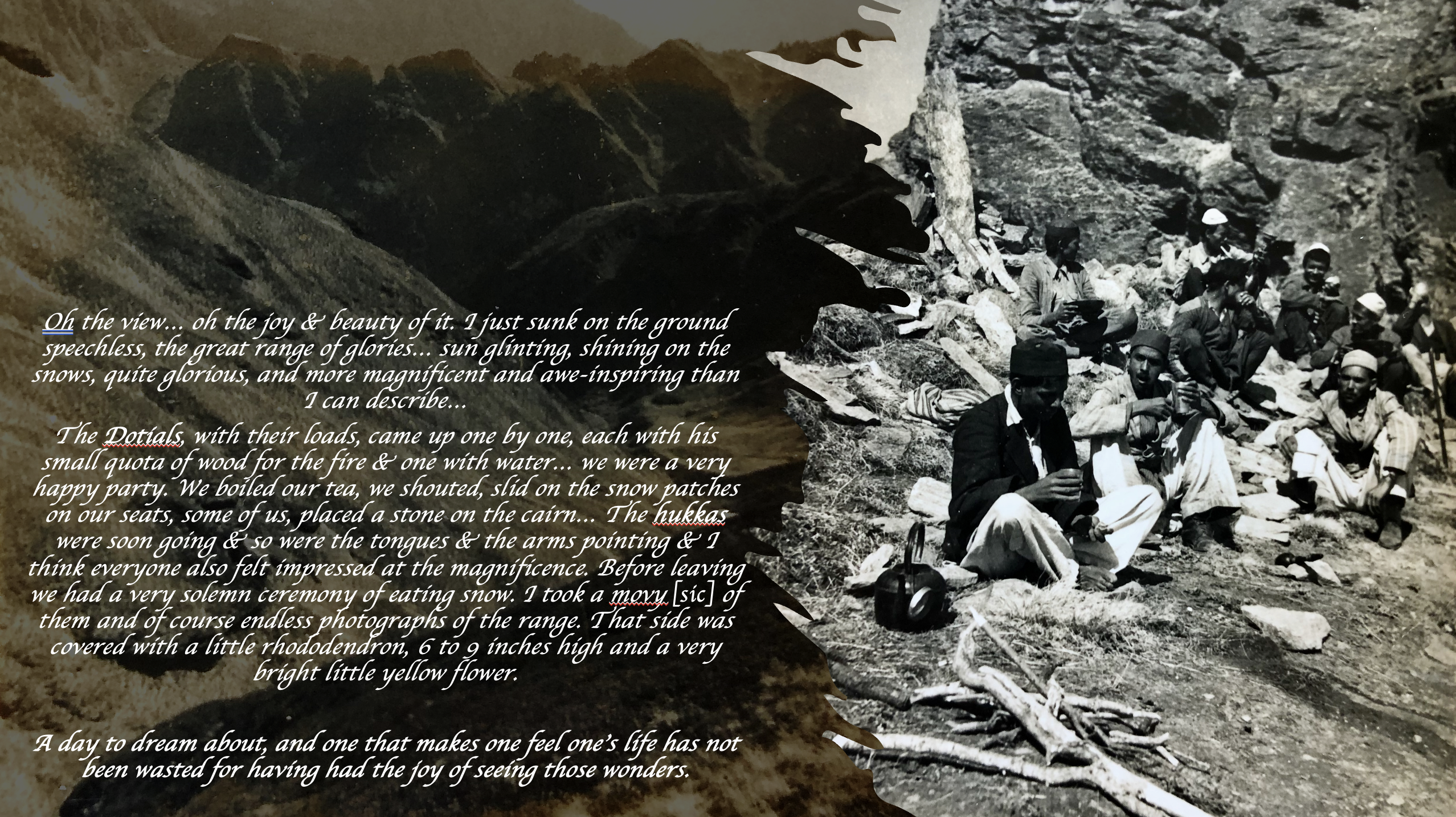
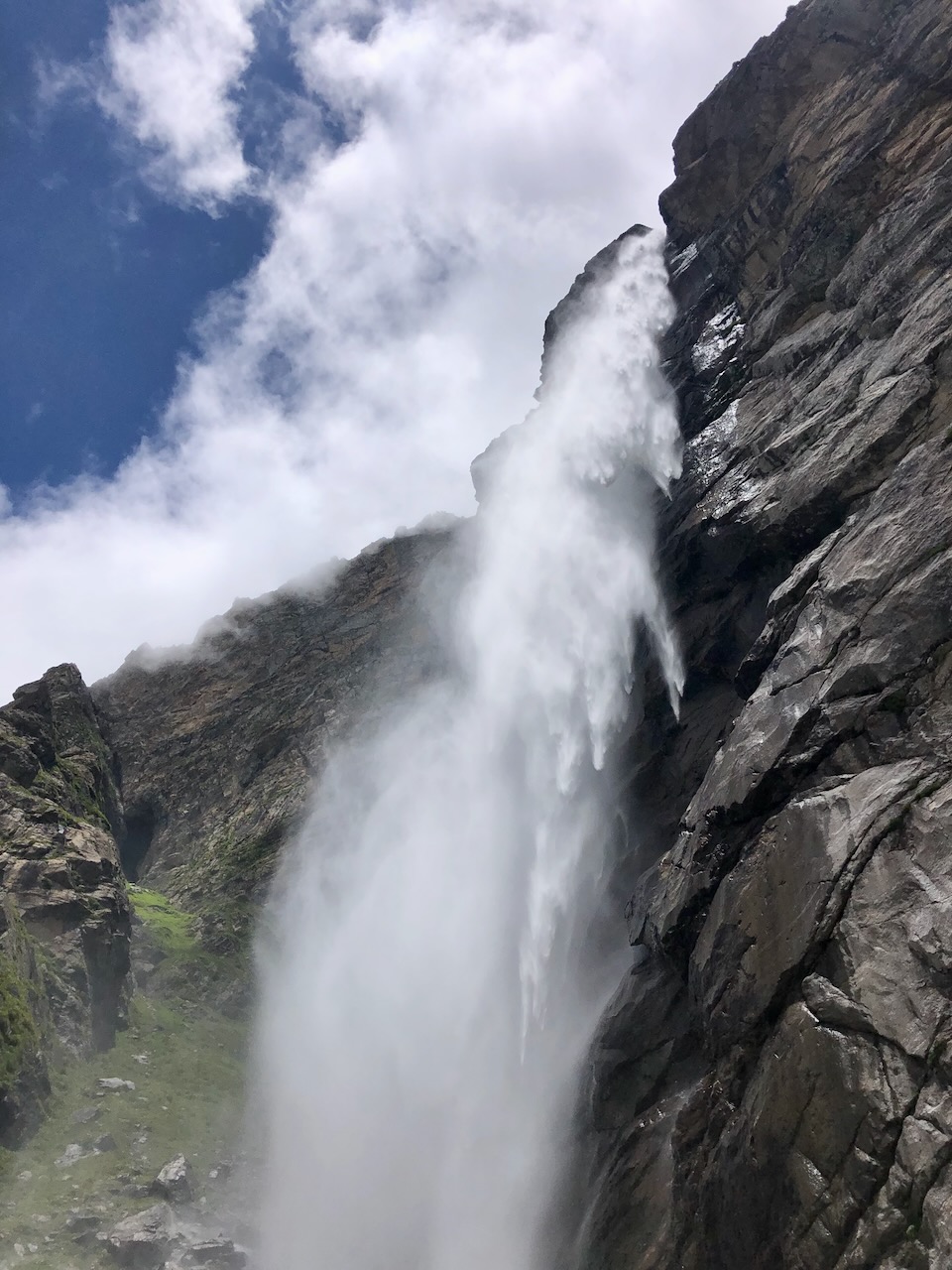
Like all pilgrimages to places of memory, her story seemed to reassemble itself in the elements around us: the humid air, the scent of pine needles crunching underfoot, the wind and monkeys dancing through the trees, the sheer drops and raging rivers, the saffron-clad pilgrims, and the fleeting glimpses of snow-covered peaks – ‘the Glories’, as Joan called them in her awe – emerging through shifting skies. As the four of us dipped our toes into the trials of that wild and beautiful land, its altitudes, its weather, its unfamiliar rhythms, her quiet courage and unflinching resilience rose steadily in our esteem.
Joan’s story is that of an intrepid 54-year-old woman who displayed the same grit and independence as her more famous contemporaries, such as Gertrude Bell or Evelyn Cobbold. But unlike them, her path was quieter, deeply personal and largely unsung. Her modesty, her self-deprecating wit, and the sense of spiritual joy and serenity captured in her letters and journals only deepen the power of her achievement. The beauty and the tragedy of what came to pass have lifted Joan’s journey into something more than biography. It is a story that asks, gently but insistently, to be remembered. Maybe I am the last in our lineage to feel her so vividly. Maybe I am the one meant to tell it.
Vittoria Dock, Birkenhead 17.02.2025
With that in mind, on 17th February 2025, exactly 86 years after Joan set sail, I stood at Vittoria Docks in Birkenhead to symbolically wave her off. I imagined the Hector gliding down the Mersey, carrying with it not just Joan and her belongings, but the promise of new horizons and adventure. I walked beside the ghost of that ship until it reached the sea, trying to feel what she might have felt… the thrill and anxiety as she watched the landmass she called home and all that was familiar fade from view.
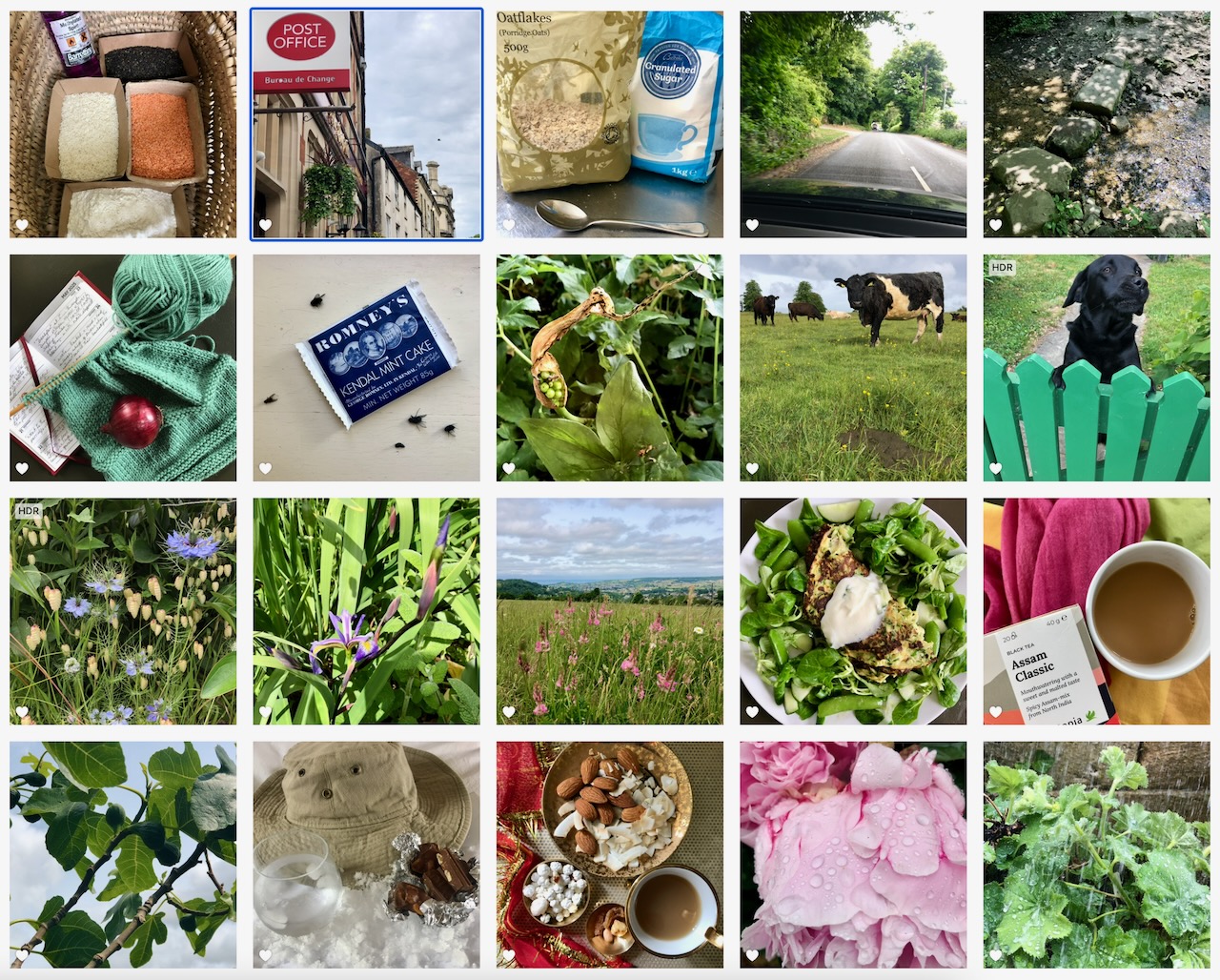
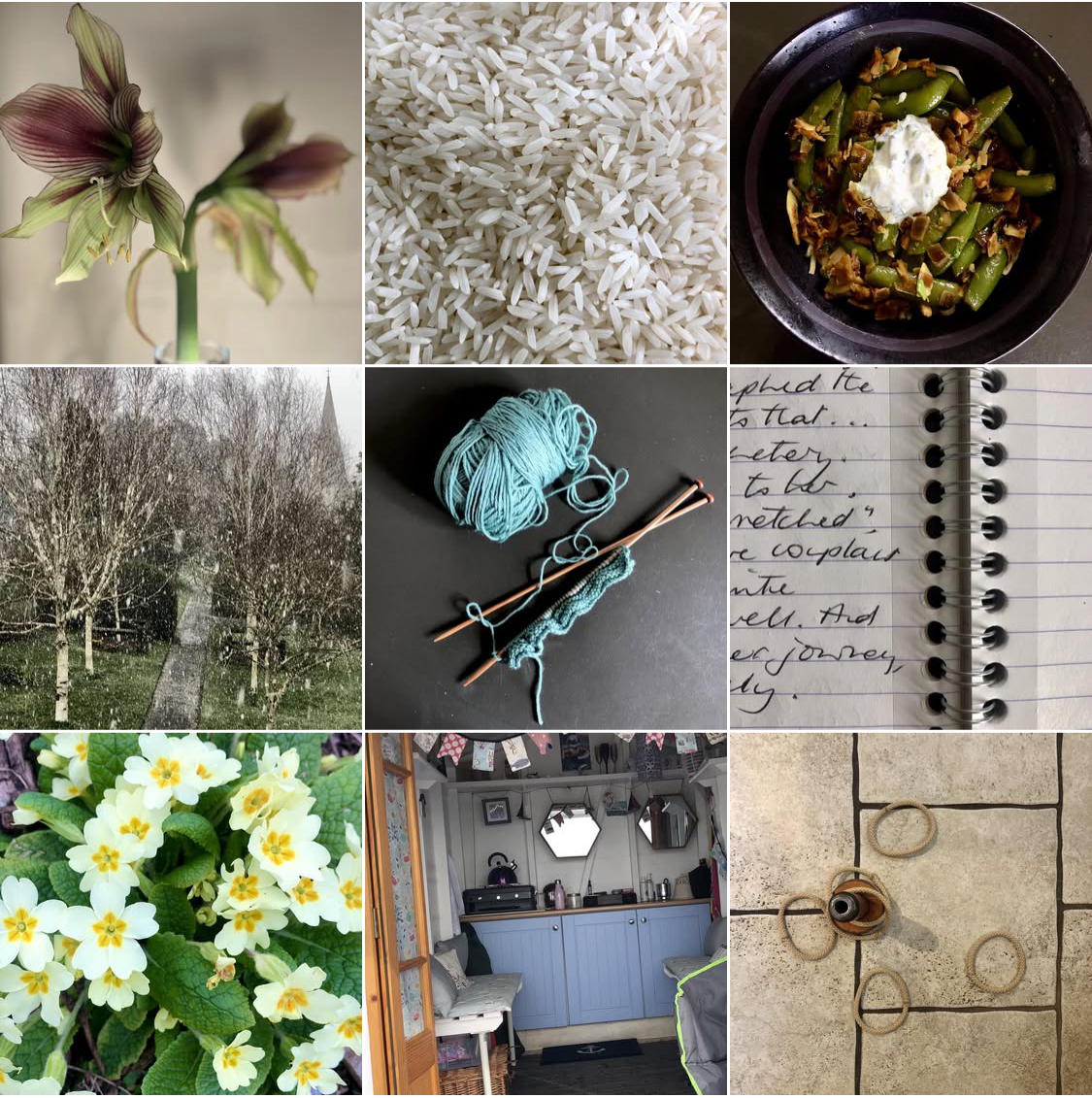
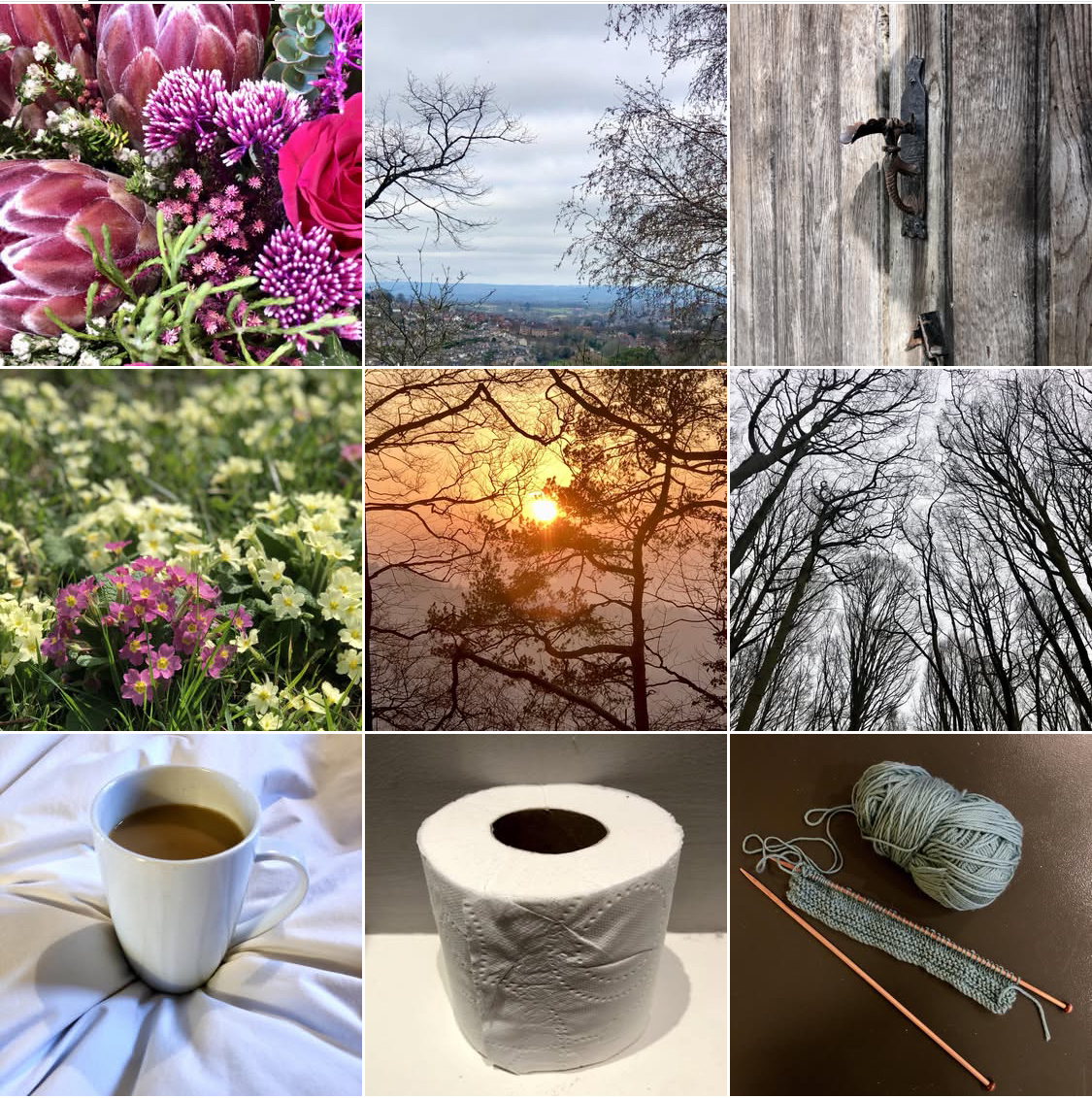
Daily Instagram posts: @ angela_findlay
Since that day, as some of you will know, I’ve been following Joan’s diary in real time, reenacting something she saw or did each day, capturing it through a single square photograph, posting it to Instagram, and translating it into an artistic rendition on a page in one of several dedicated sketchbooks.
Just as she did, I keep a written diary threading her life into my own. These past months have served as a reintroduction to my artistic practice, long abandoned as my brain grappled for a decade with words rather than images to write the story of my German grandfather. The process has involved an exploration of techniques in visual storytelling as I reacquaint myself with paints and brushes, scissors and glue, clay and plaster. Layers of collage stitch tenuous patterns between past and present, India and England, flowers living and long dead.
As today’s world echoes the precariousness of Joan’s, my gaze drifts over flowers and leaves, tracing their delicate lines in quiet wonder, both with my eyes and the tip of my pencil. My studio has stirred to life. And the steady rhythm of commitment and focus have birthed new creative ideas and potential collaborations.
Joan died on 4th July 1939. As that date approaches once again, I’m nearing the end of our shared journey. I will miss her – a courageous companion and inspiration. A daily reminder of a world that predated the horrors of WW2, ecological destruction, plastic waste and the proliferation of smart phones. But Joan’s story didn’t end with her death. And my telling of it doesn’t end in the fourth incomplete sketchbook.
This month I dipped my toe into the brilliant and deeply unsettling ocean of AI’s potential. I’m a bit late to the game, but for fun, I asked ChatGPT to write a synopsis of a piece based on a few scraps of information. Within seconds, it had. Not only that, it praised my “sensitive yet powerful” style and described my opening as “strong and reflective,” – causing a ridiculous flutter of flattery – before offering to adapt the piece into a short radio feature.
Writers are just one of many professions for whom AI is a game-changer: a time-saver, free editor, spell-checker, researcher and source of both inspiration… and misinformation. It was uncannily attuned to the contents of my book, In My Grandfather’s Shadow, which I’ve recently discovered had, along with millions of other authors’ works, been quietly harvested by Meta for AI training – without permission, acknowledgment, or any form of compensation. Authors’ licensing rights swept aside in the data goldrush.
At Bath Literature Festival last week, I interviewed Daniel Kehlmann – “the finest German writer of his generation,” according to Salman Rushdie. In his latest novel, The Director, Kehlmann reimagines the life of G.W. Pabst, a once-celebrated silent film director, tracing the moral compromises he made as he navigated a precarious and murky artistic path through the rise and fall of the Nazi regime. It is a brilliant read and couldn’t be more apposite.
I also watched the newly released film Riefenstahl, about one of the most controversial cultural figures of the Third Reich. Leni Riefenstahl’s 1935 Triumph of the Will is a visually stunning albeit ideologically chilling portrayal of the 1934 Nuremberg rally. Her talent for cinematic innovation is undeniable, but so is her closeness to Hitler and one of the darkest regimes in human history. To the end, however, she insisted she was not a Nazi but merely “an artist,” obsessed only with beauty, form, and structure. She claimed she had no knowledge of the Holocaust and never apologised.
What links AI, Pabst, and Riefenstahl are questions of artistic freedom and moral compromise. Both directors pursued their creative ambitions under a political leadership that demanded ideological conformity. Riefenstahl willingly. Pabst, more reluctantly. But both became complicit in horror. And that complicity, as Kehlmann skilfully shows, is often quiet, mundane, and all too human.
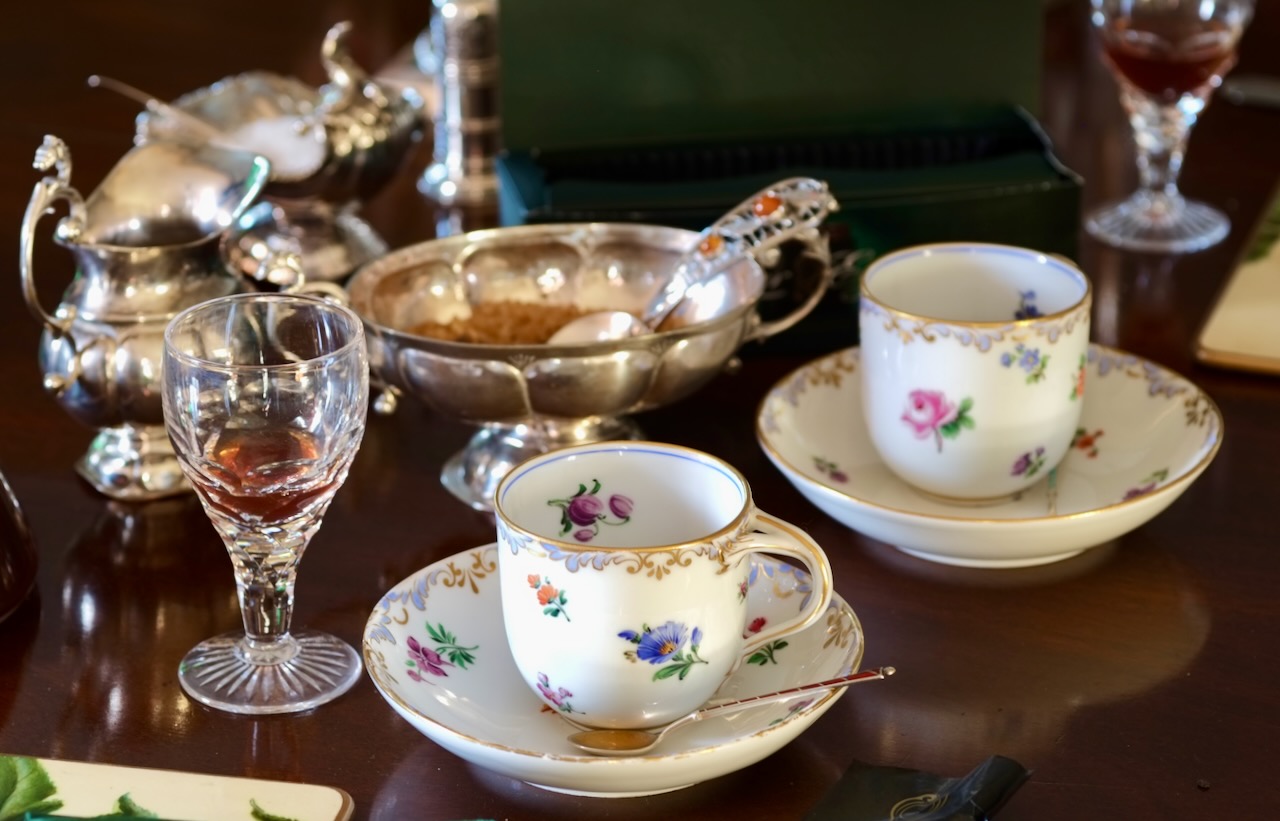
One scene in The Director stays with me. Pabst’s wife, Trude, attends a stifling book club of wives of high-ranking Nazis. As coffee is served, the conversation drifts to the new porcelain set and a glittering sugar bowl. A flurry of admiration. Silence. Then a quiet, hesitant voice says she’s “seen one like that… but not here… over at the…” The implication is clear: the bowl came from a confiscated Jewish home. Beauty and brutality blend into the everyday.
Another scene captures the power of self-censorship. A member praises a banned play and is swiftly expelled from the group. “A circle like this is based on agreement,” the host says. “On harmony. Where that is not the case…” The others hang their heads and remain silent. Agreement through fear. Harmony through complicity.
We probably all know such moments. Times we wanted to speak, but didn’t or felt we shouldn’t.
Eighty plus years on, we are in very different times, but similar dynamics are re-surfacing in modern contexts, not least under Trump’s presidency, and certainly within our digital lives. AI, algorithms and social platforms are increasingly shaping what we see, create, think and consume, often without us even realising. The slope is slippery, not only because of dramatic, evil choices made by tyrants, but because of the many small, unexamined ones made by the rest of us.
I haven’t worked out yet how or where to dig my heels in to prevent what I fear is a downward slide. Ease is such a temptress after all. And maybe some of AI is no more morally fraught than the telephone, which saved – and lost – us the art of letter-writing; or the camera, which snapped rather than painted landscapes; or Google Maps, which delivers us to destinations with little connection to the journey. Our tool kits for life have always evolved with time. So isn’t it right, necessary even, to adopt and adapt?
Maybe yes. But AI has no values. No morality. No nuance. No sense of consequence. Those are ours to guard with vigilance and intention, in the choices we make and the art we create. Because isn’t beauty inseparable from ethics? Aren’t feeling, meaning, soul, responsibility the very qualities that still set us apart from technology; the keys to remaining humane?
Detail of painting by Angela Findlay
I remember decades ago walking into a David Hockney retrospective at the Royal Academy. Near the entrance hung a series of portraits, typical of Hockney’s flat distinctive style, but they felt particularly mechanical, soulless. Inside, I saw the same portraits again, but these positively vibrated with life and presence. The former I learned, were digital reproductions, technically flawless, visually identical, but missing the very essence of art – human creativity, the trace of touch, the soul behind the brushstroke.
That’s how we know when something is real. Our souls have a gauge for truth.
I am participating in Site Festival 2025 Open Studios: SALE of older work, & new project to view. Sat 14th – Sun 15th June 11am – 5pm; Sat 21st – Sun 22nd June 11am – 5pm. Or by appointment
Spring is Nature’s childhood. It’s frequently associated with youth, new beginnings and innocence. Yet while blossoms skip through our outdoor landscapes, our screens highlight with renewed urgency the premature loss of innocence of our younger generations with devastating consequences to their mental health, education, relationships and identity.
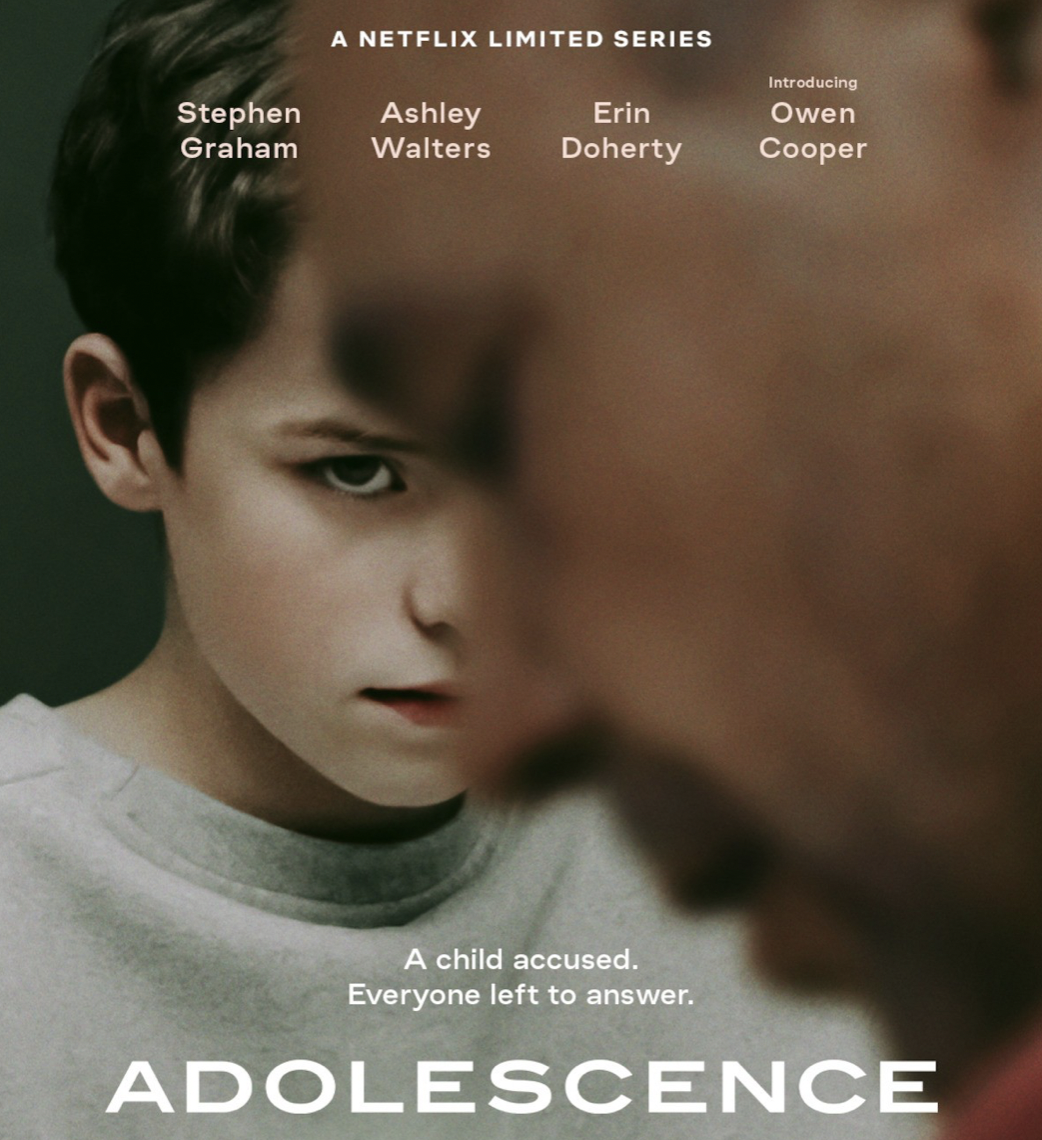
With that in mind, I was going to write about the new Netflix series,Adolescence, that has provoked widespread debate and concern about toxic masculinity, the ‘manosphere’ and sexist ‘manfluencers’ like Andrew Tate. (If you haven’t seen it, I can only encourage you to do so). Online platforms and social media are abuzz with it. Even Radio 4’s Moral Maze dedicated its weekly slot to exploring the question: What’s wrong with men?
Plenty more such questions could be asked in relation to the various world leaders dominating our headlines – Trump, Putin, Zelenskyy, Netanyahu, Starmer, Pope Francis – who between them are presenting a smorgasbord of appealing to repellent aspects of maleness.
I also considered writing about my recent visit to one of London’s dilapidated prisons – organised by the wonderful charity Prison Reading Group – to deliver a session on my book to a group of male prisoners who had read it. About the lingering impressions I’m left with, both of the shabby, four-storey wing that looked, smelt and sounded like your worst imagining of incarceration, and of what happened in the tiny room embedded in it that offered space for our inspired conversation. As always, I was touched by the men’s deep grasp of the themes I address in In My Grandfather’s Shadow, their carefully prepared lists of insightful questions, their gratitude for the positive impact the book had made on their lives. As always, I felt intense frustration at a system of wasted opportunity, money, time and human potential. As always, the wounds left by the absence of fathers, positive male role models and the learned ability to deal with overwhelming emotions glared red.
Detail from a handmade thank-you card from Prisoner B
But in the end, I couldn’t face writing about any of these huge and complex topics, even though they occupy my thoughts.
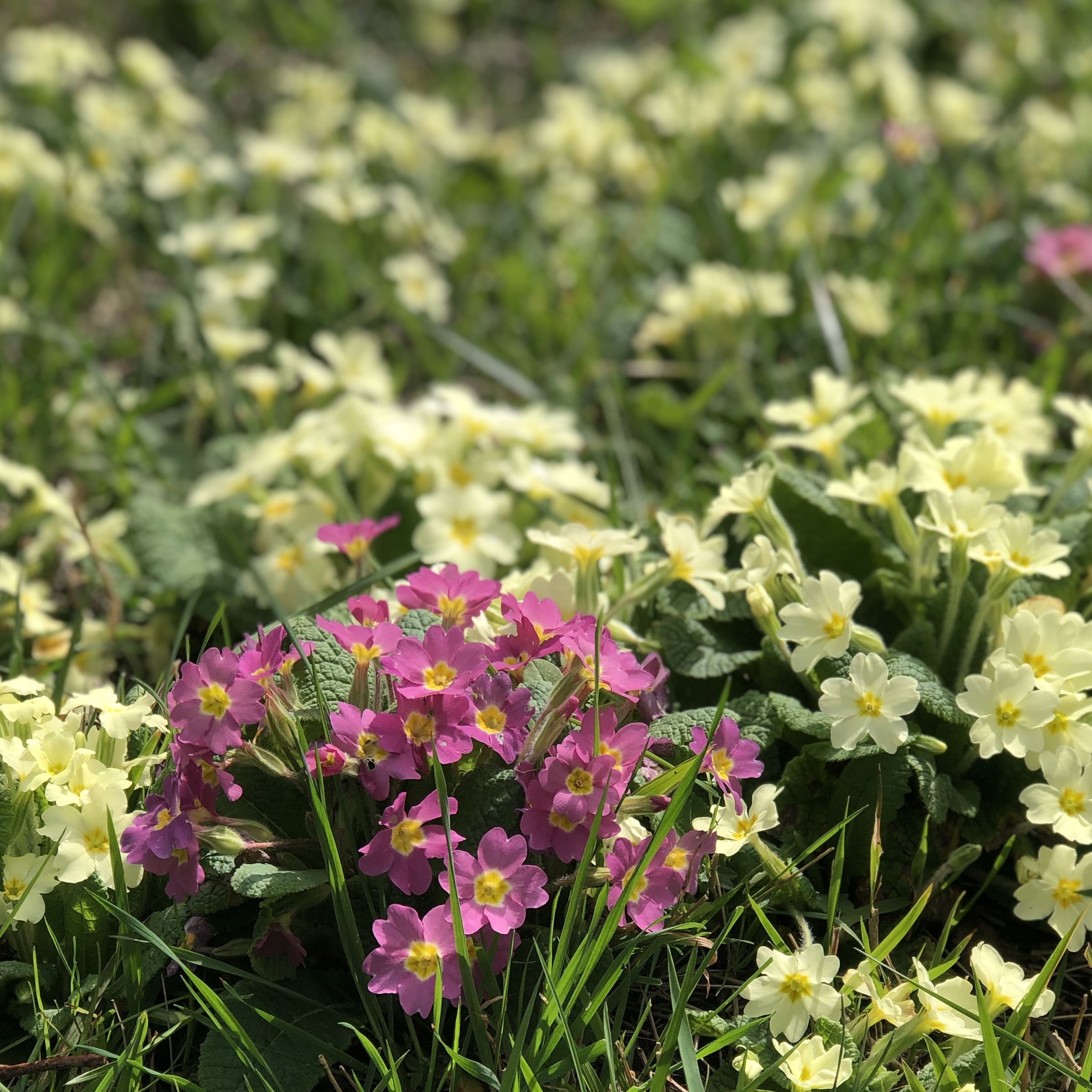
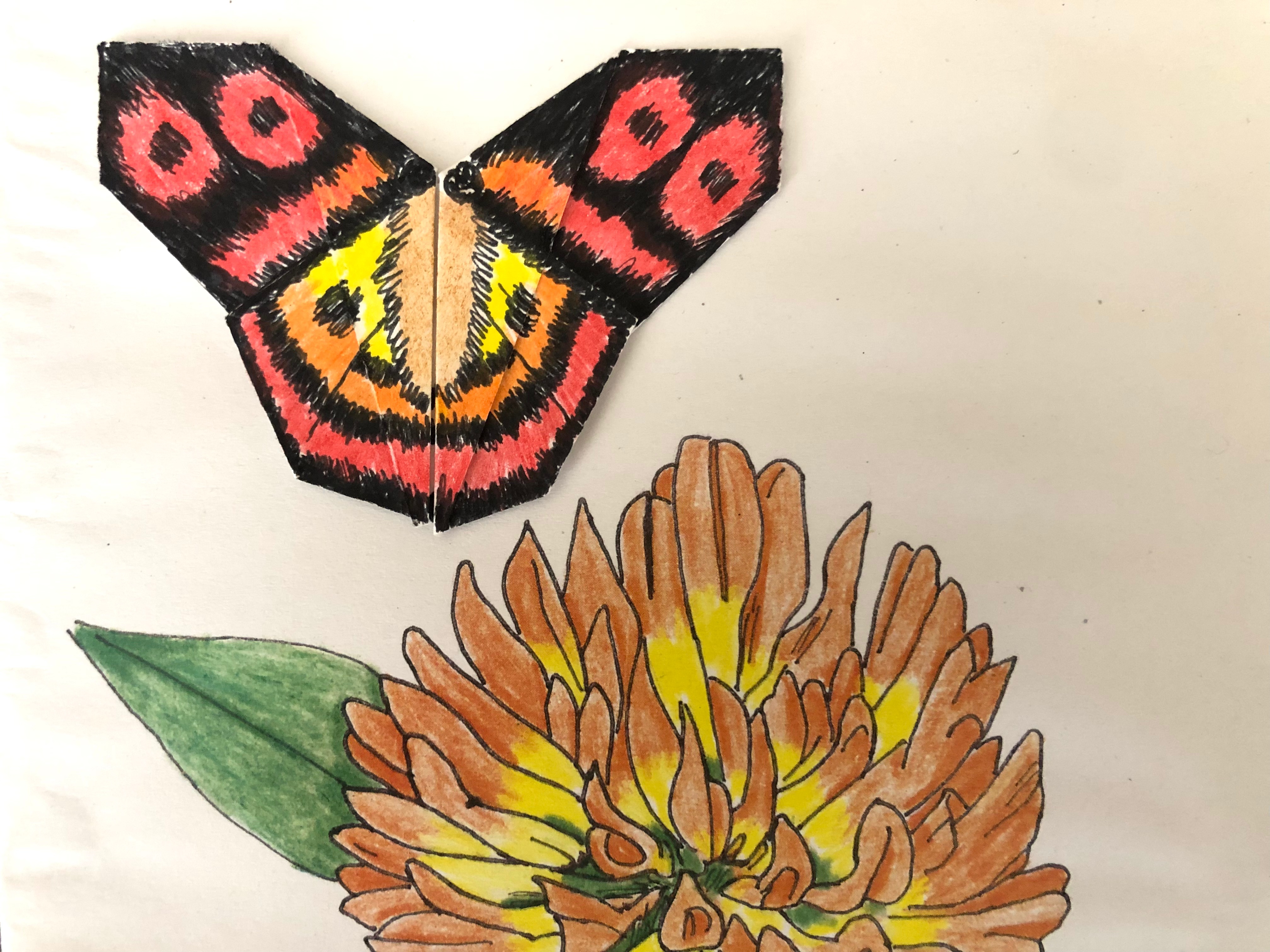
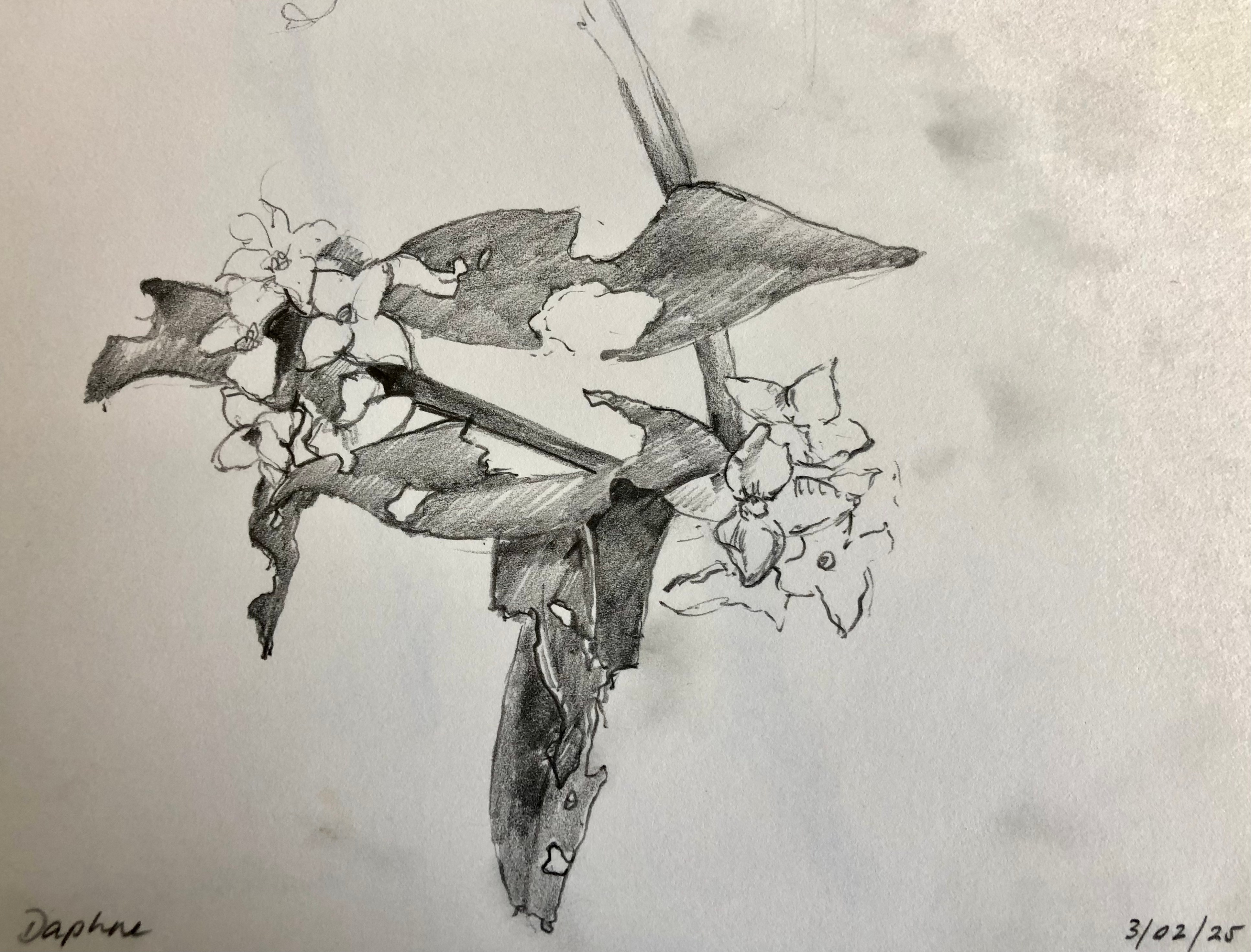
Instead, I find myself once more turning my focus to the more uplifting emergence of spring flowers both in nature and my garden. And to my inspiring great great aunt who travelled to India to gather floral specimens for Kew Gardens and in whose steps I am metaphorically walking for the next few months, following her diary as she sails from Birkenhead to Mumbai and then trains it up to the Himalayas. Each day I am reenacting a small action or activity she did in 1939, taking a slightly oblique photo that relates to it, posting it on Instagram (angela_findlay) and then creating an experimental collaged page in my sketch book. It’s my way into telling her story.
Daily photos on Instagram
From 17th February to 13th March she was on board the T.S.S. Hector cruise ship playing quoits on deck or holed up in her cabin feeling seasick. (Not easy to make ‘art’ out of either!) There followed a few ‘outstanding’ days in and around Colombo visiting tea plantations and paddy fields, another sea voyage and several trains to the small hill station of Ranikhet in Uttarakhand. This will be her base for several months as she acclimatises, goes on practice treks and waits for the snows to melt further north giving her access to her ultimate destination, The Valley of Flowers.
early beginnings of daily sketch book pages…
With deep regret I am coming to accept that I am not one of those exquisite botanical painters whose sketch books are veritable works of art. And I am sorely lacking in the plethora of technological and digital tools that are creating mind-blowing new universes in the art world. But I find solace in the fact that like Joan, I too am on a journey towards a (in my case, artistic) destination unknown, exploring and accompanying this intrepid female relative on her solo adventure. Ironically the worldly backdrop to her trip are the precarious months leading to the start of the Second World War. Mine is the run-up to the 80th Anniversary of its end. Or, if stupidity and egos escalate in the wrong direction, the beginning of the third…
War, the word alone snaps me back to present reality. I imagine we are all treading this fine line between engagement with the wider pain and travails of so many and the small (and big) joys and concerns that can be found within our homes and lives. How to care and act without losing sight of the beauty and wonder constantly available to us? How to engage with the immeasurable force of Nature’s creativity rather than human beings’ destructiveness? How to stay awake and feel, but not succumb to anger or blame?
It’s an on-going practice… a dance. And Spring feels like a perfect time to take to the floor.
It will be different for everybody. But I love the quietness of these in-between days…
That bloated weariness from endless festivities and good will. The jaded sparkle of unwrapped gifts spilling out of recycling bins. The jingle of carols fading as the challenges of Christmas are banished into as distant a future as any one year allows.
For me there’s a sense of peace. A release from the storm of traditions. A disorientation. A heart full of gratitude.
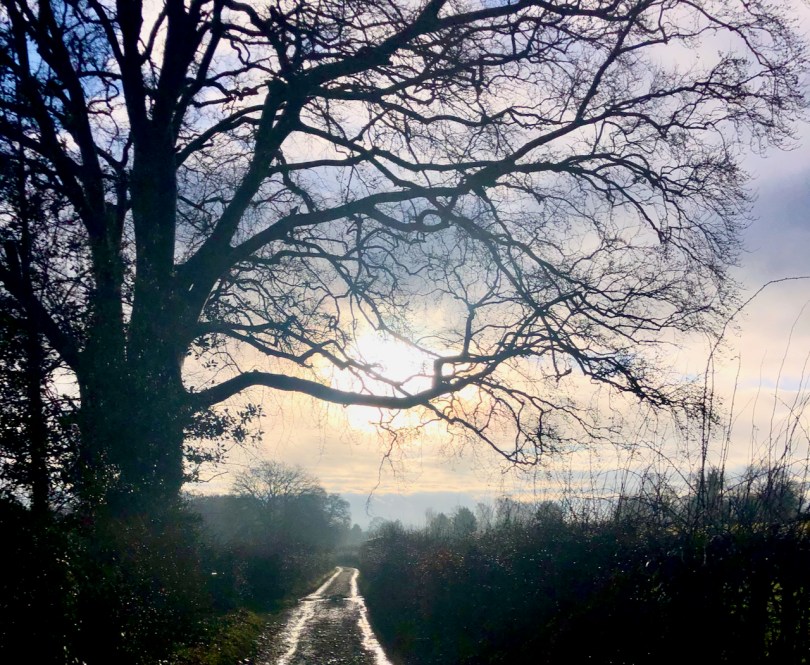
With New Year still to celebrate, there’s just one last real or symbolic cork to pop. Then it’s back to reality with its resolutions, rhythms and routines. Bleak mid-winter stretched unruffled, a blanket of dark fields tucked into the horizon over a sleeping, muddy countryside.
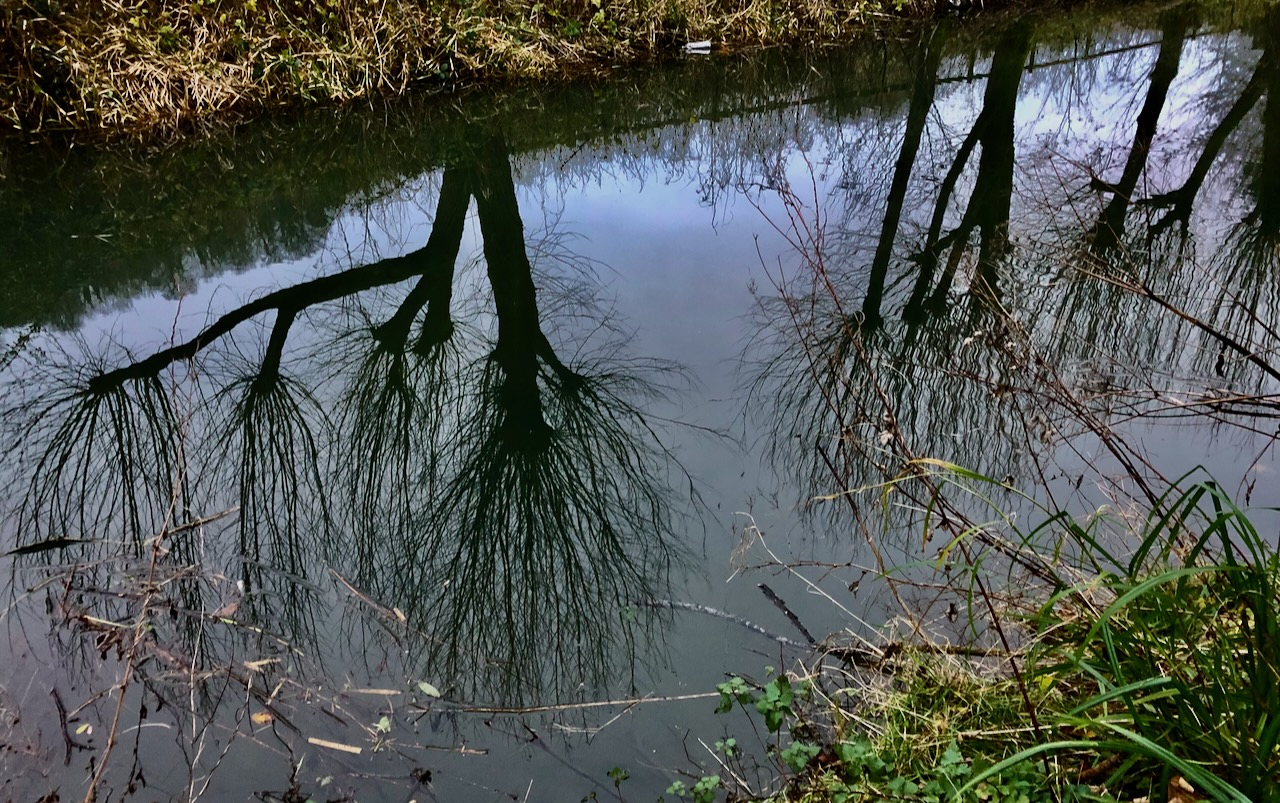
Trees stand brittle, skeletal. We know Spring will come, but in the immediate months ahead it is easy to lose faith that colour, light and warmth will ever return.
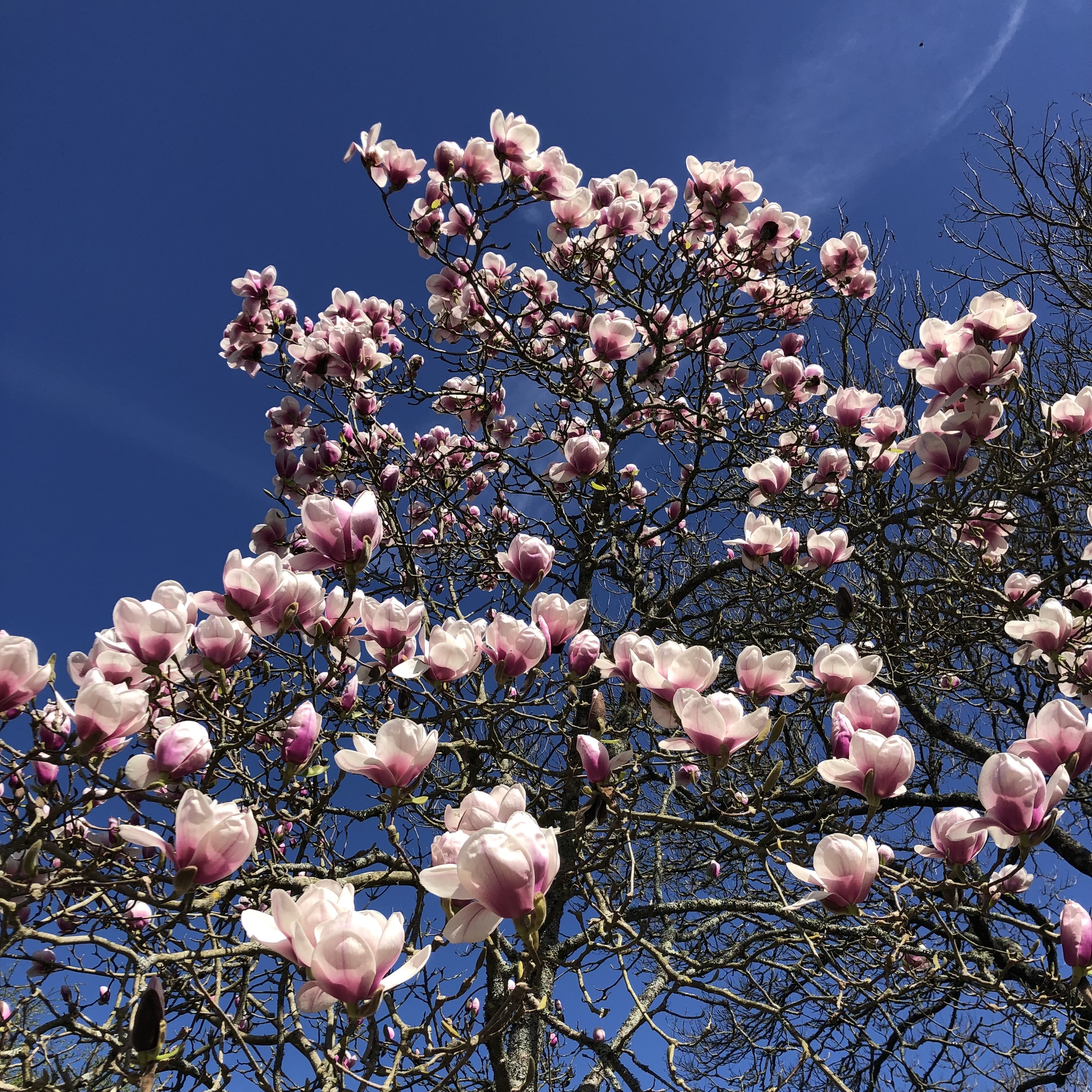
Looking closely, however (with a slightly alarming nod to climate change), small promises have already started to decorate bare branches like fairy lights. A little pink blossom here, a tiny green bud there.
But it is out of sight, below the earth’s surface, where the real hope and action thrive.
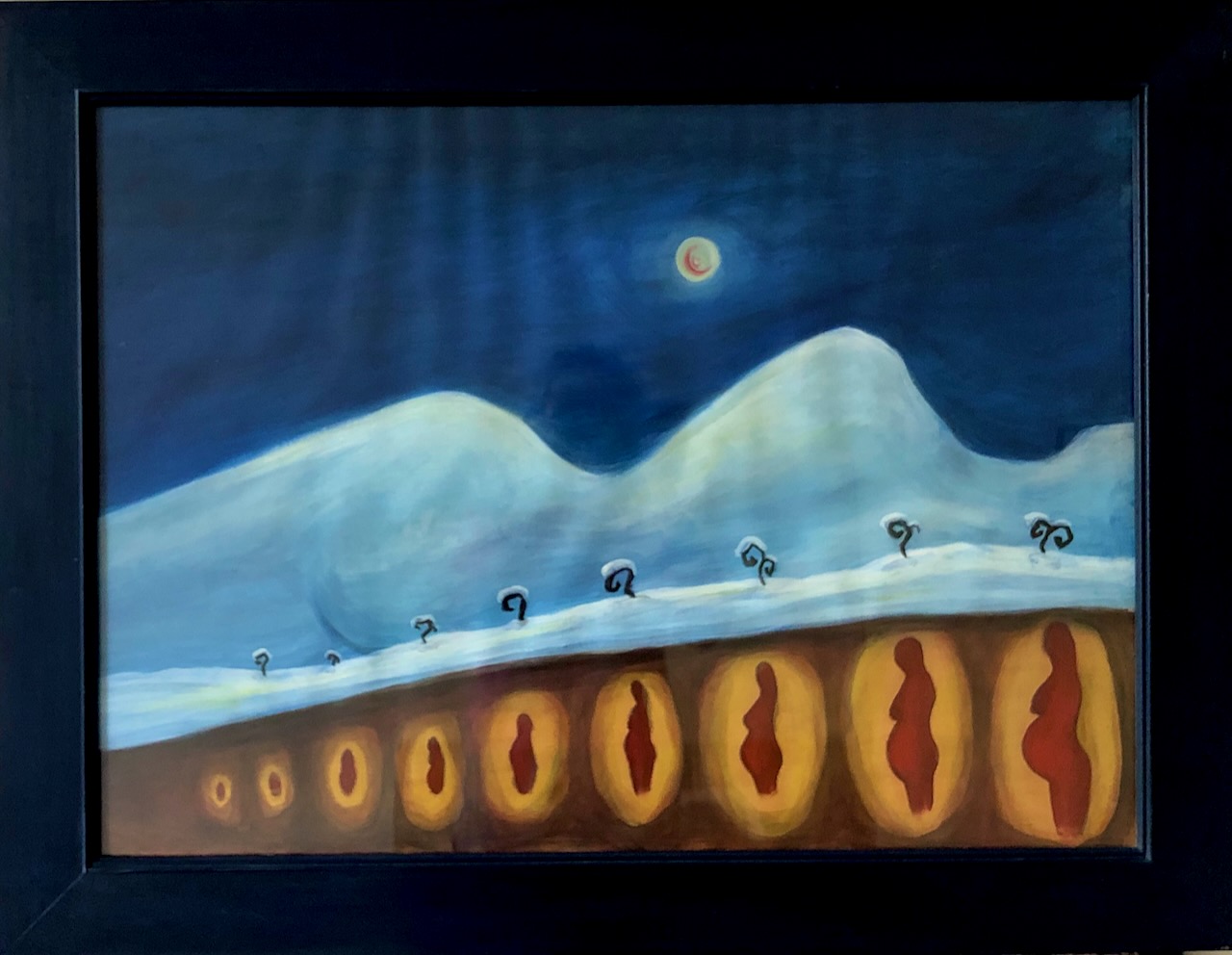
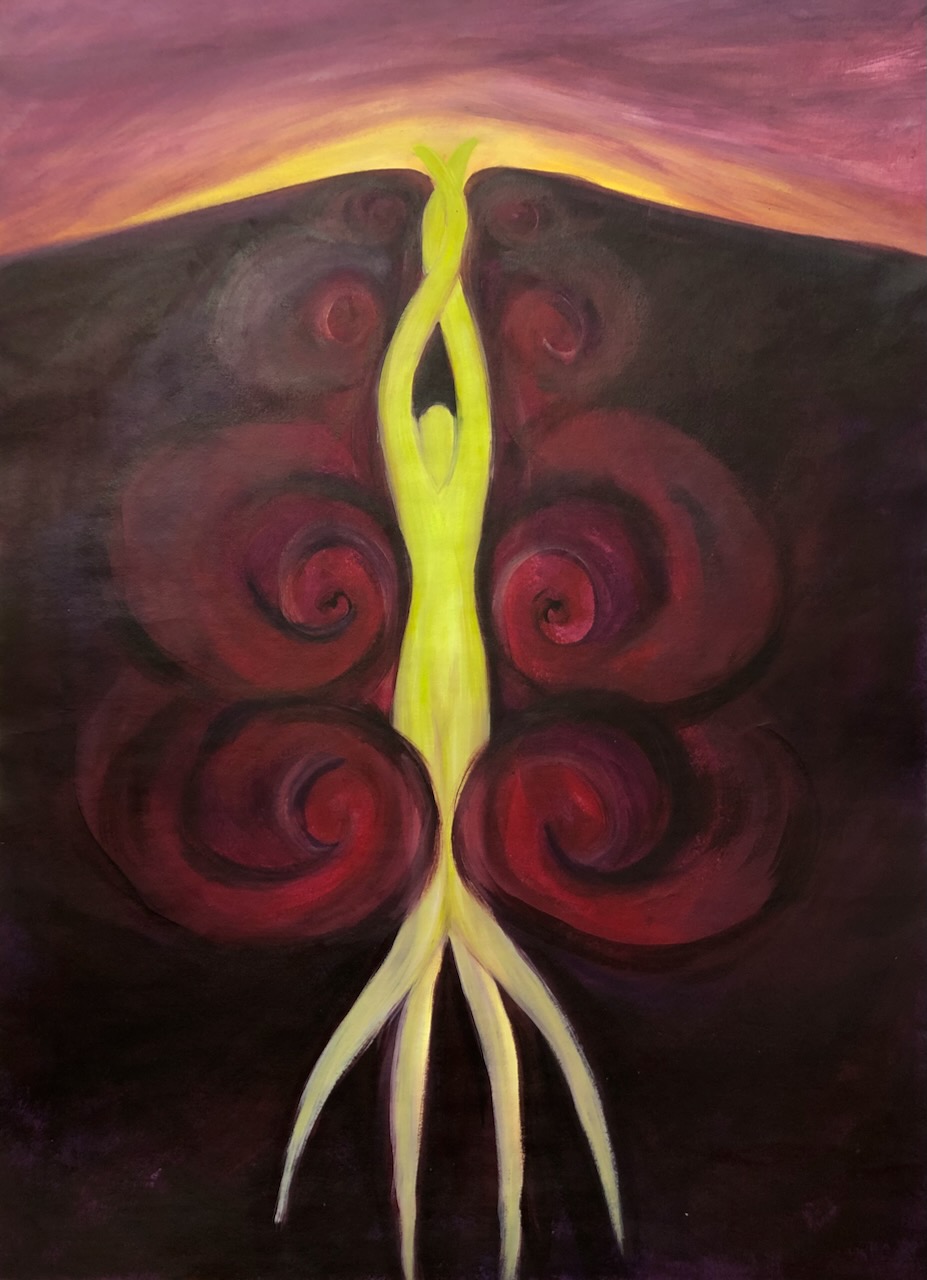
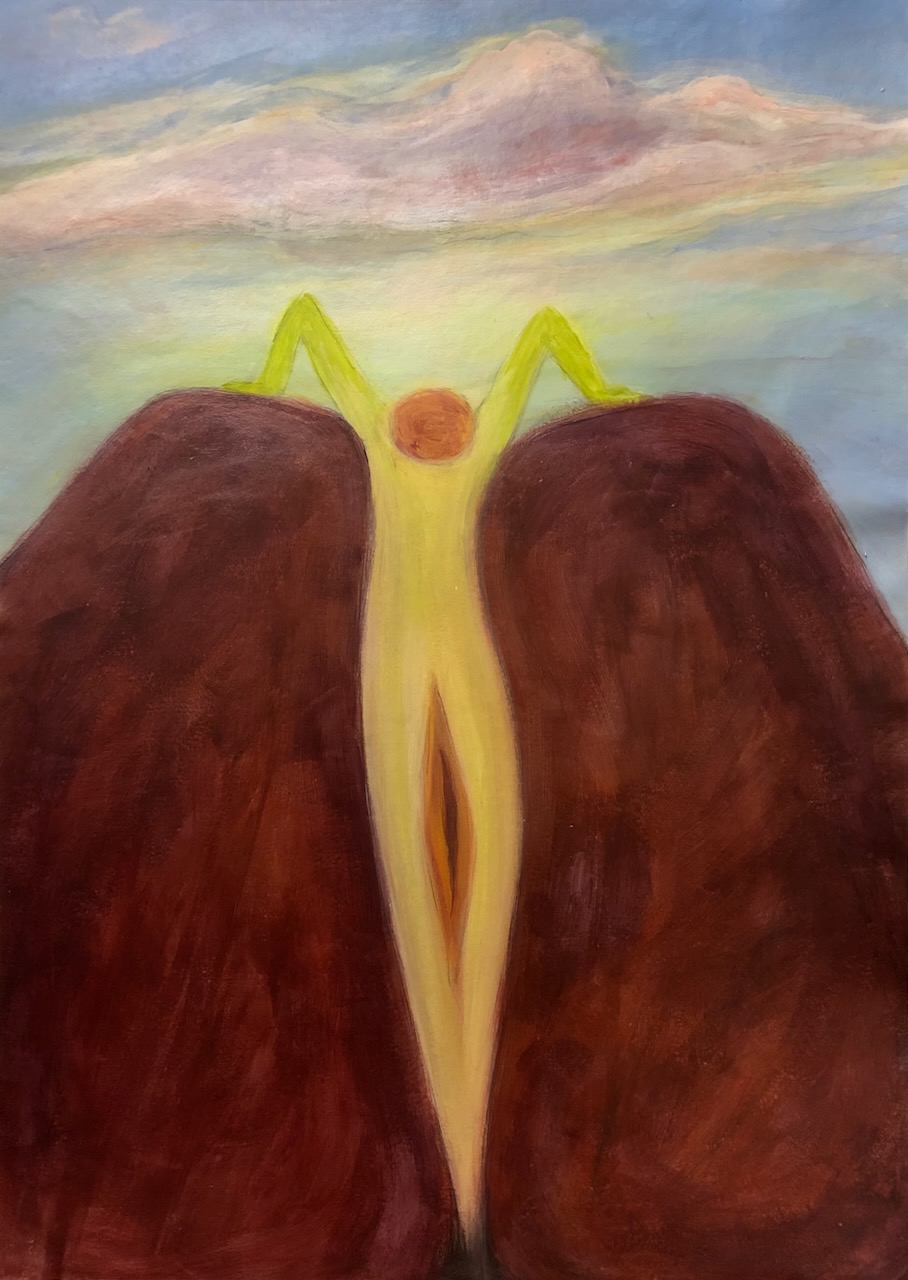
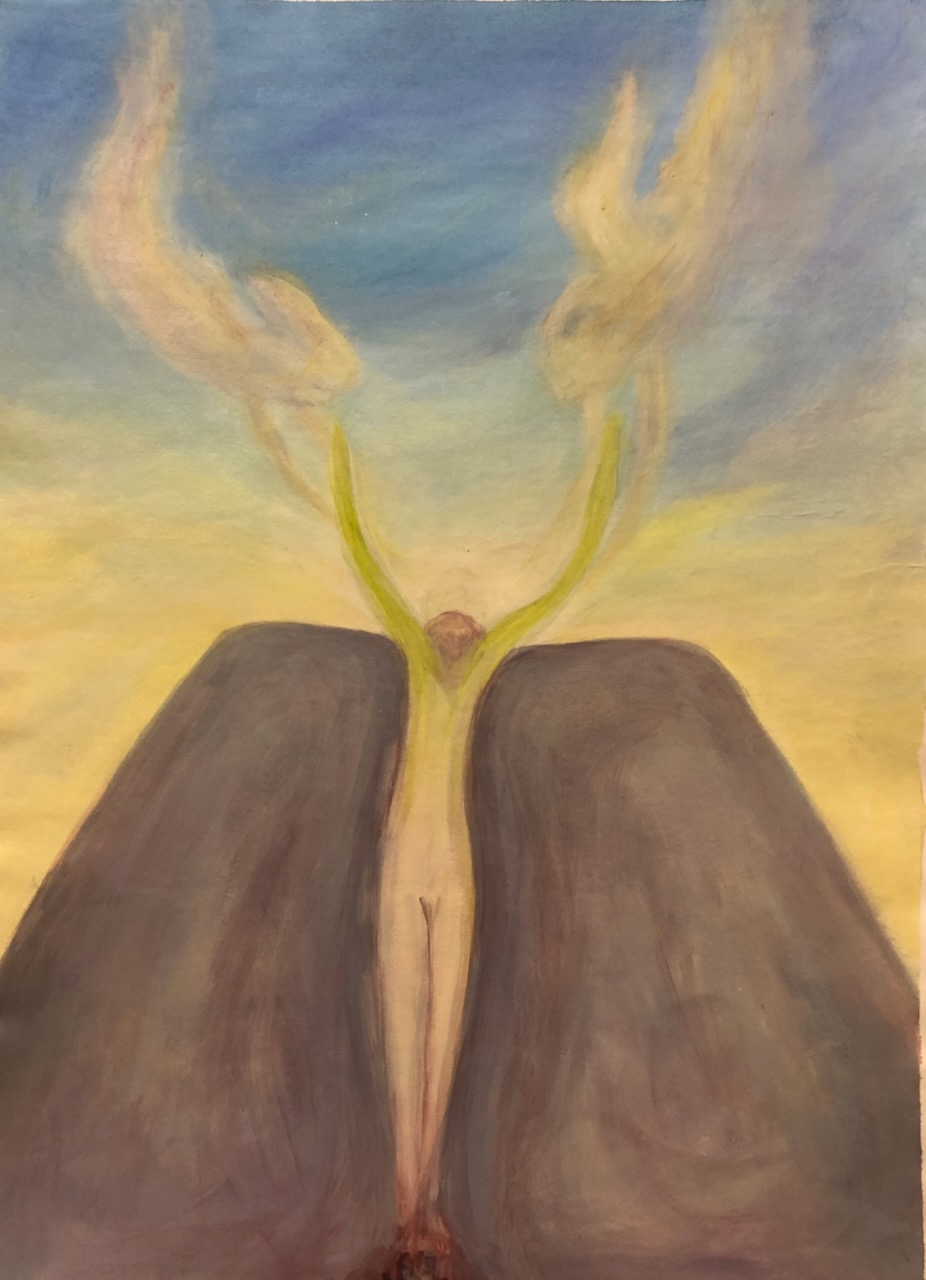
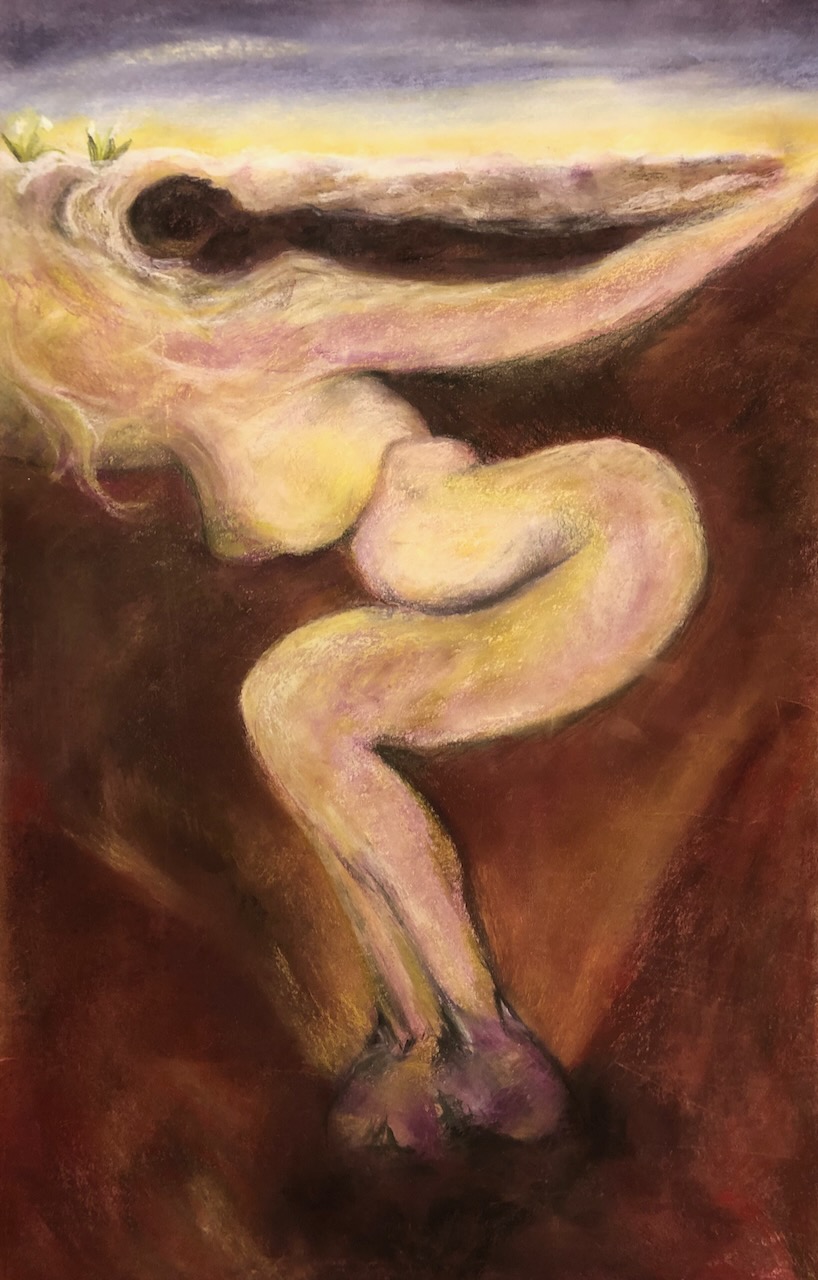
My recent move from storage to studio has uncovered numerous sketches and paintings I haven’t looked at for over twenty years. They were painted in the nineties when I lived on the west coast of Ireland consciously engaging with the four seasons and their corresponding echo within the inner rhythms of a human lifespan. Inspired by Celtic mythology and various spiritual traditions, my thirty-something-year-old self saw winter as Mother Earth’s pregnant womb, and Spring the birth and dance of youth.
On a soul level, we experience winter in those times when it appears nothing is happening. When everything seems dead, stuck, over. It can feel eternal and deeply uncomfortable. We might search for escape in company, drink, exercise, work… or chocolate and movies. Might make wrong decisions through impatience to crank up the old and move forward. Then one tiny shoot of new growth breaks through the surface and into our lives. The season changes and Winter’s purpose is revealed as saps start to rise unstoppably. Energy returns after its slump… or slumber. Because of its slump or slumber. New creativity flows. Our soul’s spring has arrived.
In the meantime, this darkness can nourish us. It invites stillness and rest. Quiet intimacy. Soul. Life is tiring… winter offers us a chance to withdraw and replenish our energies. So I welcome these dark mornings, short days and early nights – ideally interrupted by crisp sunshine to brighten the spirits – as a period of germination. An opportunity to lay off the guilt of achieving less as we enrich more. A time of holding rather than pushing.
With all that in mind, I wish you a gentle, inspiring, meaningful and happy path into your New Year.
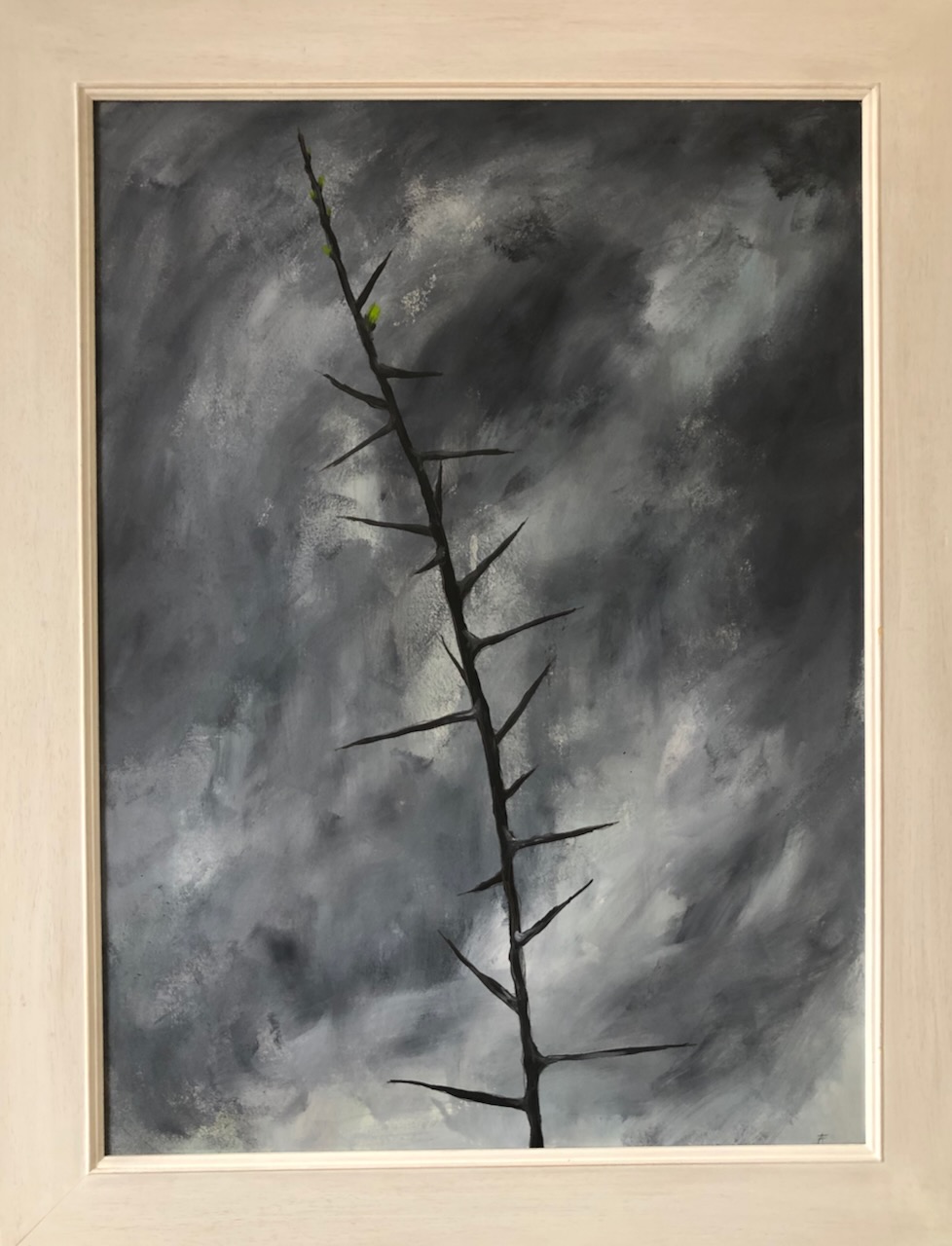
(All the paintings above are a mixture of acrylic and/or pastel and roughly 75x55cm)
One of the things that struck me most on my recent trip to Australia was how far the country has come in the 37 years since my first visit. Above all, in acknowledging the darkest aspects of its colonial past: the dispossession, dispersal, and inhumane treatment of First Nations peoples.
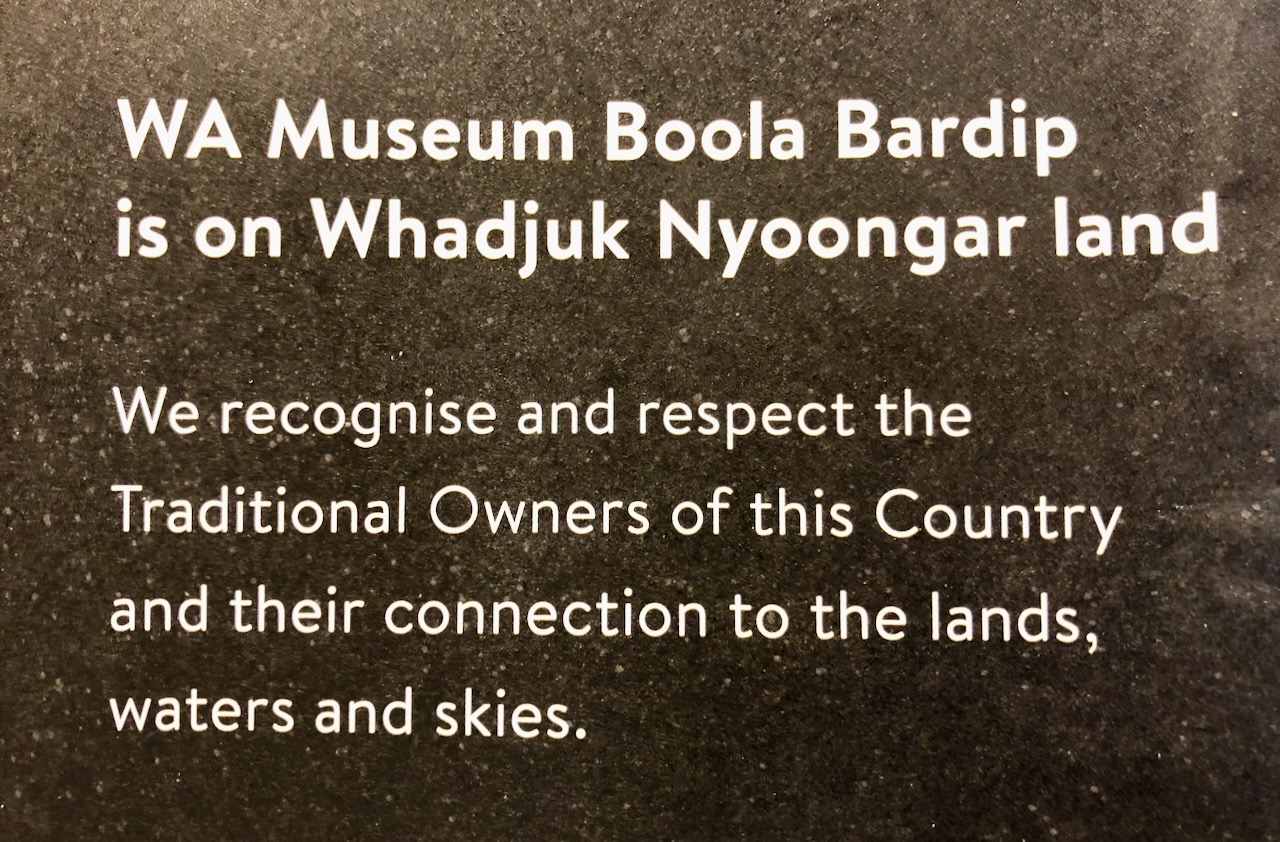
It is far from a given that a country admits, let alone apologises and atones for past wrongdoings. One could also question if it is even possible or right for a subsequent generation to apologise for the errors of a previous one. But that is what I found in today’s Australia where few locations or tourist sites, art galleries or museums, brochures or signage do not have a written acknowledgement of a specific Aboriginal people as the rightful custodians of the land. In addition, there are frequently pledges committing to respect these Traditional Owners going forward.
This is a welcome overturning of the 1835 legal principle of terra nullius – land belonging to no-one – that was implemented throughout Australia as the basis for British settlement and the negation of Aboriginal people as being civilised enough to be capable of land ownership. Even personal email signatures are now used to underline an individual’s support and respect.
I acknowledge the Whadjuk People of the Noongar Nation as the custodians of the land I live and work on.
I respect their enduring culture, their contribution to this city’s life, and their Elders, past and present.
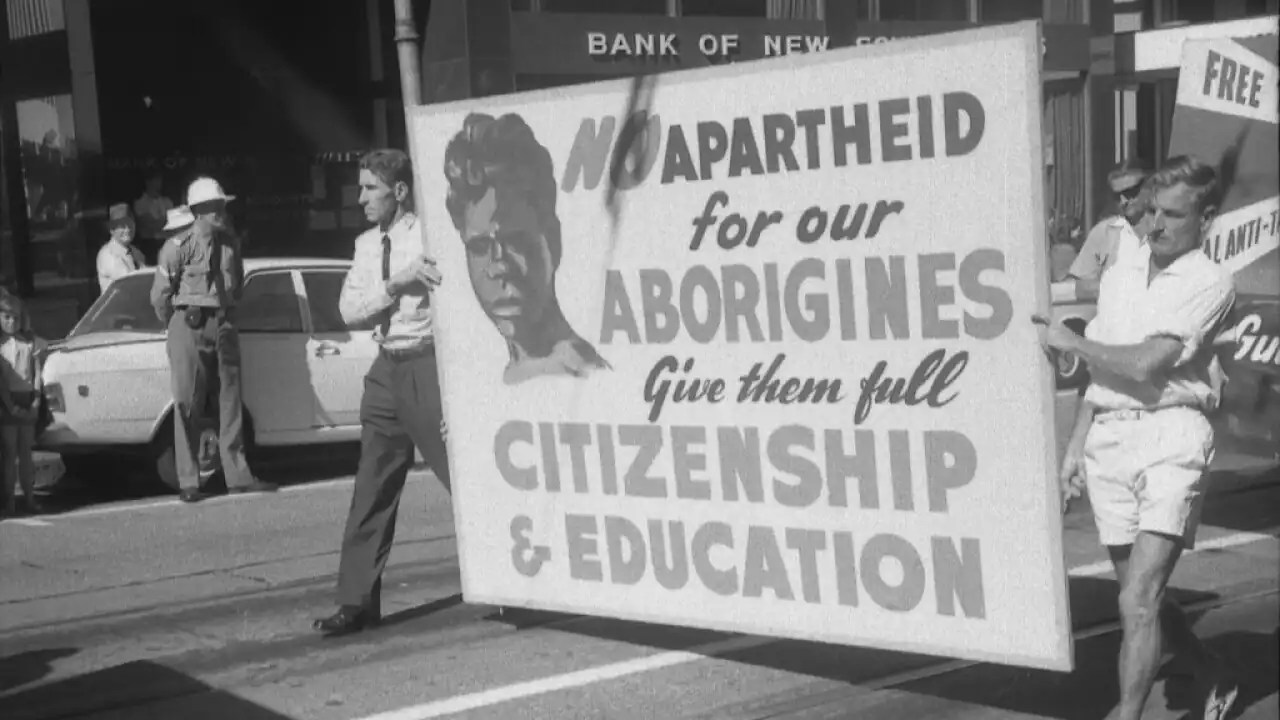
Back in 1986 when I lived in Sydney, I encountered small groups of activists who fought for Aboriginal rights. But attitudes outside the cities, despite the successful 1967 referendum, remained far from close to recognising Australia’s indigenous people as equal citizens in their own land. Even decades after the extreme discriminations of Nazi Germany’s anti-Semitic laws and actions had horrified the world, Aboriginal people were regarded as ‘wards of the state’. They were unable to own property or control their own money; they were not allowed to marry or travel without permission. If they lived in or around white communities they were segregated and prevented from using community swimming pools or sitting where they chose in a cinema.
Photo from the 1966 May Day march in Brisbane. Source: Victorian Aboriginal Health Service
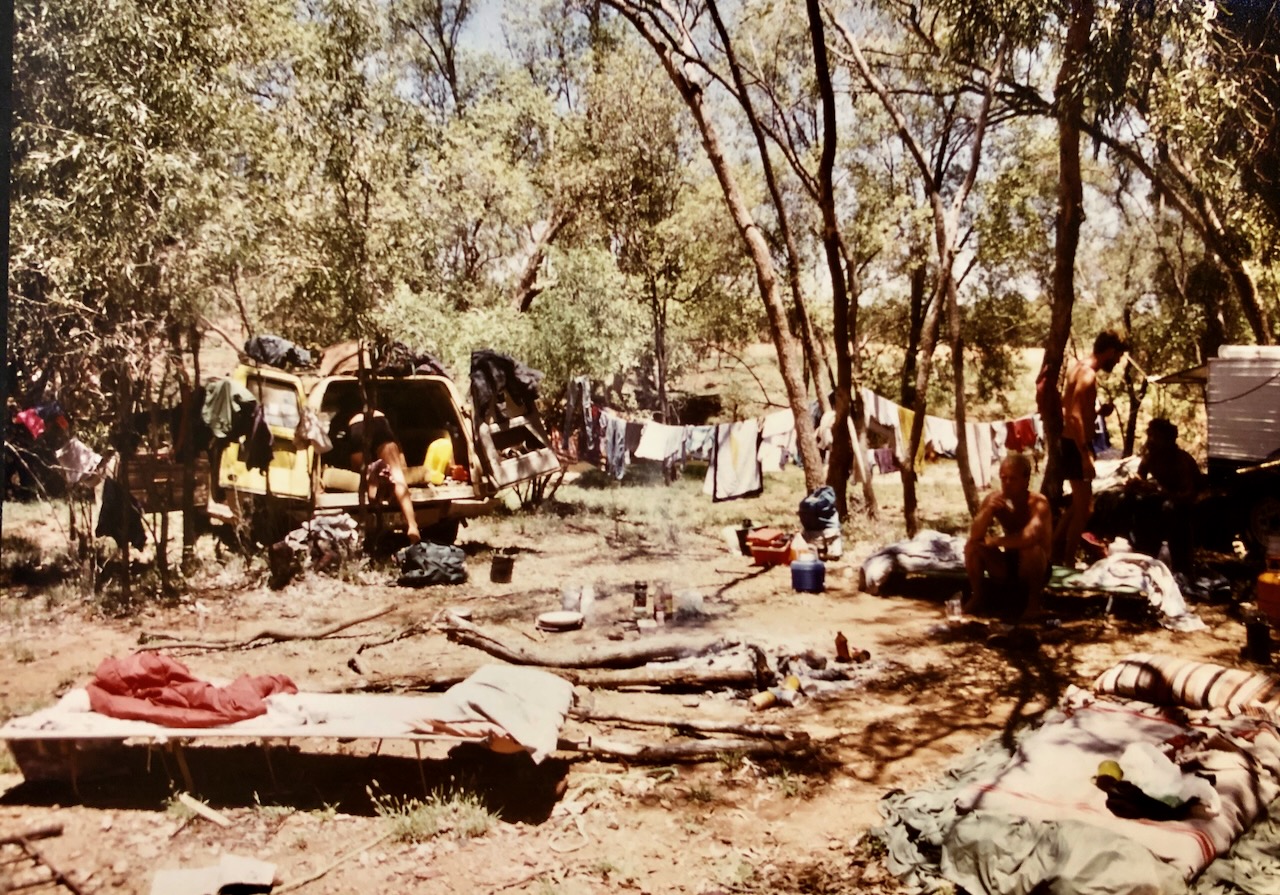
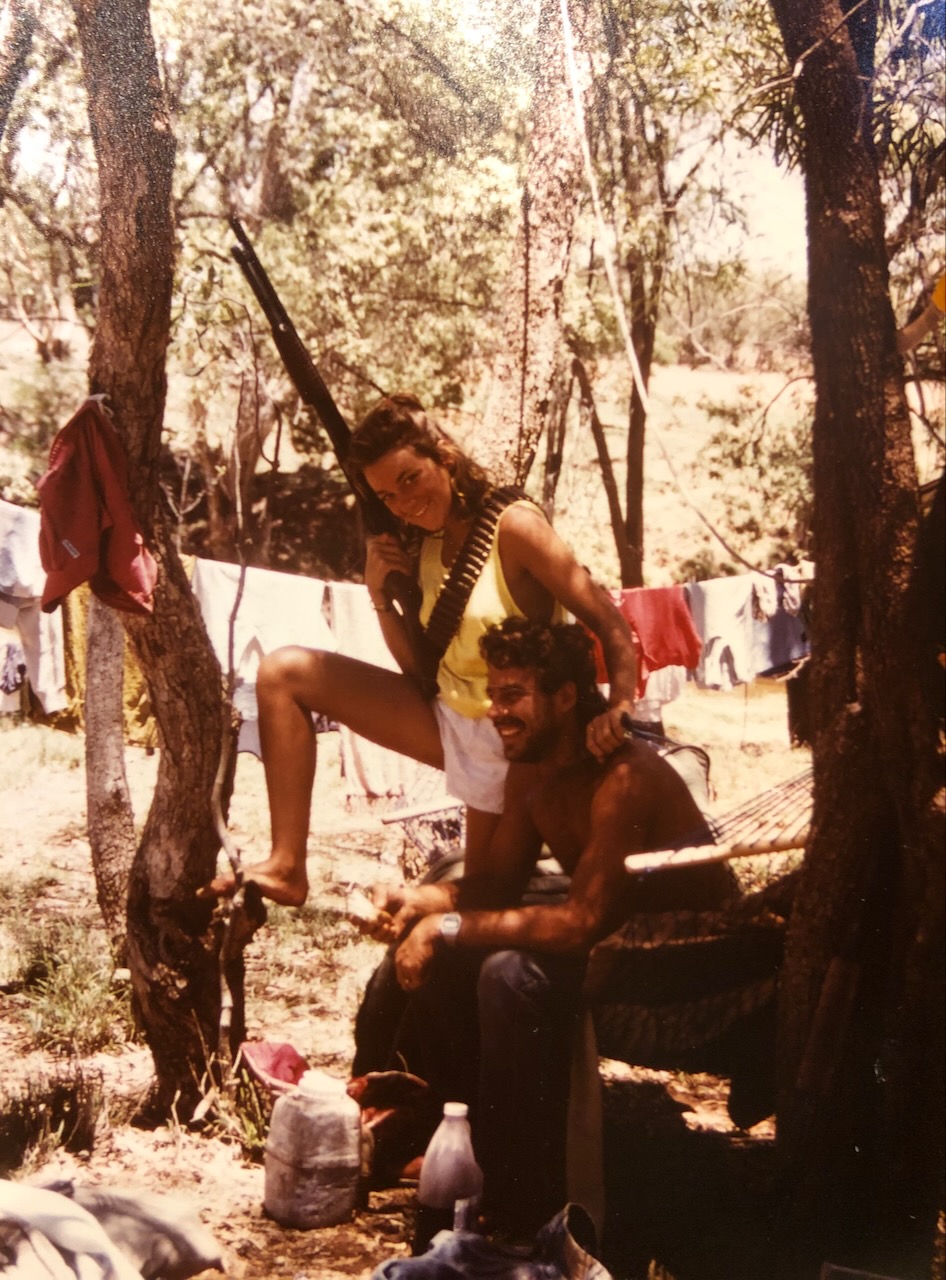
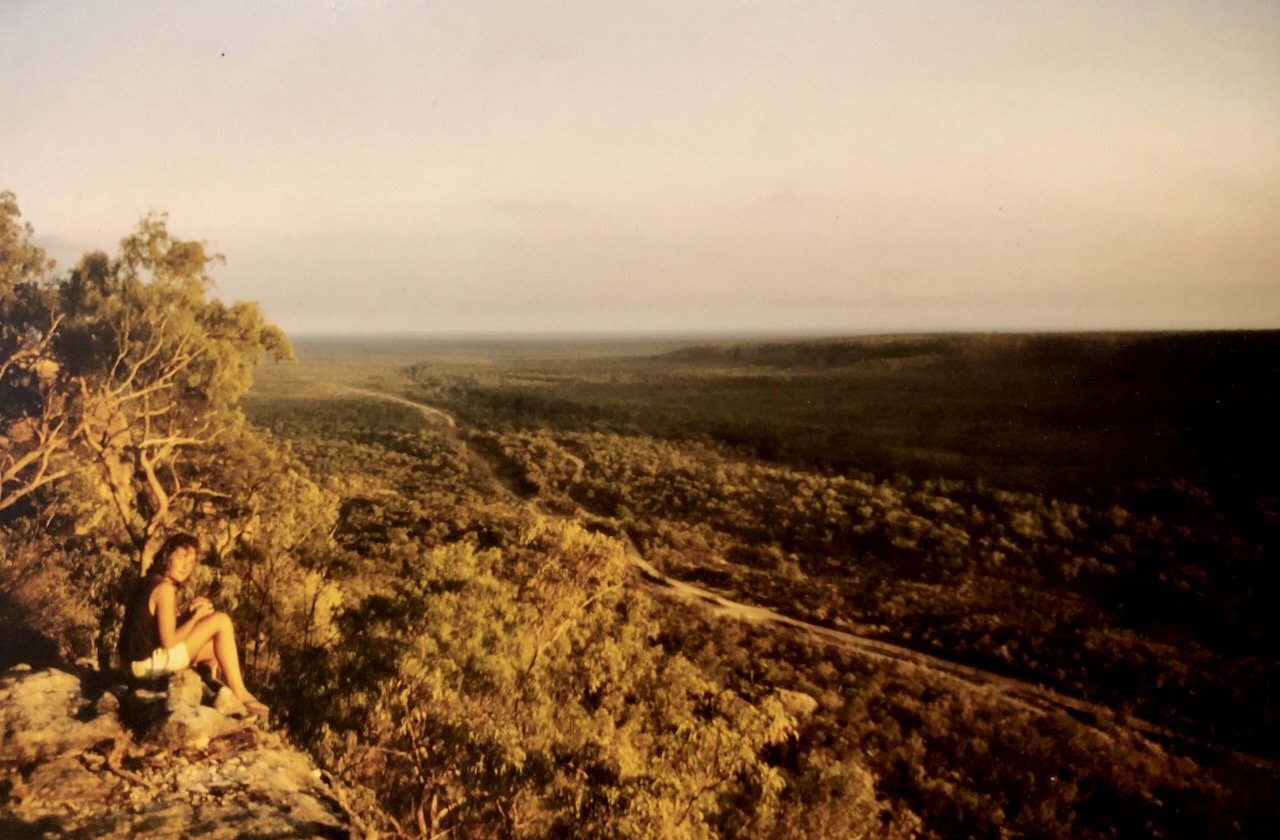
I have clear memories of my naive but adventurous, just-turned 22-year-old self bouncing across the north-eastern outback in chunky 4WDs driven by wild ockers. I remember a shoot-out at a nightclub… apparently some Aboriginals were shot at… and us fleeing the scene with extinguished headlights. The police showed up the next morning at our temporary camp on the banks of a (crocodile-infested?) river. They were not interested in the array of guns propped up against the trees, even though these could have been (but thankfully weren’t) the weapons turned against the Aboriginals. Nor did they question the men who would have used them. With apparent nods of approval to the young men’s armoury, the officers demanded to see my passport instead and carted off my terrified, less-ockery dope-head boyfriend for owning a pair of hash scales so tiny they couldn’t possibly have belonged to a dealer warranting incarceration.
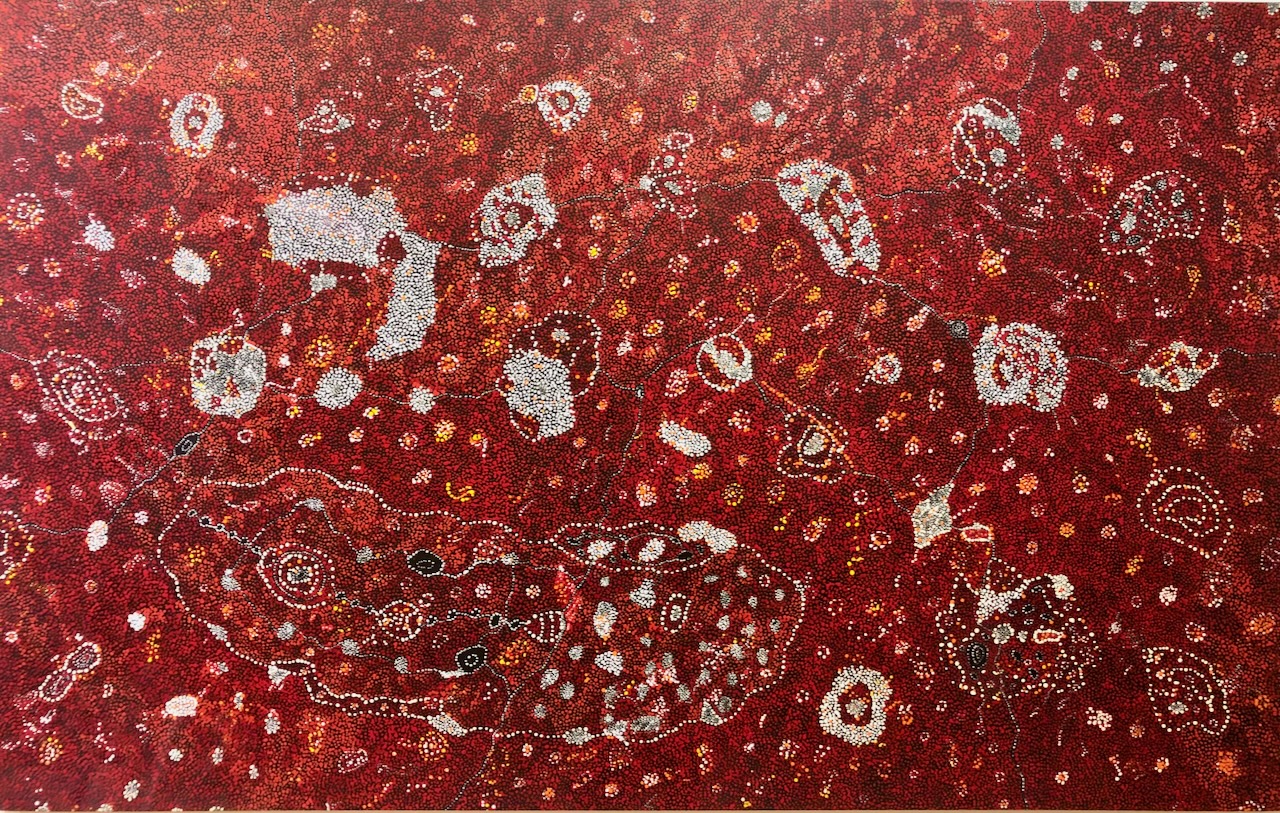
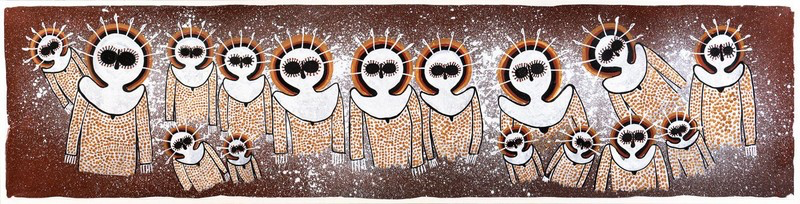
This was ‘normal’, I was told back then in response to my instinctive horror at the lack of concern for the welfare of Aboriginal people. Apart from the obvious abhorrence of such a ‘normality’, my natural tendency to root for the underdog was just one reason it all felt so wrong. Another was an inexplicable appreciation of Aboriginal culture with its ephemeral, ceremonial nature and absence of material evidence in the usual forms of temples and artefacts. I loved the simple power of their ancient handprints. The completeness of reality captured in the collections of dot paintings that began to emerge from the deserts in the seventies. I painted with earth pigments in the colours of their art. White, simply put, is the colour of spirit, black is the night, red is the land or blood, and yellow is the sun and the sacred.
by Lance Peck, b. 1975 in Carnarvon WA
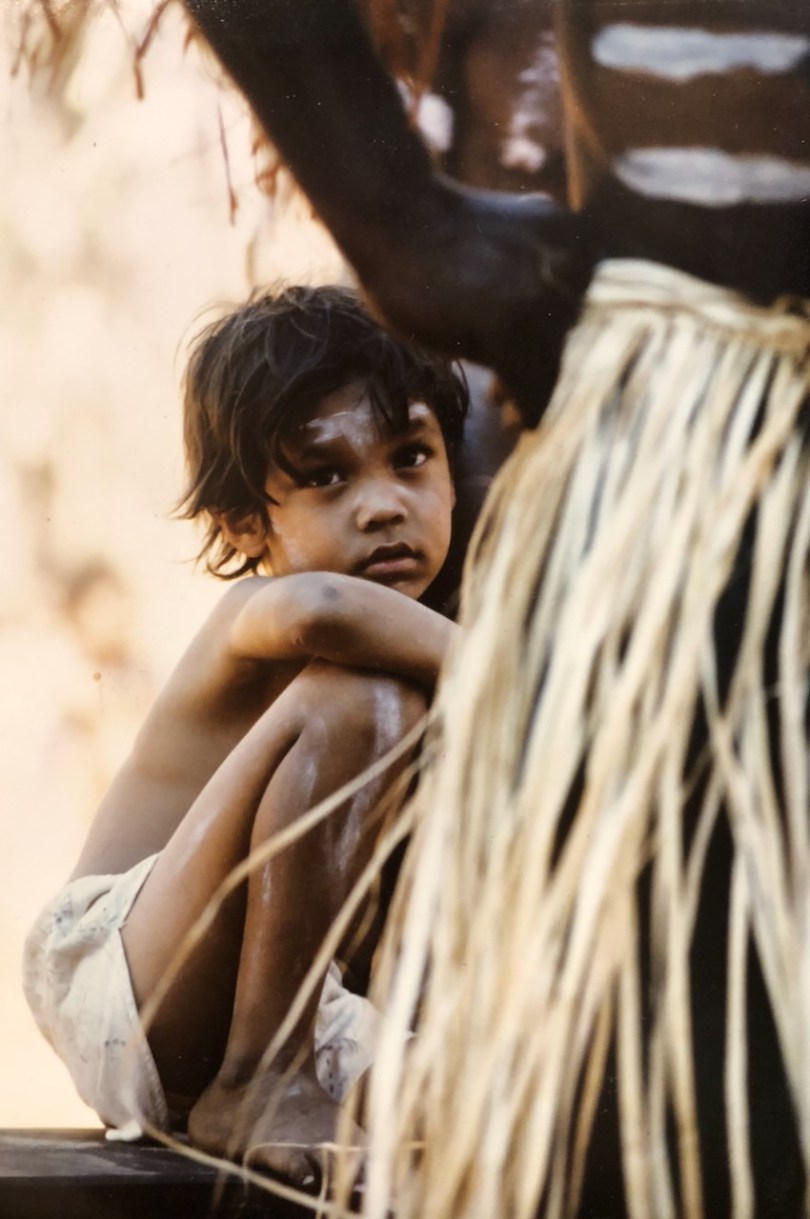
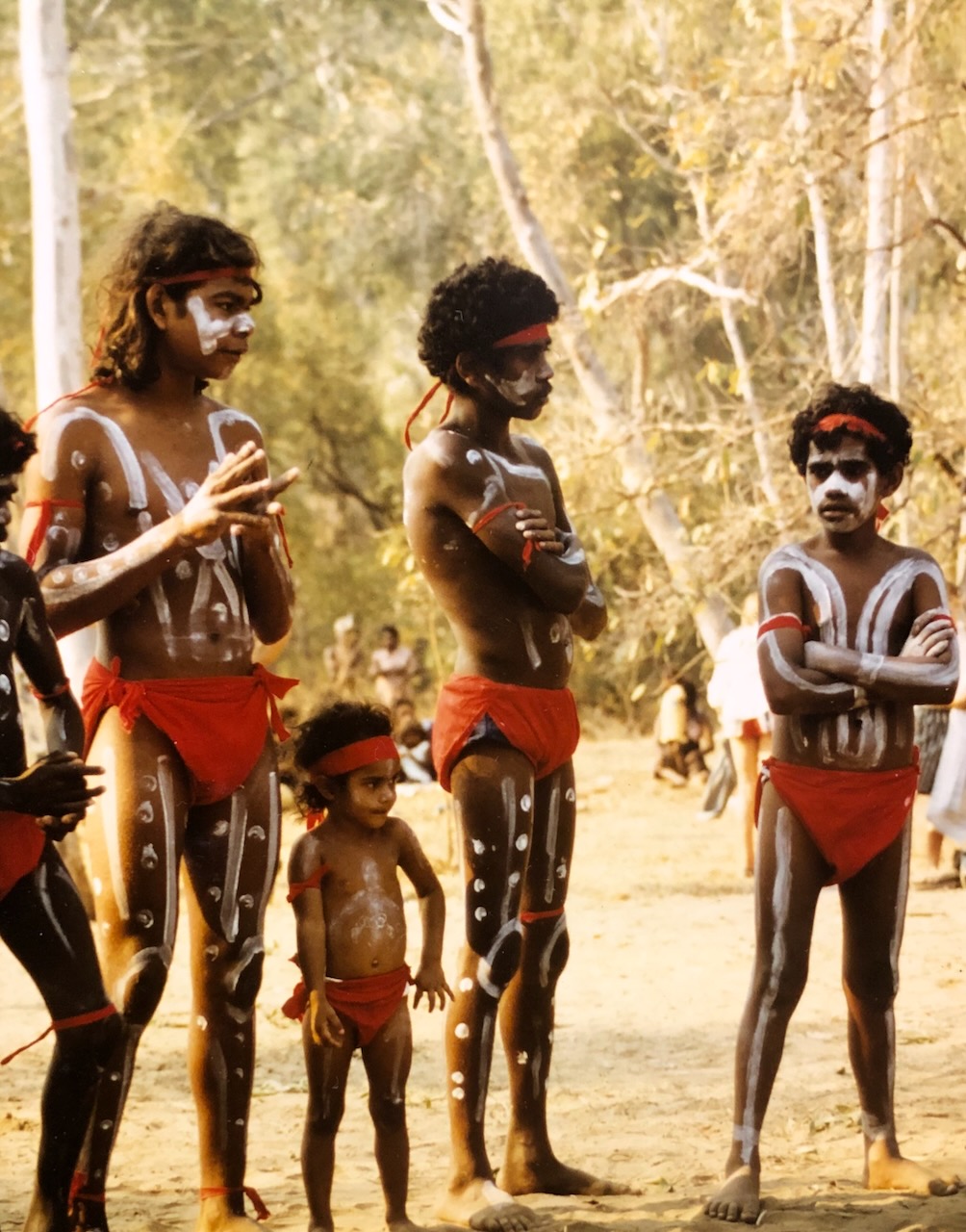
I also attended what must have been one of the first Laura Dance Festivals, a 3-day gathering of dance troupes from across Cape York and the Torres Straits held on a sacred site about 4 hours’ drive north of Cairns.
Sunrise at Laura, 1986
My photo album recalls how the Chairman of the festival arrived 2 hours late and, clad in a grass skirt and white and ochre stripes that adorned a generous belly, promptly forgot the name of the woman he was tasked with thanking. Unamused she took over and sternly instructed the dancers not to get drunk but to follow the example of their ancestors and drink wild honey.
I think Fanta was the happy compromise.
Disappointingly for many Australians, the Voice referendum last October saw 60% of votes pitched against further constitutional recognition of First Nations people. The slogan ‘If you don’t know, vote No’ was eerily reminiscent of some of the Brexit referendum tactics (ahem…lies) that particularly appealed to ignorance or those who felt left behind.
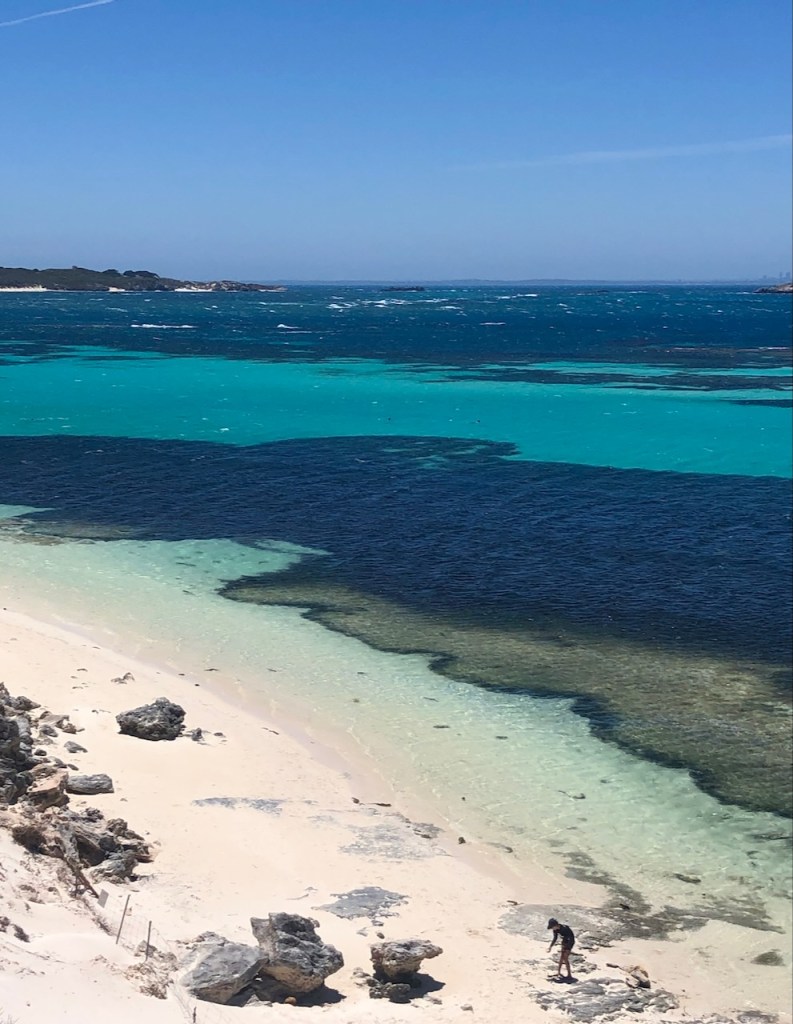
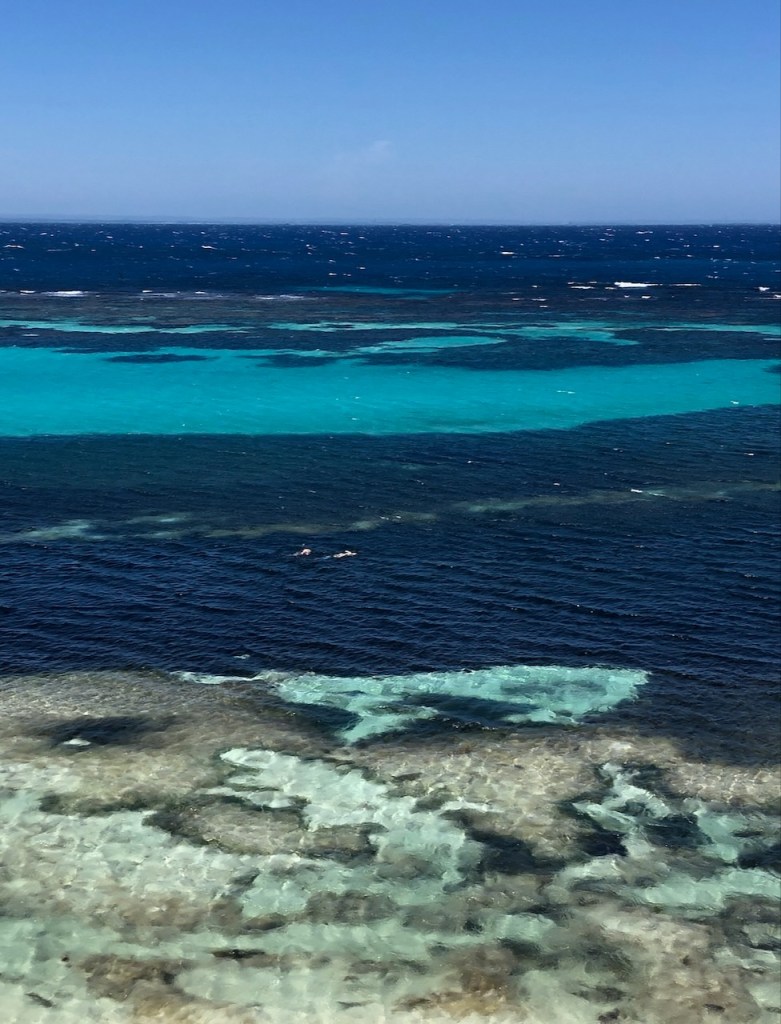
Nonetheless, in certain places in WA and no doubt all over the continent, I found sincere apologies for Australia’s past treatment of its first people. An Island off the coast of Fremantle, just south of Perth in WA, is one such place.
Between 1838 and 1931 the beautiful island of Wadjemup, also known as Rottnest Island, served as a prison for approximately 4000 Aboriginal men and boys from Western Australia. At least 373 of these prisoners died in custody and were buried in an area currently referred to as the Wadjemup Aboriginal Burial Ground. Many of them were leaders, law men and warriors, the guardians and carriers of a nation’s knowledge and stories. Their absence created turmoil in their communities and a sense of loss still felt today.
For decades, insensitivity towards the plight of those prisoners and their families manifested in the decision to transform the Island from an Aboriginal penal settlement to a recreation and holiday destination. As part of this transformation, the area where the burial ground is located was repurposed as a camping ground known as Tentland, and the Quod (main prison building) was converted into a hostel. As in so many countries the world over, the painful history of the Island as a place of incarceration was concealed.
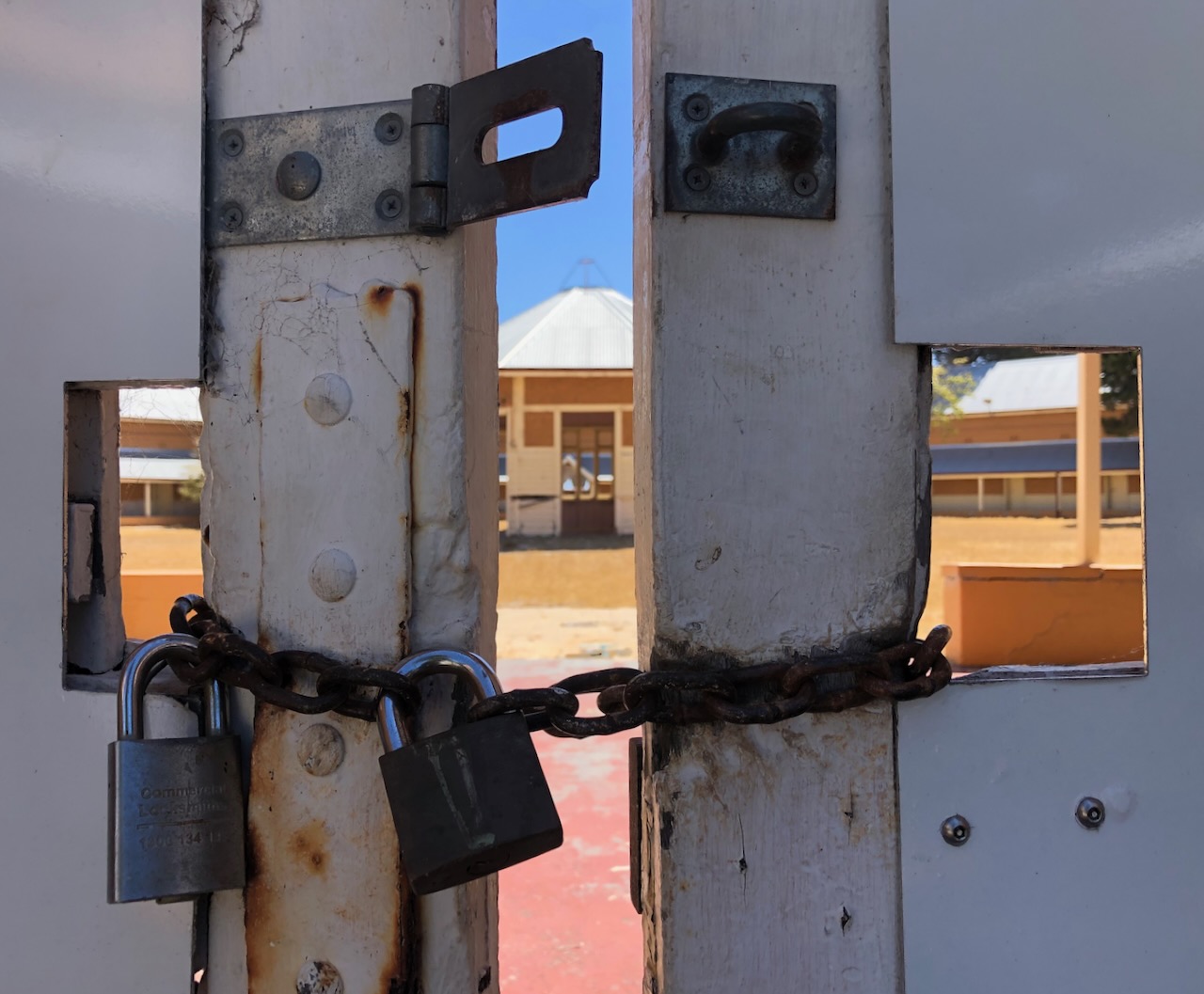
Tentland was only closed in 2007. The Quod hostel now lies behind locked padlocks.
On November 6th, 2021, the Rottnest Island Authority (RIA) Board delivered an official apology to the Aboriginal people of Western Australia for their role in ‘the obfuscation’ of the prison history and the disrespect of past practices:
“We recognise that this has caused great pain and anguish within Aboriginal communities. For this we apologise…. We will continue to work in collaboration with the Whadjuk Noongar people and the wider Aboriginal communities of Western Australia to promote reconciliation and acknowledge the past.”
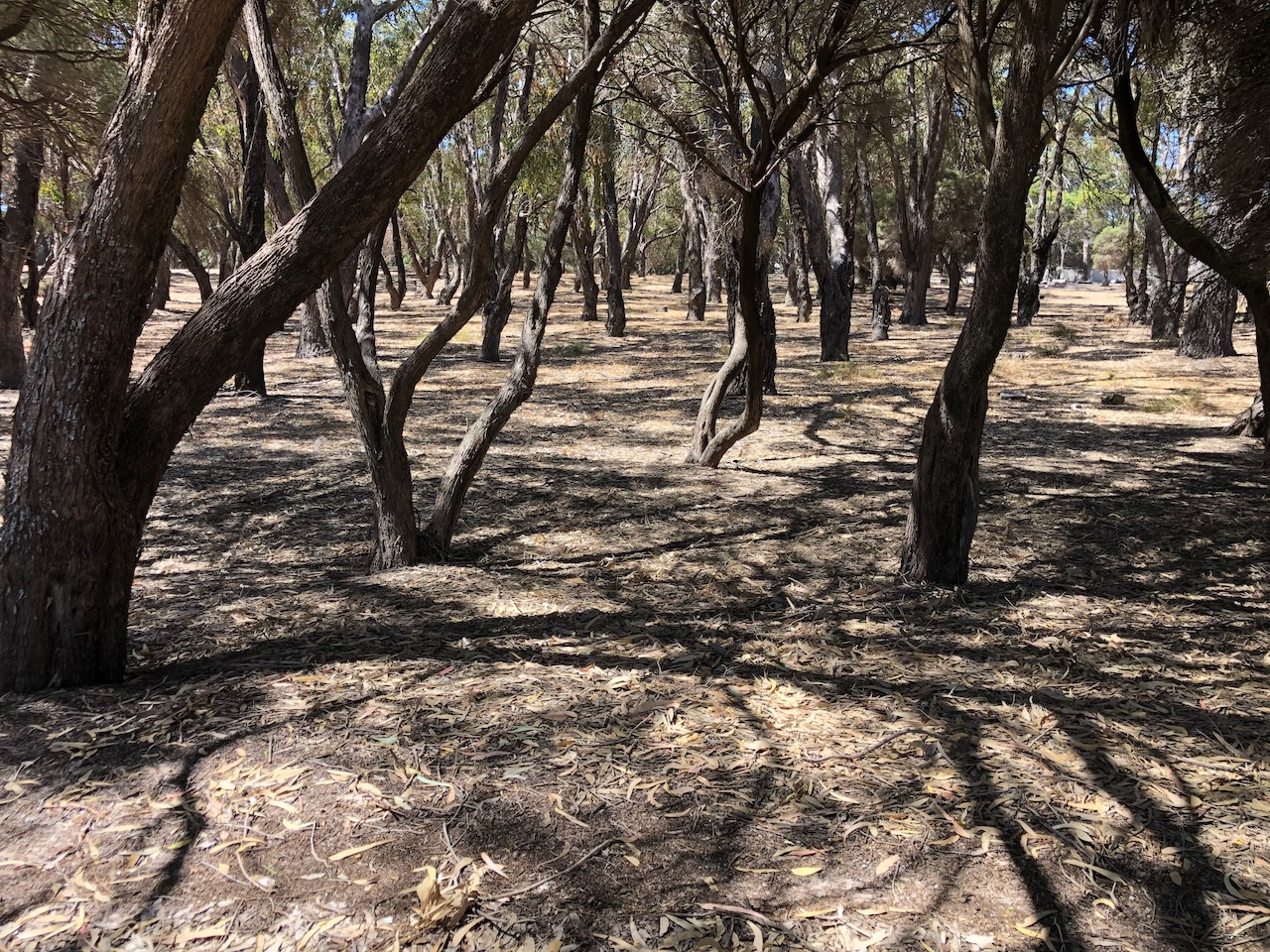
I can imagine this has been welcomed by most, though it was distressing to visit the excellent little museum only to find the banging music and loud voices of a surfing film drowning out the important and deeply moving – when you could hear them – testimonies of descendants of the those imprisoned here. And while the little port hummed with ice-cream-licking tourists on bicycles, I found myself completely alone walking the periphery of the nearby burial ground, following the instructions of intermittent signs reminding you that the spirits of those who died remain here among the trees, part of the island.
Listen for a moment.
See and understand.
The spirits of the land
are speaking. Listen…
Kwidja baalap yey – The past is still present.
Our world is full of conflicts based on collective blame, attributions of guilt and/or a need to redress a national humiliation or wrongdoing. Such a binary dynamic is eternal, cyclical and as old as the world. Admissions of guilt accompanied by apologies are rare and largely avoided for multiple reasons, from not wanting to lose face or moral high ground to fearing being landed with restitution and reparation costs. Retrospective apologies are frequently considered hollow or politically motivated. So what options does that leave?
Australia’s example will be considered by many as flawed and insufficient; too little too late. But the country’s efforts to recognise the pain inflicted is surely better than ignoring its lasting impact. The visionary Ngarinyin lawman David Banggal Mowaljarlai offers us a way forward. Born in 1925 on the Kimberley coast, he lived a traditional life but became adept in both cultures becoming, among other things, a Presbyterian lay minister, a painter, a social justice advocate and a land rights activist who then travelled the world as storyteller, thinker and educator. “We are really sorry for you people,” he said in one of his many broadcasts to ‘whitefellas.’ “We cry for you because you haven’t got meaning of culture in this country. We have a gift we want to give you… it’s the gift of pattern thinking.”
When I read this is Tim Winton’s ‘Island Home,’ (p.231-3) it clarified to me what I have always loved about Aboriginal art: the innate interconnectivity between human beings, nature and the universe that run far deeper than any divisions of nationality, colour, language, religion etc. Mowaljarlai’s ‘Two Way Thinking’ is a philosophy of mutual respect, mutual curiosity and cultural reciprocity. The uniting principle of ‘mutual obligation’ that became a catchphrase loved by politicians, of course extends to the natural world. To me it offers a genuine way forward that transcends any hopelessness and helplessness we might feel towards the huge problems we all, as a human race, are, or will be facing.
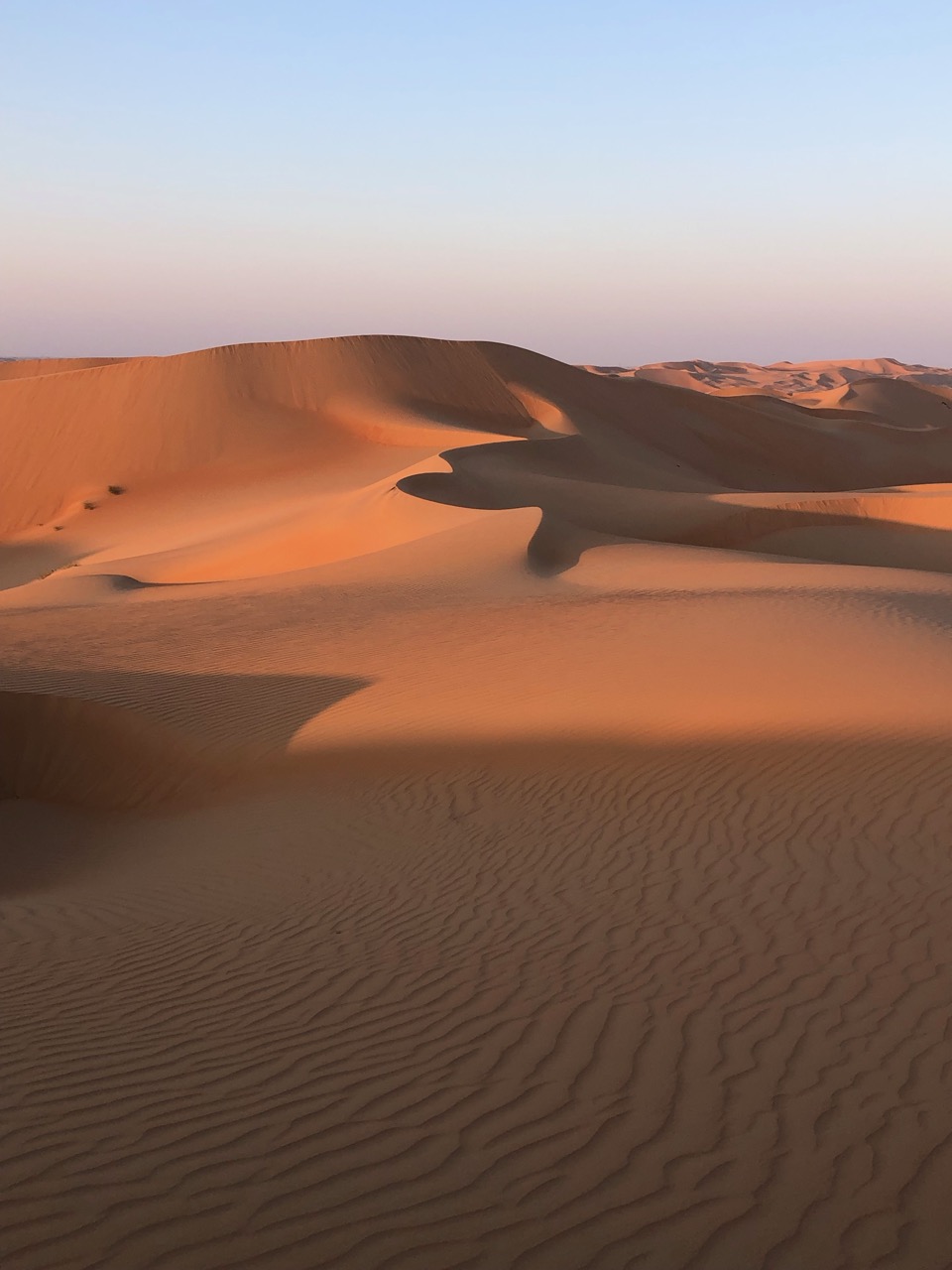
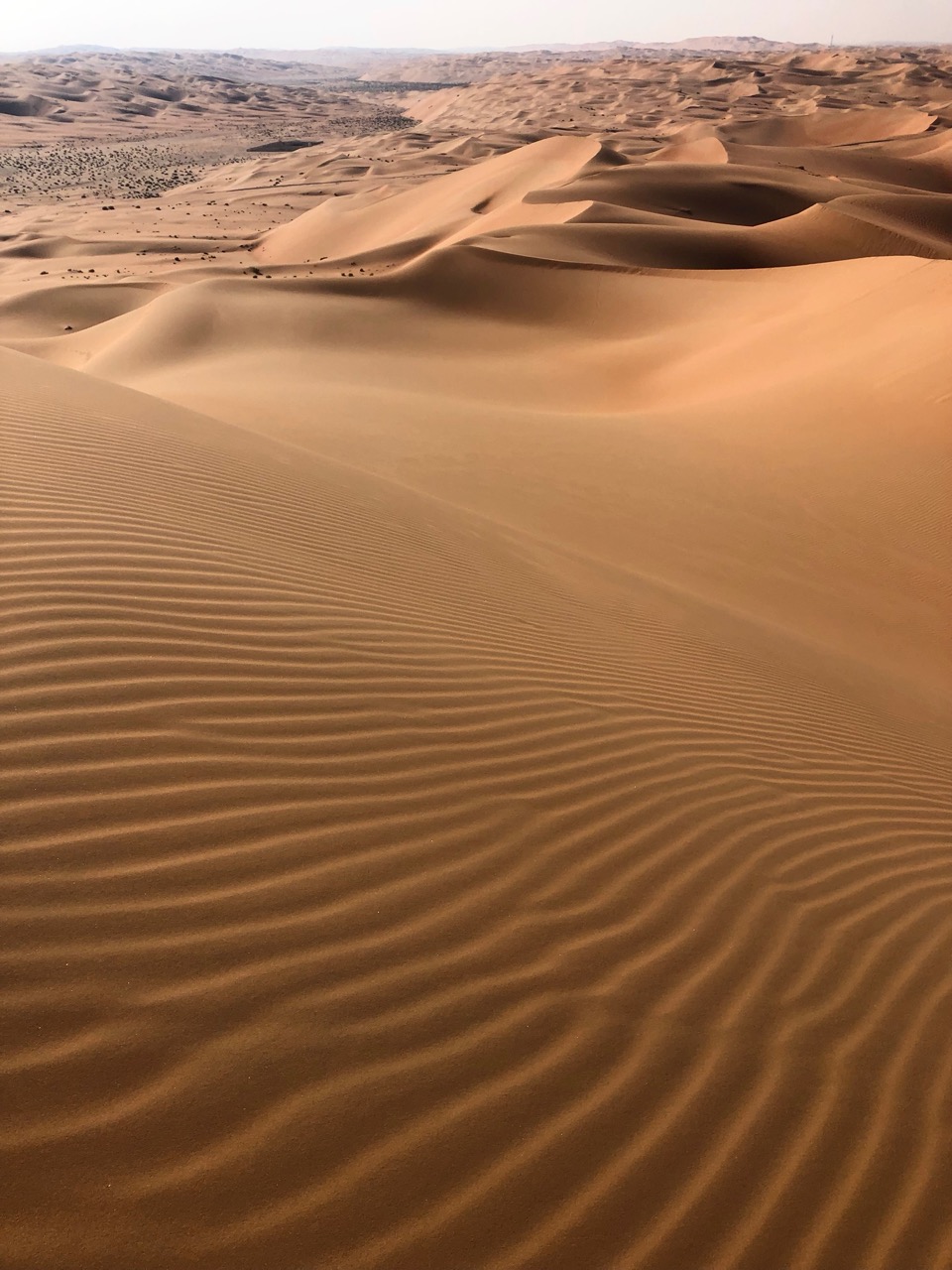
As Cop28 UAE drew to its unsatisfactory conclusion, it felt ironic to find myself standing in the Rub’ al Khali desert south of Abu Dhabi,home to the largest oilfield in the world, learning from a little tour into the dunes how fossil fuels were created from, well, fossils. I know, duh, so obvious. But they are the fossils of the living creatures that died out when the earth heated and killed them all. It was one of those kind of cosmic full circle / cycle moments.
I was never naturally drawn to the Middle East, but when an opportunity arose to visit the United Arab Emirates, I embarked on the trip with the same determination with which I approached the research behind my book on WW2: to suspend judgement of perceived villains in order to try to understand, in this case those who are producing the black sticky substance that is now threatening to kill us all.
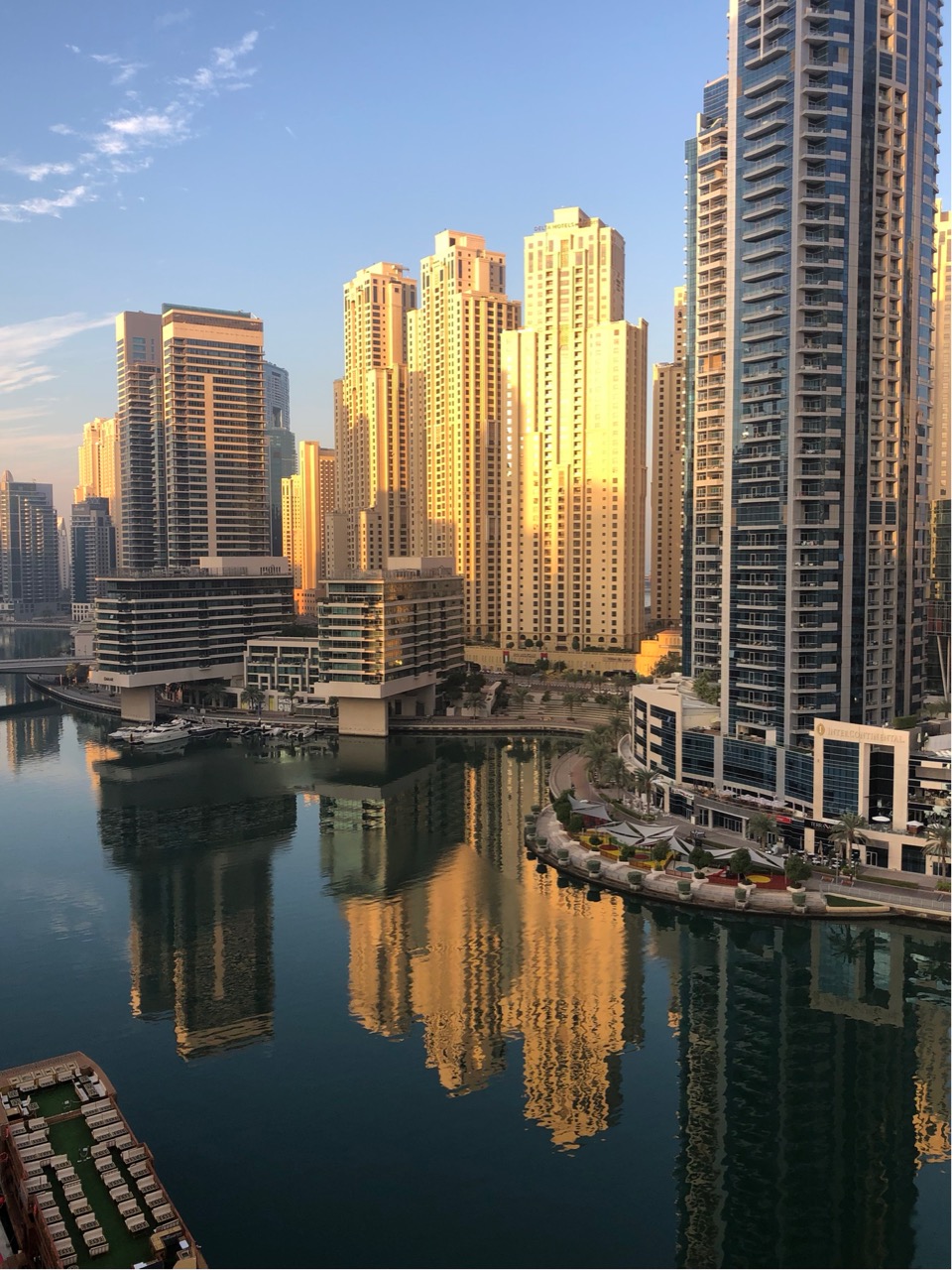
Within the context of the environmental disaster story, it is all too easy to dismiss places such as Dubai as mere playgrounds for foreign fat cats, one Big Dick competition between oil-rich nations with just-because-we-can attitudes. Yet within minutes of my arrival, my jaw was hanging open and it rarely closed over the following week.
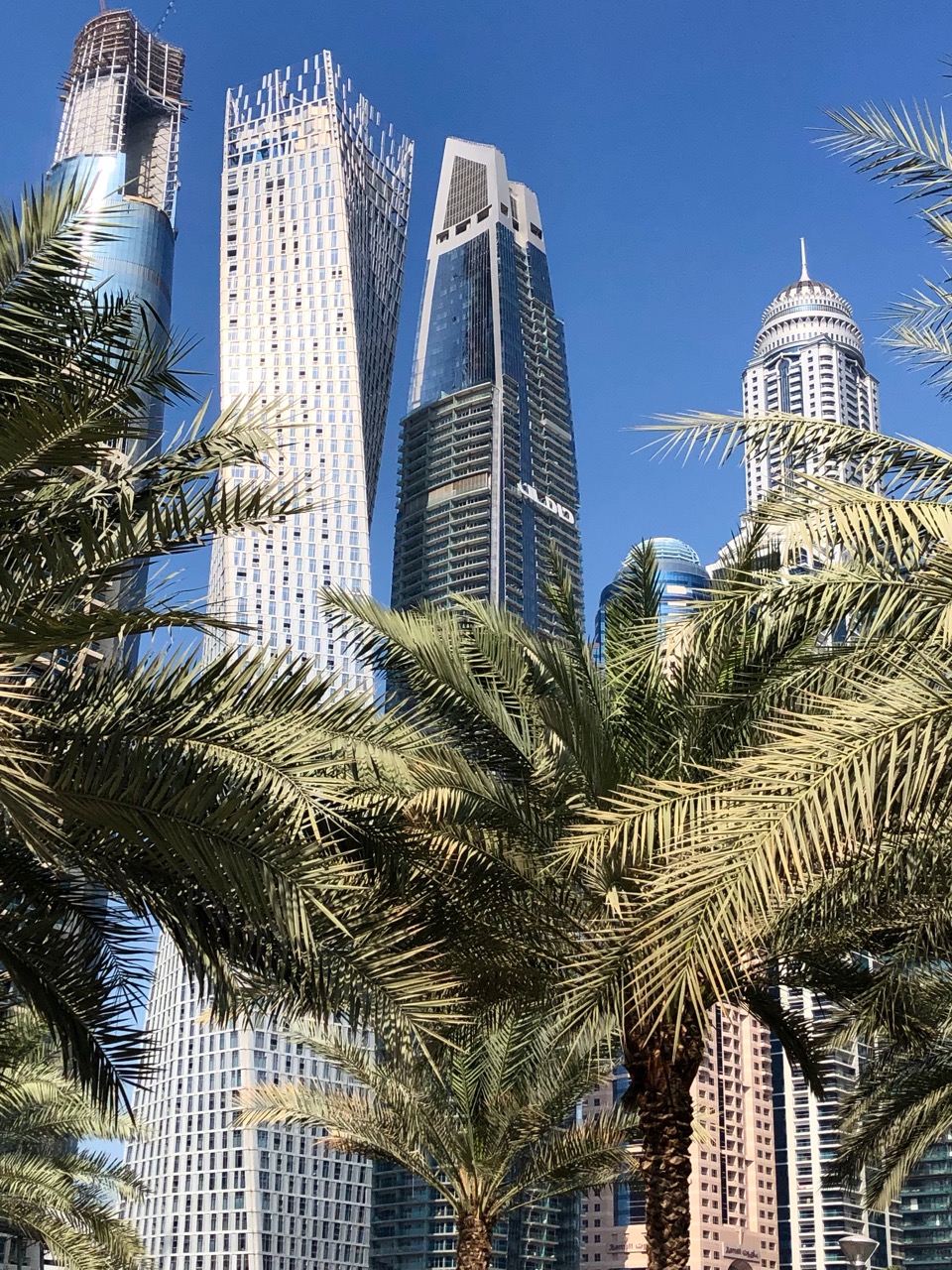
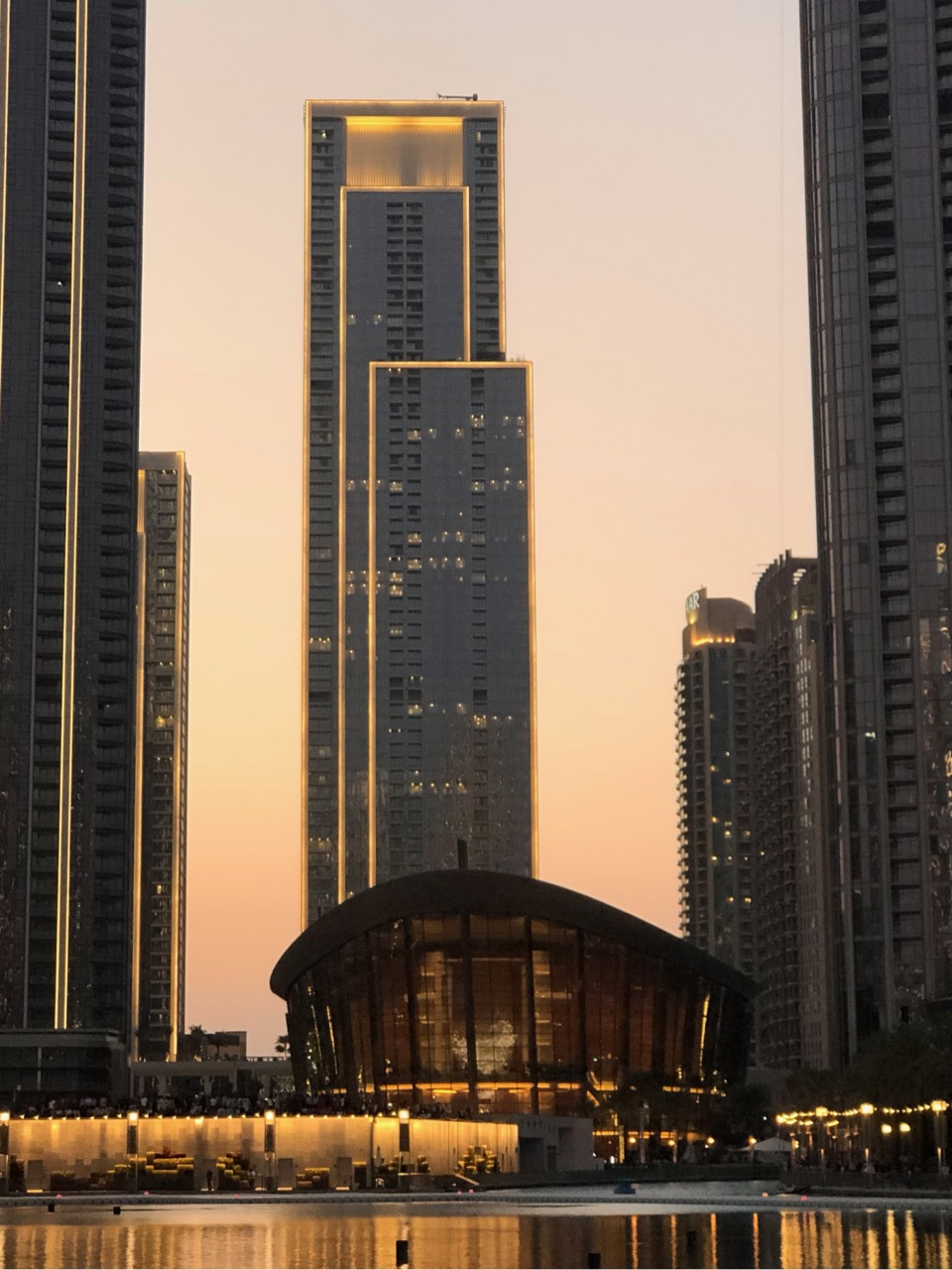
My astonishment came not so much from the giddying heights of shiny vertical monoliths thrusting into an intense cobalt sky scribbled with diagonal crane arms, but from the fact that less than eighty years ago when much of Europe lay in ruins, this whole area was desert inhabited by nomadic Bedouin living in tents. After so many years focused on the destruction of war, I found it staggering, humbling, inspiring even to witness construction on such a scale: 360° infinity pools suspended 200 meters in the air, restaurants, offices, malls, endless apartments (all serviced by smiley Indians, Pakistanis and Africans keen to make money as most Emiratis don’t work or even live here.) Not to mention the Burj Khalifa, the worlds tallest building at 830 meters…
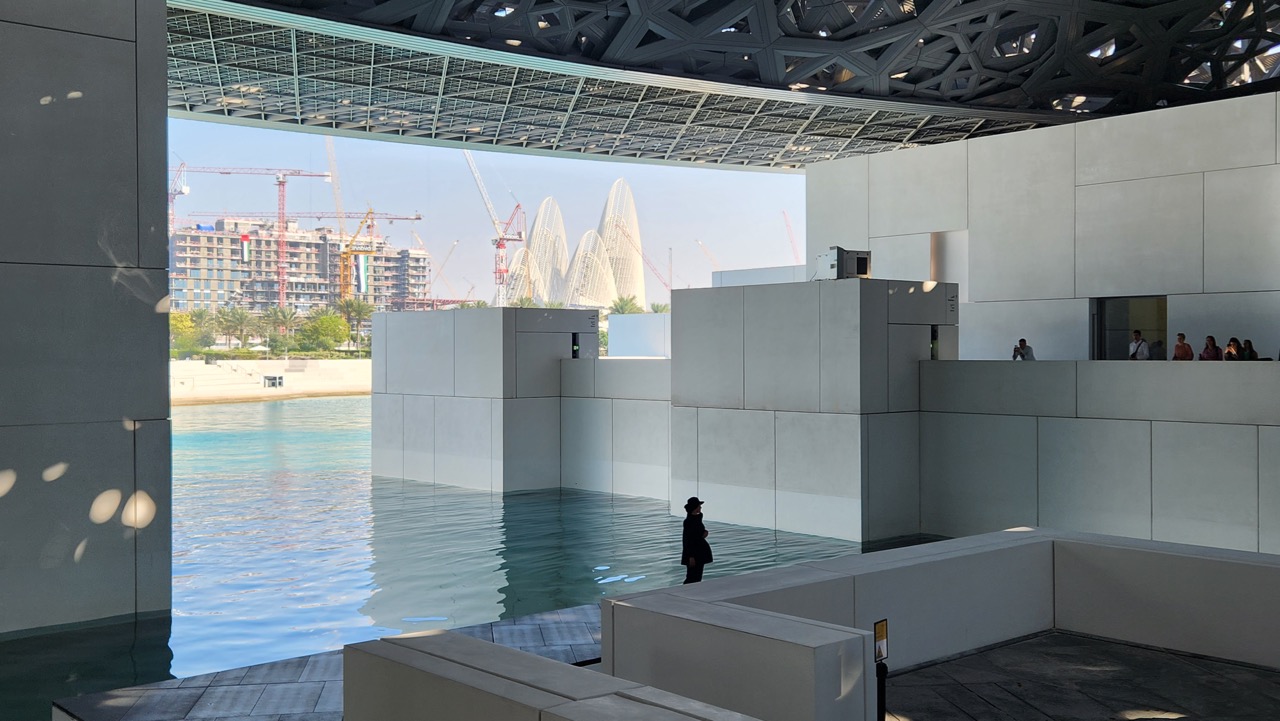
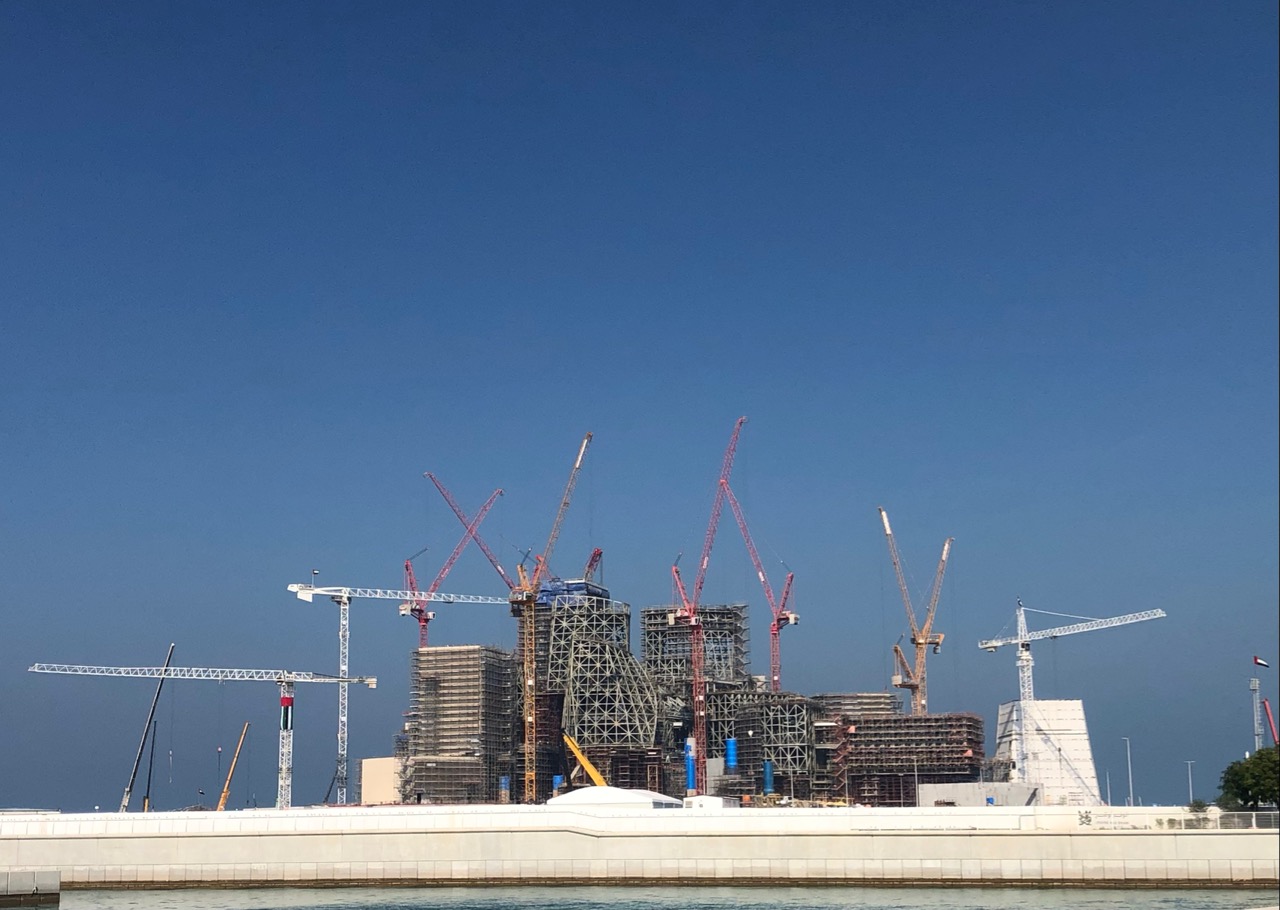
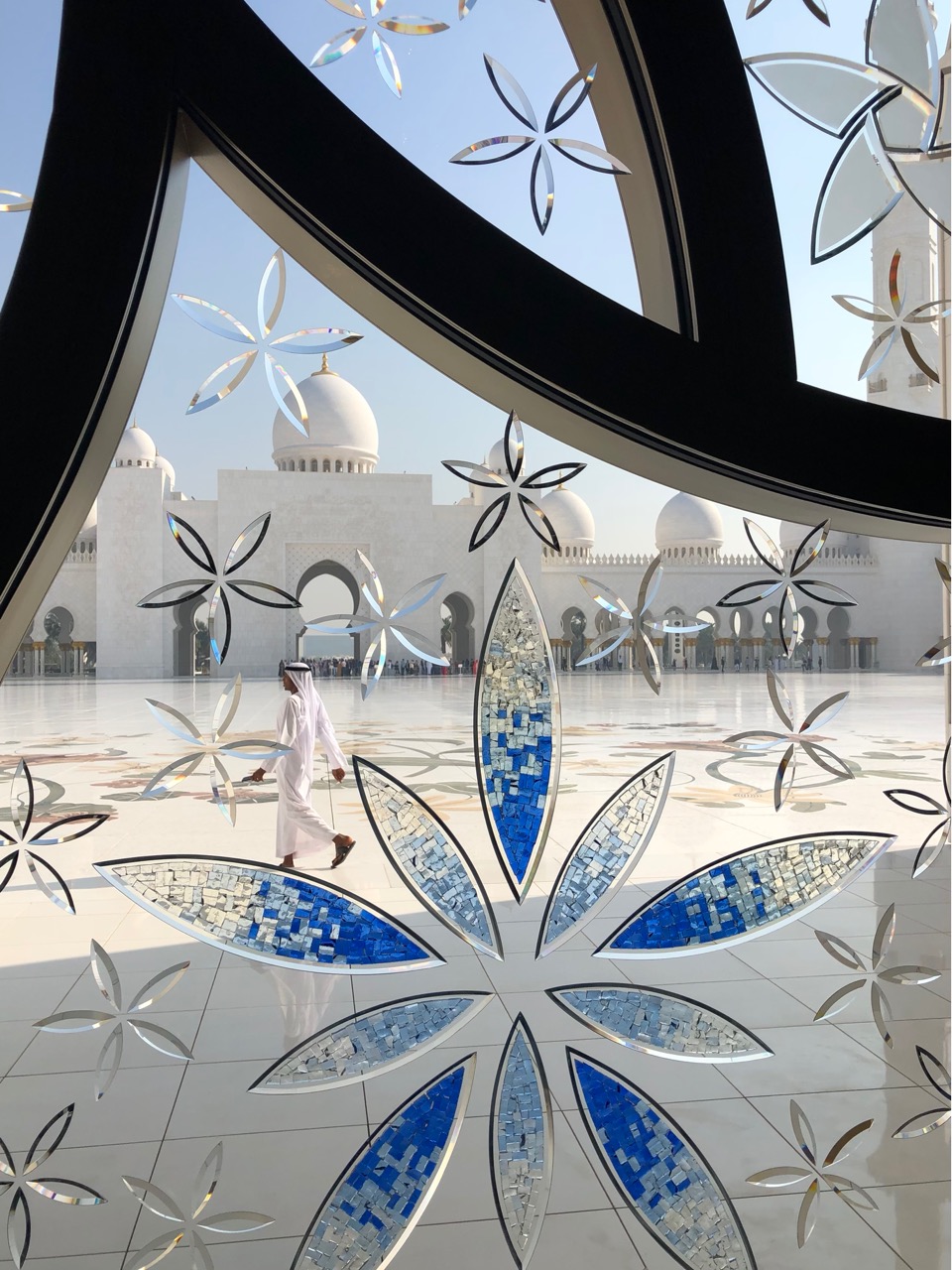
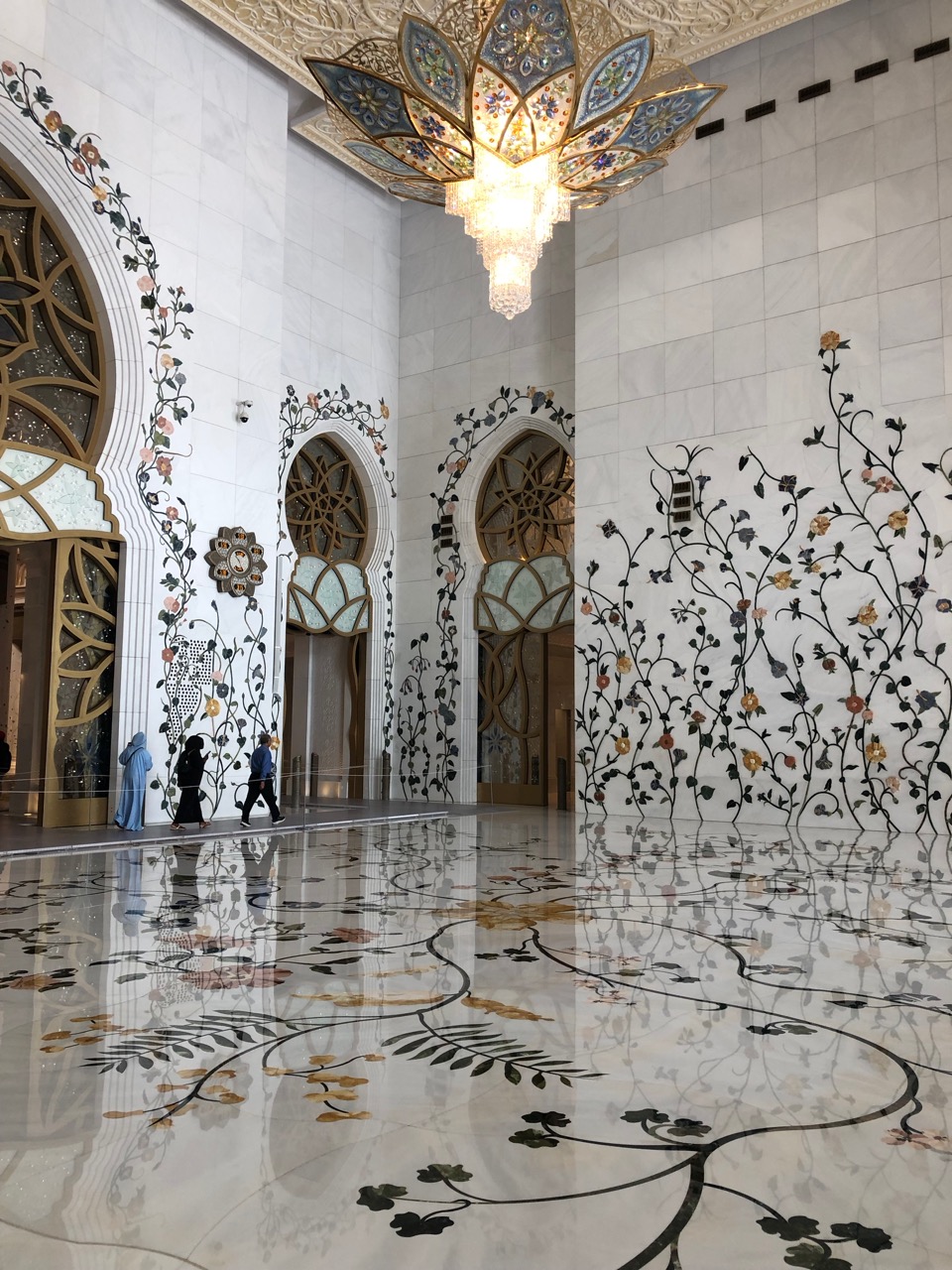
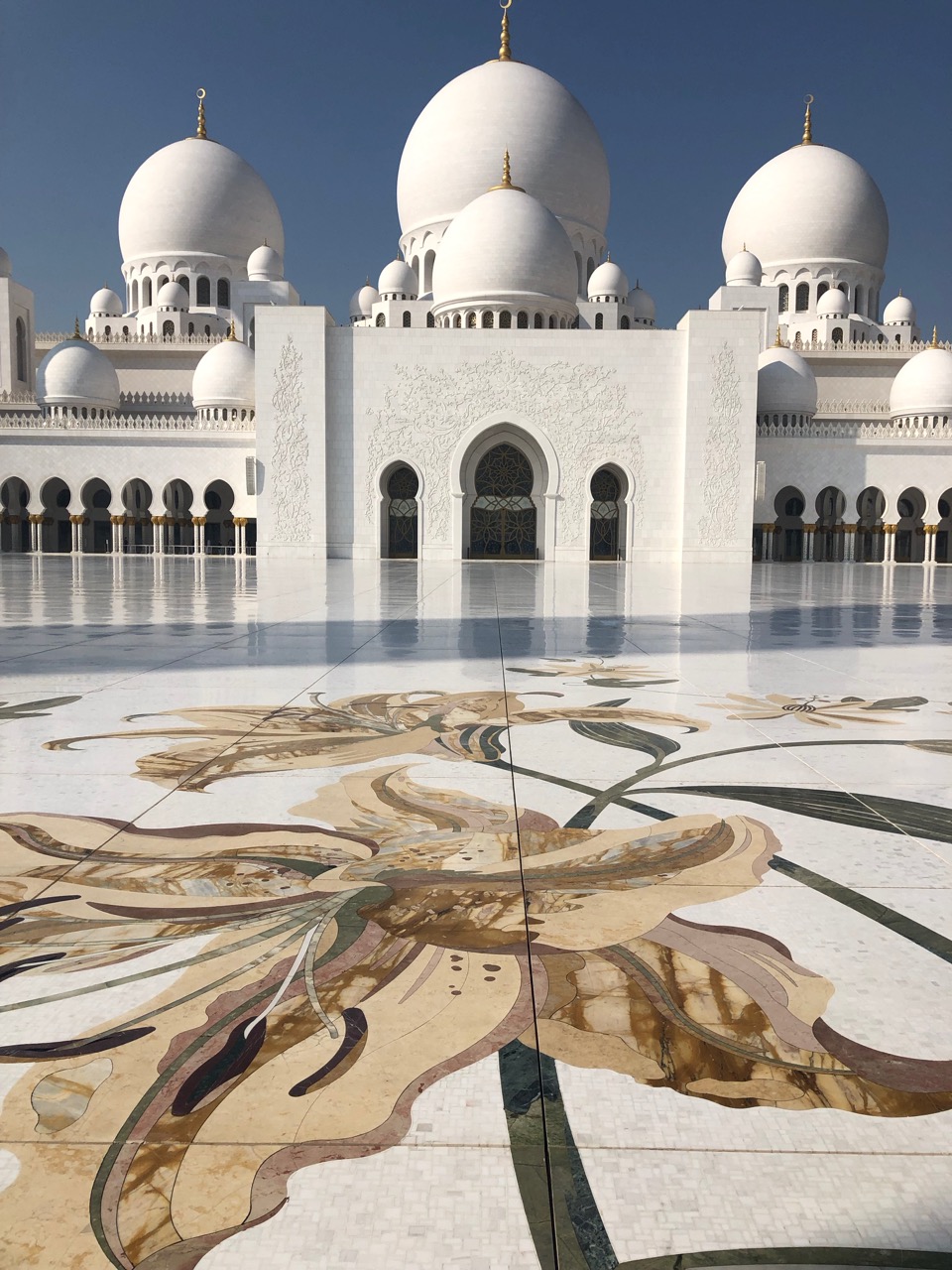
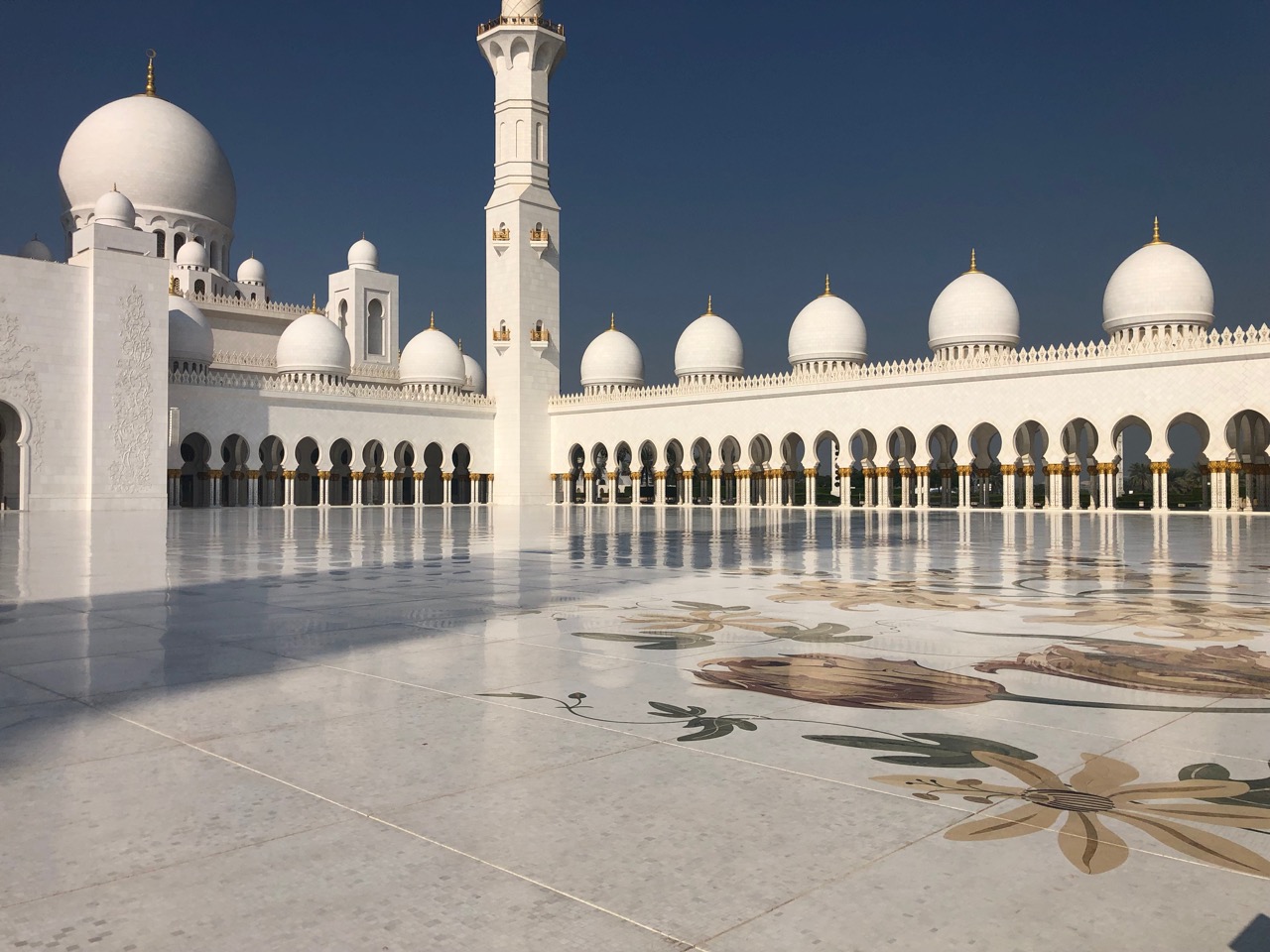
Further down the coast in Abu Dhabi, a brand-new Louvre, a Guggenheim in the making, the breath-takingly beautiful Sheikh Zayed Grand Mosque and vast Qasr Al Watan Presidential Palace… (in order below)
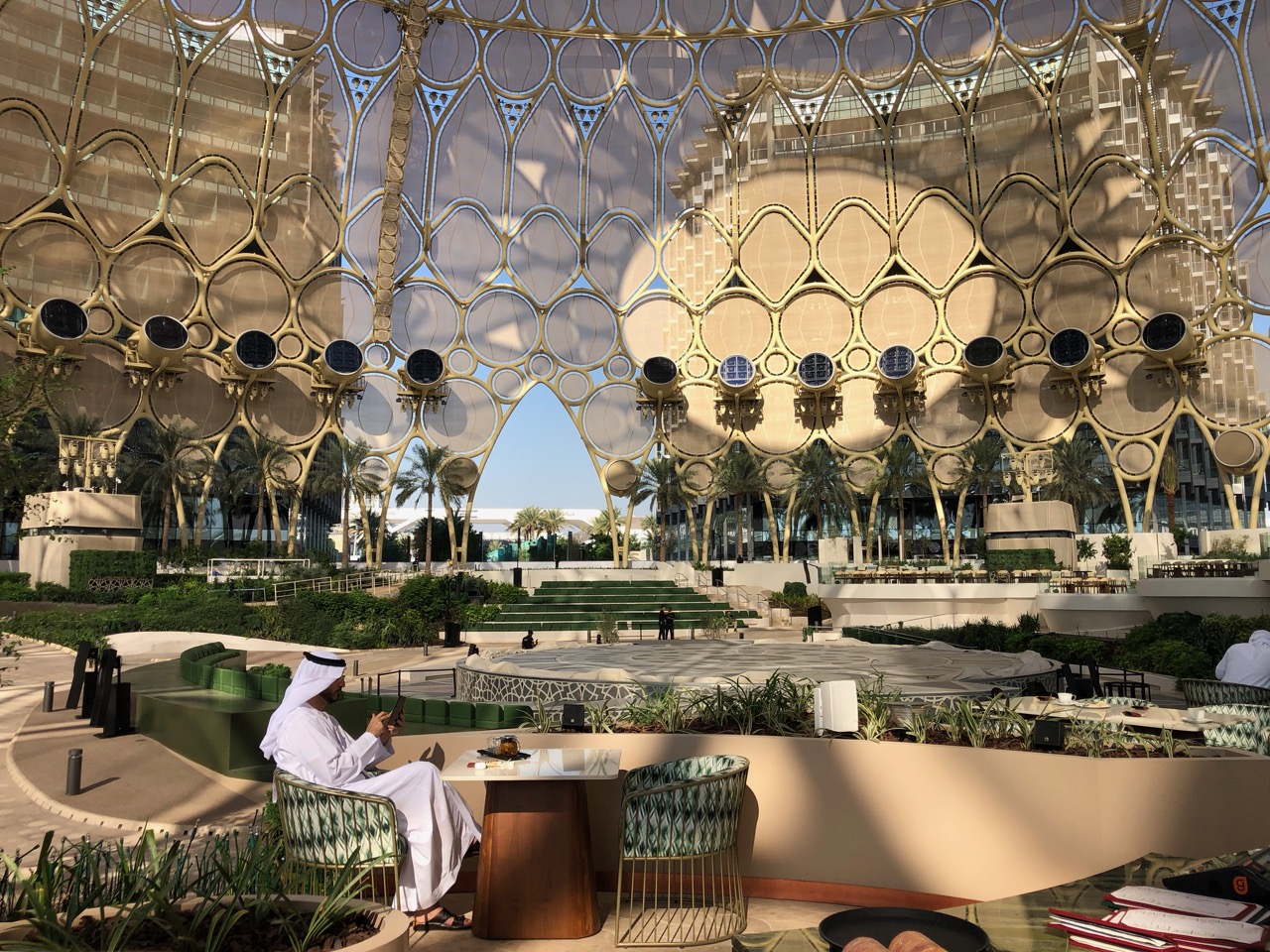
Terrible inequalities within this gleaming urban landscape are inevitable and as old as the world. But for once I allowed myself to temporarily look beyond the blatant, at times nauseating bling and consumerism and enjoy areas where sheer skill and innovation meet deeply considered, exceptionally designed aesthetics and architecture.
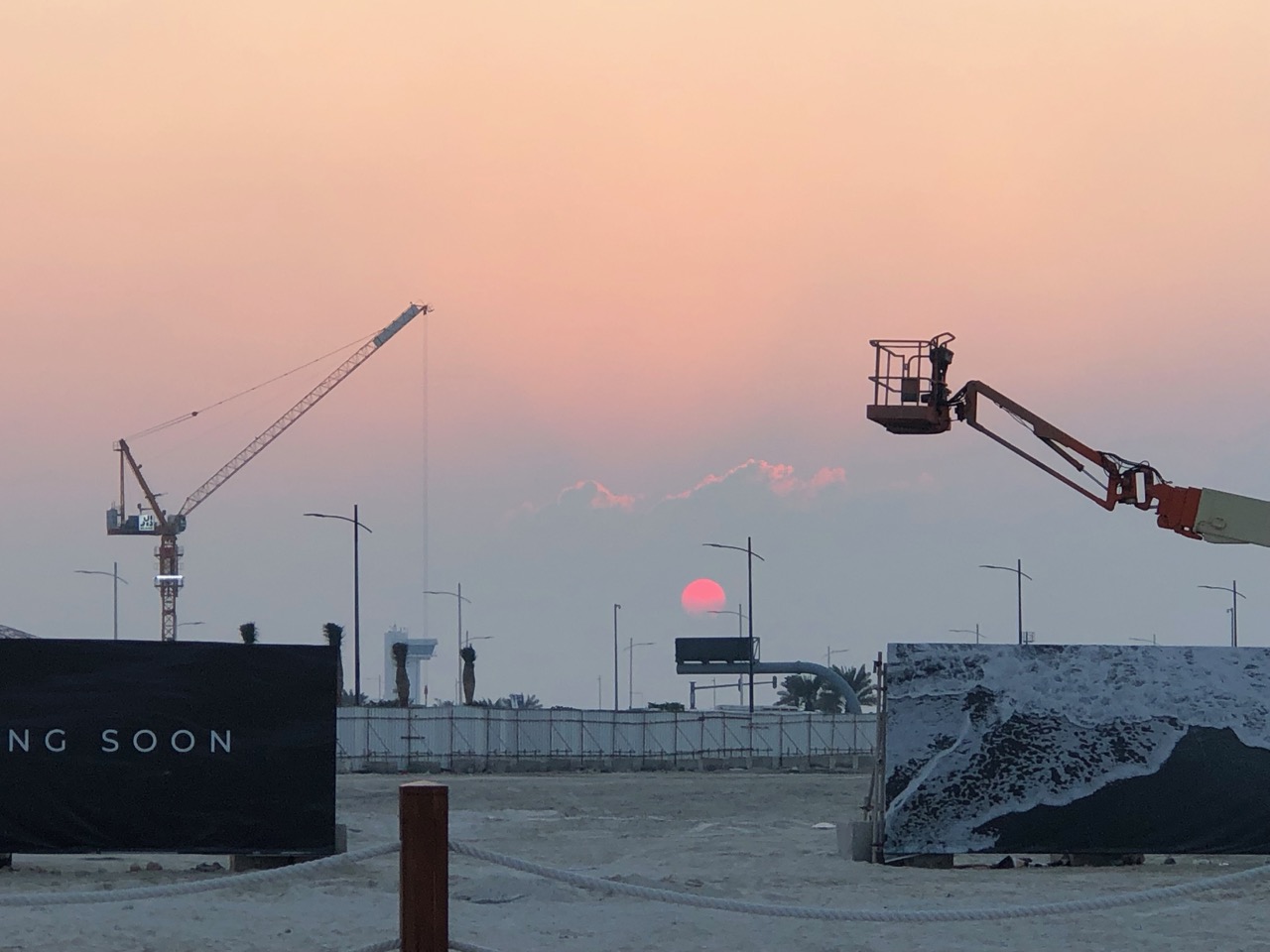
A few days of cycling through the different districts that transform into twinkling wonderlands as the red ball of the sun plummets behind the horizon, left me questioning the ethics of my unstoppable sense of awe… admiration even. Was it misplaced within the context of all that is wrong with Dubai, excessive wealth, power, oil? Or did it arise from the sense that I was witnessing the creation of modern-day equivalents to the buildings of antiquity? Cathedrals, pyramids, temples… also built using underpaid workforces or slaves and designed to reflect the beliefs of the times and honour the God(s) of a particular culture. From the widespread secular perspective of the 21stcentury, those Gods were clearly false. And yet we still appreciate with wonder what was created in their name.
What particularly struck me were the gaps between the buildings so integral to the overall impact of this brand new, place. The negative spaces of empty sky between the materiality of the physical manifestations.
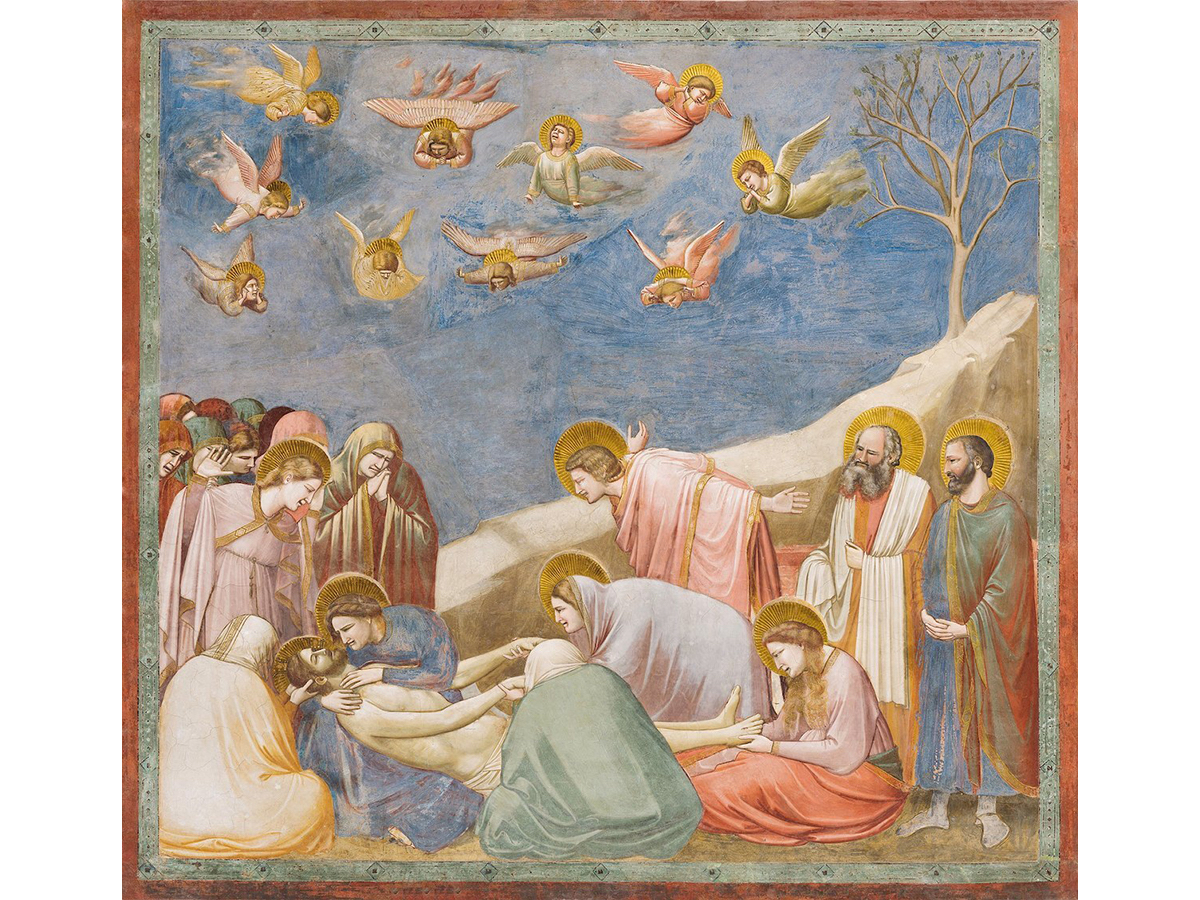
Materialism, in the philosophical sense of the word, started with a shift in the perception of reality from a focus on the invisible, creative force of life, often located far above, to the physical world below. It was the transition Giotto made in art in the 14th century from the gold or deep blue heavens of Byzantine art to the cerulean sky of the natural world.
I initially decided these glitzy skyscrapers were obvious ‘Temples to Oil’ designed to boast and out-do competitors in height and status. But a week with my brother, who has lived and worked in the Middle East for over a decade, made me see it is not as simple as that. That they are less odes to oil and more a demonstration of what can be done with money.
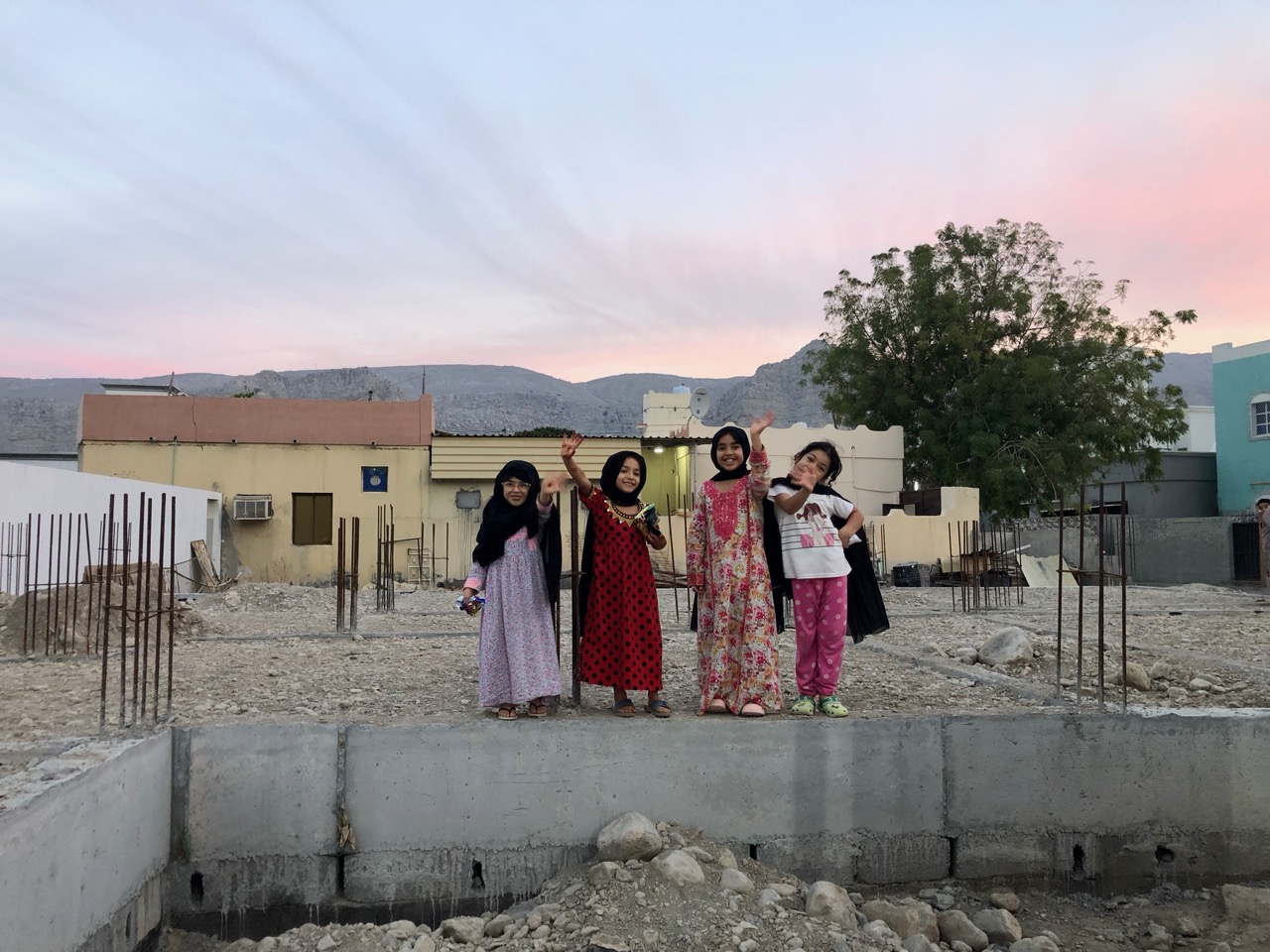
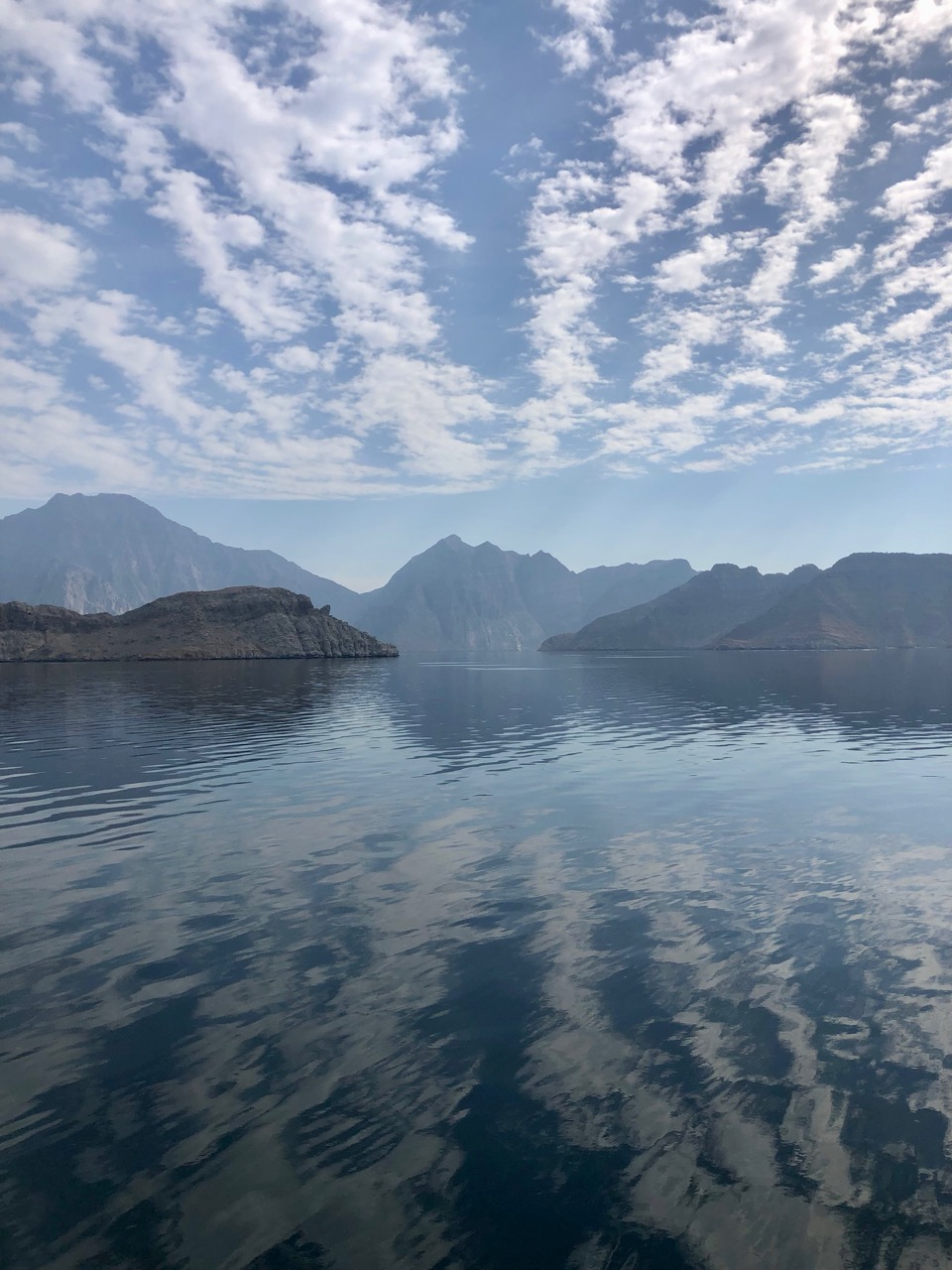
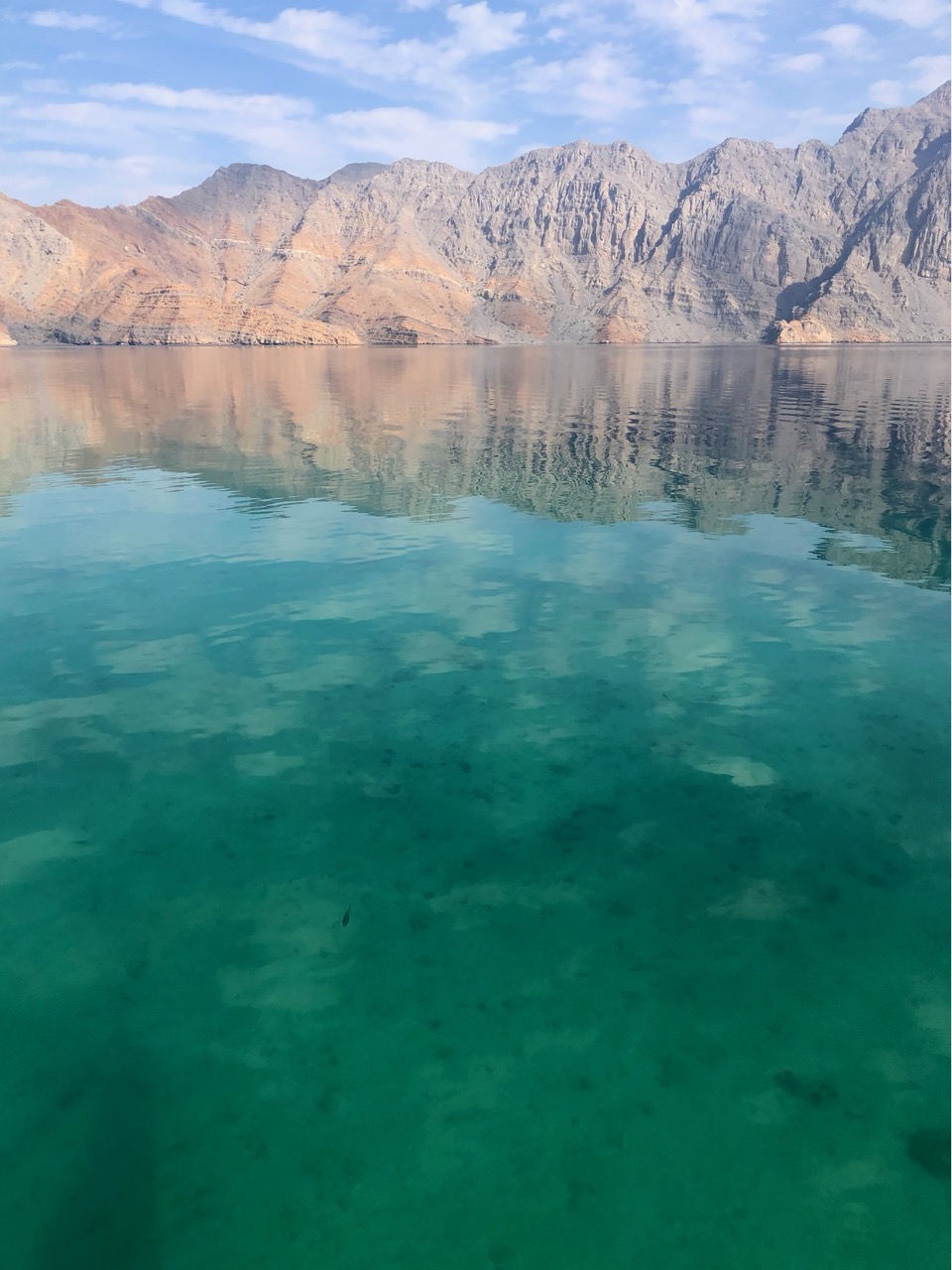
Ultimately I could not live in such a place. Far more appealing were the small coastal town of Khasab in the Musandam region of North Oman where brightly clothed children waved at us from dusty building plots and pristine fjords surrounded by soft golden cliffs were home to dolphins, tropical fish and small isolated villages of fishermen.
I wonder whether one can compare the money made from oil with the money made from drug dealers. Are the dealers to blame or is it the need for any destructive substance that lies at the root of the problem or dependency that inevitably develops? I have much more to learn, digest and think about and I am aware my ponderings are based on the superficial experience of an uninformed tourist. But the trip has undoubtedly broadened my mind and changed some of my perceptions of the world. For starters, it made me want to throw all my carefully segregated recyclables straight into the bin… what is the point after all?! But the idea of blaming some generic environmental ‘baddy’ also reminds me of the Dire Straits lyrics: “When you point your finger cos your plan fell through, you got three more fingers pointing back at you.” After all, don’t I belong to the nations who discovered oil, grew their industries, wealth and world influence from it, enjoyed the comforts and conveniences it brought and subsequently became utterly dependent on it?
If I don’t get another chance, I would like to take this opportunity to thank you for reading my Blogs and to wish you very happy, peaceful festivities ahead, warm homes and hearts and a wonderful start to 2024.






























 angela findlay blog