A Pope, a Rabbi and an 80-year-old Victory 

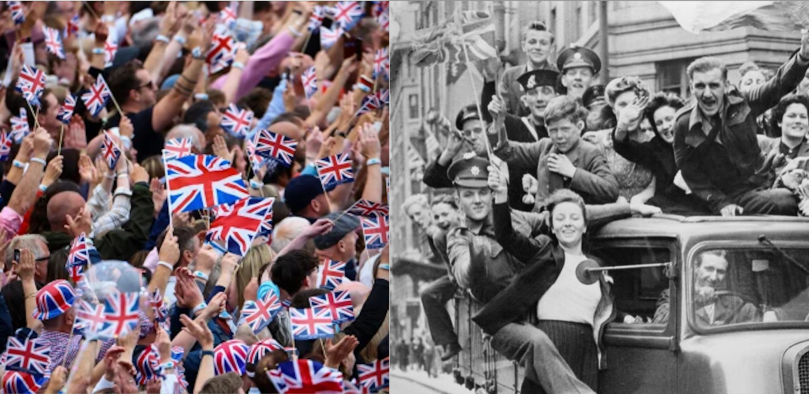
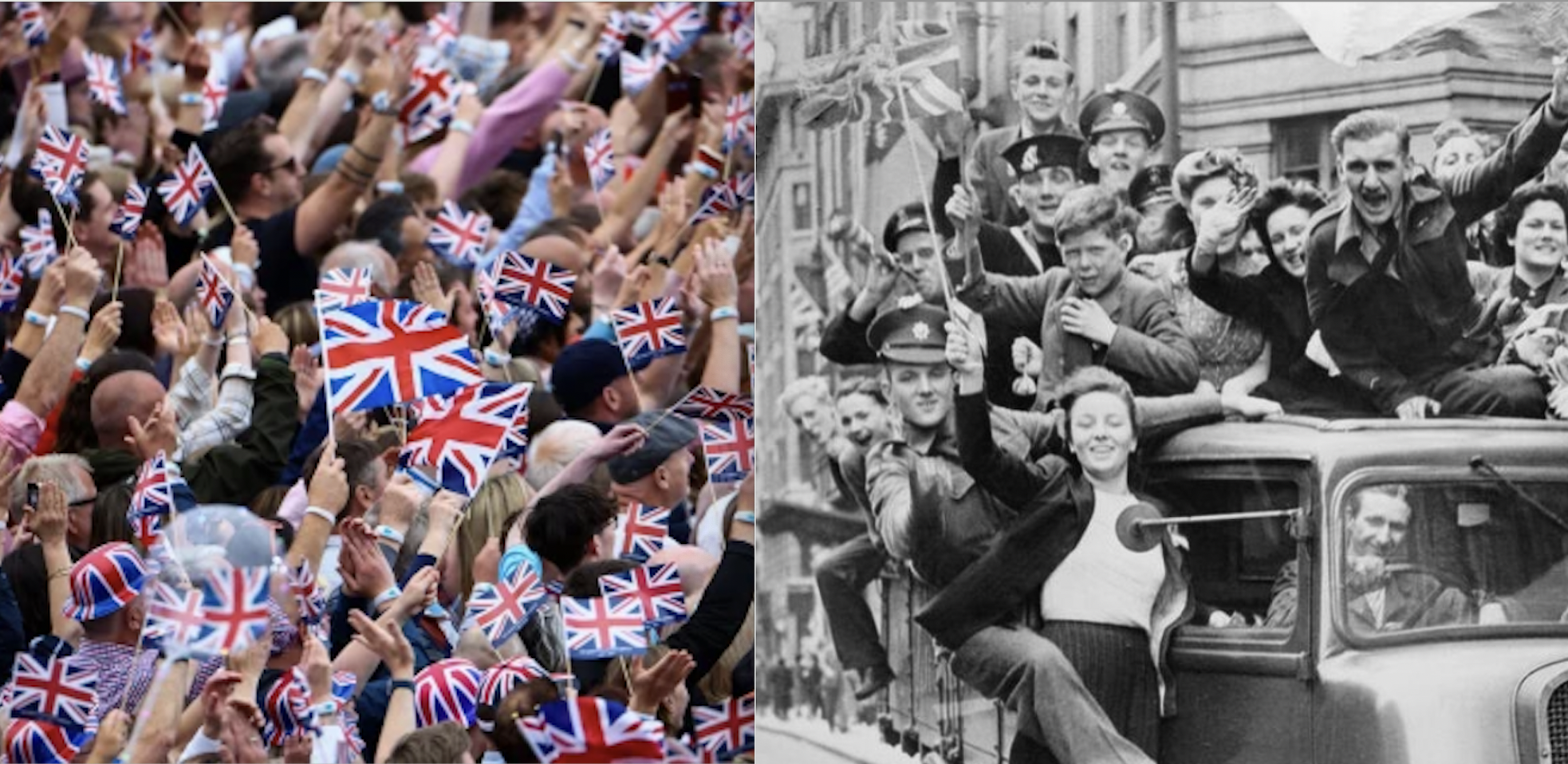
April saw the death of the widely loved Pope Francis, the Jewish festival of Passover, and the gradual build-up to the 80th Anniversary of VE Day (Victory in Europe) in May. An unusual trio of events, yet radio coverage of all three wove threads of reflection into the tapestry of this blog. 

Compassion was central to Pope Francis’s papacy – particularly towards those who are rejected or marginalised. He often spoke about the importance of honouring and never abandoning our grandparents. “If you want to be a sign of hope, go and talk to your grandfather,” he was quoted as saying. They remind us that we share the same heritage, link us to “the beauty of being part of a much larger history… a loving plan [that] is greater than we are.” He also had the humility to say “I am a sinner,” which makes me wonder where that leaves the rest of us!

In a recent Radio 4 Thought for the Day  (at 1:47:45), Chief Rabbi Sir Ephraim Mirvis described Passover as the ‘Festival of Questions;’ a time to ask, to probe, to test assumptions, refine our understanding and uncover the truth. 

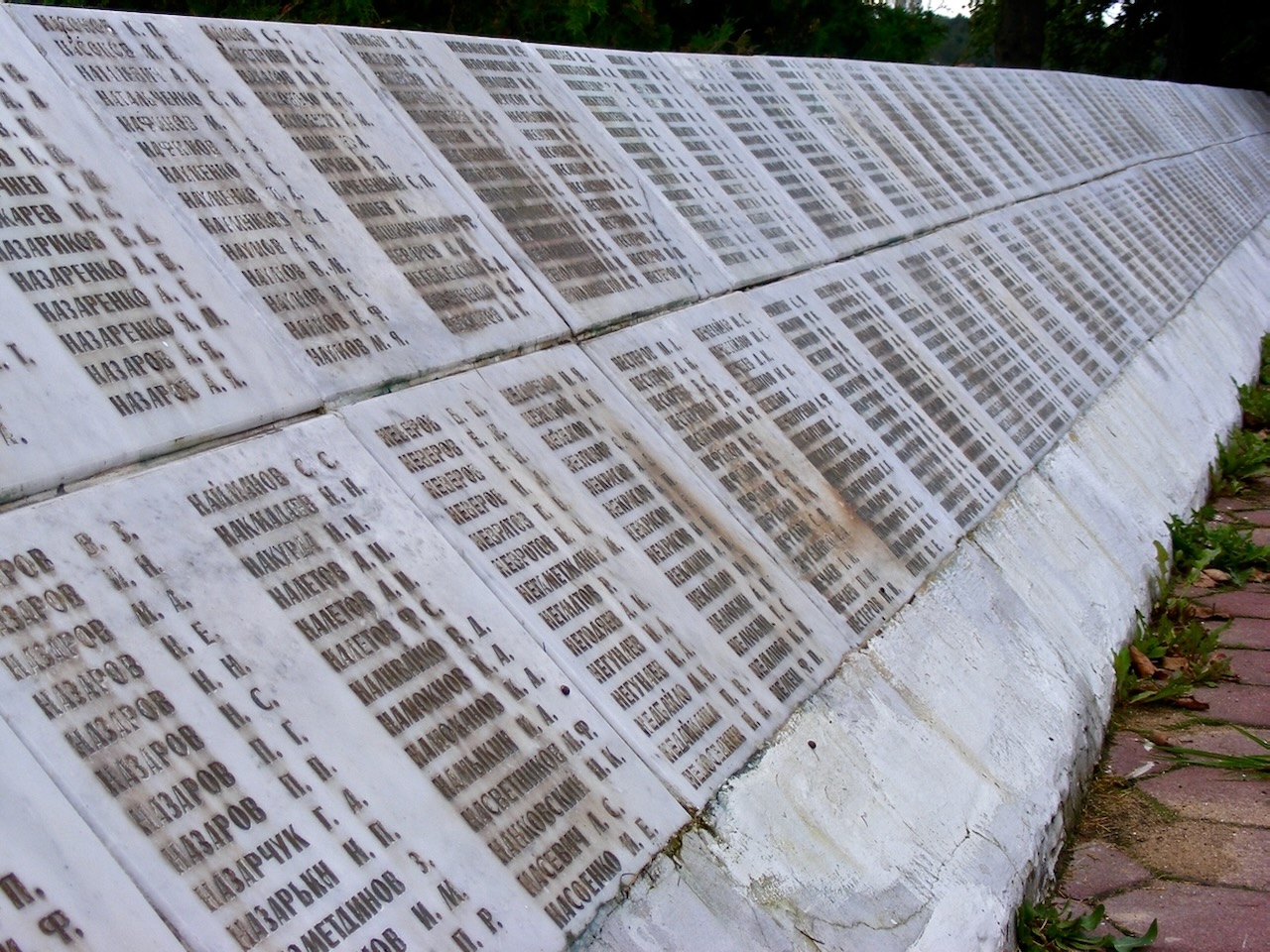
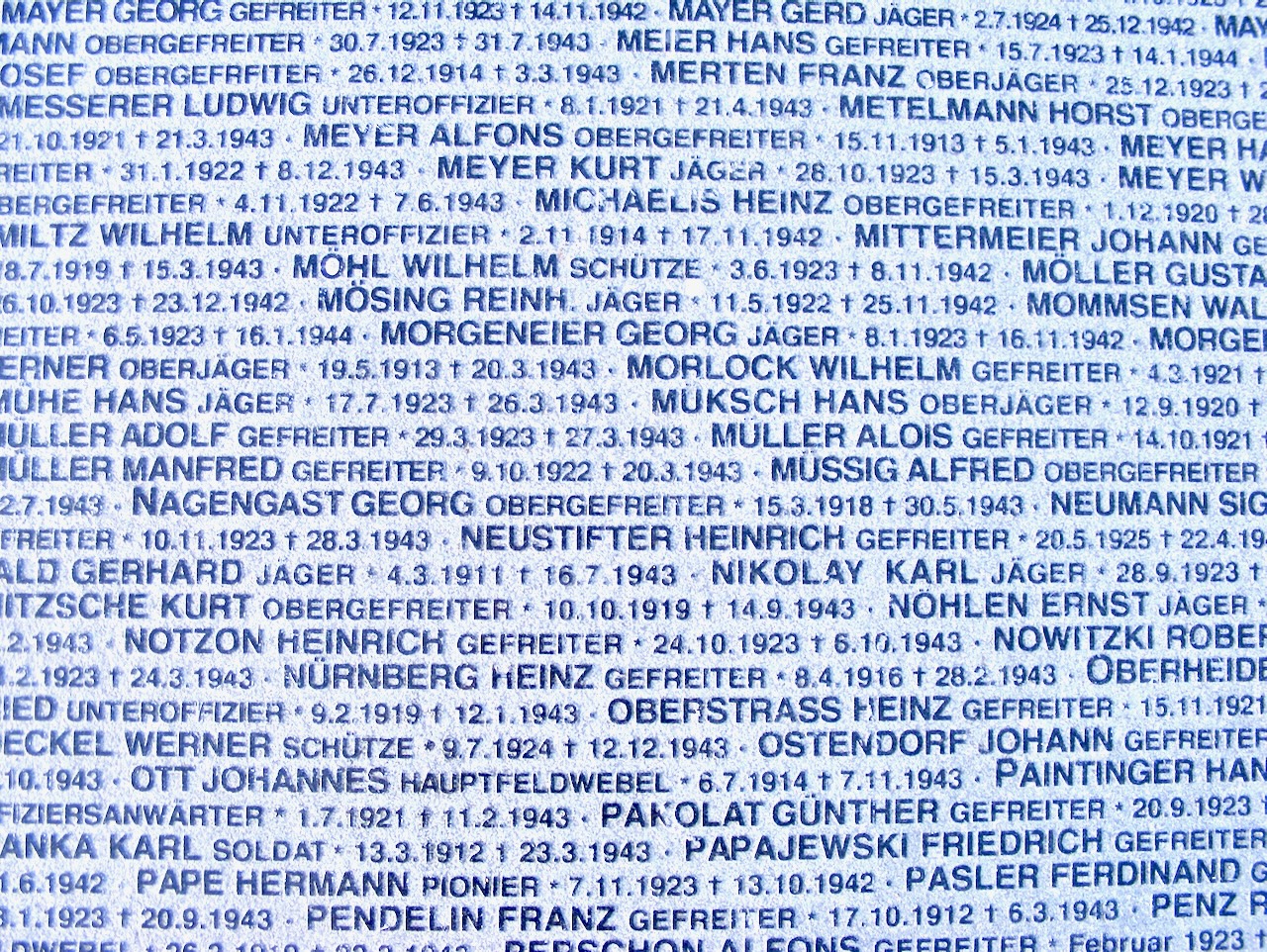
If we try to apply the guidance of both spiritual leaders to the forthcoming celebrations of VE Day on 8th May, we may find ourselves asking how the grandchildren of the ‘losers’ of WWII – many of whom had been perpetrators or complicit in Nazi atrocities – might ‘honour’ their grandfathers. How do you love – should you even try to love – someone who has acted immorally, abhorrently, even if those acts were sanctioned or ordered by a higher authority and deemed the right thing to do for Volk and country?

I’m all too aware how unfashionable, controversial and even provocative it is to suggest we spare a thought for the perpetrators. But in keeping with the spirit of my triangle, I am going to ask you to do just that. Many people, from all sides of the conflict, are quick to judge, blame and damn the Wehrmacht soldiers and SS as an indiscriminate mob of ‘monsters’, all morally inferior and wholly undeserving of being remembered. It’s completely understandable. But where does that leave their children and grandchildren? What happens when we continue to draw a line between the ‘good us’ and ‘bad them’, a distinction that may have served its time but no longer helps us move forward? Isn’t one of the most crucial lessons of this horrific chapter in history to recognise that most perpetrators were not monsters, but ordinary people… like you and me… who, through a slow drift of compromise, small decisions and ill judgements became capable of unimaginably heinous crimes? 
Eighty years on, with more than 88% of the German population having been born after the war’s end and a further 11% still children at the time, it’s difficult to place ‘guilt’ for the Holocaust on the Germans of today. After all, people cannot be guilty of things they themselves didn’t do. Yet, like many descendants of Holocaust victims and survivors, some non-Jewish Germans born in the decades after the war still wrestle, often unknowingly, with the unresolved trauma and guilt passed down from their parents or grandparents. They carry what Eva Hoffman aptly described as “the scars without the wound” – invisible wounds that silently shape their internal world and influence their actions in the external world. 

Without detracting anything from the horrors and suffering of the victims, can we imagine for a moment how it might be for post-war generations of Germans to live with legacies of silence, cover-ups, not-knowing, judgement, exclusion, blame or shame in relation to their roots? Mistrusting family stories. Wondering who knew and who did what. What impact does this have on individuals, families, societies, nations and ultimately, the wider world? How can one best deal with such a profound inheritance?

Primo Levi – who, as a Holocaust survivor had every right to think the opposite – declared that collective guilt does not exist. To think that it does is a relapse into Nazi ideology. Both he and Hannah Arendt made a powerful claim: “We are all to blame” for what happened. Collective responsibility is what matters. And that involves understanding how atrocities occur both in society and within the individual. How we become complicit. 

The roots of Nazism found fertile soil in the humiliation wrought by the terms of the Treaty of Versailles and the deeply resented ‘guilt clause’ that placed full blame for WW1 solely on Germany’s shoulders. Applying a similar dynamic to today, could there be a connection between this historical pattern and the rise of the AfD (Alternative für Deutschland), Germany’s nationalist far-right party — a movement fuelled in part by a desire to reassert national pride and, as encouraged by figures like Elon Musk, to move beyond what they perceive as an excessive “focus on Nazi guilt”?

The 2019 survey previously cited revealed that few Germans actually feel guilt and 70% (including 87% of AfD voters) believe their country has now sufficiently atoned for the actions of the Nazi regime. Another source revealed that 75% of young Germans (erroneously) believe they come from families of resistors, while 25% can’t name a single concentration camp or ghetto. As the number of living contemporary witnesses dwindles, disinformation, denial and delusions are spreading. With them, the sense of responsibility risks disappearing too – a deeply worrying and dangerous trend. Knowing firsthand the insidiously destructive effects of being shamed for a familial association with the Nazi era, I can understand how, eighty years on, rejecting any semblance of inherited guilt might feel like a healthy response. After all, who among us wants to feel terminally tainted by the wrongdoings of their forebears? Who wants to have to cut off their roots?

The marriage of my parents in March 1962

I feel fortunate that, while living in England with my German heritage was at times challenging, my parents and their families modelled true reconciliation throughout my life. My British father and German mother married just 17 years after the Second World War ended. Both their families had suffered and lost loved ones and/or homes under the others’ military objectives. Yet both found the courage to drop into their hearts and overcome division and enmity. And that, to me, is where the solution lies: in our hearts.

Patriotism is hollow if it is based only on pride and honour. Shame and conscience lead to a deeper bond. Seeing the world in binaries – in terms of ‘us’ and ‘them, good and bad, right and wrong – shuts down love. Reconciliation becomes impossible. As Britain celebrates its triumph over the evil forces, let us also remember we were not all good and they all bad. Among other short-comings, we too were guilty of antisemitism and of failing to help the Jews more. 
In another recent Thought for the Day, Rhidian Brook warned, “If you can’t see the other side’s humanity, you’ve lost.” 

My 80th Anniversary VE Day wish, therefore, as both a British and German citizen, is for us to follow the example set by the late Pope and Chief Rabbi: to think, to probe, to get uncomfortable, and to find compassion for individuals among the rejected and ostracised.

Eighty years on, might this be the moment to create new rituals of peacekeeping and unity? Without dampening the spirit of national joy, how can we include – and stand hand-in-hand with – our contemporary German friends in celebrations of peace, rather than reinforce historical divides?

Can we develop broader, more expansive narratives that encourage younger generations of Germans to face the difficult and painful truths of their families’ histories and to assume responsibility, not for what was done, but for what is still to be done? Can we remain vigilant against resting on any imagined moral high ground, against believing we would have undoubtedly been resistors and heroes under the Nazi regime? And can we instead recognise how thin the ice of democracy is becoming once again, and how difficult it is, even now, to change the course of history?

Events coming up:

Friday 2nd May, 12-1pm 
The Second World War 80 years on: Is Remembrance Working? 
Angela Findlay and Henry Montgomery In Conversation
National Army Museum, Royal Hospital Road, Chelsea, London SW3 4HT and ONLINE
80 years on from the German surrender to the Allies, Henry Montgomery, grandson of Field Marshal Bernard ‘Monty’ Montgomery and Angela Findlay, granddaughter of General Karl von Graffen of the German Wehrmacht will reflect on their grandfathers’ roles and actions in WW2 and discuss the differences in the histories, legacies and remembrance cultures of the victors and the losers and how Remembrance can remain meaningful and effective for younger generations. 
Info and tickets (free) here

Thursday 8th May, 18.00 – 19.30 
Im Schatten Meines Großvaters / In My Grandfather’s Shadow
Vortrag und Gespräch / Lecture and Conversation 
Marktkirche, Hanns-Lilje-Platz, 30159 Hannover, Germany

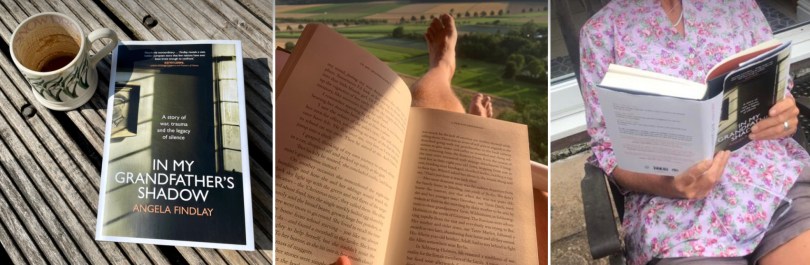
Thursday 15th May, 17.00 – 19.00 (UK time)   43. Gesprächslabor, PAKH: The Study Group on Intergenerational Consequences of the Holocaust (ONLINE)? Drawing on my own experiences outlined in my book, In My Grandfather’s Shadow, we will be discussing how such a destructive legacy can be transformed into constructive, reconciliatory approaches and positive actions. More info here: https://www.pakh.de/event/gespraechslabor-40/  

Buy or read reviews on my book, In My Grandfather’s Shadow, here
Looking at our present and future to find the lessons of the past

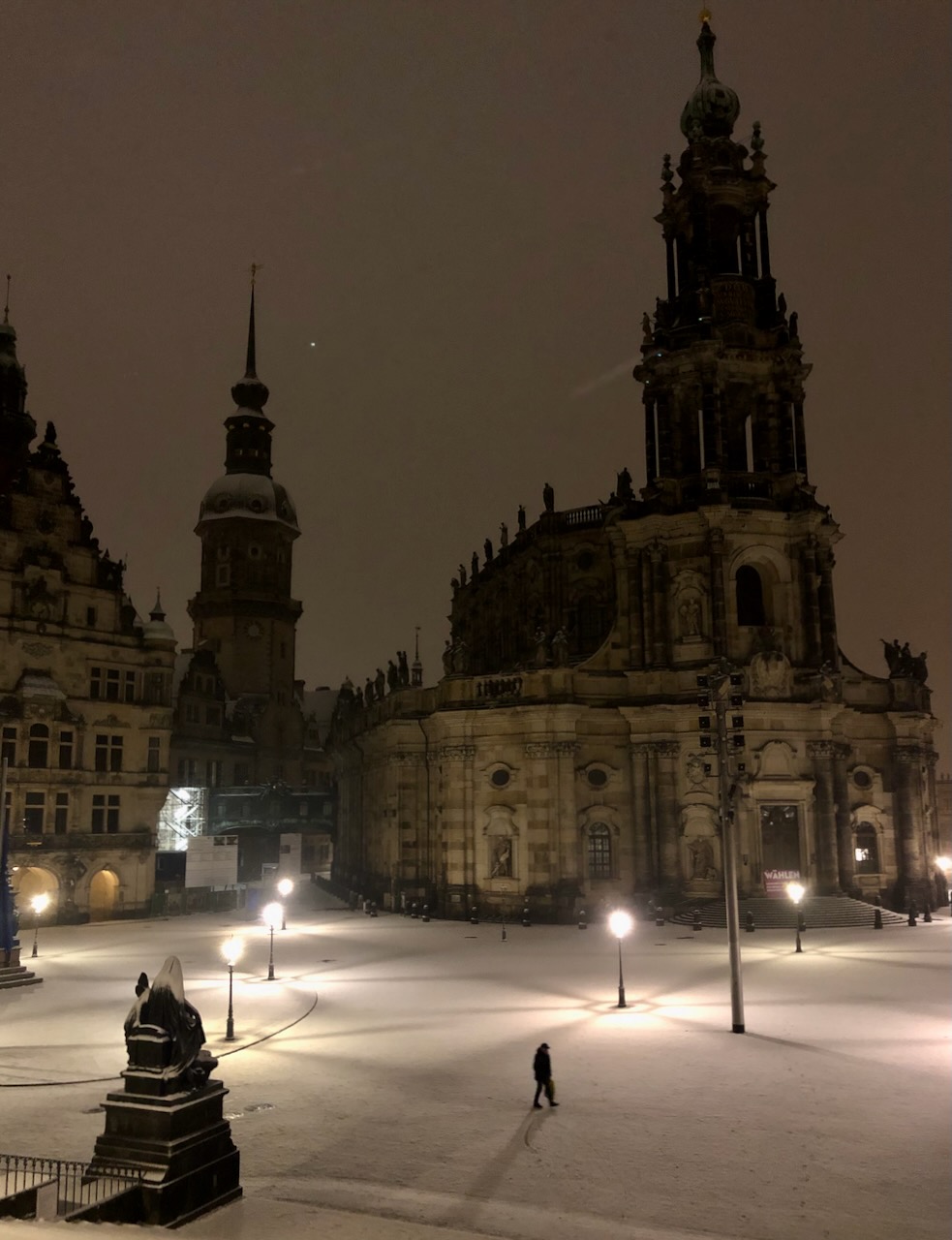
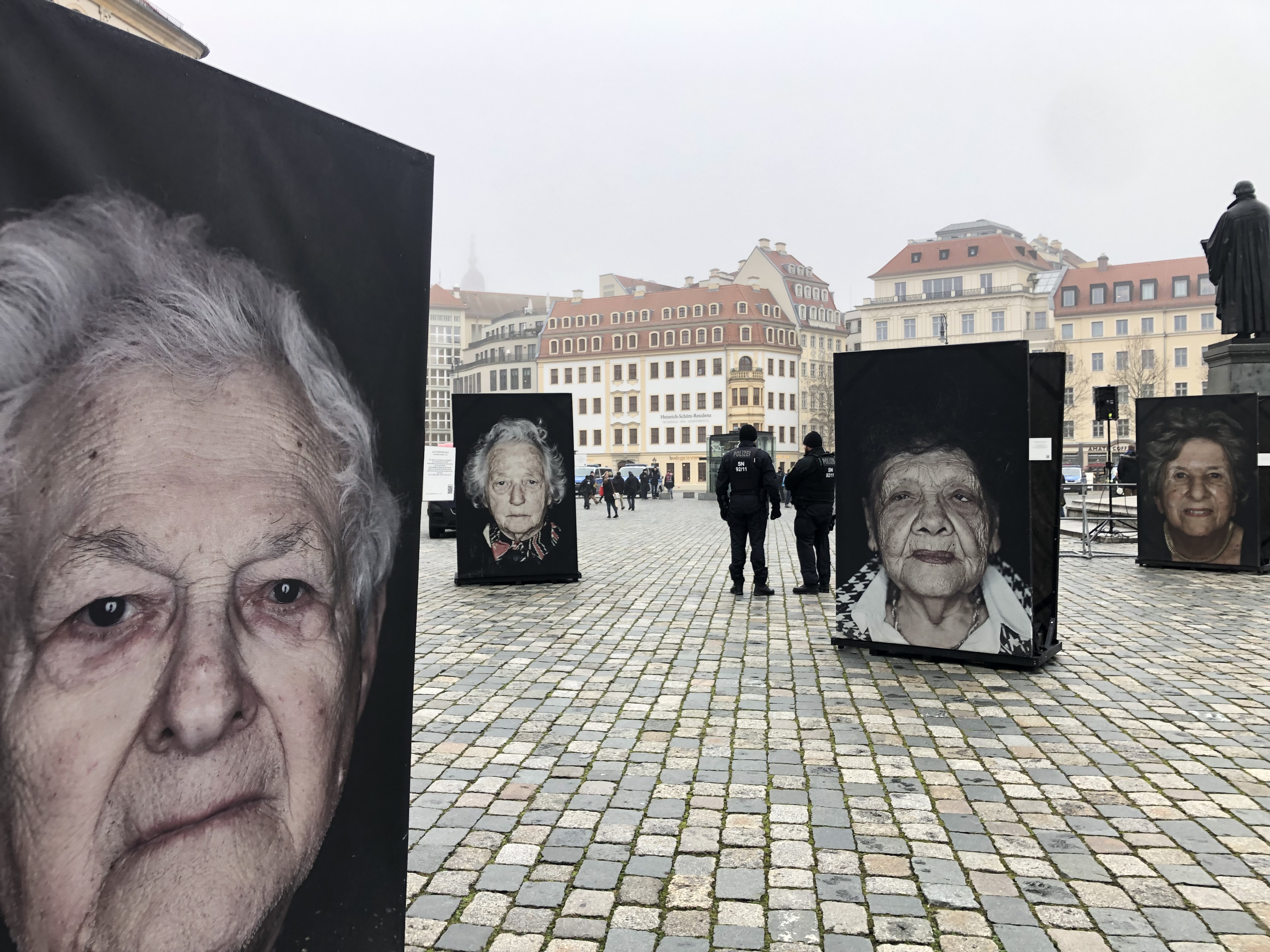
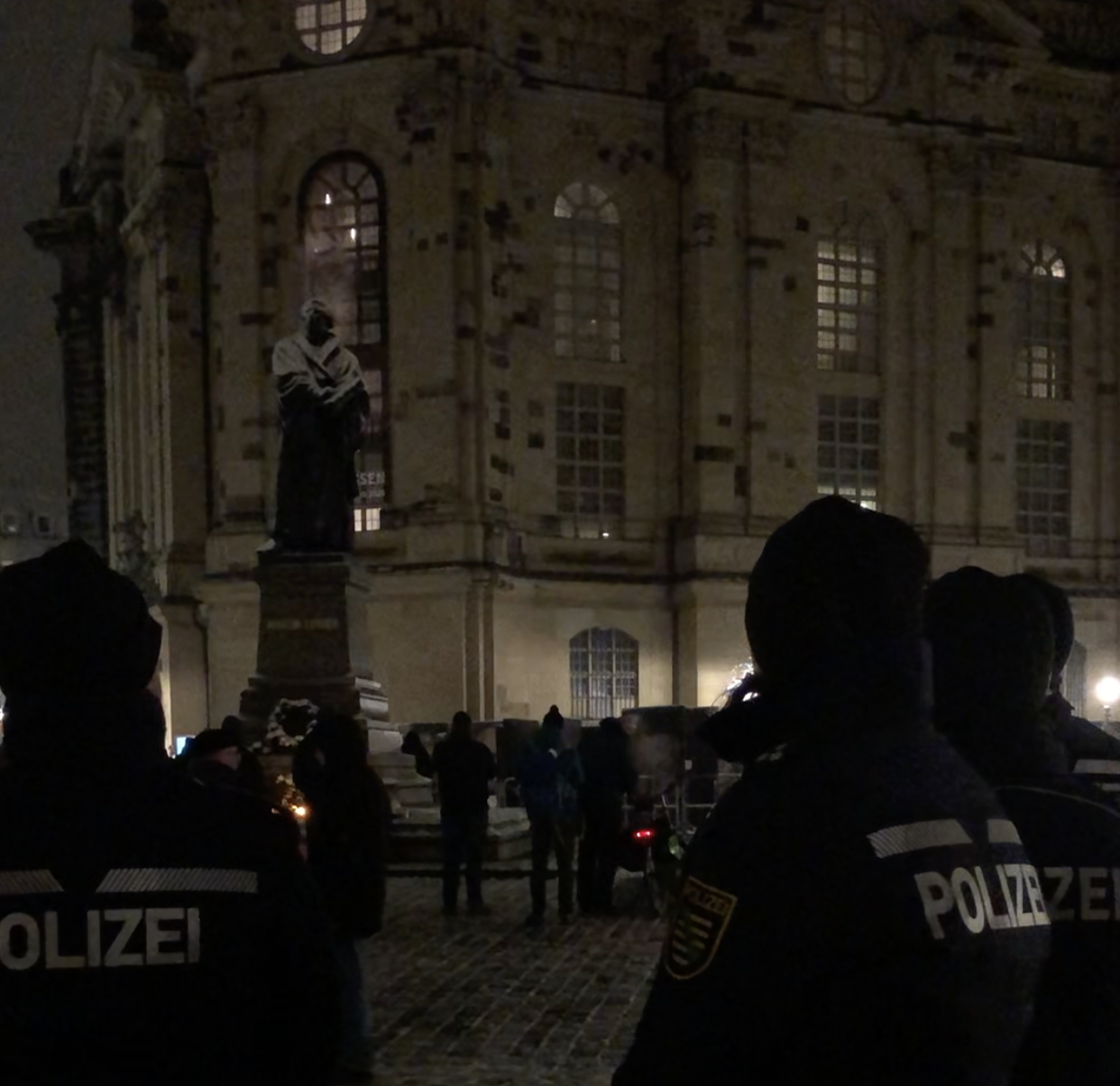
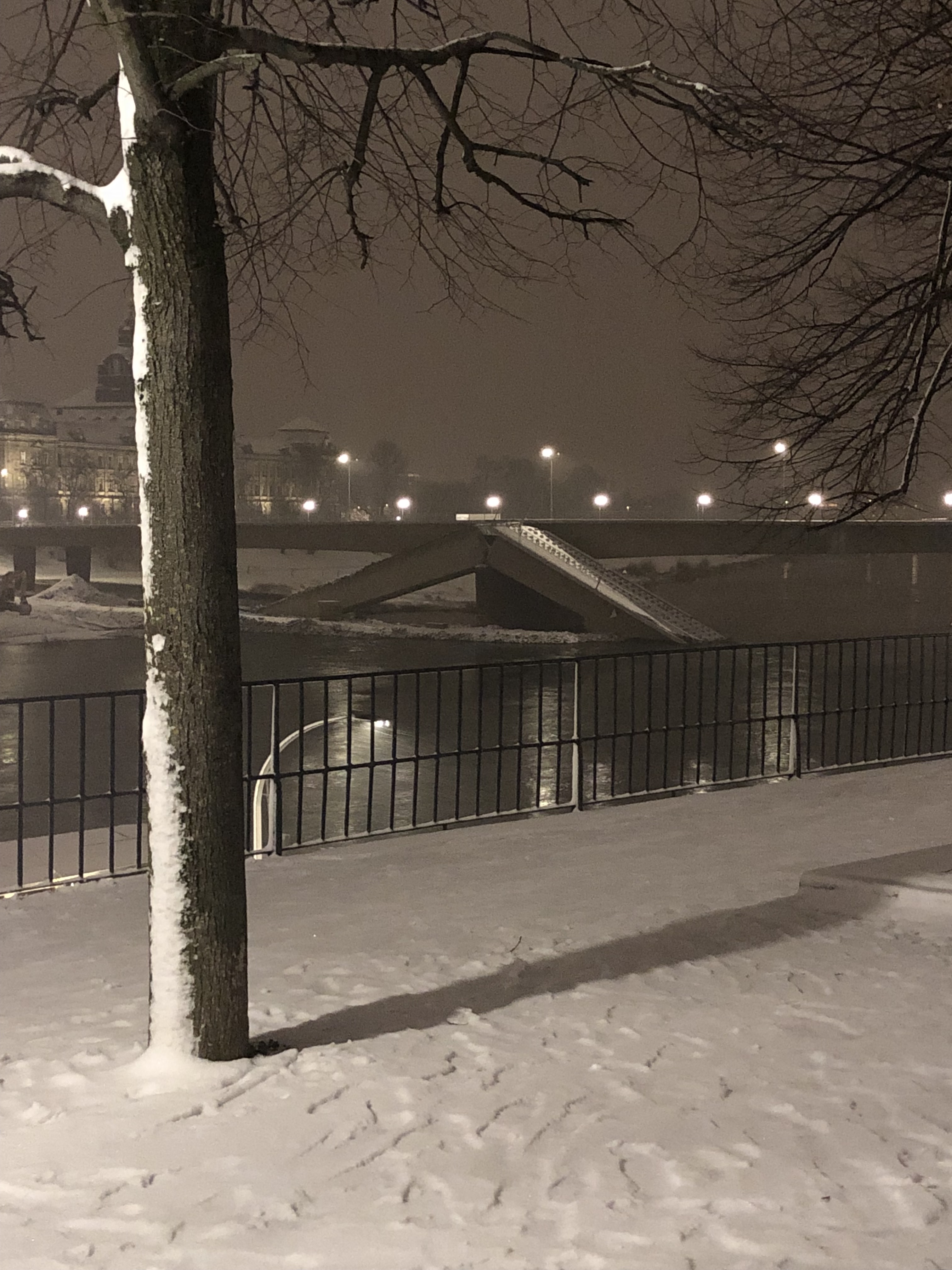
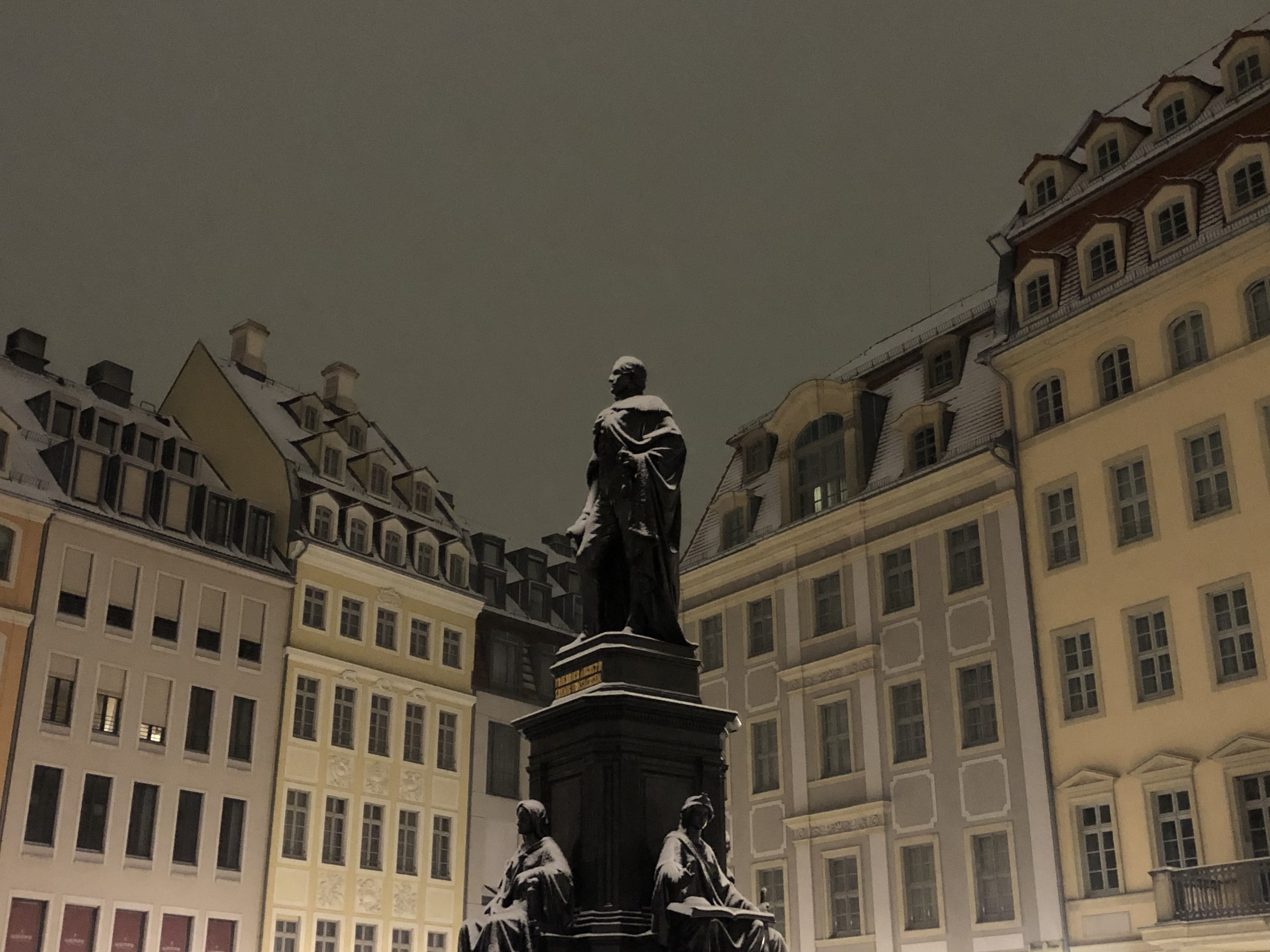
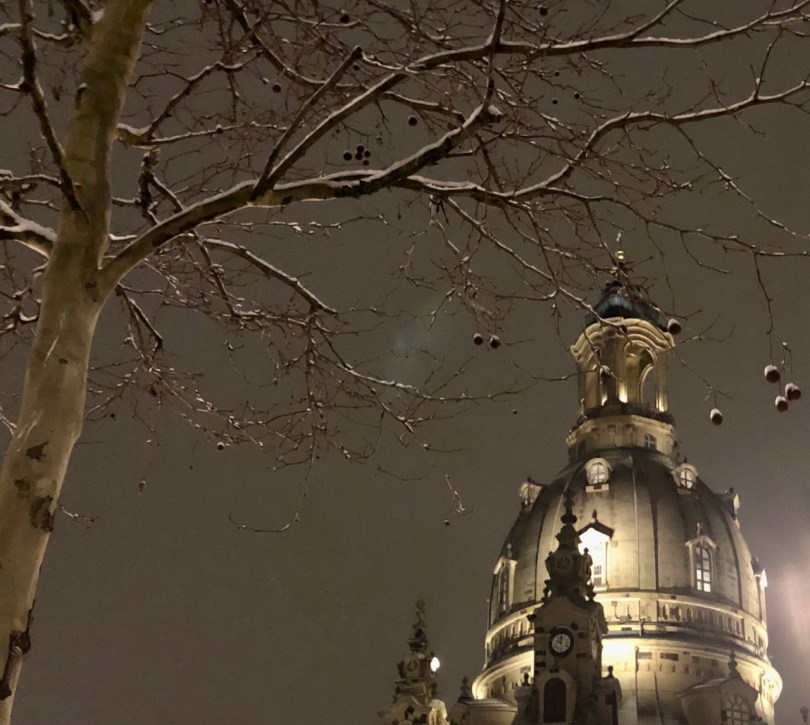
On February 13th at 9.45pm, the bells started; asymmetrical tones infusing the snow-sprinkled city. 

People wrapped in scarves and silence, stared at the dome of the Frauenkirche that 80 years before had been mangled by bombs into a pile of rubble that would scar the city for over fifty years.

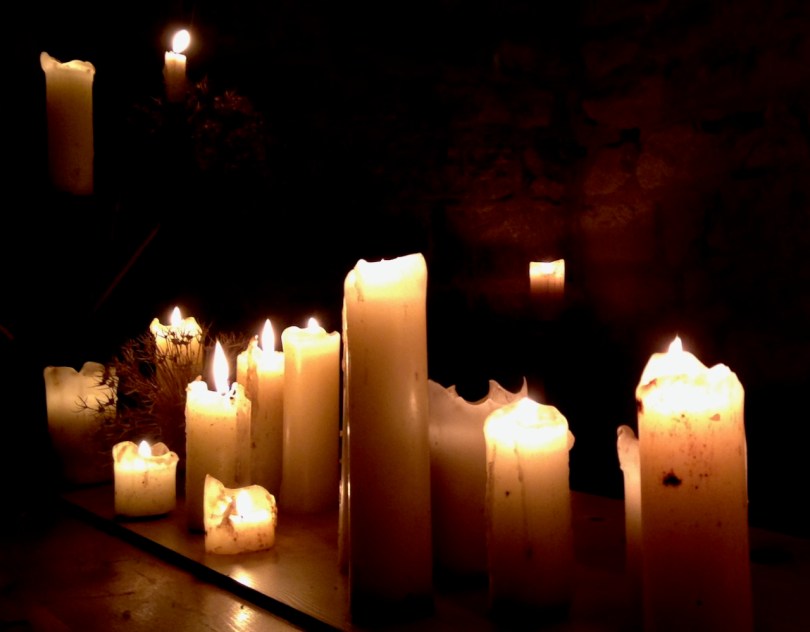
Candles placed on the ground flickered benign flames as memories haunted the minds of those who had witnessed a firestorm that melted asphalt, roofs and neighbours alike.

A human chain of hand-holding citizens wove through the resurrected buildings, knitted together both in remembrance and defiance of the re-emerging forces of lessons not learned.

This year’s anniversary of the British and USA bombing of Dresden was determined not simply to look back and roll out familiar but increasingly empty tropes such as ‘Never Again’. Instead, ‘Future through Remembrance’ was the theme repeated through the activities I attended as a Trustee of the British Dresden Trust. Younger generations from Germany, Ukraine, Poland, UK occupied the foreground mingling the wisdom of elders with messages that gave genuine hope for our troubling times. 

Stay awake. Be aware and curious as a child about what is happening around you. Look at history from multiple angles. Step back to see it in perspective. Take responsibility. 

Benjamin Britten’s War Requiem followed by silence in place of applause gave the horror, tragedy and futility of any war the viscerality needed to galvanise us out of complacency into using Remembrance fiercely rather than sentimentally; to unite us as human beings, each with a heart and soul that thump with a longing for peace. 

It was the move from formality to informality, from grand gestures to tiny actions we are all capable of doing everyday, that left the most lasting impression. From pomp and ceremony to conversation; from people in suits or uniforms telling us the importance of remembrance of a time that is increasingly distant, both temporally and emotionally, to a lively exchange between young and old from different nations on the values of democracy and peace.

Peace that is all too easily taken for granted. 

Further Reading and Links

The Dresden Trust

History and politics collide as Dresden mourns its destruction in WWII by Katja Hoyer

DRESDEN: A Survivor’s Story by Victor Gregg

DRESDEN: The fire and the darkness by Sinclair McKay

AIR RAID by Alexander Kluge

The Duke of Kent marks the 80th anniversary of the bombing of Dresden

Commemoration: 80th Anniversary of the destruction of Dresden

l

Remember, Remember… we all lost

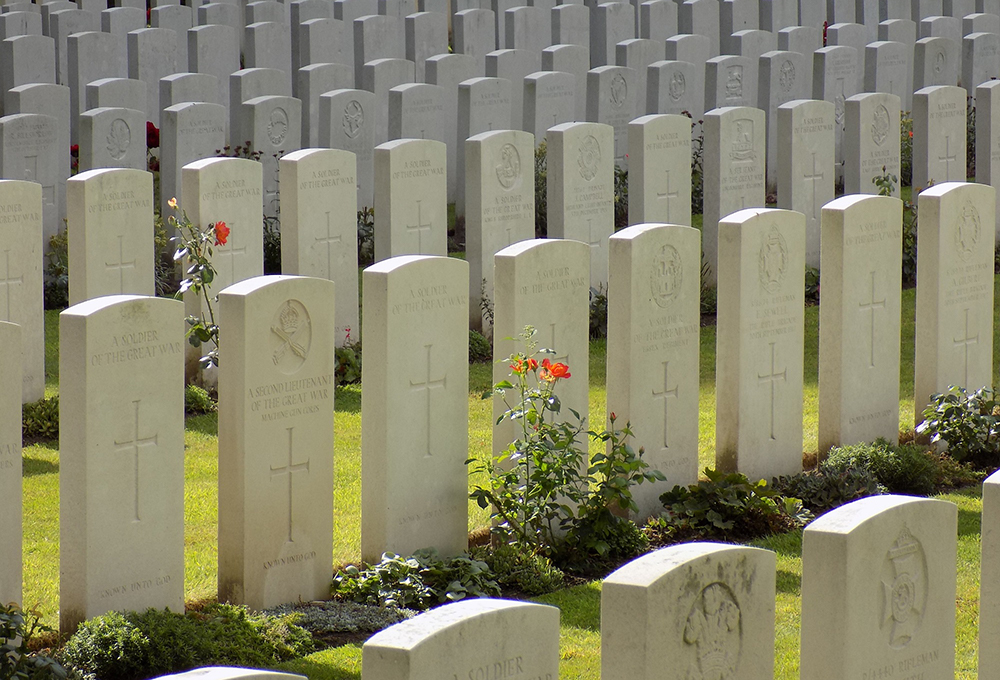
‘Tis the season to remember. In our progression through the grey gloom of this autumn [just 18 minutes of sunshine since 28th October apparently!] and the celebrations of Halloween, All Souls, Samhain, Guy Fawkes and November 11th, the dead take centre stage. Leaves and forest floors redden while poppies bloom on jacket lapels, village monuments and shop counters. This Sunday in London, as on all Remembrance Sundays, red wreaths will be laid by royalties, senior politicians and Commonwealth High Commissioners before some of the last surviving WW2 veterans march or are wheeled past the Cenotaph.

We have been collectively remembering Armistice Day since 1919, the first anniversary of peace at the end of World War One. Remembrance has since been extended to both World Wars and all those who have given their lives in service to defend our freedoms. It is a hugely important day for the British, the Commonwealth and many other countries around the world, albeit not in Germany. There, since the Middle Ages, 11am on 11.11 has marked the start of the carnival season and, on a more serious note, Armistice Day is not considered to have welcomed the beginning of peace but years of intense unrest and far worse horrors to come. 

British and Commonwealth dead

I often dedicate my November blog to our traditional, deeply moving and impeccably executed rituals of remembrance, but not always without a little questioning too. Through the 15 years of research for In My Grandfather’s Shadow, I came to appreciate a far broader narrative of WW2 remembrance than that which Britain generally embraces and teaches. Granted there has been welcome progress over the decades with the inclusion of women as well as the huge contributions and sacrifices made by Gurkha, Indian, Sikh, African and Caribbean servicemen, among others. But there is still widespread ignorance of the bigger context.

Russian dead

When I give my talks, I often use statistics. They provide a solid, black and white foundation of fact to my more psychological / philosophical ponderings. So often these figures shock. For example, when I ask people to guess the total losses, including civilians, of say Russia, Germany and Britain in the Second World War they are usually so far out that they themselves are horrified. I challenge you to make a guess… I’ll put the answers at the end of the blog. One man literally went white when he realised how wrong he had been in his thinking or, by his own admission, his lack of thinking. Another woman recently wrote to tell me how my book had opened her eyes in so many ways. “First off,” she said, “the big realisation of how little I have understood of the two world wars, my ignorance of those times and the aftermath.” This despite attending remembrance services all her life. 

German dead

The quantity of deaths doesn’t mean each death was any less keenly felt. But I think she voices what is probably true of most of us. I certainly was ignorant of the broader landscape of loss and destruction, and no doubt still would be if I hadn’t had German roots that needed excavating and hadn’t made trips through Germany and Russia that exposed me to other ways of looking. The World Wars are the episode in history with which the British are often accused of being unnaturally obsessed. And yet, as a nation, we often present it as a deceptively straightforward story of good triumphing over evil. The victors write history after all. 

Every nation has its ‘chosen traumas’ and ‘chosen victories’ which serve as cornerstones to its identity and prevent true healing from the past as they continue to play out in the present. We frequently have binary views of how we should feel based on – to use the reader’s words again – “simplistic, reductionist understanding… goodies and baddies…” Rarely have we “considered what it must feel like to have a different identity…” 

I really appreciate and admire this woman’s soul-searching honesty. The humility and gentle opening to hearing the other sides’ stories gives me huge hope.   

Healing, reconciliation, peace, forgiveness… all goals we strive for within our culture of Remembrance… can best come about when we become familiar with and find some understanding for the other side’s experience. Maybe, with our greater distance from both the acute trauma and the impassioned jubilation of our forebears, that is what generations now and in the future can strive to do more of. 

Answer to my statistics question: Out of the around 60 million people killed in WW2, 26 million were Russian, approx. one third of them military and two thirds civilians. Between 7-9 million Germans died, roughly 6 million were soldiers and 3 million civilians. In the United Kingdom, just under 451,000 were killed. That’s 383,800 military, including combatants from overseas territories (Crown Colonies and the Indian Empire), and 67,200 civilians.

To protest too much… or too little?

The coronation of King Charles III and Victory in Europe Day 1945

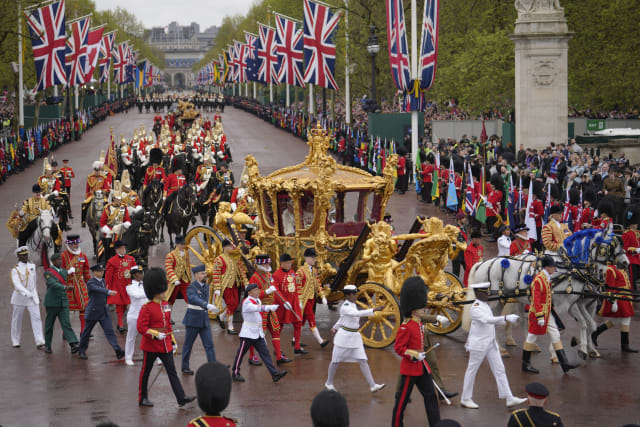
This Coronation Bank Holiday weekend marks two events that will retain prominence in British history books forever: the crowning of King Charles III on Saturday 6th May 2023 and the 78th anniversary of Germany’s unconditional capitulation on 8th May 1945 that brought an end to the Second World War in Europe. 

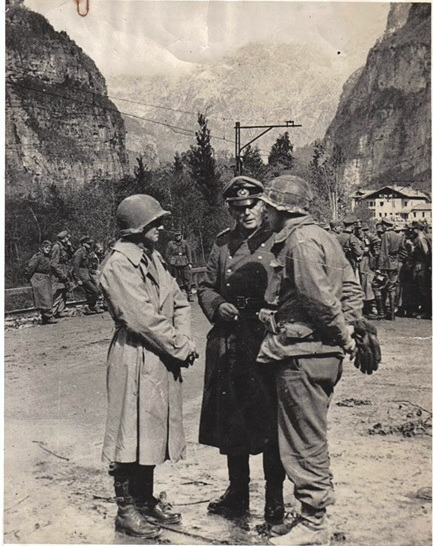
My grandfather (centre) surrendering to the American forces in northern Italy on 2 May 1945.

The Royal Family and Britain’s World War victories are defining features of our national identity and regularly create occasions for celebration. This weekend, both elements came together with the unforeseen effect of highlighting a common, more sinister undercurrent relating to protest, or rather the right to protest. 

For some people the traditional spectacle of ritual, religion, militarism, pomp and swathes of red, white and blue flag-wavers doesn’t reflect any aspect of their lives. Indeed, the price tag of putting on such an event appears obscene in a cost-of-living crisis. And the slightly creepy swearing of an oath of allegiance to the king resembled rather too closely the oath of obedience demanded by Hitler. 

‘Not my King’ became their activist cry, just as other universal voices have cried out: ‘No war,’ ‘Just Stop Oil,’ ‘Insulate Britain,’ ‘Not in my name,’ ‘Me too,’ ‘Black lives matter.’

I am with everybody who is either tired of or has been inconvenienced by protestors. But I fully understand the frustration, desperation even, people feel that leads them to take extreme measures in order to draw attention to what they see as being destructive or plain wrong… for us all. Their right to have that voice of protest is indisputable. Aren’t we after all constantly reminded that the Second World War was fought and won to protect our freedoms because Hitler’s evil regime had removed so many? 

No wonder then that there was an outcry of concern when, in the run-up to the coronation, the government rushed stronger laws through parliament intensifying the powers of the recently passed Policing Act while resurrecting proposals in the largely rejected Public Order Bill. With extended stop and search powers, the criminalisation of disruptive protests, and the imposition of protest banning orders, the right to peaceful protest is clearly under increasing threat. 

“The coronation is a chance for the United Kingdom to showcase our liberty and democracy, that’s what this security arrangement is doing,” Mr Tugendhat, the Security Minister, told BBC Radio 4’s Today programme in defence.

Liberty and democracy? Hmmmh… I’m not sure those words quite match the policies and resulting actions!

And while the statement Home Secretary Suella Braverman made on Tuesday 2nd May might sound fair enough, in reality it is pure, misguided hypocrisy: 

The public shouldn’t have their daily lives ruined by so called ‘eco-warriors’ causing disruption and wasting millions of pounds of taxpayer money… The selfish minority must not be allowed to get away with this. We are giving our police and courts the tools they need to stop this chaos and I back them in making full use of these powers.”

In another context, say in relation to our water companies and their appalling levels of waste, pollution and greed, a similar statement would make perfect sense, maybe along these lines:

The public shouldn’t have their daily lives and futures ruined by blatant ‘eco-destroyers’ causing disruption to public water services due to the contamination of our waterways and the wasting of millions of gallons of water each day. The selfish companies must not be allowed to get away with this. We are giving inspectors and courts the tools they need to stop these criminal practices and I back them in making full use of these powers.

Pollution on the Jubilee river in southern England. ‘The EA has called for water company directors to be imprisoned for the appalling decline in performance.’ Photograph: Maureen McLean/REX/Shutterstock

I personally believe Britain would be a poorer nation, not a richer one without the monarchy. But I still respect the views of those who want a British republic because they see the Royal Family as an outdated, unrepresentative, dysfunctional and extortionately expensive establishment that should be abolished. Given King Charles’s sincere dedication and visionary, common sensical, environmental concerns and solutions, which he has expressed – and been ridiculed for – since the 1970s, my hopes are that he will sympathise with protestors in ways this government doesn’t. And he will help push forward the environmental agenda that the whole world desperately needs to make its priority.

The lessons of the Second World War, especially of the Third Reich with its top-down dictatorship, are more relevant today than ever. Nazism showed us how thin the ice of morality is, how even such a culturally advanced country as Germany could fall through into barbarity. It happened slowly, incrementally, in full sight. Little laws restricting more and more little freedoms…

As I say in In My Grandfather’s Shadow: Germany’s lessons are therefore universal, as are the questions we must all ceaselessly ask ourselves: how thick or thin is the ice today, and what structures are in place to stop us falling through it again?

‘In My Grandfathers Shadow’ is now out in Paperback.

Links to further reading (as always, not all reflect my opinions necessarily)

UK security minister defends new anti-protest laws before coronation – The Guardian

The Shame of the Coronation Arrests – The Spectator

King Charles will be green in deeds before words, says adviser – The Times

Water company environmental performance hits new low – Environment Agency

England’s water industry now represents the unacceptable face of capitalism – Simon Jenkins

Victory in Europe Day, 8th May 1945

Right to protest in UK ‘under threat’ after coronation arrests, human rights group warns – iNews

Forthcoming Events:

Monday 22nd May: British and Irish Association of Holocaust Studies Online Conference

Monday 22nd May: Nailsworth Festival

Tuesday 27th June: Bradford Literary Festival

Remembering Russia’s past as a way to understanding its present

The Remembrance Sunday of 2022 will be one of thankfully few since 1945 that sees another war in Europe raging. As we remember those who lost their lives in past wars, fellow Europeans will be losing theirs in the all too real conflict fighting itself out in Ukraine.

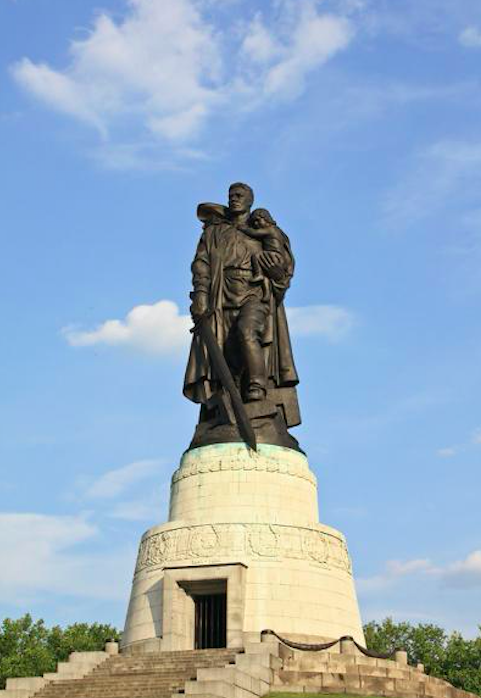
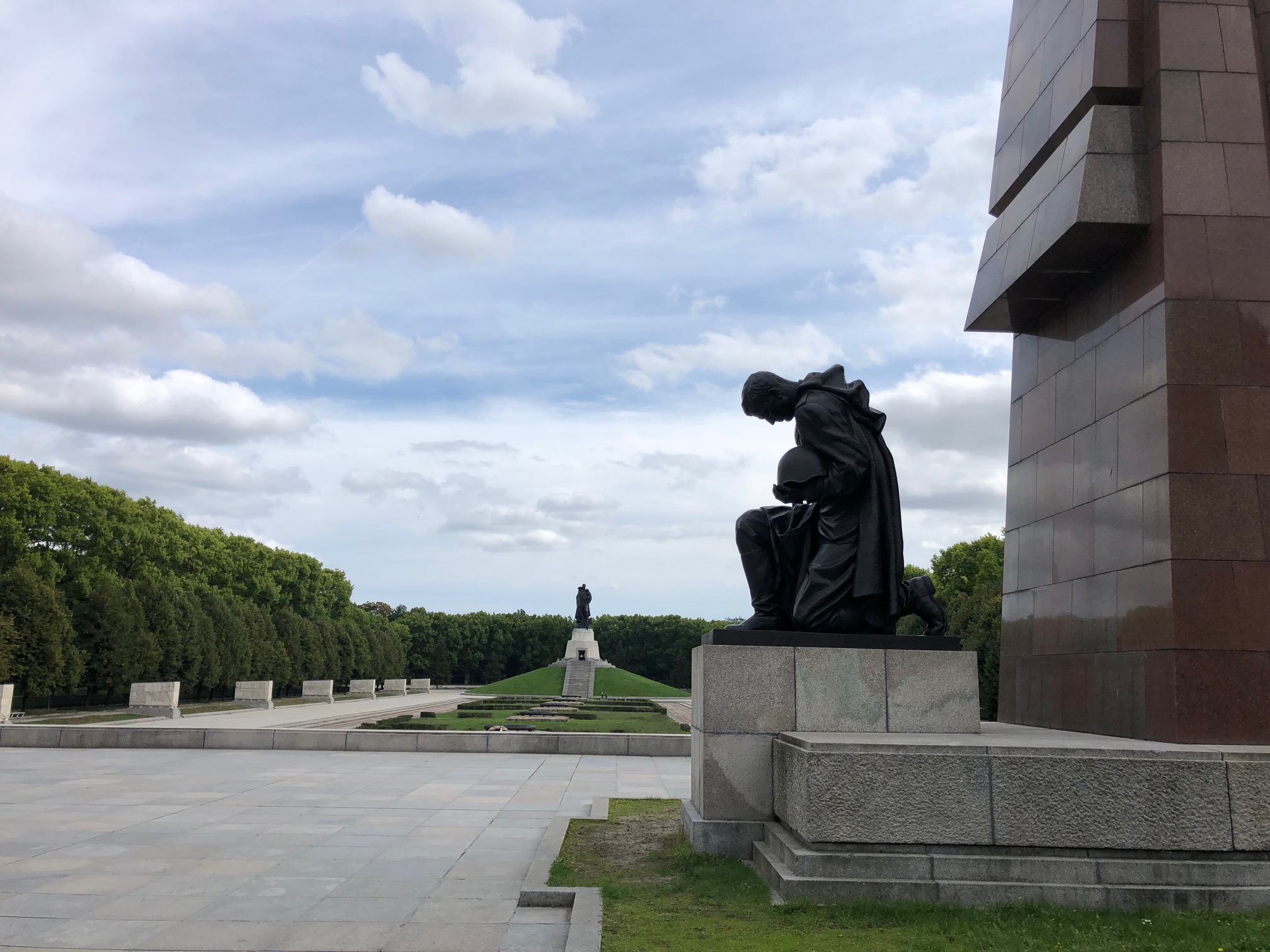
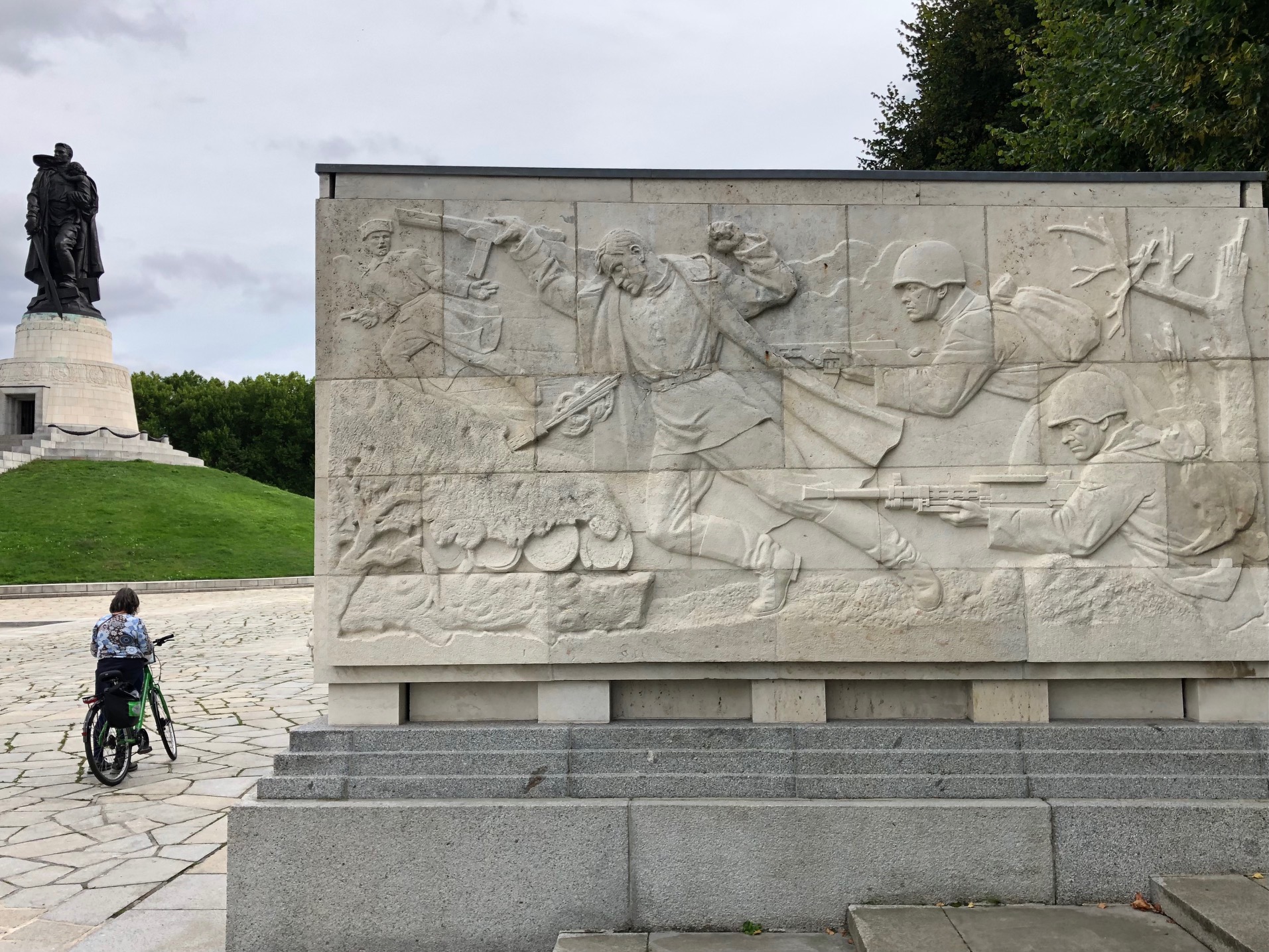
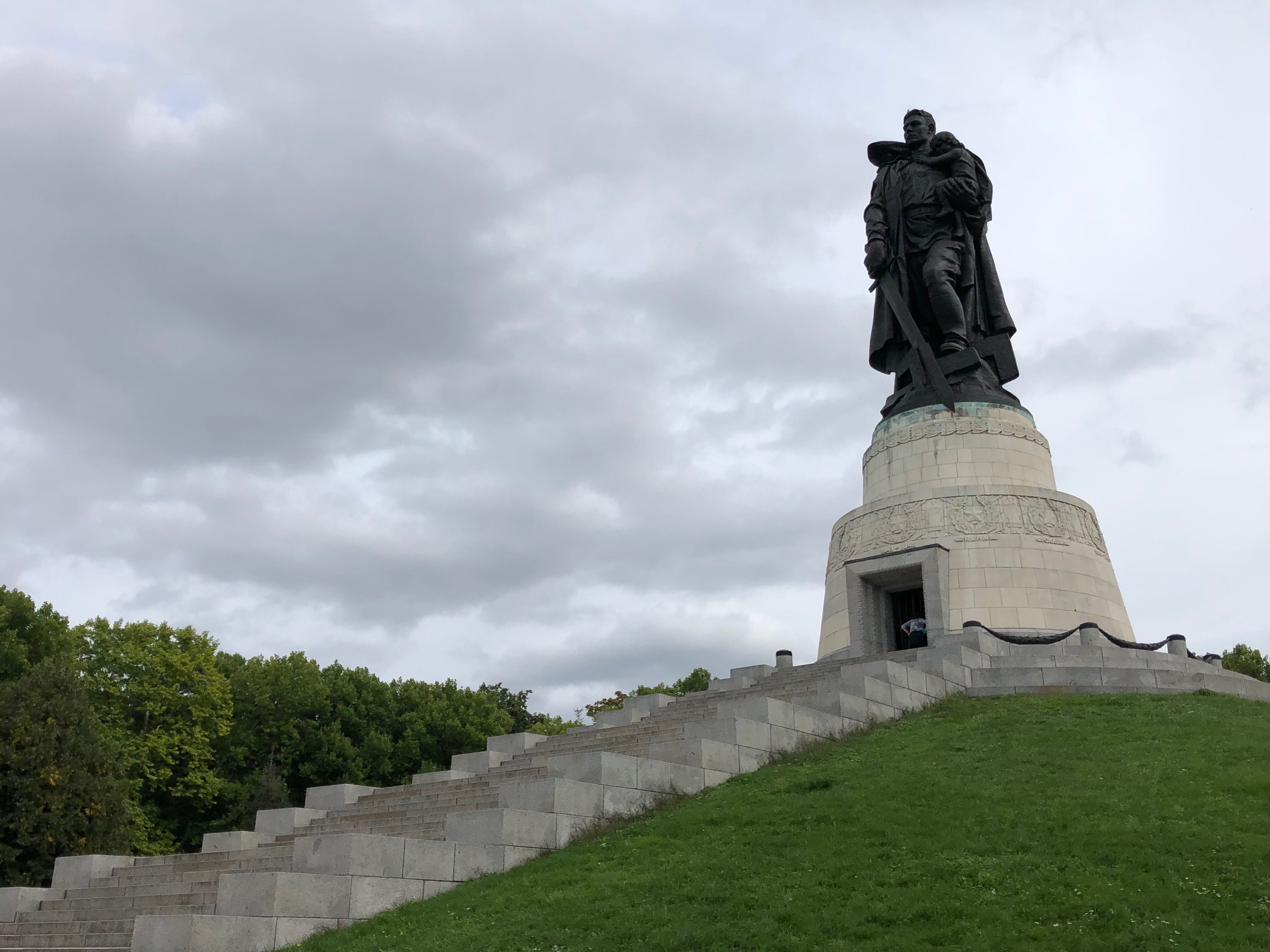
In my last blog I wrote about travelling the Berlin Wall Way, itself a form of 100+ mile-long memorial remembering both a repressive episode in history and those who lost their lives trying to escape it. Well, a little off that route in what was central East Berlin is Treptower Park, the largest Soviet military memorial outside the Soviet Union. Opened on 8th May 1949, it is a 10-hectare cemetery for 7000 of the more than 22,000 Soviet soldiers killed in the battle to take Berlin in the final months of the Second World War and contains the world-famous symbol of the role played by the Soviet Union in destroying National Socialism: the 13-meter towering statue of a Soviet soldier holding a lowered sword over a shattered swastika and cradling a rescued German child in his arm.

The Soviet Warrior Monument built by Yevgeny Vuchetich

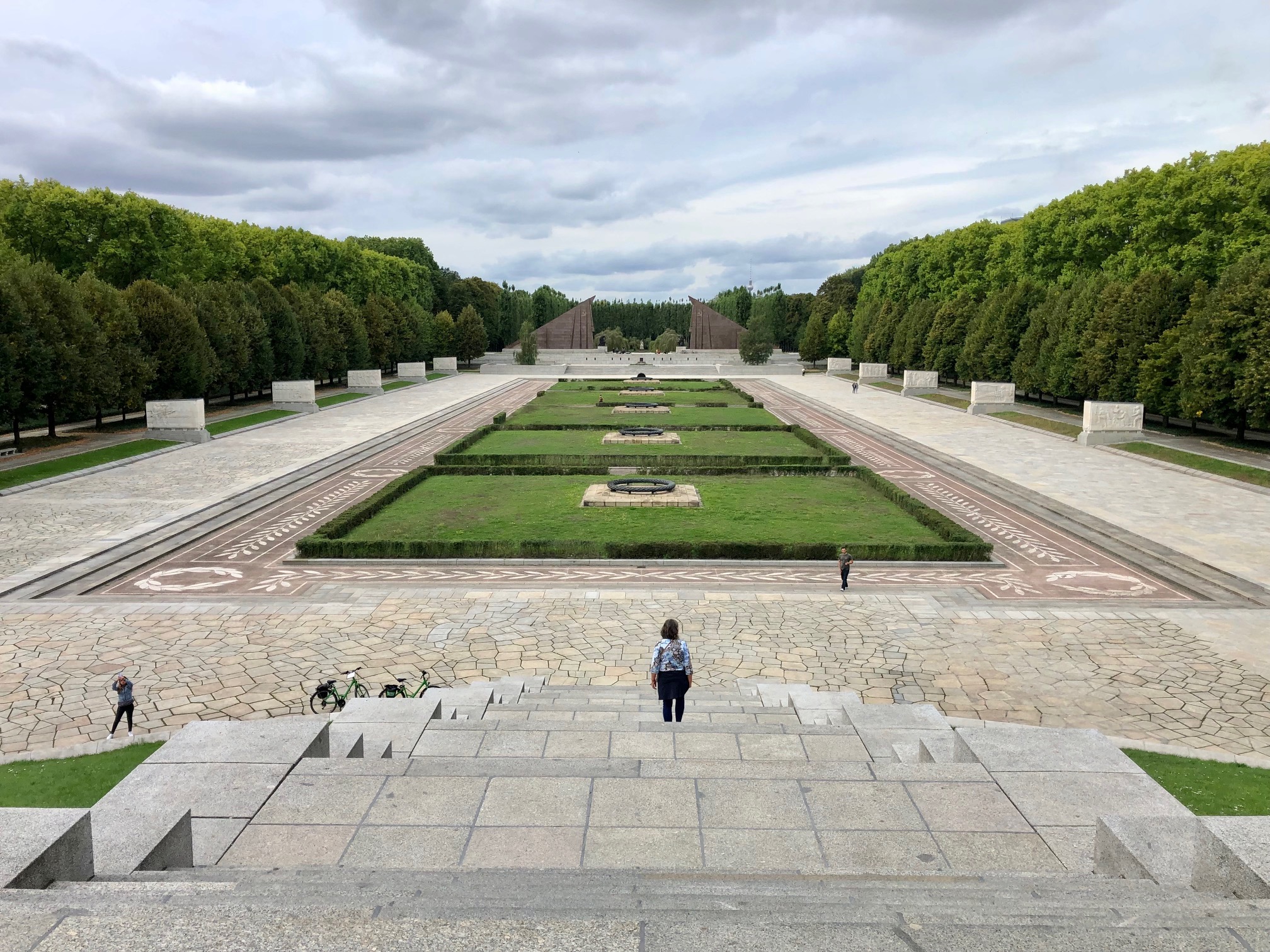
To experience this place is to experience a sense of the enormity and profundity of the impact WW2 had on the Soviet / Russian people. For a start it is vast. And the extensive layout is designed to take you through a process of mourning and remembrance to honouring the victors as heroes and liberators. 

‘Heroes and liberators.’

We too use those words in relation to our own soldiers. But how often have we – or do we – actively honour the decisive role the Soviet soldiers played in defeating Nazi Germany? And how often do we include the mind-boggling numbers of Russians murdered or killed in the process (25 million to give a rough/round figure) in our process of remembrance? We don’t really, is the only answer I can find. And yet they were our allies in a war that we, as a nation, have made central to our national identity. Could our slightly introspective leanings and lack of acknowledgment of the Soviet sacrifices and achievement (among many other factors, not least the horrors of the Stalin era) have contributed to the attitudes of subsequent regimes and politics towards the West? Just a question… but one that walking through Treptower Park certainly made me ask.

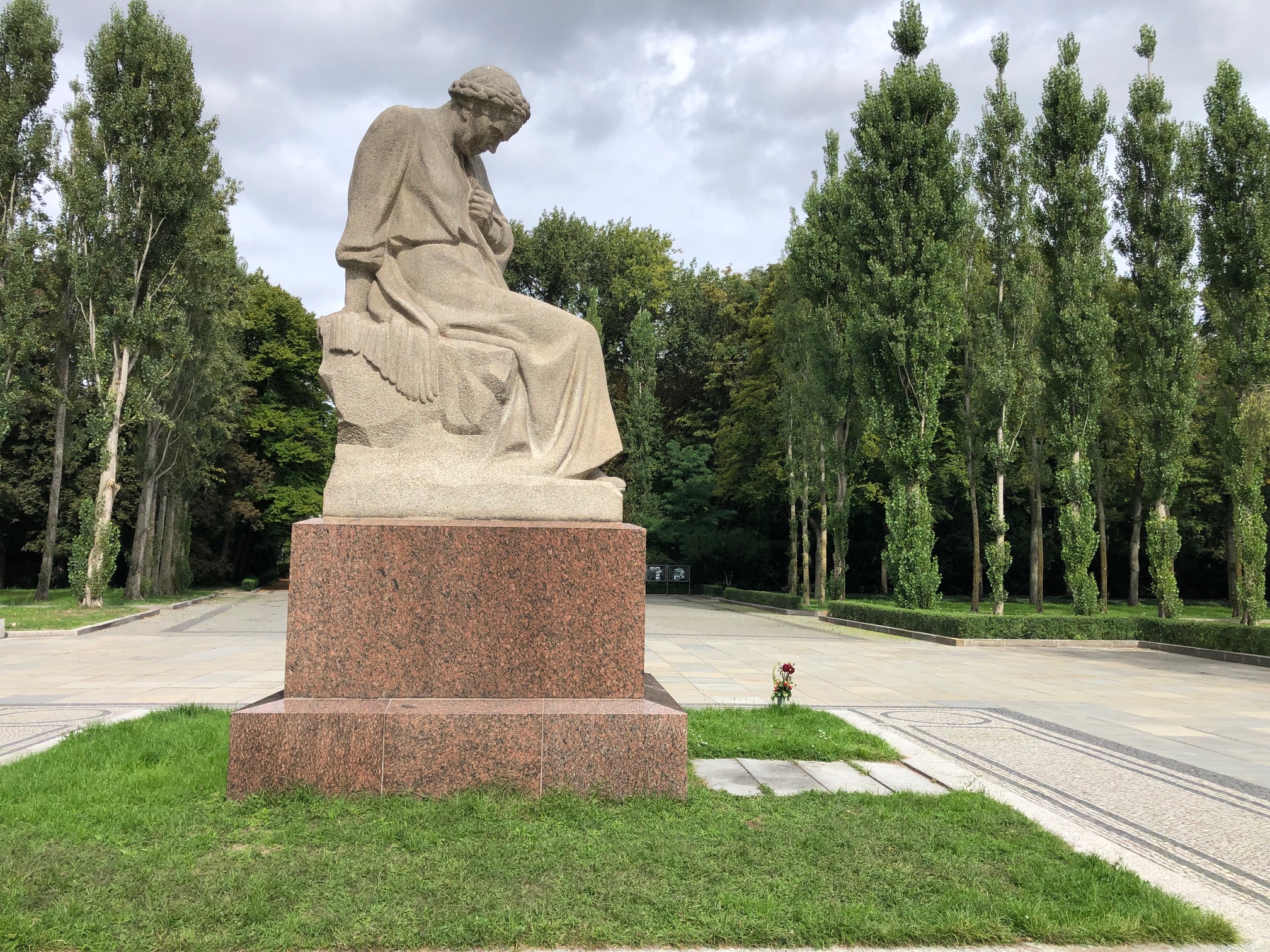
‘Mother Homeland’

Entering through one of two avenues, the (tiny) visitor is led first to the statue of a grieving “Mother Homeland.” 

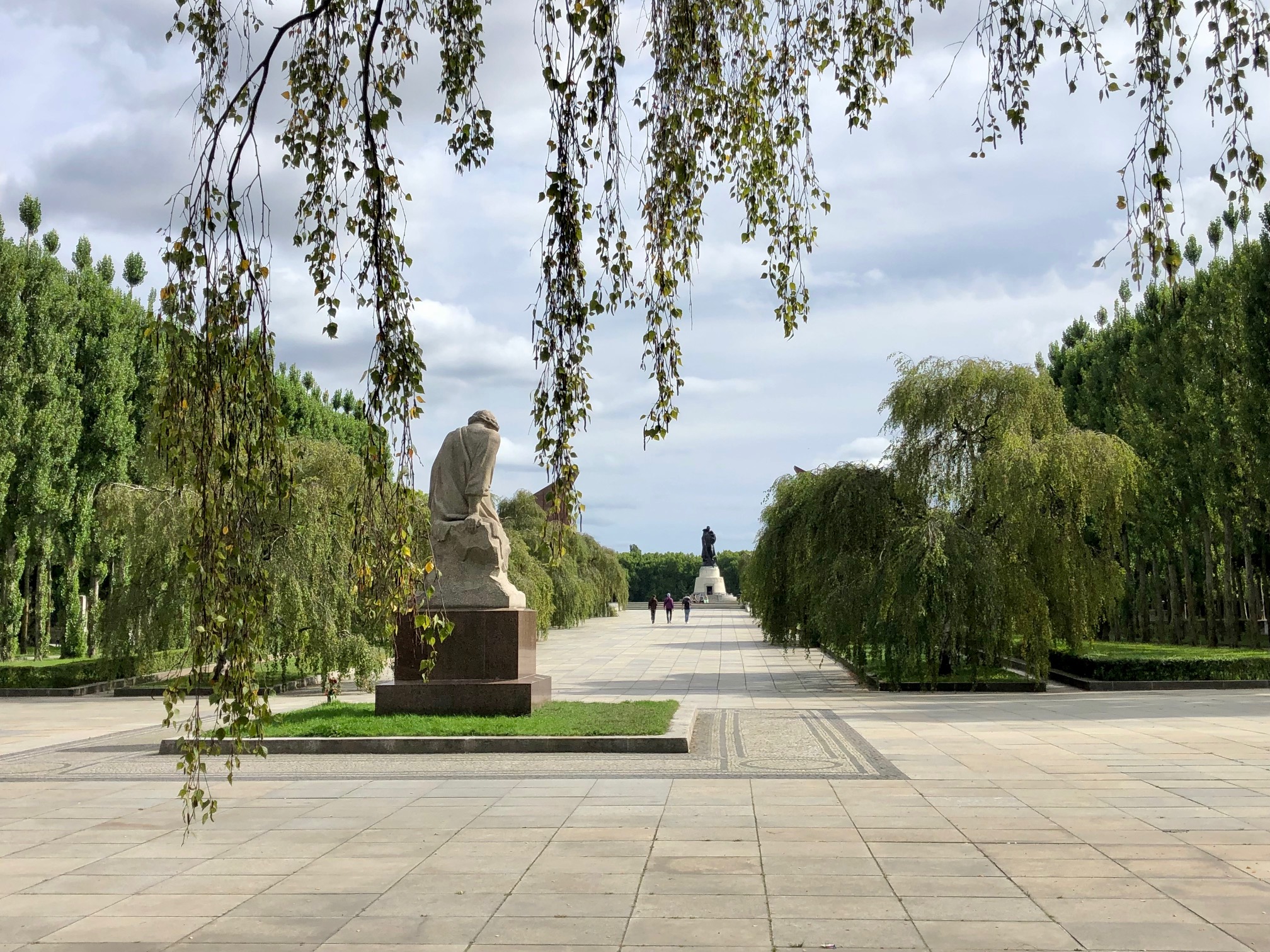
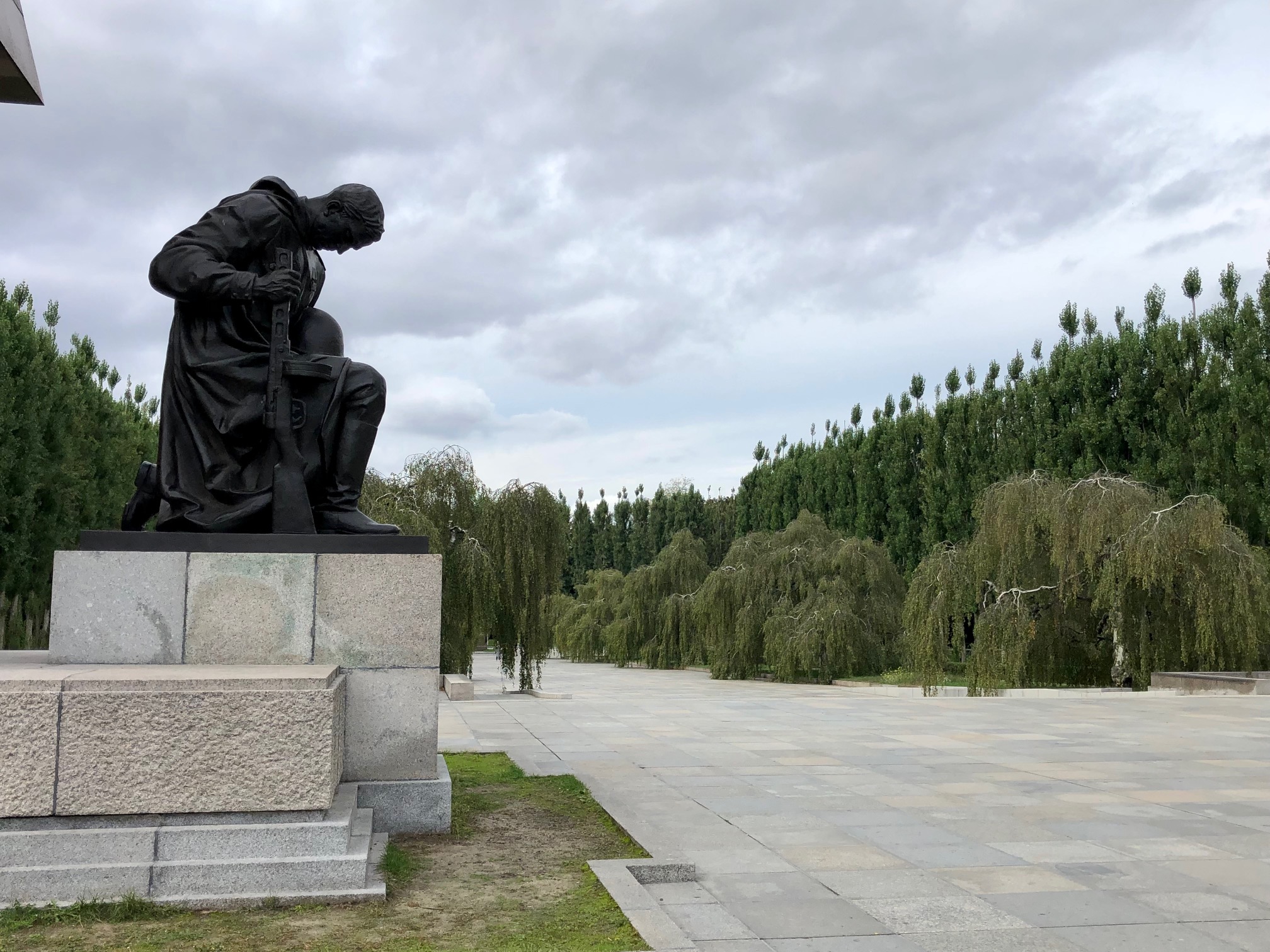
From there a promenade lined with weeping birches – incredibly moving witnessing trees seemingly crumpled in grief – you arrive at two sphynx-like kneeling soldiers that act as guardians to the cemetery section below. 

Looking back to the avenue of weeping birches
Looking ahead to the cemetery

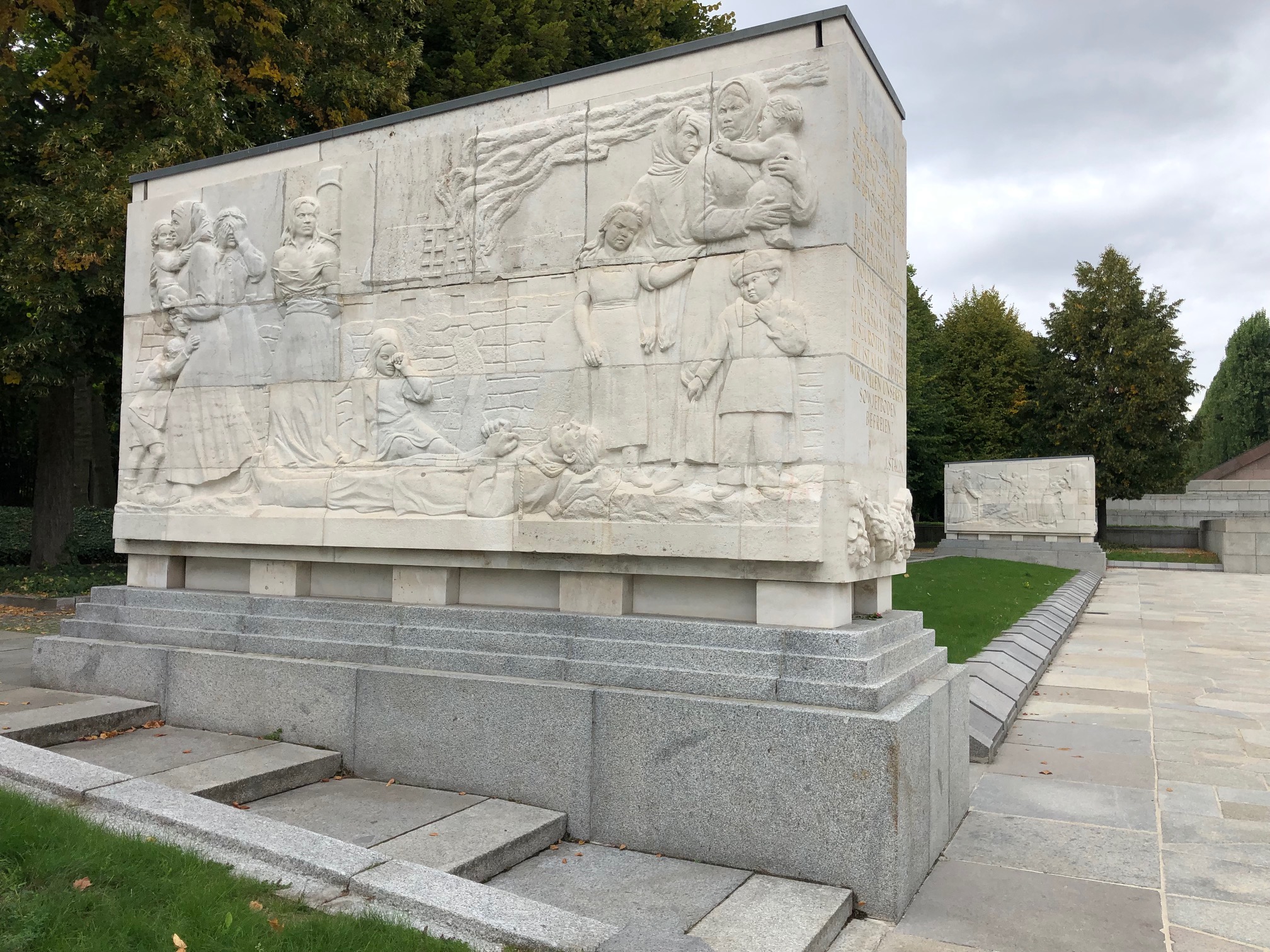
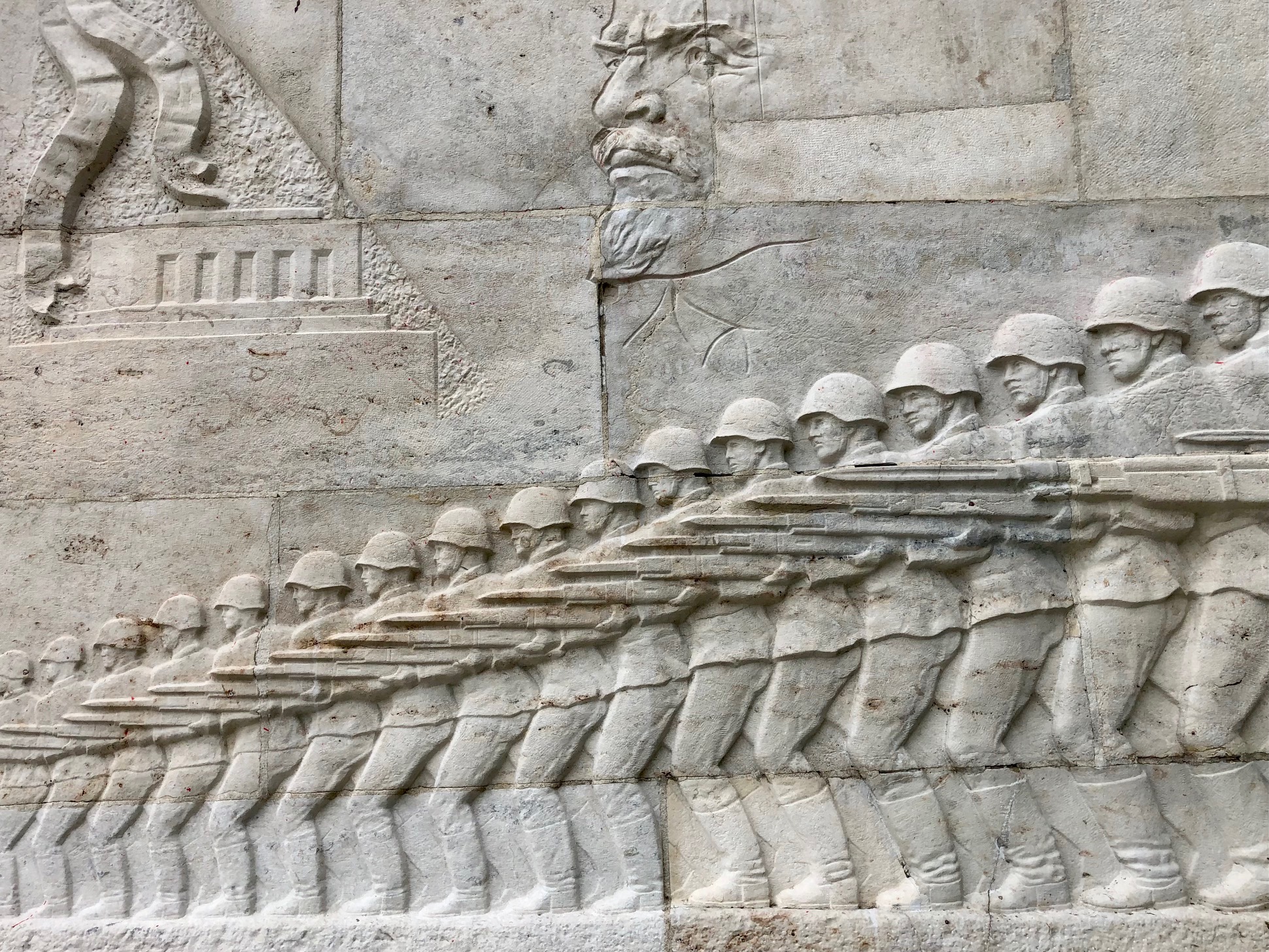
Beautifully executed stone reliefs illustrating scenes from the ‘Great Patriotic War’ decorate the sixteen marble sarcophagi flanking the graves, while gold-lettered quotes by J. Stalin, the commander in chief of the Soviet armed forces, underscore the importance of the Communist Party and the Red Army under his leadership. Though clearly outdated, these quotes survived Khrushchev’s denouncement of Stalinist rule in 1956 with the subsequent cull of Stalin-statues and effective banning of any mention of his name in public. 

The sarcophagi tell the story of the Second World War in Russia…
…through extraordinary imagery and craftsmanship.
Dedicated to the ‘heroic dying’ of the Russian people

At the very far end, you climb a stepped hill to a mausoleum supporting the aforementioned bronze statue of a Soviet soldier holding a small German girl.

Turning around to descend, you get an overview of the whole dramatic panorama that reflects the historical narratives and artistic concepts dominant in the Soviet Union under Stalin and to a degree still exist today: monumentality, hero worship, a personality cult, and a claim to exclusivity.

Treptower Park has been and continues to be a frequent venue for commemorative events. Since 1990, with the signing of the German-Soviet treaty on neighbourly relations and the German-Russian agreement on the upkeep of war graves in 1992, the Federal Republic of Germany committed itself to the care, renovation and maintenance of all Soviet military graves and war memorials in Germany. 

The evident meticulousness with which the whole site continues to be maintained (and patrolled by German police) is another of Germany’s visible expressions of understanding and reconciliation that have been extended to the Russian Federation and other countries brutally destroyed in the Third Reich’s expansionist and ideological wake. Does this reaching out in friendship make it easier to understand Angela Merkel’s unpopular (certainly in retrospect) policy relating to the Nord Stream pipeline? And the apparent weakness of Olaf Scholz’s initial reluctance to break Germany’s practice and permit the transfer of lethal weapons to areas of conflict… in this case, to Ukraine?

If the premise of my book is true and unresolved traumas of one generation can impact the lives and behaviour of subsequent generations, then the extreme collective traumas experienced by the Russian people over the past century are part of what we are seeing playing out in the attitudes, politics and actions of Russia today. Trauma responses such as emotional numbness, low self-esteem, acceptance of poverty might go some way to explain the apparent passivity and gullibility of large swathes of the population. Likewise, trauma responses such as shame might be producing the violence, megalomania and greed of those in power. Is this then, by extension of the idea, the natural destiny of all traumatised nations? After all we can see similar dysfunction and violence in Africa, South America and plenty of other nations once brutally colonised.

Psychohistory‘ – a new but exciting term to me that I appear to have already been practicing – seems to offer a way forward in thinking about these things. It combines history with psychology/psychoanalysis and social sciences/humanities to understand the emotional origin of the behavior of individuals, groups and nations, past and present. In other words, the ‘why’ of history.

I don’t have any answers, nor even the right questions yet, just an ever-growing sense of discomfort in simple, black and white narratives of good and bad, right and wrong. And an increasing belief that we are still very far from seeing, let alone comprehending the fuller picture. But we need to become more trauma-informed in all areas of life. For to neglect trauma is to leave people in a state of emotional numbness. And when you don’t feel, you become capable of overriding humanity and care for fellow living beings and life itself.

Further Reading / Viewing: 

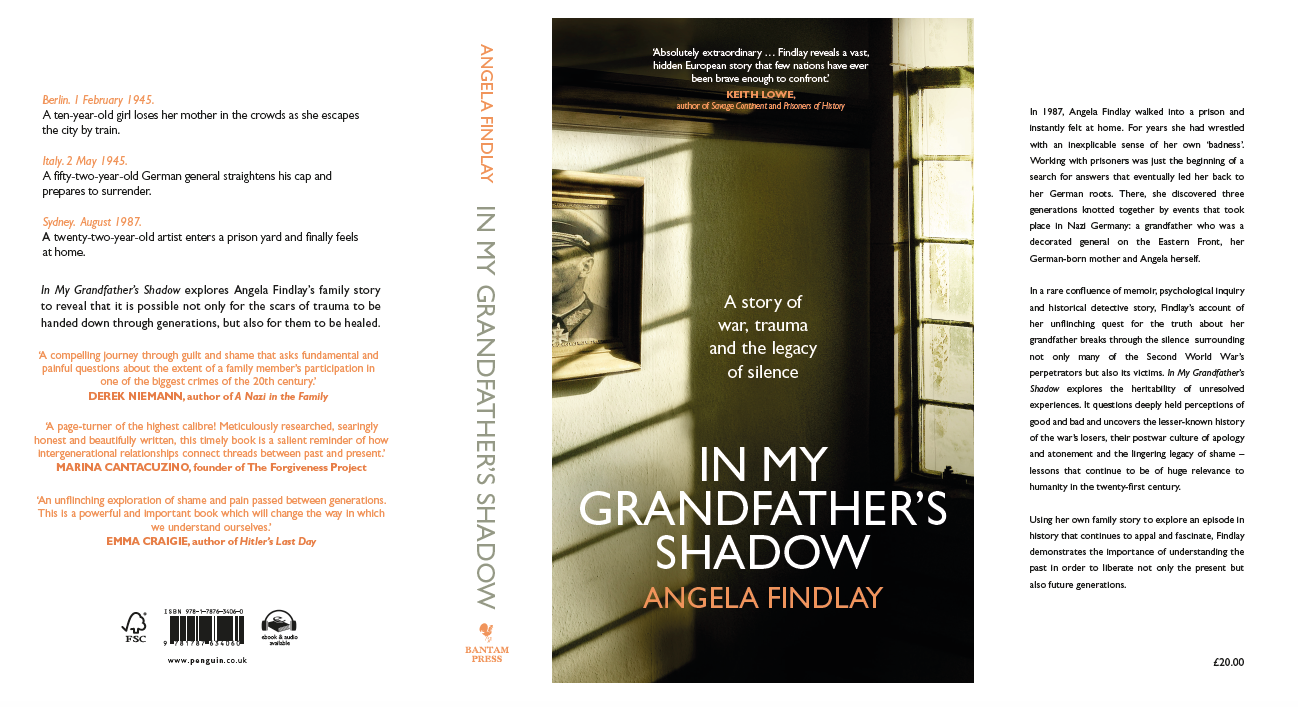
These questions are explored more deeply in my book: In My Grandfather’s Shadow. Published by Penguin Transworld and Bantam Press in July 2022 and available in most bookshops and the usual online outlets

The brilliant BBC documentary ‘Russia 1985-1999: Traumazone’ by Adam Curtis is made up of multiple film snippets taken in those years. As a fly on the wall experience and from the comfort of an armchair, it doesn’t get much ‘better’ in terms of an experience of Russia. To have lived through those years of extreme deprivation, corruption and hunger must have been little short of appalling.

Russia 1985-1999: TraumaZone review – ingenious, essential viewing from Adam Curtis

‘Generations of hurt’: Children and grandchildren of war survivors fear ripple effect of Russia’s war in Ukraine

Russia has yet to recover from the trauma of the Stalin era – The Guardian

Cycling the Berlin Wall Way… an education, a warning, an inspiration

In the faultless pageantry of Queen Elizabeth’s recent funeral, we witnessed one of the things that Britain does really well. Whether you are pro- or anti-monarchy, it was a spectacular display of planning, coordination, ritual, symbolism and attention to detail, as well as a gratitude- and love-filled farewell to the only ‘Her Majesty’ we have known. Impossible though it might sound, I missed most of it!

I was in Berlin experiencing what Germany does really well: remembrance and commemoration of a difficult and painful history. It was, however, not Germany’s intensive and on-going process of coming to terms with its Nazi past that I was focused on. This time, I was with my two siblings cycling the Berlin Wall Way, a continuous bicycle path that follows the former footprint of the 100-mile long Berlin Wall as closely as possible. Taking five days to complete, with added time to explore some of the many poignant locations in the centre, it was a total eye-opener, not least to the very concept of a divided city and country.

Map of West Berlin with the 160km Wall marked in red

The first initially confusing fact to digest is that, contrary to the widely held idea that the Berlin Wall was a north-to-south boundary separating West and East Berlin, in reality the wall went all the way round West Berlin thereby creating a democratic West German island within socialist East Germany. Even with a map, we found ourselves frequently asking: So, are we in the West or the East? the answer to which, I assure you, is rarely as straightforward or obvious as it sounds.

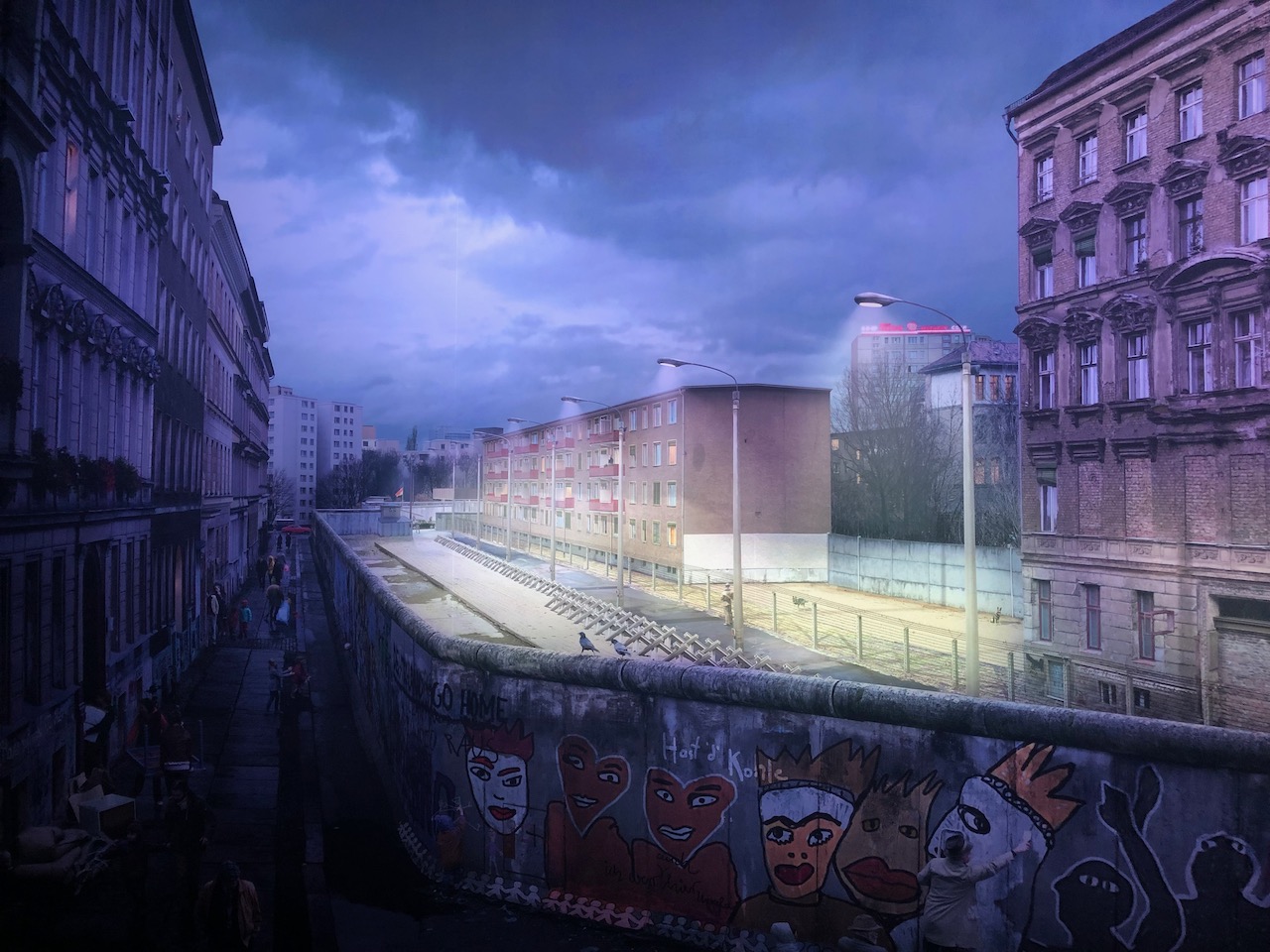
The second tangible shock felt while snaking along its course, was the utter illogic and arbitrariness of this ideological divide – through streets, houses, communities, lakes and woodlands. This randomness would have started as a line drawn on a map by the leaders of the victorious nations – USA’s President Harry S. Truman, Josef Stalin of the USSR, Britain’s prime ministers Winston Churchill and then Clement Attlee as well as other leading members of the three delegations present. That’s probably how most of the other contested border lines around the world have originated. To engage with the whole concept of division, not to mention the impact it had on families and friends separated for nearly three decades, is almost impossible. An enormous 360˚panorama entitled THE WALL by artist Jadegar Asisi gave us arguably our most immediate and visceral sense of being in West Berlin looking at and over the wall into the deadly world behind.

From the360˚ panorama THE WALL by Jadegar Asisi

The third challenge was understanding the complex evolution and structure of the wall that was built in three phases, starting overnight on 13th August 1961 as Berliners slept. What began as a barbed wire barrier and the closure of all but 13 of the 81 established crossing points between the Western and Soviet sectors, eventually developed into not one but two concrete walls separated by a corridor of no man’s land known as the ‘death strip’ with mines, raked sand to detect footprints, trip wire machine guns and armed East German guards in watch towers or patrolling on foot with dogs. By 1989, the Wall was lined with 302 watchtowers and more than 136 people had died trying to cross it.

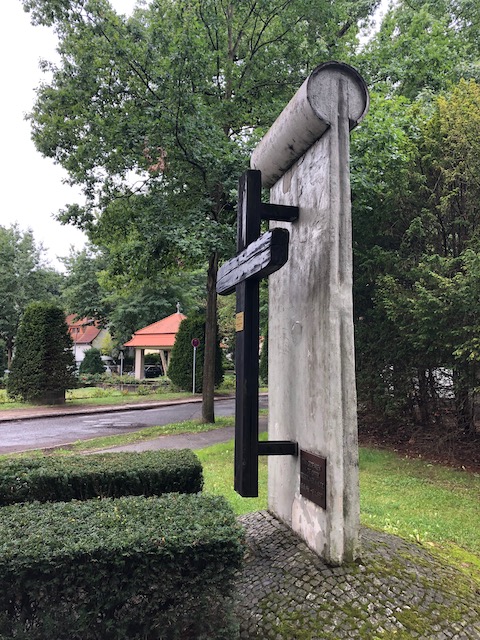
An example of a section of the wall. What we call the Berlin Wall is on the left

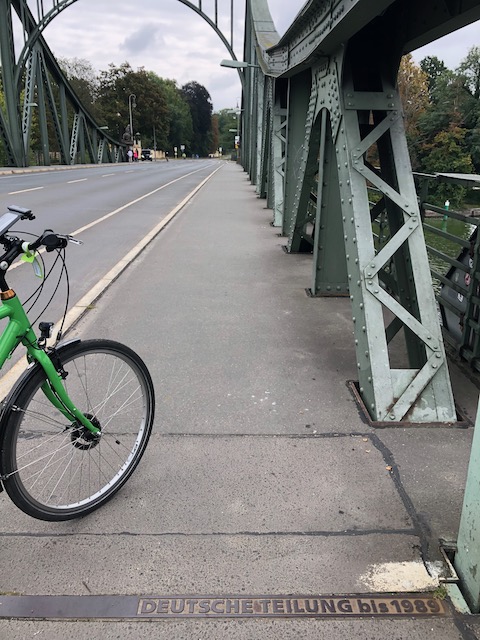
Our little trio started our circumnavigation of West Berlin on the famous Glienicker Bridge in Potsdam in the middle of which spies were on a number of occasions exchanged in the dead of night.

Glienicker Bridge

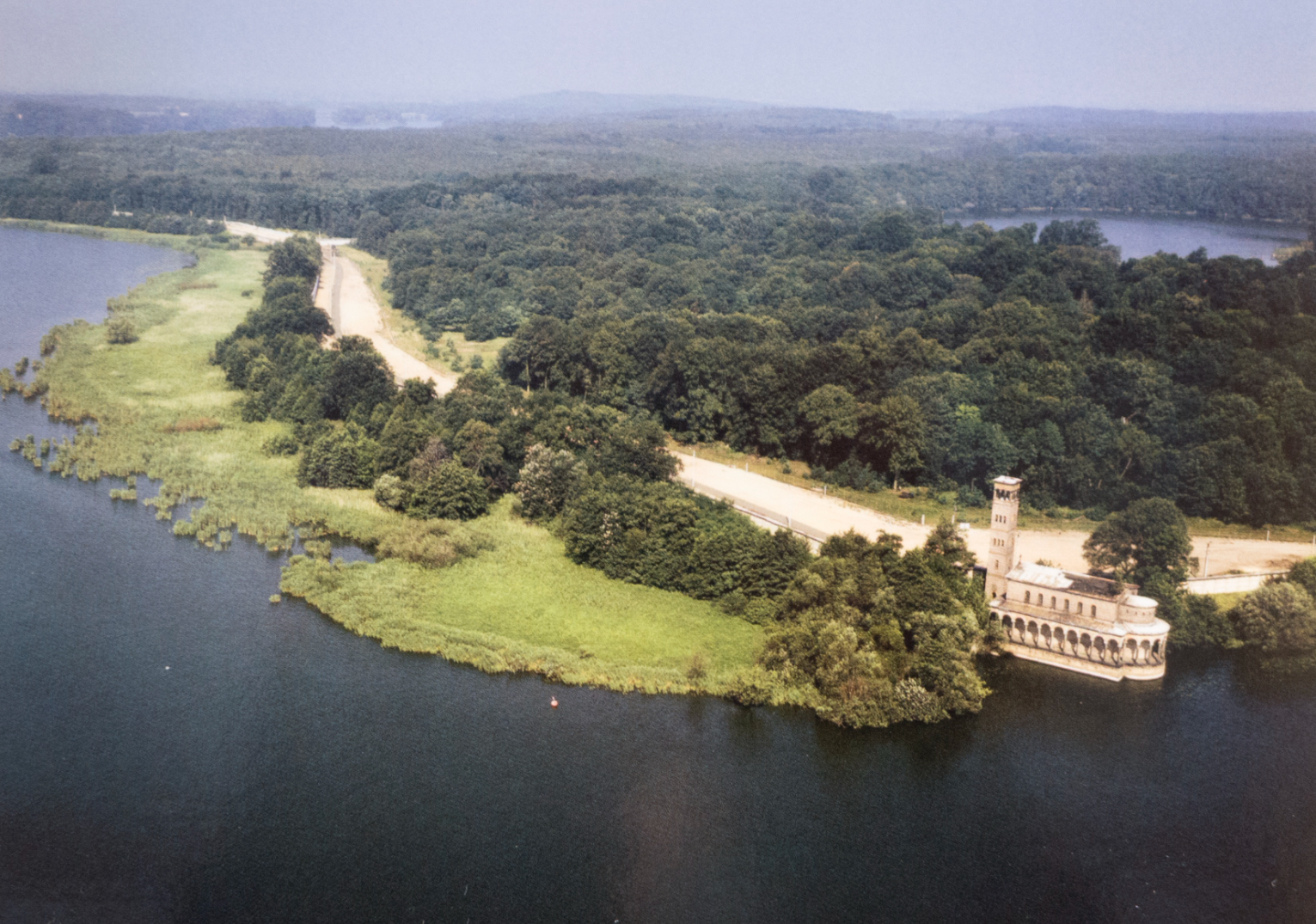
Following a reassuringly well-marked ‘Mauerweg’ route, we soon passed Schloss Cecilienhof, host to the 1945 Potsdam Conference where the division of Berlin and Germany into occupied zones was decided. From there we hugged the shoreline of beautiful lakes, passing the Sacrower Heilandskirche, the church stranded in the controlled border strip and cut off from its congregation.

Heilandskirche, Sacrow, 1961

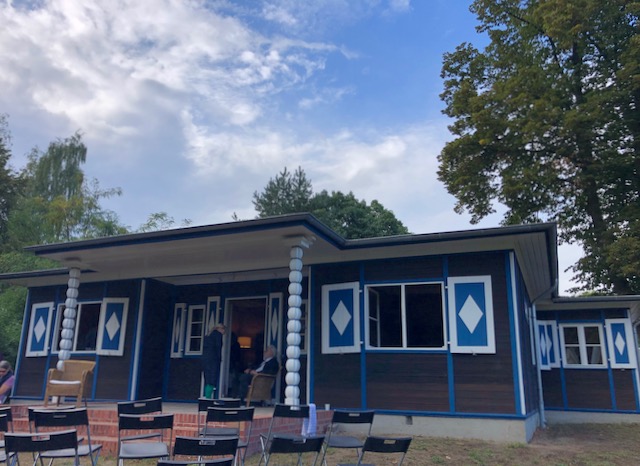
Heading north, we reached Alexander House, whose history became the subject of the acclaimed book by Thomas Harding, The House by the Lake, and is now a place of education and reconciliation.

Alexander House: The House by the Lake

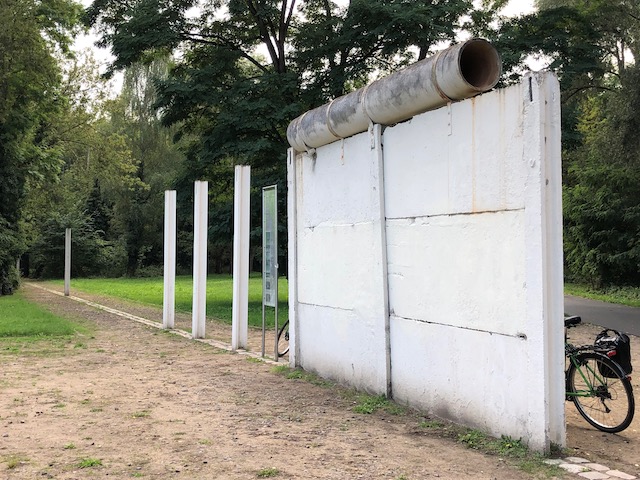
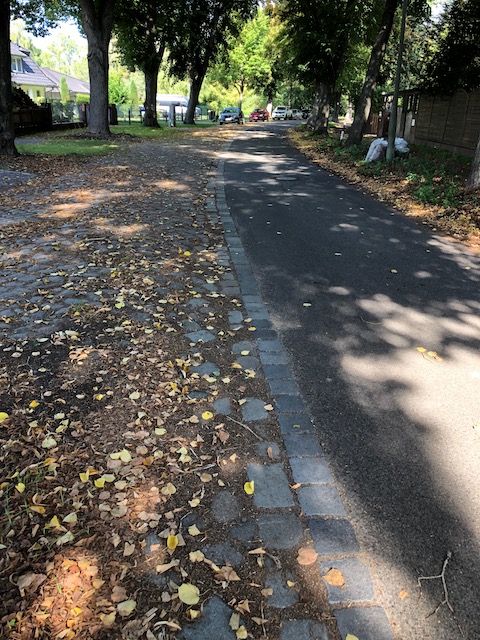
Staying in different hotels en route at intervals of roughly 30 miles enabled us to gain a sense of the scale of the wall and the extraordinary episode in history that only ended a little over 30 years ago. Sections of the concrete boundary, a double cobbled stripe embedded into the pavement or road surface, information boards with photographs and explanations all punctuated our journey.

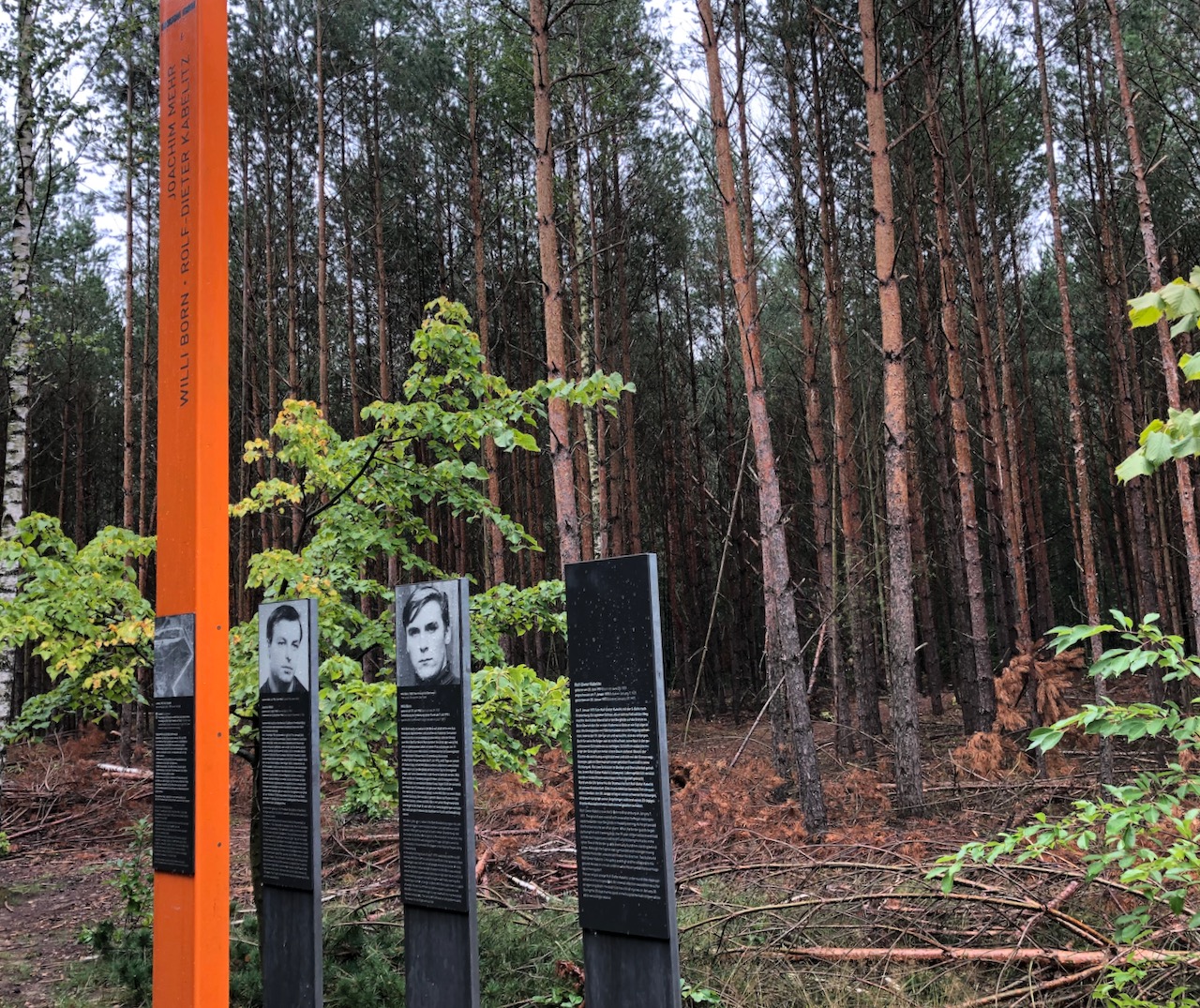
Most moving were the memorials telling heartbreaking stories of failed escapes, largely by young twenty-something-year-old men. With the same unflinching honesty for which all German WW2 or Holocaust-related museums and memorials have come to be known, these allowed us to feel the individual human cost of an ideology based on fear and a necessity to keep people in rather than keeping undesirables out, as the East’s ‘Anti-Fascist Wall’ name misleadingly proclaimed.

Continuing along canals and suburbs, we crossed the ‘Bösebrücke,’ the ‘Bad Bridge’ or Bornholm Bridge that made history on the evening of 9th November 1989 through the jubilant scenes of East Germans flooding across to be greeted by their Western “brothers and sisters” with sparkling wine, cheers and hugs while bemused Eastern border guards watched on helplessly. Unlike my former visits to Berlin while researching for my book, it was this joyous energy of liberation that primarily accompanied me on this trip and allowed me to experience the incredible resilience of Berlin’s inhabitants, past and present, and the revival of its worldwide status as a brilliantly creative, thriving city.

The Bornholm Bridge today and 1989 (pictured)

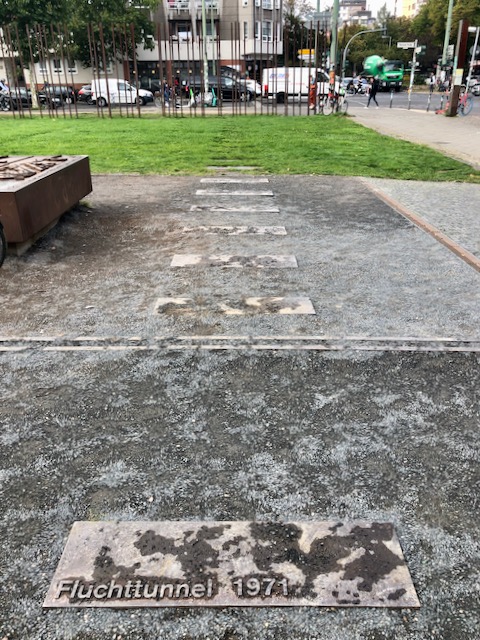
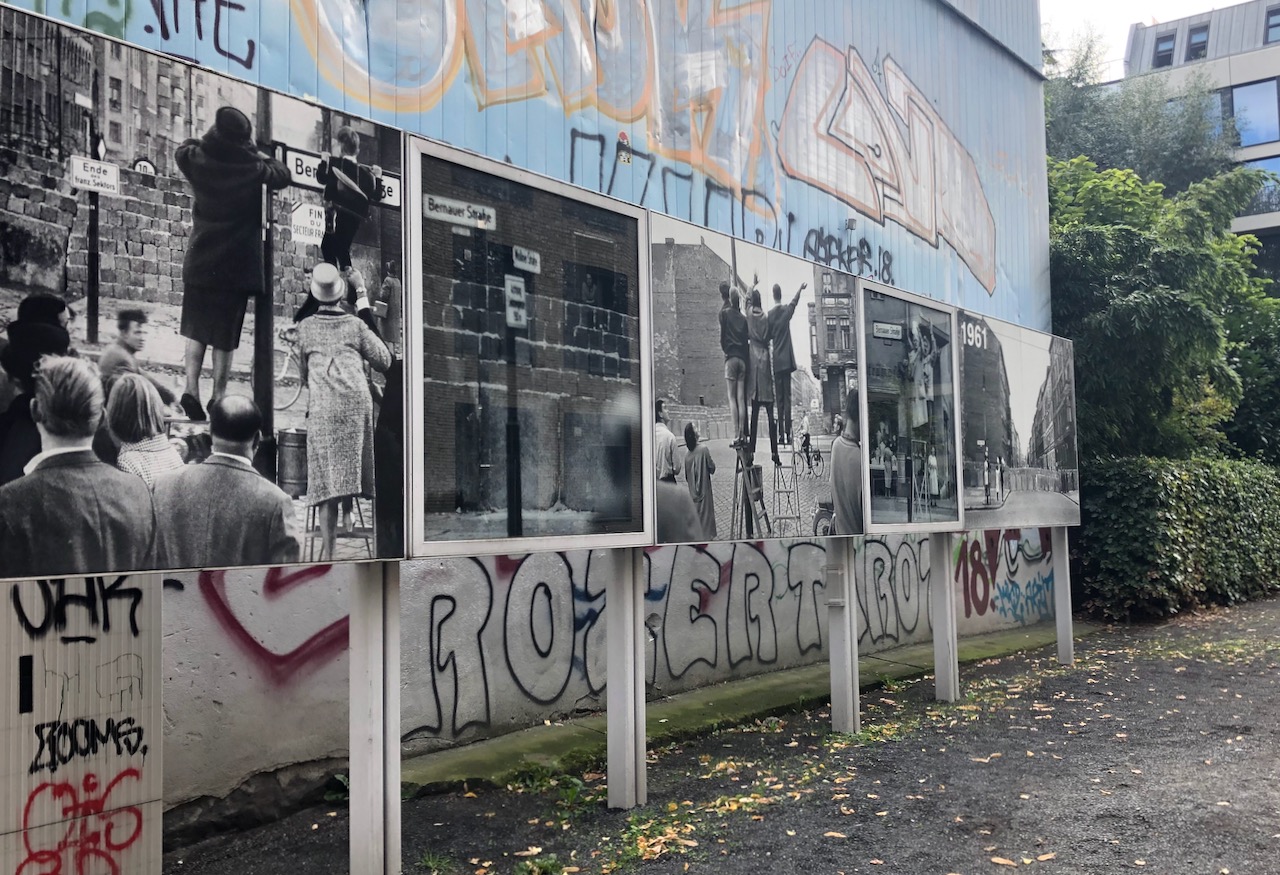
On we cycled, heading south through the beautifully curated but frequently harrowing Mauerpark (Wall Park) that leads into the Bernauer Strasse from which many of the well-known pictures of people jumping out of house windows into tautly held blankets in the West were taken. It was also the street under which various escape tunnels were dug similar to that shown in the 1962 documentary, The Tunnel and including the ‘Tunnel 29’ of the brilliant podcast and book with the same name.

An extended section of the wall and border strip have been preserved as a chilling testimony to its once terrifying presence.

Bernauer Strasse

The Wall then continues through Berlin Mitte past some of Berlin’s most famous landmarks: the Reichstag, the Brandenberg Gates, Under den Linden and the Tiergarten, past Potsdamer Platz and Check Point Charlie and along the boundary of what is now one of Berlin’s most chilling museums – the Topography of Terror – but what once was the location of many of the most sinister ministries of the Nazi regime. Then through graffiti-covered Kreuzberg, over the River Spree and to the longest surviving stretch of the inner wall painted in 1991 by painters from all over the world to form the colourful East Side Gallery.

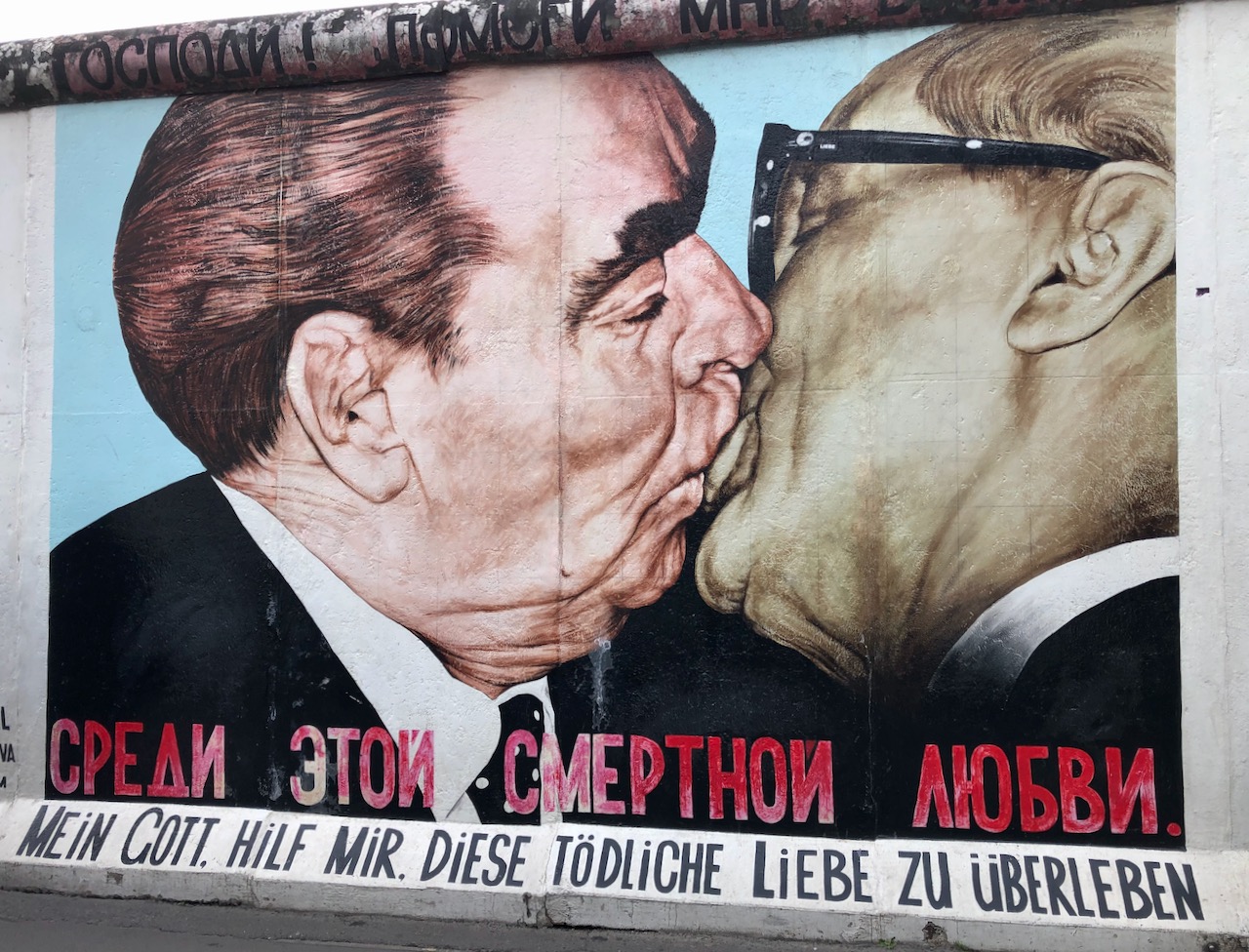
Eastside Gallery: ‘My God. Help me to survive this deadly love.” From a press photograph of Leonid Brezhnev and Erich Honecker painted by by Dmitri Vrubel.

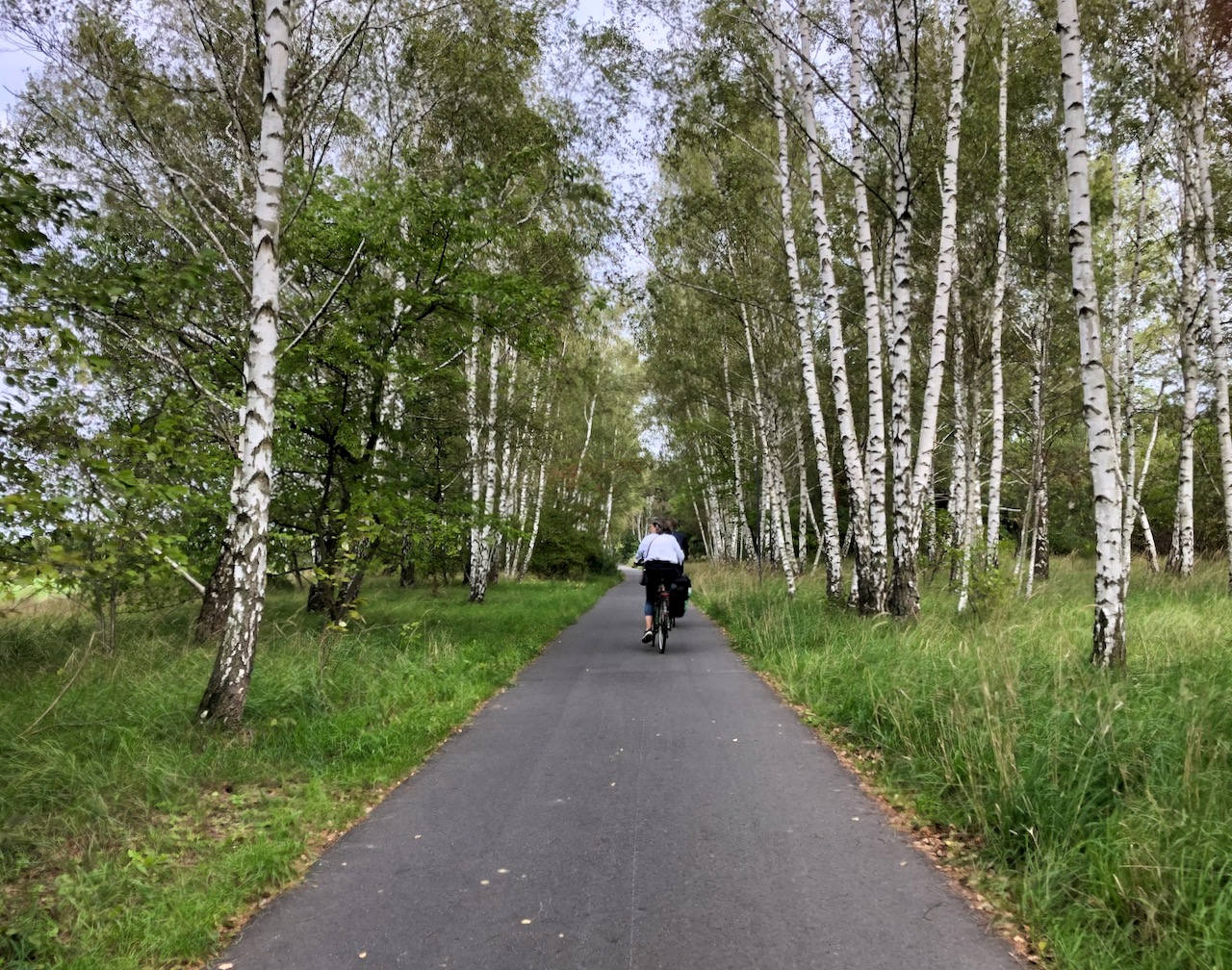
The final 40 miles or so along the southern strip of the wall’s course back to Potsdam was largely rural. A sense of peace replaces the former horror of all that the border came to represent. Long stretches of open fields, avenues of birch trees and an alley of 800 ornamental cherry trees donated by Japanese citizens and a TV station in 1995 “out of joy over the reunification of Germany.”

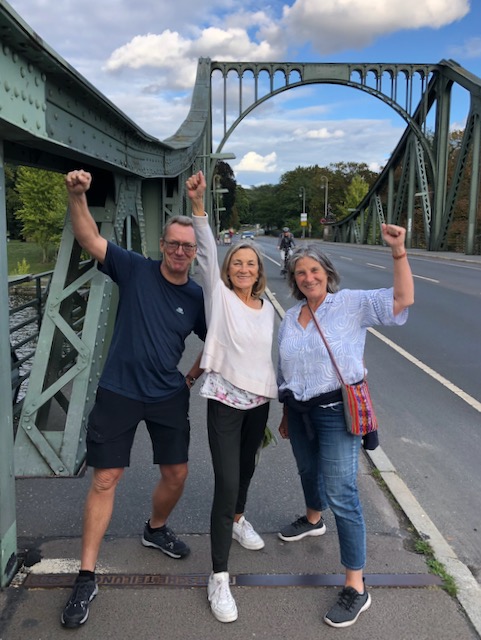
Finally, the three of us arrived back on the Glienicker Bridge from which we had begun our trip, each a little changed, each with a greater knowledge and understanding of German history and our German roots. Each with different emotional responses but a shared sense of the ultimate triumph of humanity and freedom over inhumane systems of repression.

Back on Glienicker Bridge

Upcoming Events relating to my book – In My Grandfather’s Shadow:

Friday 7th October, 7pm. Ebeneza Presents, Somerset: In My Grandfather’s Shadow. More information and tickets here
Sunday 9th October, 4pm. Cuckfield Book Festival: I will be in conversation with Julia Boyd, the best-selling author of Travellers in the Third Reich and A Village in the Third Reich.
More information and tickets here
Wednesday 12th October, 4pm. Mere Literary Festival: In Conversation with Jo Hall. More information and tickets here
Sunday 3rd November, 8.30pm. Stroud Book Festival: In Conversation with Alice Jolly, novelist, playwright and memoirist. More information and tickets here

Can we start recognising the different qualities of lived experience and logic… and valuing them equally?

July has provided many rich and interesting stories I could write about.

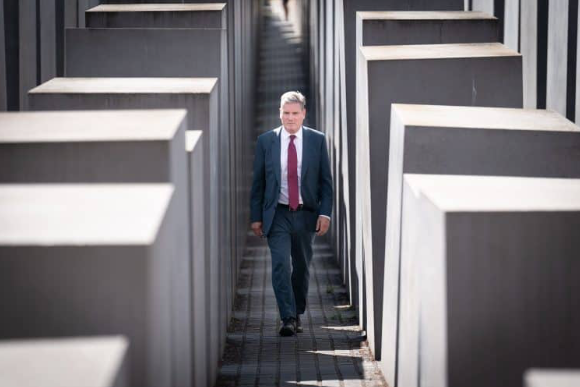
There was the Labour leader, Sir Keir Starmer’s ill-judged campaign video in which he and Shadow Foreign Secretary, David Lammy, are filmed walking thoughtfully through the grey corridors of the Holocaust Memorial in central Berlin, ‘a massive faux-pas’ in Germany where such a carefully choreographed and blatant political usage of the site would be a complete and passionate no-no. 

Sir Keir Starmer in Berlin

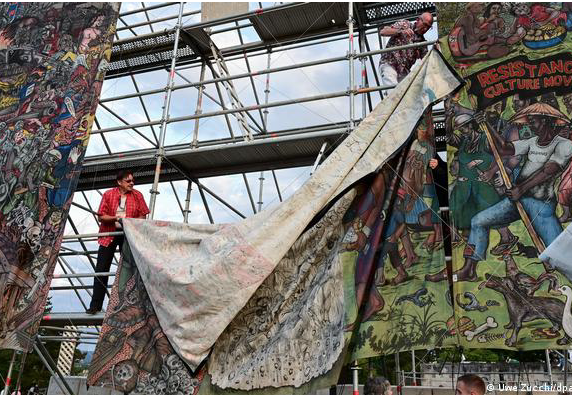
Or the contentious mural by the Indonesian art collective, Taring Padi, deemed unacceptably antisemitic and therefore quickly removed from this year’s Documenta international contemporary art fair in Kassel, the director quitting soon after.

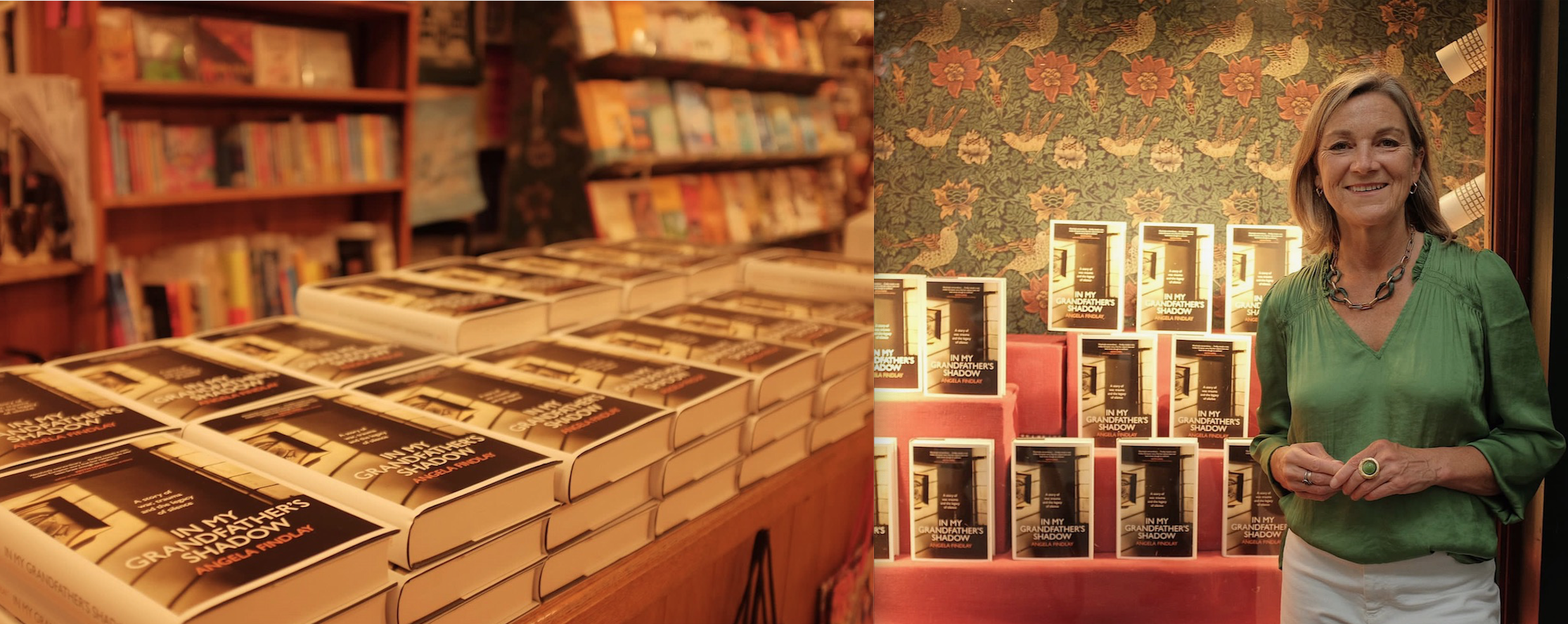
And my personal highlight, the three wonderful book launches that celebrated my arrival at the summit of my endless mountain. July has buzzed with the tangible excitement of people starting to read In My Grandfather’s Shadow and a string of radio interviews (all available here) and future invitations to talk about the themes and questions it raises.

Book Launch at Daunt Books, Holland Park

But two other experiences left me reflecting once again on what I see as a fundamental fault line in our troubled world. One was a recent review of my book, In My Grandfather’s Shadow, in the Observer. The other, the National Theatre Live broadcast of Suzie Miller’s award-winning play, Prima Facie in which an outstanding Jodie Comer (the BBC’s Killing Eve’s notorious assassin) plays a young and brilliant barrister who, after an unexpected event, is forced ‘to confront the lines where the patriarchal power of the law, burden of proof and morals diverge.’ 

In different ways, both the article and the play illustrate the age-old dynamic of ‘feminine’ versus ‘masculine’ perspectives in which the feminine experience is ignored, interrogated until it no can longer stand up and finally overridden, often with catastrophic consequences as the play demonstrates. For example, just 1.3% of rapes end in prosecution. Why? One reason is clear: the clunky measuring tools employed by the law to establish ‘proof’ are wholly inadequate when it comes to female trauma.

On a far less serious level, the Observer review by Matthew Reisz, former editor of the Jewish Quarterly and a staff writer at Times Higher Education, created a similar tension. I am hugely chuffed to have a got a review in the Observer. And there were compliments, like ‘strange and powerful.’ And Reisz was convinced by my hypothesis that a parent’s PTSD can have an impact on a child. Science after all accepts that as real and it’s now mainstream thinking, though it wasn’t always. What Reisz clearly doesn’t give any credence to is the reality, let alone the possibility, of the very premise of the book.

‘Much less plausible,’ apparently, is my belief that I am ‘in some sense haunted by the grandfather she never knew.’ As for the techniques I develop to find an “improbable epiphany” that will help me understand what kind of man he is, well, they are clearly the same “esoteric claptrap” that I suggest my grandfather might have seen them as! 

Matthew Reisz has every right to think like he does, and many will agree with him. I am well prepared for this kind of critique. I knew the ‘woo-woo’ stuff (as one or two of my editors called the more weird occurrences) could be problematic for some readers. But I insisted on keeping it. Without it, it was neither my story nor my book. And certainly not my truth. Including a ‘feminine’ perspective on the largely masculine arena of war and traditional fact-based history was for me essential. And I use ‘feminine’ here not as in female, but as in that inner dimension within all of us. That inexplicable world of instinct, intuition, serendipity, dreams and the invisible whisperings of the dead; often the source of creativity or vision, yet also the areas of human experience so often dismissed as ‘dippy-hippy nonsense,’ not ‘real’ or valid because they are ‘unprovable,’ or apparently just ‘wrong’. For it was these things – not clever science or psychologists – that provided the clues to solving the mystery of what I was experiencing. 

The book is intensely personal. But the issues it explores – addiction, shame, trauma, inherited guilt, forgiveness, reconciliation – are not. As Prima Facie so dramatically shows, they require a different approach to the logic and plausibility of left-brain thinking. This is what I feel Reisz unfortunately misses. In his final sentence, he reveals the source of his unsettledness in the apparent contradiction of ‘a woman who has dedicated her book to “all those whose lives are affected by discrimination, oppression or war” searching so desperately for redeeming qualities in a decorated Wehrmacht general.’ Is he suggesting there couldn’t possibly be any while misunderstanding my desire to comprehend a relative as wanting to exonerate them?

It’s going to be so interesting hearing different responses to In My Grandfather’s Shadow and coming into dialogue with others about their own relationships to the darker corners of their heritages, which is what frequently comes up. Like the prisoners in my art classes, like audience members at my lectures, people begin to talk when you make it safe for them to do so. That’s what I hope telling my difficult story will encourage: conversation. Not about provable facts, but fears, feelings and experiences. Conversation. Not with a goal of judging or a need to be right. Certainly not doubting or questioning the reality of what is being said. Just from a genuine desire to understand others. That’s how we can find our shared humanity.

So just to finish with a bit of undiluted ‘woo-woo,’ I found a 4′ grass snake in my hall a week or so ago. A Stroud friend told me that when animals come into our houses, they have a message. I thought no more about the symbolic significance of a snake. But then yesterday, without me mentioning the snake, another friend reminded me of the questions asked in Goethe’s beautiful story, The Fairytale of the Green Snake and the Beautiful Lily in which the snake sacrifices itself to bridge the divide between the land of the ordinary senses and the land of the spirit or soul. It roughly translate as:

‘What is more precious/glorious than gold?’ asked the King. 

‘Light’, answered the snake.

‘What is more refreshing/quickening than light?’ asked the King.

‘Conversation’ said the snake.

Who’d have thought 18 minutes standing on a red dot could unleash such terror?

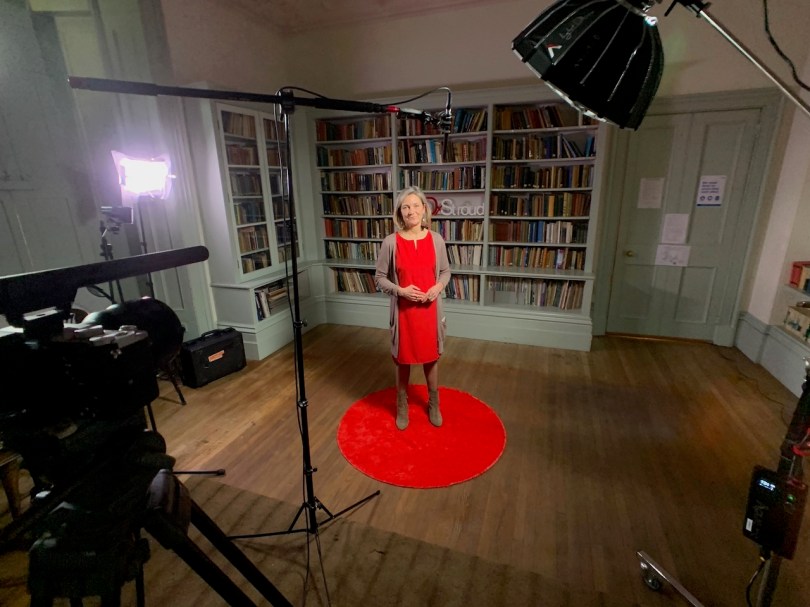
The news that I had been selected to speak at TEDxStroud came on what can only be called a day from hell. It was August 2020. The brick gable end of my mother’s old garage had just collapsed in a storm leaving live electricity cables strewn across the driveway. She was unadvisedly trying to tidy them away while sinking into a diabetic low when we received the news that my brother-in-law’s father had died of Covid. In the flurry of activity and phone calls that followed, the email plopped into my inbox: CONGRATULATIONS! You are one of nine people selected from 84 applicants to deliver a TEDx talk on the theme of Emergence…  

I had totally forgotten I had even applied and my heart simultaneously raced and sank as I realised this was another gauntlet I had to take up. TED is the mecca of public speaking platforms. The iconic red spot on the floor has hosted some of the world’s very best speakers and lured over 3,600 people with a good idea to share. There are strict criteria: No more than 18 minutes per talk. No selling or promotion of a product or business. No profit or pay to speakers or organisers… just a good idea that is worth spreading. 

Tickets and further information can be found here

Over the following months, Covid threw curveballs at the original visions for a live event with an audience of 400, sending each one flying like skittles in an alley. Lockdown even forced a postponement from November’20 to March’21. The organising team were undeterred in their commitment. With each new restriction, they adapted, delivering changes of plan with supportive sensitivity and unwaning optimism. Meanwhile, we speakers met in Zoom rooms hosted by other talented volunteers where we would listen and feed back to each other while witnessing amorphous blobs of chosen subjects being honed to their essence. Not ‘just a minute‘ without ‘hesitation, deviation or repetition’ as on BBC Radio 4, but 18 minutes! 

Sounds easy? It’s not. The techniques to memorise our talks ranged from falling asleep to a recording of your own voice droning its way into your memory, (nothing has ever sent me to sleep faster, all insomniacs click here if you’d like a copy!) to delivering it in a silly Texan accent. We had to practice talking to the barrel of a camera lens while smiling at some imaginary audience member sitting beyond it. We even had to choose proper clothes to wear as opposed to our baggy lockdown jumpers and leggings. 

Practicing…

Kind friends tried to assuage the terror that gained momentum over the final two months until it clenched my chest in a vice and froze my brain. “But you speak so well… it’s no different from the talks you already give… you can do this with your eyes shut.” But a TEDx talk isn’t the same at all. It will be uploaded to YouTube and made available to a global audience… potentially forever. You have no slides or prompts to jog the memory. And what’s more, my ‘great’ Tedx idea isn’t an easy one to talk about, let alone sell as a ‘gift’! Because I am basically asking people to get really uncomfortable; to follow me on a journey that descends into the dark underbelly of human experience, where prisoners, Nazis, unspeakable atrocities or war experiences fester like wounds marinated in silence, pain and shame. 

I sometimes feel I should apologise for bringing such things into the light of awareness. But I won’t, because the rewards are too great to ignore. And because it has become clear, not just to me but to neuroscientists, geneticists and psychologists, that we have to go there if we want to break the cycle by which toxic, unresolved past traumas and wrongdoings persistently disrupt the present. Now more than ever, it is important to recognise the link between the past and so many of today’s symptoms of violence, division, discrimination, inequality, addictions, injustices, racism… 

It is not easy to face unacknowledged past harm, not least because it will have been buried for a reason, often a good reason such as protection or avoidance of pain. But I promise you, it is ultimately easier than schlepping it around with us, patching it up and handing it on to the next generation to deal with. 

Recording my TEDx talk on Thursday 11th March

So, may I invite you to join us this SUNDAY 21st MARCH 2021 from 2pm, not just to hear my TEDx talk Facing the past to liberate the present, but the talks of seven other amazing speakers, each of whom has been on an equally intense journey to deliver a wonderful idea as a gift to you and our world. Tickets and further information can be found here.

PLEASE SIGN UP TO MY NEWSLETTER to be kept informed about all my forthcoming events or click on FOLLOW MY BLOG at the top of the page to receive them straight into you inbox.

The past residing in the present and shaping the future

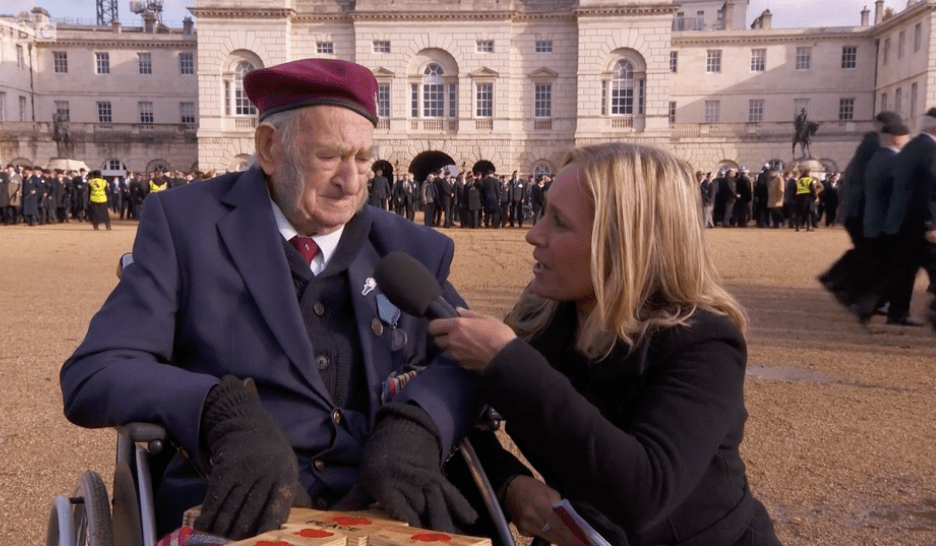
“It’s the memories,” 98-year old D-Day veteran, John Sleep, told the BBC interviewer, Sophie Raworth on Remembrance Sunday. Dressed in a blue suit decorated with medals and donning a burgundy beret and tie, his wheelchair was parked on Horse Guards Parade in front of the traditional ‘march past’ the Cenotaph. Asked how vividly he could remember it all, he said, “It was yesterday.” Silence followed as his face crumpled in its fight against tears. As for so many veterans, the title of “hero” bestowed on servicemen today feels misplaced. What he and his fellow soldiers did was not heroic, glorious or even brave necessarily. Those are qualities that belong to their friends who didn’t return. They are the real ‘heroes’ and their memories still roam and haunt the minds of the living. 

Memories; PTSD; horror, honour and pride get shaken into potent cocktails of commemoration at this time of year. Last weekend was almost overwhelming in the scale of significant events to be remembered. Don’t get me wrong; I love remembering the past because each time I ‘re-member’ an event, I learn a little more about its relevance to the present and the future. Time became a linear construct through the human need for rationality and order. Yet in reality, or in my experience at least, time refuses to simply line up chronologically. The past and future co-habit each moment of what we call the present.

November 1989, the fall of the Berlin Wall

This year’s calendar of remembrance started on 9th November, when Europe and beyond celebrated the 30thAnniversary of the fall of the Berlin Wall and remembered all those who died on the physical and symbolic front line of the Cold War. A bit like with the 9/11 collapse of the Twin Towers, it seems that everybody can place exactly where they were when it happened. I can recall my Sussex landlady’s unbridled joy as she danced in front of her television clapping her hands as the ‘Ossis’ flooded through the wall into the welcoming, cork-popping arms of West Germans. I remember clapping and grinning with her, careful to disguise my shameful ignorance of just how momentous a moment this was. The Cold War may have been the political backdrop to life back then, but I was still in the dark over the potency of German history… half my family’s history.

Next up was the annual Festival of Remembrance at the Albert Hall, an event that every year both moves me to tears and irritates me in equal measure. I have written about it before but in spite of some deeply kitsch musical contributions – James Blunt, the former army officer with a remarkably high voice and Leona Lewis, former X-Factor winner, who massacred ‘Like a Bridge over Troubled Water’ – I found this year’s festivities generally more sensitive, less triumphal (thank goodness) and more inclusive. They focused on the 75th anniversaries of lesser known, yet no less brutal, battles of 1944, such as Monte Cassino and Rome, and the collaboration and friendship of the British, Commonwealth and Allied armies who fought them. They also marked the 100th anniversary of GCHQ and the vital, albeit largely uncelebrated role of the secret services such as the code-breaking work at Bletchley Park completed by a workforce 76.35% of which were women… 

Ok, women’s forgotten / ignored / unrecognised place in war and history is a blog for another day. It’s the role of pride in all these activities of remembrance that I want to touch on here. Specifically the pride felt for and by family members. Pride can comfort in the face of death. Pride can give meaning to apparent pointlessness. Pride can assure the memory of a person is maintained for generations to come. Pride can overcome some of the horror of war. It can swell the heart and make thoughts soar. It can be a balm on the trauma of loss, which, if unprocessed, can be passed from generation to generation. 

So how is it for the relatives of German soldiers, I wonder? Millions died and yet pride is a tool that cannot be employed to soften the sharp corners of grief or maintain the memory. It’s difficult, I know. But for the sake of generations to come, in order to avoid the transgenerational transmission of unresolved emotions and to understand and most importantly quash the re-emergence of Germany’s Far Right, we need to address the problematic nature of remembering the men and women who were limbs in Hitler’s military body of destruction, but also brothers, fathers, husbands, sons, friends… and grandfathers of ordinary German families. 

John Sleep, our 98-year old veteran, is already putting my challenge into practice. Resting on the chequered blanket draped over his lap and gently held in place by misshapen hands in muddy, black woolen gloves, lies a simply-crafted wooden cross decorated with painted poppies and the word ‘Peace’. “It’s for the Monument of Tolerance,” he explained, “an organisation set up on the German border with all nationalities in it. The idea is to prevent wars,” he continues without the hesitation of his earlier answers. John also ‘does’ the German services. “I’ve got no problem with the Germans,” he declares. (Well that’s nice to hear.) “I think they did me a favour.” (Really??) “They got me a very good pension.” (Ah… ok – slightly disappointed face) But fair enough. He’d had “an argument” with a German tank and it had won.  

I like the ideas behind this Dutch Monument of Tolerance. Unveiled on 8 March 2001, it serves as a reminder of the more than 700 soldiers of 11 nationalities who lost their lives in the Leudal area between 1940 and 1945. I am pleased that at least here German families have an opportunity to bestow a tiny fraction of the recognition other nations can pour over their military family members. So, next Sunday 17th November, on the occasion of Germany’s humble Volkstrauertag – ‘people’s day of mourning’ – I would like to invite you to join me for a tiny minute in thought. A tiny moment in which we try and extend the lines of our famous and treasured poem of Remembrance to include some of Germany’s Wehrmacht soldiers and their families. 

“At the going down of the sun and in the morning, we will remember them.”

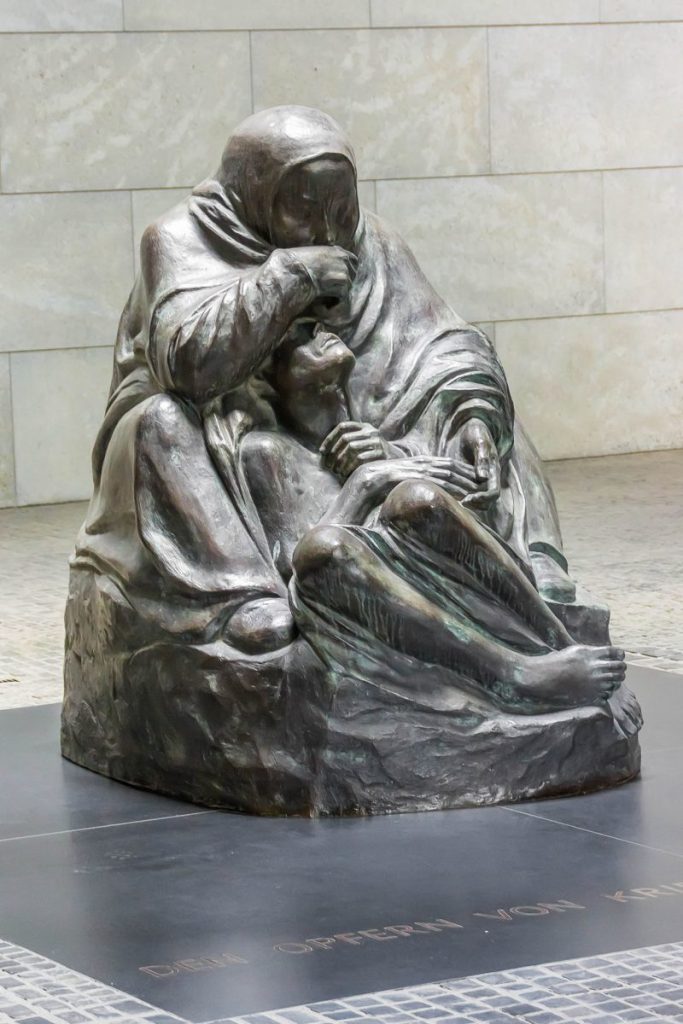
Käthe Kolwitz: Mother with her dead son, Neue Wache, Berlin