To apologise, or not to apologise (for slavery), that is the question.

I am already anticipating a deeply divided and critical response to the recent announcement that Charlie Gladstone and five members of his family, all descendants of the Victorian-era prime minister William Gladstone, are travelling to Guyana to apologise for the significant role one of their ancestors played in the slave trade. But I’d like to ask those who are cynical of such a trip to consider what the alternatives might be.

John Gladstone, William’s father, was one of the largest slave owners in the British West Indies. You can read all about him in the links at the end, but basically he made a fortune as a Demerara sugar planter enslaving hundreds of Africans to work in his plantations until slavery was abolished in 1833. He then became the fifth-largest beneficiary of the £20m fund (about £16 billion today) set aside by the British government in 1837 to compensate planters for loss of income. The final instalments of this compensation were paid out in 2015.

Charlie Gladstone is roughly the same age as me and, though the ‘crimes against humanity’ perpetrated by his family member were nearly 200 years ago whereas those my German grandfather was involved in were a mere eighty, the burden of shame may well weigh as heavily. As I describe in detail in my book, In My Grandfather’s Shadow, the unresolved deeds of our forefathers remain in a family blood line, in our roots. Whether you are ignorant of or choose to engage with them, there will be an impact that needs resolution of some sort. 

Apology is one of many steps that can be taken to try to repair wrongdoing, and personally I think it is good that people such as those in the group Heirs of Slavery, including David Lascelles 8th Earl of Harewood, are finally beginning to address not only the sources of their family’s wealth, but also our collective colonial history and the traumatic consequences that can still be witnessed all too clearly in racism, inequalities in health, wealth, education and opportunity. In their cases it is about apology and accountability, with some of them making financial contributions towards charitable institutions and – in the Gladstone’s case – further research into the impact of the slave trade.

Harewood House, built between 1759-71 with the profits made from plantations and slavery

Others are at it too. Back in July, the Dutch King, Willem-Alexander, apologised on behalf of his country for the Netherland’s historical involvement in slavery and asked for forgiveness. It’s of course a flawed gesture in its incompleteness, but isn’t a heartfelt apology, whether possible or not so long after the event, at least a gesture of recognition of wrongdoing that can lead to a willingness to redress the former total loss of humanity? So many victim groups would attest to the immense value of a genuine ‘I’m sorry’.

King Willem-Alexander apologising on 160th anniversary of the abolition of slavery in the Netherlands

Our prime minister doesn’t think so. Back in April, Rishi Sunak refused to apologise for UK’s role in slavery saying that ‘trying to unpick our history is not the right way forward’ and that the focus, ‘while of course understanding our history in all its parts and not running away from it, is making sure that we have a society that is inclusive and tolerant of people from all backgrounds.’

Fair point about looking forwards. But how can you truly ‘understand’ such a horrific history, underpinned by past government policy, without being moved to demonstrate some direct expression of remorse to those it continues to affect? Or is that precisely what we are scared of? That an apology equates to an admission of culpability and therefore an obligation to compensate?

In his series of essays based on lectures delivered at Oxford University and bound into the 2009 book Guilt about the Past, Bernard Schlink, German author of the 1997 bestseller The Reader and various other literature, tackles not only German guilt about the past, but other long shadows of collective and global past guilt. (I am well aware we can’t actually be guilty of something we didn’t do, but we can still feel guilt.)
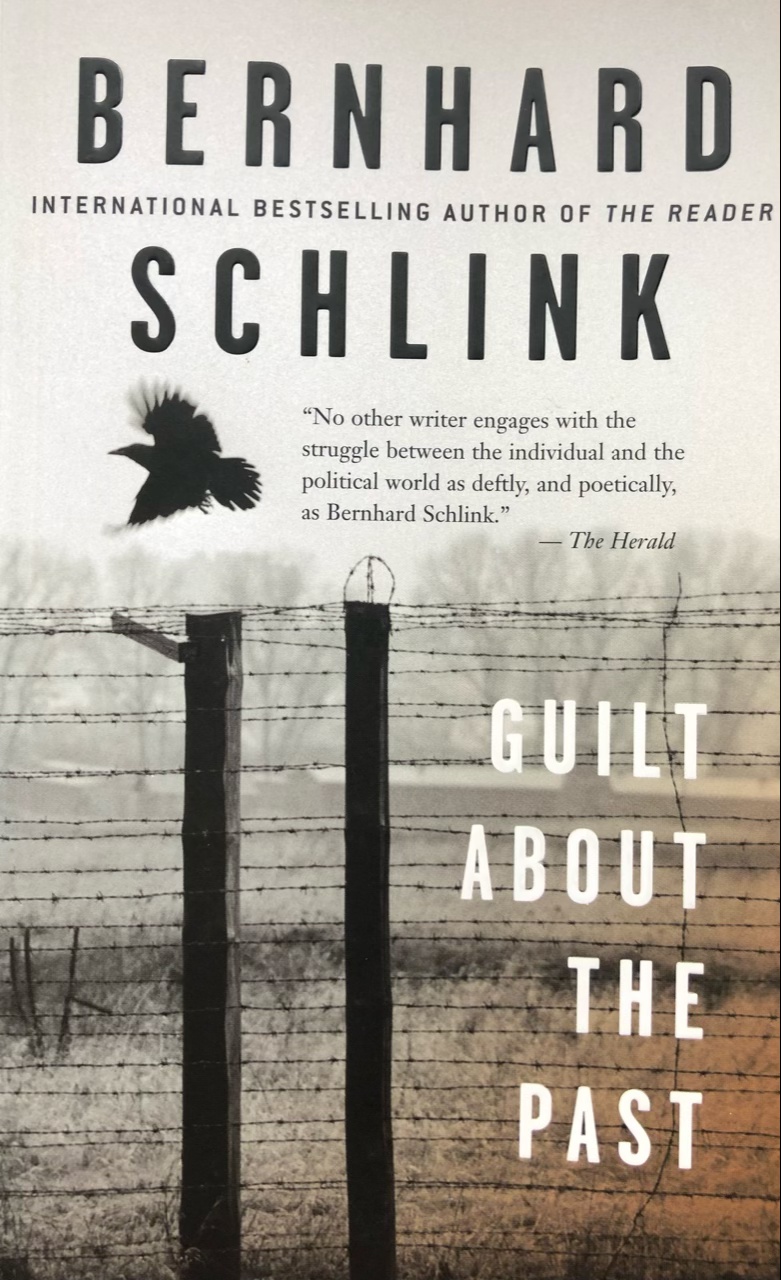
In the essay entitled ‘The Presence of the Past’, he addresses the issue of remembering or forgetting a traumatic past. “A collective past, like that of an individual, is traumatic when it is not allowed to be remembered and is just as much so if it has to be remembered… Detraumatisation is the process of becoming able to both remember and forget; it is leaving the past in the past, in a way that embraces remembrance as well as forgetting. This applies in the same way to the victims and their descendants as to the perpetrators and their descendants.” (p.36)

We need to find that balance.

One of Schlink’s claims that struck me most while exploring my own sense of guilt for my German family’s past was in the chapter on ‘Forgiveness and Reconciliation.’ He says that if someone seeks forgiveness for their own guilt it has weight, but “to ask for forgiveness for someone else’s guilt is cheap.” (p.73) 

Cheap… So where does that leave those of us living today and the question of apology for things that happened decades or even centuries ago? 
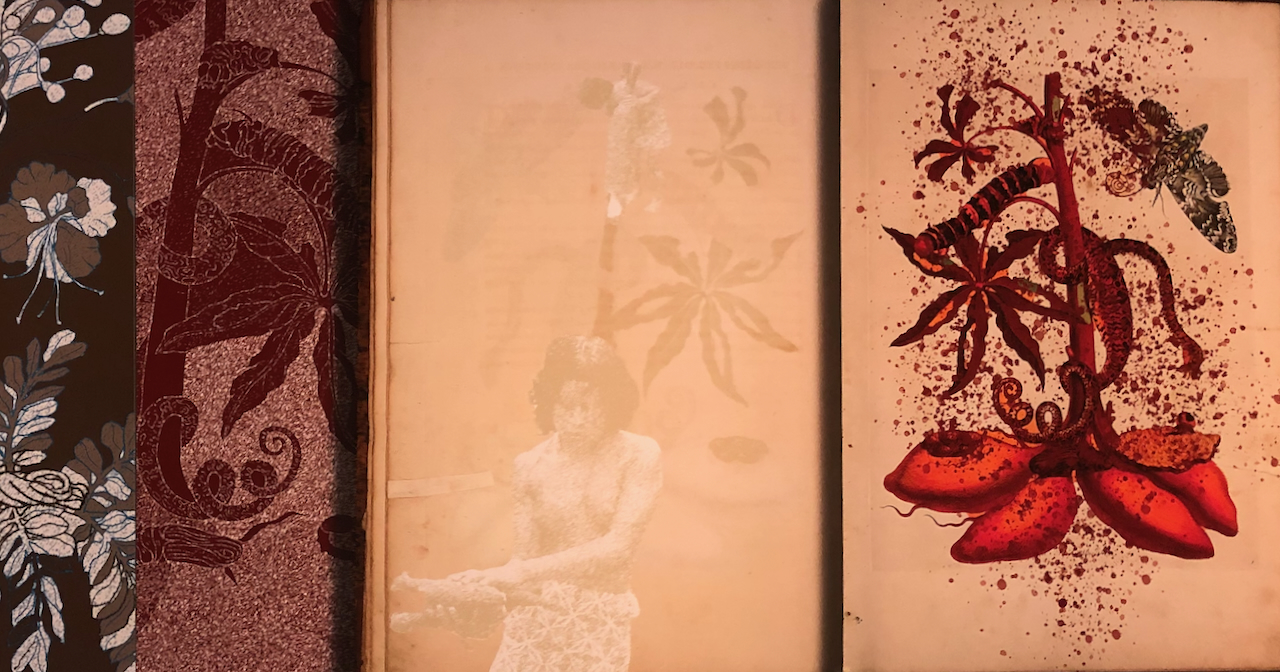
Detail from Patricia Kaersenhout’s ‘Of Palimpsests and Erasure’ (2021) (https://www.pkaersenhout.com)

Schlink and I come to a similar conclusion. It’s about understanding. He says, any kind of reconciliation requires “a truth that can be understood.” And “true understanding is more than searching for and finding causes. It includes putting yourself in someone else’s place, putting yourself in someone else’s thoughts and someone else’s feelings and seeing the world through that person’s eyes.” Doing this, he says, establishes equality. “We make [the other person] equal to us and us to them; we build up society when we understand.” (p.82)

This form of ‘understanding’ goes way beyond the slightly glib understanding the current leader of our country suggests. It requires engaging in the truth of what happened and feeling it. Feeling how appalling it was and being moved to act to heal and make good the wrongs that still poison our national veins and those of the human beings living today whose forefathers were harmed.

Further reading, as always not all links reflect my own opinions:

William Gladstone: family of former British PM to apologise for links to slavery 
William Gladstone’s family to apologise for historic links to slavery

‘I felt absolutely sick’: John Gladstone’s heir on his family’s role in slavery

Rishi Sunak rejects calls for slavery reparations from UK

When will Britain face up to its crimes against humanity?

Dutch king apologises for country’s historical involvement in slavery

Campaigners urge king to do more to acknowledge UK’s slavery role

The British aristocratic families reckoning with their slave owning past

The German translation of In My Grandfather’s Shadow will be published in Germany in September. Please contact me for details of forthcoming events relating to in Germany.

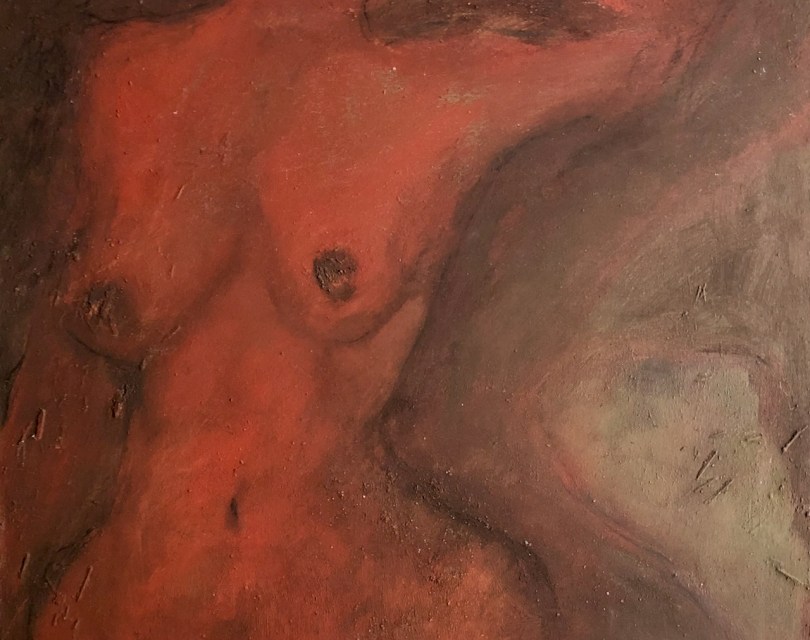
Title painting: ‘Salt of the African earth‘ by Angela Findlay, 1994

To remove, or not to remove statues: that is not the question Britain’s imperial past is asking of the present.

Something huge is happening in the UK. Britain’s colonial past is storming into the present and will not quieten until we listen to what it has to say. The national journey ahead of us will be deeply healing if we do.

In the past three weeks, the words “I can’t breathe” have become a universal slogan. And no, they have nothing to do with the Corona virus. They were the dying words of George Floyd as he was slowly killed, in full view, by a Minneapolis police officer. Like a match to dry tinder, his appalling, videotaped death ignited fury. Black Lives Matter and other anti-racist movements leapt to life spreading protests like bush fires through streets around the world. In the UK, while many people peacefully chanted, knelt or lay down in solidarity with the murdered man and fellow victims of racism, others went further, rocking the symbols of white supremacy quite literally off their pedestals.

In Bristol, the main target was the widely-despised statue of Edward Colston. Since his death in 1721, the philanthropist’s name and generosity had been celebrated in famous landmarks – a street, a school, the city’s largest concert hall – while the uncomfortable truth of his lucrative role as Deputy Governor of the Royal African Company (RAC), the most prolific slave-trading institution in British history, was hushed up. Estimates suggest he himself presided over the shipping of around 84,500 African men, women and children to the Americas to be sold as slaves. Horrendous 2-3 month sea journeys chained to the slave decks caused 19,000 to perish. Their RAC-branded bodies were unceremoniously tipped into the Atlantic Ocean as “wastage.”   

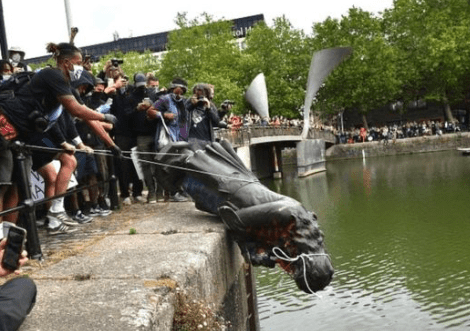
Colston’s statue being deposited in Bristol Harbour by protestors

Colston’s bronze presence has long been contentious in the city that used to be known as the ‘slave capital,’ but previous attempts to remove him had failed. On June 7th, however, Colston the philanthropist met his slave-trader Hyde when he was toppled off his perch and dumped head first into the harbour like one of the thousands of slaves under his watch. Whether you agree with such activism or not, it could hardly have been a more perfect gesture of karmic comeuppance. The aftershocks of his heavy landing are still reverberating, cracking the shiny veneer of Britain’s preferred version of history upon which it has built its largely benevolent national self-image.

I am not interested in judging the wisdom of this action – it was emotional and inevitable. I do not condone any of the subsequent violence and I deplore the eruption of the Far Right onto the streets with their eagerness to fight… anything. I am, however, glad that it was sufficiently contentious to prise open the Pandora’s Box of Britain’s imperialism making it impossible to slam the lid down on the restless ghosts of historic crimes.

Anyone who has attended my talks or read my blogs will know I have long been calling for Britain to look at, learn from and redress its own past wrongdoings. It has hitherto been far too easy to hide them in the shadows of the more recent Nazi genocide against which every atrocity naturally pales. For far too long, our history books and curriculums have primarily been testaments to our greatness: our victories and sacrifices, our worldwide achievements and position, the industrial revolution, the apparent huge benefits of British rule, the abolition of slavery… all worthy of celebration to those who still harvest and enjoy their fruits. But vast swathes of society are excluded from the feast and are still locked in lives of disadvantage, poverty and discrimination… or prison.

Churchill’s (boxed) statue in Parliament Square

The fact that until 2015 tax payers were still paying off the £20 million debt borrowed by the government in 1833 to pay compensation, not to victims or descendants of slavery, but to wealthy slave owners who lost out when slavery was abolished, shows how the tentacles of slave ownership reach into our present. Surely such glaring insult and inappropriateness are more worthy of expressions of outrage than the temporary covering of Winston Churchill’s statue? Yet Boris Johnson’s string of passionate tweets defending the lump of bronze representing his all-time role model were not only the same typical deflections from the existential debate being demanded by living people… on our streets… now, which are employed by many conservative thinkers. They also display a widespread British contradiction that is out of date and out of sync with the world. We as a nation verge on the obsessive when it comes to remembering our past as saviours of Europe from fascism. Yet we refuse to acknowledge the dark underbelly of murder, pillage, torture, cruelty, oppression, racism – the list is long – that formed the foundations of wealth, privilege and inequality on which so much of British society is built.

The prime minister scored an own goal when he tweeted “We cannot now try to edit or censor our past… those statues teach us about our past, with all its faults.” The editing and censoring the past is precisely what these protests have been about! Other than one in Liverpool, there are no dedicated museums to the slave trade. As for ‘teaching us about our past,’ one viral video of a slave trader being torn down has achieved far more in terms of educating people about Britain’s past atrocities than any existing statue has ever done. On an official visit to Jamaica in 2015, David Cameron employed much the same avoidance tactic by stating that it was time to “move on from this painful legacy and continue to build for the future.” How can you move on from something that is still happening? Until Britain finds a way as Germany has been trying to do – initially reluctantly and on the insistence of the British – to reckon with its imperial past and scarred present, we will not be able to “move on”.

Monuments are key to national identity. They demonstrate and instruct the values of a society by elevating heroes of the time onto plinths to be looked up to and respected for generations to come. They are not innately required to be permanent. Romans used to melt down their statues for coins. So what should happen when those same values become disgusting, offensive and humiliating, whichever angle you look at them from? When they become symbols of psychological and political oppression? Would British people not rightly feel offended or appalled having to constantly walk past statues of former oppressors – Hitler, Goebbels, Rommel – either here or in Germany? Yet this is what the black community have had to endure, seeing the slave-traders who murdered their ancestors, committed mass crimes, genocide and atrocity against them still celebrated in public. The toppling, removal or covering of monuments is not “to lie about history,” as Johnson claims. Nor should it become the prime debate, as it has in right wing papers, whose writers are incidentally putting up almost identical arguments and resistance to owning national atrocity as Germans once did. The statues have simply woken people from their willful amnesia. But there is a danger. If the agitators of colonial history simply vanish, so could the discourse and urgently needed education.

The removal of the slave-owner Robert Milligan statue in Canary Wharf

From all my studies and experience of Germany’s post-WW2 culture of Vergangenheitsbewältigung (working through the past) and the ensuing counter memorials and museums that dot the nation’s cities, parks and pavements, there is much the British state/we can, and must, do. As descendants of the original perpetrators, current generations are not to be blamed for the sins of their fathers, but we are responsible for making amends. So, rather than focusing purely on the clunky symbols and symptoms of discontent and planning ten-year prison sentences for those desecrating memorials, the government should be fully engaging with the debate and the root of the problem: institutional racism. The full truth of our past – warts and all – must be integrated into history lessons and school curriculums, museums and public monuments. Like in Germany, cities around the UK could hold their own competitions for imaginative counter monuments – Banksy has already submitted his proposal. Or information tableaus could be erected beside any monuments that remain in situ presenting the other side of the story along with an unmitigated condemnation of any repetition of those values. Also like in Germany, rather than building the highly contested Holocaust memorial by the Houses of Parliament, a memorial to Britain’s own victims could be created as a reminder of how fragile civilisation and democracy are. And for the victims’ descendants, opportunities for conversation, dedicated remembrance days, apology, restitution, compensation, reconciliation, investment… it’s all so late but there is so much to do.

Banksy’s sketch proposal for reinstating the Colston monument as part of a slavery memorial

Facing and talking about uncomfortable truths is the first step to healing them. Covid has exposed the inequalities in our society. We have a unique opportunity here for attitudinal and structural change. In the words of the soul singer, Erykah Badu, we need to ‘stay woke’. We simply cannot go back to sleep on this. Rumi, the 13th Century Persian poet’s beautiful message is so very apposite for these times.

“Out beyond ideas of wrongdoing and rightdoing,

there is a field. I’ll meet you there.

When the soul lies down in that grass,

the world is too full to talk about.

Ideas, language, even the phrase “each other”

doesn’t make any sense.

The breeze at dawn has secrets to tell you.

Don’t go back to sleep.

You must ask for what you really want.

Don’t go back to sleep.

People are going back and forth across the doorsill

where the two worlds touch.

The door is round and open.

Don’t go back to sleep.”

Further reading (I have included a couple of articles with which I wholeheartedly disagree!)

The dark side of British History you weren’t taught in school – video by George Monbiot

Robert Clive was a vicious asset-stripper. His statue has no place on Whitehall by William Dalrymple

Removing the statue of Cecil Rhodes would be cowardly and anti-intellectual by Daniel Hannan

When will Britain face up to its crimes against humanity? by Kris Manjapra

Buried for 50 years: Britain’s shameful role in the Biafran war by Frederick Forsyth 

All lives matter: There is too much at risk for us to let the ‘culture warriors’ win. You cannot teach the lessons of history by trying to erase it by Liam Fox

Britain’s colonial crimes deserve a lasting memorial. Here’s why by Afua Hirsch

Until we reckon with our imperial history, Britain’s toxic culture war will burn by Daniel Trilling