
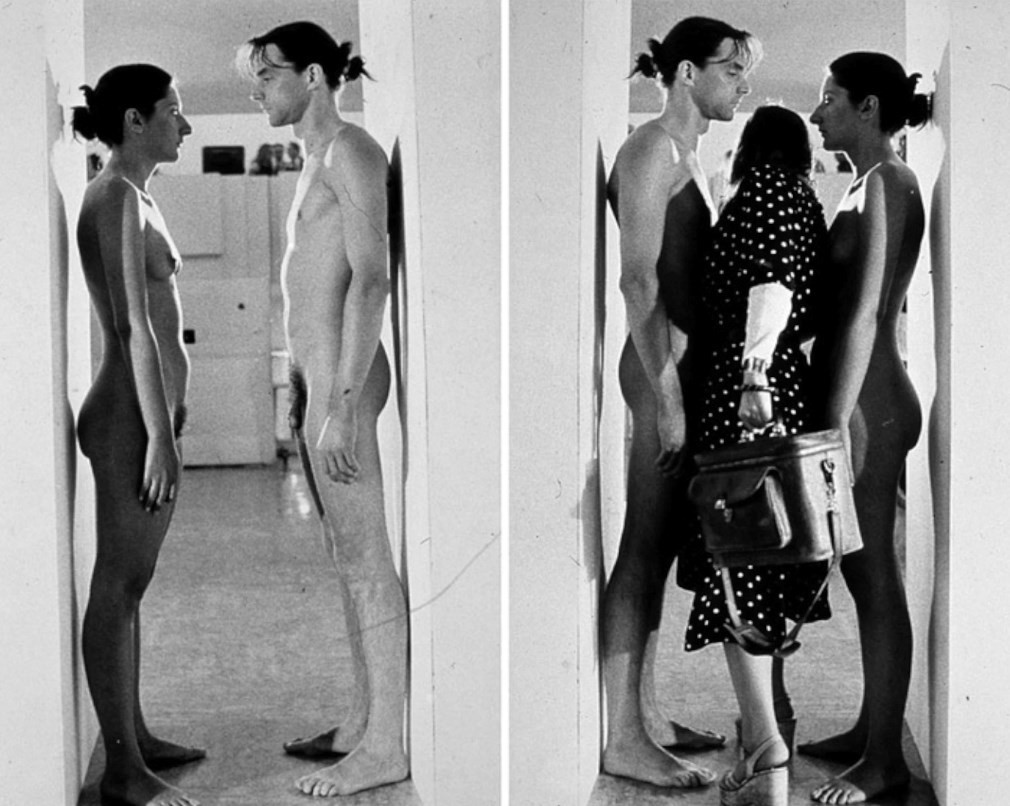
It’s not every day that you squeeze yourself between two nude bodies lining a doorway. But visiting the Marina Abramović exhibition at the Royal Academy on Friday, that is exactly what I did. And the experience was so visceral, so vulnerable and in such stark contrast to everyday interactions with fellow human beings that it got me thinking… as all good art does.

Unbelievably, scandalously actually, this is the Royal Academy’s first solo female retrospective to run through those grand, main rooms in its 255-year history. I was still digesting that appalling fact as I entered the first room to be met with the full force of the artist. Video footage shows Abramović sitting in still silence gazing into the eyes of some of the 1,545 people (also represented through videos) who queued up to sit opposite her at MoMa New York in 2010. With this trusting personal connection between artist and visitor established, you allow her to take you through the trauma, pain, and almost impossible endurance she puts her body and soul through to end up in a place of meditation, peace and transcendence.
Earlier in the week, walking on an autumnal Whitehall lined with statues of Britain’s WW2 military heroes striking distinctly ‘male’ poses, I was struck anew by the glaring gap between the (traditionally designated) sexes. Each man was raised on his very own plinth set back from the road under the shade of mature plane (I think?) trees.

Opposite them, in the middle of the two-way street and on a black stela, an array of bronze female wartime outfits hung, saggy as if on coat hooks to represent the wartime contribution of over 7 million women. It’s not a new observation, but in the light of Abramovic, it is starker than before.

I can only recommend you go and see, or rather experience this show. It shook me out of the increasing numbness I have felt as relentless bad, sad and mad news breaks like waves through social media outlets, radios and tv sets to crash into our lives. In order to cope, many of us feel we have to switch off or shut down. To look or move away. To rage at our impotence or pretend it has nothing to do with us.
Speaking out has always been an option. But at times, fear of being cancelled or becoming a Twitter/X target of hate silences our voices (an unlikely scenario with my scant number of followers.) Equally, speaking out can frequently feel like you are shouting into the wind.
Take prisons… one of few areas in life I feel confident I know a little more about than most. In recent weeks they have regularly hit the headlines for multiple reasons; reasons about which I have been banging on since the eighties when I first started teaching in them. The big, but far from new, problem is overcrowding… our prisons are full. Last time I heard (13.10.23) there were just 557 spaces left across the prison estate.
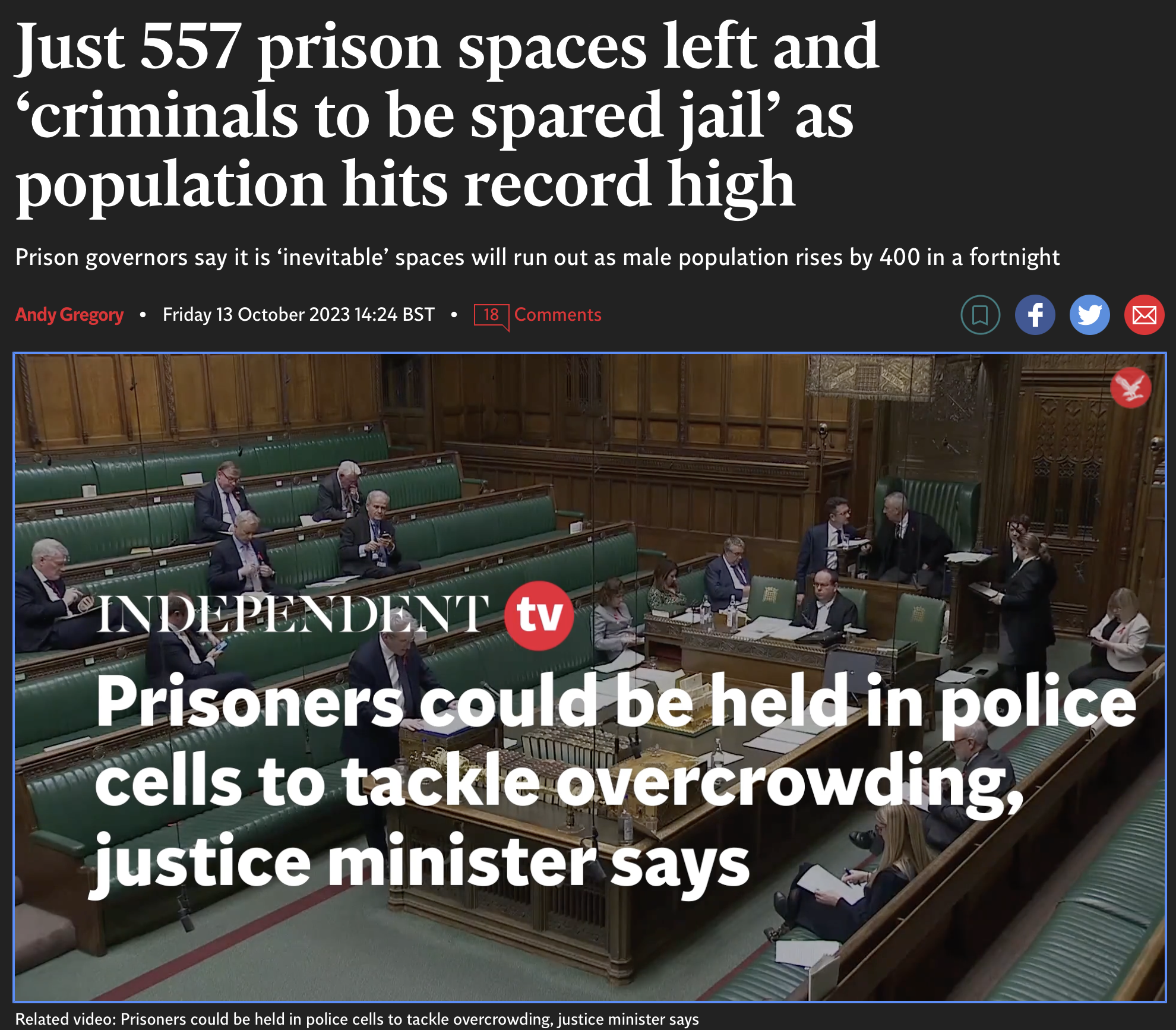
Devoted and committed to the ‘tough on crime’ mantra, the government’s short-term thinking has landed in a cul-de-sac with just a handful of short-term ideas that could have been long-term solutions decades ago. They are not rocket science, just obvious tips like ‘Stop putting so many people who aren’t a danger to others in prison!’ Or ‘Stop this revolving door of madness of locking people away for longer and longer and then releasing them, often with just £70 in their pockets, a criminal record, a drug habit they didn’t have before they went in, and nowhere to stay when they come out…!’ It is sheer insanity to think they are going to miraculously be rehabilitated and can go on to lead a crime-free life.
And still current policy remains the same: to create yet more institutions of failure and waste in the “biggest prison-building programme since the Victorian era.”
Sorry, I can feel my blood beginning to boil…
But one more example of this system of illogic. And a new one at that. On 03.10.23, the Justice Secretary, Alex Chalk, (the eleventh JS since 2010), announced that the government wants to outsource the problem by renting prison cells overseas in a variation of the Refugees-to-Ruanda thinking? Well that’s going well.
And so it goes on throughout the whole Criminal Justice System. And has done for as long as I can remember. But still the majority of my Art behind Bars audience members come up to me and say, “I had no idea.” I say that with exasperation rather than blame. But it makes me realise that speaking out has its limitations. So, for the record and possibly the last time I allow myself to become incensed in a blog, here is one of my slides with some statistics (please allow for inevitable fluctuation) that give an insight into the failure, people and costs caught up in our current prison system.

Right, let’s return to Marina Abramović and the immediacy of her work’s impact compared to mine. Drawing inspiration from the feelings and inner experiences her powerful performances evoke, I would like to propose a different solution to our on-going crisis.

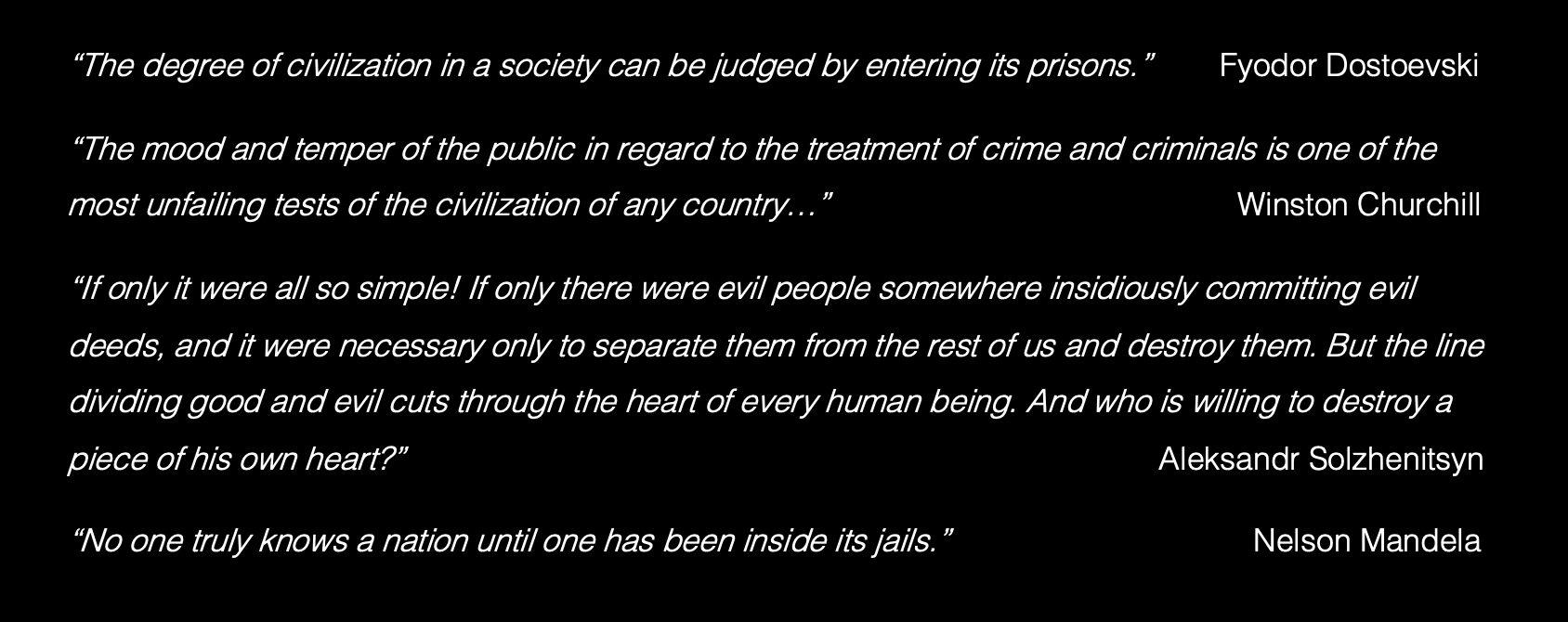
I suggest every government minister, every magistrate, judge, lawyer, banker, teacher and member of the public is taken into one of Britain’s many failing prisons. For when you feel the impact of the first of many heavy doors lock behind you; when you smell the socks, watery cabbage and frustrated testosterone (95% of prisoners are men); when you hear the shouts of anger and cries of despair; when you taste the fear of under-trained staff and terrified, often traumatised men and women, and see the size of a cell and the squalid world in which these people are banged up in the name of and for the apparent protection of us all, then people might understand what so many important figures have claimed about the relationship of prisons and society, and finally demand change.
Further reading – Too many articles in every newspaper to list, so here are some specialists on Criminal Justice:
Why the prison population crisis is everyone’s concern
Prison Reform Trust: Bromley Briefings Prison Factfile, January 2023
Work with Offenders: Government considering exporting prisoners to ‘partner countries’
A few dates of my forthcoming events open to all:
Thursday 26th October, 7.30pm: Im Schatten meines Großvaters, Frauenkirche, Dresden
Wednesday 15th November, 5pm: Difficult Family Legacies: Lily Dunn and Angela Findlay, Goldsmiths, University of London
Thursday 16th November, 6.30pm: War and Peace: A Century of British-German Relations. Co-hosted by The Dresden Trust and the National Army Museum, London
22-24th November: 3 evening talks in Laubach, Frankfurt and Heidelberg. Contact me for details


 angela findlay blog