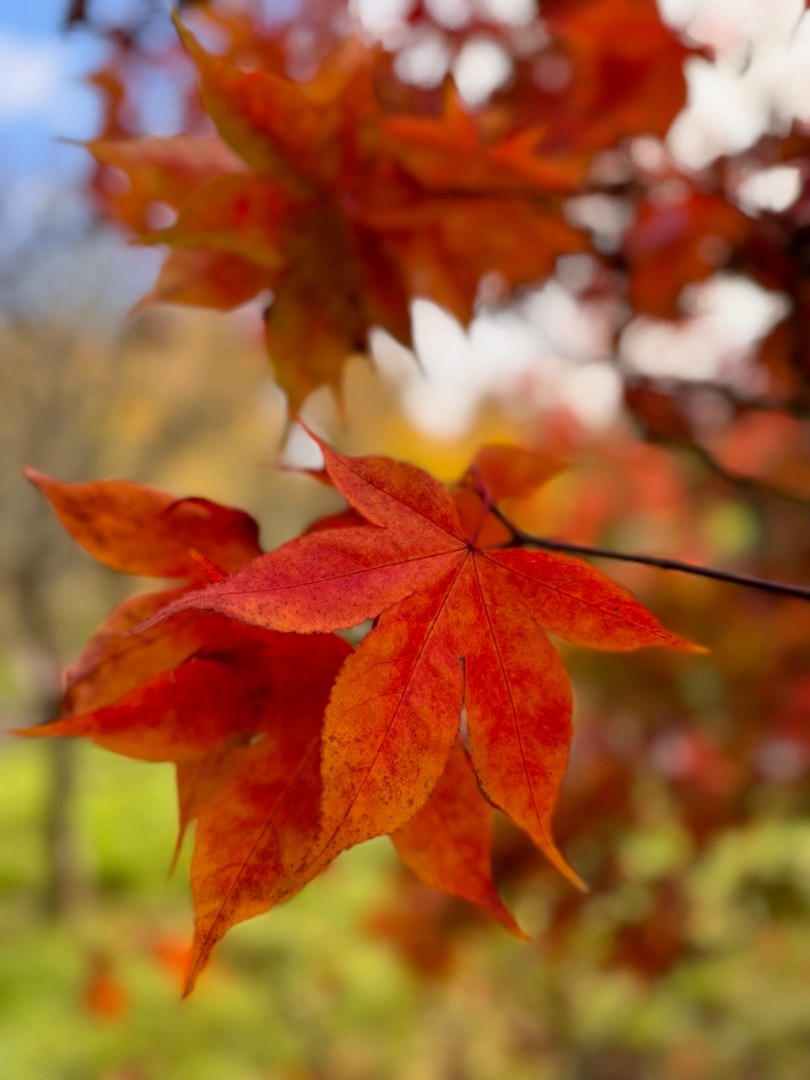
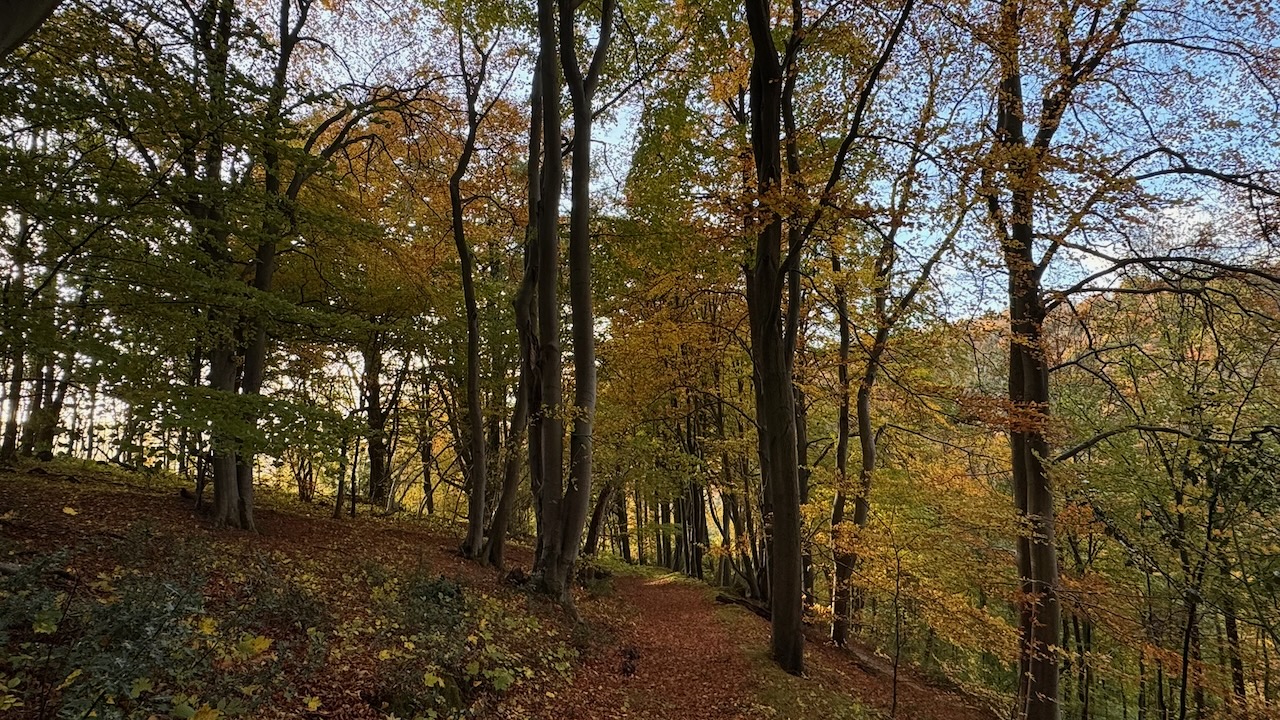
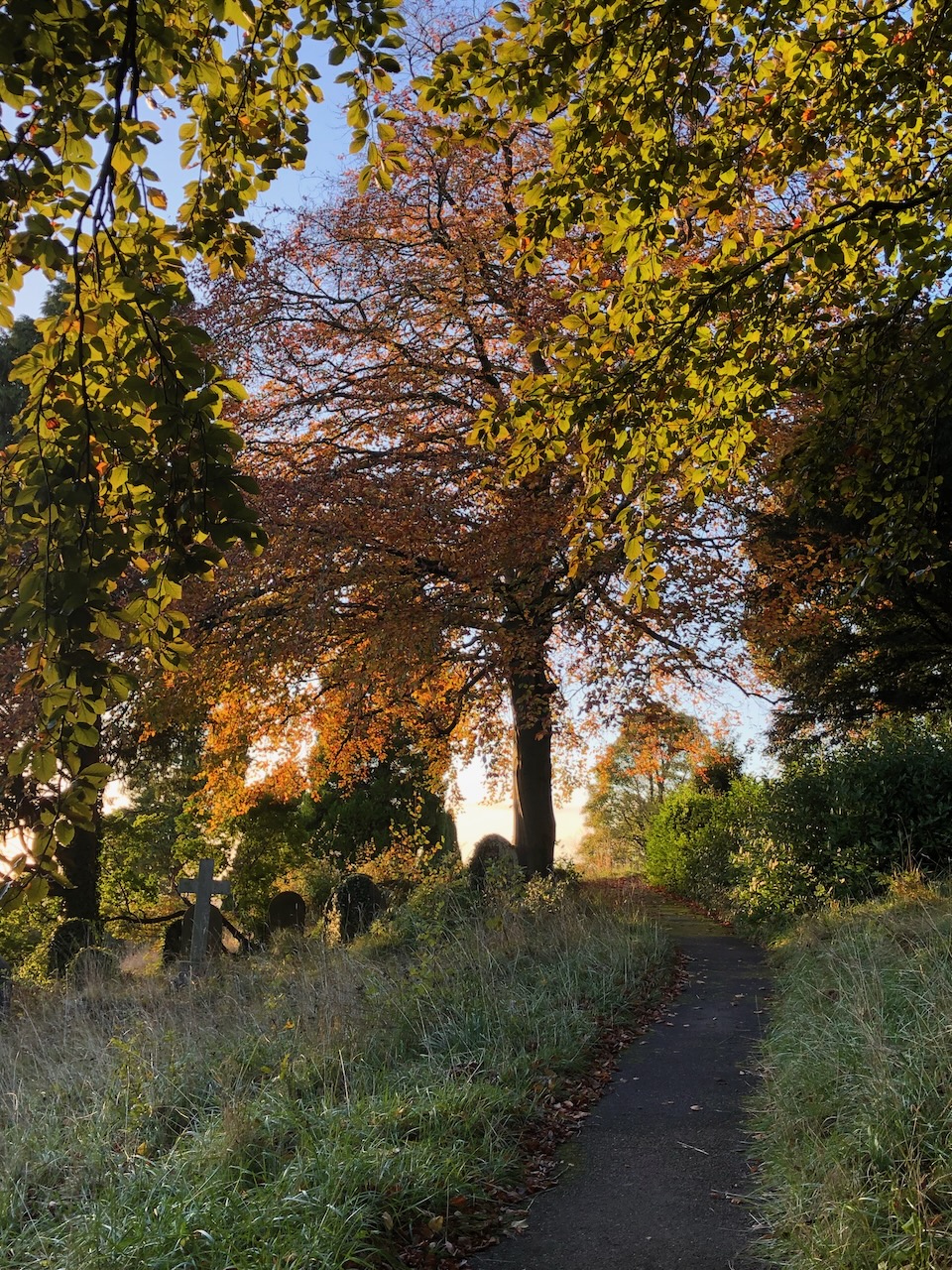
I normally plant bulbs on Remembrance Sunday. But this year I’ve been ill. Instead I went for a gentle walk in nearby woods, silent but for the breeze combing its way through the upper branches.
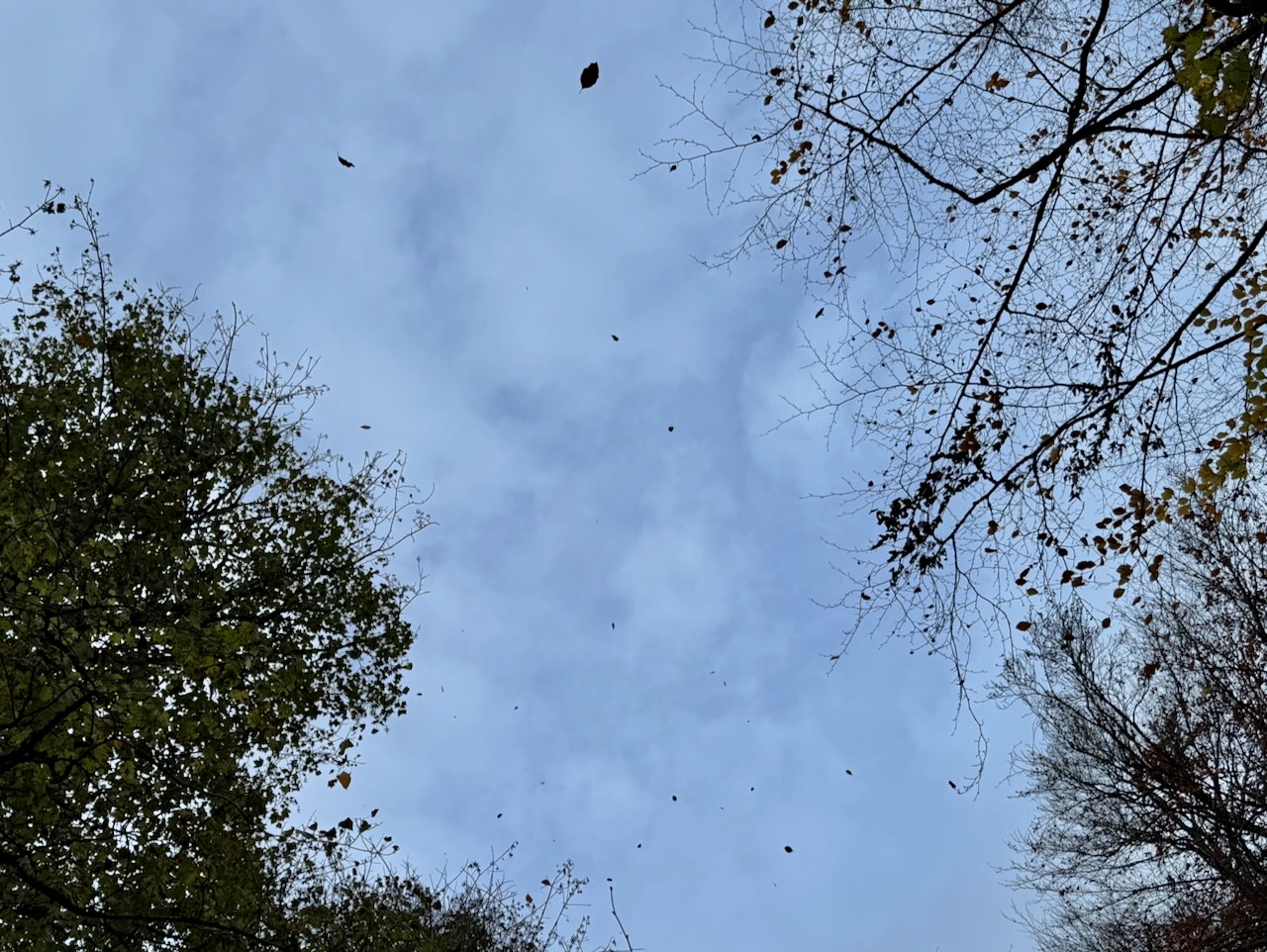
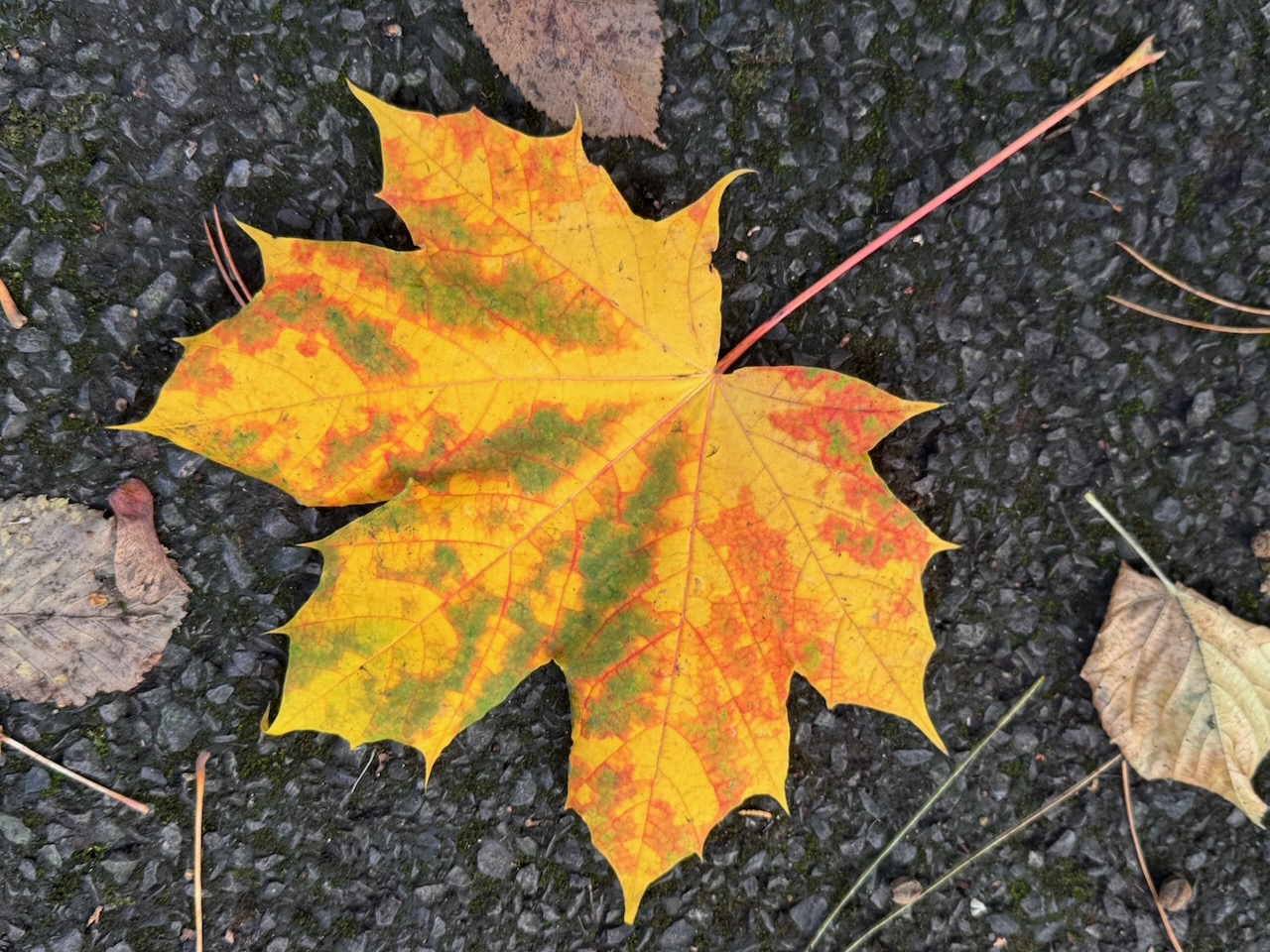
Down below, all was still. Except for individual leaves falling like snow. Each one taking its moment to break from the twig to which it had been rooted since the spring and dance in a series of pirouettes, twirls and summersaults before landing quietly among the already fallen. Unseen except by a chance walker.
Do they pick their moment, or are they plucked from life?
A certain readiness is a prerequisite for each leaf to fall. In summer, winds can howl through the branches and yet the leaves remain bound to the tree, weathering the storm, held in place by life forces that ebb and flow in synchrony with the seasons.
Death is natural for these fallen.
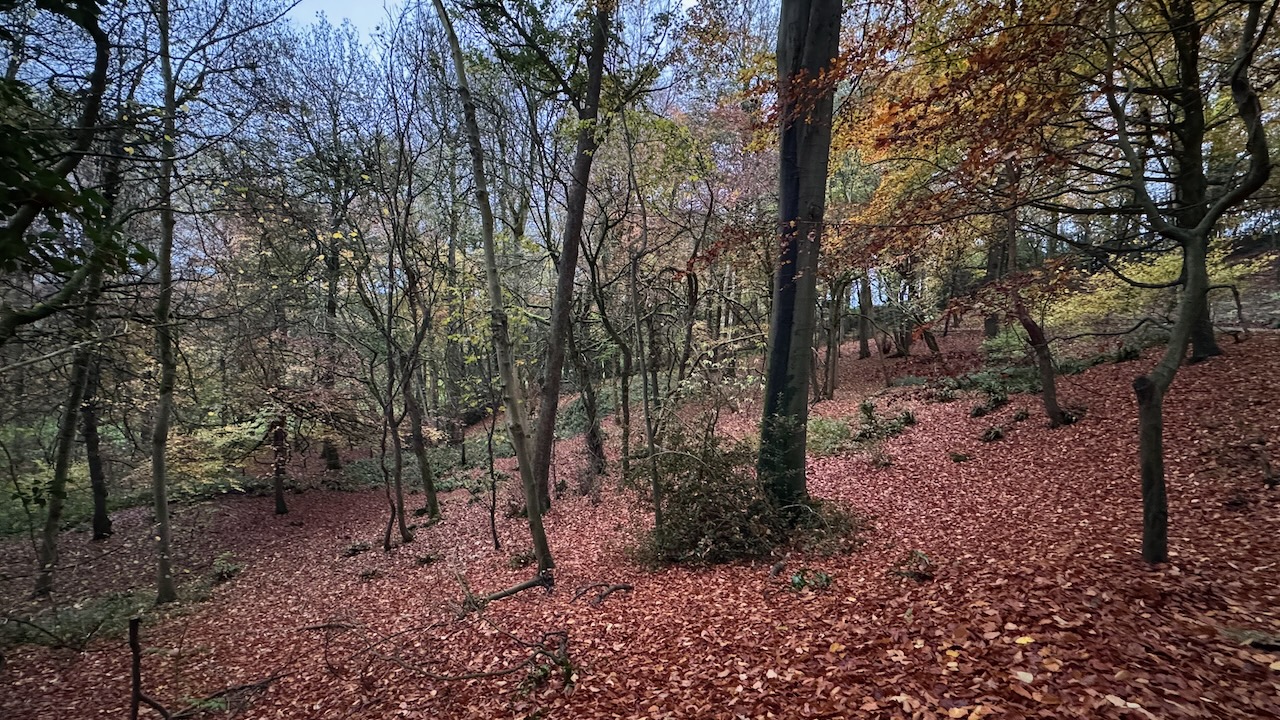
As I shuffle through the carpet of rust and gold, the rustle so reminiscent of childhood memories – kicking through the golden floors of beech forests in little rubber wellies – I can only ponder the dead. The war dead all around the world. The families they left behind. The scars of loss, grief, trauma and silence that remain in their wake, often hidden for generations, shaping the souls of those who come after.
We call them the fallen. It softens the reality of how they died. But while we remember them with warm hearts and deep gratitude, let us – with all the advantages of hindsight – not forget the utter horror, violence and futility of war.
As countries around the world build their armies and arsenal, let us refrain from falling into the trap of thinking war can ever be a solution to political, religious, geographical or economic problems.
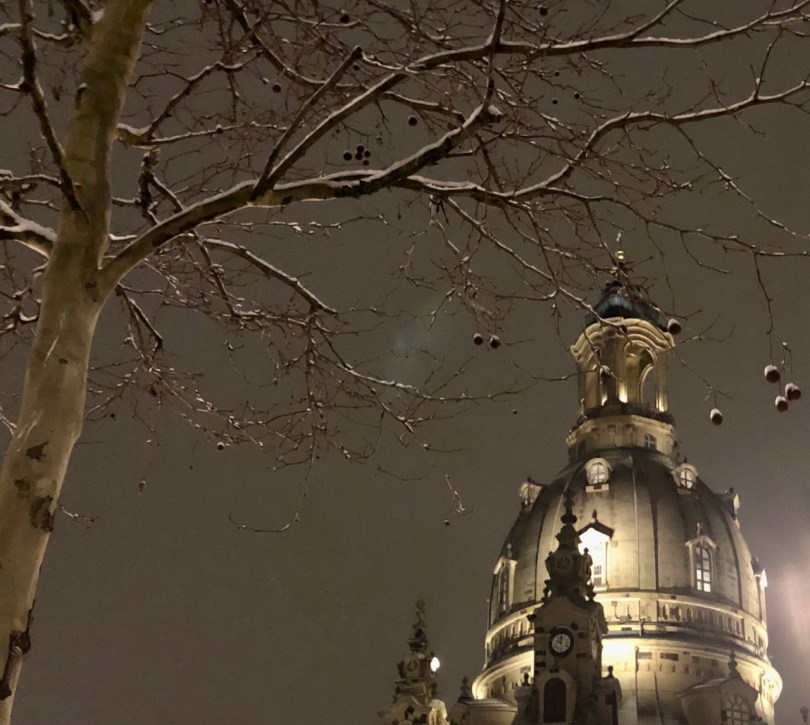
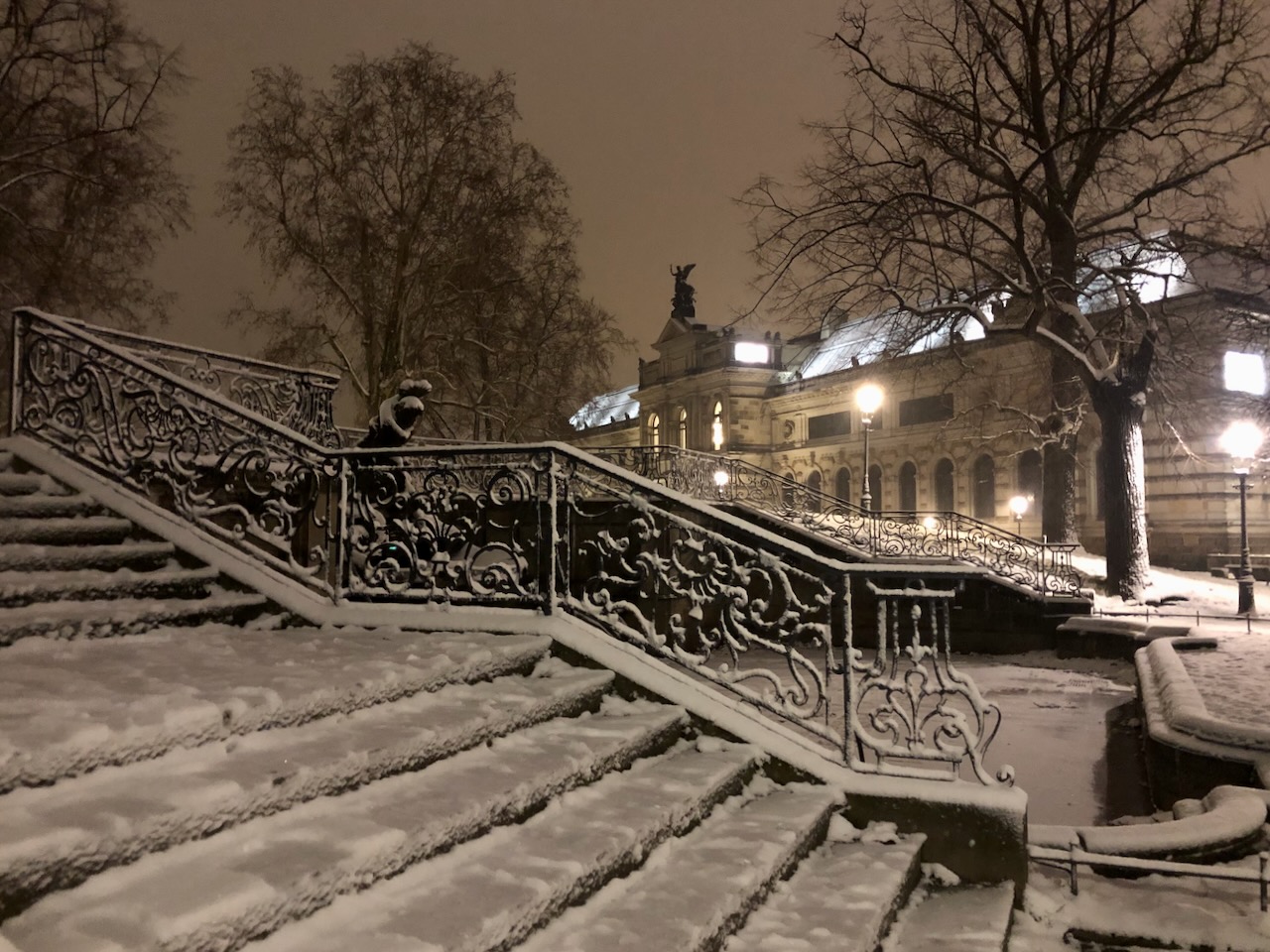
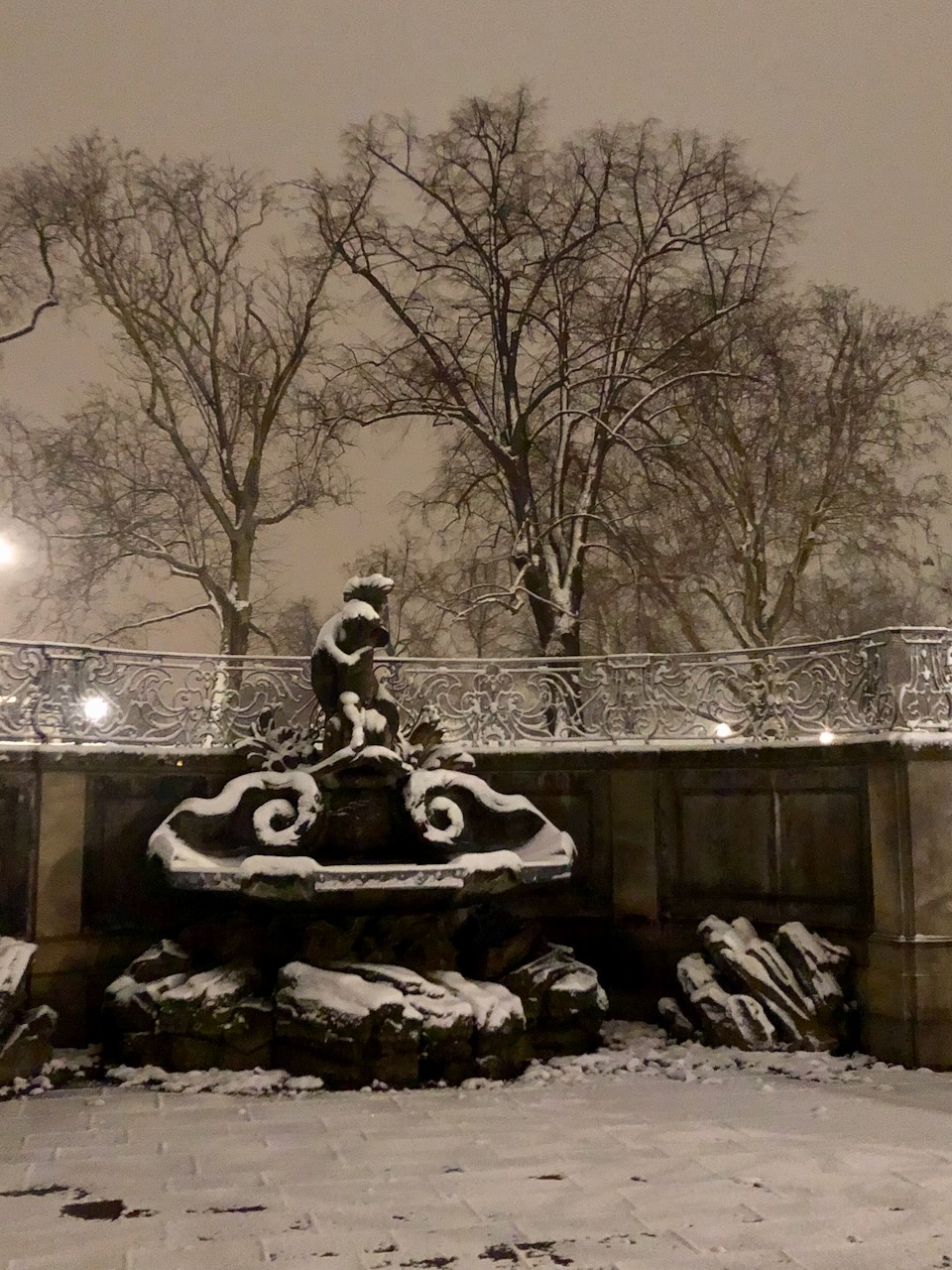
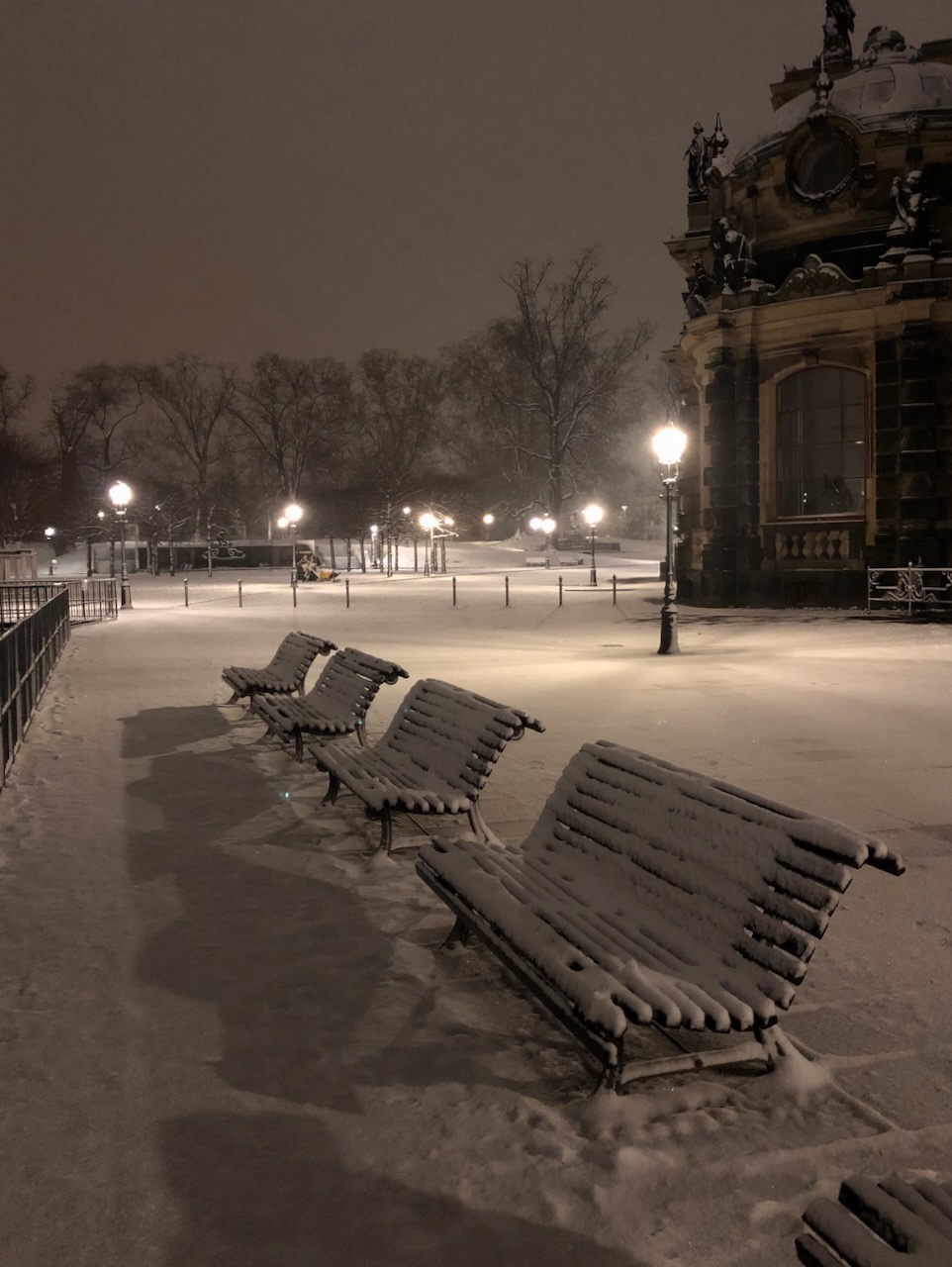
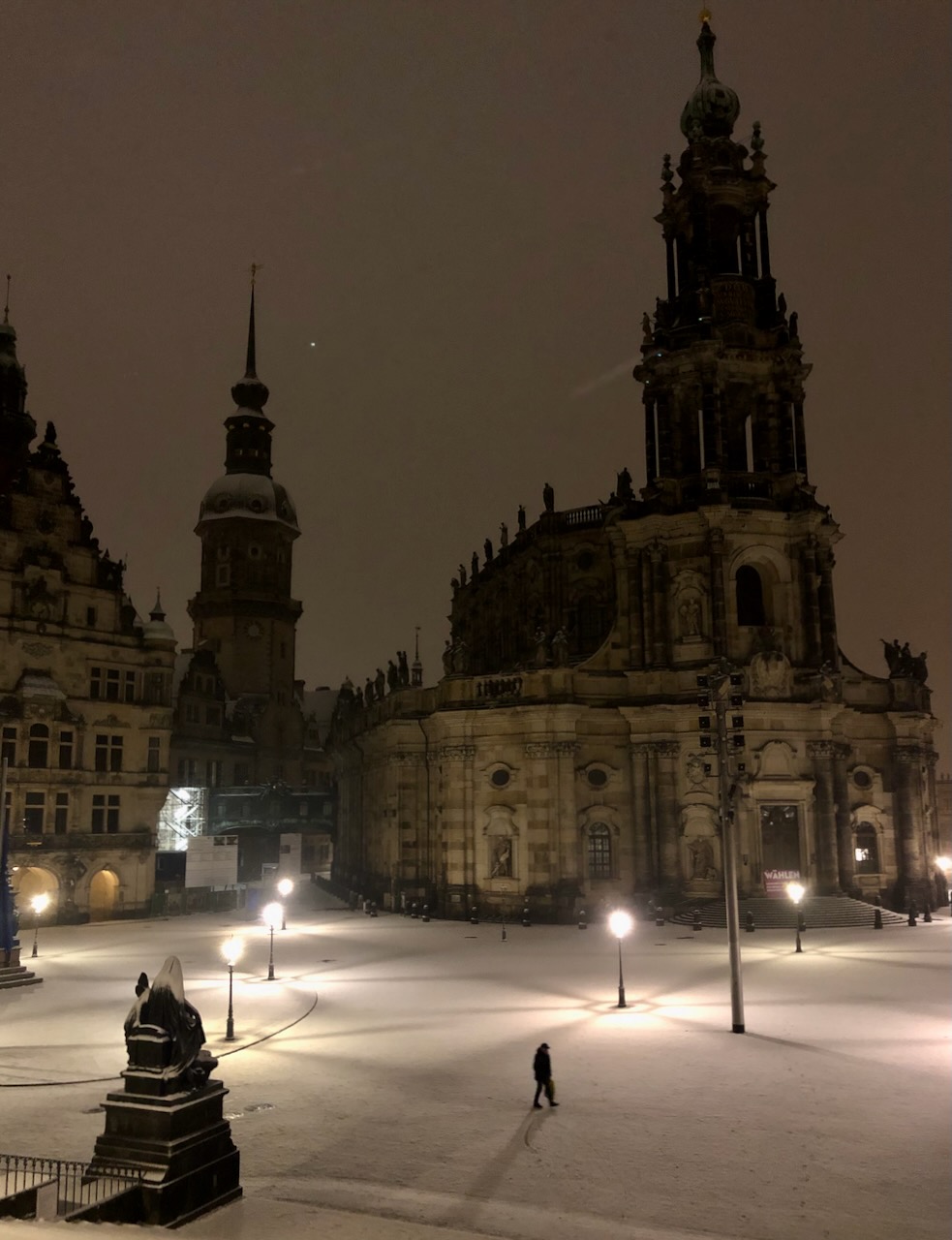
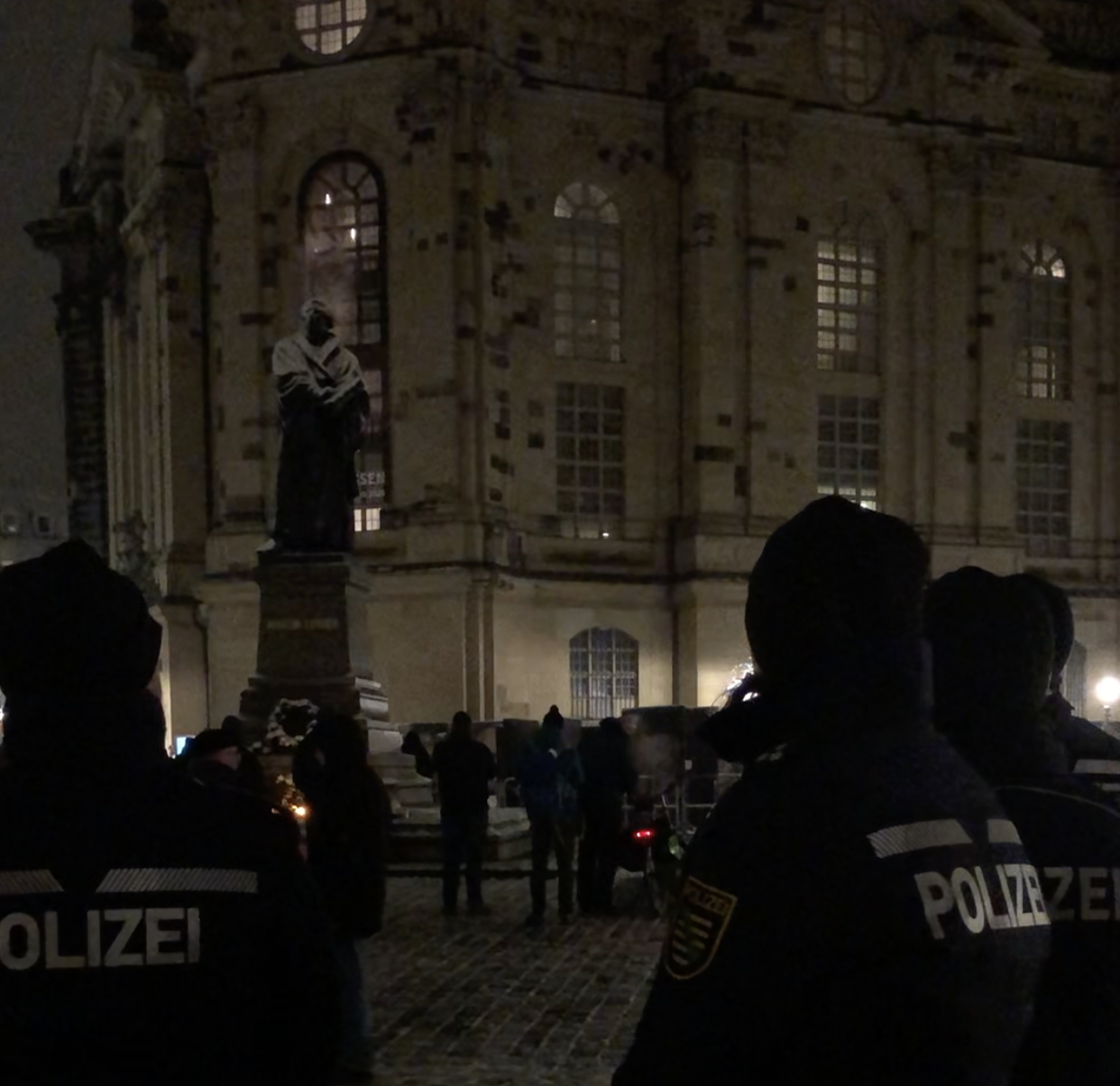
On February 13th at 9.45pm, the bells started; asymmetrical tones infusing the snow-sprinkled city.
People wrapped in scarves and silence, stared at the dome of the Frauenkirche that 80 years before had been mangled by bombs into a pile of rubble that would scar the city for over fifty years.
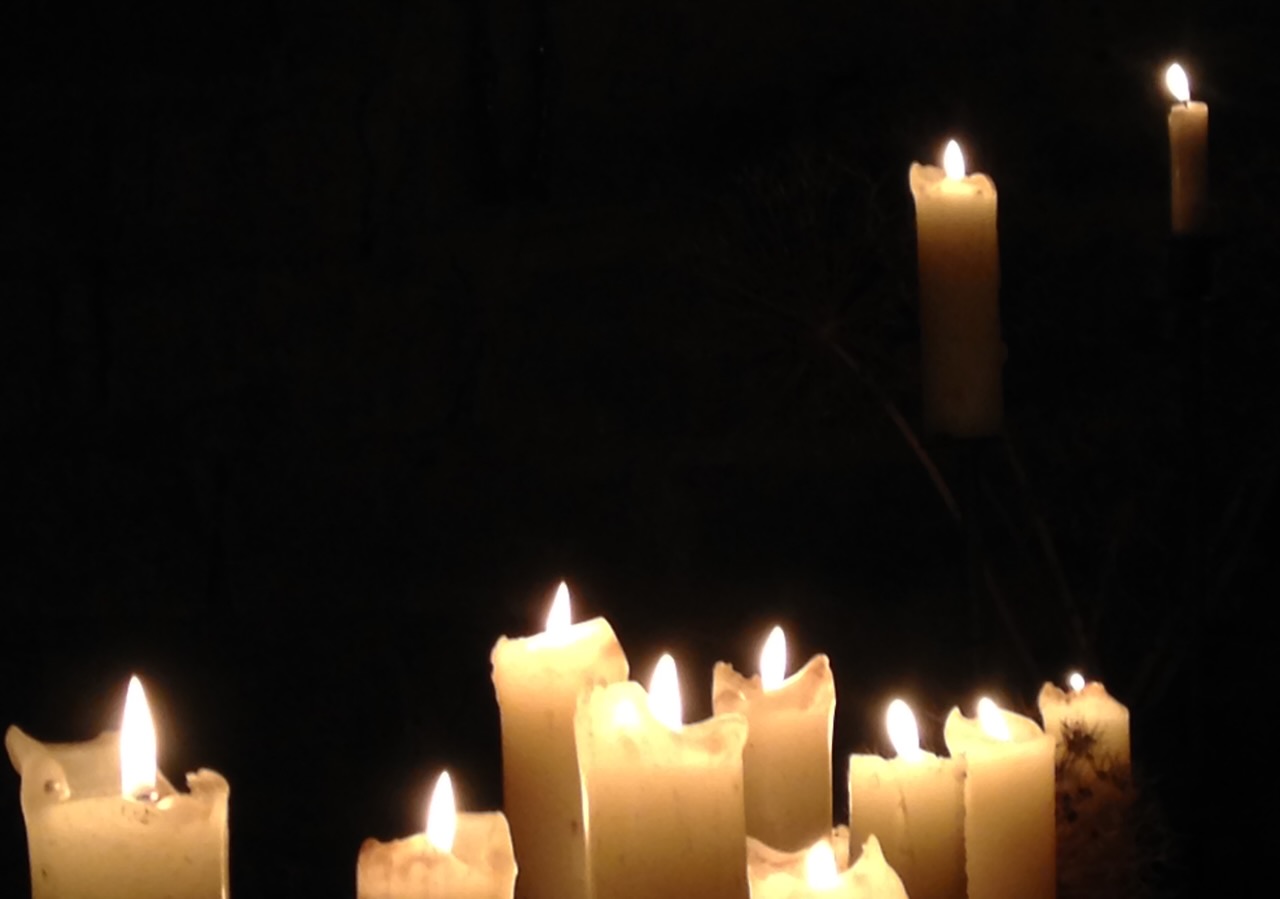
Candles placed on the ground flickered benign flames as memories haunted the minds of those who had witnessed a firestorm that melted asphalt, roofs and neighbours alike.
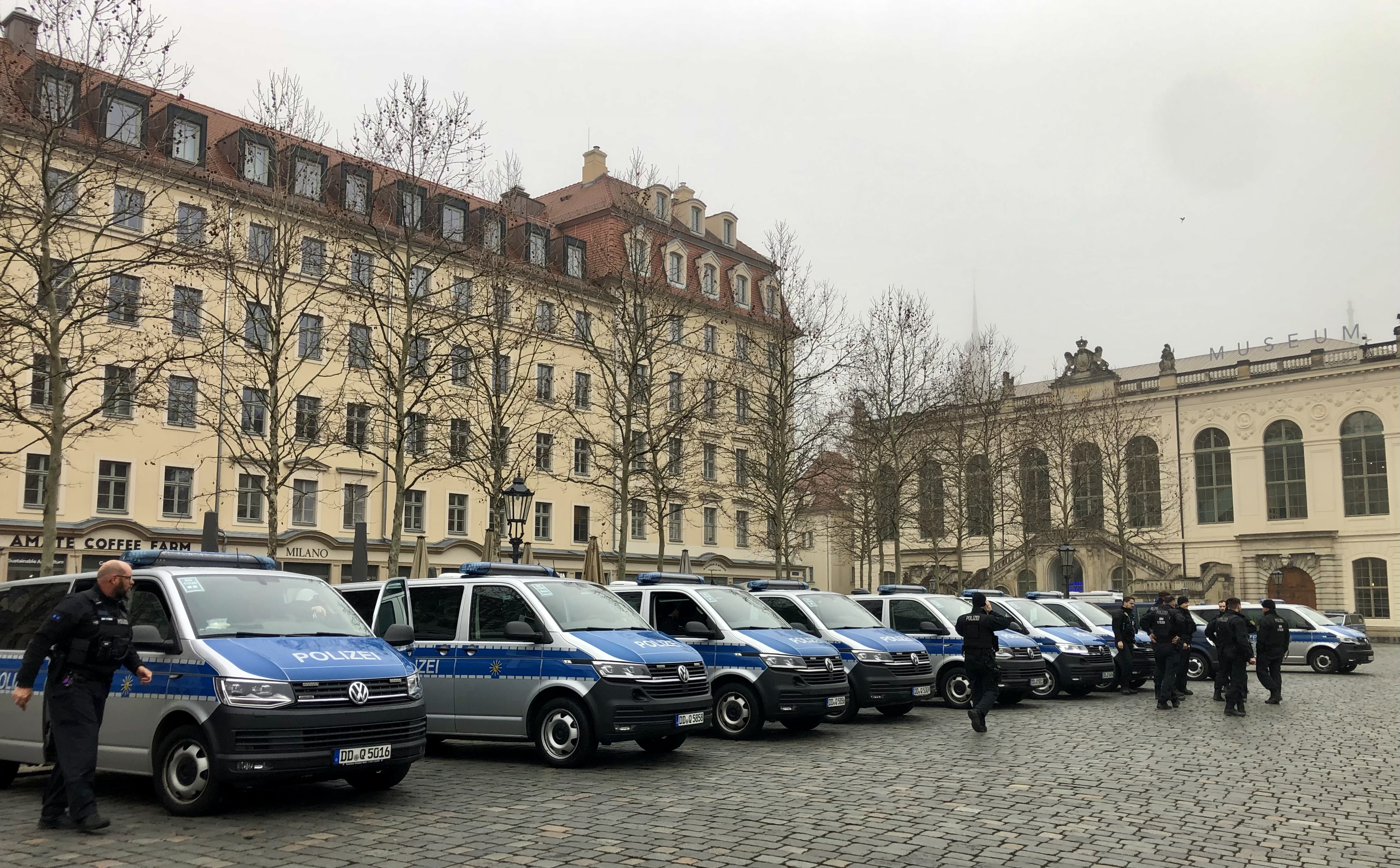
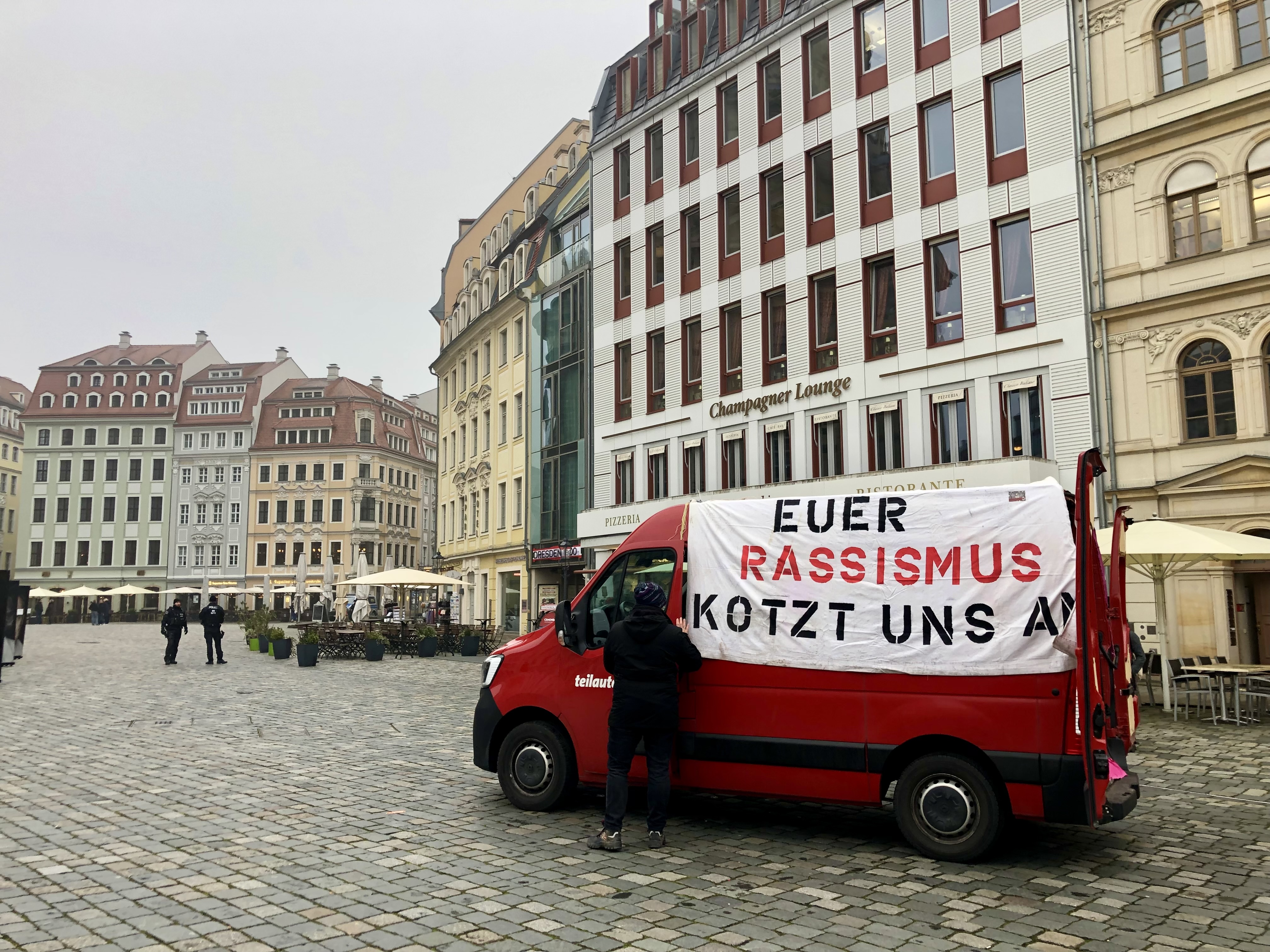
A human chain of hand-holding citizens wove through the resurrected buildings, knitted together both in remembrance and defiance of the re-emerging forces of lessons not learned.
“Your racism makes us sick”
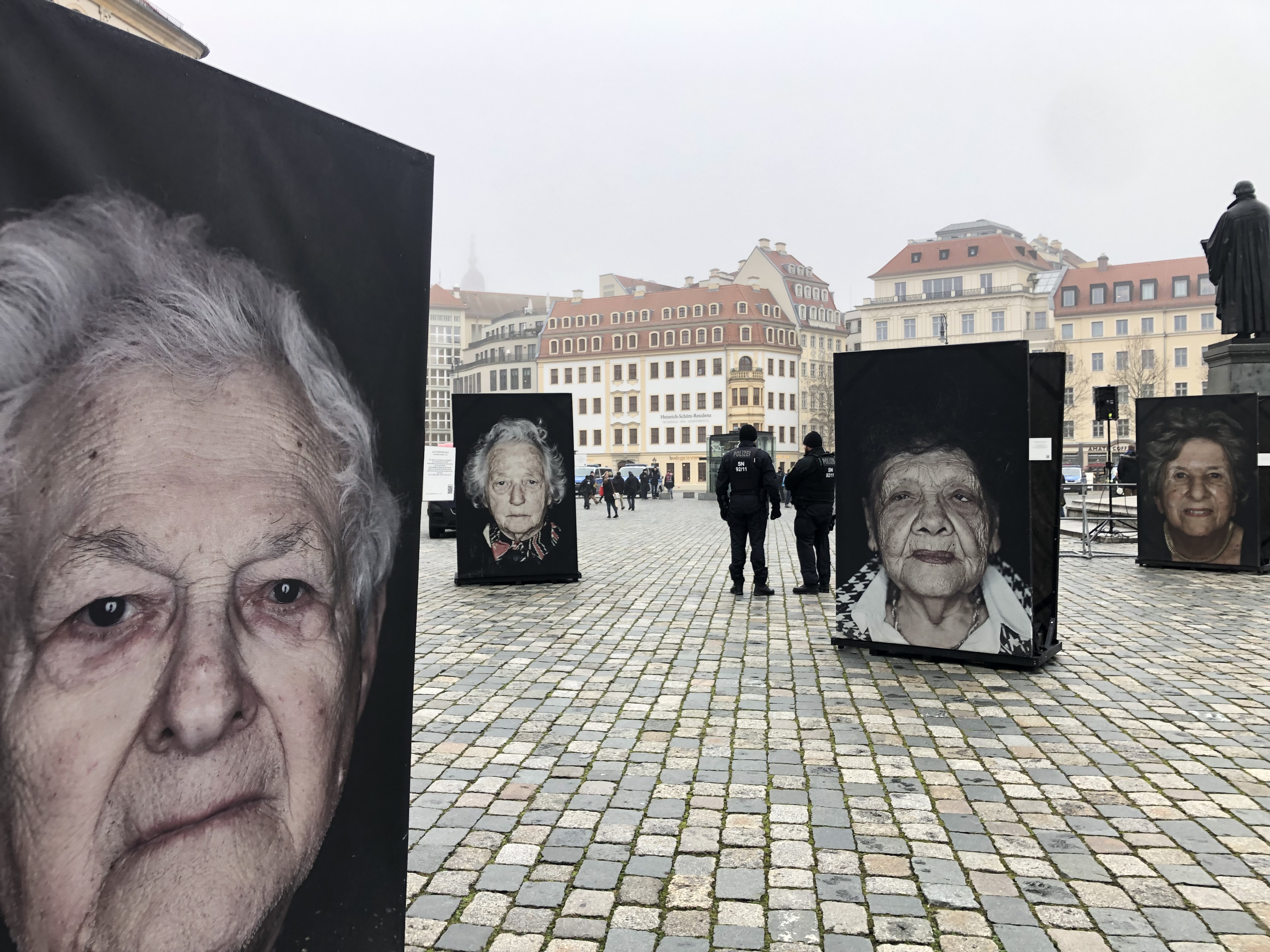
This year’s anniversary of the British and USA bombing of Dresden was determined not simply to look back and roll out familiar but increasingly empty tropes such as ‘Never Again’. Instead, ‘Future through Remembrance’ was the theme repeated through the activities I attended as a Trustee of the British Dresden Trust. Younger generations from Germany, Ukraine, Poland, UK occupied the foreground mingling the wisdom of elders with messages that gave genuine hope for our troubling times.
Stay awake. Be aware and curious as a child about what is happening around you. Look at history from multiple angles. Step back to see it in perspective. Take responsibility.
Benjamin Britten’s War Requiem followed by silence in place of applause gave the horror, tragedy and futility of any war the viscerality needed to galvanise us out of complacency into using Remembrance fiercely rather than sentimentally; to unite us as human beings, each with a heart and soul that thump with a longing for peace.
It was the move from formality to informality, from grand gestures to tiny actions we are all capable of doing everyday, that left the most lasting impression. From pomp and ceremony to conversation; from people in suits or uniforms telling us the importance of remembrance of a time that is increasingly distant, both temporally and emotionally, to a lively exchange between young and old from different nations on the values of democracy and peace.
‘Tis the season to remember. In our progression through the grey gloom of this autumn [just 18 minutes of sunshine since 28th October apparently!] and the celebrations of Halloween, All Souls, Samhain, Guy Fawkes and November 11th, the dead take centre stage. Leaves and forest floors redden while poppies bloom on jacket lapels, village monuments and shop counters. This Sunday in London, as on all Remembrance Sundays, red wreaths will be laid by royalties, senior politicians and Commonwealth High Commissioners before some of the last surviving WW2 veterans march or are wheeled past the Cenotaph.
We have been collectively remembering Armistice Day since 1919, the first anniversary of peace at the end of World War One. Remembrance has since been extended to both World Wars and all those who have given their lives in service to defend our freedoms. It is a hugely important day for the British, the Commonwealth and many other countries around the world, albeit not in Germany. There, since the Middle Ages, 11am on 11.11 has marked the start of the carnival season and, on a more serious note, Armistice Day is not considered to have welcomed the beginning of peace but years of intense unrest and far worse horrors to come.
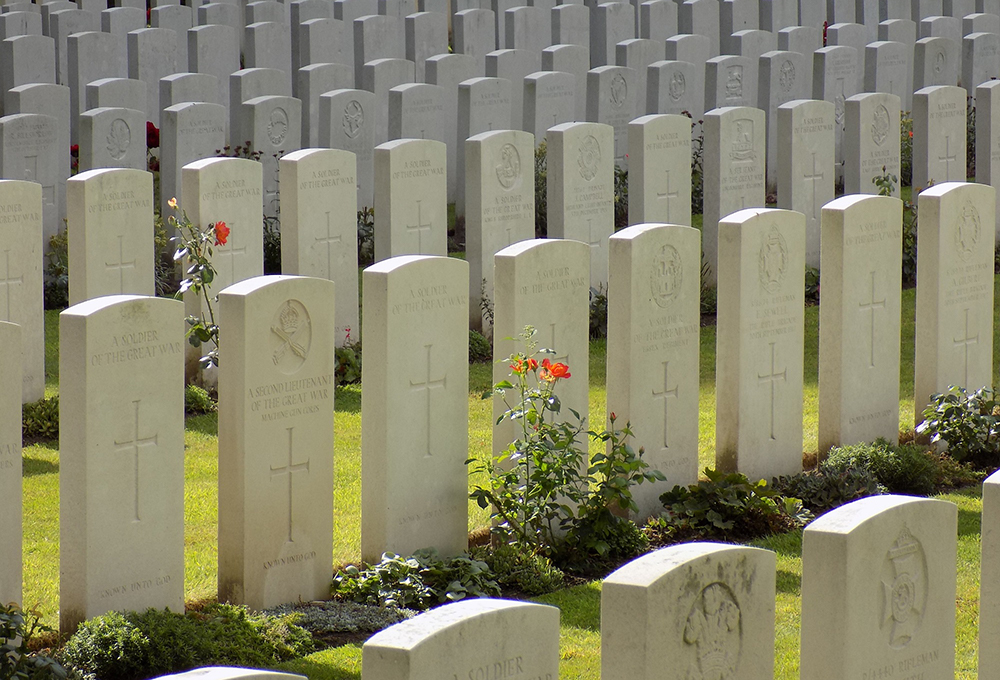
British and Commonwealth dead
I often dedicate my November blog to our traditional, deeply moving and impeccably executed rituals of remembrance, but not always without a little questioning too. Through the 15 years of research for In My Grandfather’s Shadow, I came to appreciate a far broader narrative of WW2 remembrance than that which Britain generally embraces and teaches. Granted there has been welcome progress over the decades with the inclusion of women as well as the huge contributions and sacrifices made by Gurkha, Indian, Sikh, African and Caribbean servicemen, among others. But there is still widespread ignorance of the bigger context.
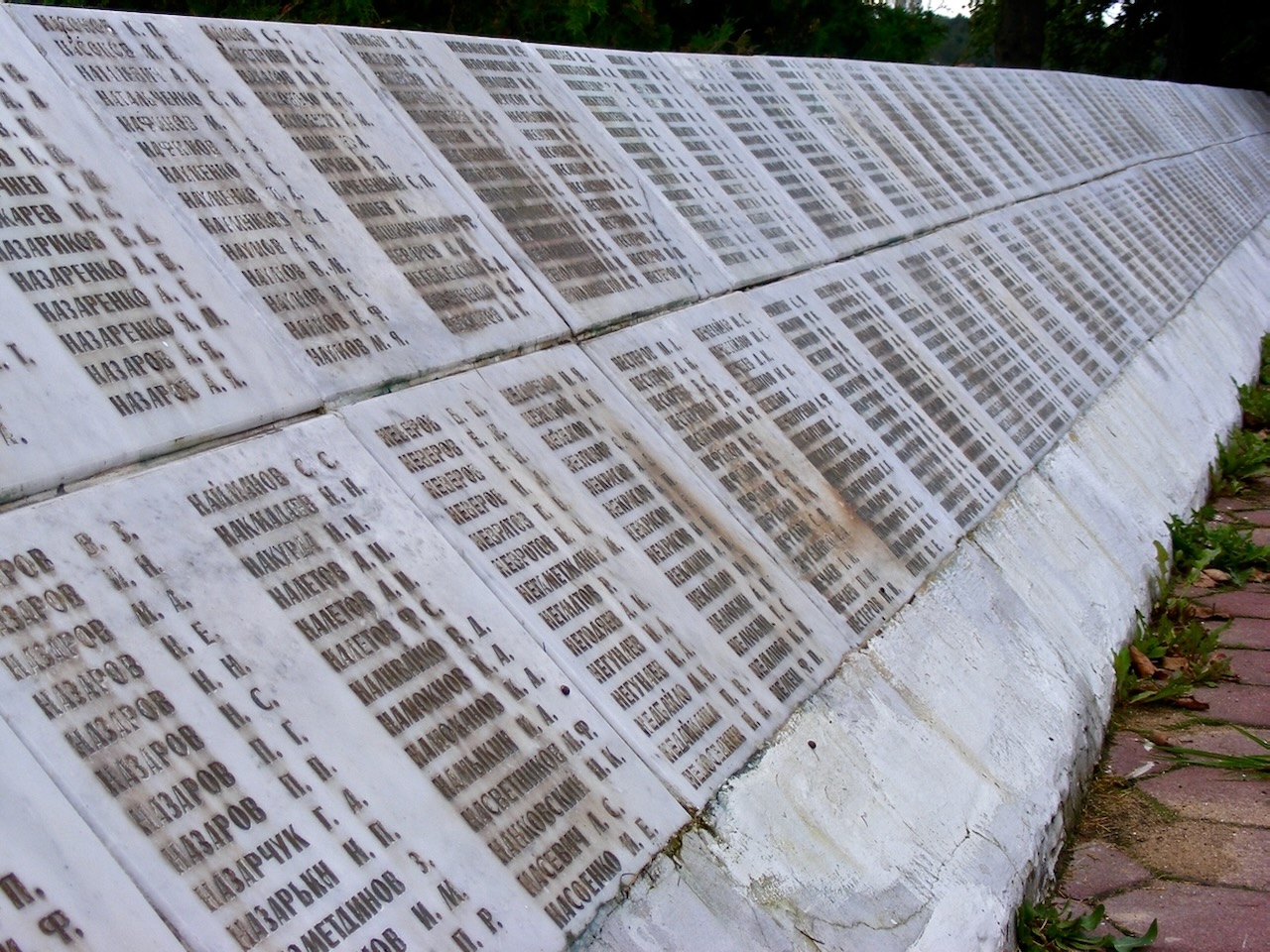
Russian dead
When I give my talks, I often use statistics. They provide a solid, black and white foundation of fact to my more psychological / philosophical ponderings. So often these figures shock. For example, when I ask people to guess the total losses, including civilians, of say Russia, Germany and Britain in the Second World War they are usually so far out that they themselves are horrified. I challenge you to make a guess… I’ll put the answers at the end of the blog. One man literally went white when he realised how wrong he had been in his thinking or, by his own admission, his lack of thinking. Another woman recently wrote to tell me how my book had opened her eyes in so many ways. “First off,” she said, “the big realisation of how little I have understood of the two world wars, my ignorance of those times and the aftermath.” This despite attending remembrance services all her life.
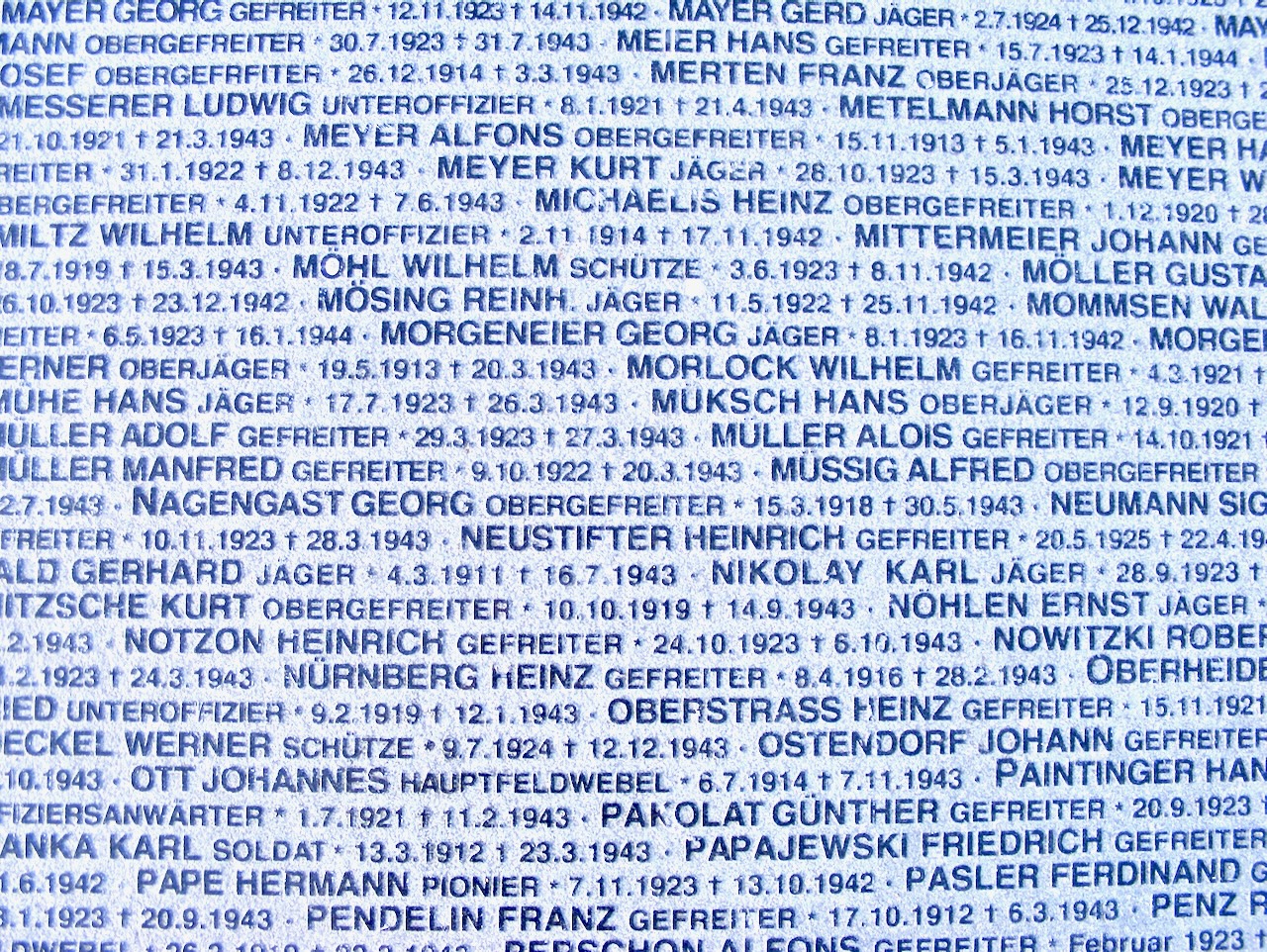
German dead
The quantity of deaths doesn’t mean each death was any less keenly felt. But I think she voices what is probably true of most of us. I certainly was ignorant of the broader landscape of loss and destruction, and no doubt still would be if I hadn’t had German roots that needed excavating and hadn’t made trips through Germany and Russia that exposed me to other ways of looking. The World Wars are the episode in history with which the British are often accused of being unnaturally obsessed. And yet, as a nation, we often present it as a deceptively straightforward story of good triumphing over evil. The victors write history after all.
Every nation has its ‘chosen traumas’ and ‘chosen victories’ which serve as cornerstones to its identity and prevent true healing from the past as they continue to play out in the present. We frequently have binary views of how we should feel based on – to use the reader’s words again – “simplistic, reductionist understanding… goodies and baddies…” Rarely have we “considered what it must feel like to have a different identity…”
I really appreciate and admire this woman’s soul-searching honesty. The humility and gentle opening to hearing the other sides’ stories gives me huge hope.
Healing, reconciliation, peace, forgiveness… all goals we strive for within our culture of Remembrance… can best come about when we become familiar with and find some understanding for the other side’s experience. Maybe, with our greater distance from both the acute trauma and the impassioned jubilation of our forebears, that is what generations now and in the future can strive to do more of.
Answer to my statistics question: Out of the around 60 million people killed in WW2, 26 million were Russian, approx. one third of them military and two thirds civilians. Between 7-9 million Germans died, roughly 6 million were soldiers and 3 million civilians. In the United Kingdom, just under 451,000 were killed. That’s 383,800 military, including combatants from overseas territories (Crown Colonies and the Indian Empire), and 67,200 civilians.
With the approach of Holocaust Memorial Day, I find myself engaging with some of my customary questions around how to remember the past and learn from it.
There is no question that 27th January is a day to collectively bear witness to those murdered under Nazi Germany’s heinous regime. To honour their memories and acknowledge the agonising voids they once filled. To hold in our minds and hearts those who survived and those born later scarred by the violence inflicted on their families. I personally can’t imagine a time when this is not the right thing to do.
Added to remembrance, is the necessity to grasp and implement the lessons of such dark episodes in history. The most obvious ones centre on the dangers and wrongness of discrimination; of othering fellow human beings for their perceived inferiorities or differences in religion, outlook, appearance, social standing, sexual orientation etc. This may feel relatively straightforward for decent people. It becomes less easy, however, when we are requested to act in the face of similar wrongdoings, rather than look away or rant on social media; to become ‘upstanders’ rather than bystanders. How do we do that in this world where injustices can be found everywhere?
One could deduce, that punishing the culprits is an important aspect of commemorating the Holocaust and avoiding future genocides, though the time for that may now have passed. Just over a month ago, the 97-year-old German care home resident, Irmgard Furchner, became possibly the last person to be convicted of Nazi war crimes. After a divisive trial in Itzehoe, she was given a 2-year suspended sentence for her role as the 18-year-old secretary to the Stutthof concentration camp commandant, Paul-Werner Hoppe. For many people, this is justice, no matter how late, and all the more deserved due to Furchner’s evident absence of remorse. For some, however, it is a vindictive attempt to assuage Germany’s collective guilt. For others, it is misplaced and sickening virtue-signalling, pointless scape-goating… the debate is lively.
Irmgard Furchner
A positive outcome of Germany’s learning from its dark past is its nigh on eighty years of pacifism. But this too appears to be being brought to an end, albeit with huge reluctance and resistance within the country. Putin’s illegal war and NATO’s unified military response in support of Ukraine have put understandable pressure on Germany to break its resolve not to get involved in military conflicts and supply Ukraine with its world class Leopard 2 tanks specifically designed to compete with the Russian T-90 tanks. Last night, after months of hesitation and debate, the Chancellor, Olaf Scholz, and the German government finally agreed to send a company of battle tanks and allowed other countries to send their German-made tanks too.
The whole issue is extremely complex, I know, but the psychological irony seems unavoidable.
On the one hand, the widespread tendency to never let Germany forget the wrongs of its Nazi past is still alive and kicking. On the other, there is now equally widespread demand that it does just that. Or rather that it selectively remembers some bits of its past and forgets others, such as the traumatic memories of the last time German tanks rolled into Russia with the horrifically high death tolls and suffering of tens of millions that ensued. I wish I could ask my German grandfather what he thinks of the situation, having fought on the eastern front for so long… (See Chapters 14 & 15 in my book In My Grandfather’s Shadow)
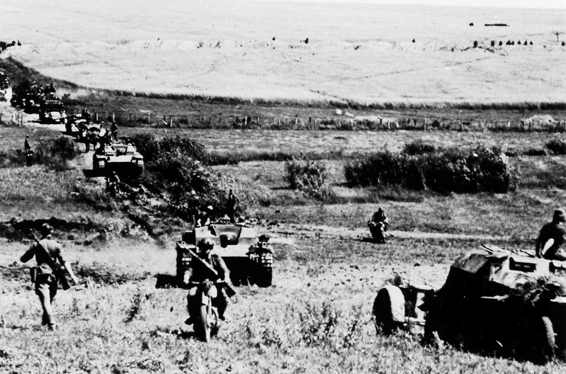
Operation Barbarossa, 1941
From many points of view, including a growing number within Germany itself, there are compelling arguments for the government to embrace a Zeitenwende’ (turning of the times) in its foreign policy and to override its long-standing commitment to peacekeeping, up its defence budget and contribute more military solidarity to its NATO allies in a shared effort to support Ukraine against Russia. I am not saying this is right or wrong, just recognising that it is a HUGE step for Germans and Germany, a potential game-changer for either good or bad, and one we should try to understand rather than simply criticise and judge.
Within the over-simplified, clean-cut narrative of Putin = bad, Ukraine/NATO = good, (which is naturally true from the West’s perspective but not from Russia’s and its allies, hence the conflict), space should be allowed for Germany’s justified fears of an escalation. Its visceral memories of fighting Russia and closer proximity to the country, raise genuinely terrifying concerns that we need to take seriously. At the same time, the contradictions in the messages being delivered to Germany surely don’t go unnoticed: Remember and take the full blame for the atrocities you caused with the Holocaust and the Second World War… but actually, forget some of them now and immediately dispatch tanks against the former enemy with whom you have been trying to make some kind of peace or amends and play a decisive and deadly frontline role in what could easily become a Third World War.
Maybe it really is time for Germany to move beyond its WW2 identity. I hope that this Zeitenwende in German policy will also find a counter Zeitenwende in certain mindsets.
November, in many cultures, is the month designated to remembering those who are no longer there. With a strange synchronicity, everything I did, watched, read or listened to pointed towards ‘absence,’ that non-presence devoid of form that artists call ‘negative space.’ “Empty space is the silence between musical notes, the pauses in poetry, the stillness of a dancer. Therein often lies the meaning or drama of a piece.” (In My Grandfather’s Shadow, Ch 11, p.144)
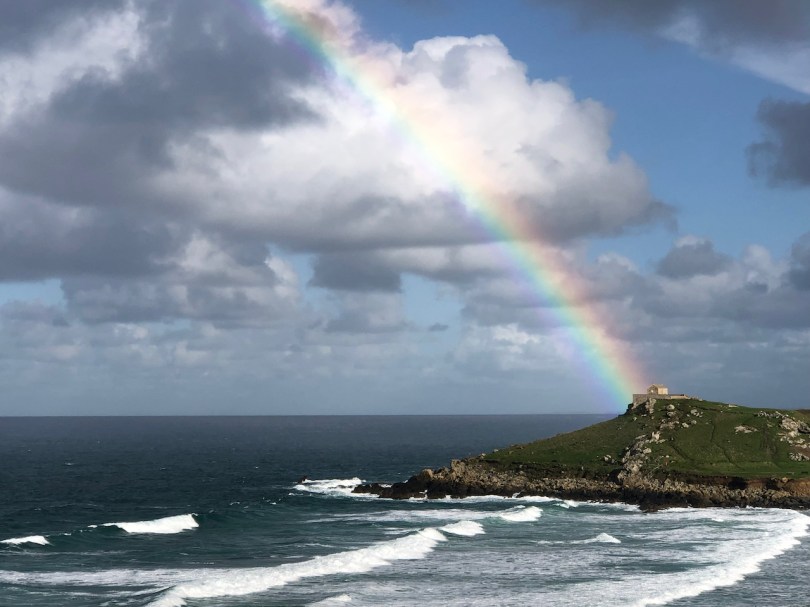
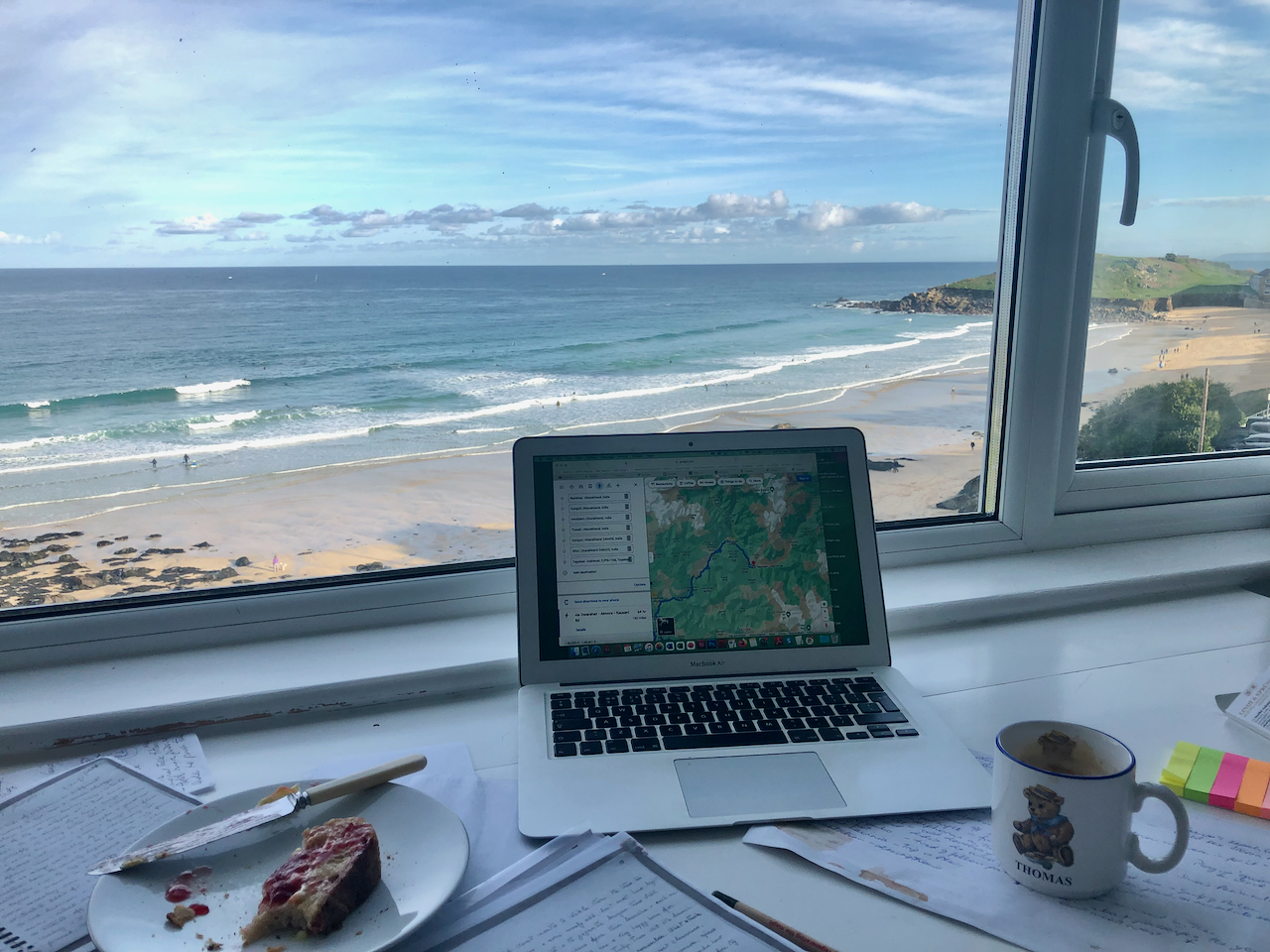
I have just returned from a week in St Ives, the Cornish place that boasts the highest concentration of blue light in the UK and challenges many an artist to capture its effect in paint. A kind author friend each year offers her house of clean white rooms overlooking the beach and cliffs as a form of writing retreat for three of her fellow writer friends. All four of us want to make the most of precious time out, so the interiors fall silent during the days that in turn empty of all structure, just as our minds declutter of chores.
I spent my time reading the diaries of my intrepid, spinster great great aunt, who travelled alone to the Himalayas in 1939 to gather flowers for Kew Gardens. I followed her slow, awe-filled progress as she step-by-stepped her precarious way through lofty peaks and flower- or snow-filled valleys, pausing with her when she rested to stare at the perfectly choreographed performance of clouds and weather dancing in front of my window. Thoughts wafted through my mind, some being noted, others just fading in and out like rainbows. For a whole week, I simply was.
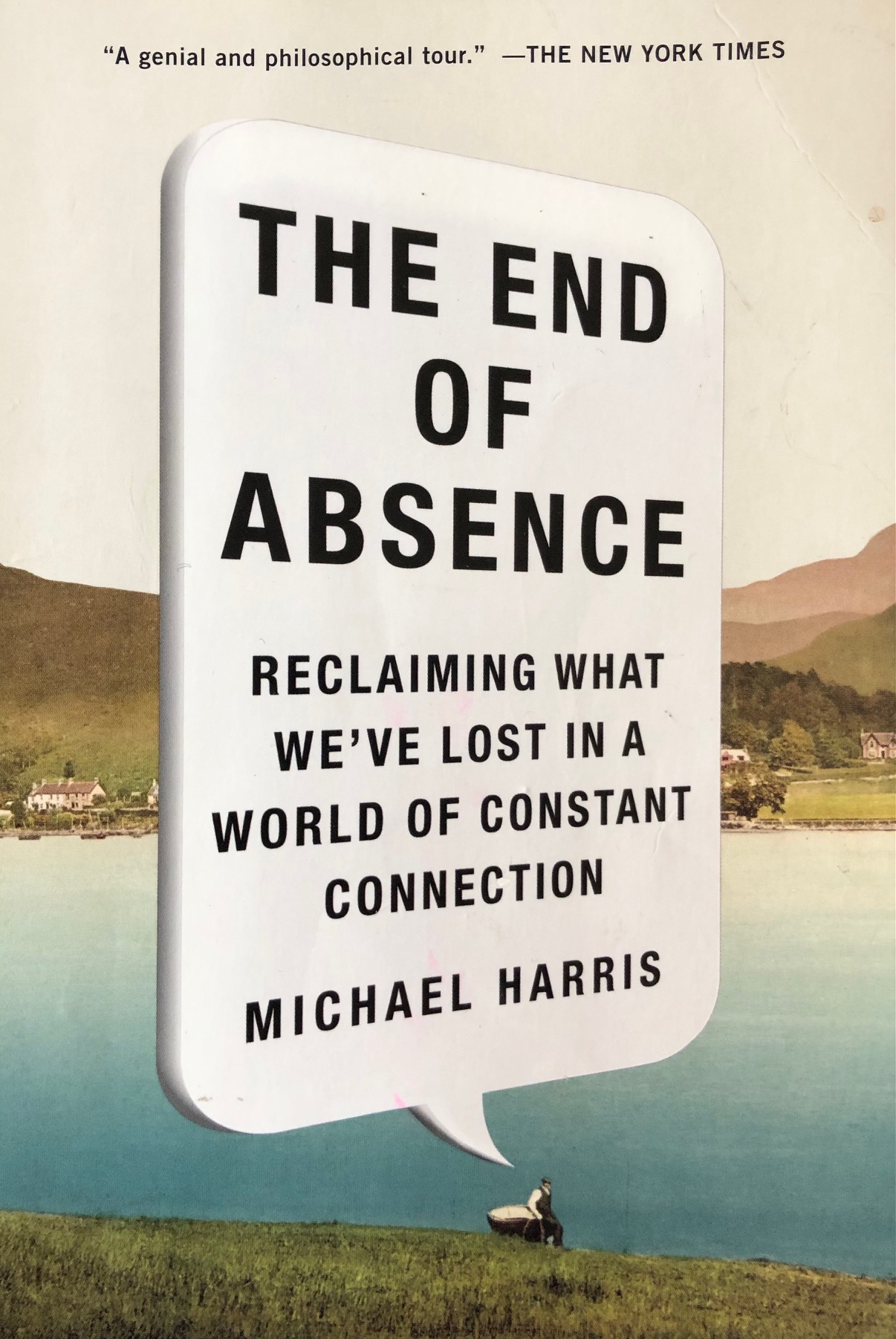
My time there, along with books and films I have recently ingested, have been making me realise just how much I miss and yearn to regain some of what I remember loving doing as a child… nothing. Being born a day-dreamer, the spaces between activity and connection were always filled with a rich, albeit invisible world that had the capacity to entertain, or indeed bore. Boredom… how rarely we have time for that potentially creative vacuum within today’s ubiquitous overload of information, social media and communications that interrupt our rhythms with an octave of pings. I don’t think this is just a grumpy, old-age thing. (Well it may be a bit.) This nostalgia is captured well in ‘The End of Absence’ by the considerably younger and hipper author, Michael Harris. He reminds us of what we are in danger of losing as generations, who have never known life without the internet, gradually overtake those of us who have.
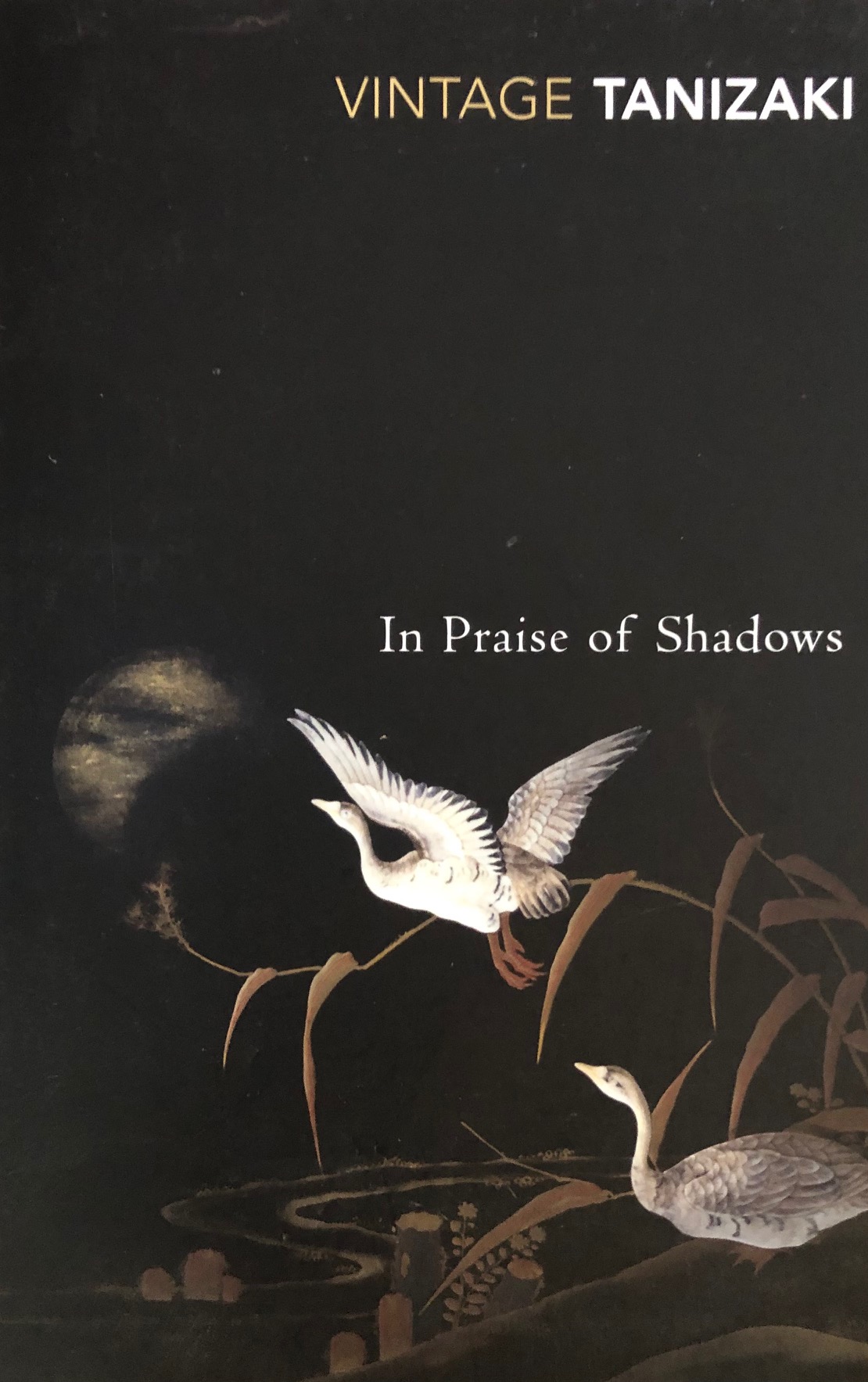
The recently released and highly acclaimed film ‘Living’ based on the book by Akira Krosawa, screen written by Kazuo Ishiguro and starring Bill Nighy is set in 1950s London. Not a lot happens, and what does, happens incredibly slowly. The cinematography is stunning and emulates the subtle grace described in ‘In Praise of Shadows,’ a slim book by Junichiro Tanizaki that gently reveals traditional Japanese aesthetics and use of space. Unlike us in the west where the achievement of light is basically both goal and God, in Japan it was – and maybe still is in places – the creation of shadows that was the source of beauty and mystery. This quiet understatement is part of what I want to rediscover.
Another film I watched where even less happens but with still more potency and power, is The Banshees of Inisherin. Dark, sad, funny and impeccable in every way, including the acting of its two ‘In Bruges’ stars, Brendan Gleeson and Colin Farrell, it basically portrays the painful ending of an long-standing friendship caused by the simple declaration by one: ‘I don’t want to be friends with you anymore’. The extensive space the film allows each facial movement, scene, sentence… one can almost feel the multi-layered clutter of ones own world begging to be emptied into black bin bags, or deleted.
With this increasingly strong desire to create more space, I decided to have a big Studio Sale of my art. (All works available can be viewed here.) And to finally sort through my real and digital filing office and cabinets in order to establish more clarity and space for new shoots and fruits.
So with the start of Advent this Sunday and the build-up to the crazy, all-consuming Christmas season, I would like to invite you to join me in seeking out and reclaiming some of those quiet spaces life used to offer in abundance, and still does if we just stop… feel… and dream our way into them.
Wishing you a very Happy and Meaningful Advent…
Related Links
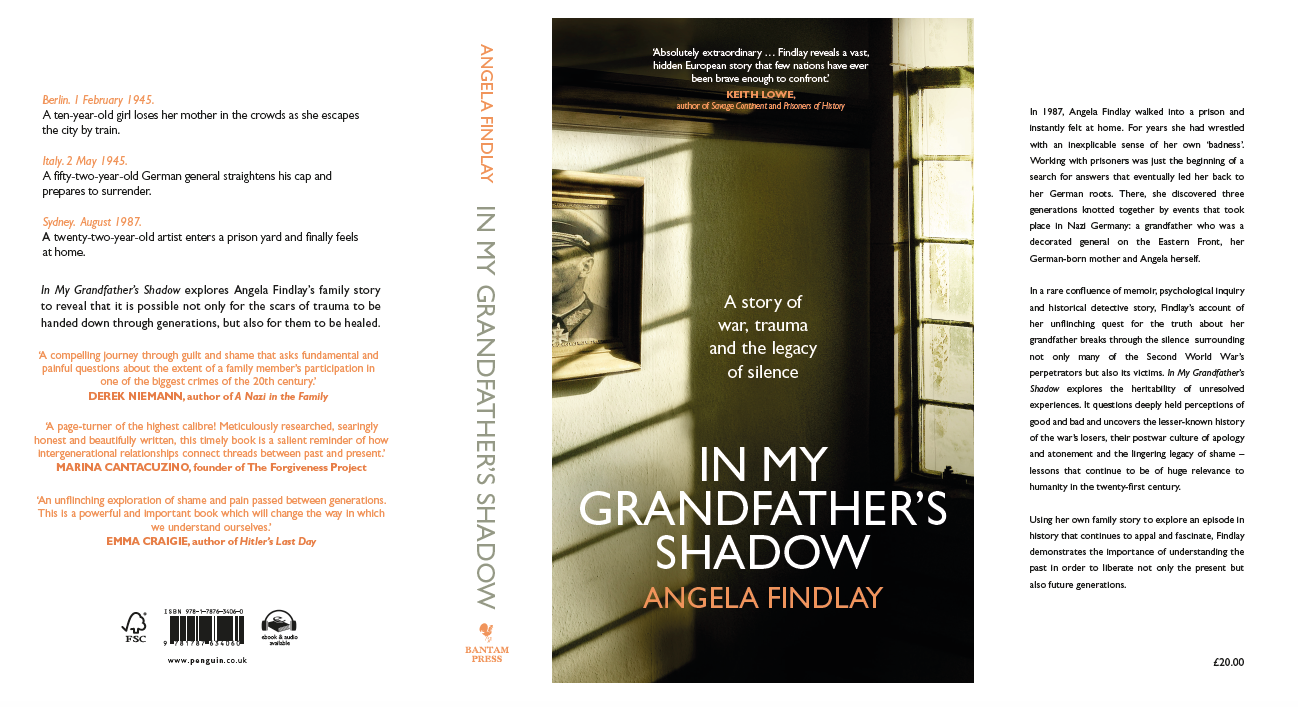
To buy my book, In My Grandfather’s Shadow, as a Christmas present, please order from your local bookshop or online here
“In My Grandfather’s Shadow’ is a brave, powerful, honest, thoughtful and meticulously researched book. I enjoyed it immensely. It has made me think very hard about intergenerational trauma transfer and explains so much about Germany, and perhaps, in the current context, Russia.” General Sir Richard Shirreff, former Deputy Supreme Allied Commander Europe and author of ‘War with Russia’
To listen to the recent 5-part Interview with Chris Baxter on Radio West, please go to BBC iPlayer here
To look through and/or buy a piece of ART please go to my website: www.angelafindlay.com
The Remembrance Sunday of 2022 will be one of thankfully few since 1945 that sees another war in Europe raging. As we remember those who lost their lives in past wars, fellow Europeans will be losing theirs in the all too real conflict fighting itself out in Ukraine.
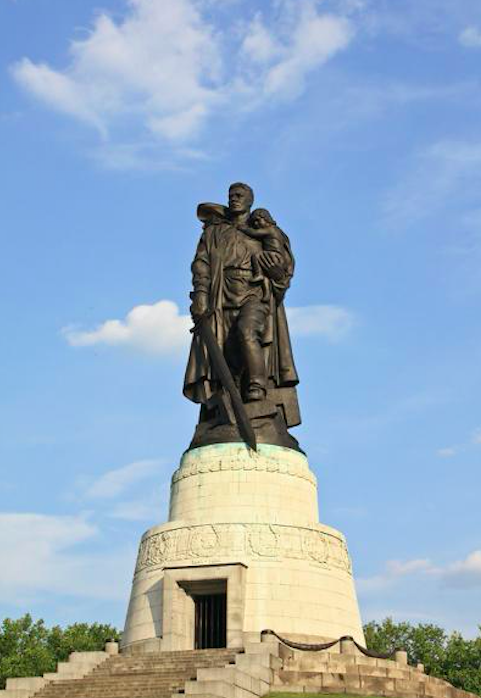
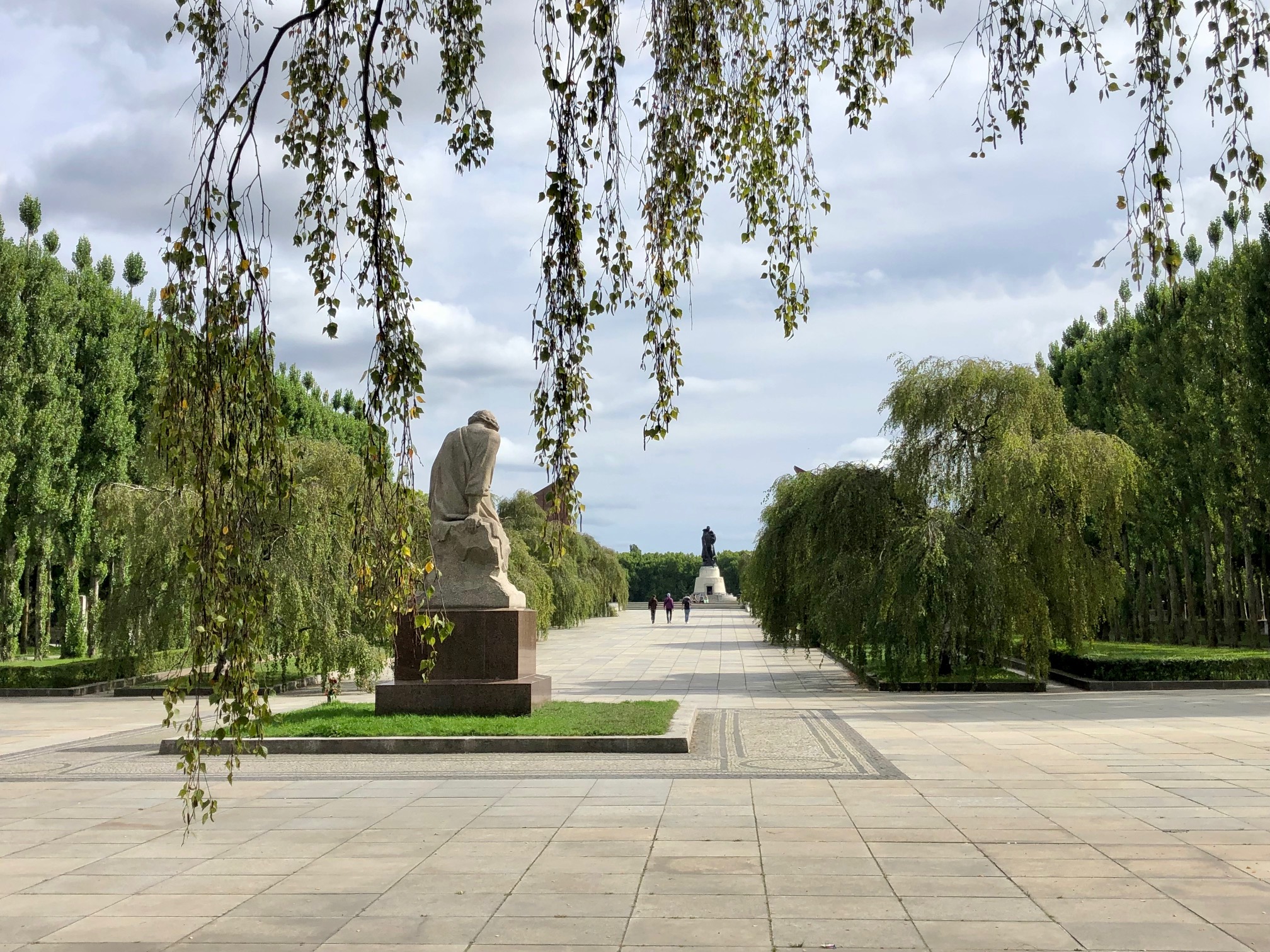
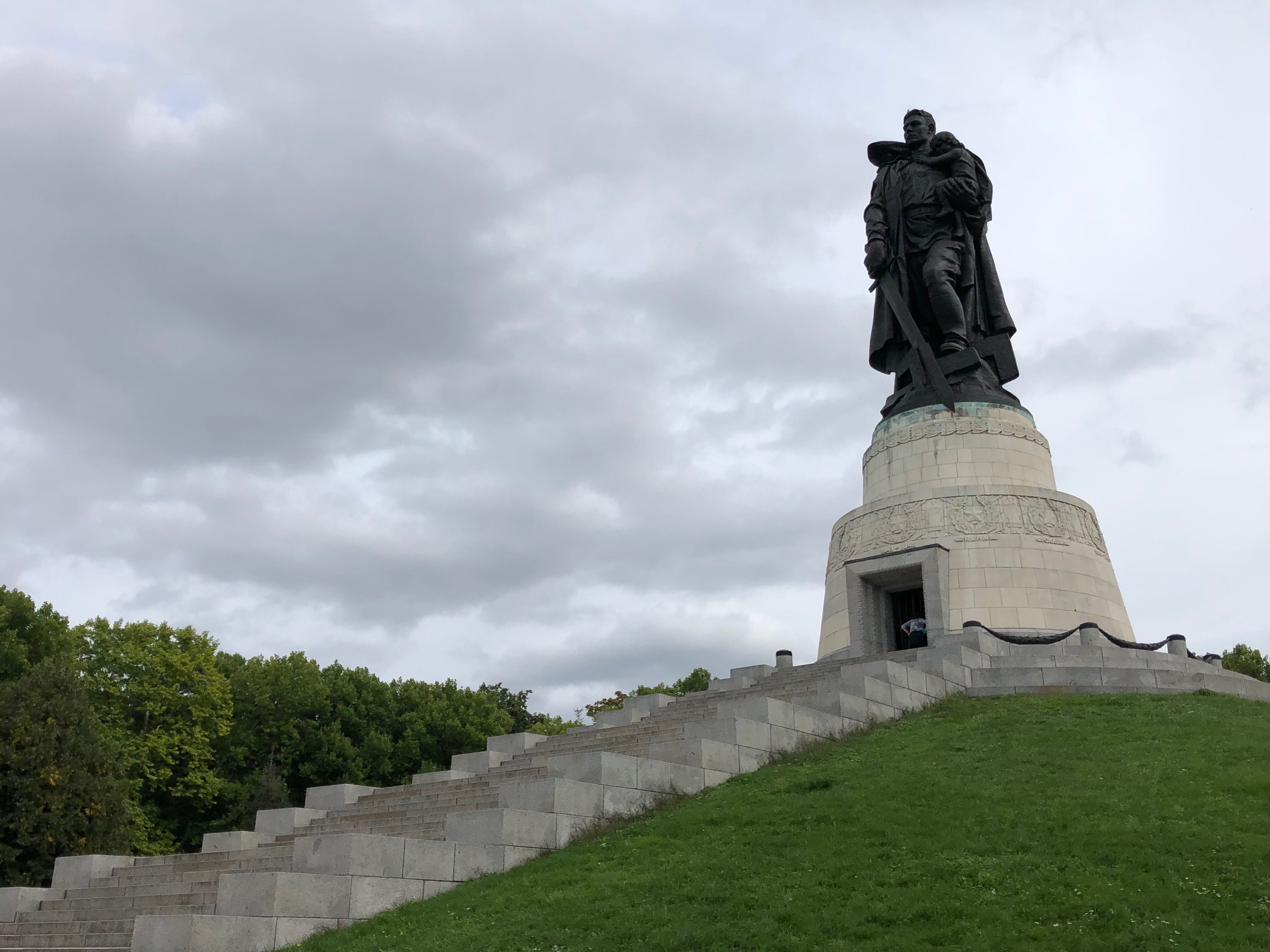
In my last blog I wrote about travelling the Berlin Wall Way, itself a form of 100+ mile-long memorial remembering both a repressive episode in history and those who lost their lives trying to escape it. Well, a little off that route in what was central East Berlin is Treptower Park, the largest Soviet military memorial outside the Soviet Union. Opened on 8th May 1949, it is a 10-hectare cemetery for 7000 of the more than 22,000 Soviet soldiers killed in the battle to take Berlin in the final months of the Second World War and contains the world-famous symbol of the role played by the Soviet Union in destroying National Socialism: the 13-meter towering statue of a Soviet soldier holding a lowered sword over a shattered swastika and cradling a rescued German child in his arm.
The Soviet Warrior Monument built by Yevgeny Vuchetich
To experience this place is to experience a sense of the enormity and profundity of the impact WW2 had on the Soviet / Russian people. For a start it is vast. And the extensive layout is designed to take you through a process of mourning and remembrance to honouring the victors as heroes and liberators.
‘Heroes and liberators.’
We too use those words in relation to our own soldiers. But how often have we – or do we – actively honour the decisive role the Soviet soldiers played in defeating Nazi Germany? And how often do we include the mind-boggling numbers of Russians murdered or killed in the process (25 million to give a rough/round figure) in our process of remembrance? We don’t really, is the only answer I can find. And yet they were our allies in a war that we, as a nation, have made central to our national identity. Could our slightly introspective leanings and lack of acknowledgment of the Soviet sacrifices and achievement (among many other factors, not least the horrors of the Stalin era) have contributed to the attitudes of subsequent regimes and politics towards the West? Just a question… but one that walking through Treptower Park certainly made me ask.
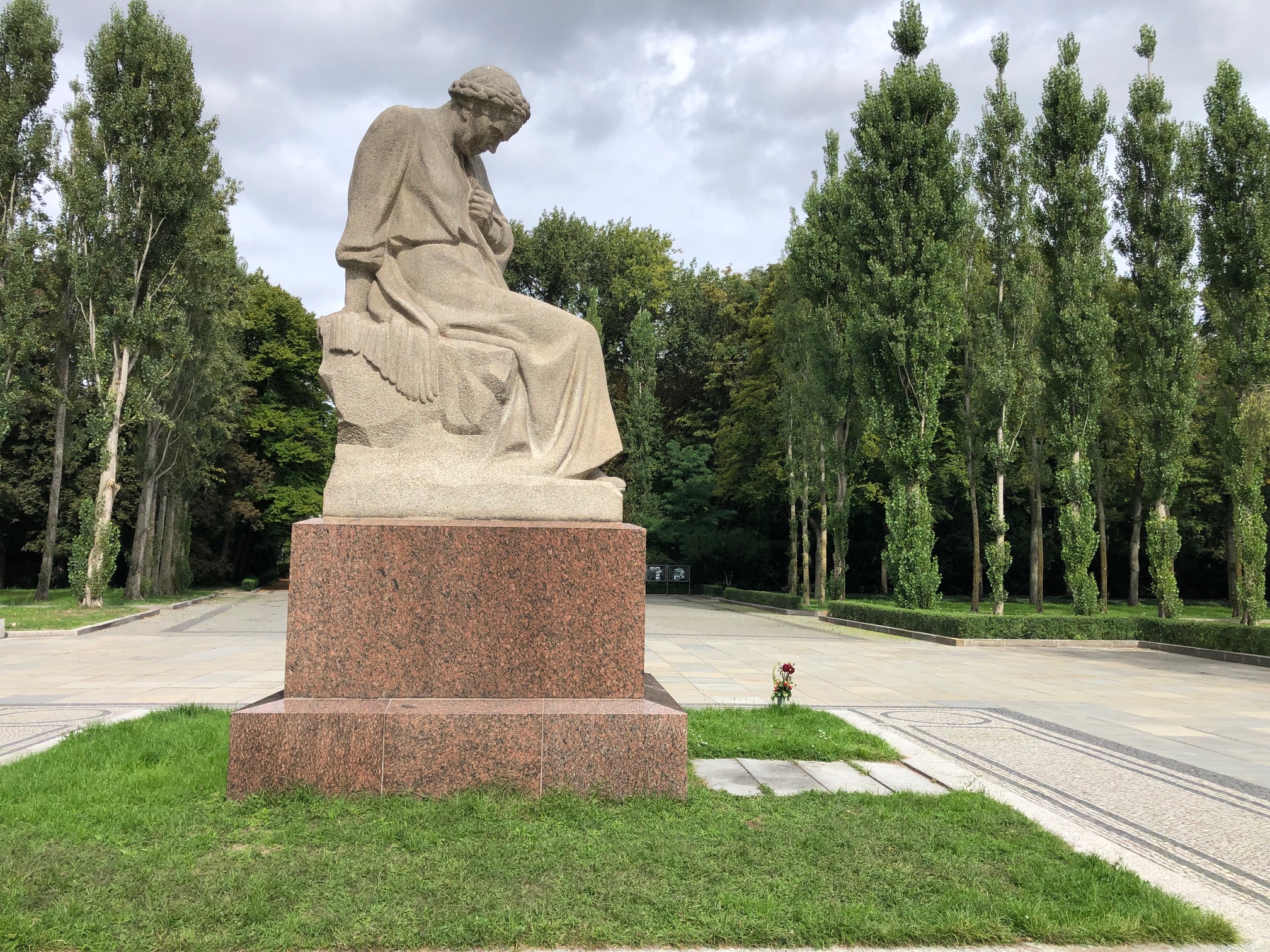
‘Mother Homeland’
Entering through one of two avenues, the (tiny) visitor is led first to the statue of a grieving “Mother Homeland.”
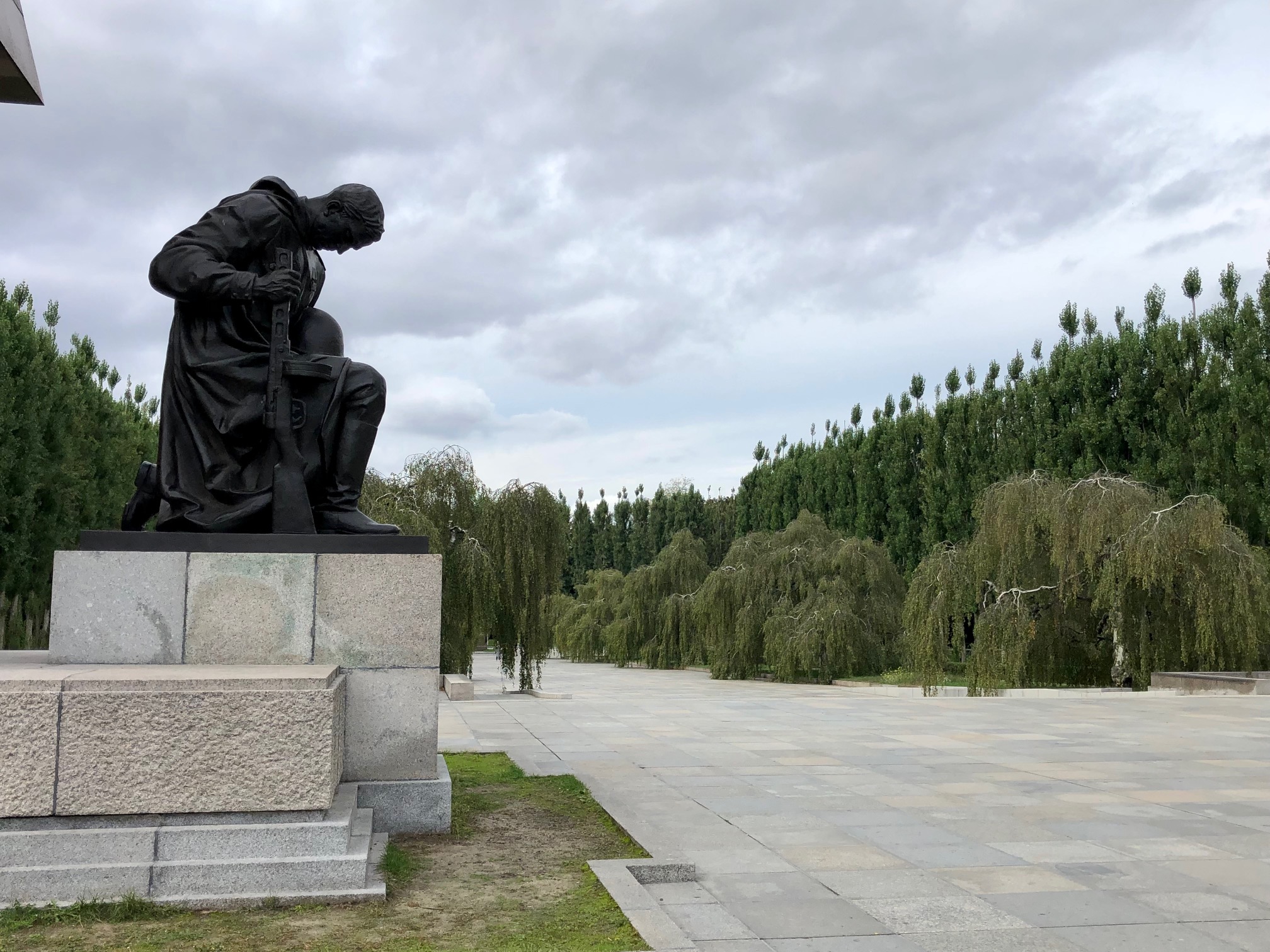
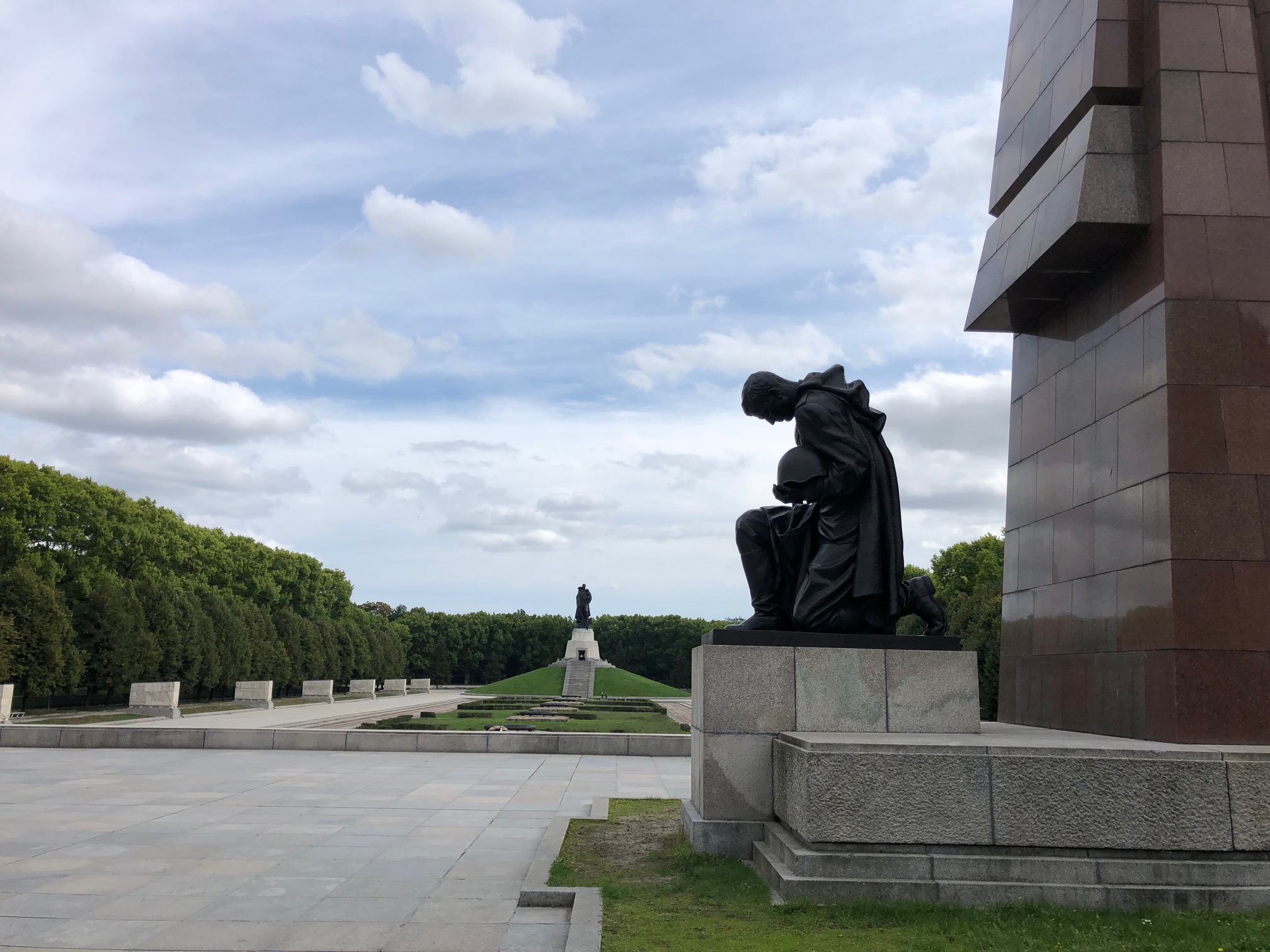
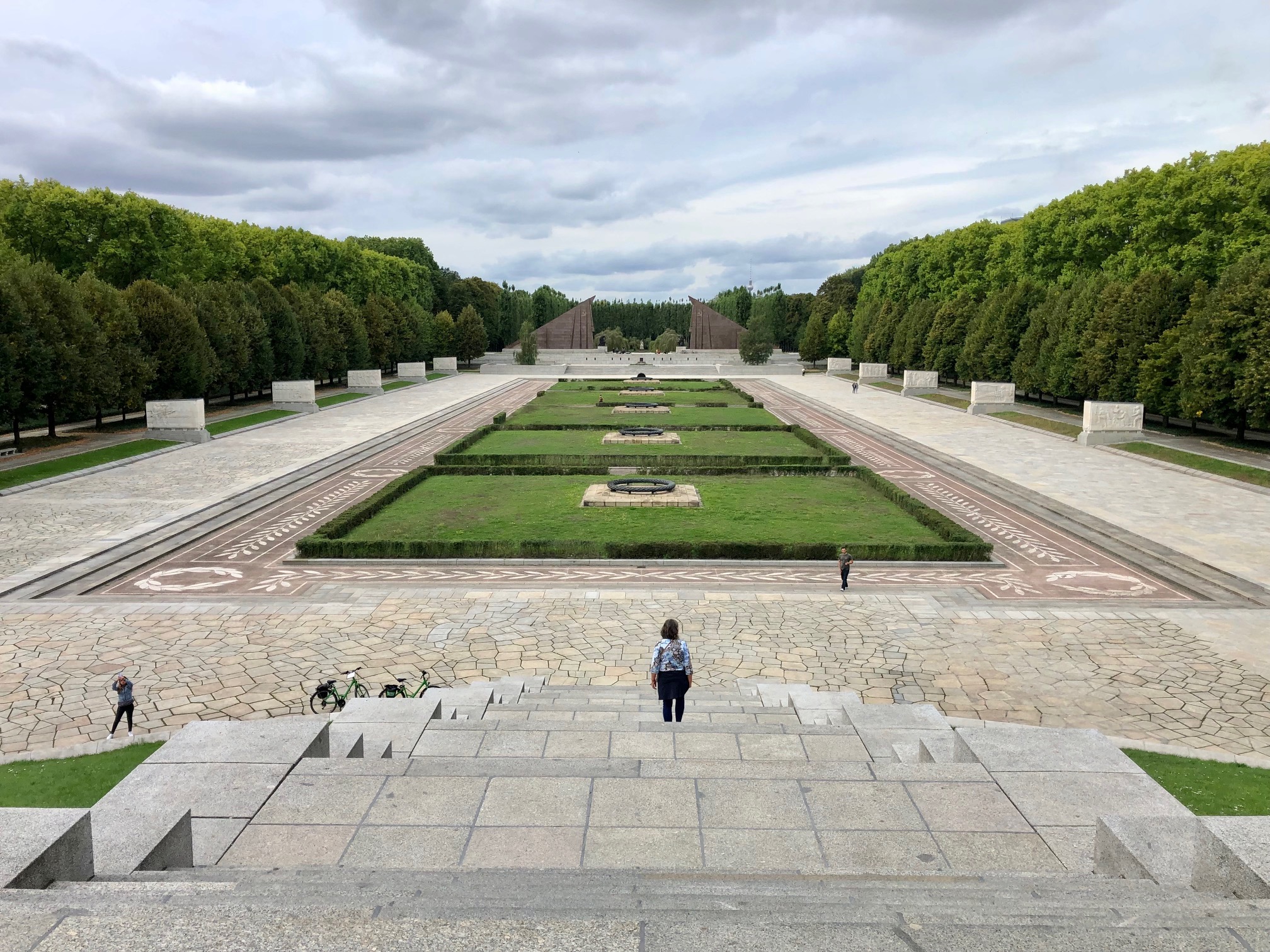
From there a promenade lined with weeping birches – incredibly moving witnessing trees seemingly crumpled in grief – you arrive at two sphynx-like kneeling soldiers that act as guardians to the cemetery section below.
Looking back to the avenue of weeping birches
Looking ahead to the cemetery
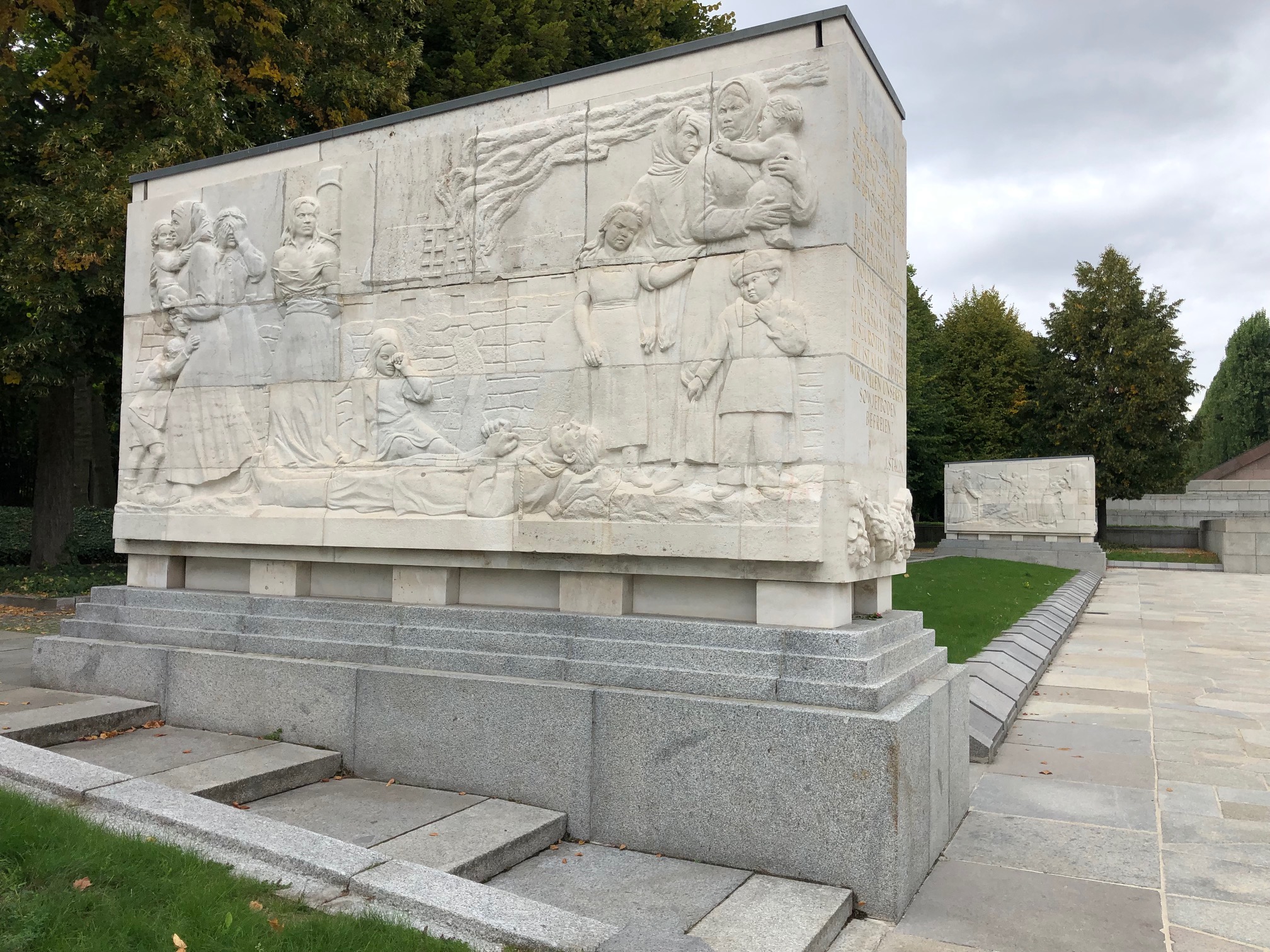
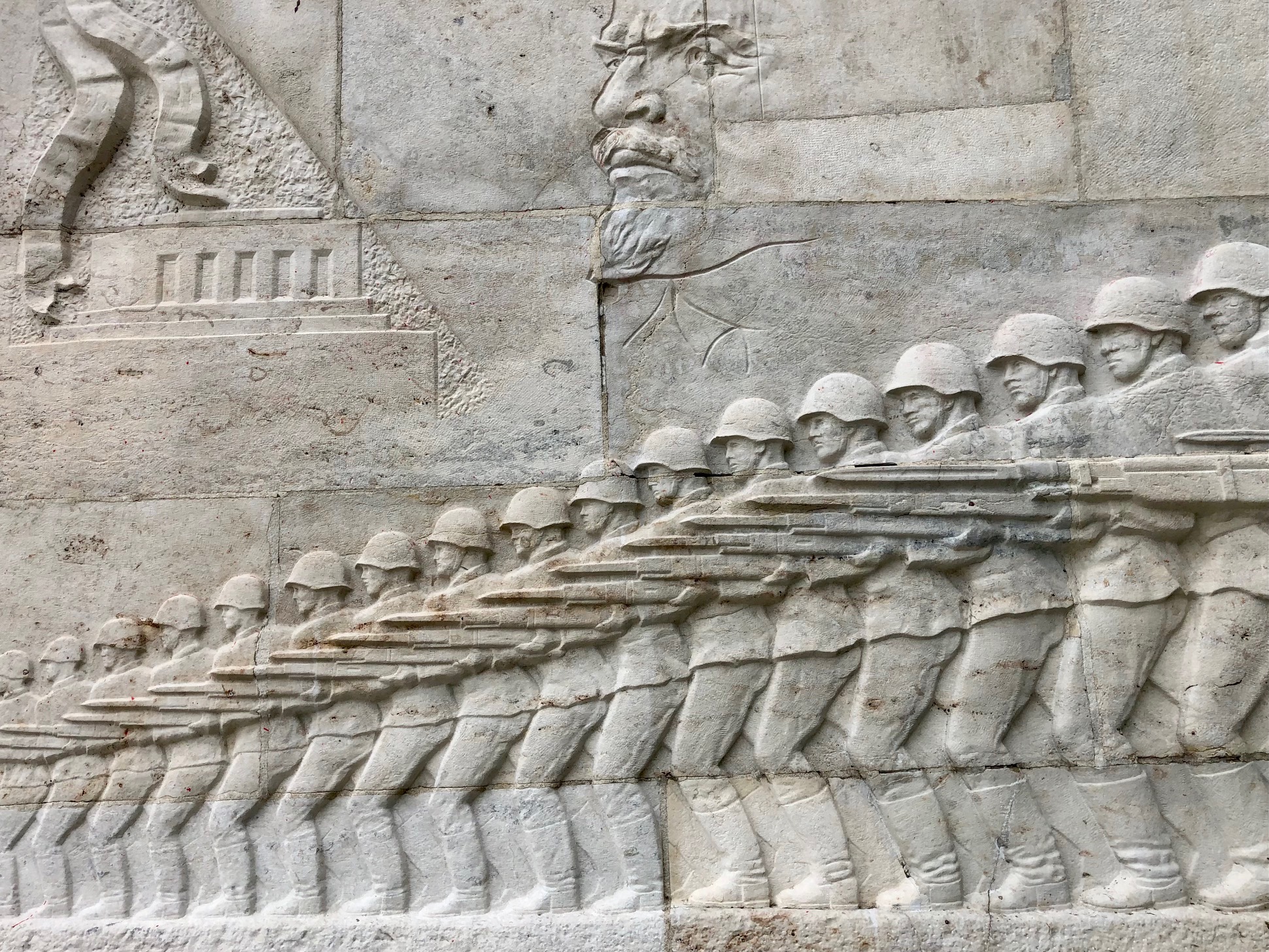
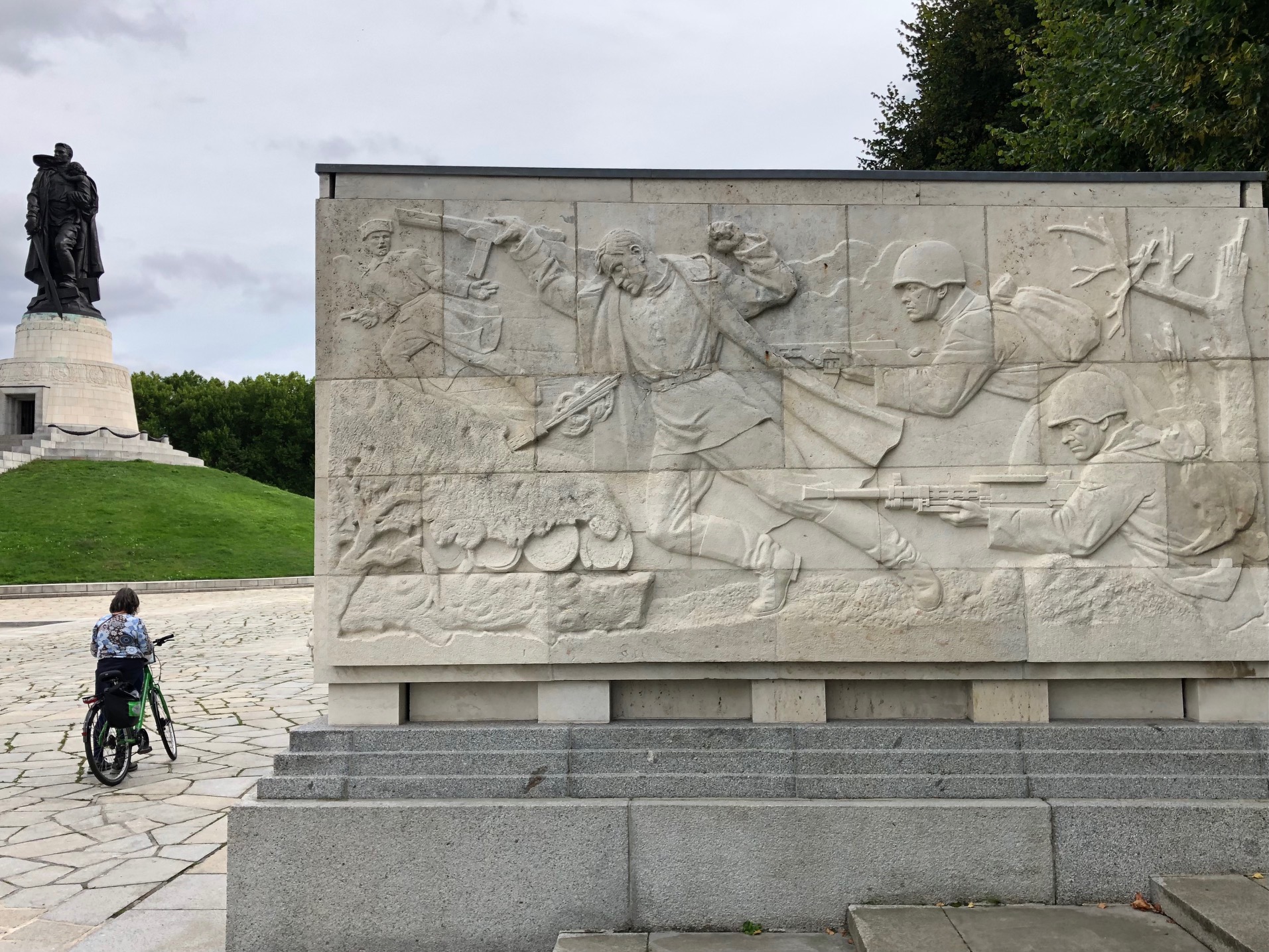
Beautifully executed stone reliefs illustrating scenes from the ‘Great Patriotic War’ decorate the sixteen marble sarcophagi flanking the graves, while gold-lettered quotes by J. Stalin, the commander in chief of the Soviet armed forces, underscore the importance of the Communist Party and the Red Army under his leadership. Though clearly outdated, these quotes survived Khrushchev’s denouncement of Stalinist rule in 1956 with the subsequent cull of Stalin-statues and effective banning of any mention of his name in public.
The sarcophagi tell the story of the Second World War in Russia…
…through extraordinary imagery and craftsmanship.
Dedicated to the ‘heroic dying’ of the Russian people
At the very far end, you climb a stepped hill to a mausoleum supporting the aforementioned bronze statue of a Soviet soldier holding a small German girl.
Turning around to descend, you get an overview of the whole dramatic panorama that reflects the historical narratives and artistic concepts dominant in the Soviet Union under Stalin and to a degree still exist today: monumentality, hero worship, a personality cult, and a claim to exclusivity.
Treptower Park has been and continues to be a frequent venue for commemorative events. Since 1990, with the signing of the German-Soviet treaty on neighbourly relations and the German-Russian agreement on the upkeep of war graves in 1992, the Federal Republic of Germany committed itself to the care, renovation and maintenance of all Soviet military graves and war memorials in Germany.
The evident meticulousness with which the whole site continues to be maintained (and patrolled by German police) is another of Germany’s visible expressions of understanding and reconciliation that have been extended to the Russian Federation and other countries brutally destroyed in the Third Reich’s expansionist and ideological wake. Does this reaching out in friendship make it easier to understand Angela Merkel’s unpopular (certainly in retrospect) policy relating to the Nord Stream pipeline? And the apparent weakness of Olaf Scholz’s initial reluctance to break Germany’s practice and permit the transfer of lethal weapons to areas of conflict… in this case, to Ukraine?
If the premise of my book is true and unresolved traumas of one generation can impact the lives and behaviour of subsequent generations, then the extreme collective traumas experienced by the Russian people over the past century are part of what we are seeing playing out in the attitudes, politics and actions of Russia today. Trauma responses such as emotional numbness, low self-esteem, acceptance of poverty might go some way to explain the apparent passivity and gullibility of large swathes of the population. Likewise, trauma responses such as shame might be producing the violence, megalomania and greed of those in power. Is this then, by extension of the idea, the natural destiny of all traumatised nations? After all we can see similar dysfunction and violence in Africa, South America and plenty of other nations once brutally colonised.
‘Psychohistory‘ – a new but exciting term to me that I appear to have already been practicing – seems to offer a way forward in thinking about these things. It combines history with psychology/psychoanalysis and social sciences/humanities to understand the emotional origin of the behavior of individuals, groups and nations, past and present. In other words, the ‘why’ of history.
I don’t have any answers, nor even the right questions yet, just an ever-growing sense of discomfort in simple, black and white narratives of good and bad, right and wrong. And an increasing belief that we are still very far from seeing, let alone comprehending the fuller picture. But we need to become more trauma-informed in all areas of life. For to neglect trauma is to leave people in a state of emotional numbness. And when you don’t feel, you become capable of overriding humanity and care for fellow living beings and life itself.
Further Reading / Viewing:
These questions are explored more deeply in my book: In My Grandfather’s Shadow. Published by Penguin Transworld and Bantam Press in July 2022 and available in most bookshops and the usual online outlets
The brilliant BBC documentary ‘Russia 1985-1999: Traumazone’ by Adam Curtis is made up of multiple film snippets taken in those years. As a fly on the wall experience and from the comfort of an armchair, it doesn’t get much ‘better’ in terms of an experience of Russia. To have lived through those years of extreme deprivation, corruption and hunger must have been little short of appalling.
In the faultless pageantry of Queen Elizabeth’s recent funeral, we witnessed one of the things that Britain does really well. Whether you are pro- or anti-monarchy, it was a spectacular display of planning, coordination, ritual, symbolism and attention to detail, as well as a gratitude- and love-filled farewell to the only ‘Her Majesty’ we have known. Impossible though it might sound, I missed most of it!
I was in Berlin experiencing what Germany does really well: remembrance and commemoration of a difficult and painful history. It was, however, not Germany’s intensive and on-going process of coming to terms with its Nazi past that I was focused on. This time, I was with my two siblings cycling the Berlin Wall Way, a continuous bicycle path that follows the former footprint of the 100-mile long Berlin Wall as closely as possible. Taking five days to complete, with added time to explore some of the many poignant locations in the centre, it was a total eye-opener, not least to the very concept of a divided city and country.
Map of West Berlin with the 160km Wall marked in red
The first initially confusing fact to digest is that, contrary to the widely held idea that the Berlin Wall was a north-to-south boundary separating West and East Berlin, in reality the wall went all the way round West Berlin thereby creating a democratic West German island within socialist East Germany. Even with a map, we found ourselves frequently asking: So, are we in the West or the East? the answer to which, I assure you, is rarely as straightforward or obvious as it sounds.
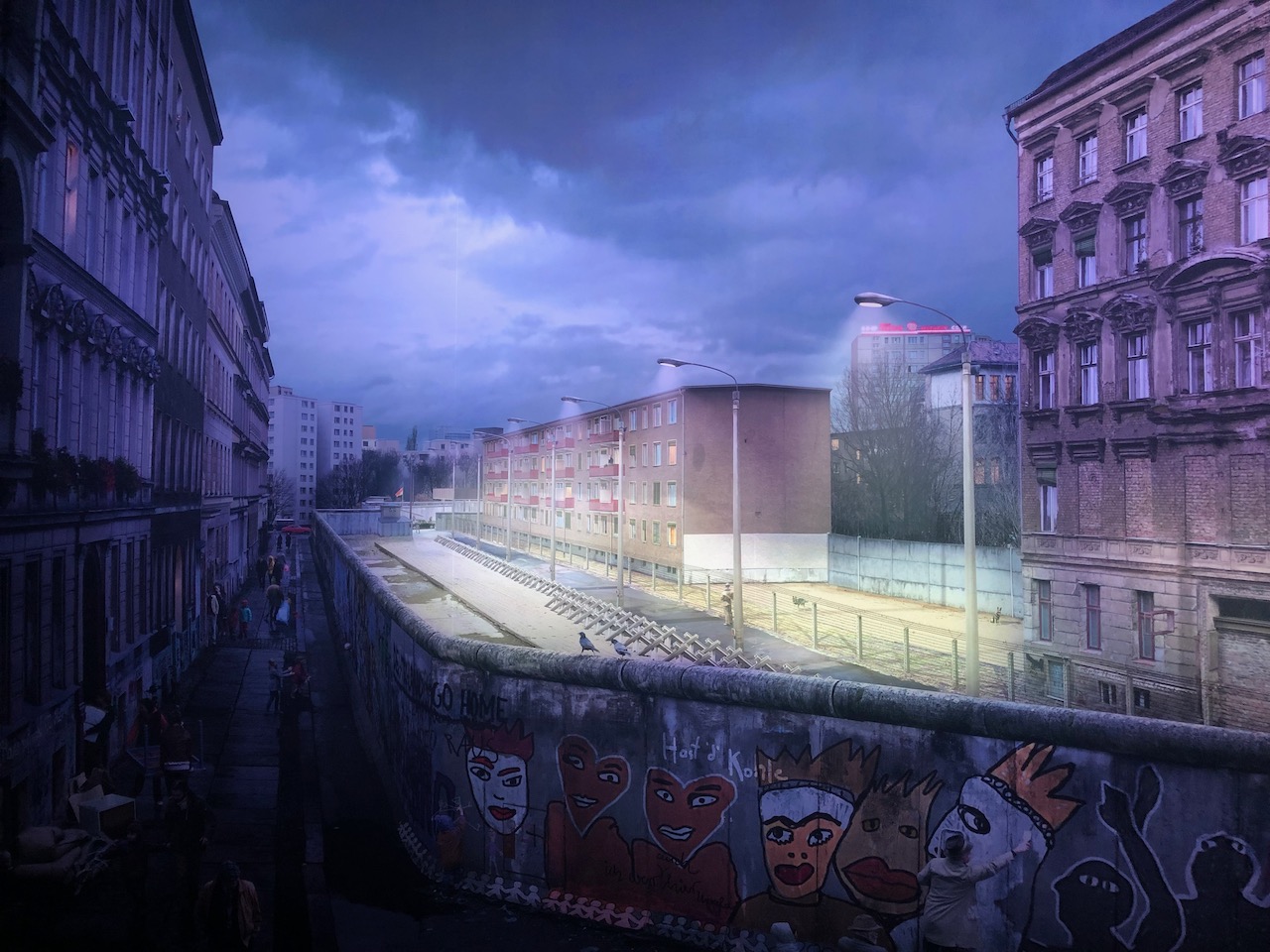
The second tangible shock felt while snaking along its course, was the utter illogic and arbitrariness of this ideological divide – through streets, houses, communities, lakes and woodlands. This randomness would have started as a line drawn on a map by the leaders of the victorious nations – USA’s President Harry S. Truman, Josef Stalin of the USSR, Britain’s prime ministers Winston Churchill and then Clement Attlee as well as other leading members of the three delegations present. That’s probably how most of the other contested border lines around the world have originated. To engage with the whole concept of division, not to mention the impact it had on families and friends separated for nearly three decades, is almost impossible. An enormous 360˚panorama entitled THE WALL by artist Jadegar Asisi gave us arguably our most immediate and visceral sense of being in West Berlin looking at and over the wall into the deadly world behind.
From the360˚ panorama THE WALL by Jadegar Asisi
The third challenge was understanding the complex evolution and structure of the wall that was built in three phases, starting overnight on 13th August 1961 as Berliners slept. What began as a barbed wire barrier and the closure of all but 13 of the 81 established crossing points between the Western and Soviet sectors, eventually developed into not one but two concrete walls separated by a corridor of no man’s land known as the ‘death strip’ with mines, raked sand to detect footprints, trip wire machine guns and armed East German guards in watch towers or patrolling on foot with dogs. By 1989, the Wall was lined with 302 watchtowers and more than 136 people had died trying to cross it.
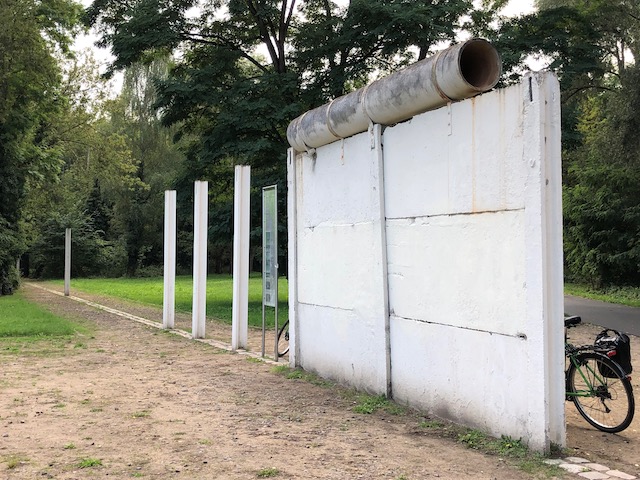
An example of a section of the wall. What we call the Berlin Wall is on the left
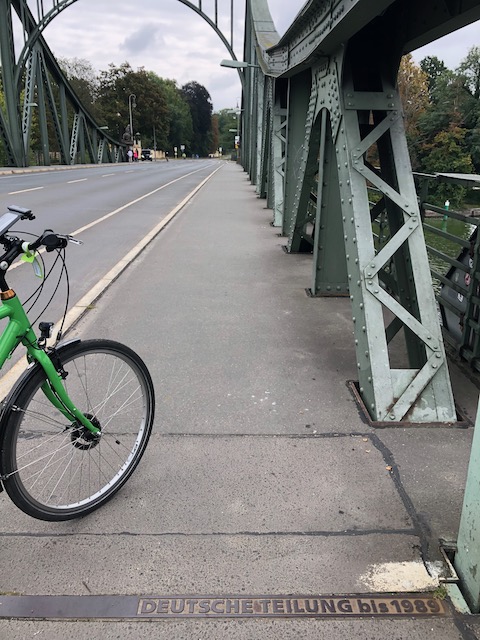
Our little trio started our circumnavigation of West Berlin on the famous Glienicker Bridge in Potsdam in the middle of which spies were on a number of occasions exchanged in the dead of night.
Glienicker Bridge
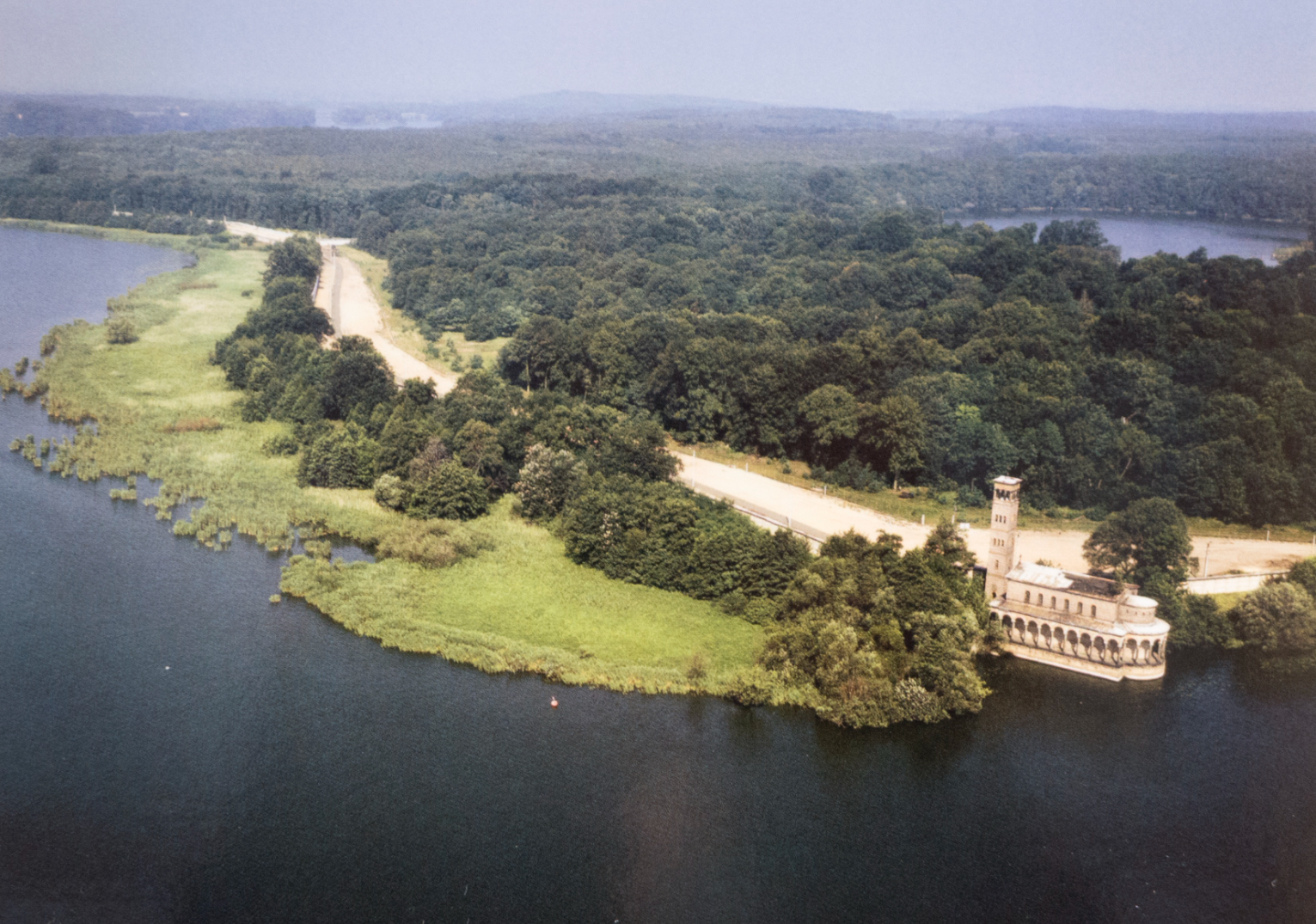
Following a reassuringly well-marked ‘Mauerweg’ route, we soon passed Schloss Cecilienhof, host to the 1945 Potsdam Conference where the division of Berlin and Germany into occupied zones was decided. From there we hugged the shoreline of beautiful lakes, passing the Sacrower Heilandskirche, the church stranded in the controlled border strip and cut off from its congregation.
Heilandskirche, Sacrow, 1961
Heading north, we reached Alexander House, whose history became the subject of the acclaimed book by Thomas Harding, The House by the Lake, and is now a place of education and reconciliation.
Alexander House: The House by the Lake
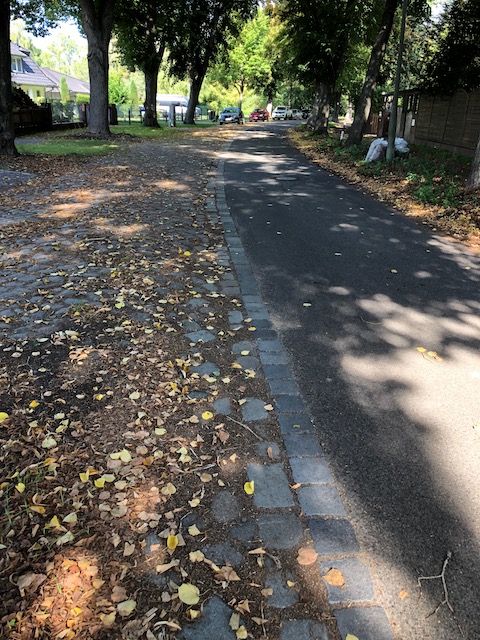
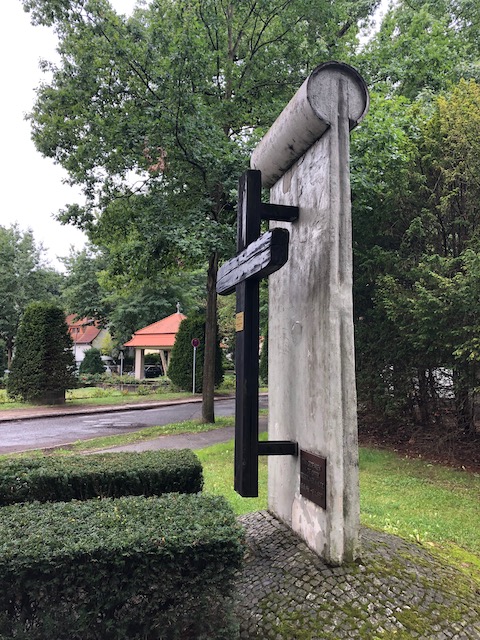
Staying in different hotels en route at intervals of roughly 30 miles enabled us to gain a sense of the scale of the wall and the extraordinary episode in history that only ended a little over 30 years ago. Sections of the concrete boundary, a double cobbled stripe embedded into the pavement or road surface, information boards with photographs and explanations all punctuated our journey.
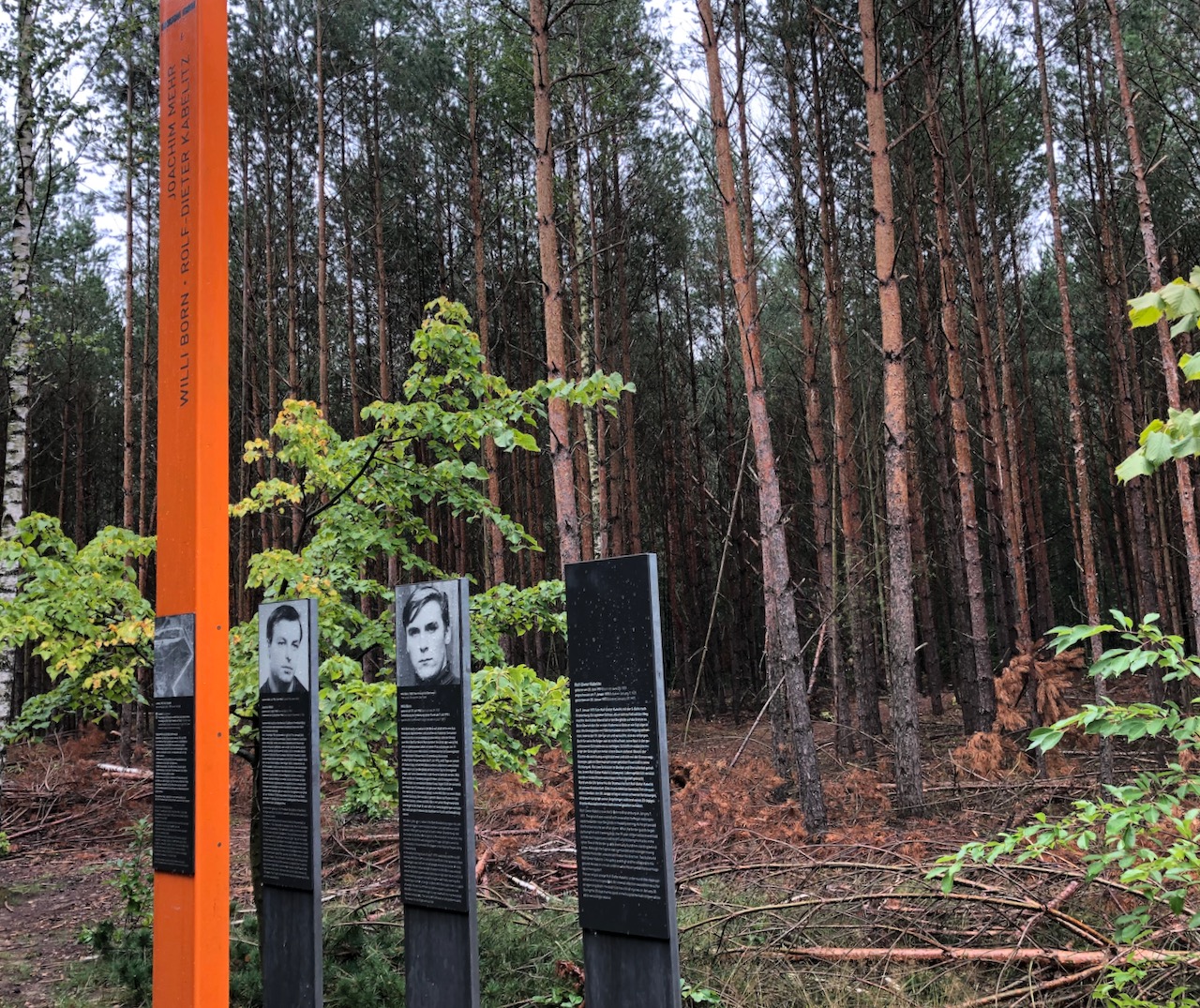
Most moving were the memorials telling heartbreaking stories of failed escapes, largely by young twenty-something-year-old men. With the same unflinching honesty for which all German WW2 or Holocaust-related museums and memorials have come to be known, these allowed us to feel the individual human cost of an ideology based on fear and a necessity to keep people in rather than keeping undesirables out, as the East’s ‘Anti-Fascist Wall’ name misleadingly proclaimed.
Continuing along canals and suburbs, we crossed the ‘Bösebrücke,’ the ‘Bad Bridge’ or Bornholm Bridge that made history on the evening of 9th November 1989 through the jubilant scenes of East Germans flooding across to be greeted by their Western “brothers and sisters” with sparkling wine, cheers and hugs while bemused Eastern border guards watched on helplessly. Unlike my former visits to Berlin while researching for my book, it was this joyous energy of liberation that primarily accompanied me on this trip and allowed me to experience the incredible resilience of Berlin’s inhabitants, past and present, and the revival of its worldwide status as a brilliantly creative, thriving city.
The Bornholm Bridge today and 1989 (pictured)
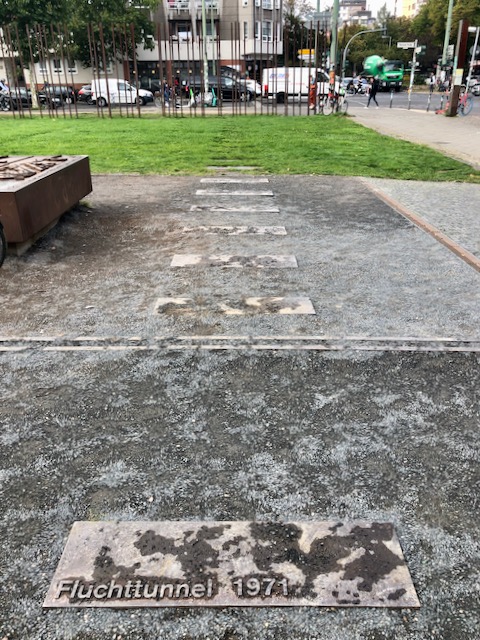
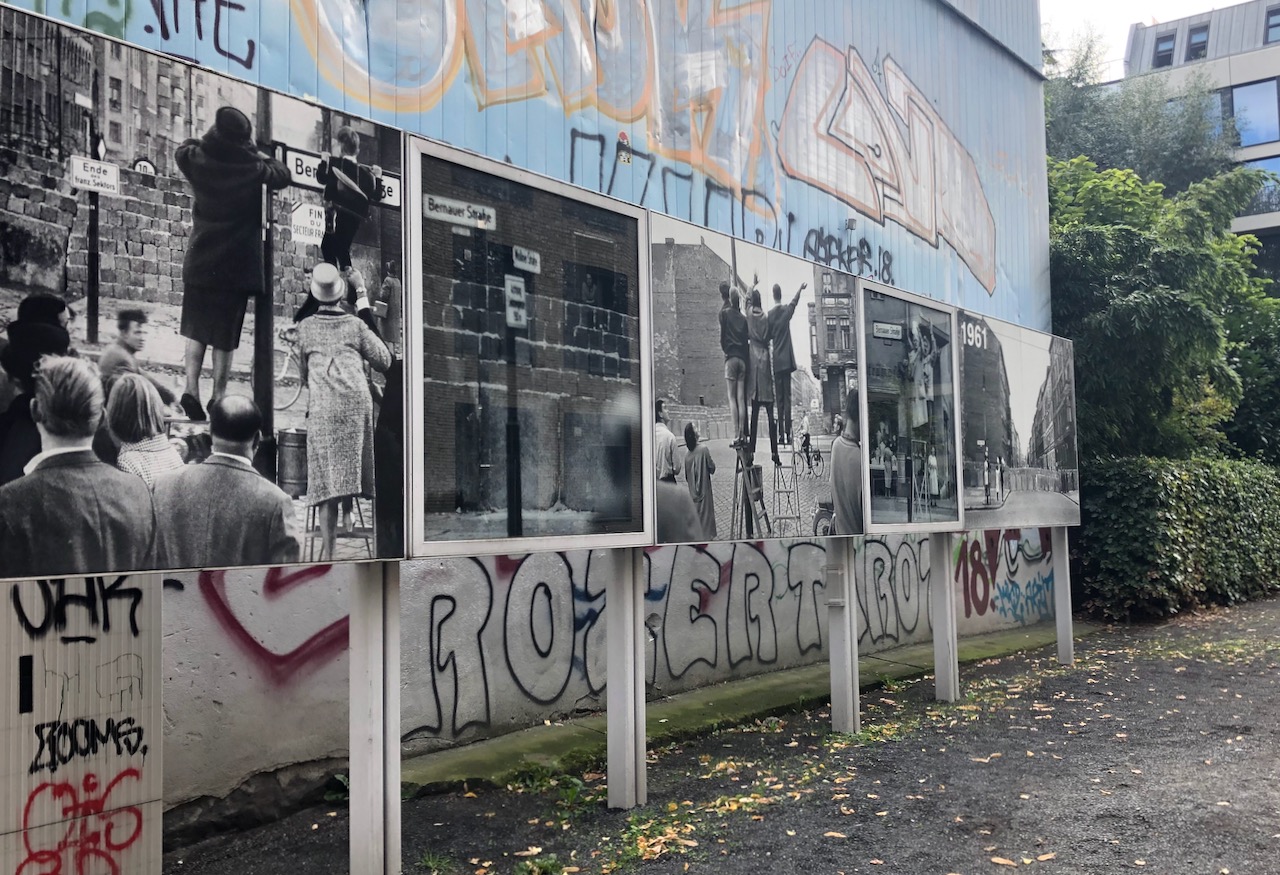
On we cycled, heading south through the beautifully curated but frequently harrowing Mauerpark (Wall Park) that leads into the Bernauer Strasse from which many of the well-known pictures of people jumping out of house windows into tautly held blankets in the West were taken. It was also the street under which various escape tunnels were dug similar to that shown in the 1962 documentary, The Tunnel and including the ‘Tunnel 29’ of the brilliant podcast and book with the same name.
Bernauer Strasse: a 1971 ‘Flight tunnel'(L) and photographs from the Western side of the wall 1961 (R)
An extended section of the wall and border strip have been preserved as a chilling testimony to its once terrifying presence.
Bernauer Strasse
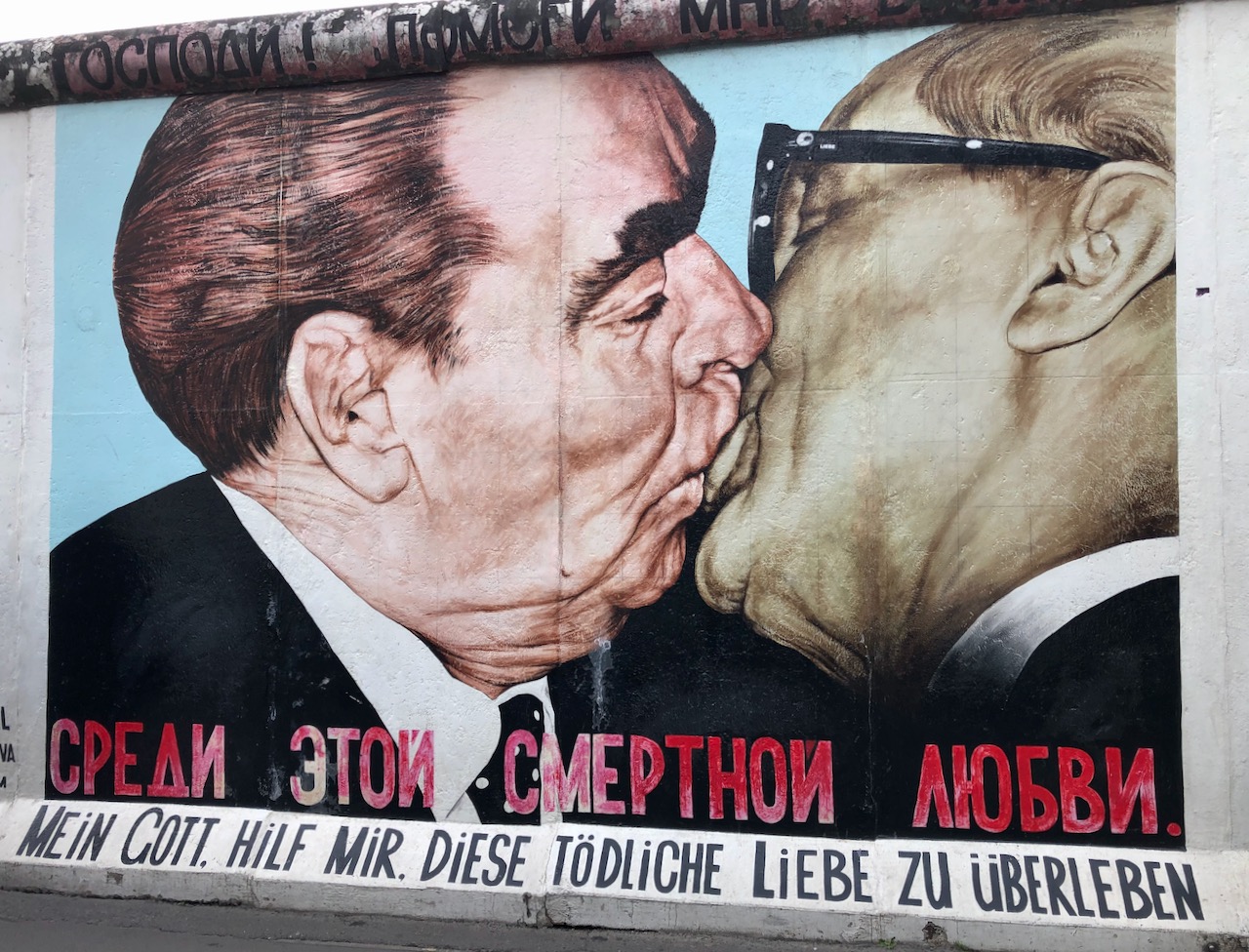
The Wall then continues through Berlin Mitte past some of Berlin’s most famous landmarks: the Reichstag, the Brandenberg Gates, Under den Linden and the Tiergarten, past Potsdamer Platz and Check Point Charlie and along the boundary of what is now one of Berlin’s most chilling museums – the Topography of Terror – but what once was the location of many of the most sinister ministries of the Nazi regime. Then through graffiti-covered Kreuzberg, over the River Spree and to the longest surviving stretch of the inner wall painted in 1991 by painters from all over the world to form the colourful East Side Gallery.
Eastside Gallery: ‘My God. Help me to survive this deadly love.” From a press photograph of Leonid Brezhnev and Erich Honecker painted by by Dmitri Vrubel.
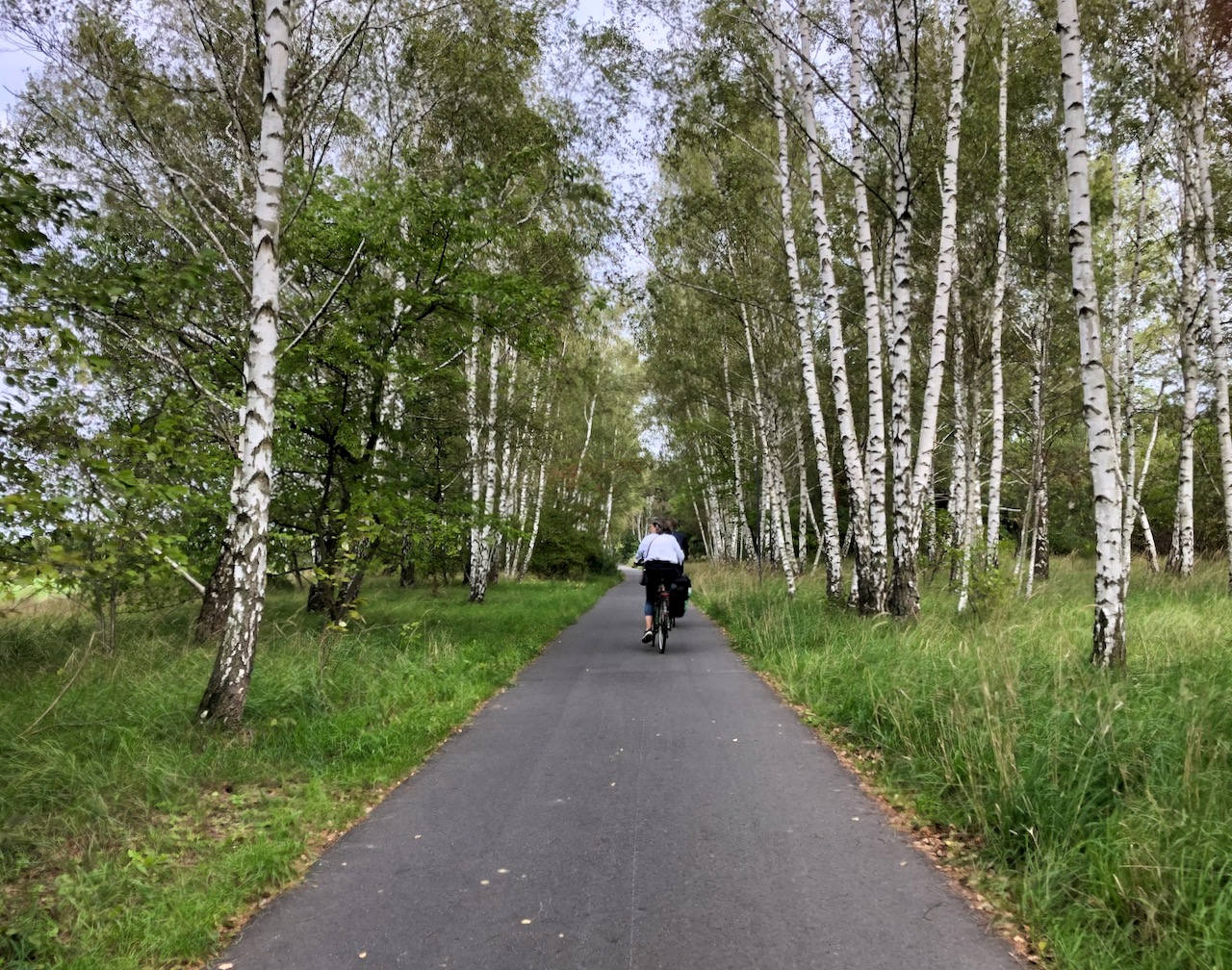
The final 40 miles or so along the southern strip of the wall’s course back to Potsdam was largely rural. A sense of peace replaces the former horror of all that the border came to represent. Long stretches of open fields, avenues of birch trees and an alley of 800 ornamental cherry trees donated by Japanese citizens and a TV station in 1995 “out of joy over the reunification of Germany.”
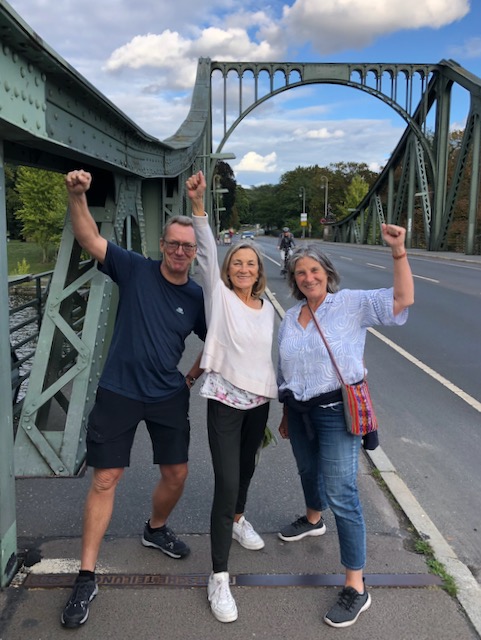
Finally, the three of us arrived back on the Glienicker Bridge from which we had begun our trip, each a little changed, each with a greater knowledge and understanding of German history and our German roots. Each with different emotional responses but a shared sense of the ultimate triumph of humanity and freedom over inhumane systems of repression.
Back on Glienicker Bridge
Upcoming Events relating to my book – In My Grandfather’s Shadow:
Friday 7th October, 7pm. Ebeneza Presents, Somerset: In My Grandfather’s Shadow. More information and tickets here
Sunday 9th October, 4pm. Cuckfield Book Festival: I will be in conversation with Julia Boyd, the best-selling author of Travellers in the Third Reich and A Village in the Third Reich. More information and tickets here.
Wednesday 12th October, 4pm. Mere Literary Festival: In Conversation with Jo Hall. More information and tickets here
Sunday 3rd November, 8.30pm. Stroud Book Festival: In Conversation with Alice Jolly, novelist, playwright and memoirist. More information and tickets here
For many a year, as regular readers of my blog can attest to, I have acknowledged and written about Armistice Day, Remembrance Sunday and the need to remember. But this year, 11.11. passed me by unnoticed. I was definitely silent at 11am, but not because I was remembering. I was in the depths of Cornwall deeply immersed in the increasingly final (final final x 10) Final Edits of my book.
I feel bad for forgetting, because I do think it’s important that we remember and commemorate. Just listen to the repeat of Radio 4’s 2014 programme Commemoration to hear some of the main reasons we do. But I also find it curious that I did forget. For this dance between remembering and forgetting is a healthy one. I should know. I have been dancing it a long time.
On Thursday 11th November, the only glimpse I caught of a world beyond the war narratives constantly unfolding in words on my laptop screen, was the sound of the shaky-voice of South Africa’s last white president, FW de Klerk. He had died in Cape Town aged 85, and his office had issued a prerecorded posthumous video apology for the pain caused by his country’s discriminatory system of white rule. On reflection, this collision in time between his apology and our Armistice Day, revealed what, to me, might actually be the essence of why we still need to remember.
“I, without qualification,” said the man who, together with Nelson Mandela, had overseen the end of apartheid, “apologise for the pain and hurt and the indignity and the damage that apartheid has done to black, brown and Indians in SA.”
I cannot comment on his speech or his former role in the painful history of his country – you can read a bit about them on some of the links below. But, whatever sceptics and critics say about his motives or timing or whether what he said went far enough, I did feel the power of apology in his words. Genuine apology is that all too often underrated act that can set into motion so much of what we try to achieve through remembrance: restitution, forgiveness, reconciliation and healing. For many victims of wrongdoing or harm, such acknowledgement of their pain and a heartfelt apology for it is all they really want.
Of course, on Remembrance Sunday of all days, we first and foremost want to honour and show gratitude to the fallen and to hold their loved ones in our thoughts and hearts. But, if you don’t know any soldiers who have fought, let alone died in contemporary wars, or if you have never met a veteran of the World Wars, as is increasingly the case, it is hard to actually ‘remember’ in more than a slightly abstract way. For many school children, the Second World War exists in a last century time warp, as I found out at one of my recent talks when one of them asked me whose side I had been on! (Really? Have you not listened to a word I have just said? Or do I just look like I am 95-years-old?)
That is why I am wondering if Remembrance could shift some its emphasis on the past, to include more about the present and the future. The act of apology innately requires an understanding of the lessons history can teach us. Embedded within an apology is more than just a hope for ‘Never Again’. A genuine apology is ‘Never Again’ in action. So today, Britain’s Remembrance Sunday, I am not only going to remember the sacrifices and losses of war. I am going to imagine a time when the hands of heartfelt apology are extended between nations both in acknowledgement of past mistakes and in renewed agreement to act in ways that assure such mistakes never happen again.
When it comes to Remembrance, I cannot think of a more important day to take time to reflect than today – Holocaust Memorial Day, the anniversary of the liberation of Auschwitz by the Soviet army in 1945. Eighty or so years lie between us and the horrors that started in Germany and then spread beyond. Most of the survivors of those times are no longer able to bear witness to them. And yet, for many descendents, that past will still be alive shaping their present. It is primarily for them, and all that they carry in their hearts, that I pay such attention to this day.
As readers of my blogs will know, any day of remembrance raises questions in me: what to remember, how to remember it and to what end? I’m always particularly interested in the editing process of our personal, collective and national memories. Which selection of people, events and actions we choose to remember and honour. And which get left out.
Edits of history come about for all sorts of reasons, not least because some memories are too painful… or shameful to re-visit. But what happens to things that happened, but aren’t included in the stories we tell about ourselves? What happens to those awkward truths or people that disrupt more favoured version of events? Obviously politics plays a big role in shaping a country’s historical narrative to support left, right or centre agendas. But I still ask, what happens to the inconvenient truths that get suppressed, denied or banished to the footnotes?
Plans for a Holocaust memorial next to Parliament
I found this recent article by Richard Evans in the New Statesman fascinating: How should we remember the Holocaust? It describes some of the multiple points of view in the on-going debate about the appropriate form, location, size, message and so much more of the proposed Holocaust Memorial and learning centre in the heart of Westminster. It’s complicated. This is exactly the kind of debate Germany has been engaged in almost incessantly since the eighties and that lies behind their extensive culture of ‘counter memorials.’ At one point it was even suggested that perpetual debate on the form of a memorial was possibly the best way to keep the memories alive.
I have many thoughts (obviously!) on what is said in the article, but I will spare you of them here (except one!) in favour of inviting you, on this day, to think about where you stand in relation to Holocaust remembrance. My ‘one’ opinion echoes that of Raphael Wallfisch, a leading international concert cellist whose mother was forced by the SS to play in the infamous women’s orchestra at Auschwitz. He insists that the proposed ‘British Values Learning Centre’ “must reflect clearly and truthfully, the complete and unvarnished truth of Britain’s role before, during and after the Jewish Holocaust…” This request for a fuller picture is echoed by many others in the Jewish community and beyond.
We are witnessing all around the world not only a rise in anti-Semitism, but also eruptions of rage as suppressed, uncomfortable truths surface. Covid-19 is giving us an opportunity to re-think how, what and why we remember. The Britain of today needs to rise to this challenge, now more than ever before. Of course, remembering and hearing the stories of the victims is paramount. But if we primarily focus on what Germany did and how the British triumphed over evil, we are missing a vital lesson. Britain also needs to look at, and learn from, what we as a nation didn’t do… but could have done.
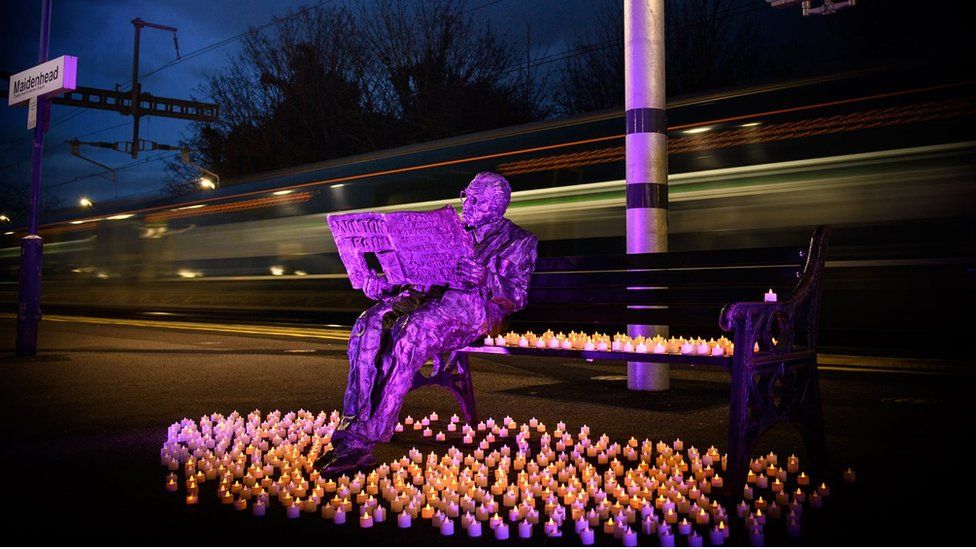
Statue of Sir Nicholas Winton, the “British Schindler” at Maidenhead railway station
This man, Sir Nicholas Winton, could never be accused of not having done enough. Against all odds, he smuggled 669 boys and girls, destined for concentration camps, out of Czechoslovakia in 1939. Celebrating his unbelievable bravery and life-saving initiative with candles feels a truly fitting way to mark this day. We can all join in for households across the country are being invited to light a candle at 8pm this evening, as an encouragement to us all to “be the light in the darkness.”
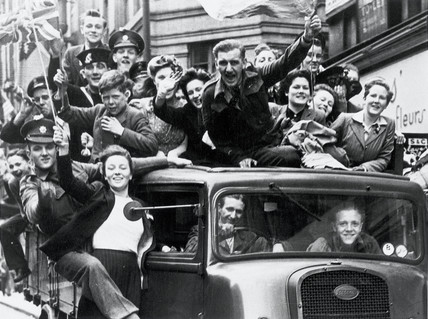
Friday 8thMay 2020 will be the 75thAnniversary of the end of the Second World War in Europe. It was the day when millions of people took to the streets and pubs to celebrate. For those who can remember that time in 1945, the emotions will be particularly poignant. Victory over the German enemy finally brought the promise of peace. That is indeed worthy of celebration. But what should we be doing three quarters of a century on?
VE Day, 1945
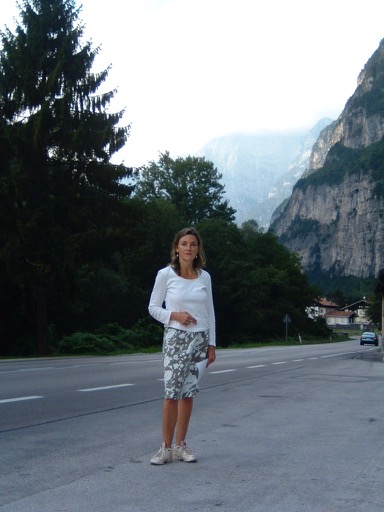
On Saturday 2nd May, I was due to be in Belluno on the edge of the Dolomites standing together with a group of total strangers from America and Italy. We had connected on Facebook and had hatched a plan to meet in the area where seventy-five years previously our fathers’, or grandfathers’, paths had crossed, first in war and then in peace. My sister, mother and my two octogenarian German aunts were coming too.
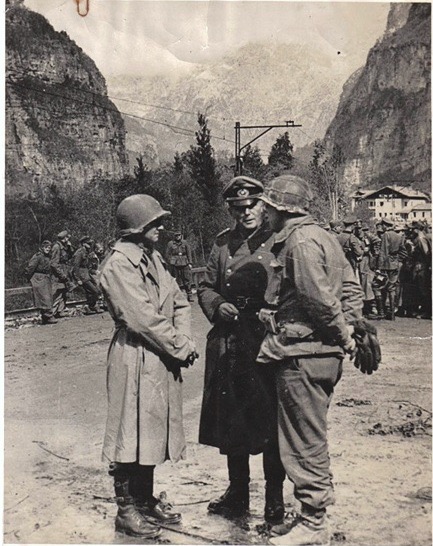
For me, it had all started fifteen years ago with the discovery of a photograph. I had googled my German grandfather’s name for the first time and the small black and white image that appeared on the screen instantly commanded my full attention. Until then, I had only known my grandfather as a framed photo on my mother’s writing desk. Just a face slightly obscured by the peak of a General’s hat with an iron cross hanging like a choker from a collared neck. He hadn’t moved in forty years. Now he was suddenly standing in front of me, wrapped in a belted, three-quarter length coat trimmed with a double row of perfectly aligned shiny buttons.
His face is instantly recognisable, his eyes still partially hidden as he talks to two men in baggier uniforms. He looks relaxed, upright. There’s even an air of authority in the way one of the seventy-a-day cigarettes I had often heard about rests between the fingers of his right hand. Reading the caption below the photo, I learn that it is 2nd May, 1945. The soldier on the left is an American Colonel, CO of the 337thInfantry, the other a translator. They are negotiating the handover of German troops and armaments. This is the day of Germany’s unconditional capitulation to the Allies. The moment my grandfather’s war ended and his time as a prisoner began. His experiences in the years that followed as a POW to the British would shape his family’s inner, and outer, worlds.
2nd May, 1945
After years spent disentangling the family roots from the blood-soaked mud of conflict and Germany’s post-war silence, my relatives and I would be travelling to meet the sons of the American 337th Division and the granddaughter of the Colonel in the photograph. They had warmly welcomed me into their group. This 75thanniversary, supported by the Councillor of Culture in Belluno, had little to do with victory or defeat, winners or losers, goodies or baddies. It was about reconciliation. About growing friendships and understanding in the soil of broken grief and lingering pride or devastation. It promised to be a very special occasion… we will try again next year.
Visiting the location in 2007
I can feel I am slightly bracing myself for what will happen on 8thMay. How will Britain mark this historic occasion? Energetic flag-waving aside, will it be much the same as our annual Remembrance Days in November and D-Days in June? Tony Hall, Director General of the BBC says their coverage “will bring households together to remember the past, pay tribute to the Second World War generation, and honour the heroes both then and now.” So yes, judging by that and the day’s schedule, it probably will.
Starting with a two-minute silence at 11am, a series of sing-alongs, prayers and encounters with veterans will follow, all interwoven with the familiar black and white footage. Then comes an evening of singers and actors performing well-loved songs, poetry and stories until 9pm when the Queen’s pre-recorded message will be broadcasted to close the day. Those who have got this far will probably feel slightly mushy (and possibly quite drunk). Filled with genuine gratitude to those who served, they will feel proud to be British, to be on the side of the victors and the heroic defenders of our freedoms… And that is all fine. Of course it is. But it’s not enough anymore.
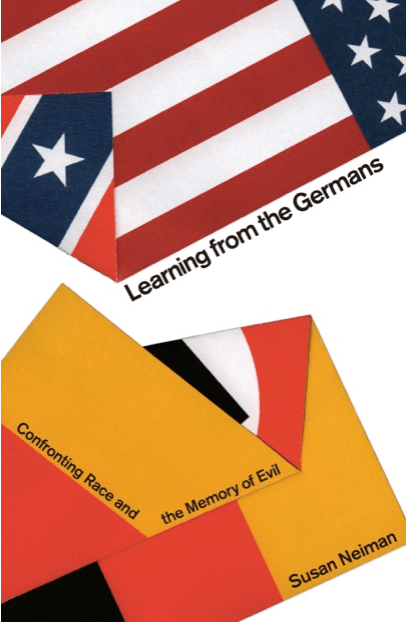
History used to be a matter of consolation or pride, now it is more a matter of warning and learning. As it shifts over time, black and white narratives of good and bad, victory and defeat, perpetrators, victims and heroes no longer hold. The story becomes more nuanced, the divisions more blurred, the lessons more universal. Simply remembering has become empty. Yet as Susan Neiman explains in her excellent book, Learning from the Germans, “We are not hardwired for nuance. Learning to live with ambivalence and to recognise nuance may be the hardest part of growing up.” No country can fully celebrate the triumphs of its history while ignoring the darker moments. So we cannot, nor should we be allowed to rest in our national self-image as the incontestable good guys. Seventy-five years ago, yes, but not today.
Neil Macgregor, former director of the British Museum and now of the Humboldt Forum in Berlin notes: “What is very remarkable about German history as a whole is that the Germans use their history to think about the future, where the British tend to use their history to comfort themselves.”
Maybe 75 years on is the right time for us to stop merely re-playing the gore, glory and gratitude of the Second World War and to start reaching beyond our own borders to include the histories and destinies of foreign populations, such as Russia, Poland, China – even Germany, who lost infinitely more and triumphed daily in tinier, but no less important ways. With a general consensus among historians about what happened and why, we can then shift our emphasis onto becoming fully aware that no country is immune from falling into the same abyss as Germany. Its descent happened gradually in full view. Like a frog being slowly brought to boil in a saucepan, most people didn’t notice.
Covid-19 has ushered in a rash of startlingly rapid changes to our laws and freedoms. We are forcibly and necessarily being shaken out of complacency and into the realisation that civilisation as we know it is both fragile and reversible. So more urgently than ever, our World War anniversaries need to be reminders of this and opportunities for learning and growth to inspire collective vigilance against darker forces and a genuine sense of unity across borders.
Let’s see what happens on Friday. If I wave anything, it won’t be a flag for Victory but a white flower for on-going Peace.





















 angela findlay blog