THE WILL TO CHANGE IS THERE… BUT HOW DO WE BUILD ON IT?

As I write this blog, I am holding in my thoughts and heart all who are suffering, grieving, lonely, lost, anxious, frightened, helping, serving, or dying and all the infinite shades of individual human experience that fall between.

Like for some, but unlike for so many more, my rural little Covid world of the past 5 weeks has been a haven of sun-filled peace. Such is the stillness that you can almost hear buds bursting into bouquets of blooms as Spring rustles through the land like a breeze. Woods carpeted in white and blue have become cathedrals for choirs of birds filling the daily Sunday silence with song. Time is no longer measured by clock hands and calendars, but by the gradual emptying of a fridge shelf or the clapping hands on the pavements that announce another week has passed.Ā 

As if from another world, packages of numbers wrapped in the language of war drip-drip-drip-feed death, tragedy, fear and devastation into our days rippling the peace like a faulty tap. Are we at war with Covid-19? Is our sole purpose in the face of a cruel enemy that is attacking all we have come to know and value as ā€œnormal,ā€ to defeat it? War requires strategies to target and vanquish an adversary through killing. But, as Angela Merkel said in her address to the nation on 18thMarch, the Covid-19 pandemic is a war without a human enemy.

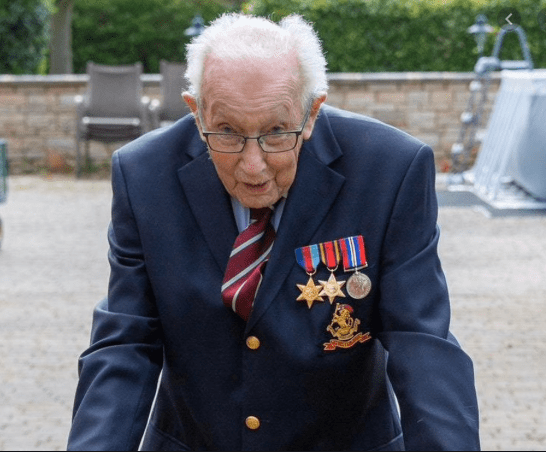
I find it interesting and heart-warming that 99-year old Captain Tom Moore, an army veteran who fought in the world’s largest war, has become Britain’s inspiration and symbol for how to face the Coronavirus. In total contrast, both to armed conflict situations of war and the language used by several governments, he is not fighting toĀ killĀ off something. By completing lengths of his back garden, he is walking to help our dedicated servicesĀ save lives.Ā 

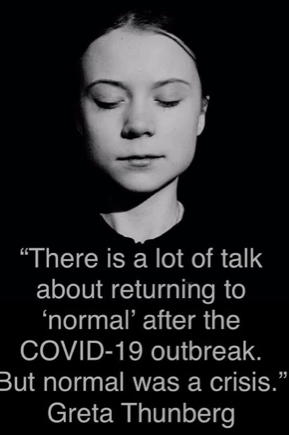
I have to confess that there are moments when I almost dread the day Covid-19 is ā€œsent packing,ā€ as Boris Johnson blustered before the virus robbed him of his usual air, and things return to ‘normal’. Of course I want a rapid end to the huge and relentless suffering of so many. But I don’t want us to go ā€œback to normal.ā€ I don’t want the war metaphors to continue but now with triumphant declarations of victory. For Covid-19 has not just been a vile enemy and bringer of death and misery. It has also been a huge teacher, a creator of peace, a unifier of communities, a friend to nature, a highlighter of the fissures in our society and a persistent pointer to the most vulnerable, the most needed and the most brave. Covid-19 is a killer, yes, but as anyone who has been close to the death of a loved one will attest to, it is also guiding us to our hearts.Ā 

Many people have said it much better than I can, either in this or my last blog. In my opinion, one of the most insightful and erudite writings on the subject isĀ the essay The Coronation by Charles Eisenstein. In it he says:Ā Covid-19 is showing us that when humanity is united in common cause, phenomenally rapid change is possible. None of the world’s problems are technically difficult to solve; they originate in human disagreement. In coherency, humanity’s creative powers are boundless… Covid demonstrates the power of our collective will when we agree on what is important.

I feel deeply and passionately that there is a much bigger picture to the close-up snapshots we are getting from around the world. We are standing before a phenomenal chance for change. A unique opportunity to not go back to the ā€œnormal,ā€ which was neither just, nor sustainable, nor even working for the majority of the global population. As Charles Eisenstein asks: For years normality has been stretched nearly to its breaking point, a rope pulled tighter and tighter… Now that the rope has snapped, do we tie its ends back together, or shall we undo its dangling braids still further, to see what we might weave from them?

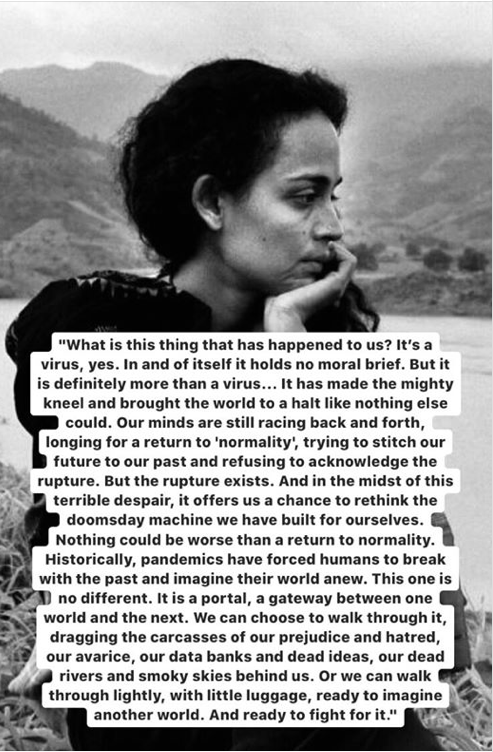
The Indian author, Arundhati Roy, says much the same inĀ THE WAY AHEAD:

Arundhati Roy

The writing has been on the wall for a long time. I sincerely hope Covid-19 will make it impossible for these ways of thinking to be brushed aside and ignored as the domain of dippy-hippies, whacko scientists, alternative dropouts, idealists, artists or activists. I pray that during this prolonged pause enough of us can shift our values and priorities fully into the camp of those we are currently embracing, not just as individuals but also as a nation. As I have frustratingly learned from decades of campaigning for prison reform, the political impetus to change will only come from widespread public insistence and/or inspired and wise leadership. I don’t yet know what exactly I, what we as individuals, can do and I welcome all suggestions. But maybe a good starting point is to follow New Zealand’s Prime Minister, Jacinda Ardern’s encouragement to ā€œBe strong, be kind.ā€
Some further opinions:

Penguin is publishing essays about Covid-19 by their leading authors every Monday, likeĀ It’s all got to change by Philp Pullman and A New Normal by Malorie Blackman

The pandemic is a portal by Arundhati Roy

Covid-19 and the language of war by ADRIAN W J KUAH AND BERNARD F W LOO
Coronavirus and the language of war New Statesman

Coronavirus: How New Zealand relied on science and empathy BBC News

The Coronation by Charles Eisenstein as a podcast and as a PDF file

George Monbiot talks about Coronavirus

The Covid-19 pandemic – what else? But this time seen through an artist’s eyes

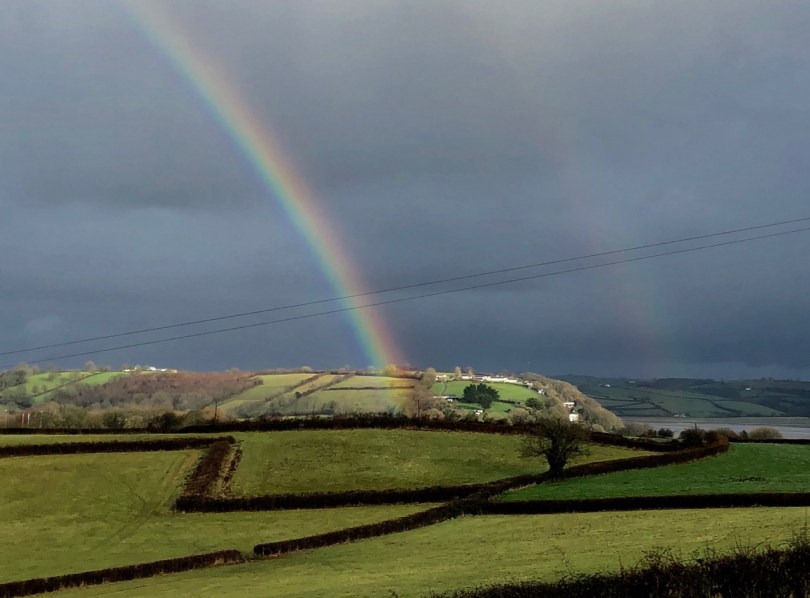
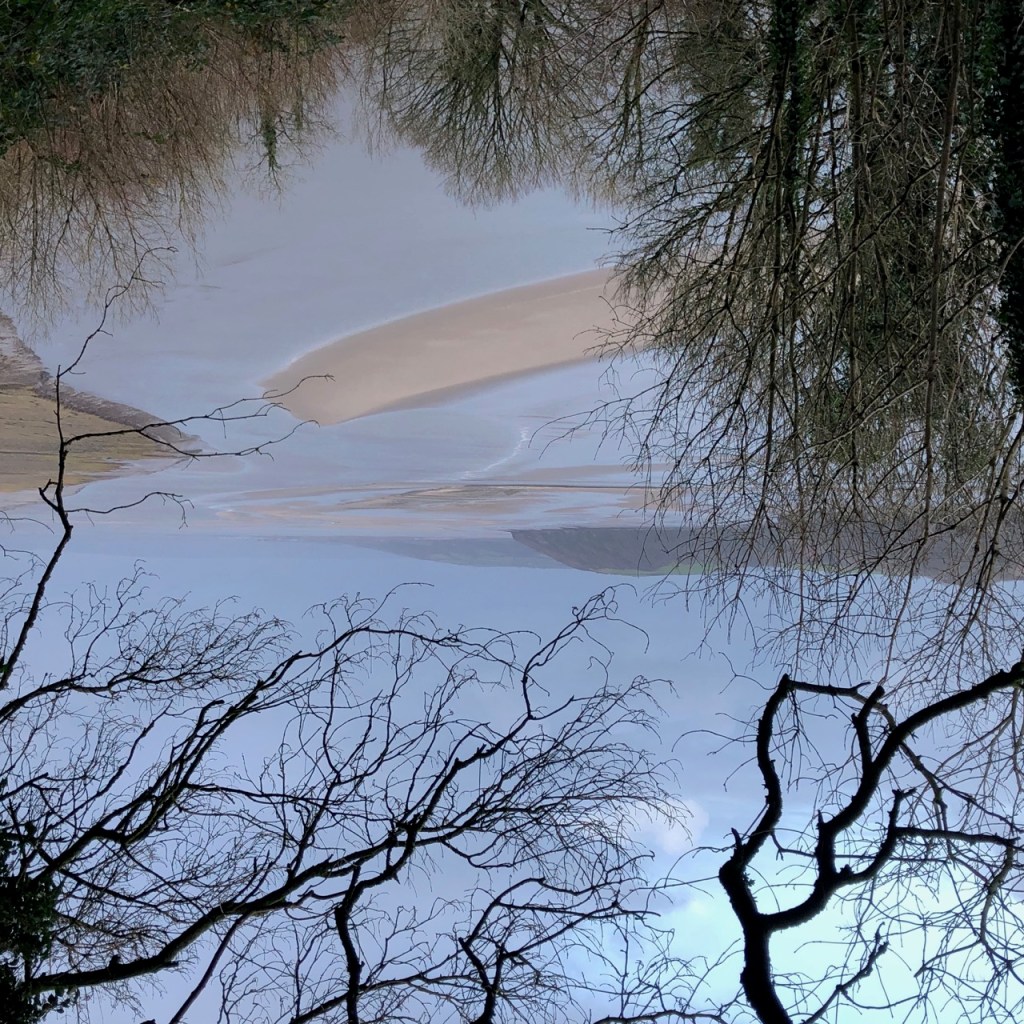
Covid-19’s march across the world and into our daily lives scares, astonishes and negatively impacts me like everyone. I can’t comment on the daily shape-shiftings of scientific, economic and political strategies, for I know nothing about any of them. But as a visual artist largely working from the right side of my brain, I am used to stepping back to see the bigger picture and my eyes are trained to blur out details and see things in terms of shapes, colours and gestures. A quick way to experience this shift away from the logical thought of our left brain is to squint your eyes and look through your eyelashes. Or take a painting or photo and turn it upside down. Both methods filter out what we ā€˜know’ enabling us to see familiar things differently. Objects of importance might fade. A shadow, a colour, a form might stand out.

When I look in this way at what is happening around us, I of course see the total upheaval and devastation for so many. But I can also see something that gives me glimmers of hope where before I had none. For within the language of tragedy and loss – of lives, jobs, holidays and everything we consider ā€˜normal’ – are calls to pay attention to areas of society we normally neglect. Maybe you too can see that there is a bigger, more subtle picture as well as a huge opportunity behind the obvious reasons we are universally being told to ā€˜stop’?

Not all the symbols I see fit of course, and some people will dismiss them as coincidental. But what if this pandemic is actually a natural and inevitable effect of what decades of human behaviour have caused? Covid-19 primarily attacks the lungs and airways, leaving people starved of oxygen. If trees are the lungs of our planet producing the vital oxygen we need to live, haven’t decades of excessive, shortsighted, polluting and disposable lifestyles had the same impact on the world as that of heavy smoking on a person? 

As in cases of disease in the microcosm of any individual’s life, a massive pause button has been pressed grinding the cogs of contemporary life to a halt and forcing us to rest, reflect on and reconsider our lifestyle choices. In the constant pursuit of economic ā€˜growth’, we have been travelling at high speed down a cul-de-sac. What we are experiencing now is the slamming on of brakes and screeching to a halt before we hit the wall. We knew it was there but we did not listen or act. We now have to do both.   

Suddenly priorities have shifted into reverse and our full attention is turned to the protection of the elderly, the vulnerable, those on zero-hour contracts, single-parent families, nurses and medical staff. Suddenly the ā€˜invisible’ refuse collectors, hospital cleaners, shelf stackers and ambulance drivers become the vital heroes that will keep the last cogs of a groaning infrastructure moving. Suddenly the idea of locking people into tiny cells for up to 23 hours appears unacceptably inhumane and reducing the overcrowding of prisons becomes an obvious first step. 

Forced self-isolation will give many people a taste of the extreme solitude many people face each day, from those bereaved, unemployed or sick to artists and writers. It highlights the danger of ā€˜home’ for children of violent parents or domestically abused women. And as food shelves are stripped by panicked stock-piling, one has to think of those who can only afford to live from one day to the next and will be faced with empty shelves. 

While the language of the media is understandably dramatic and war references temptingly apposite, they are not necessarily helpful. We are not at war with anyone. Like war, this situation will probably bring out the best and worst ends of the spectrum of human nature. Unlike war, and yet like nothing we have faced previously, we are all in this together. All united in our shared desire to continue being able to breathe. 

Seeing the world’s beautiful cities and bays emptied of tourists, traffic and cruise ships, the skies emptied of planes is eerie (and economically catastrophic for many), but all this could inspire us to change our habits from endless consumption and movement to a greater appreciation of stillness, each other and simply being alive. So, while we are being collectively advised and forced to change our habits and embrace new priorities, why don’t we collectively work on changing them for good… in both senses of the word?

Keep well and safe, everybody. Spring is coming regardless.

Oh yes, and some really good news, which was going to be the theme of this month’s blog… I have signed a contract with Penguin Transworld to publish my book! I have a considerable amount of work still to do on it but will keep you posted.

How worried should we be about the rise of the far right?

I raise this question specifically in the wake of last week’s 75th anniversary of the Dresden bombing raid by the Allies, an occasion of remembrance that is known for bringing far-right protestors out in droves. Each year, in what they call their ā€˜Trauermarsch’ (funeral march), several hundred neo-Nazis, xenophobic Pegida and anti-immigrant Alternative for Germany (AfD) protestors set off from the city’s central station to commemorate the dead. The blatantly neo-Nazi flags, tattoos and slogans, however, betray their true agenda. 

While part of me is swift to unreservedly dismiss all forms of far-right nationalism and extremism, another part is keen to understand: What are their grievances? What are their goals? And how should we, as individuals, meet this growing trend around the world? 

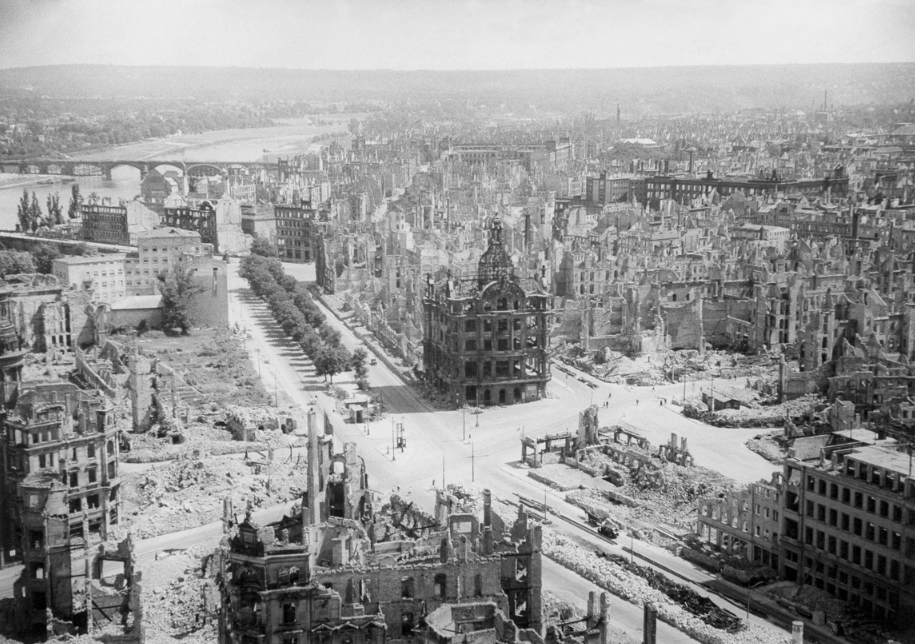
I am at the very beginning of my research into these questions, but in relation to the Dresden bombings of 13th and 14th February 1945, it seems that the far-right scene have several axes to grind. For them, Dresden has become a symbol of how the Allies rewrote the history of the Second World War. Drawing on the language and inflated figures first propagated by Goebbels and the Nazi propaganda ministry, Dresden was a ā€œterror attack,ā€ an indisputable war crime in which up to 300,000 people – primarily women, children and refugees fleeing from the east – were horrendously murdered over three nights. (This claim is in spite of the 2010 historical investigation commissioned by the city and largely accepted by historians that conclude figures would be closer to 25,000.) By shifting the focus onto atrocities committed by the victors, they can call for a stop to Germany’s culture of atonement and guilt.

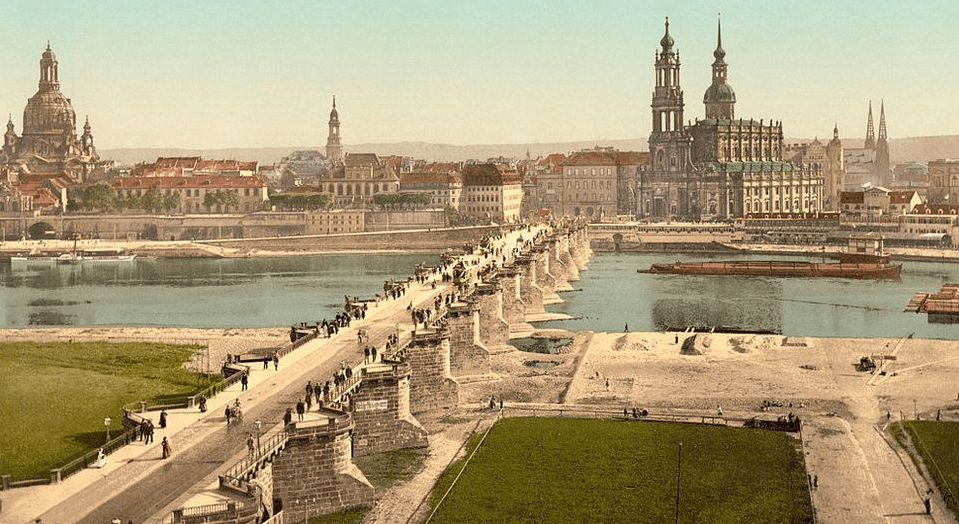
Dresden, the “Florence on the Elbe”
Dresden after the bombing in 1945

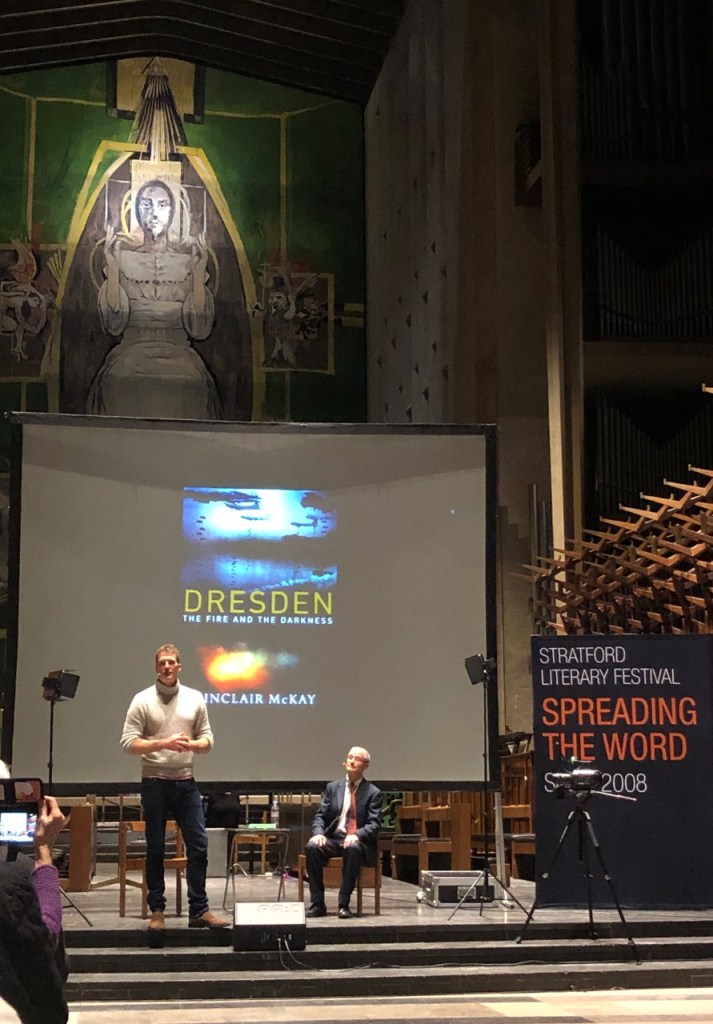
This year, the emphasis of their message was not so much on the numbers as on what they call ā€œthe truthā€ about the bombings. They want to make a stand against the way the bombing of Dresden, once known as the ā€œFlorence on the Elbeā€ for its Baroque beauty, is relativised and compared with what happens in wars all around the world. They want to preserve Dresden’s uniqueness, the myth of martyrdom and its status as a ā€˜city of innocence.’ In some of this they do have a point. The debate about whether Dresden was a war crime or not still divides international historians and the public alike. Just a few weeks ago, I travelled to Coventry Cathedral to hear historian Dan Snow explore the legitimacy of Dresden as a target with Sinclair McKay, whose book Dresden, The Fire and The Darkness has recently been published. 

In the official ceremonies two days before the far right took to the streets, the man who has become a bit of a hero in my eyes, President Frank-Walter Steinmeier, addressed the dangers of this way of thinking. Unlike the 75th anniversary of the Liberation of Auschwitz at which he had spoken a few weeks before (see my January blog), the victimhood of Germans had to be placed centre-stage here. For whether perceived as deserved retribution or a tactical military operation, the bombing raids were calculatedly horrendous creating infernos of such intense heat that people literally melted. It’s an event that does indeed deserve much self-reflection and on-going soul-searching by the Allies as well as a continuation of the already considerable efforts of reconciliation by the British. 

Speaking with his hallmark combination of deep sensitivity and resolute strength, Steinmeier remembered the victims but, even here, he was quick to remind Germans of their role as perpetrators. He warned against the “political forces” that seek to “manipulate history and abuse it like a weapon.” He reached out to all present to “work together for a commemoration that focuses on the suffering of the victims and the bereaved, but also asks about the reasons for this suffering.” And, seemingly referring to the far right directly, he said, ā€œWhoever pits the dead of Dresden against the dead of Auschwitz, whoever seeks to talk down German wrongs, whoever falsifies improved knowledge and historical facts, we as democrats must loudly and clearly contradict them. We must defy them.ā€

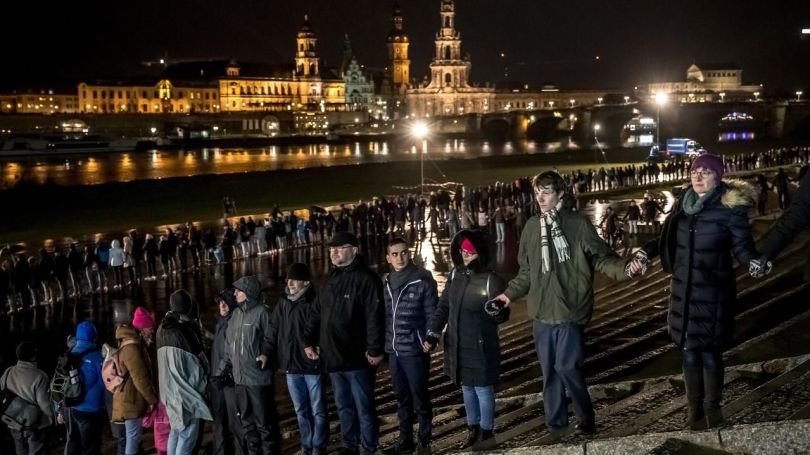
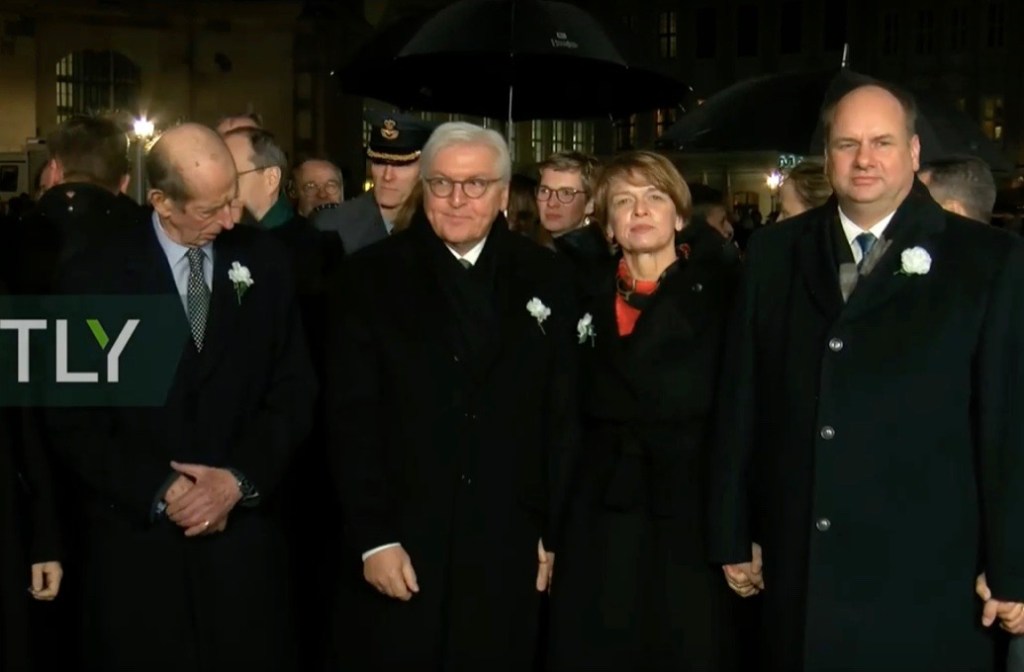
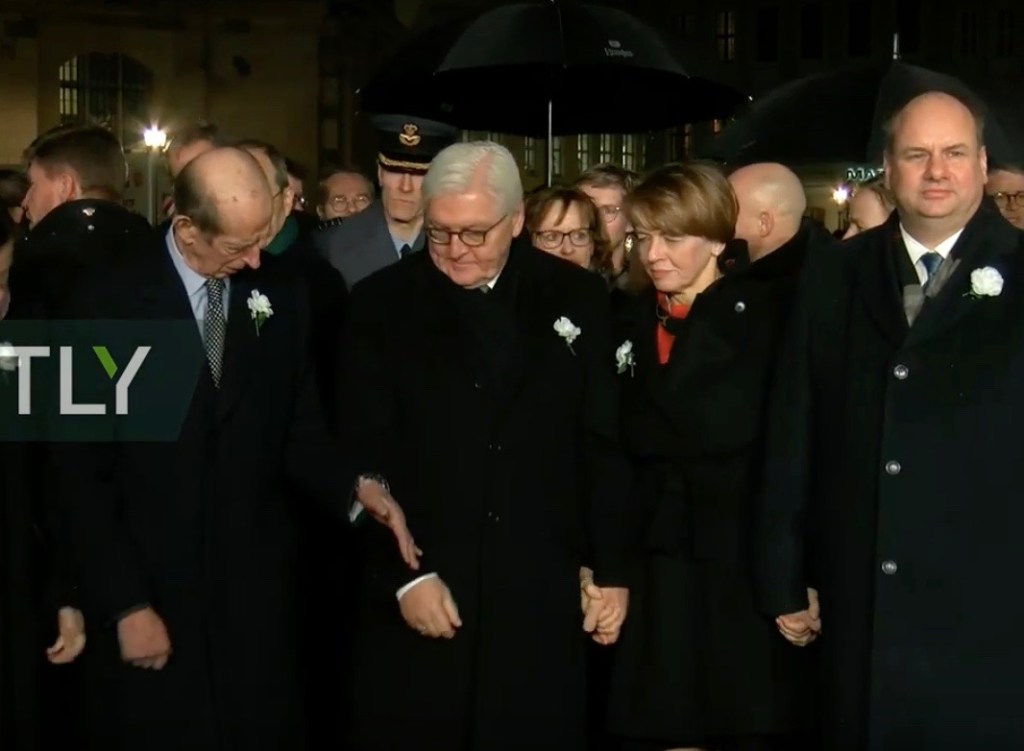
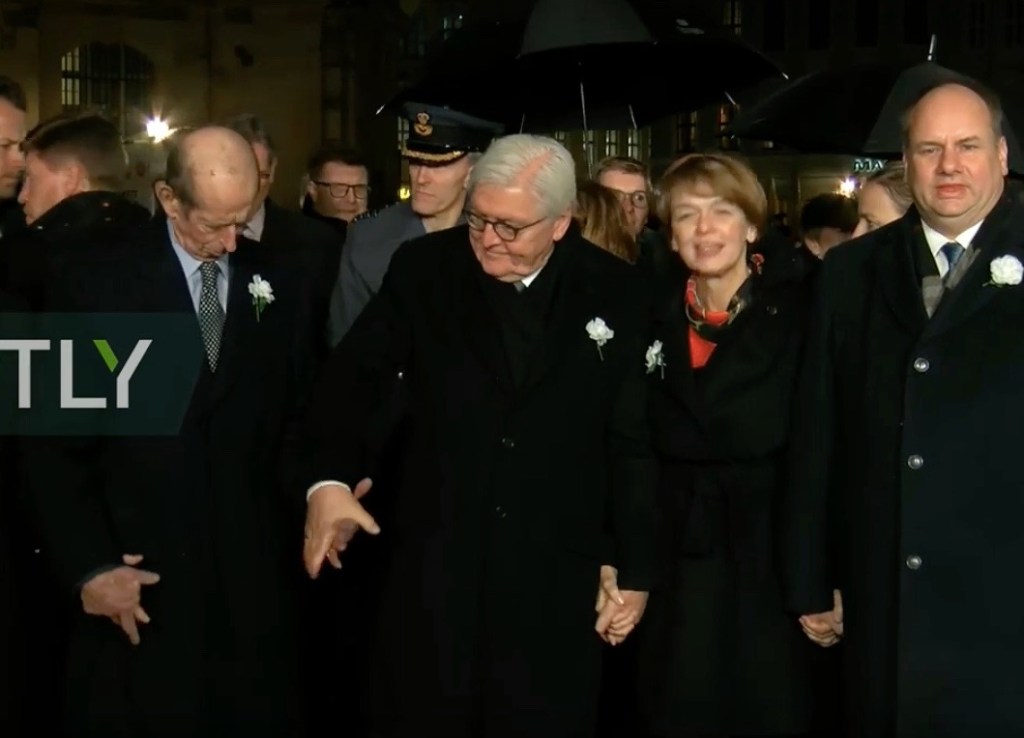
Steinmeier later joined thousands of residents in holding hands to form the annual human chain of “peace and tolerance.” Standing quietly beside him in icy rain and wind was the Duke of Kent, a long-standing contributor to British reconciliation efforts and Patron of The Dresden Trust (of which I am now honoured to be a Trustee). I don’t think Steinmeier dared initiate what happened next, but to his credit, the Duke did. Over a delightful few seconds, the nearly eighty-five-year-old royal looked down and, seeing the empty right hand of the German President, reached out and took it in his. And there they stood for a considerable time, hand in hand bearing witness to their respective nations’ capacities for the wholesale destruction of innocents.

The Duke of Kent (left) holding hands with German President, Frank-Walter Steinmeier

So far, my answer to my own questions is that there are way too many of us prepared to make a stand against the dark desires of the far right for them to gain significant power. In Dresden, two days after Steinmeier’s call to protect democracy, thousands of anti-fascist counter-demonstrators took to the streets forcing the comparatively low numbers of neo-Nazis to change their route. As one said, “On a day like this, you can’t just stand idly by. We are here to say that this is not our Dresden. There is no room for Nazis in this city — not now, not ever.”

Learn more:

Dresden marks WWII bombing in far-right stronghold.

Dresden: The World War Two bombing 75 years on – BBC News

History Extra Podcast: The bombing of Dresden

Actions may speak louder than words, but words can lead to actions…

This first month of 2020 offered a veritable feast of potential inspiration for January’s blog. It was hard to choose. On the theme of prisons, there was BBC Two’s The Choir in which Gareth Malone has just two episodes to get young men in Aylesbury Young Offenders Institute to sing and viewers to cry. I know from experience, the latter was definitely easier. 

In cinemas, Jojo Rabbit, a risky, irreverent, bitter-sweet comedy about Hitler, breaks through taboos and somehow gets you laughing at the Nazis in ways they would have hated. Less amusing is Sam Mendes’s 1917, which, through its close-up filming method, dumps its audiences into the putteed boots and helmeted heads of two young British soldiers and sends them off on an impossible mission through hell. Within minutes one has snagged his hand on rusty barbed wire, a wound that alone would send all of us racing to A&E. But that is a mere scratch compared to what awaits him.

Another extraordinary BBC two-episoder, Lost Home Movies of Nazi Germany, gives deeper and more nuanced insights into both the lives and the beliefs of individuals living through those times. While Channel 4’s moving My grandparents’ War follows Kristen Scott Thomas and three other esteemed British actors as they uncover the brave roles their grandfathers played in the Second World War. 

2020 will be a year of 75th anniversaries relating to WW2 with more such documentaries, films, books (oh I wish mine too) and podcasts covering increasingly personal moments of suffering, bravery and evil. History has definitely shifted. No longer just a narrative of kings, politics and wars, it now hones in on the stories of individuals caught up in or affected by the decisions of their leaders. Our appetite to understand experiences from the two world wars has not abated, for they still touch us personally. But one day there will be no more contemporary witnesses to testify to the horrors, misery, fear and loss. No more survivors of the Shoah to remind us not to forget what can happen; to warn us that we are not immune.

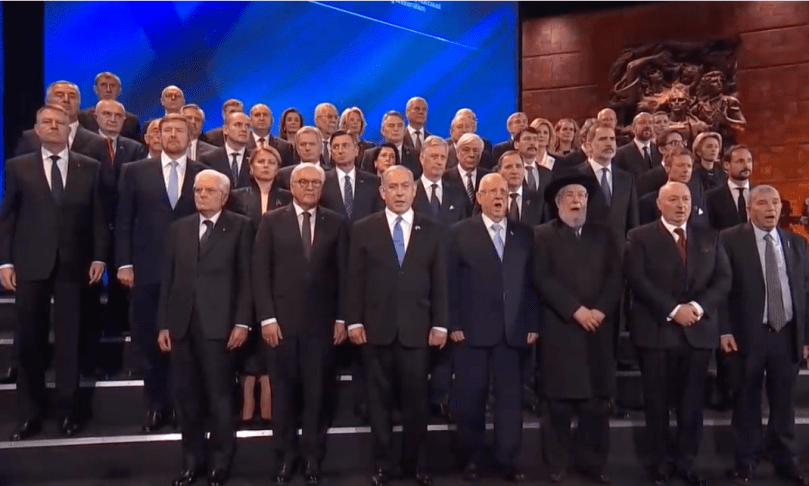
Over the past five years there has been a 320% rise in Far-Right attacks globally. In 2018 alone, there were 387 violent anti-Semitic incidents – 35 in Germany, 68 in the UK… The Holocaust was clearly not enough to snuff out the thinking that leads to such evil. Which is why I have chosen last week’s commemoration of the 75thanniversary of the liberation of Auschwitz and International Holocaust Remembrance Day at Yad Vashem in Jerusalem as my blog’s focus. There the overriding message of world leaders was of the necessity for vigilance to the language of hate, discrimination and prejudice. (The full speeches are on YouTube)

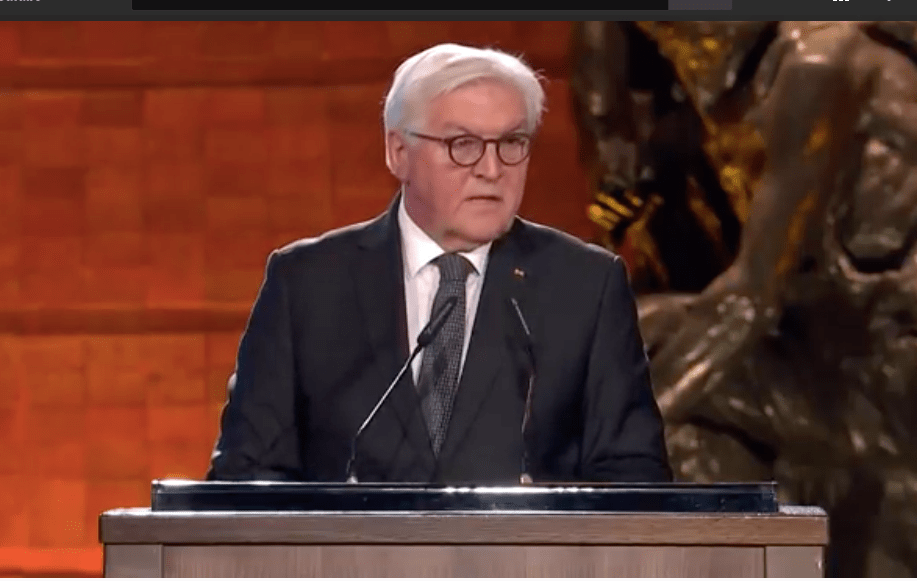
I have no doubt the Jewish speakers’ speeches in Jiddish were profound and extraordinary. And Prince Charles spoke movingly about the risk of the Holocaust being placed under a glass bubble within history and urged us to re-commit ourselves to tolerance and respect. (He speaks at 1:31:30) But it was once again the German president, Frank-Walter Steinmeier, the first ever German president to address guests at Yad Vashem, who, in my view, stole the show with his impossibly difficult and brave speech. I would like to include extracts from it here because, as we approach the thankfully silent bongs of Big Ben on 31st January, I believe his words are relevant to each and every one of us to act upon in our own little ways.

Opening his address (which starts at 1.49.20) with a Jewish blessing in seemingly fluent Hebrew, he continued in English, telling the tragic stories of four individuals murdered in the Holocaust. With the humility and honesty that has become a hallmark of German leaders at such occasions, he unflinchingly took responsibility on behalf of his country:

ā€œGermans deported them. Germans burnt numbers on their forearms. Germans tried to dehumanise them, to reduce them to numbers to erase all memory of them in the extermination camps. They did not succeed…. As human beings, they live on in our memory.ā€

Frank-Walter Steinmeier talking at Yad Vashem in Jerusalem

Referring to the Yad Vashem monument, he continued, ā€œI stand before this monument as a human being and as a German… and I bow in deepest sorrow.ā€

His reference to ‘human beings’ didn’t stop at the victims and those on the side of good: ā€œThe perpetrators were human beings,ā€ he continued, lightly emphasising each of our potential to become perpetrators or victims. ā€œThey were Germans; those who murdered, those who helped in the murdering, and the many who silently towed the line… they were Germans. The industrial mass murder of 6 million Jews, the worst crime in the history of humanity – it was committed by my countrymen. The terrible war, which cost far more than 50 million lives, is originated from my country. Seventy-five years later, after the liberation of Asuchwitz, I stand before you all as President of Germany, and I stand here laden with the historical burden of guilt.ā€

Gulp… I don’t know if it moves you, but I know a little of just how heavy that burden is. But as anybody dealing with criminals and/or victims can attest to, genuine admissions of guilt and acts of apology, forgiveness, restorative justice or therapy offer opportunities for reconciliation, that powerfully healing balm for wounds which threaten to fester forever. Steinmeier knows this:

ā€œAt the same time, my heart is filled with gratitude… gratitude for the hands of the survivors stretched out to us, gratitude for the new trust given to us by people in Israel and across the world, gratitude that Jewish life is flourishing again in Germany. My soul is moved by this spirit of reconciliation… a spirit, which opened up a new and peaceful path for Germany and Israel; for Germany and Europe and the countries of the world.ā€

I love the way Germans can speak of ‘heart’ and ‘soul’ and ‘spirit’ so effortlessly…

“The eternal flame at Yad Vashem does not go out. Germany’s responsibility does not expire. We want to live up to our responsibility. By this, dear friends, you should measure us. I stand before you grateful for this miracle of reconciliation and I wish I could say that our remembrance has made us immune to evil. Yes, we Germans remember, but sometimes it seems as though we understand the past better than the present. The spirits of evil are emerging in a new guise, presenting their anti-Semitic, racist, authoritarian thinking as an answer for the future, a new solution to new problems of our age. And I wish I could say we Germans have learnt from history once and for all. But I cannot say that when hatred is spreading…”

“Of course, our age is a different age, the words are not the same, the perpetrators are not the same, but it is the same evil. And there remains only one answer: Never again. Nie wieder. That is why there cannot be an end to remembranceā€¦ā€

President Steinmeier and Prince Charles
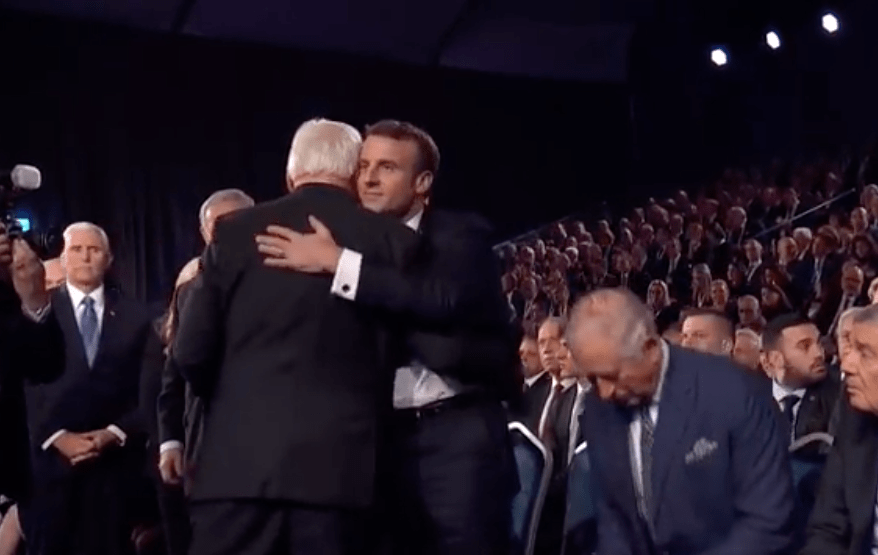
President Steinmeier hugged by President Macron
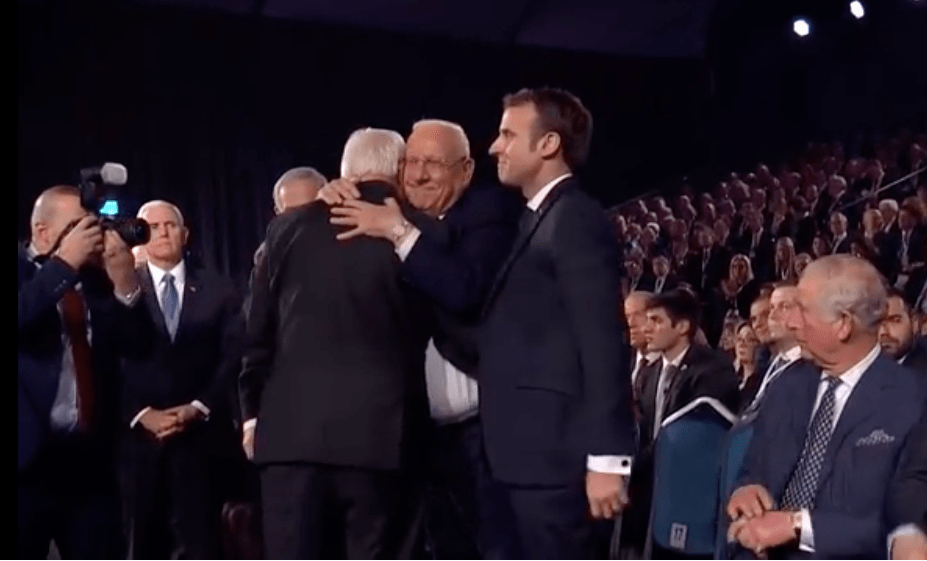
President Steinmeier hugged by Avner Shalev, Chairman of the Yad Vashem Directorate

I am so glad that President Steinmeier was given such heartfelt hugs on returning to his seat. After Prince Charles’s slightly awkward handshake and strained smile, President Macron looked him in the eyes and embraced him followed by Avner Shalev, Chairman of the Yad Vashem Directorate, who looked like he would never let him go. Such displays of heart, soul and spirit warm me every time.

Further reading:

The Times of Israel: At Yad Vashem, German president says Germans haven’t learned lesson of Holocaust

The Telegraph: Holocaust is no mere ‘fact of history’: Prince Charles stands with world leaders against rise of anti-Semitism

The Guardian: The need to remember and retain the lessons of what became the Holocaust grows rather than diminishes. 

The New York Times: At Holocaust Memorial, a Survivor and Towering Moral Voice Says He ā€˜Cannot Forgive’

To honour Jack Merritt and Saskia Jones, I urge you to support their positive attitudes to rehabilitation

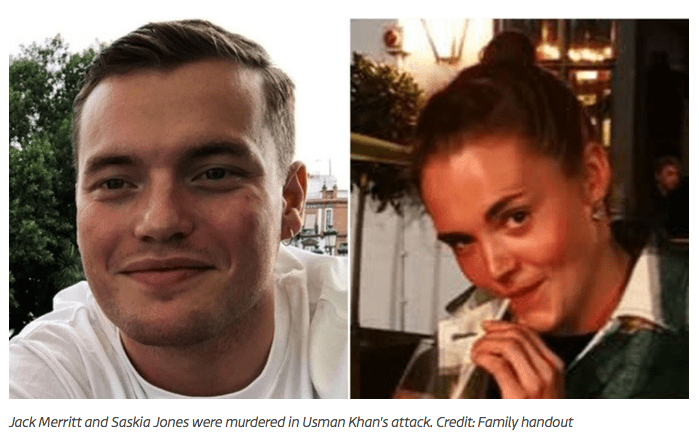
Sometimes something is reported in the news that inspires an immediate counter-response to the usual political finger-pointing that ensues. When faced with horrific and tragic incidents like the London Bridge attack on Friday 29thNovember, it is all too easy for our knees to jerk us into the simplistic mindsets of wanting to punish, blame and demand, or promise, policies that are ā€˜tougher on crime.’ After all, two bright young people – 23-year old Saskia Jones and 25-year old Jack Merritt – were killed. What’s more, it was while attending a conference celebrating the five-year anniversary of Learning Together, a prison education initiative from the Cambridge Institute of Criminology, through which students and prisoners learn side-by-side. 

Jack and Saskia were clearly two shining lights whose hearts and talents were directed towards helping those residing in the darkest corners of our society. In words taken from tributes to them:Ā 

ā€œSaskia’s warm disposition and extraordinary intellectual creativity was combined with a strong belief that people who have committed criminal offences should have opportunities for rehabilitation… (More here)

ā€œJack lived his principles; he believed in redemption and rehabilitation, not revenge, and he always took the side of the underdog. He was deeply, creatively and courageously engaged with the world, advocating for a politics of love.” (More here)

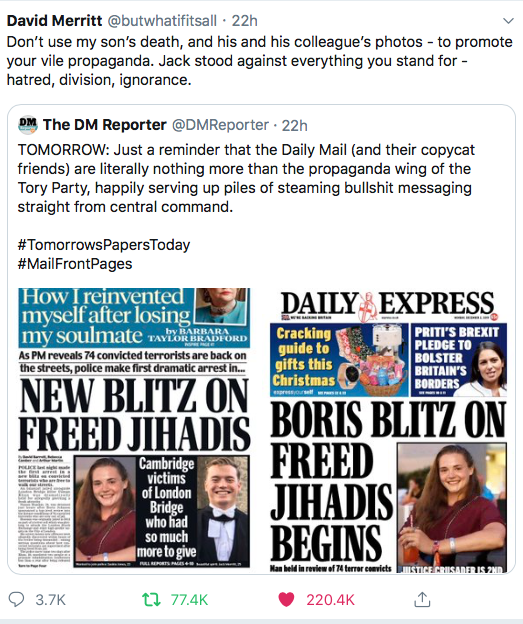
The incident is tragic. Our anger is justified. Our desire for action, natural. Our fear of the same thing happening again, heightened… But when political leaders and media outlets effortlessly slip into the amplification of these emotions, there follows a rash of promises and policies often based on inaccuracies or blatant lies, which all too often lead to harmful and unforeseen failures further down the line. I am relieved that over the weekend this process was quickly called out and widely condemned as ā€œbeyond disgusting.ā€ And David Merritt, Jack’s father, tweeted: ā€œDon’t use my son’s death, and his colleague’s photos to promote your vile propaganda. Jack stood against everything you stand for – hatred, division, ignorance.ā€

According to his father, ā€œJack Merritt died doing what he loved, surrounded by people he loved and who loved himā€¦ā€ That knowledge will, I hope, bring him and his family comfort during the dark times ahead. When I worked in prisons and was often, if not daily, in situations where I could have been harmed, I sometimes wondered whether I would stop my work with prisoners if something terrible happened. I was lucky, I wasn’t attacked. But even if I had been, I don’t believe I would have necessarily stopped, for I too loved and believed in what I was doing, in spite of the risk. Just as a fire fighter can love his/her work while knowing they may well get burned, or even die.

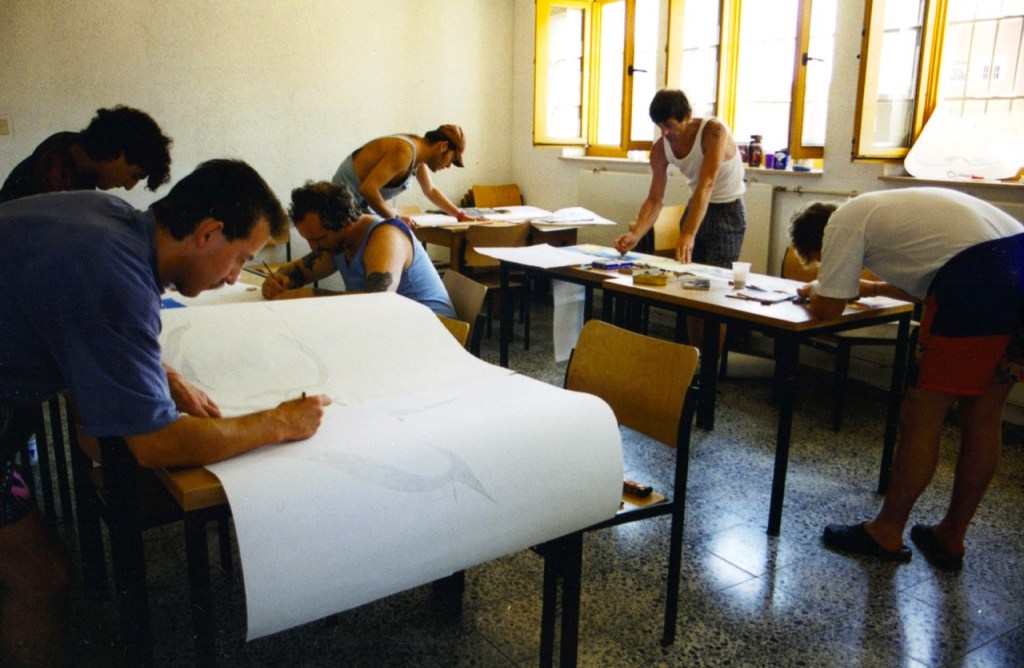
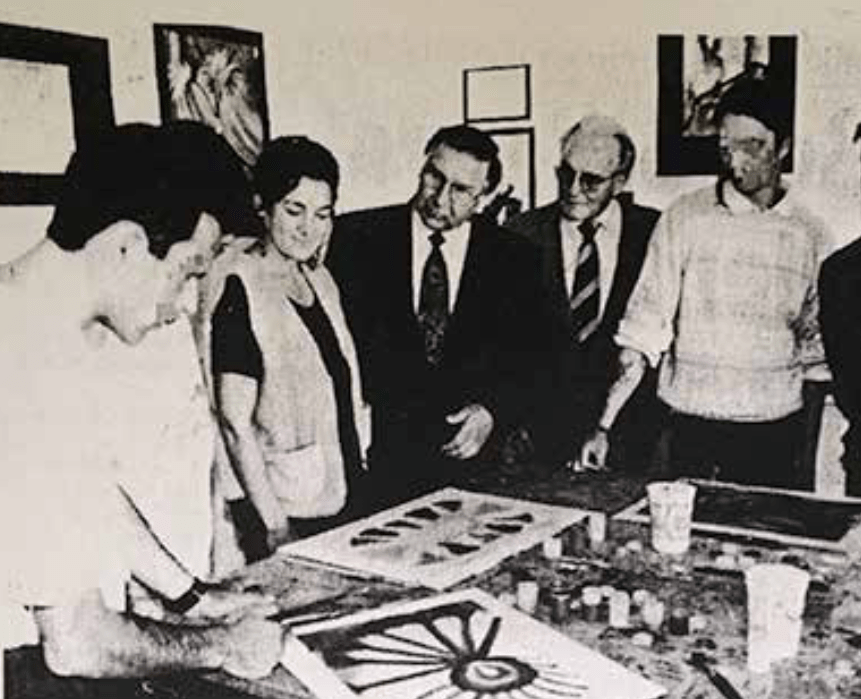
Back in the nineties, I came close to falling victim to the dangerous ā€œSex Beast of Cologne,ā€ as the tabloids labeled the quiet, unassuming man in my art class who, unbeknownst to me, was plotting to take me hostage. His plans failed, but if they hadn’t, I know I would not have wanted macho bravado and knee-jerk reactions to dominate the post-incident discourse. Nor would I necessarily conclude that my way of working had failed or was wrong. It would have devastated me if the prison had closed down or placed guards in my art classes thereby destroying the chances for rehabilitation I was so dedicated to establishing. Of course there are lessons to be learned, but may the right lessons be learned. 

Me teaching ‘The Sex Beast’ in 1996

Over the next days and weeks, as more facts emerge, we’ll hear more simplified explanations of the causes, more tough talk, more blame and more reactive and punitive measures being promised… I beg you not to fall for unashamed political optimisations of this tragic situation such as our prime minister’s ā€œGive me a majority and I’ll keep you safe from terror.ā€ Boris Johnson’s policies on prisons and crime do not make sense. They have long been proven not to work. They will not make you safer. You can see that for yourself here. And here. And here.

I believe the best way to make sense of such seemingly senseless tragedies is to hear and honour what the people who died stood for. So I urge you to heed Jack’s wishes as passed on by his father:

“What Jack would want from this is for all of us to walk through the door he has booted down, in his black Doc Martens.

That door opens up a world where we do not lock up and throw away the key. Where we do not give indeterminate sentences, or convict people on joint enterprise. Where we do not slash prison budgets, and where we focus on rehabilitation not revenge. Where we do not consistently undermine our public services, the lifeline of our nation. Jack believed in the inherent goodness of humanity, and felt a deep social responsibility to protect that. Through us all, Jack marches on.

Borrow his intelligence, share his drive, feel his passion, burn with his anger, and extinguish hatred with his kindness. Never give up his fight.

You can read Dave Merrit’s full article here

And a few of the many other related articles… if you can face the political blame and shame games:

London Bridge attack: Boris Johnson ignores family’s plea not to exploit victims’ deaths

London Bridge victim’s father said his death shouldn’t be used to justify ‘draconian sentences,’ as Conservatives call for tougher punishment

Johnson’s response to London Bridge attack ignores complex reality

Blame game: Johnson and Corbyn clash as political row over London Bridge terrorism continues

The past residing in the present and shaping the future

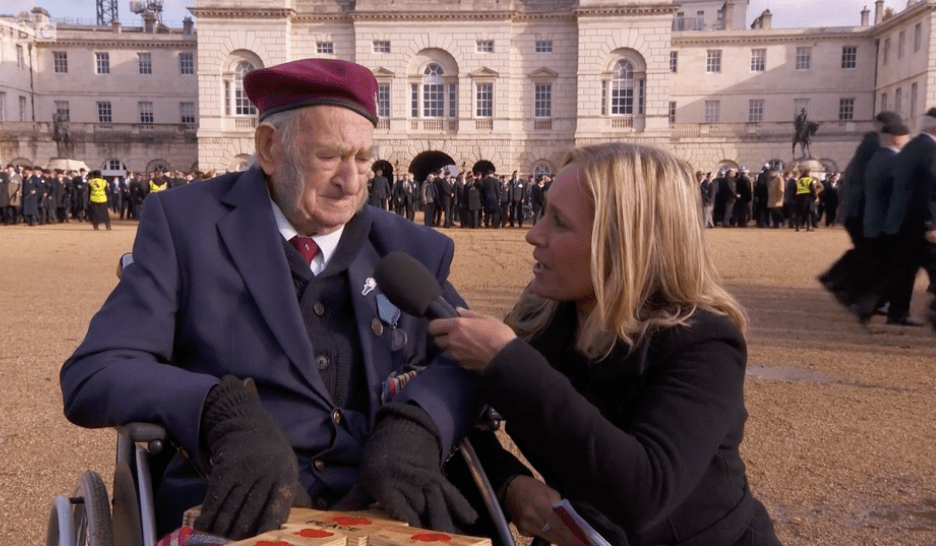
ā€œIt’s the memories,ā€ 98-year old D-Day veteran, John Sleep, told the BBC interviewer, Sophie Raworth on Remembrance Sunday. Dressed in a blue suit decorated with medals and donning a burgundy beret and tie, his wheelchair was parked on Horse Guards Parade in front of the traditional ā€˜march past’ the Cenotaph. Asked how vividly he could remember it all, he said, ā€œIt was yesterday.ā€ Silence followed as his face crumpled in its fight against tears. As for so many veterans, the title of ā€œheroā€ bestowed on servicemen today feels misplaced. What he and his fellow soldiers did was not heroic, glorious or even brave necessarily. Those are qualities that belong to their friends who didn’t return. They are the real ā€˜heroes’ and their memories still roam and haunt the minds of the living.Ā 

Memories; PTSD; horror, honour and pride get shaken into potent cocktails of commemoration at this time of year.Ā Last weekend was almost overwhelming in the scale of significant events to be remembered. Don’t get me wrong; I love remembering the past because each time I ā€˜re-member’ an event, I learn a little more about its relevance to the present and the future. Time became a linear construct through the human need for rationality and order. Yet in reality, or in my experience at least, time refuses to simply line up chronologically. The past and future co-habit each moment of what we call the present.

November 1989, the fall of the Berlin Wall

This year’s calendar of remembrance started on 9thĀ November, when Europe and beyond celebrated the 30thAnniversary of the fall of the Berlin Wall and remembered all those who died on the physical and symbolic front line of the Cold War. A bit like with the 9/11 collapse of the Twin Towers, it seems that everybody can place exactly where they were when it happened. I can recall my Sussex landlady’s unbridled joy as she danced in front of her television clapping her hands as the ā€˜Ossis’ flooded through the wall into the welcoming, cork-popping arms of West Germans. I remember clapping and grinning with her, careful to disguise my shameful ignorance of just how momentous a moment this was. The Cold War may have been the political backdrop to life back then, but I was still in the dark over the potency of German history… half my family’s history.

Next up was the annualĀ Festival of RemembranceĀ at the Albert Hall, an event that every year both moves me to tears and irritates me in equal measure. I have written about it before but in spite of some deeply kitsch musical contributions – James Blunt, the former army officer with a remarkably high voice and Leona Lewis, former X-Factor winner, who massacred ā€˜Like a Bridge over Troubled Water’ – I found this year’s festivities generally more sensitive, less triumphal (thank goodness) and more inclusive. TheyĀ focused on the 75thĀ anniversaries ofĀ lesser known, yet no less brutal,Ā battles of 1944, such as Monte Cassino and Rome, and the collaboration and friendship of the British, Commonwealth and Allied armies who fought them. They also marked the 100thĀ anniversary of GCHQ and the vital, albeit largely uncelebrated role of the secret services such as the code-breaking work at Bletchley Park completed by a workforceĀ 76.35% of which were women… 

Ok, women’s forgotten / ignored / unrecognised place in war and history is a blog for another day. It’s the role of pride in all these activities of remembrance that I want to touch on here. Specifically the pride felt for and by family members. Pride can comfort in the face of death. Pride can give meaning to apparent pointlessness. Pride can assure the memory of a person is maintained for generations to come. Pride can overcome some of the horror of war. It can swell the heart and make thoughts soar. It can be a balm on the trauma of loss, which, if unprocessed, can be passed from generation to generation.Ā 

So how is it for the relatives of German soldiers, I wonder? Millions died and yet pride is a tool that cannot be employed to soften the sharp corners of grief or maintain the memory. It’s difficult, I know. But for the sake of generations to come, in order to avoid the transgenerational transmission of unresolved emotions and to understand and most importantly quash the re-emergence of Germany’s Far Right, we need to address the problematic nature of remembering the men and women who were limbs in Hitler’s military body of destruction, but also brothers, fathers, husbands, sons, friends… and grandfathers of ordinary German families.Ā 

John Sleep, our 98-year old veteran, is already putting my challenge into practice. Resting on the chequered blanket draped over his lap and gently held in place by misshapen hands in muddy, black woolen gloves, lies a simply-crafted wooden cross decorated with painted poppies and the word ‘Peace’. ā€œIt’s for the Monument of Tolerance,ā€ he explained, ā€œan organisation set up on the German border with all nationalities in it. The idea is to prevent wars,ā€ he continues without the hesitation of his earlier answers. John also ā€˜does’ the German services. ā€œI’ve got no problem with the Germans,ā€ he declares. (Well that’s nice to hear.) ā€œI think they did me a favour.” (Really??) ā€œThey got me a very good pension.ā€ (Ah… ok – slightly disappointed face) But fair enough. He’d had ā€œan argumentā€ with a German tank and it had won.Ā Ā 

I like the ideas behind this DutchĀ Monument of Tolerance.Ā Unveiled on 8 March 2001, it serves as a reminder of the more than 700 soldiers of 11 nationalities who lost their lives in the Leudal area between 1940 and 1945.Ā I am pleased that at least here German families have an opportunity to bestow a tiny fraction of the recognition other nations can pour over their military family members.Ā So, next Sunday 17thĀ November, on the occasion of Germany’s humble Volkstrauertag – ā€˜people’s day of mourning’ – I would like toĀ invite you to join me for a tiny minute in thought. A tiny moment in which we try and extend the lines of our famous and treasured poem of Remembrance to include some of Germany’s Wehrmacht soldiers and their families.Ā 

ā€œAt the going down of the sun and in the morning,Ā we will remember them.ā€

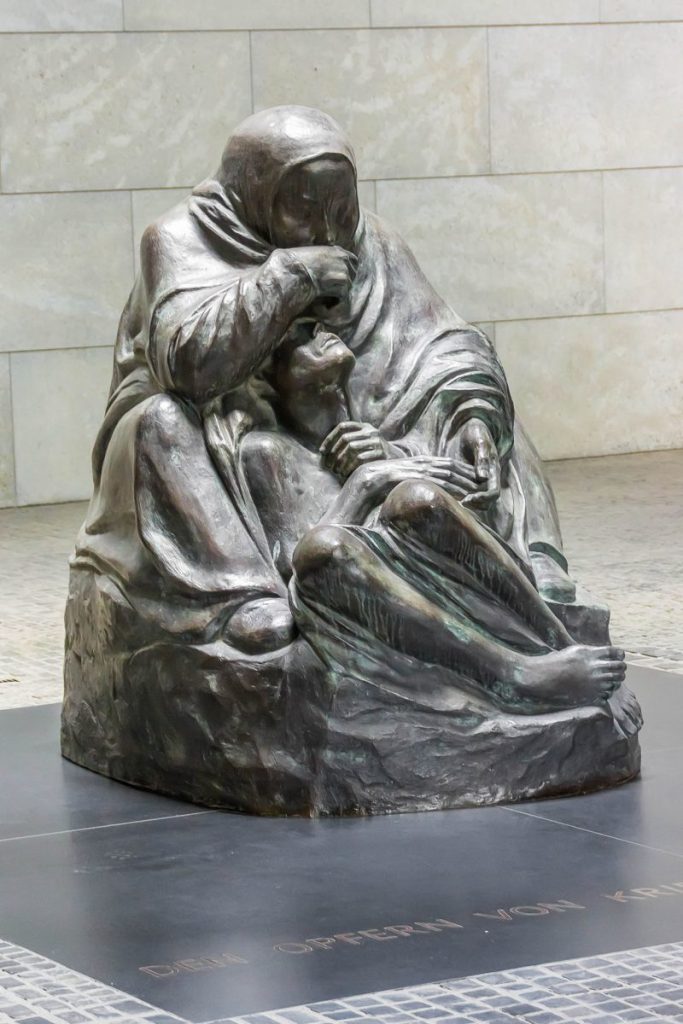
KƤthe Kolwitz: Mother with her dead son, Neue Wache, Berlin

A talk, an exhibition and a TV series…

October is a busy month. Lots to see and do or get done. Can I just add three things to your list? The first two are London-based and optional; the third should really be compulsory for everybody.

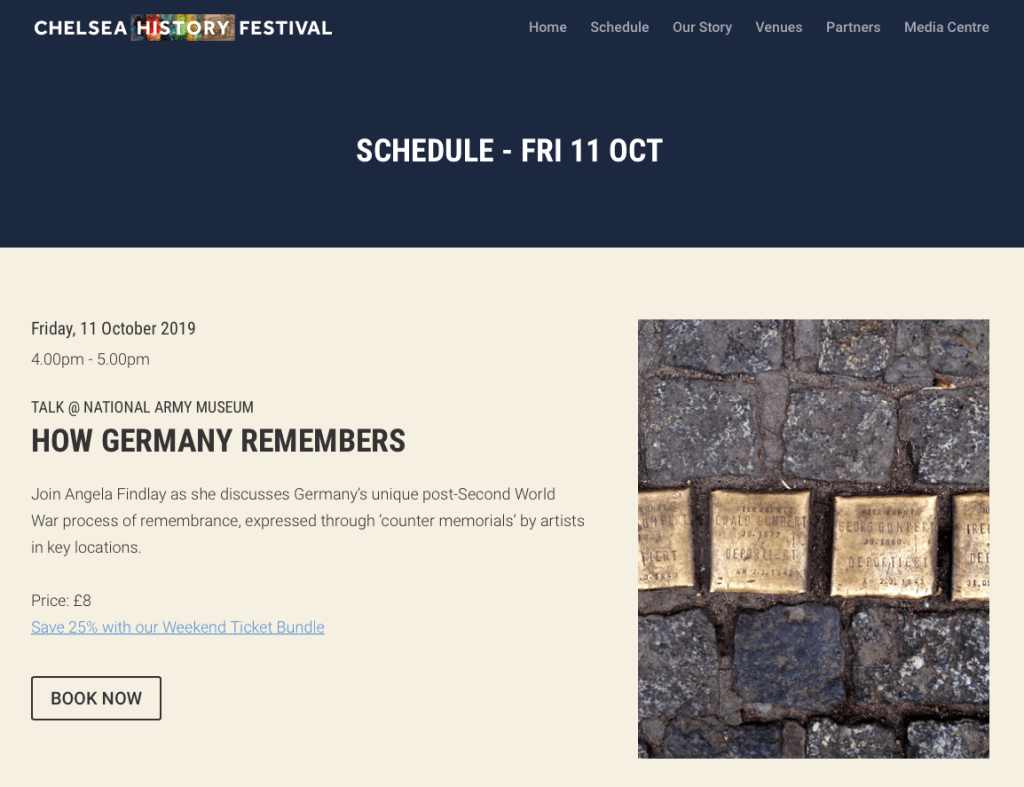
So firstly, for anyone in London on Friday 11th October at 4pm, I am very excited to be speaking at the National Army Museum’s inaugural Chelsea History Festival. My talk How Germany Remembers is just one in a whole line-up of talks by impressive historians, writers and speakers – including Max Hastings.

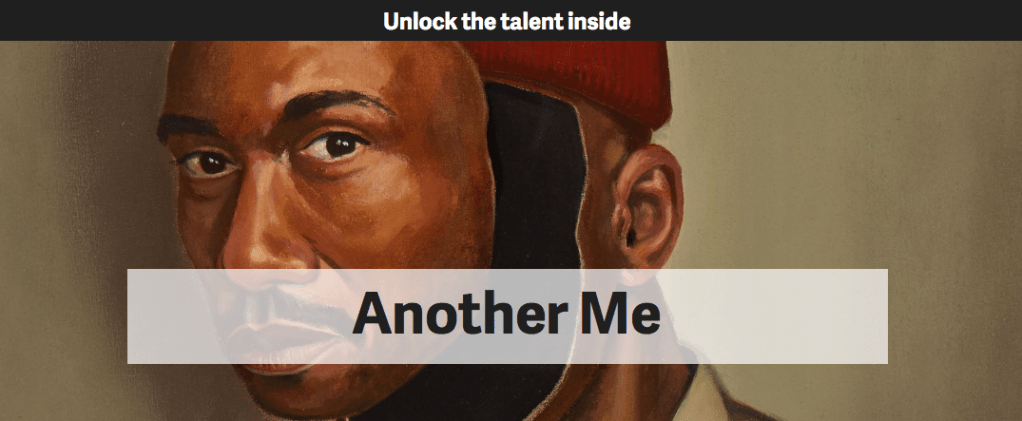
Secondly, and also this month until 3rd November, The Koestler Arts annual exhibition – Another Me – will be showing at the Southbank. I personally haven’t been yet but I know it will once again provide visitors with a glimpse of the huge talent and potential locked up in our prisons. It is a showcase for what the arts can do for people’s well-being, self-esteem and rehabilitation.

I was in fact invited to expand on these benefits for the autumn edition of The Arts Society magazine. Please feel free to read my article ‘Art behind Bars’ to learn more.

But thirdly, and in stark contrast to the positivity of the arts, is the shocking Channel 4 series Crime and Punishment. I know, I know, I have been here many times before. You are probably sick of me going on about the plight of prisoners and state of our prison system. But you won’t be half as sick as all the people involved, who know how acute the crisis is.

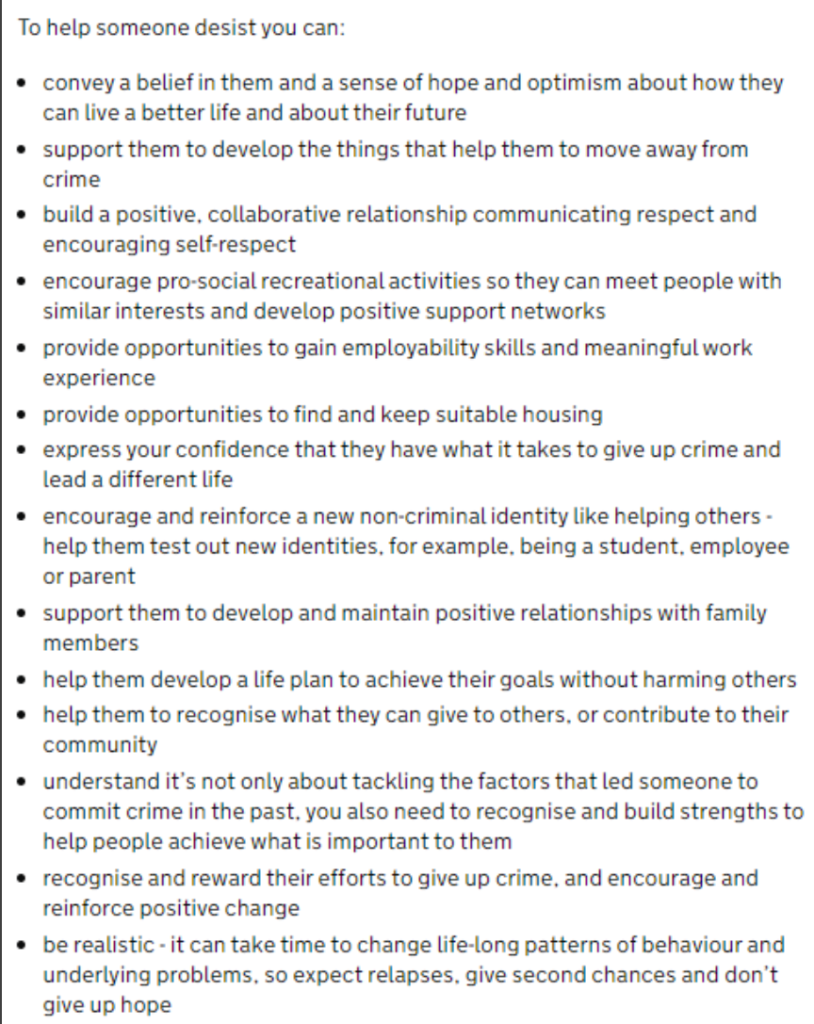
Please watch it. Even just Episode 2. And then compare what you see with the Ministry of Justice’s evidence-based summary of what works…

Even I was aghast at what I saw in the first three episodes, and I have been in many of our jails. Everything has got so much worse since the 43% cuts to the budget from 2011 onwards: the levels of frustration from being locked 23 hours a day in conditions that even animal rights campaigners would protest against; the levels of desperation that lead people to shred their bodies or hang themselves to get a radio or better clothes to wear for a visit from their wife and kid; the levels of terror in young officers who patrol the wings after just 10 weeks training and 2 weeks shadowing; and the levels of weary resignation of those who enrolled to help and make a difference but are repeatedly forced to cower behind plastic shields and just ‘contain’.

Photograph 3
Guernsey Prison, Margaret Macdonald Platinum Award for Photography 2019, Koestler Arts

I believe everybody you see in this series is doing their best. But increasingly without hope of change. What you witness is the underbelly of our society. A society that punishes disadvantage, that punishes mental health, that punishes lack of education. In almost every shot, hopelessness seeps under the cell doors to mix with the blood of self-harm.

We all probably feel there are far better causes to engage with – cancer patients, the rain forests, refugees and hedgehogs; that offenders have only themselves to blame and that prison has nothing really to do with us. But if you are reading this, it probably does. Because so many of us have had advantage, education, guidance and love. And it is precisely us who can help bring about change. How? you might ask. Well a good start would be to recognise that Boris Johnson’s policies to extend sentences and build more and bigger prisons are wholly illogical and will only make the situation worse. You could then take a moment to retreat into your imagination, put on the battered, ill-fitting shoes of some of these offenders and try to walk a few steps. See how far you are able to get. The barriers to a crime-free productive life on release are enormous and once more of us realise just how bad things are, we can all join in with the other voices that are demanding: enough is enough.

We love commemorating our victories and losses… but not our declarations of war it seems?

Could it be that even the British have become weary of commemorating the World Wars? Or was the lack of fanfare around the 80th anniversary of the outbreak of the Second World War earlier this month down to having a selective national memory? Do we only like to remember the bits where we emerge as clear heroes, victors or victims?

To my surprise, nothing, or very little, happened in this country on 3rd September 2019. Yet, at 11.15am on that day in 1939, Prime Minister Neville Chamberlain, in a somber broadcast to the nation made from the Cabinet room in 10 Downing Street, announced with regret that his efforts to ensure peace had failed and that ā€œthis country is at war with Germany.ā€ The ensuing conflict lasted six years and cost around 50 million lives.

For Poland this anniversary was obviously a huge deal. Germany’s invasion was the catalyst for Britain’s and France’s declaration of war and few places suffered the same level of death and destruction between 1939 and 1945. It lost about a fifth – that’s six million – of its population including the vast majority of its three million Jewish citizens. Wielun, the first city to be bombarded by the Luftwaffe, was the chosen location for forty world leaders and representatives of other countries to gather together for a dawn ceremony on Sunday 1st September at 4am (2am GMT). Polish President Andrzej Duda, German Chancellor Angela Merkel, French Prime Minister Edouard Philippe, US Vice President Mike Pence were all present. (President Trump cancelled citing the approach of Hurricane Dorian as his reason for basically spending the day on the golf course.) President Putin wasn’t invited. But, why wasn’t our Prime Minister there? I think we sent our Foreign Secretary, Dominic Raab, to a subsequent ceremony in Warsaw but…? 

Surely a bit more than just a nod to our role in the unfolding of the most momentous episode in modern history would have been appropriate? Maybe a moment where we press pause on all justifications and humbly reflect on the regrettable escalation of the horrors that our declaration of war unleashed? Or a clearly stated renewed commitment to peace in Europe? Or an informed and respectful acknowledgment of the far greater losses suffered by so many other nations? I recently asked friends how many people they thought died in WW2. “Seven million Soviets? Two million Germans? Two million British?ā€ they guessed. ā€œActually we have no idea,ā€ they admitted. And they didn’t. Most British people don’t. It was between 20 and 27 million Soviets, 7 million Germans and 450,000 British… that’s including Crown Colonies.

To be fair, Boris Johnson, in a videoedĀ speech that circulated on Twitter,Ā praised the “dogged and unconquerable resistance” Poland displayed during the Second World War and how itĀ “never succumbed to tyranny…”Ā But he also couldn’t help slipping in a quick pat on the UK’s back forĀ standing with Poland “in times of triumph and tragedy.” Hmmmh, you just have to listen to Neil Macgregor’s excellent series on Radio 4Ā ā€œAs others see usā€ to realise that this is not quite how Poland sees things. Part of their otherwise generally positive national memory of us is of ‘betrayal’, not once but three times! (This relates to the Katyn massacre, ignoring the plight of Polish Jews and Britain’s role at the Yalta Conference in 1945 when it was decided that Poland would be given to the Soviets.

British Defence Secretary, Ben Wallace, just rolled out the same old tired stuff about Britain going to war to “defend our values and our allies from the Nazis”. (Defending ones values and friends is how all sides justify conflict, however small or large.) He added, “Even though nearly every family in the UK still possessed the memories and hurt of the First World War, they were prepared again to make the ultimate sacrifice. The incredible courage of that generation who fought for our freedom must never be forgotten.” Aaaagh, they just can’t help themselves, these men! It is always all aboutĀ us.Ā Our heroism,Ā our sacrifice,Ā our justified defence. Wouldn’t this have been the perfect time to engage with Polish history? The imbalance between what we know about others and what others know about us is embarrassing. Our narrative that ā€œWe went to war for Polandā€ is, for example, in Polish minds ā€œWe declared war for Polandā€ because the much hoped for military support didn’t actually follow. We really need to start embracing a wider-angled view of history! (This podcast is a great start)

For me it was once again the German contribution that lit a way forward for us all. Speaking with typical unreserved apologetic candour, President Frank-Walter Steinmeier described how “Eighty years ago, at this very moment, all hell rained down on Wielun, fueled by German racist barbarity and the desire to annihilate… My country unleashed a horrific war that would cost more than 50 million people – among them millions of Polish citizens – their lives. This war was a German crime… I, along with [Merkel], want to tell all Poles today that we will not forget. We will not forget the wounds that Germans inflicted on Poland. We will not forget the suffering of Polish families and nor will we forget the courage of their resistance.” He then went on, with a bowed head and speaking in both German and Polish, to ask for Polish forgiveness. ā€œI bow my head before the victims of the attack on Wielun. I bow my head before the Polish victims of Germany’s tyranny. And I ask for your forgiveness.ā€  

Wow! I know, this is not new. Germany has been publicly apologising for years, starting back in 1970 with Willy Brandt’s silent ‘Kniefall‘. Nevertheless, can we just pause and reflect a moment. The president of a powerful country holding up his hands in surrender and basically saying: “What we did was shit. We were shits. There are no words to describe just how shit we were and nothing can ever change that.” Just imagine how difficult that is to do. And how different the world would be if more people did that. The power of apology. The power of asking for forgiveness. (Whether it is possible to ask for forgiveness on behalf of another / others is debatable as Bernard Schlink does so well in his book ‘Guilt about the past’. But still…)

I’m glad that in a return speech, President Duda thanked Steinmeier for his presence at the painful anniversary before continuing to rightly denounce Nazi Germany’s attack on Poland as “an act of barbarity” and list other massacres and atrocities on Polish soil. He also drew attention to the genocide and mass murder continuing around the world today, and underlined the importance of international alliances like NATO and the European Union. (The question of further compensation was also raised later on… but you can read a fuller summary of the speeches here.) The pain still lingering between these countries that were so utterly destroyed on so many levels is visceral. As is the will for lasting reconciliation.

As much as I am frustrated and disappointed by our on-going and often unimaginative, inward-looking and lop-sided to the point of ignorant rhetoric on the World Wars, I am also optimistic. Younger generations are asking awkward questions that force a re-evaluation of the dusty, airbrushed pictures of our ā€˜glorious’ Empire. And the answers they are finding are uncomfortable. Maybe when we stop hiding our misdeeds behind the undisputedly ghastly deeds of the Nazis and the Holocaust and finally acknowledge our own national shadow, when we admit that the whole British Empire was based on the genocide of indigenous people and a forcing of our values on others, maybe then we can be genuinely better in the present and the future. 

Further reading:

https://www.dw.com/en/german-president-asks-for-polish-forgiveness-on-wwii-anniversary/a-50247207

https://www.telegraph.co.uk/news/2019/09/01/german-president-asks-forgiveness-80th-anniversary-start-second/?WT.mc_id=tmg_share_em

https://www.theguardian.com/world/2019/aug/30/truth-is-a-casualty-80-years-after-start-of-second-world-war

Boris Johnson’s plans for ‘cracking down on crime’ aren’t ‘bold’, just old. And they don’t work.

More prison places, more punishment, longer sentences and tougher stop-and-search powers for police… I am far from alone in being dismayed at Boris Johnson’s ideas on prison reform. 

However, his prison policies are no more and no less than I would expect from him: vain, backward-looking, wilfully ignorant of evidence and expertise and whiffing of his trademark self-serving disregard for the people affected. Anybody who works in the system or has occupied themselves with the deeper issues behind the revolving door of our flailing, and failing, system can see the shallow grasp he has of what is required.Ā As the respected Prison Reform Trust says: ā€œTough rhetoric is no substitute for understanding the evidence.ā€Ā 

In a blatant display of easy vote-winning, tough-on-crime policies, Johnson is returning to Michael Howard’s aggressive and long disproven claim: ā€˜Prison Works!’ So let’s just unpick a little of what he and his team are suggesting as part of their ā€œboldā€ plan (ā€˜bold’? ā€˜Old’ would be a more accurate description) ā€œto create a justice system, which cuts crime and protects law-abiding people.”Ā 

1. ā€œ10,000 new prison placesā€ – at a cost of Ā£2.5 billion – ā€œso we can keep criminals behind bars.ā€ Nothing new here, not least the well-known fact that prison is not a solution to cutting crime or reoffending. The then justice secretary, Liz Truss, made the same pledge in 2016 and the places were first due by 2020. The government then quietly reduced its target to 3,360 places by 2023. So far only one prison has been completed.

Responses to this idea: 

Peter Dawson, Director of The Prison Reform Trust: ā€œDoing away with overcrowded and outdated prisons makes a lot of sense. But governments have been promising that for decades and they always underestimate what’s involved. According to the prison service’s own figures it would take 9,000 new spaces just to eliminate overcrowding – not a single dilapidated prison could be taken out of use before that figure was reached.ā€ 

Frances Crook, CEO of the Howard League for Penal Reform: The construction of new prisons is ā€œan exercise in ego and reputationā€ and a ā€œgross squandering of taxpayers’ money.ā€ 

Robert Buckland QC, the fifth Conservative justice secretary in four years: ā€œMore and better prison places means less reoffending and a lower burden on the taxpayer in the futureā€¦ā€ Except it DOESN’T Mr Buckland! And there is a raft of evidence, teams of experts and front-line workers and decades of failure to reduce re-offending through a punitive system to prove it. 

2. To ā€œproperly punishā€ offenders by sending more to jail and to make sure criminals are ā€œserving the time they are sentenced toā€ by putting an end to the automatic release of prisoners half way through their sentence. Hmmm… just a few weeks ago research indicated that short prison sentences were driving up reoffending and former Justice Secretary, David Gauke, had called for ā€œineffectiveā€ prison sentences of under six months to be abolished. You can do the maths yourselves. Currently reoffending costs the UK Ā£18bn per annum. Keeping an adult in prison costs around Ā£37,000 a year, with at least double that amount for a young offender. Reoffending rates for sentences of less than 12 months stand at 65%. There are 83,000 people in the system… Put those figures on your campaign bus Mr Johnson. 

3. Apparently it’s ā€œtime to make criminals feel afraid, not the public.ā€ Home Secretary Priti Patel goes further and wants them to feel ā€œterror.ā€Ā ā€œPopulist electioneeringā€ says Simon Jenkins in The Guardian, and it is. Even the most basic psychology or a bit of listening to offenders’ stories would reveal the terror many of them have already felt in their homes, schools or communities making them feel compelled to join gangs or arm themselves with knives. Can the government not see the relationship between the rise in knife crime and the nine years of brutal cuts – that Johnson supported – to community support officers, probation, police, not to mention education, youth services, housing, mental health and other public services?Ā Johnson wants ā€œā€¦to keep criminals off our streets and turn them into law-abiding citizens when they have paid their debt to society.ā€ But has society honouredĀ itsĀ duty to educate those people, to support their needs, to protect them?Ā 54% of prisoners are dyslexic, 50% can’t write, 29% were victims of abuse as children. They will be released with just Ā£46, a criminal record, often a newly acquired drug habit and frequently nowhere to live… so where is the ‘bold’ plan for the chances they will be receiving to become ‘law-abiding citizens’?

That’s still not the end of it.

4. “20,000 more police officers” – which will merely reinstate those lost by the past years of Tory cuts. “Extended stop and search powers” – which often result in the unfair targeting of ethnic minorities and were a key factor in the anti-police anger that triggered the riots while Johnson was mayor of London. Even reports by both the Home Office and the Metropolitan Police found no long-term significant reductions in crime. And “Ā£100 million worth of airport style X-ray scanners, metal detectors and mobile phone blockers to crackdown on drugs and weapons coming into prisons – even though many of them come in with underpaid officers wanting to make an extra buck.
Johnson’s next point makes me laugh… and weep!

5. ā€œIt is vital we have a world-leading prison estateā€¦ā€ How about aiming for a fair, functioning, humane prison estate as a start? Every single HM inspector of prisons says the same: our prisons are shameful shambles. We lock up more people than anywhere else in Western Europe; we already have excessively long sentences; prisons are filled to 95% of their operational capacity; overcrowding, cuts in front-line prison staff (1/3 of newly-appointed recruits leave within a year of being in post) and squalid conditions have led to the highest levels of violence and self-harm. Drugs abound while meaningful activities, education and work remain a luxury… you can read about countless other contradictions of purpose and violations of human dignity almost weekly.

Frances Crook again: Mr Johnson “doesn’t seem to understand” how the current justice system works. “What is coming out of Number 10 is politics but not real life. It’s not going to deal with real-life crimes and victims. It’s a lot of hot air.

I am in good company when I say a government’s approach to prison policy is a litmus test for its maturity, wisdom, far-sightedness and humanity. 

Dostoevski:ā€œThe degree of civilisation in a society can be judged by entering its prisons.ā€ 

Mandela: ā€œNo one truly knows a nation until one has been inside its jails.ā€ 

Even Johnson’s hero, Churchill:ā€œThe mood and temper of the public in regard to the treatment of crime and criminals is one of the most unfailing tests of the civilisation of any countryā€¦ā€ 

In his macho rhetoric on the treatment of crime and criminals,Ā painfully devoid of detail on educational or rehabilitative measures,Ā Boris Johnson may mean well. ‘Tough on crime’ always appeals to the general public as it’s apparently for our safety. But with these measures, he is merely exposing naked ignorance, vanity and apparent indifference to the issues faced by real people.Ā Emptying prisons of short sentence prisoners; providing extensive education and work opportunities; rolling out victim awareness and restorative justice courses; offering incentives for good behaviour; instating many more, well-trained prison officers on the wings with time, not only to open and close doors but to listen and guide… These are some of the things that will move our prison system in the direction of being fit for purpose. Only then can we start dreaming of ‘being safe’ and having the “world-leading prison estate” Johnson wants.

Further reading:

Mark Capleton: I’ve been in and out of prison for 35 years – trust me, Boris Johnson’s criminal justice policies are useless. Behind every sentence, there is a person. Without the rehabilitation and education opportunities given to me, I would be back inside. But the prime minister’s announcements don’t offer those chances at all. https://www.independent.co.uk/voices/boris-johnson-crime-policy-prisons-cps-stop-and-search-a9056966.html

Putting more people in prison is not the way to cut crime. If Boris Johnson wants to be tough on crime he must reduce re-offending rates, says Reform researcher Aidan Shilson-Thomas.Ā https://www.publicfinance.co.uk/opinion/2019/08/putting-more-people-prison-not-way-cut-crime
Boris Johnson thinks building more prisons can curtail violence – he couldn’t be any more wrong. Johnson is appropriating the pain of victims for political legitimacy while simultaneously abandoning those who need help rather than jail time. Ā https://www.independent.co.uk/voices/boris-johnson-prisons-stop-and-search-criminals-a9056286.html
Dresden… a spectacular phoenix rising from the ashes

My recent trip to Dresden and Leipzig reminded me what wonderful places German cities can be. Particularly in summer when the music of high quality buskers wafts through squares lined with outdoor cafĆ©s offering chilled Grauburgunder and Pfefferling (chantarelle) dishes with white asparagus; when young people ride on rickety city bikes across the cobbles, hands dangling by their sides. It’s only the ever-present cranes punctuating the skyline of sloping roofs, or the gaping, pulled teeth-like gaps between buildings that remind you that all you are looking at was, in the not so distant past, rubble; grey, gaunt, improbably upright faƧades standing sentry among collapsed homes and destroyed families. 
I have to admit, before I went to Dresden I had questions about travelling to a reconstructed, rather than original, Baroque city. I questioned whether destroyed buildings should be re-built and replicated or whether their ā€˜death’ should be seen as an opportunity for something new. Or whether a 21stcentury appearance of 18th century architecture still constitutes an historic monument. My first sighting of the city’s famous profile of domes and spires lining the river and my subsequent face-to-face meeting with the ā€˜Florence on the Elbe’ quickly rendered those questions superfluous. Dresden is simply beautiful.

Of particular interest to me as a newly elected trustee to the London-based Dresden Trust, was the city’s most historic and well-loved landmark, the Frauenkirche. Its bombed remains had been left untouched by the communist regime of East Germany for decades, both as a symbol against war and a memorial for those 25,000 killed in the notorious 2-day aerial bombing attack by Britain’s RAF and the USA. 

After the 1989 fall of the Berlin Wall and 1990 reunification of Germany, the future of the Frauenkirche became a focus of the widespread national debates and philosophical soul-searching still continuing to this day. 1993 then launched seventeen months of clearing, documenting and organising the 23,000 cubic meter mound of rubble with characteristic German thoroughness. 8,390 interior and exterior faƧade stones and ceilings were saved as well as over 90,000 back up blocks and other features. By 2005 – to cut a much longer story short – the church re-opened. Crowned by a shining golden orb – donated by the Dresden Trust as a heartfelt gesture of reconciliation from the people of Britain and created by a team of silversmiths headed by the son of a Bomber Command pilot – the church now proudly dominates the bustling Neumarkt once again, almost a literal phoenix raised from the ashes.Ā 

The golden orb donated by The Dresden Trust

In a former industrial area a few miles away is the antithesis of the Frauenkirche’s resurrection. Housed in an empty gas container, the huge 360˚ digitally processed panorama of the bombed city by the Berlin-based artist, Yadegar Asisi, is almost as mind-blowing. Visitors enter the cylindrical space at ground level but can climb a centrally erected scaffold tower to view the city from various levels. Against a backdrop of music, lights dim or flicker to emulate night or bombs as people stand in silence staring at the abyss of destruction.

Dresden, 1945. A section of the 360˚ Panometer by Yadegar Asisi

Looking at this seems to viscerally insult ones humanity, possibly all the more so because, though we have all clocked the pointlessness of war many times over, ā€œThis time, we were the pigsā€. In that devastating space, the guest book entry of an American visitor resounds with rare indisputability. This was ā€˜us’. Whatever our justifications for bombing Dresden – and there are always apparent justifications for aggression, just talk to violent offenders, listen to politicians – we designed bombs to have the maximum impact, not just on buildings or military targets but on civilians. It was an act that rightly continues to needle our ā€˜heroic victors’ narratives and shake the moral high ground we want to, and often do, occupy. For that reason alone, I am grateful for Dresden. 

Left: one of two original walls left standing

Nearly seventy-five years on, only the dark sections of the original Frauenkirche and the blackened stones that polka-dot the soft sandstone exterior like plasters bear witness to the horrors of those two fateful nights in February 1945. As normal life buzzes at its feet, the church, often filled with music, stands defiantly, a profoundly moving symbol of peace and reconciliation and a testament to the sheer bravery, optimism and determination of Dresdeners.